Your phone contains metals from deep inside Earth. The water in your bottle may have fallen as rain months ago or seeped underground for years. The oxygen you breathe is connected to plants, algae, and the atmosphere. Human life depends on Earth in ways that are easy to miss because they are so familiar. But these resources are not spread evenly across the planet, and many are limited.
People depend on Earth's systems every day for food, water, air, building materials, fuels, and raw materials for technology. Some of these resources can be renewed fairly quickly, while others take millions of years to form. That means Earth provides a great deal, but it does not provide every region with the same resources, and it does not replace everything at the rate humans use it.
Earth can be understood as four connected systems, as [Figure 1] shows: the geosphere, or solid land and rocks; the hydrosphere, including oceans, rivers, lakes, and groundwater; the atmosphere, the layer of gases around Earth; and the biosphere, all living things. These systems constantly interact. Rain from the atmosphere falls on land, flows into rivers and oceans, and supports life in the biosphere.
The food you eat, the water you drink, the air you breathe, and the materials in buildings and devices all come from these linked systems. A forest needs soil, water, sunlight, and air. A fishery depends on ocean water, nutrients, and living populations. A farm depends on weather, fertile soil, and fresh water. Earth's systems are not separate boxes; they work together.
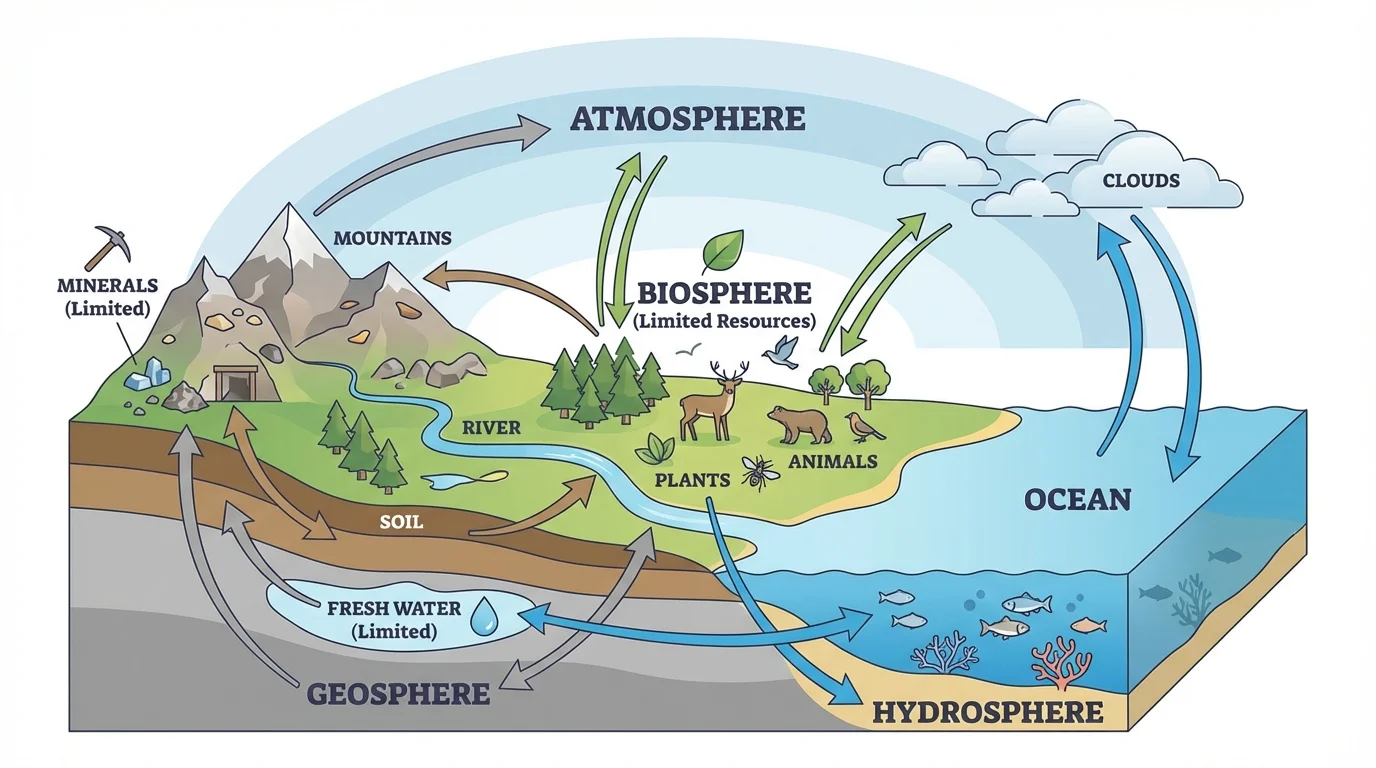
Because the systems are connected, a change in one system can affect the others. For example, drought begins with reduced precipitation in the atmosphere, but it also lowers river flow in the hydrosphere, dries soils in the geosphere, and stresses plants and animals in the biosphere. This is why scientists study Earth as a system rather than as isolated parts.
Natural resource is any material or feature from Earth that people use. Resources include water, soil, forests, fish, minerals, and the gases in the air. A renewable resource can be replenished naturally on a relatively short timescale if it is used carefully, while a nonrenewable resource forms so slowly that it cannot be replaced within a human lifetime.
Different places rely on different combinations of Earth's systems. Coastal communities may depend heavily on fisheries and shipping. Mountain communities may depend on forests, snowpack, rivers, and minerals. Dry regions may depend on deep groundwater or water brought from elsewhere. Where people live strongly affects which resources are easiest to obtain.
A resource is not just something found in nature. It becomes a resource when people can use it. Iron ore is valuable because people can turn it into steel. Sand can be a resource for glass and concrete. Sunlight is a resource because it supports life and can be captured by solar panels. Even clean air is a resource, because people and other organisms must have it to survive.
Resources are often grouped into a few major types. Mineral resources include metals such as iron, copper, and aluminum, as well as nonmetals such as salt and phosphate. Freshwater resources include lakes, rivers, glaciers, and groundwater. Biosphere resources include wood, crops, livestock, fish, medicines from plants, and healthy soils that help living things grow.
Some resources are used directly. People drink water, which has the chemical formula \(H_2O\), and breathe a mixture of gases that includes oxygen. Other resources are processed first. Bauxite is refined into aluminum. Crude oil is turned into fuels and plastics. Trees are cut into lumber or made into paper. The path from natural material to useful product can be long and complex.
One of the most important ideas in Earth science is that many resources are limited. Limited does not always mean "almost gone." It means there is not an endless supply that humans can use without thinking. Some resources are physically finite, and some are renewable only if they are used at a rate that nature can match.
Minerals are usually nonrenewable on human timescales. Earth can form new mineral deposits, but this often takes millions of years. If a copper deposit is mined out, another one does not quickly appear nearby. Fossil fuels are also nonrenewable because they formed from ancient organic matter over vast spans of time.
Fresh water is renewable because it moves through the water cycle, but accessible fresh water is still limited. Water can evaporate, condense, and fall again as precipitation, yet the amount available in a certain river, lake, or aquifer at a certain time may be small. If people pump groundwater faster than it is recharged, that supply shrinks.
Biosphere resources can be renewable too, but only with careful management. Trees can regrow, fish populations can recover, and soil can remain fertile if land is protected. But overfishing, deforestation, and poor farming can damage these resources faster than natural systems can replace them. Renewable does not mean unlimited.
Human timescales matter. Earth changes over millions of years, but human societies make plans over years, decades, or centuries. A resource that renews in 10 million years is effectively nonrenewable for people living today. That is why scientists often describe resources in terms of whether they can be replaced over a human lifetime.
Think about a forest and a metal mine. A forest may regrow over decades if protected. A metal ore deposit may have formed when hot fluids moved through rock long before dinosaurs existed. Both are valuable, but they do not recover at the same speed. Understanding timescale helps explain why some resources need stricter protection.
Earth's resources are not spread evenly because Earth itself has a long and active history, as [Figure 2] illustrates. Plate movement, volcanism, mountain building, erosion, sediment deposition, and climate patterns all affect where resources form and where they remain. The map of resources is really a map of Earth's past.
For example, many metal deposits form in places where magma or hot fluids move through the crust. These conditions often occur near plate boundaries and volcanic regions. Copper, gold, and silver deposits are commonly linked to this kind of geologic activity. That is one reason some mountain belts and volcanic zones are rich in valuable minerals.
Other resources form in sedimentary environments. Oil and natural gas often develop in ancient sea basins where dead organisms were buried under layers of sediment. Coal formed from thick accumulations of ancient plant material in swampy environments. Limestone forms from shells and other materials in marine settings. These resources appear where the right environments existed long ago, not randomly.
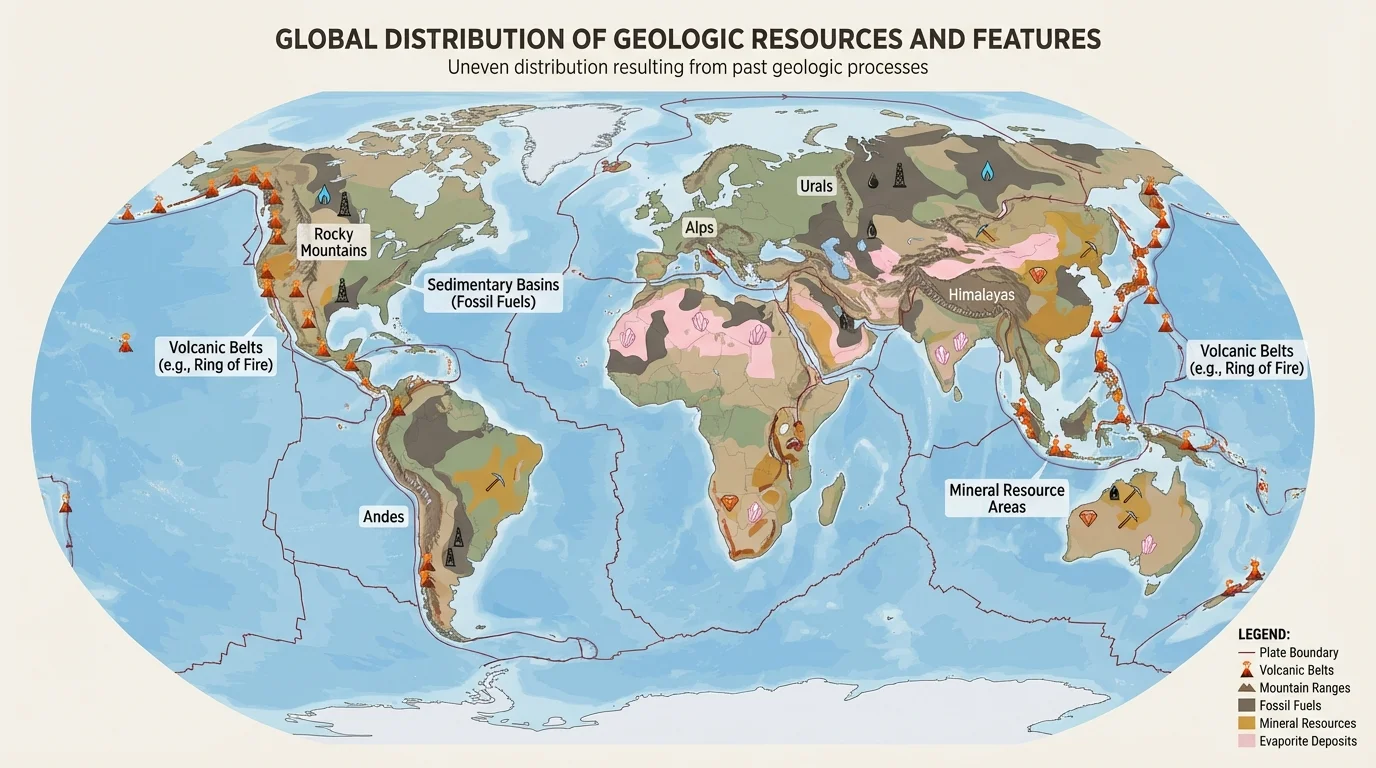
Erosion and weathering also matter. Rivers carry sediments and can concentrate valuable minerals in certain places. Wind can shape deserts and affect soil development. Glaciers carve landscapes and leave behind sediments. Even after a resource forms, later processes may expose it, bury it, scatter it, or concentrate it further.
Climate affects distribution too. Regions with high rainfall often have more surface fresh water than deserts. Warm, wet climates may support dense forests, while dry grasslands support different types of farming. The same planet has tropical rainforests, frozen polar regions, dry deserts, and fertile river valleys. Each setting offers different opportunities and limitations.
Because of this uneven distribution, countries trade resources. One region may export iron ore, another grain, another timber, another oil. Trade can help societies access resources they lack locally, but it can also create dependence and political tension. Geography shapes economics more than many people realize.
Minerals are naturally occurring solid substances with specific chemical compositions and structures. Most rocks are made of one or more minerals. Some minerals are especially useful because they contain metals or other materials people can extract. When a rock contains enough valuable material to mine profitably, it is called an ore.
Mineral deposits form in several ways. Some crystallize from cooling magma. Others form when hot water carrying dissolved substances moves through cracks in rock and leaves minerals behind. Still others form by evaporation, such as salt deposits that remain when water dries up. These processes happen only in certain environments, so useful minerals end up concentrated in some places and absent in others.
Chile is famous for large copper deposits. South Africa has major deposits of gold and platinum. Australia has abundant iron ore. These patterns are not accidents. They are linked to each region's geologic history. The same idea from [Figure 2] applies here: today's mines reflect ancient tectonic and volcanic events.
Some everyday devices use tiny amounts of many different elements. A smartphone may contain copper, gold, silver, lithium, cobalt, and rare earth elements, which means one object can connect you to mining regions all over the world.
Mining makes these materials available, but it can also change landscapes, create waste rock, and pollute water if it is not carefully managed. That is why recycling metals is important. Reusing aluminum, copper, and steel reduces the need to remove as much new material from Earth.
Earth looks like a blue planet, but most of its water is salty ocean water. Only a small fraction is fresh water, and much of that is frozen in glaciers or locked underground. The fresh water that is easiest for people to use comes mainly from rivers, lakes, and shallow groundwater, and that share is surprisingly small.
[Figure 3] The water cycle moves water through Earth's systems. Water evaporates from oceans, lakes, and soil, condenses into clouds, falls as precipitation, and then flows over land or seeps underground. This movement renews fresh water, but not always where or when people need it most.
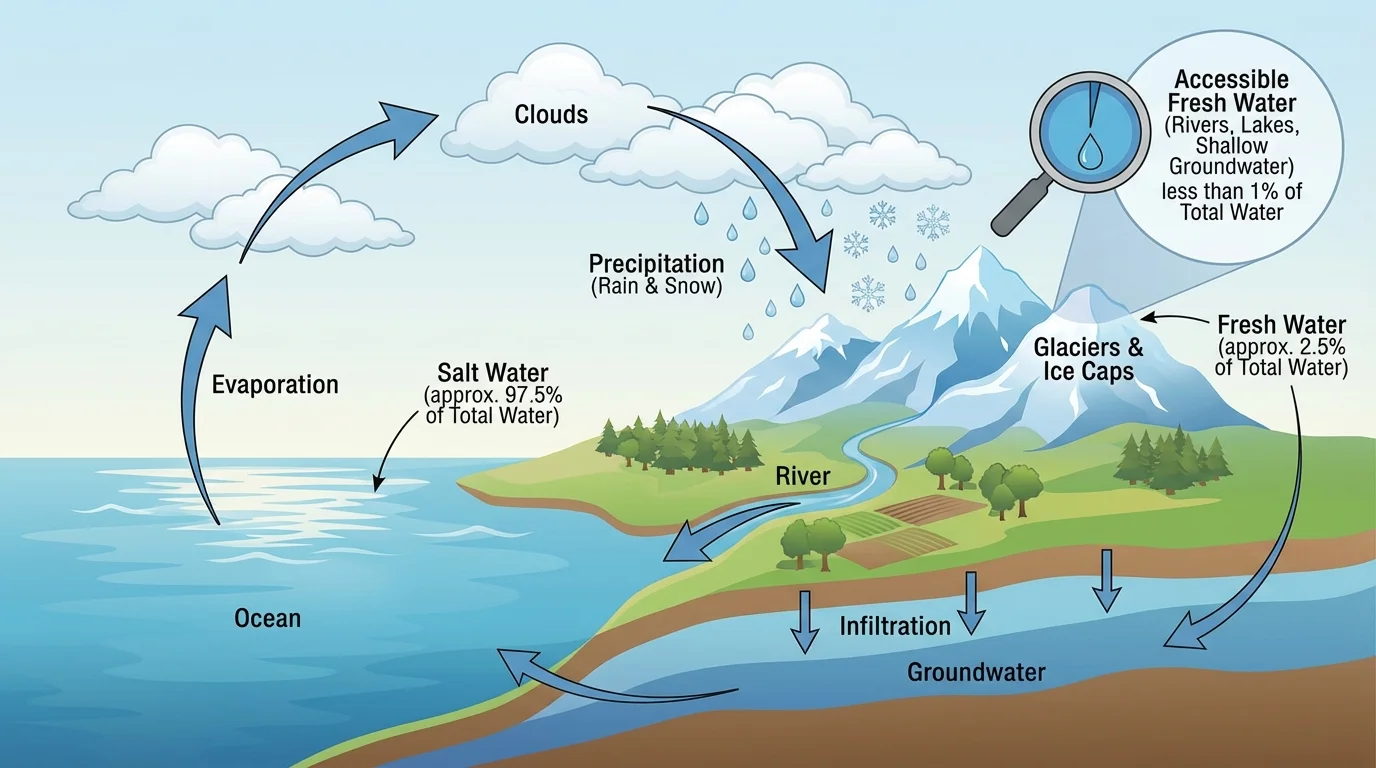
Fresh water is distributed unevenly. Tropical regions may receive heavy rainfall, while deserts receive very little. Mountain snowpacks act like natural storage systems, releasing meltwater into rivers during warmer months. In some places, ancient groundwater stored in aquifers took thousands of years to collect. If it is removed too quickly, recovery may be slow.
Consider two regions: the Great Lakes area of North America and the Sahara Desert in Africa. One has enormous surface fresh water reserves; the other has very limited rainfall and depends heavily on groundwater and careful water management. The difference is related to climate, location, and geologic history.
Real-world application: measuring water availability
Suppose a town receives groundwater recharge of \(50\) million liters per year but pumps \(80\) million liters per year.
Step 1: Compare recharge and use
The aquifer gains \(50\) million liters and loses \(80\) million liters each year.
Step 2: Find the net change
\(80 - 50 = 30\) million liters are removed faster than they are replaced.
Step 3: Interpret the result
The groundwater supply is shrinking by \(30\) million liters each year, so this use is not sustainable over the long term.
This simple calculation shows why even renewable water supplies can become limited.
Pollution can make water even less available. If a river or aquifer becomes contaminated by chemicals, sewage, or excess fertilizer, the water may no longer be safe to drink or use easily. So water quantity and water quality both matter.
The biosphere resources people use come from living things and the ecosystems that support them. These include forests for wood, crops for food, fish populations, livestock, fibers such as cotton, medicines derived from plants, and fertile soils full of organisms that recycle nutrients.
[Figure 4] Healthy ecosystems do more than provide products we can collect. Wetlands filter water. Forests store carbon and provide habitat. Pollinators such as bees help many crops reproduce. Decomposers in soil break down dead material and return nutrients to the ground. If ecosystems are damaged, resource production often falls too.
Soil is one of the most overlooked biosphere resources. It forms slowly from weathered rock, dead organisms, water, air, and time. Productive soil contains minerals, organic matter, microorganisms, and spaces for water and air. Yet erosion can remove topsoil much faster than nature builds it.
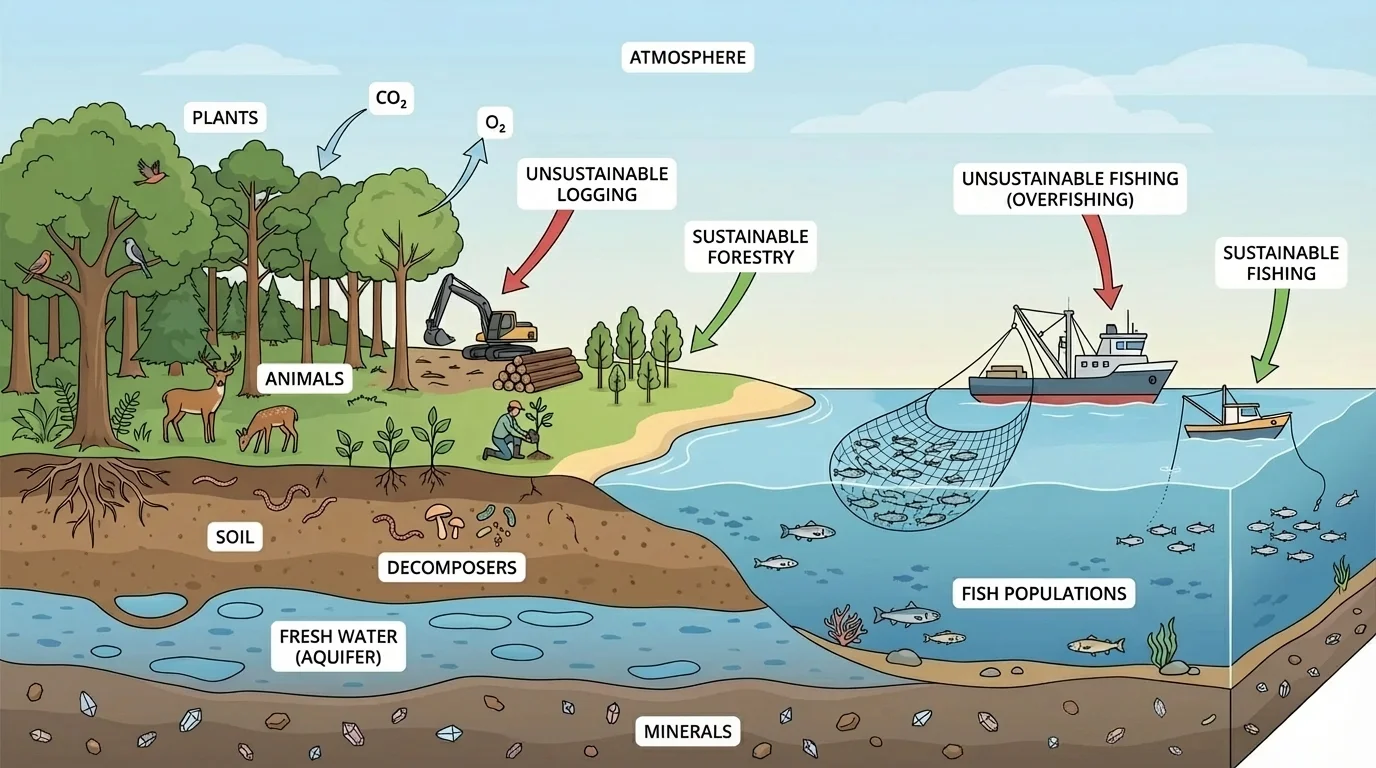
Fisheries provide another example. A fish population can be renewable if enough adults remain to reproduce. But if harvesting is too intense, the population may crash. This happened in parts of the North Atlantic, where cod populations dropped sharply after years of overfishing. A renewable resource became severely depleted because use exceeded recovery.
Forests can be managed in different ways as well. Selective cutting, replanting, and protected areas can help maintain forest resources. Clear-cutting large areas without recovery plans can reduce biodiversity, increase erosion, and damage water systems. The biosphere is productive, but it is not indestructible.
Sustainability means balance. A resource is used sustainably when people meet present needs without preventing future generations from meeting theirs. In many cases, this means using renewable resources no faster than they can recover and using nonrenewable resources carefully while developing recycling and alternatives.
The same lesson from [Figure 4] applies to farms, forests, and fisheries: humans are part of ecosystems, not outside them. When ecosystems are healthy, they keep supplying resources and services. When they are damaged, people feel the effects too.
Resource limits do not mean people are helpless. Human choices strongly affect how long resources last and how fairly they are shared. Conservation reduces waste. Recycling allows materials to be reused. Better technology can improve efficiency, such as irrigation systems that deliver water more carefully or buildings that use less energy.
Still, technology does not erase limits. A desalination plant can turn salt water into fresh water, but it requires energy and infrastructure. Recycling metals helps, but not every material is recovered completely. New methods can stretch resources, yet Earth's basic supply patterns still matter.
There are also social questions. Who gets access to water during drought? Who benefits from mining, and who deals with pollution? How should fishing limits be set? Science helps explain what is happening in Earth systems, but societies must make decisions about how to respond.
Earlier Earth science ideas still matter here: weathering breaks rock into sediment, erosion moves material, deposition lays it down, and plate tectonics reshapes Earth's crust. These same processes help create, move, expose, and bury many resources.
Because resources are unevenly distributed, countries often rely on one another. Japan imports many raw materials. Oil-rich countries export fuel. Nations with major river systems may have advantages in agriculture or hydroelectric power. Global trade networks are deeply connected to Earth science.
In the Middle East, large oil reserves formed in ancient marine environments where organic material was buried and transformed over time. In Chile, copper deposits are linked to tectonic activity along the western edge of South America. In the Amazon, the biosphere provides timber, medicines, biodiversity, and climate regulation, even though these resources can be damaged by deforestation.
In central Africa, minerals such as cobalt are important for rechargeable batteries used in electronics and electric vehicles. In Canada and the United States, the Great Lakes region holds a major share of the world's easily accessible fresh surface water. In Iceland, volcanic activity provides geothermal energy because hot rocks lie near the surface.
These examples show a powerful pattern: where resources are found is closely tied to Earth's history and processes. Ancient seas, plate collisions, volcanic eruptions, long periods of erosion, and climate patterns all leave clues that shape modern human life.
Understanding Earth's resources is really about understanding connections. Land, ocean, atmosphere, and biosphere work together. Resources form through natural processes, but people use them through technology, trade, and decision-making. A metal in a tablet, water in a reservoir, wood in a house, and food on a plate all tell stories about Earth systems.
When people recognize that resources are limited, unevenly distributed, and often slow to replace, they can make wiser choices. That includes protecting ecosystems, managing water carefully, recycling materials, and planning for the future instead of assuming Earth's supplies are endless.
