A drop in rainfall can shrink a pond, and suddenly fish struggle, insects change, birds leave, and plants along the edge begin to dry out. One small change can affect many living things because ecosystems are built from connections. No organism lives completely alone. Every plant, animal, fungus, and microbe depends on its surroundings and on other organisms in ways that are often surprising.
An ecosystem is all the living and nonliving things in an area, along with the interactions among them. In a pond, for example, fish depend on water, oxygen, food, and shelter. Aquatic plants depend on sunlight, water, minerals, and suitable temperatures. These links are part of a system, as [Figure 1] shows, where living things and nonliving factors constantly affect one another.
The living parts of an ecosystem are called biotic factors. These include plants, animals, fungi, bacteria, and other organisms. The nonliving parts are called abiotic factors. These include sunlight, temperature, water, soil, air, and minerals. Organisms need both kinds of factors to survive. A rabbit needs plants to eat, but it also needs water, oxygen, and a place where the temperature is suitable.
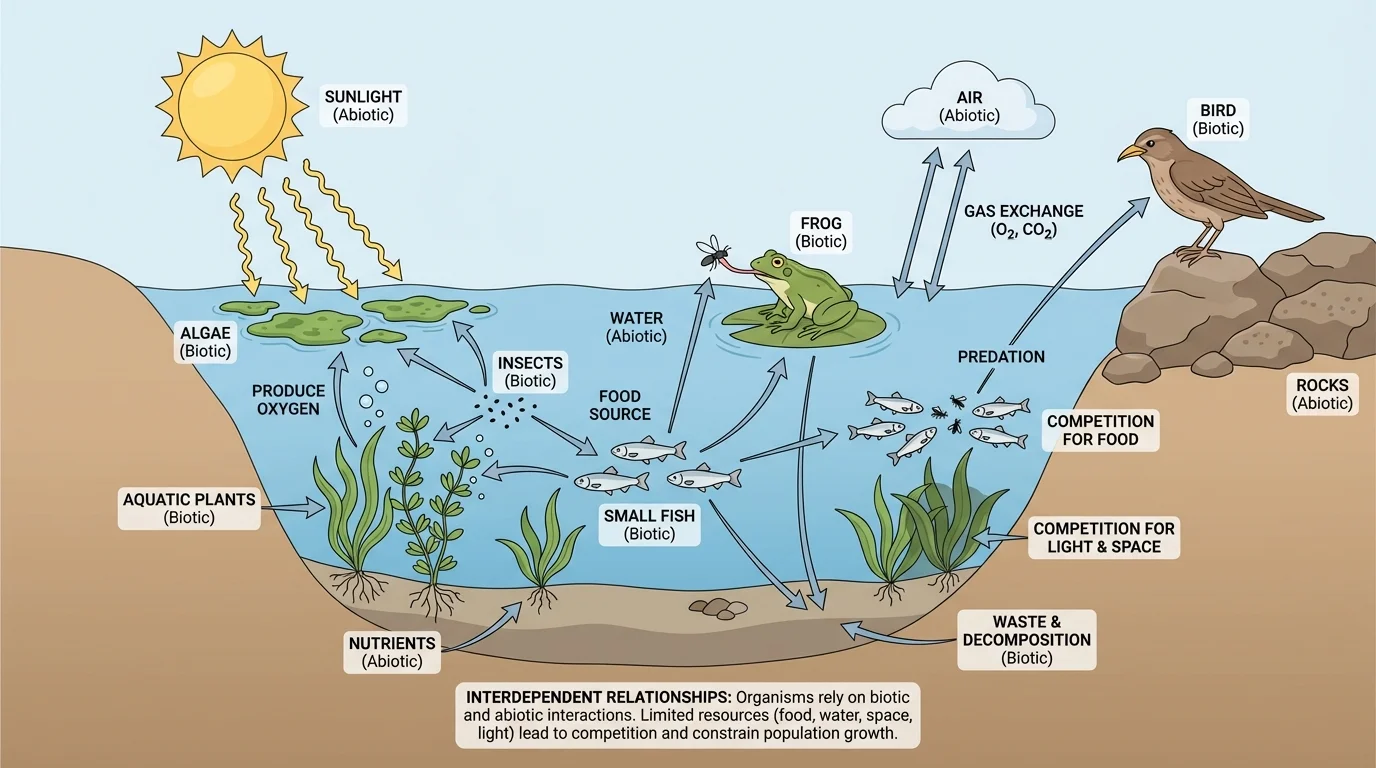
Not every ecosystem looks the same. A desert has very little water, so organisms there must survive dry conditions. A rainforest has abundant water and many species, but organisms may compete intensely for sunlight and space. In the ocean, salt levels, pressure, and depth matter. The specific abiotic conditions help determine which organisms can live in each place.
Ecosystem means the community of living things and the nonliving environment interacting together. Biotic factors are the living parts of the system, and abiotic factors are the nonliving parts.
Because ecosystems are systems, a change in one part often affects another part. If water temperature rises in a stream, the amount of dissolved oxygen can fall. Fish that need more oxygen may die or move away. Then animals that eat those fish may also be affected. This is why scientists study relationships instead of looking at only one organism at a time.
Every organism needs resources. A plant needs sunlight, water, carbon dioxide \(\textrm{CO}_2\), and minerals from the soil. Through photosynthesis, plants produce sugars such as glucose \(\textrm{C}_6\textrm{H}_{12}\textrm{O}_6\) and release oxygen \(\textrm{O}_2\). Animals depend on food, water, oxygen, shelter, and suitable temperatures. Decomposers such as fungi and bacteria depend on dead organisms and wastes as sources of matter and energy.
These needs connect organisms to their environment in very specific ways. A cactus can survive in a desert because it stores water and has structures that reduce water loss. A trout thrives in cool, oxygen-rich streams but may not survive in warm, muddy water. A sunflower grows best where there is enough light. Organisms are not just placed into ecosystems randomly; their traits help match them to certain conditions.
Many organisms also depend on other species. Bees collect nectar and pollen from flowers. In the process, they help pollinate plants, allowing seeds to form. Wolves depend on prey animals such as deer. Deer depend on plants. Earthworms help break down dead material and mix soil, which helps plants grow. Even tiny organisms can be essential to the whole system.
Some coral reefs are built by tiny animals that depend on microscopic algae living inside their tissues. The algae provide food through photosynthesis, and the coral provides shelter, showing how closely life can be linked.
Abiotic factors can set hard limits on life. If a seed has plenty of soil nutrients but no water, it will not sprout. If a lake contains water but becomes too polluted, some species may no longer survive there. If winter temperatures are too low, insects may die unless they have ways to avoid freezing. Living things depend on more than one condition being right at the same time.
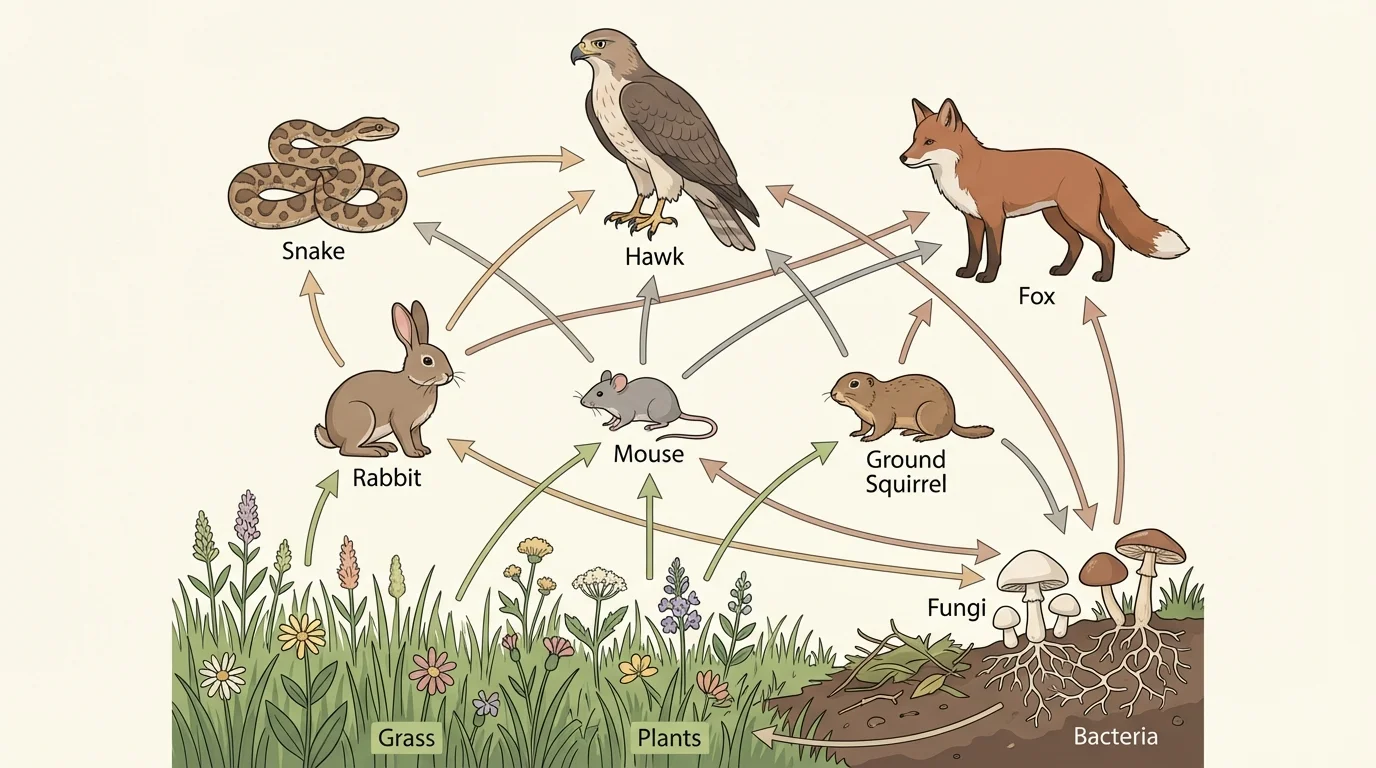
Organisms interact in many ways. Some eat others, some help one another, and some compete for the same needs. Feeding relationships connect organisms into a network, and [Figure 2] illustrates how one species may be linked to several others at once. These interactions help move energy and matter through ecosystems.
A food web is a model that shows many connected feeding relationships. It is more realistic than a simple food chain because most organisms eat more than one kind of food and may be eaten by more than one predator. Grass may be eaten by rabbits and mice. Snakes may eat mice, and hawks may eat snakes and rabbits. Decomposers break down dead material from all levels.
One important relationship is predation, in which one organism catches and eats another. In this relationship, the hawk is the predator and the mouse is the prey. Predation can help control population size. If prey become too abundant, predator populations may increase because food is easier to find. If prey become scarce, predator numbers may later decrease.
Some relationships are not about eating. In mutualism, both organisms benefit. Bees and flowering plants are a classic example. In commensalism, one benefits while the other is not helped or harmed much, such as a bird nesting in a tree. In parasitism, one organism benefits while the other is harmed, such as ticks feeding on a deer.
These relationships can overlap. A single organism may compete with one species, avoid a predator, and help another species all in the same day. That is why ecosystems are dynamic. They are always changing as organisms feed, grow, reproduce, and respond to conditions around them.
Why food webs matter
A food web helps scientists see that removing or adding one species can affect many others. If a top predator disappears, prey populations may increase. If those prey eat large amounts of plants, plant populations may decrease. A food web shows that ecosystem effects often spread farther than people first expect.
Later, when scientists study environmental damage, they often trace changes through a food web. As seen earlier in [Figure 2], no organism is connected to just one other organism. That is why protecting one species often means protecting many relationships at the same time.
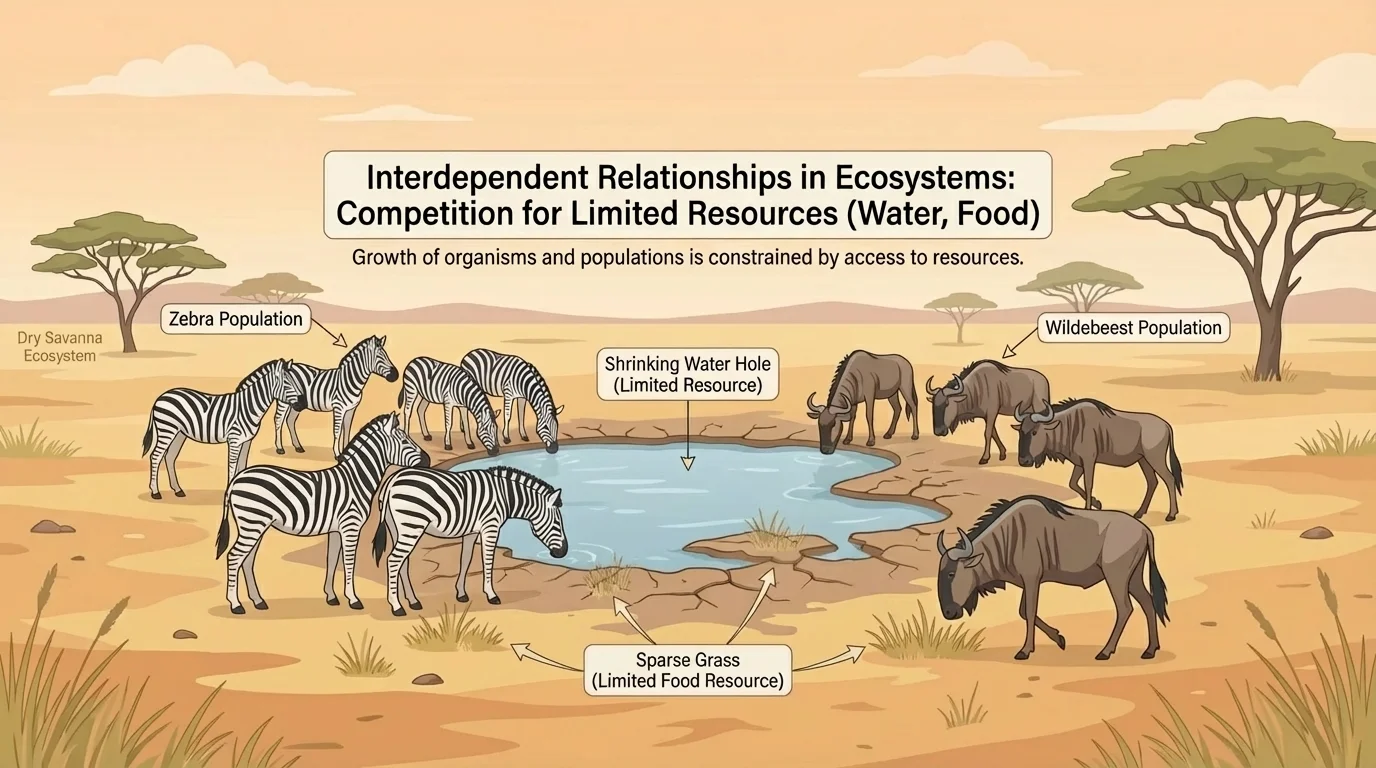
[Figure 3] In every ecosystem, organisms with similar needs may struggle to get enough of the same resource. This competition happens when food, water, space, light, oxygen, or shelter is limited. The overlap in needs is the key idea.
Competition can happen within a species and between species. Two oak trees growing close together may compete for sunlight, water, and soil nutrients. A group of wolves may compete with one another for prey in winter. Zebras and wildebeest may compete for grass and access to watering holes during dry seasons.
Competition is not always a direct fight. Sometimes it is indirect. If two bird species eat the same seeds, one species may leave less food for the other even if the birds never physically interact. In crowded conditions, some organisms get fewer resources, grow more slowly, produce fewer offspring, or die. That is one reason populations do not increase forever.
Plants also compete strongly. In a forest, tall trees may block sunlight from reaching shorter plants. Vines may climb trees to reach the light. Roots spread through soil to absorb water and minerals. Even though plants do not chase one another, they are constantly part of competition for limited resources.
Case study: seedlings in a garden bed
A student plants many bean seeds in a small space. At first, lots of seedlings sprout.
Step 1: Early growth looks successful
Water, soil, and sunlight are available, so many young plants begin growing.
Step 2: Resource demand increases
As the plants get bigger, each one needs more water, more mineral nutrients, and more room for roots and leaves.
Step 3: Competition increases
Because the garden bed is crowded, some plants get shaded and some receive less water and fewer nutrients.
Step 4: Growth becomes limited
The healthiest plants keep growing, but many others stay small or die.
This shows how limited resources constrain growth even when living things begin with good conditions.
The same pattern applies to animals. If a habitat can support only a certain amount of food, then adding more animals does not create more food. Instead, individuals must share what exists. In difficult times, fewer survive to reproduce. This directly limits population growth.
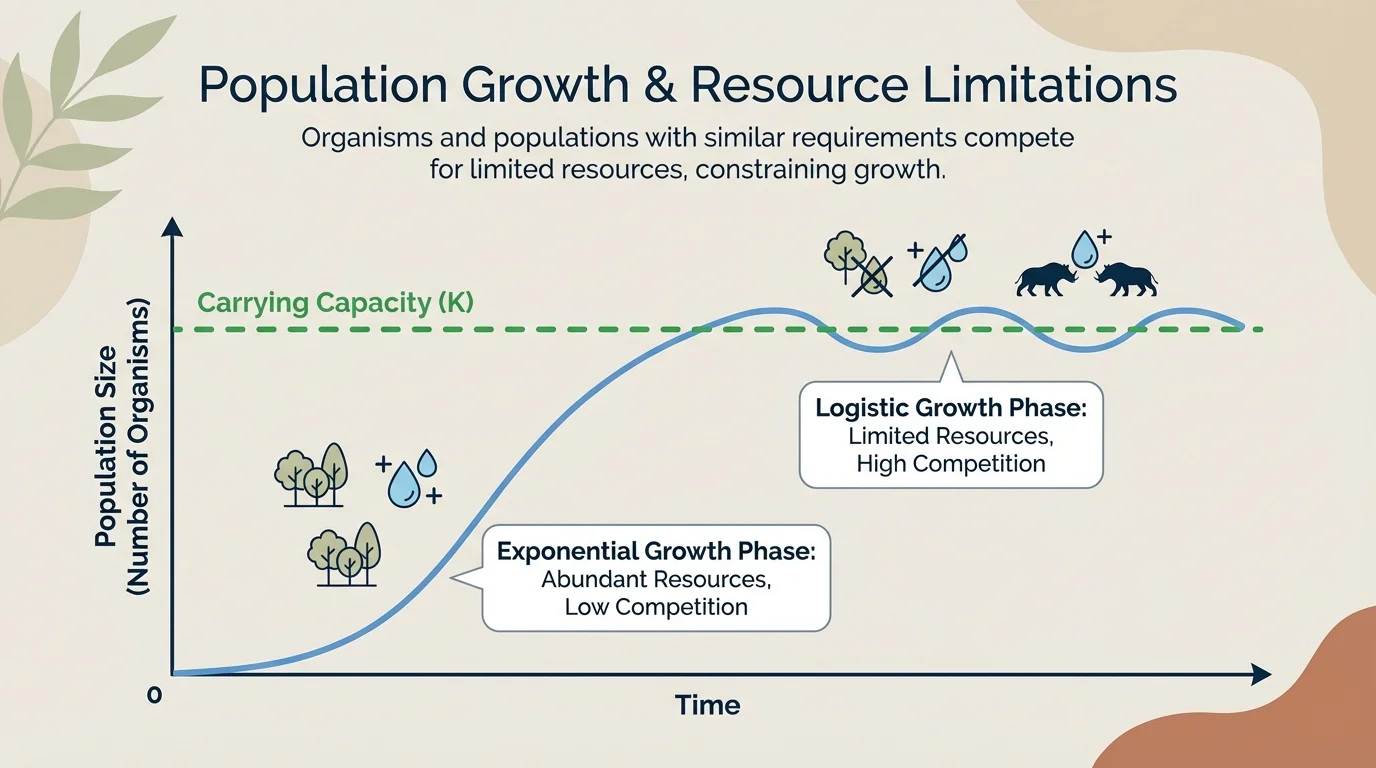
A population is all the members of one species living in the same area. Population size can increase when births are greater than deaths, but growth slows when resources become scarce. Populations often rise at first and then level off as environmental limits are reached.
[Figure 4] Scientists often describe a habitat as having a carrying capacity, which is the largest population size an environment can support over time. This is not an exact fixed number. It can change if rainfall changes, if disease spreads, or if people alter the habitat. Still, it is a useful way to think about limits.
Suppose a small pond has enough food and oxygen to support about \(200\) fish for a long period. If there are \(80\) fish, the population may grow because resources are still fairly available. If the population rises to \(190\), competition becomes stronger. If it rises above \(200\), some fish may not get enough food or oxygen, so growth slows or the population decreases back toward the limit.
Some limiting factors depend on population size. If a habitat becomes crowded, disease may spread more easily, food may run short, and competition may intensify. These are often called density-dependent factors because their effects become stronger when the population is denser.
Other limiting factors affect populations regardless of size. A wildfire, flood, or sudden freeze can reduce a population whether it is large or small. These are often called density-independent factors. Both kinds of factors help explain why populations rise and fall instead of increasing without end.
Living things need energy and matter to grow, repair themselves, and reproduce. If they cannot get enough food, water, oxygen, or other necessary resources, their life processes slow down or stop.
Reproduction is especially sensitive to resources. A plant stressed by drought may produce fewer seeds. Birds may lay fewer eggs if food is scarce. Mammals may have fewer surviving young when water is limited. So when resources shrink, it is not only survival that is affected. Future population growth is affected too.
We can describe a simple population change with a basic relationship: new population size equals the old population size plus births and minus deaths. In symbols, \(P_{new} = P_{old} + B - D\). If a rabbit population starts at \(50\), with \(18\) births and \(10\) deaths over a season, then \(P_{new} = 50 + 18 - 10 = 58\). If food later becomes scarce and deaths rise while births fall, growth may stop or reverse.
Looking back at [Figure 4], the curve levels off not because organisms choose to stop reproducing, but because the environment sets limits. Access to resources constrains what a population can do over time.
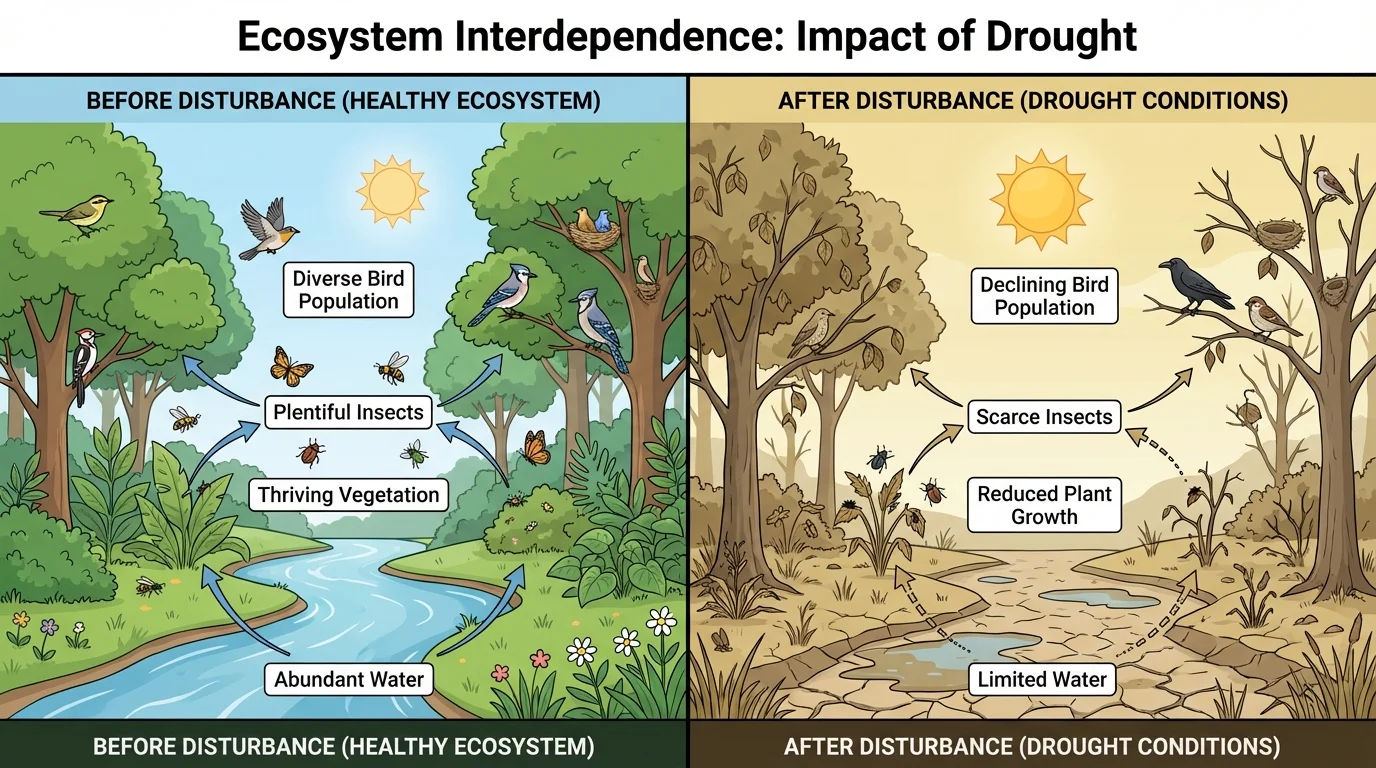
Ecosystems are never perfectly still. Seasons change, weather changes, populations rise and fall, and new organisms may enter an area. When one factor changes, the effects can spread through the system, as [Figure 5] illustrates with a disturbance affecting several parts of a habitat.
A drought can reduce plant growth. With fewer plants, herbivores have less food. If herbivore numbers drop, predators may also decrease. Lower water levels can change temperature and oxygen conditions, affecting fish and insects. This chain of effects is sometimes called a ripple effect through the ecosystem.
Human actions can also change ecosystems. Pollution can harm water quality. Deforestation removes habitat and changes soil moisture and temperature. Building roads can split habitats into smaller pieces, making it harder for animals to find food and mates. Introducing an invasive species can create new competition or predation that native species are not adapted to handle.
For example, if a nonnative plant spreads quickly, it may block sunlight from native plants and use up water in the soil. Insects that depended on the native plants may decline. Birds that fed on those insects may then decline too. One species can reshape many interactions.
Sea otters help protect kelp forests by eating sea urchins. When otter numbers fall, urchins can multiply and overgraze kelp, changing the whole coastal ecosystem.
At the same time, ecosystems can be resilient. After a disturbance, populations may recover if enough habitat and resources remain. Recovery depends on how severe the change was and whether the key relationships in the ecosystem are still intact.
The drought example from [Figure 5] helps explain why scientists watch both abiotic and biotic changes. Rainfall may seem like a nonliving factor only, but it can influence nearly every living population in the system.
Understanding ecosystem relationships is important far beyond science class. Farmers need to know how crops compete for water, nutrients, and space. They also need to understand pollinators, pests, and soil organisms. If too many plants are crowded into one field, each plant may receive fewer resources and produce less food.
Fisheries scientists study how many fish can be caught without reducing the population too much. If people remove fish faster than the population can replace them through reproduction, the number of fish drops. This is an ecosystem problem, not just a counting problem, because fish also depend on plankton, oxygen, temperature, and breeding habitat.
Real-world application: managing a deer population
A protected park has experienced a rapid increase in deer. At first, this seems positive, but scientists look at resource limits.
Step 1: Count the population
Suppose the park has about \(300\) deer.
Step 2: Examine available resources
Researchers check how much vegetation, water, and space are available through the year.
Step 3: Look for signs of competition
If many young trees are heavily eaten and deer appear thin, the population may be near or above what the habitat can support.
Step 4: Predict ecosystem effects
Too many deer can reduce plant growth, which affects insects, birds, and soil stability.
Managing the deer population helps protect the entire ecosystem, not just one species.
Conservationists also use these ideas to restore habitats. In wetlands, they may improve water flow, remove invasive species, or protect nesting areas. In cities, people can support ecosystems by planting native species, reducing pollution, and preserving green spaces where organisms can find food and shelter.
Even a schoolyard shows interdependence. Grass depends on sunlight, water, and soil. Insects feed on plants. Birds feed on insects or seeds. After heavy foot traffic, fewer plants may grow, which affects the animals using that area. Once you start looking for interactions, ecosystems appear everywhere.
"In nature, nothing exists alone."
— Rachel Carson
This idea captures the heart of ecosystem science. Organisms and populations are shaped by their environmental interactions, and growth is limited by access to resources. To understand why populations change, we must look at the whole network of living and nonliving connections around them.
