A train can levitate above a track, a crane can lift a car without anyone touching it, and a tiny spark can jump from your finger to a metal doorknob. These events may look unrelated, but they are all connected by the same big idea: electromagnetic forces. Unlike a push from your hand or a kick to a ball, these forces can act without direct contact. That makes them some of the most surprising and useful forces in science.
Electric and magnetic forces are part of everyday life. When clothes cling together in a dryer, electric force is involved. When earbuds, speakers, and electric motors work, magnetic effects are involved. In many devices, electricity and magnetism are linked so closely that scientists group them together as electromagnetic interactions.
These forces can either pull objects together or push them apart. That depends on what kinds of charges or magnetic poles are interacting. Their size also changes. A stronger charge produces a stronger electric force. A larger electric current can produce a stronger magnetic effect. In both electric and magnetic situations, distance matters a lot: when objects move farther apart, the force becomes weaker.
Electric force is the force between charged objects.
Magnetic force is the force caused by magnets, magnetic materials, or moving electric charges.
Electromagnetic force is the broad term for the related electric and magnetic interactions that act over a distance.
To understand these forces, it helps to remember something about force in general: a force can change an object's motion. It can start motion, stop motion, speed something up, slow it down, or change its direction. Electromagnetic forces do all of these things, even when the objects are not touching.
[Figure 1] Electric force depends on electric charge, a property of matter that comes in two types: positive and negative. Opposite charges attract, while like charges repel. A positively charged object and a negatively charged object pull toward each other. Two positively charged objects push apart, and two negatively charged objects also push apart.
You may have seen this after walking across a carpet and touching a metal object. Friction can move electrons from one surface to another. If an object gains extra electrons, it becomes negatively charged. If it loses electrons, it becomes positively charged. The electric force between charges can then cause static cling or a spark, as shown in [Figure 1].
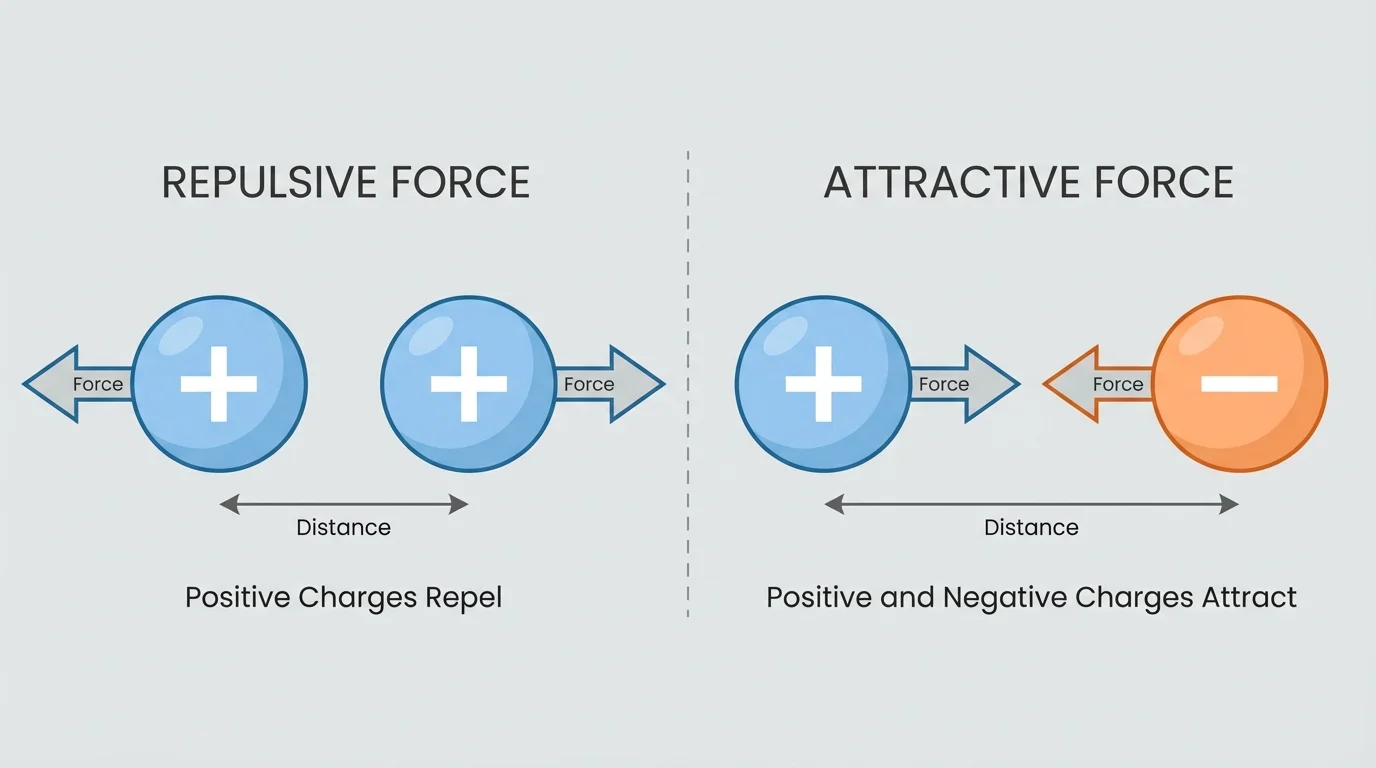
Many objects are neutral, which means they have equal amounts of positive and negative charge overall. Neutral does not mean "no charges at all." Matter is made of atoms, and atoms contain charged particles. A neutral object can still be affected by a nearby charged object because charges inside it can shift slightly. That is why a charged balloon can stick to a wall even though the wall is neutral.
Scientists often describe the space around a charged object using an electric field. An electric field is the region where another charge would feel an electric force. You cannot see the field directly, but you can see its effects. The charged balloon on the wall and the spark from a fingertip are both signs that an electric field is present.
Atoms contain protons with positive charge, electrons with negative charge, and neutrons with no charge. Charge is not the same as energy, but charged particles can interact strongly through electric forces.
The size of the electric force depends mainly on two ideas: the amount of charge and the distance between the objects. If the charges are larger, the electric force is larger. If the distance between them increases, the electric force becomes smaller.
A simple way to express this relationship is:
\[F \propto \frac{q_1 q_2}{d^2}\]
Here, \(F\) stands for electric force, \(q_1\) and \(q_2\) are the amounts of charge, and \(d\) is the distance between the objects. The symbol \(\propto\) means "is proportional to." Middle school students do not need to calculate this with advanced constants, but the pattern is very important.
For example, if one charged object has twice as much charge and the other stays the same, the electric force becomes about twice as large. If the distance doubles, the force becomes much weaker: because of the \(d^2\) part, doubling the distance makes the force about \(\dfrac{1}{4}\) as large.
Electric-force pattern example
Suppose two charged objects are \(2\) units apart and pull on each other with a force of \(12\) units.
Step 1: Double one charge while keeping the distance the same.
The force doubles, so the new force is \(24\) units.
Step 2: Instead, keep the charges the same and double the distance from \(2\) to \(4\).
The force becomes \(\dfrac{1}{4}\) as large, so the new force is \(\dfrac{1}{4} \times 12 = 3\) units.
This shows that distance can have a very strong effect on electric force.
This is why static electricity is most noticeable when charged objects are very close together. As the gap shrinks, the force increases, and eventually electrons may jump through the air as a spark. Air normally acts as an insulator, but a strong enough electric field can cause it to conduct.
The earlier diagram also helps explain why attraction and repulsion change motion in opposite ways. Arrows pointing inward represent pulling together, while arrows pointing outward represent pushing apart.
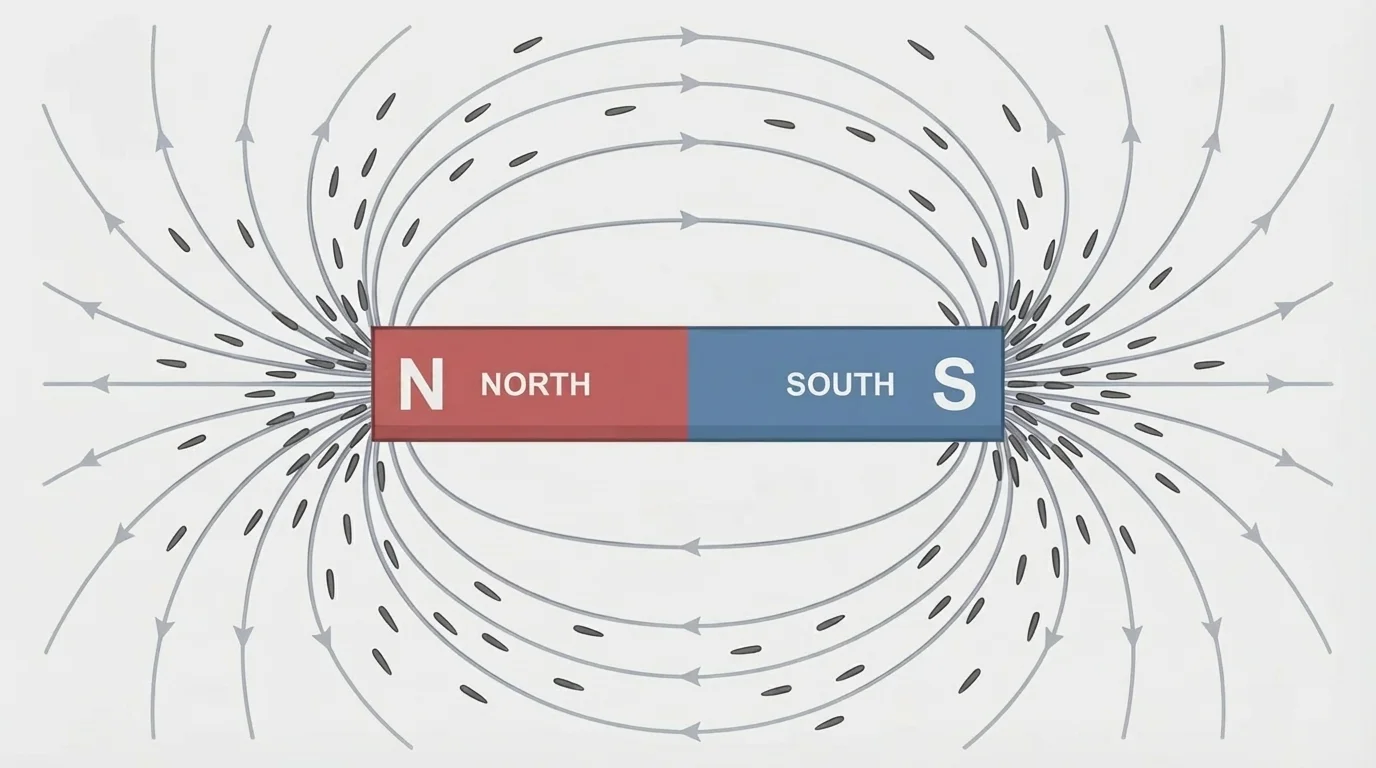
[Figure 2] helps show how a magnetic force is produced by magnets, magnetic materials, and moving electric charges. Every magnet has two poles: north and south. Like electric charges, magnetic poles can attract or repel. Opposite poles attract, while like poles repel. The pattern of this interaction appears in the magnetic field around a bar magnet.
If you bring the north pole of one magnet close to the south pole of another magnet, they pull together. If you bring two north poles together, they push apart. This behavior is very useful in compasses, latches, motors, and levitating systems.
Magnets are surrounded by a magnetic field, the region where magnetic forces act. Iron filings sprinkled around a magnet line up in curved patterns because the filings respond to that field. The field is strongest near the poles. These curved field-line patterns help explain why forces change with position.
Not all metals are strongly attracted to magnets. Iron, nickel, and cobalt are common magnetic materials, but metals such as aluminum, copper, and gold are not strongly attracted in ordinary situations. This surprises many students because they expect magnets to attract "metal" in general. The real rule is more specific.
Earth itself acts like a giant magnet. A compass needle is a small magnet that turns to line up with Earth's magnetic field. This is one reason magnetism matters far beyond the classroom: it helps with navigation, animal migration, and many technologies.
Some animals, including certain birds and sea turtles, appear to sense Earth's magnetic field and use it to help with long-distance travel.
[Figure 3] helps show one of the most powerful ideas in science: electricity and magnetism are linked. An electric current, which is a flow of electric charge, creates a magnetic field around it. A straight wire carrying current has a magnetic field around the wire. If the wire is wrapped into a coil, the magnetic effect becomes stronger. If the coil is wrapped around an iron nail, the setup becomes an electromagnet.
An electromagnet is a magnet produced by electric current. Unlike a permanent magnet, it can be turned on and off. This makes electromagnets especially useful in machines. When the current flows, the magnetic field appears. When the current stops, the magnetic field mostly disappears.
The strength of an electromagnet depends on several factors. A larger current usually makes a stronger electromagnet. More turns of wire in the coil also make it stronger. Adding an iron core increases the magnetic effect even more. Distance still matters too: the magnetic force becomes weaker as you move farther away from the magnet.
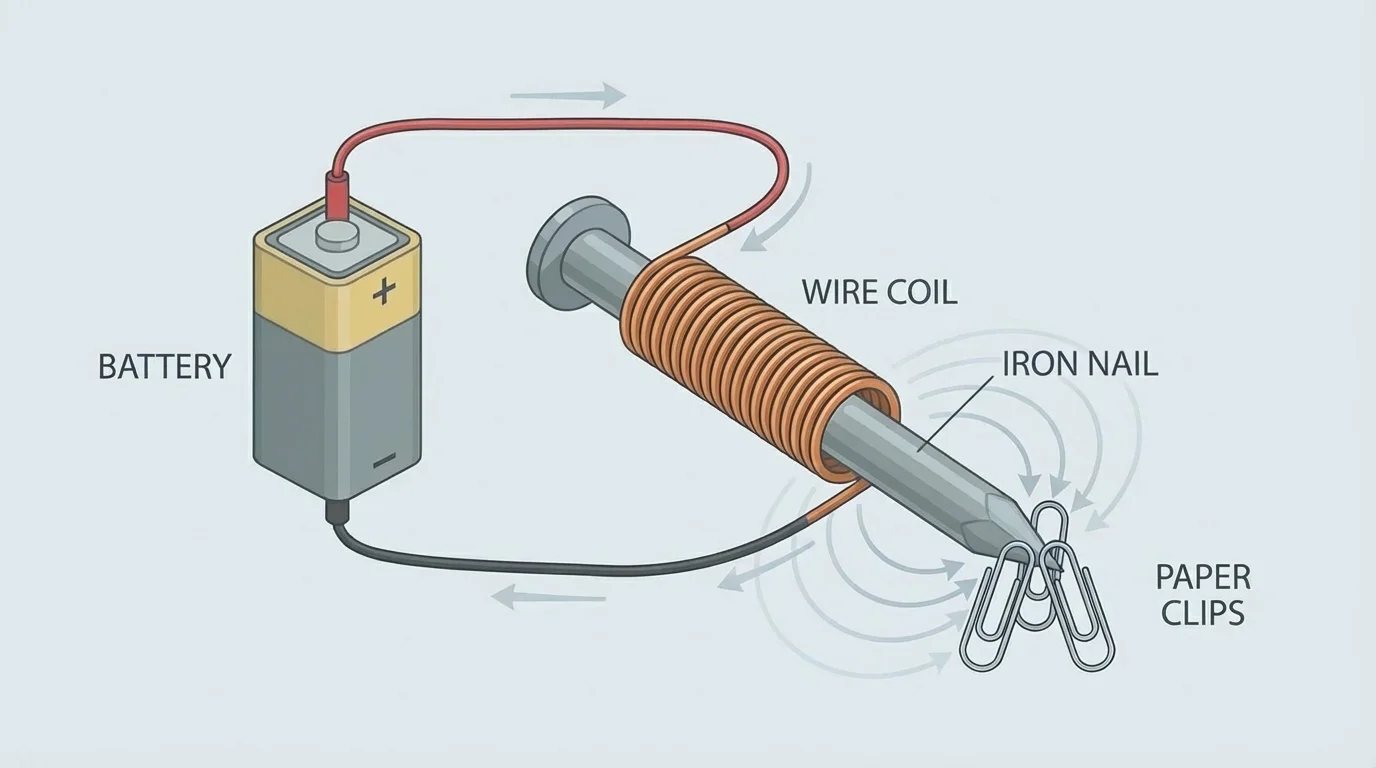
How electricity and magnetism work together
Electric charges can create electric forces when they are still, and magnetic effects when they move. This is why a battery-powered circuit can create magnetism in a wire, and why motors can turn electrical energy into motion.
A simple pattern can describe electromagnets: if current doubles, the magnetic effect often becomes stronger; if the distance increases, the force felt by another object usually decreases. The exact amount depends on the design, but the overall trend is clear.
Electromagnet example
A classroom electromagnet lifts \(4\) paper clips with one battery.
Step 1: Increase the current by using a stronger power source in a safe setup.
The electromagnet usually becomes stronger and may lift more than \(4\) paper clips.
Step 2: Keep the same battery but add more loops of wire around the nail.
The magnetic field becomes stronger, so the nail can usually lift more clips than before.
This is not an exact formula example, but it shows the cause-and-effect pattern: more current or more coil turns usually means more magnetic strength.
Electric and magnetic forces are closely related, but they are not identical. Both can act at a distance, both can attract or repel, and both become weaker with distance. However, electric forces act between charges, while magnetic forces involve magnets, magnetic materials, and moving charges.
| Feature | Electric Force | Magnetic Force |
|---|---|---|
| What causes it | Electric charges | Magnets or moving charges |
| Can attract? | Yes | Yes |
| Can repel? | Yes | Yes |
| Acts without touching? | Yes | Yes |
| Gets weaker with distance? | Yes | Yes |
| Can be created by current? | Current is moving charge, not the basic cause of all electric force | Yes, current creates magnetic fields |
Table 1. Comparison of major features of electric and magnetic forces.
Another important difference is that isolated electric charges can exist, but magnetic poles always come in pairs. You can separate positive and negative electric charges onto different objects. But if you cut a bar magnet in half, each half still has both a north pole and a south pole.
This is why the field pattern in [Figure 2] loops from one pole to the other instead of starting from only one isolated magnetic pole in ordinary magnets.
Electromagnetic forces are behind many technologies students use or hear about every day. In an electric motor, current in coils interacts with magnetic fields and produces motion. That motion powers fans, blenders, electric cars, and many robots.
Speakers and headphones also use electromagnetism. A changing current in a coil creates a changing magnetic force. That force moves a thin surface called a diaphragm back and forth. The moving diaphragm pushes air and creates sound waves. Without electromagnetic force, modern audio technology would not work.
Scrap-yard cranes use powerful electromagnets to lift heavy steel. This works because the magnetic field can be switched on to pick up metal and switched off to release it. The classroom setup described earlier is a much smaller version of the same idea.
Maglev trains use magnetic forces for lifting and guiding the train. By reducing contact with the track, friction is lowered, and the train can move very quickly. Hospitals use magnetic fields in MRI machines to help create detailed images of the inside of the body. Even credit cards, electric doorbells, and computer parts depend on electromagnetic ideas.
Distance example in real life
Suppose a small magnet strongly pulls a paper clip when it is \(1\) centimeter away, but the pull becomes much weaker at \(5\) centimeters.
Step 1: Observe the pattern.
As distance increases from \(1\) to \(5\) centimeters, the magnetic force decreases.
Step 2: Connect the observation to technology.
Engineers place magnets and coils carefully because even a small change in spacing can change how strongly a device works.
This is why distance matters in speakers, motors, and magnetic locks.
A common misconception is that only charged objects feel electric force. In reality, neutral objects can still be attracted when charges inside them shift slightly. That is what happens when a charged balloon sticks to a wall.
Another misconception is that magnets attract all metals. As discussed earlier, magnets strongly attract only certain materials, such as iron, nickel, and cobalt. Copper wire, for example, is important in electromagnets not because the wire itself is strongly magnetic, but because moving charges in the wire create a magnetic field.
Some students also think bigger always means stronger. But magnetic and electric forces depend on several variables, not just size. A small object with a strong charge nearby may exert a larger force than a bigger object farther away. The relationship \(F \propto \dfrac{q_1 q_2}{d^2}\) reminds us that distance can reduce force very quickly.
Finally, strong electromagnetic effects can be dangerous in some situations. Powerful magnets can affect electronics or pinch fingers. Large electric charges can create shocks. Scientists and engineers use shielding, insulation, and careful design to control these forces safely.
Once you understand that electric and magnetic interactions can attract or repel, and that their size depends on strength and distance, many everyday events begin to make more sense—from static cling to compasses to the operation of motors.
