What if a tiny change in a code inside your cells could make you lactose intolerant, change your risk of a disease, or even affect how you respond to certain medicines? 🤔 That "code" is in your DNA, and it works through genes, chromosomes, and proteins.
Every living thing you know—dogs, oak trees, bacteria, and you—has traits that come from instructions stored inside its cells. Understanding how those instructions are written, stored, and used helps explain why you are similar to your parents but still unique.
All living things are made of cells. Some organisms, like bacteria, have just one cell. Others, like humans, have many cells working together, each with the same basic genetic instructions.
Inside most of your cells there is a central structure called the nucleus. The nucleus holds your DNA, a long molecule that carries genetic information. DNA is like a long sentence written with only four "letters," called bases: A, T, C, and G.
Because DNA is so long, it is organized into separate pieces called chromosomes. These are tightly coiled packages of DNA and proteins. In humans, most cells have 46 chromosomes, arranged in 23 pairs. One chromosome of each pair comes from your mother, and the other comes from your father.
Before studying genes, it helps to remember that DNA is the molecule that carries hereditary information, and chromosomes are organized pieces of DNA stored in the cell nucleus.
When a cell divides to make more cells, it copies its chromosomes so that each new cell gets a complete set. This is one way your body grows and repairs itself.
Chromosomes are not just random pieces of DNA. Along each chromosome are specific stretches of DNA called genes. As shown in [Figure 1], each gene has a particular place on a chromosome, like an address on a street.
A gene is a segment of DNA that usually provides the instructions for making a specific protein. Different genes control different proteins, and those proteins affect your traits.
Because your chromosomes come in pairs, you usually have two copies of each gene: one on the chromosome you got from your mother and one on the matching chromosome from your father. These matching chromosomes in a pair are called homologous chromosomes.
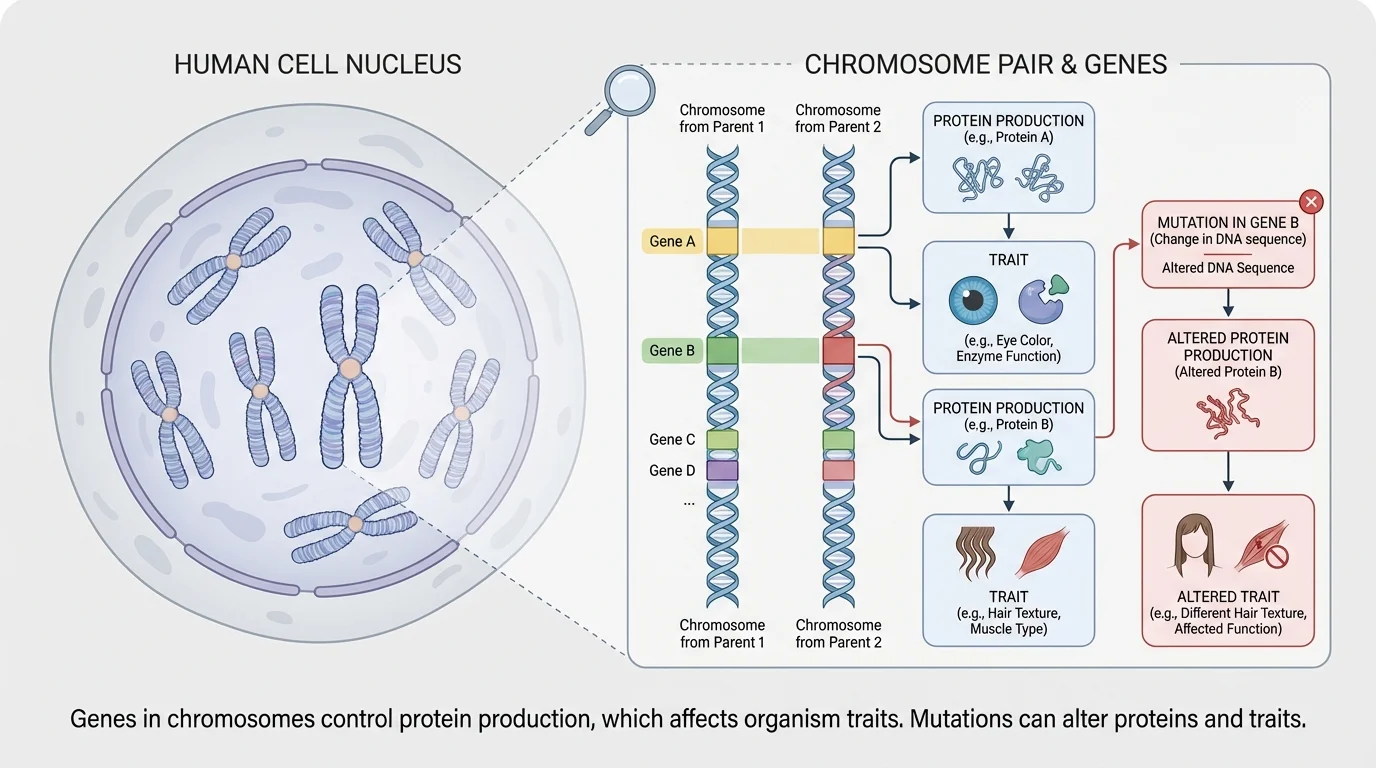
Each version of a gene can be slightly different. These different versions are called alleles. For example:
Because you have two alleles for most genes (one from each parent), the combination of those alleles helps decide your traits. For some genes, one allele may be dominant (stronger in its effect), and another may be recessive (its effect is hidden when the dominant one is present). In middle school, you often see this with classic examples like pea plant flower color or human dimples.
Even though each cell in your body usually has the same set of genes, different cells "turn on" different sets of genes. A skin cell and a nerve cell contain the same genes, but they use different ones, so they look and act differently.
A gene by itself is just a piece of DNA. The real action happens when the cell uses the information in that DNA to make a protein. The basic idea is often called the central dogma of molecular biology: DNA → RNA → Protein, as shown in [Figure 2].
DNA as a Code
DNA stores information in the order of its bases: A, T, C, and G. Groups of three bases can be thought of as "words" in a recipe, each three-base word giving instructions for adding a specific building block to a protein.
Proteins are long chains of smaller molecules called amino acids. The order of amino acids in a protein determines its shape and what it can do. The gene's DNA sequence tells the cell what order to put the amino acids in.
To build a protein, a cell follows two main steps, as illustrated in [Figure 2]:
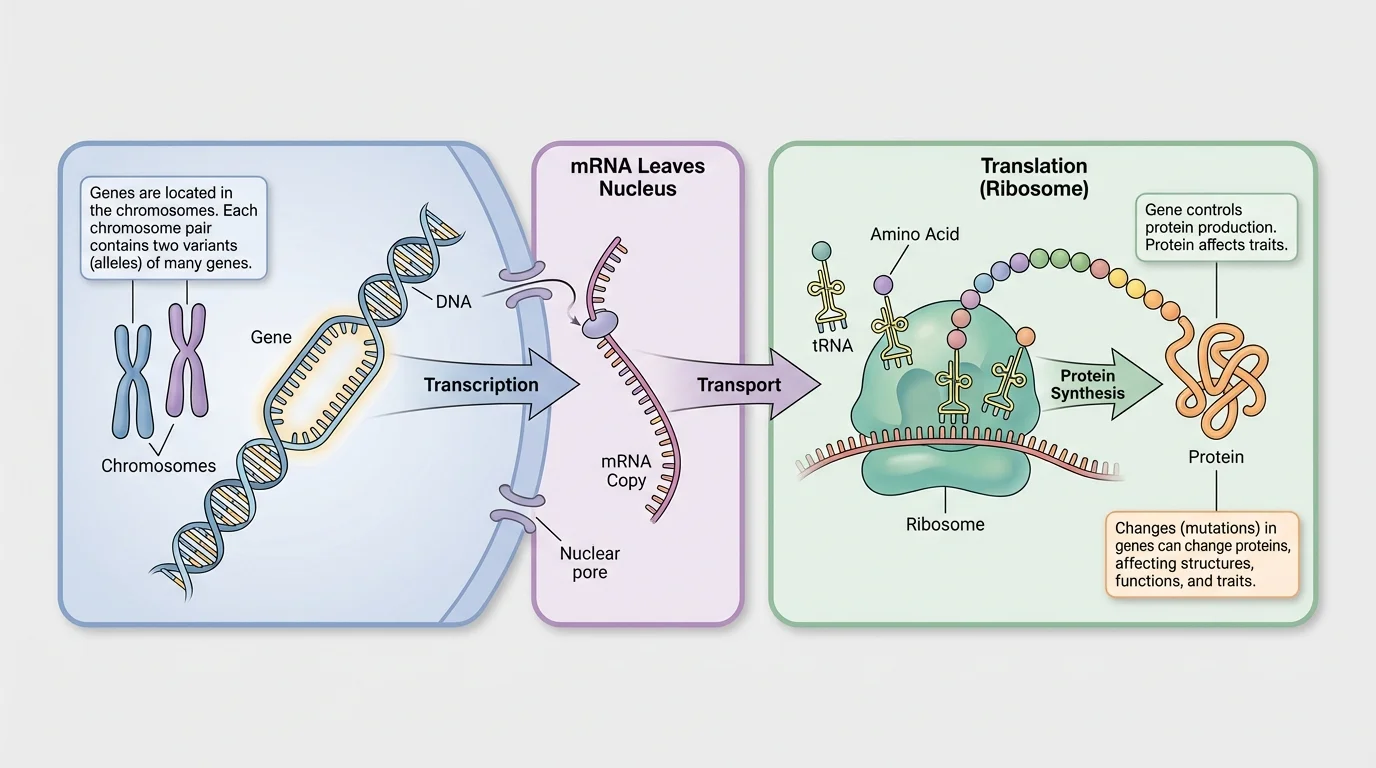
This process is a bit like using a cookbook app on your phone. DNA is the master cookbook stored safely in the "cloud" (the nucleus). The mRNA is like a specific recipe you download to your phone. The ribosome is your kitchen, where you follow the recipe step by step, adding ingredients (amino acids) to make the final dish (the protein).
If the DNA "recipe" changes, the mRNA will change, and the protein may be built differently—or not work at all. This connection is important when we think about mutations later.
Why do proteins matter so much? Because almost everything about how your body looks and works depends on them. 🌍
Proteins can have many jobs, including:
Here are some concrete examples of how genes → proteins → traits:
Even traits that you cannot see directly, like your tendency to high or low cholesterol, your body's ability to fight certain infections, or how fast you can break down a medicine, are often related to proteins that your genes help build.
Some people have a version of a gene that makes a bitter taste receptor protein extra sensitive, so they taste certain vegetables (like Brussels sprouts) as much more bitter than other people do.
So when we say a gene "controls" a trait, what we really mean is that the gene's instructions control the production of proteins, and those proteins influence the structures and functions in the body that we recognize as traits.
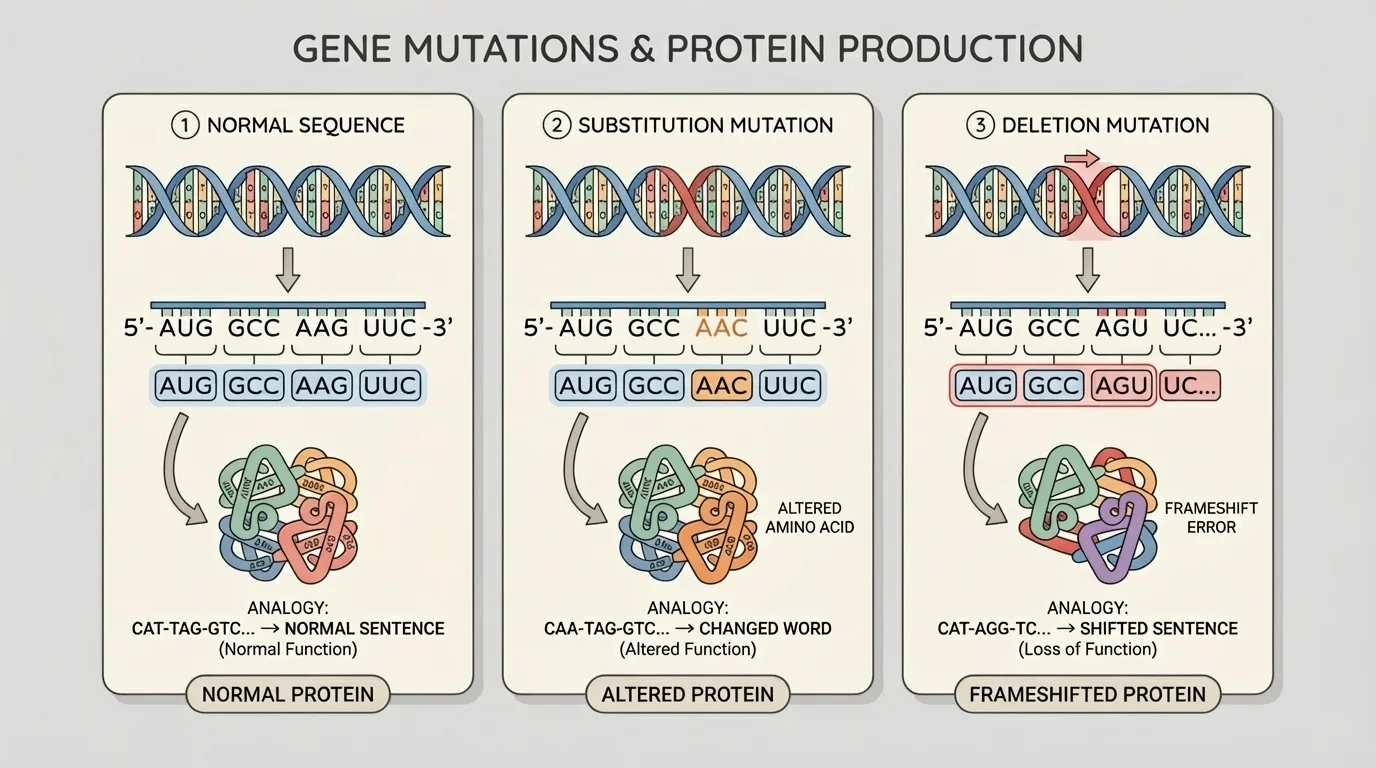
Now that we know genes are recipes for proteins, what happens if the recipe changes? A mutation is a change in the DNA sequence of a gene. These changes can affect how a protein is made or whether it works properly, as illustrated in [Figure 3].
Mutations can occur in several ways:
Groups of three bases are read together as "words." An insertion or deletion can shift how the three-base groups are read, which is called a frameshift mutation. As shown in [Figure 3], this can change every "word" after the mutation, often making the protein nonfunctional.
Not all mutations have the same effect. They can be:
Mutations can happen in two main types of cells:
Mutations can be caused by copying mistakes when DNA is replicated, or by environmental factors like certain chemicals, radiation, or even some viruses. Your cells have repair systems that fix many DNA mistakes, but not all of them are repaired.
Over long periods of time, helpful mutations that are passed down can contribute to evolution, while harmful ones may be removed from the population if they reduce survival or reproduction.
The idea that genes → proteins → traits, and that mutations can change this pathway, has many real-world applications. 🔬
Medicine and health:
Agriculture and food:
Everyday life and society:
All of these applications rely on the same basic idea: genes are located on chromosomes, each chromosome pair carries two versions of many genes, genes control protein production, and changes in genes can alter proteins and traits.
You can model how mutations change "proteins" using simple materials at home or in class. 🎯
Example activity: Letter-code protein model
Use letters or beads to represent DNA bases and amino acids.
Step 1: Choose a simple code
Decide that three letters (like "CAT") will represent one amino acid. Make a "gene" by writing a series of letters in groups of three, such as "CAT GGA TTC". Each triple stands for an amino acid.
Step 2: Build a "protein"
Use different colored beads or shapes to represent each three-letter code. String them in order to model the protein.
Step 3: Introduce a mutation
Change one letter (substitution), add one letter (insertion), or remove one letter (deletion) in the DNA "gene." Regroup into sets of three and rebuild the "protein" with beads. Compare the original and mutated proteins.
This shows how a small change in the gene can change the entire sequence of "amino acids" in the protein.
This kind of modeling helps you see why the exact order of DNA bases in a gene is so important for making a working protein and how mutations can have big or small effects.
