Look around at the living things people depend on every day: dogs that herd sheep, corn with large kernels, dairy cows that produce lots of milk, and roses bred for color and scent. None of these examples happened by accident. Humans have spent many generations choosing which organisms should reproduce. By doing that, people can increase certain traits in future generations. This process is called artificial selection, and it is one powerful way humans influence the characteristics of living things.
Artificial selection matters because it connects several big ideas in life science. It shows that living things vary, that traits are inherited, and that populations can change over time. It also helps explain why the foods we eat, the pets we keep, and many farm animals look very different from their wild ancestors.
Artificial selection is the process in which humans choose organisms with desired traits to be the parents of the next generation.
Selective breeding is another name for artificial selection.
Trait means a characteristic of an organism, such as fur color, height, speed, seed size, or disease resistance.
When humans practice selective breeding, they do not create traits from nothing. Instead, they work with traits that already exist in a population. For example, if some tomato plants naturally produce sweeter fruit and others produce less-sweet fruit, a farmer can choose seeds from the sweeter tomatoes to plant next year. Over many generations, sweetness may become more common in that tomato population.
[Figure 1] Artificial selection begins with a simple idea: organisms of the same kind are not exactly alike. Even brothers and sisters in the same litter or seeds from the same kind of plant can differ. Some differences are easy to notice, such as body size or color. Other differences are less obvious, such as resistance to disease or how much milk a cow produces.
Humans choose which organisms with desired traits will reproduce. In everyday language, that means choosing parent organisms because they have features people want. The chosen parents reproduce, and their offspring are more likely to have those same features. If people keep making similar choices generation after generation, the chosen traits become more common.
This does not mean every offspring will be identical. Inheritance is not like photocopying. Offspring often resemble their parents, but there is still variation. That variation is important because it gives breeders something to select from in each new generation.
The reason offspring resemble their parents is that traits are influenced by genes. Genes are pieces of inherited information found in an organism's DNA. You can think of genes as instructions that help determine characteristics, although many traits are shaped by both genes and the environment.
For example, a sunflower's height may depend partly on genes and partly on environmental factors such as sunlight, water, and soil nutrients. A puppy may inherit genes related to coat color, ear shape, or body size, but its health also depends on food, care, and exercise. Artificial selection focuses on inherited differences so that useful or desired traits can be passed on.
Remember that inheritance means the passing of traits from parents to offspring. A population has variation when individuals differ from one another. Without variation, selective breeding would not work because there would be no different traits to choose from.
Another key idea is that many traits are influenced by more than one gene. This is why characteristics such as speed, size, and milk production can vary a lot. Breeders may not know every gene involved, but by observing results over generations, they can still increase a trait by choosing the best parents.
Artificial selection works best when the desired trait is heritable, meaning it can be passed from parent to offspring. If a change is caused only by the environment and not by genes, it usually will not be inherited. For instance, trimming a poodle's fur gives it a certain look, but its puppies are not born with that haircut.
Selective breeding changes populations step by step. A breeder first observes variation in a population, such as taller and shorter plants. Then the breeder chooses the organisms with the preferred trait to reproduce. Their offspring are evaluated, and again the breeder selects those with the strongest version of the trait. Repeating this process over many generations can noticeably shift the population.
Suppose a farmer wants taller wheat plants because they are easier to harvest. In generation 1, the farmer keeps seeds only from the tallest plants. In generation 2, many plants are a bit taller on average. The farmer repeats the process. Over time, the average height of the wheat population increases because the genes linked to taller growth become more common.
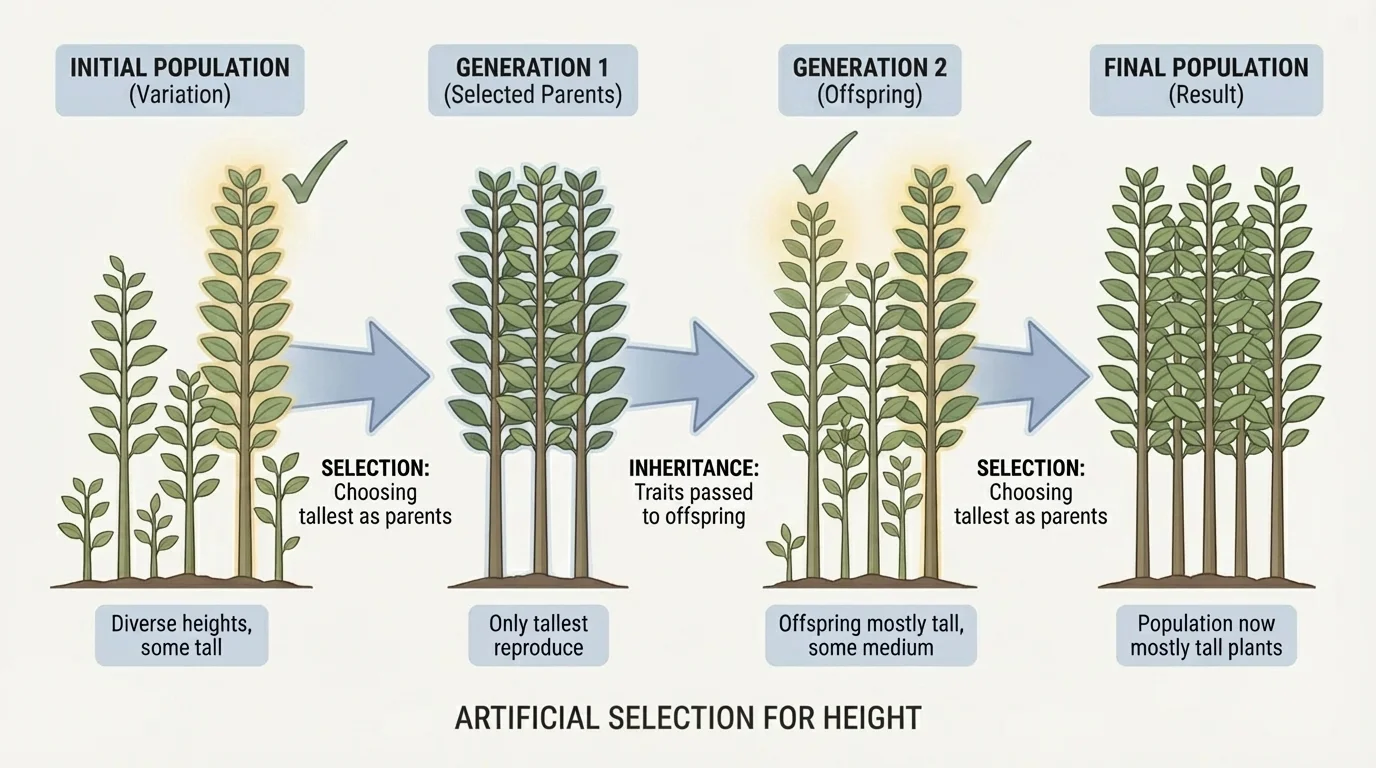
This same general process can be used for many traits: sheep with thicker wool, dogs with strong scent-tracking ability, hens that lay more eggs, or pumpkins with larger fruit. The key is repeated selection. A single generation may show only a small change, but many generations can lead to dramatic results.
Why repeated selection matters
One round of breeding may slightly increase a trait, but repeated selection across generations changes which genes are common in the population. That is why selective breeding can produce major differences between wild ancestors and domesticated organisms.
Breeders often keep careful records. They may track which parents produce the healthiest offspring, which lines grow fastest, or which individuals survive disease. This record-keeping helps them make better choices in the next generation.
Artificial selection and natural selection are similar because both affect which organisms reproduce. In both cases, inherited traits can become more common in a population over time. The big difference is who or what does the selecting.
[Figure 2] In artificial selection, humans choose the traits they want. A farmer might prefer sweeter fruit, larger seeds, or calmer animals. In natural selection, the environment determines which traits help organisms survive and reproduce. Predators, climate, disease, and competition all act as selecting forces in nature.
For example, wild rabbits may evolve traits that help them avoid predators or survive cold winters. Humans do not choose those traits. But if people breed pet rabbits for floppy ears or unusual fur patterns, that is artificial selection. The process still involves inheritance and population change, but the selector is different.
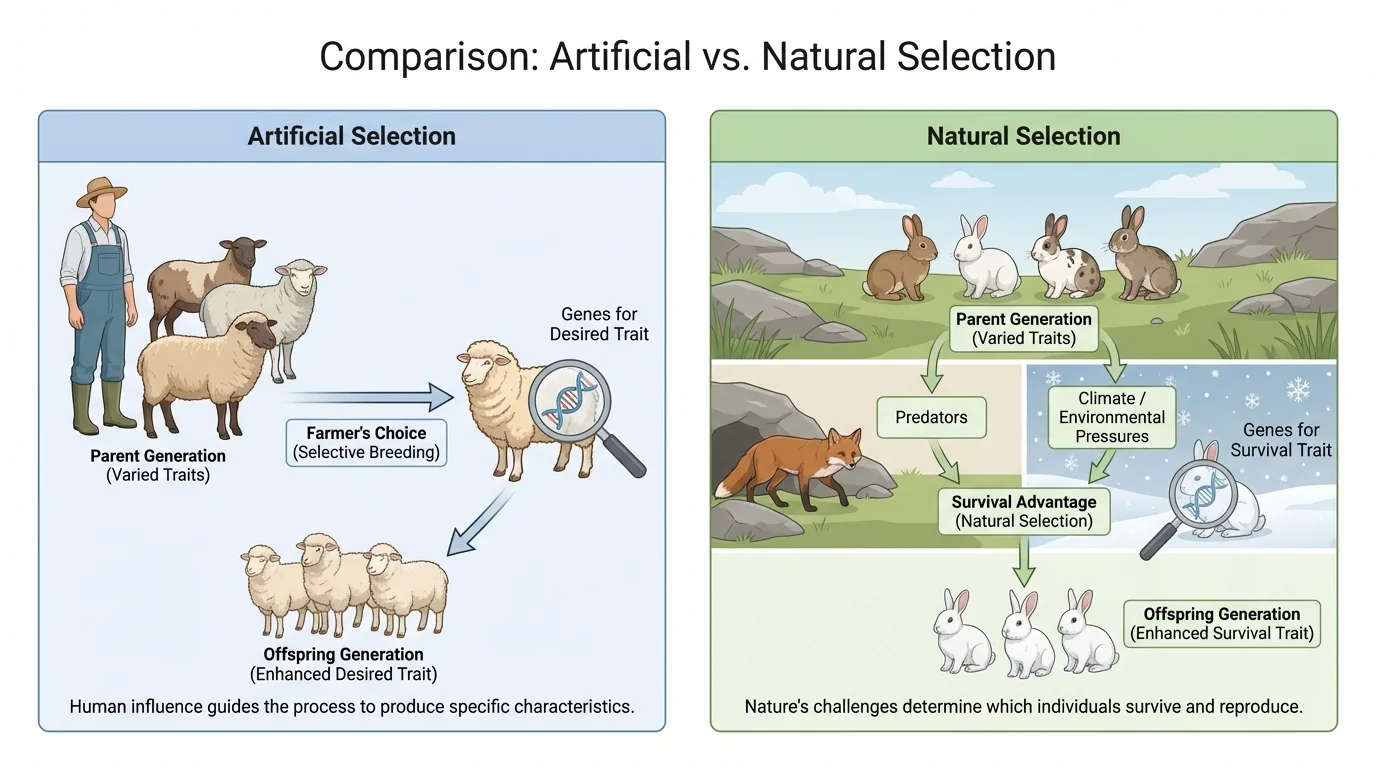
Sometimes artificial selection can produce traits that help humans more than the organism itself. A chicken bred to grow very quickly may provide more meat, but if growth becomes too extreme, it may also create health problems. In natural selection, traits tend to spread when they improve survival or reproduction in the wild environment.
This comparison also helps explain an important idea in evolution: populations change over generations when certain inherited traits become more common. Artificial selection gives scientists a clear, real-world example of how that kind of change can happen.
Dogs are one of the most familiar examples of artificial selection. All dog breeds belong to the same species, yet they can look and behave very differently. Over many generations, humans selected dogs for traits such as size, speed, guarding ability, herding behavior, scent detection, or companionship. That is why a Chihuahua and a Great Dane are both dogs, even though they are extremely different in body shape and size.
Cattle provide another strong example. Some cows have been bred mainly for milk production, while others have been bred for beef. Dairy cows are selected for traits such as high milk yield and good udder health. Beef cattle may be selected for fast growth and strong muscles.
Chickens have also been selectively bred in different ways. Some breeds are raised mainly for eggs, while others are raised for meat. Humans have chosen birds with traits that match these goals, such as egg-laying rate, body size, or feather type.
Some dog breeds were shaped for highly specific jobs. Border collies were selected for herding skill, bloodhounds for scent tracking, and sled dogs for endurance in cold conditions.
Horses have been bred for speed, strength, or endurance depending on human needs. A racehorse and a draft horse show how one species can be shaped in very different directions when people select different traits over many generations.
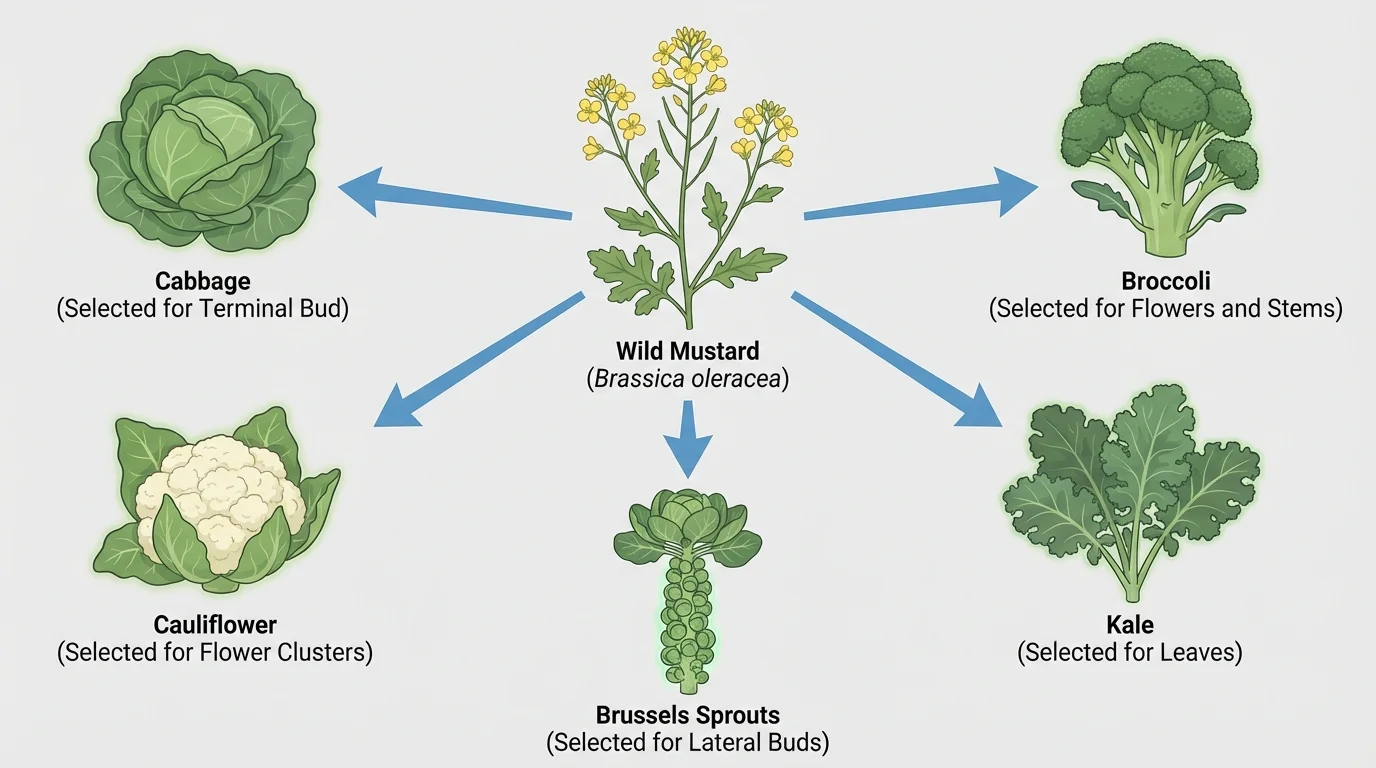
[Figure 3] Plant breeding has had a huge effect on human civilization because it helps produce more reliable food. People have selected crops for larger fruits, better flavor, easier harvesting, resistance to pests, and the ability to grow in different climates. One of the most striking examples is that several vegetables humans eat today came from the same wild ancestor.
Wild mustard was selectively bred over many generations to emphasize different parts of the plant. Selection for larger leaves helped produce kale. Selection for bigger flower buds helped produce broccoli. Selection for a dense, short stem and leaf structure helped produce cabbage. This means very different vegetables can come from one original species when humans repeatedly choose different traits.
Corn is another famous example. Modern corn looks very different from its wild ancestor, teosinte. Through long-term selective breeding, humans favored plants with larger kernels and cobs that were easier to harvest and eat. The result is a crop that has become one of the world's most important food plants.
Farmers also breed plants for disease resistance. If some bean plants survive a fungal infection better than others, those survivors may be chosen as parents for the next generation. This can help create crop populations that stay healthier and produce more food.
The plant relationships in [Figure 3] show that selection can focus on different structures of the same species. Humans might choose for leaves, stems, buds, seeds, or roots depending on what is useful.
Artificial selection has many practical uses. In agriculture, it can increase food production by creating plants and animals that grow well, resist disease, or produce more usable food. In medicine, laboratory animals may be bred for certain traits that help scientists study health and disease. Working animals can be bred for behaviors that help people, such as guiding, guarding, or herding.
Selective breeding has also helped create crops suited to local conditions. In places with dry climates, breeders may favor drought-tolerant plants. In colder regions, they may select varieties that can survive shorter growing seasons. This can improve food security for communities.
Real-world application: breeding tomatoes for useful traits
Plant breeders may want tomatoes that taste good, resist disease, and stay firm during shipping.
Step 1: Observe variation
Some tomato plants naturally produce sweeter fruit, while others resist disease better.
Step 2: Choose parents
Breeders select parent plants that show the most useful combination of traits.
Step 3: Grow the offspring
The offspring are tested to see which ones inherited the desired characteristics.
Step 4: Repeat over generations
The best offspring become the next parents, and over time the crop improves for human use.
This process can lead to tomato varieties that are more productive and easier to grow.
Because artificial selection works with inherited traits, it has become an important tool in farming and food production. Many staple crops and domestic animals today are the result of long-term human choices about reproduction.
Artificial selection can be useful, but it also has risks. One major concern is reduced genetic diversity. Genetic diversity means the variety of genes within a population. If breeders focus too narrowly on a few traits, many other gene versions may become rare or disappear.
Low genetic diversity can make a population more vulnerable to disease or environmental change. If nearly all plants in a crop field are genetically similar, one disease might spread through them very quickly. In animals, heavy selection for appearance can sometimes increase inherited health problems.
For example, some dog breeds have been selected so strongly for body shape that they suffer from breathing problems, joint issues, or other disorders. This reminds us that humans have a responsibility to consider animal welfare, not just desired appearance.
Why genetic diversity matters
A population with more genetic diversity is more likely to include individuals that can survive new diseases, climate changes, or other challenges. When selective breeding becomes too narrow, it can make the whole population less resilient.
Another limit is that artificial selection depends on existing variation. Breeders cannot simply request any trait they imagine unless there are genes in the population that can help produce it. Selection can only build on inherited differences that are already present or that appear through mutation over time.
Today, scientists and farmers combine traditional breeding with careful observation, data, and knowledge of genetics. They may test plants for disease resistance, measure growth rates, and track family lines. Even with modern tools, the basic idea remains the same: choose parents with desired inherited traits and allow those traits to become more common in offspring.
Artificial selection is not the same as genetic engineering. In selective breeding, humans choose which organisms reproduce, but the genes are still passed on through reproduction. In genetic engineering, scientists directly change DNA in a lab. Both can affect traits, but they work in different ways.
Selective breeding can also support conservation in some cases. For example, people may breed endangered species in captivity while trying to maintain healthy variation. However, conservation breeding must be done carefully so that populations do not lose too much genetic diversity.
Consider a flock of sheep in which wool thickness varies. A farmer wants thicker wool for warmer clothing. The farmer breeds only the sheep with the thickest wool. In the next generation, more lambs have thick wool than before. The farmer repeats this process for several generations.
At first, the change may seem small. But like the plant example earlier in [Figure 1], repeated selection gradually shifts the whole population. After many generations, thick wool becomes much more common because the genes linked to that trait are being passed on more often.
This case shows the central idea clearly: humans cannot choose the exact genes inside each offspring one by one through ordinary selective breeding, but they can strongly influence which inherited traits become common in a population by choosing the parents.
| Feature | Artificial Selection | Natural Selection |
|---|---|---|
| Who does the selecting? | Humans | The environment |
| What is selected? | Traits people want | Traits that help survival and reproduction |
| Examples | Dog breeds, dairy cows, crop plants | Camouflage, drought tolerance in wild plants |
| Result over time | Population changes in chosen directions | Population adapts to environmental pressures |
Table 1. Comparison of artificial selection and natural selection.
Artificial selection gives us a clear window into evolution because it shows that populations are not fixed. When certain inherited traits are chosen again and again, living things can change greatly across generations. The dogs, crops, and farm animals around us are evidence of that process.
