A species is not a frozen design. If that were true, bacteria would not become harder to kill, insects would never resist pesticides, and birds on islands would not end up with beaks shaped for very different foods. Life changes because environments change, and populations contain differences. Over long periods of time, those differences matter.
Every habitat places challenges on living things. It may be cold, dry, crowded, full of predators, low in food, or changed by humans. Organisms that live there must survive long enough to reproduce. If some individuals happen to have traits that help them do better in those conditions, they are more likely to leave offspring. Over many generations, the population can look different from the one that came before.
This process is part of biological evolution, which means a change in populations of living things over time. Evolution does not always mean one species suddenly turning into a completely different kind of organism. Very often, it means the distribution of traits in a population shifts little by little across many generations.
Natural selection is the process in which individuals with inherited traits that fit an environment are more likely to survive and reproduce. Over generations, those helpful traits become more common in the population, while less helpful traits become less common.
Adaptation is an inherited trait, or the process that produces such a trait, that improves survival or reproduction in a particular environment.
Think about a population of rabbits living where winters become colder and snow lasts longer. If some rabbits have thicker fur that helps them stay warm, those rabbits may survive better and have more young. Their offspring may inherit that thicker fur. After many generations, thicker fur may become more common in the population.
Natural selection depends on several connected ideas. First, individuals in a population are not exactly the same. Second, many of their differences are inherited from parents. Third, more young are often produced than can survive. Fourth, the environment affects which individuals are most likely to survive and reproduce. When all of this happens together, the population changes over time.
It is important to notice what changes. An individual organism does not evolve during its own lifetime. A lizard cannot decide to grow stickier toes because it wants to climb better. Instead, if some lizards are born with toe structures that already help them cling to surfaces, those lizards may leave more offspring. The change appears in the population over generations, not as a choice made by one individual.
Living things inherit traits from their parents through genetic information. Traits can include body structures, body processes, and some behaviors. Because offspring are similar to, but not exactly the same as, their parents, populations contain variation that natural selection can act on.
Another key idea is that "successful" in evolution does not mean strongest, smartest, or fastest in every situation. It means better able to survive and reproduce in a specific environment. A thick coat may help in cold places but be a disadvantage in hot climates. A trait is helpful only in the conditions where it provides an advantage.
Natural selection cannot happen unless individuals differ from one another. These differences are called variation. In a group of plants, some may grow taller, some may tolerate dry soil better, and some may produce more seeds. In a group of birds, some may have slightly longer beaks or sharper eyesight.
Much variation is inherited. Offspring receive genetic information from their parents, so many traits run in families. New variation can also appear through a mutation, which is a change in genetic information. Most mutations do not create a major advantage. Some have no noticeable effect, some are harmful, and a few can be helpful in certain environments.
Variation does not appear because organisms "need" it. A useful trait must already exist in some form before natural selection can favor it. If no individuals in a population have a trait that helps with a new challenge, the population may struggle or even die out.
In large populations, many tiny inherited differences can exist at the same time. Natural selection often works on these small differences rather than on dramatic changes.
Because variation is already present, environmental change can quickly affect which individuals do better. A sudden drought, a new predator, a new disease, or human-made pollution can all shift which traits are favored.
Natural selection changes trait frequencies over generations, as [Figure 1] illustrates with a beetle population living on dark soil. If the population contains both light-colored and dark-colored beetles, birds may spot the lighter beetles more easily. Dark beetles are better camouflaged, so more of them survive and reproduce.
The next generation then includes a larger share of dark beetles because the beetles that survived were more likely to pass on the dark-color trait. If the same conditions continue generation after generation, the population shifts. Dark coloration becomes common, while light coloration becomes less common.
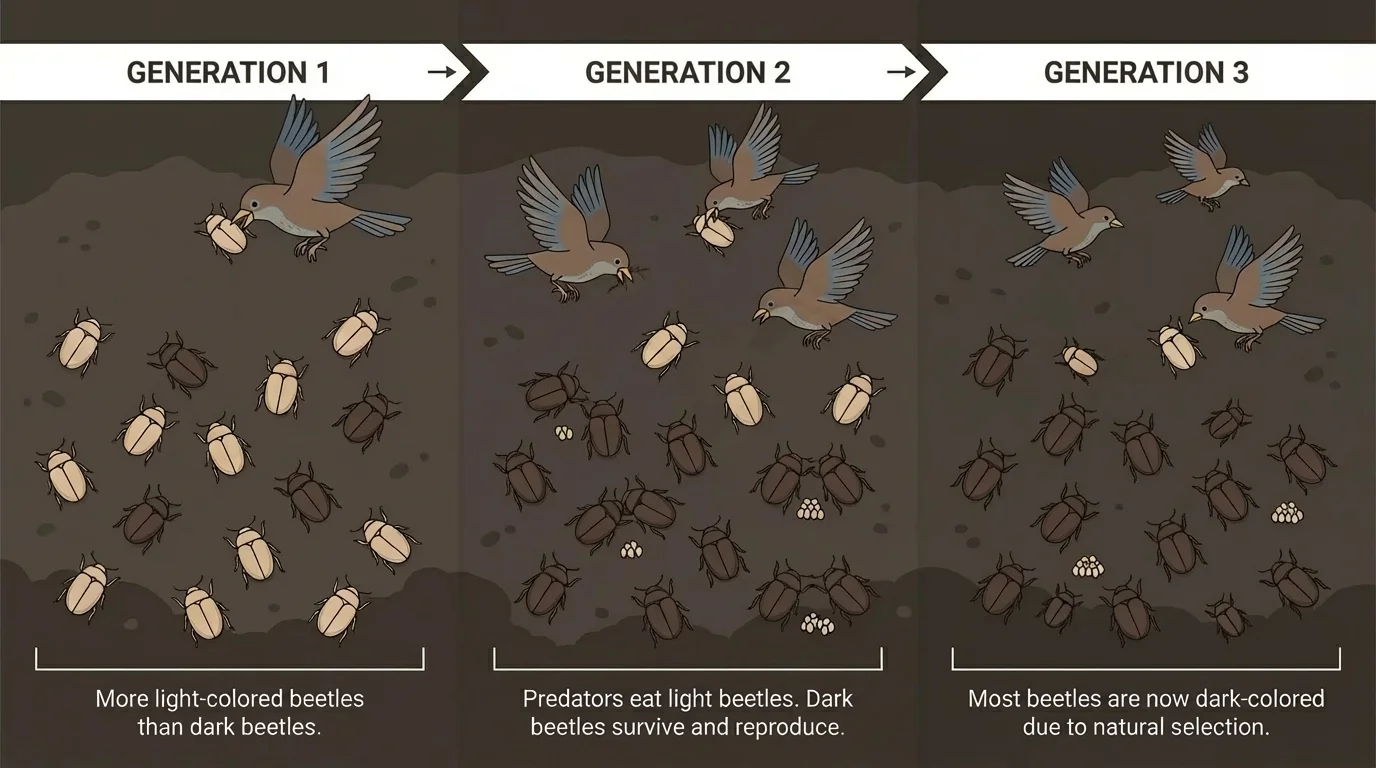
This kind of change can be described in four simple stages. There is inherited variation. The environment leads to differences in survival or reproduction. Those who reproduce pass their traits to offspring. Then, over time, the population's trait distribution changes.
Population change, not instant transformation
Natural selection does not remake every organism at once. Instead, it changes the proportion of traits in a population. If a trait helps even a little, and if it is inherited, that trait can gradually increase over many generations.
Suppose a bird population has beak lengths that vary. If flowers with deep nectar tubes are the main food source, birds with slightly longer beaks may feed more successfully. They may produce more offspring, and the average beak length of the population may increase over time. This is a shift in the distribution of a trait.
Looking back at the beetles in [Figure 1], notice that not every light beetle disappears in one generation and not every dark beetle survives. Natural selection affects chances, not guaranteed outcomes. Over time, though, those small differences in survival and reproduction can add up to major population change.
A very common mistake is to say that organisms adapt because they try hard or because they want to survive. In everyday language, "adapt" can mean adjusting during your lifetime, like putting on a coat in winter. In biology, adaptation refers to inherited traits shaped over generations.
For example, a desert fox does not grow large ears because it decides the weather is hot. Instead, if foxes with larger ears lose body heat better and survive more successfully in hot conditions, they may leave more offspring. Over many generations, larger ears can become common in that population.
Another mistake is to think natural selection produces perfection. It does not. It works with the variation already present, and it is limited by what is inherited from earlier generations. A trait can be "good enough" rather than perfect. Also, what is useful in one setting may be harmful in another.
"The environment does not give organisms what they need; it favors organisms that already have traits that help them survive and reproduce."
This is why adaptation is always linked to a specific environment. Polar bear features suit icy habitats. Those same features would not necessarily be helpful in a tropical rainforest. There is no single "best" trait for all places and all times.
One famous example of natural selection involves camouflage, as [Figure 2] shows with peppered moths on different tree backgrounds. In England, peppered moths came in lighter and darker forms. Before heavy industrial pollution, many trees had pale bark covered with lichens, so light moths were harder for birds to see.
During the Industrial Revolution, soot darkened many tree trunks. In those polluted areas, dark moths became better camouflaged, and birds more easily spotted the lighter moths. Over generations, dark moths became more common. Later, when pollution decreased and trees became lighter again, lighter moths increased.
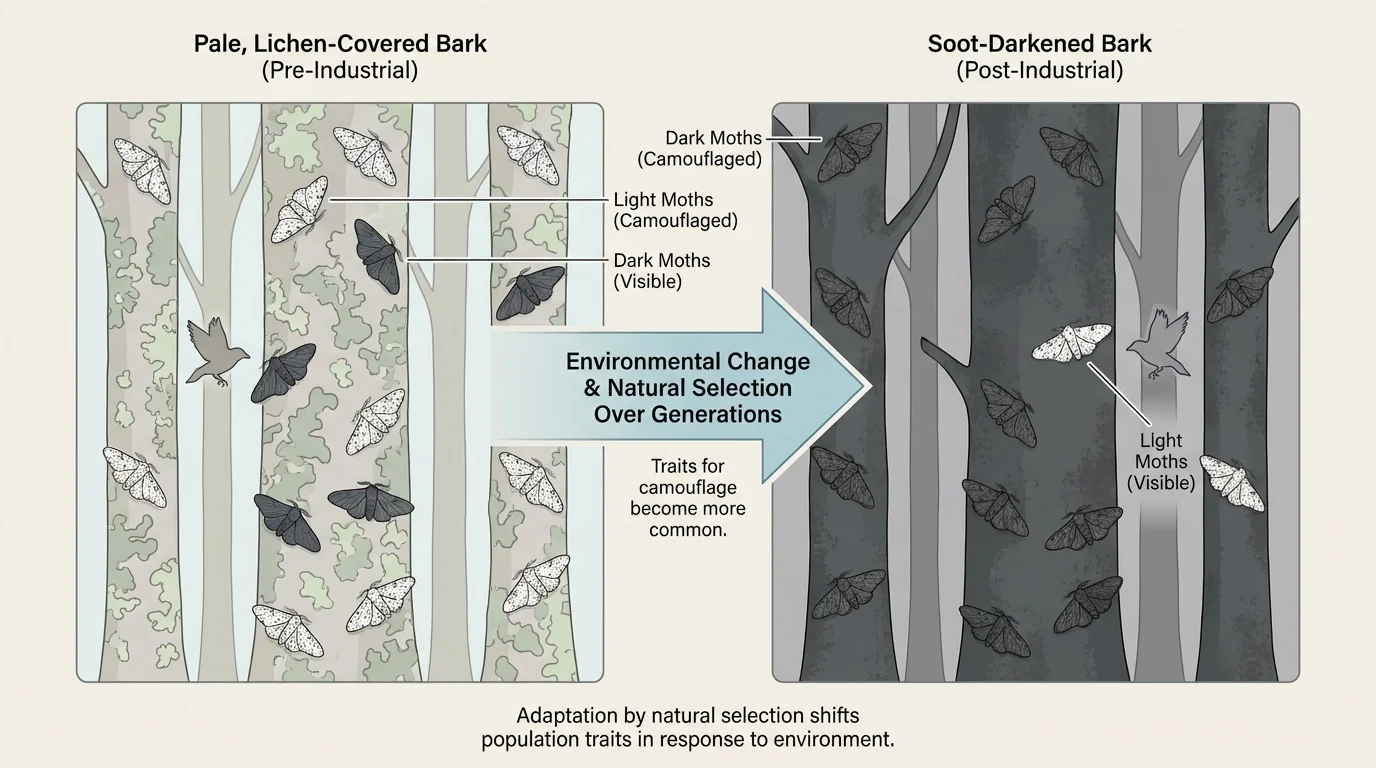
This example matters because it shows that which trait is favored depends on environmental conditions. Neither color is always best. The advantage changes when the habitat changes.
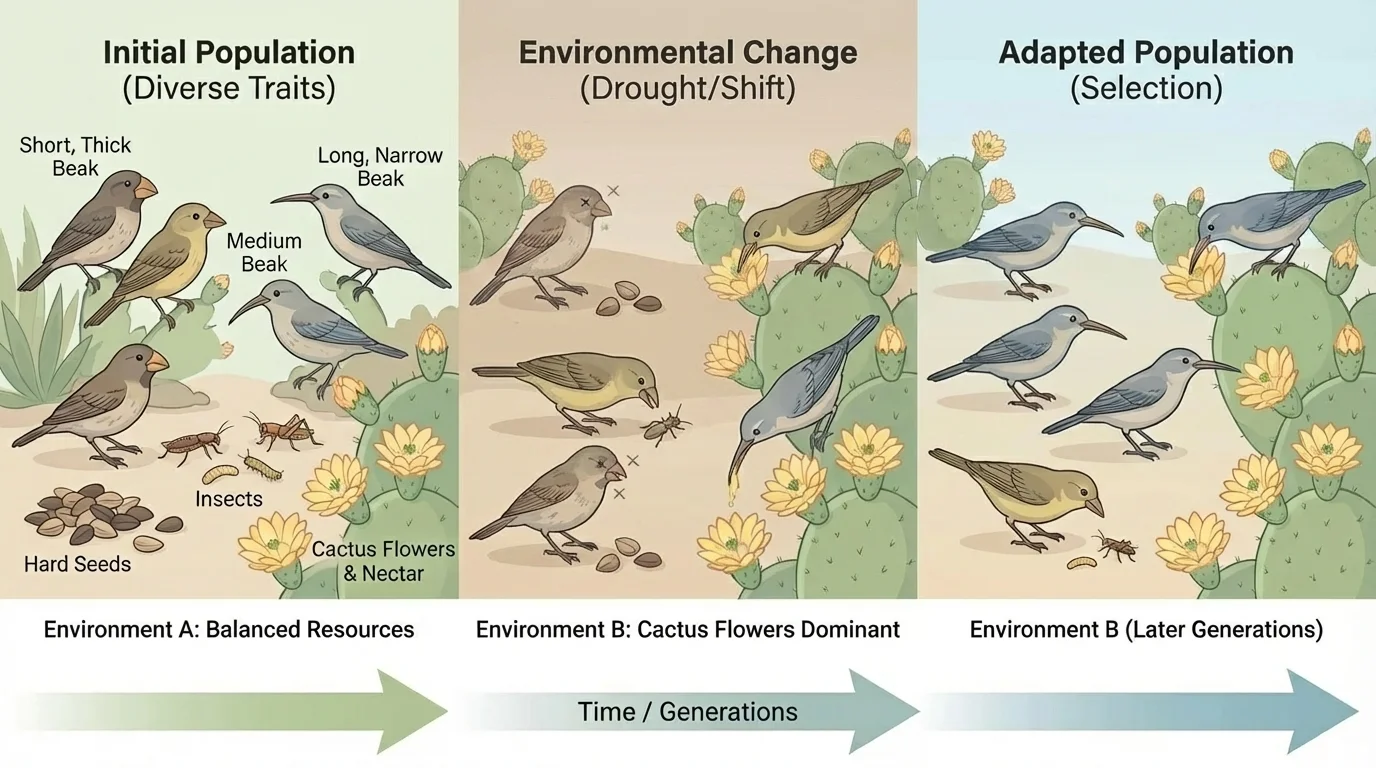
Another well-known example comes from Darwin's finches. These birds live on the Galápagos Islands, and different populations have different beak shapes. Some beaks are thick and strong for cracking seeds. Others are narrower for catching insects or feeding from flowers. Food supply helps shape which beak traits are useful.
Case study: a drought and seed-eating birds
A bird population includes individuals with small, medium, and large beaks.
Step 1: A drought changes the food supply.
After the drought, many small soft seeds are gone, but large hard seeds remain.
Step 2: Birds with larger, stronger beaks feed more successfully.
These birds survive in greater numbers because they can crack the hard seeds.
Step 3: Survivors reproduce.
If beak size is inherited, their offspring are more likely to have larger beaks too.
Step 4: The population changes.
After several generations, larger beaks become more common than before the drought.
The environment did not "give" birds larger beaks. It favored birds that already had that trait.
These examples help explain how new environmental pressures can push populations in different directions. They also show that adaptation is not random in its results, even though the variation it acts on may arise without regard to what the organism needs.
Food availability can favor different traits, as [Figure 3] illustrates with finches whose beak shapes match different foods. But food is only one factor. Temperature, rainfall, predators, disease, competition, nesting space, and access to mates can all affect which traits increase or decrease in a population.
If a climate becomes drier, plants that conserve water better may leave more offspring. If a new predator arrives, prey that run faster, hide better, or blend into the background may survive more often. If a disease spreads, individuals with inherited resistance may be more likely to live and reproduce.
Human actions also change environments. Deforestation removes habitats. Pollution changes water and air conditions. Overfishing changes which fish survive to reproduce. Even city life can create new pressures, such as noise, artificial light, and heat from buildings and pavement.
Some species can adapt if enough useful variation is present and if change is not too fast. Others cannot keep up. That is one reason why rapid environmental change can increase the risk of extinction.
Selection depends on context
A trait is not simply "good" or "bad." It is more or less helpful under certain conditions. The same trait can be favored in one environment, ignored in another, and selected against in a third.
The finch beaks in [Figure 3] make this idea clear. A thick beak is useful when hard seeds are common, but a narrow beak may be better when insects or nectar are the main food source.
Natural selection is powerful, but it is not the only thing that affects evolution. Also, not every change in a population is caused by selection. Still, for understanding adaptation, natural selection is one of the most important processes.
Selection can only act on inherited traits. If a trait is not passed from parents to offspring, it will not become more common through natural selection. For example, a scar from an injury may affect one individual, but it is not an inherited trait.
Selection also does not guarantee long-term survival. A population may be well adapted to one set of conditions and then face a sudden environmental shift that makes those traits less useful. If change is severe and rapid, the species may decline before helpful traits can spread.
Some features are trade-offs. A trait that helps in one way may cost energy or create another problem. Evolution often produces workable balances rather than perfect designs.
This helps explain why organisms can seem wonderfully fitted to their environments and still have limits. Every species is shaped by its history, its available variation, and the pressures of its environment.
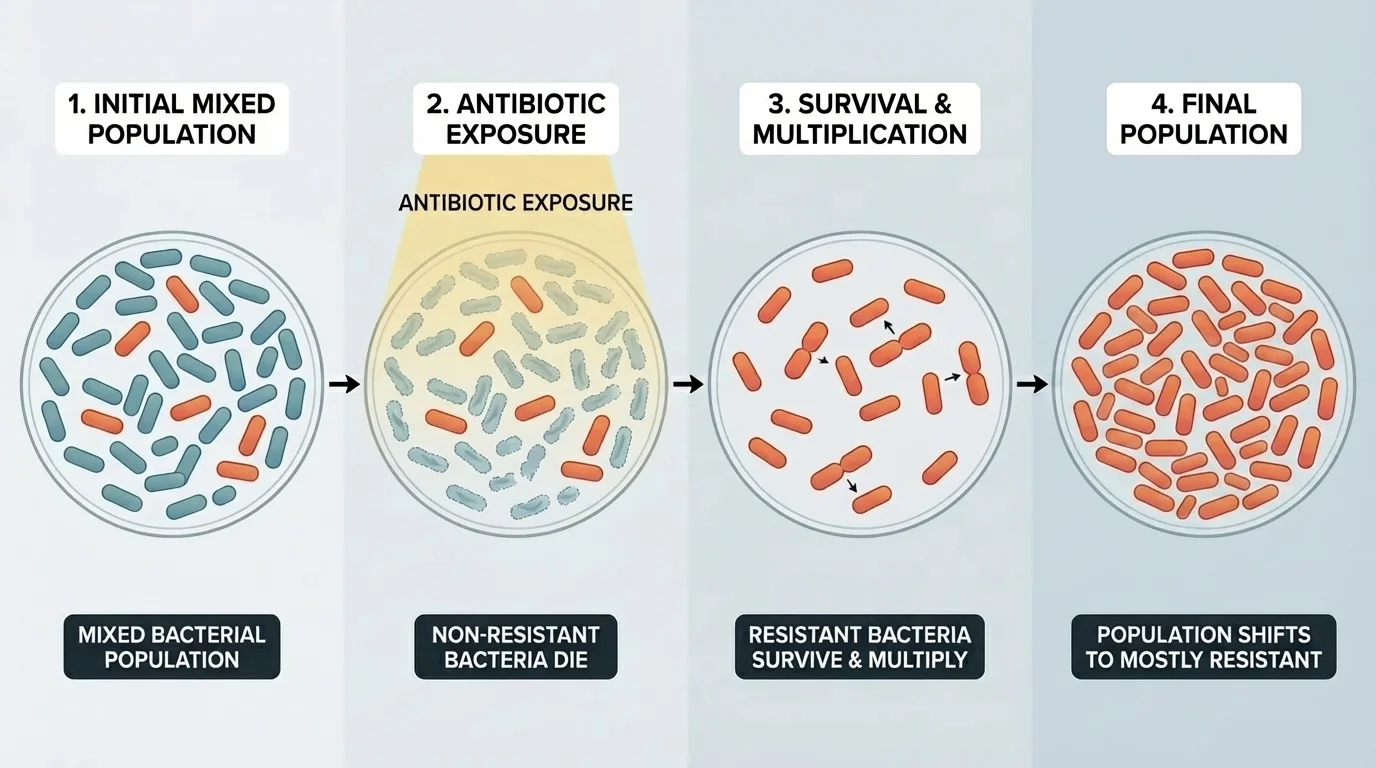
Natural selection is not just an idea from the distant past. It happens now. One striking modern example is antibiotic resistance, as [Figure 4] shows in a bacterial population exposed to an antibiotic. Some bacteria may carry an inherited trait that helps them survive an antibiotic treatment.
When the antibiotic is used, many non-resistant bacteria die. Resistant bacteria survive and reproduce. Soon, the population contains a larger proportion of resistant bacteria. This makes infections harder to treat and is one reason doctors stress careful antibiotic use.
The same pattern appears in agriculture. Insect populations may include a few individuals resistant to a pesticide. If the pesticide is used repeatedly, those resistant insects are the ones most likely to survive and reproduce. After many generations, the pesticide becomes less effective.
Conservation scientists also use ideas from natural selection. To protect species, they study habitat change, climate pressures, disease, and the amount of variation in populations. Populations with more genetic variation often have a better chance of adapting to new challenges.
| Situation | Environmental pressure | Trait favored | Possible result over generations |
|---|---|---|---|
| Peppered moths on dark bark | Predators can easily see poorly camouflaged moths | Darker coloration | Dark moths become more common |
| Finches during drought | Mostly hard seeds remain | Stronger, larger beaks | Larger beaks become more common |
| Bacteria exposed to antibiotics | Medicine kills non-resistant bacteria | Resistance traits | Resistant bacteria become more common |
| Plants in dry habitats | Little available water | Water-conserving structures | Drought-tolerant plants leave more offspring |
Table 1. Examples of environmental pressures, favored traits, and resulting population changes over generations.
The bacteria example connects back to the same idea we saw with beetles in [Figure 1]. In both cases, individuals with a helpful inherited trait survive at higher rates, and that trait becomes more common in the next generations.
Understanding natural selection helps explain the huge diversity of life on Earth. It shows why species can change, why populations differ from place to place, and why the living world is connected so closely to environmental conditions.
