If Earth had kept a diary, it would be more than 4.6 billion years long—and most of its pages would be made of rock. Scientists cannot travel back in time to watch mountains rise, seas advance, or dinosaurs disappear. Instead, they study layers of rock and the fossils inside them. Those clues let them put events in order, even when they cannot say the exact year something happened.
The system used to organize this long story is called the geologic time scale. It is like a giant calendar for Earth, but instead of days and months, it uses huge stretches of time such as eons, eras, periods, and epochs. This time scale is not based on guessing. It is built from evidence found in rock strata and the fossil record across the world.
One very important idea is that layers of rock and fossils usually give relative dating. That means they tell which event happened earlier and which happened later. They do not usually tell the exact number of years ago. If one rock layer lies below another, or if one fossil type appears before another in the sequence, scientists can place them in order without knowing an exact date.
Relative dating is determining whether something is older or younger than something else. Absolute dating is finding a more exact numerical age, often in years. The geologic time scale was first built mostly from relative dating, using rock layers and fossils.
That difference matters. If you know your great-grandparent is older than your grandparent, and your grandparent is older than your parent, you have the order right even if you do not know anyone's birth year. Geologists often work in the same way when they read Earth's rocks.
Earth changes slowly on human timescales but dramatically over millions of years. Oceans open and close. Continents drift. Species appear, change, and go extinct. Without an organized system, all of those events would be a confusing pile of facts. The geologic time scale gives scientists a framework for arranging those events from oldest to youngest.
The largest divisions are eons. Eons are divided into eras, eras into periods, and periods into epochs. These divisions are based on major changes in Earth's rocks, climate, and living things. For example, the end of the Mesozoic Era is marked by the mass extinction that included the non-avian dinosaurs.
This means the geologic time scale is not just a list of dates. It is an interpretation of Earth's history based on patterns found in rocks and fossils. Scientists look for major turning points, such as the rise of abundant oxygen, the appearance of complex life, or large extinction events.
The oldest rocks on Earth are far younger than Earth itself in many places because older rocks have often been changed, buried, melted, or destroyed. Earth's history is ancient, but its rocky record is incomplete.
Because the rock record is incomplete, scientists must compare clues from many locations. A single cliff or canyon shows only part of the story. When evidence from many rock layers around the world is combined, a much clearer timeline appears.
Many rocks form in layers called strata, especially sedimentary rocks. These layers build up when sediments such as sand, mud, shells, and tiny mineral pieces settle over time. As more material piles on top, lower layers are squeezed and hardened into rock. Scientists read these layers like pages in a history book.
A layer may record a beach, a swamp, a desert, or the bottom of an ancient sea. A layer made mostly of sand might suggest a beach or dune environment. A layer with shells may show that the area was once underwater. Coal often forms from plant-rich swamp environments. By studying the rock's materials and structure, geologists infer what the environment was like when that layer formed.
In places such as the Grand Canyon, rock layers are exposed in tall cliffs, making Earth's past easier to see. The deeper layers are usually older than the layers above them. This does not mean every stack of rocks is perfectly preserved, but it gives geologists a starting rule for interpretation.
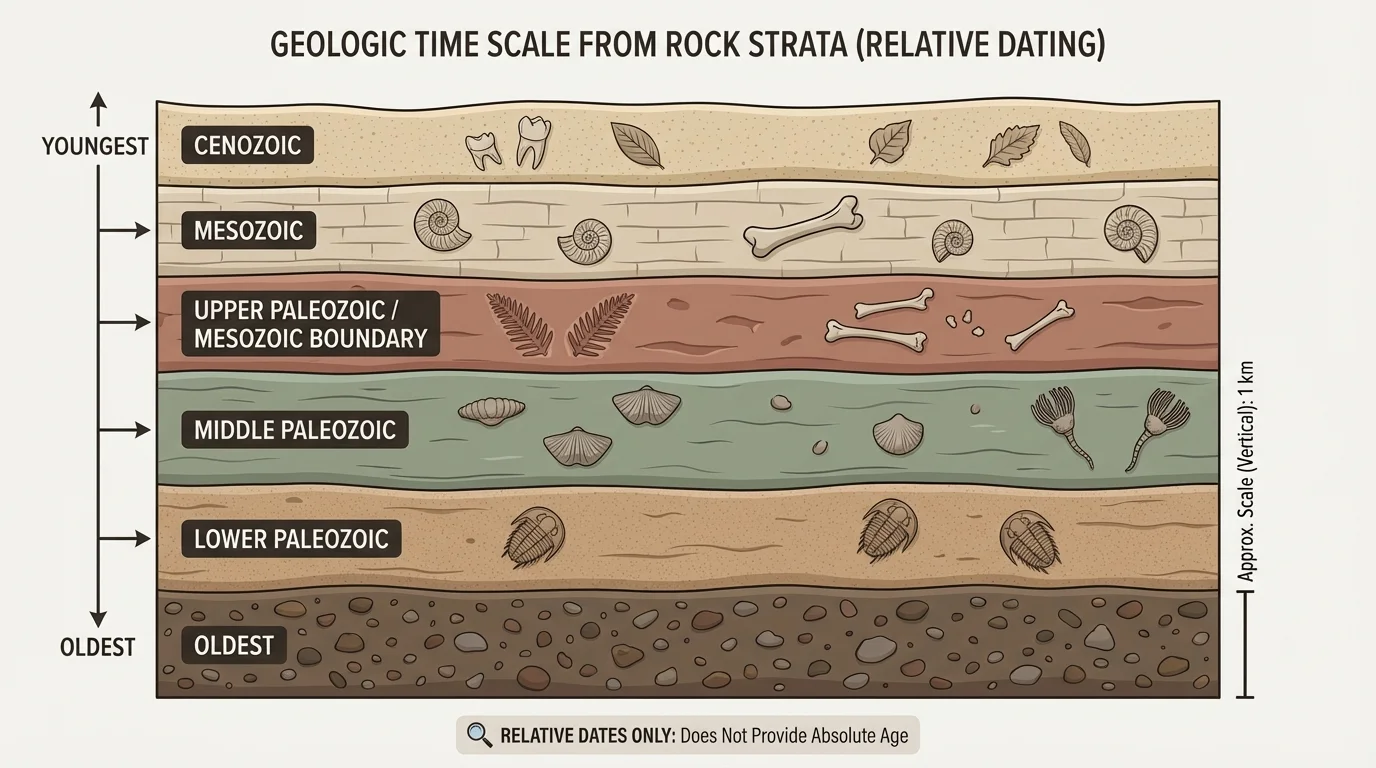
Rock strata can also reveal change over time. Suppose one area has a limestone layer with marine fossils, then a sandstone layer, then a soil-rich rock with plant remains. That pattern may suggest the area changed from shallow sea to shoreline to land. The order matters because it tells a story of changing environments.
Much later, when geologists compare different places, they may find similar sequences and begin connecting local histories into a larger regional or global one. The layered order we see in [Figure 1] becomes the basic idea behind reading Earth history in many rock formations.
Scientists do not just glance at rocks and guess. They use a set of ideas developed over centuries. These principles help them make careful interpretations. One of the most important is the law of superposition: in an undisturbed sequence of sedimentary rocks, the oldest layer is at the bottom and the youngest is at the top. Other principles also help when the rocks are not perfectly simple.
Another principle is original horizontality. Sediments are usually deposited in mostly flat, horizontal layers. If rock layers are tilted or folded today, that bending must have happened after the layers formed. This helps scientists recognize that some geologic event changed the rocks later.
Lateral continuity means layers often extend outward over a wide area before they are cut by erosion or interrupted by valleys. This allows geologists to match the same layer from one place to another, even if the land between them has been worn away.
Cross-cutting relationships are especially useful. If a crack, fault, or igneous intrusion cuts across rock layers, the cutting feature is younger than the layers it cuts through. For example, if molten rock pushes upward and hardens inside older sedimentary layers, the intrusion must have happened after those layers already existed.
Geologists also look for unconformities, which are gaps in the rock record caused by erosion or by long periods when no new layers formed. An unconformity is like missing pages in a book. The story jumps, and scientists know some history is not preserved there.
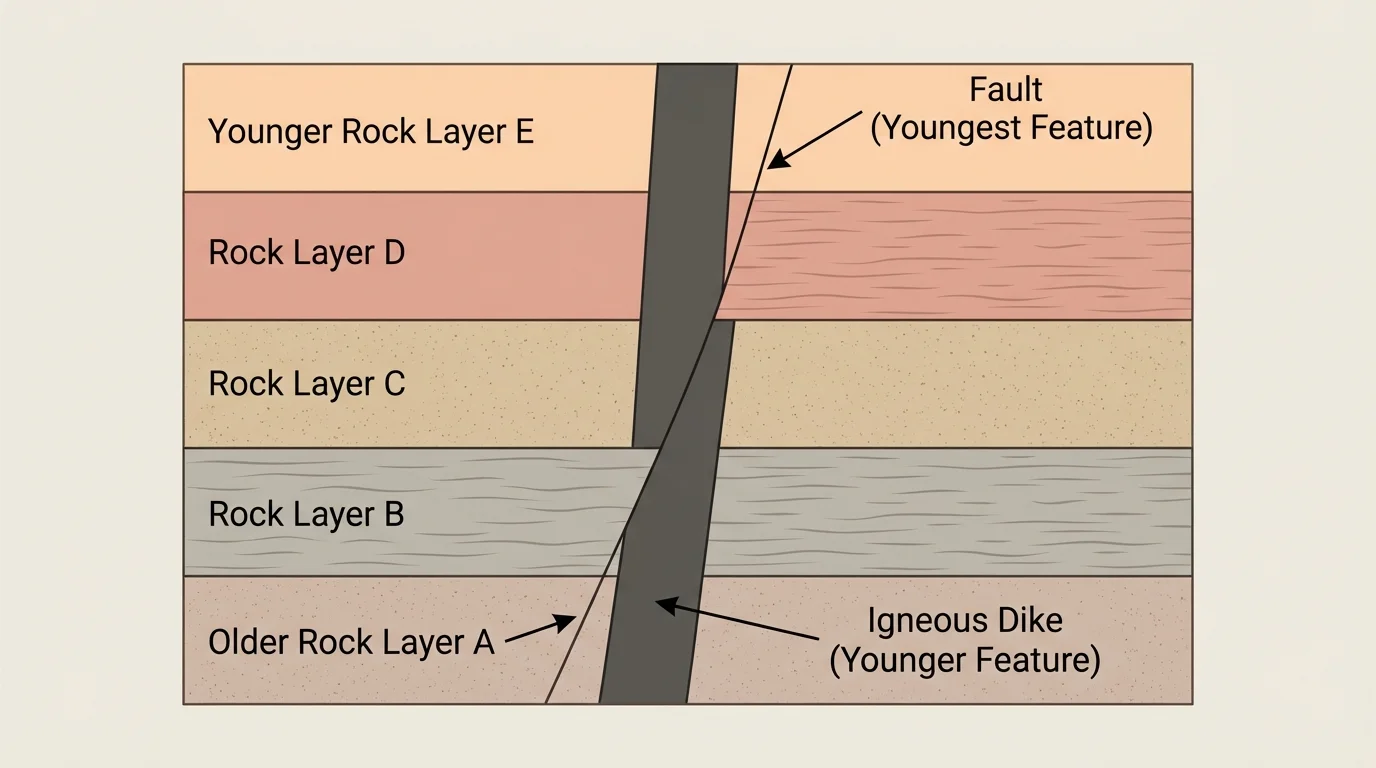
These principles are powerful because they work together. A tilted stack of layers cut by a fault tells a sequence: first sediments were deposited, then the layers hardened, then they were tilted, and later a fault cut through them. Geologists reconstruct the order step by step, even without an exact year for each event.
Example: Interpreting a rock sequence
A cliff shows three sedimentary layers. Layer A is on the bottom, Layer B is in the middle, and Layer C is on top. A fault cuts through all three layers.
Step 1: Use superposition.
Layer A formed first, then Layer B, then Layer C.
Step 2: Use cross-cutting relationships.
Because the fault cuts Layers A, B, and C, the fault is younger than all three layers.
Step 3: Put the events in order.
The order is: Layer A forms, Layer B forms, Layer C forms, and then the fault occurs.
This is a relative sequence. It tells what came before and after, but not the exact age in years.
That kind of reasoning is one reason geologists can decode complicated rock outcrops. Even when landscapes have been broken, tilted, or eroded, the order of events can still be worked out from the evidence left behind.
Rocks are not the only clues. The fossil record adds biological evidence to the story. Fossils are remains, traces, or impressions of ancient organisms preserved in rock. They show that different organisms lived at different times in Earth's history. Scientists use these patterns to compare rock layers from different locations.
If the same fossil species is found in rock layers far apart, those layers may be about the same relative age. This is especially helpful when the rocks themselves look different. A fossil can act like a time marker.
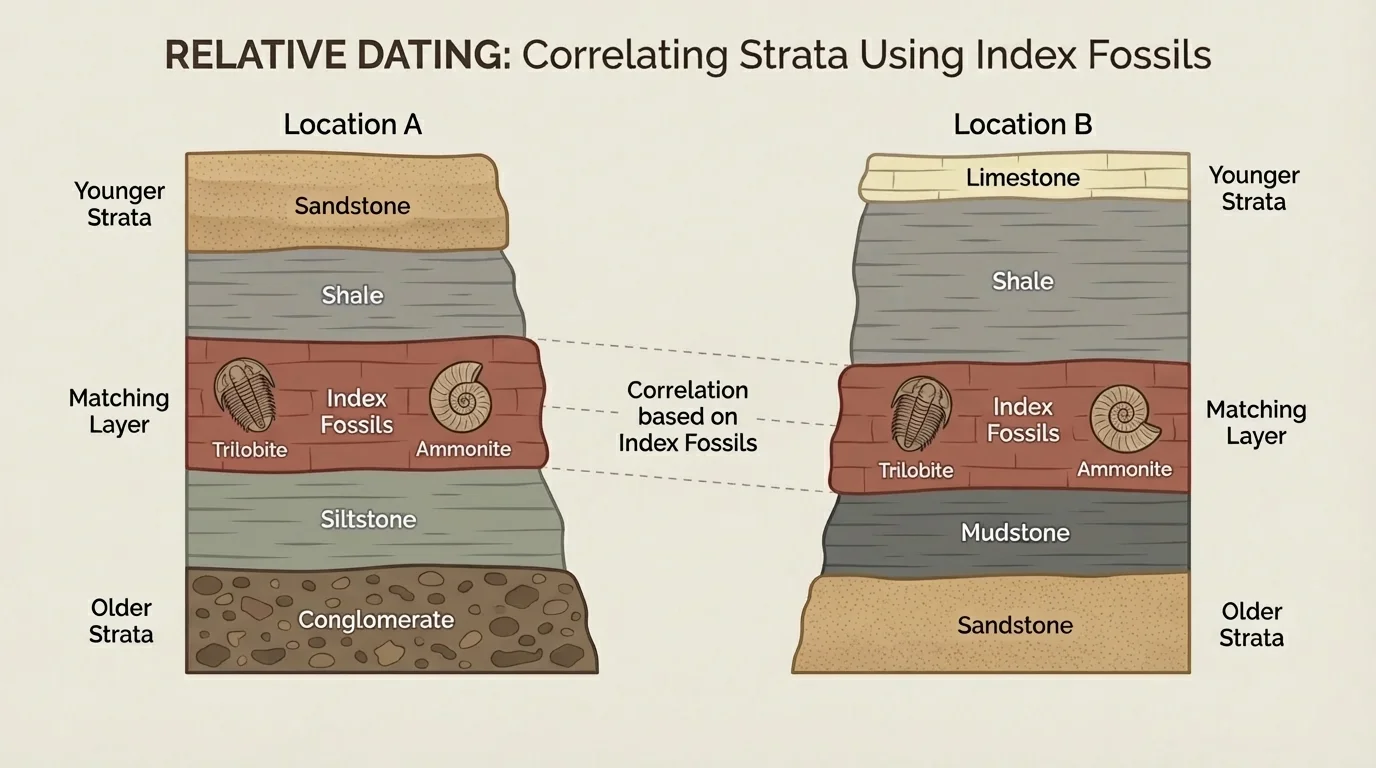
Some fossils are especially useful and are called index fossils. An index fossil comes from a species that was widespread, easy to recognize, and lived for a relatively short span of geologic time. Because that species existed during only a limited interval, finding it in a rock layer helps geologists estimate that layer's relative position in time.
For example, if a certain ammonite species is known only from a particular period, then a rock containing that ammonite likely formed during the same part of geologic history. If another rock far away contains the same ammonite, geologists can correlate the two layers even if they formed in different environments.
Fossils also reveal change in life over time. Lower, older layers may contain simple marine organisms, while younger layers contain fish, reptiles, mammals, or flowering plants. This pattern helped scientists recognize that Earth has a long history with major biological changes.
The fossil record is not perfect. Most organisms do not become fossils. Soft-bodied organisms are less likely to be preserved than those with shells or bones. Erosion can destroy fossils, and some environments are much better for preservation than others. Even so, repeated patterns from many places make the record extremely valuable.
How correlation works
Correlation means matching rock layers from different places because they share important features, such as the same index fossils or the same distinctive sequence of layers. Correlation lets geologists build a larger history from separate local records.
When geologists compare distant rock columns, they are using the same logic as matching chapters from torn copies of the same book. The matching fossil layer in [Figure 3] helps connect separate pieces into one broader timeline.
It is important not to mix up two different kinds of age information. Relative dating tells order. Absolute dating gives a numerical age, often in years. Rock strata and fossil sequences are most directly used for relative dating. They answer questions such as: Which layer is older? Which fossil appeared first? Which event happened before the fault?
Absolute ages usually require other methods, especially radiometric dating. This method uses radioactive elements in certain minerals. These elements change at steady rates into other elements over time. By measuring how much has changed, scientists estimate the age of the rock.
A simple way to think about this is with half-life. A half-life is the time it takes for half of a radioactive sample to decay into another substance. If a mineral starts with a certain amount of a radioactive element and one half-life passes, half remains. After another half-life, half of that half remains.
Example: A half-life pattern
Suppose a rock mineral originally contained 100 units of a radioactive element. After one half-life, 50 units remain. After two half-lives, 25 units remain.
Step 1: Start with the original amount.
The starting amount is 100 units.
Step 2: Apply one half-life.
100 becomes 50 because half remains.
Step 3: Apply a second half-life.
50 becomes 25.
The pattern is numerical, but the main idea is that radioactive change gives a way to estimate an actual age. Rock layers and fossils alone usually do not provide that exact number.
Relative dating and absolute dating work best together. Relative dating gives the order of events. Absolute dating helps place parts of that order on a numerical timeline. But the key idea here is that the geologic time scale was organized first from relative evidence in rocks and fossils, and numerical ages were added later as methods improved.
The geologic time scale is built by combining evidence from rock strata, fossils, and later numerical dating. Scientists from many countries compare rock sequences, identify major changes, and divide Earth's history into meaningful sections.
These divisions often reflect major events. For example, one boundary may mark the appearance of abundant visible life in the oceans. Another may mark a mass extinction. Another may reflect the spread of mammals after the extinction of many reptiles. The boundaries are based on evidence in the rock record, not just on neat calendar-style spacing.
Three broad parts of Earth history are often emphasized in middle school science: the Precambrian, the Paleozoic, the Mesozoic, and the Cenozoic. The Precambrian covers most of Earth's history and includes the earliest life. The Paleozoic includes the spread of marine life and the first life on land. The Mesozoic is famous for dinosaurs. The Cenozoic is the age of mammals; it includes human history, which is only a tiny fraction of the whole timescale.
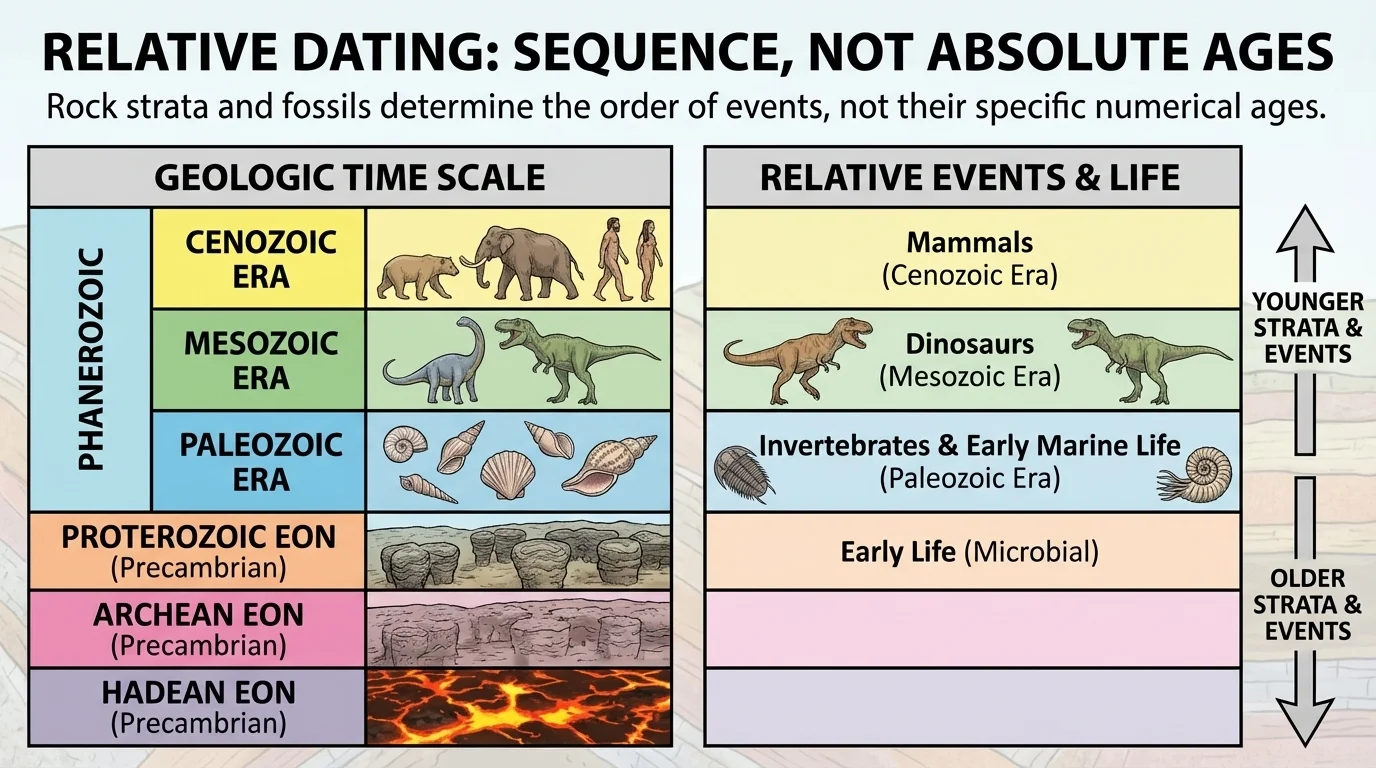
This organized scale helps scientists compare events from different places. A fossil found in one continent can be discussed in relation to rocks on another continent because both are placed within the same larger system. The geologic time scale acts like a shared language for Earth history.
| Division | What it means | Example of what may mark it |
|---|---|---|
| Eon | Largest major division of geologic time | Huge changes in Earth's early history |
| Era | Subdivision of an eon | Major changes in life forms |
| Period | Subdivision of an era | Distinct fossil patterns and rock layers |
| Epoch | Subdivision of a period | More specific environmental and biological changes |
Table 1. Major divisions used to organize the geologic time scale.
When students first see the geologic time scale, it can seem like a list to memorize. It is more meaningful to see it as the result of detective work. The time scale in [Figure 4] represents many observations stitched together into one long, evidence-based history.
Reading rock layers is not just about ancient life. Geologists use relative dating when searching for groundwater, fossil fuels, and useful minerals. If a rock layer that stores water is found in one place, matching that layer elsewhere can help locate underground water supplies.
Oil and natural gas companies also study strata and fossils to identify promising rock formations. Paleontologists use relative dating to place new fossil discoveries into the story of life. Environmental scientists study past climate changes recorded in rock and sediment layers to better understand present climate trends.
Relative dating also helps explain natural hazards. Understanding where faults cut through younger or older rocks can reveal the order of tectonic events in a region. That information supports better knowledge of earthquake history and landscape change.
Earth's surface is constantly shaped by weathering, erosion, deposition, plate movement, and volcanic activity. Those processes create, destroy, and rearrange the rock record, which is why geologists must interpret evidence carefully.
Even museum displays depend on these ideas. When you walk past a dinosaur skeleton placed in the Mesozoic Era section, that placement comes from evidence in rock layers, fossil sequences, and later age measurements.
The rock record is incomplete. Some layers were never formed. Some were eroded away. Others were buried so deeply that heat and pressure changed them. In some places, rocks melted and became igneous rock, erasing older details. These gaps mean Earth's history must be reconstructed from partial evidence.
Also, layers are not always neat and flat. They can be folded, faulted, overturned, or metamorphosed. Fossils may be rare, broken, or absent. Correlations between places may be uncertain at first. This is why geology involves interpretation, testing, and revision.
That does not mean the evidence is weak. It means science becomes stronger by checking many clues together. A single outcrop may mislead, but repeated patterns from rocks, fossils, chemistry, and physics create a much more dependable picture.
"The present is the key to the past."
— A basic principle of geology
Scientists continue refining the geologic time scale as new evidence appears. Better dating methods, newly discovered fossils, and improved global comparisons can sharpen boundaries and fill in missing parts of the story. The overall picture remains clear: Earth has a very long history, and rock strata plus the fossil record provide a way to organize that history mainly by relative age.
