A rocket lifts off because burning fuel pushes gas downward, and the gas pushes the rocket upward at the same time. A soccer ball speeds up only when a force acts on it. A heavy shopping cart is harder to start moving than an empty one. These are not separate facts—they are all connected by a few powerful ideas about forces and motion.
A force is a push or a pull. Some forces happen through direct contact, like your hand pushing a door or your shoe pushing the ground. Other forces act from a distance, like gravity pulling objects toward Earth or a magnet pulling on certain metals.
Forces can change how an object moves. They can start motion, stop motion, speed an object up, slow it down, or change its direction. If you roll a basketball and then tap it from the side, the ball curves because the sideways force changes its motion.
To talk about motion clearly, scientists describe where an object is, how fast it is moving, and in what direction it moves. Motion is not just about speed. A skateboard moving north at a certain speed is different from one moving south at the same speed because direction matters too.
Motion is a change in position over time. Position tells where something is compared with a chosen starting point. Direction tells which way something is moving or which way a force acts.
When you study motion, you are really studying the relationship between forces and the object's response. Some objects respond with only a tiny change in motion, while others respond strongly. That depends on both the force and the object's mass.
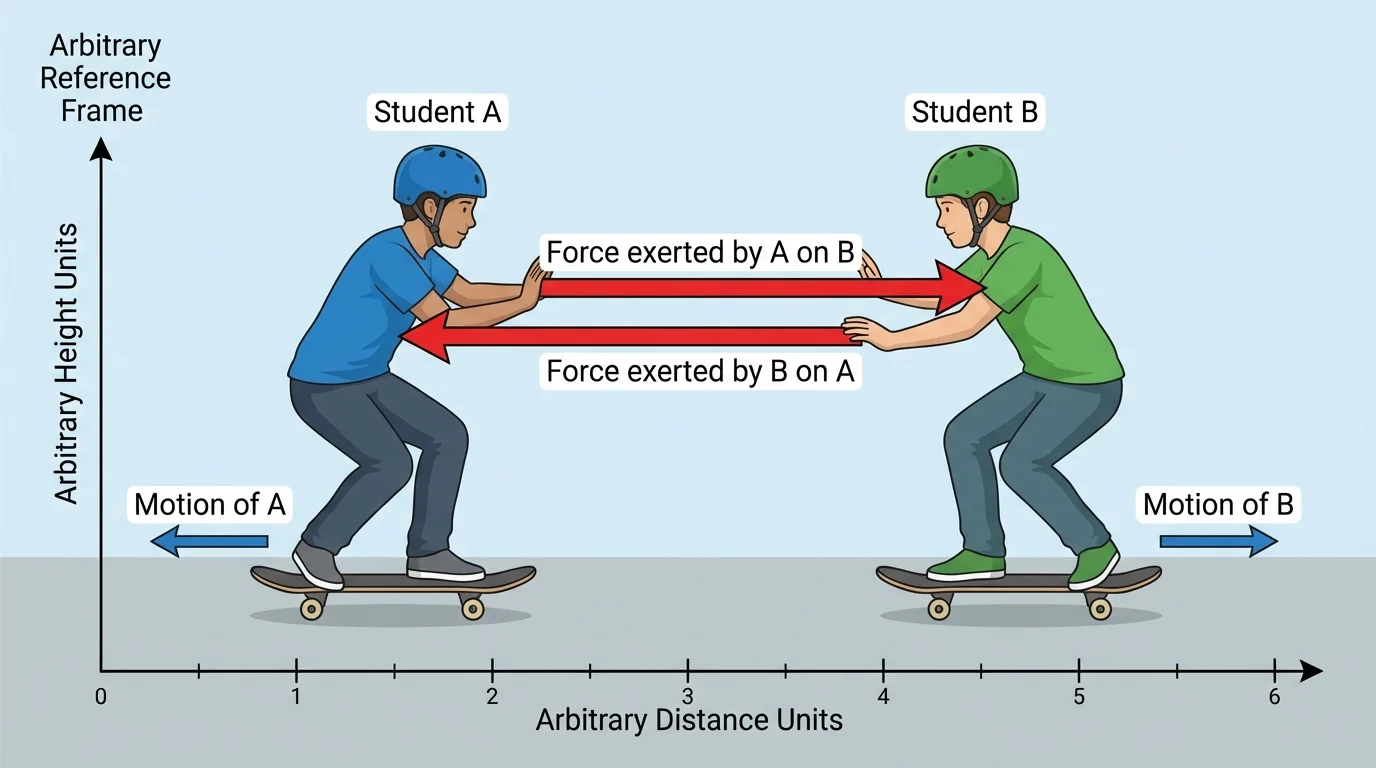
One of the most surprising ideas in physics is that a force never appears by itself. Whenever two objects interact, each one pushes or pulls on the other. This is Newton's third law, and [Figure 1] illustrates it with two students on skateboards: if student A pushes student B, then student B pushes student A with the same strength in the opposite direction.
This does not mean the two forces cancel each other out, because they act on different objects. One force acts on student A. The other force acts on student B. Since the forces act on different objects, each object can still change its motion.
If you jump off a small boat, your feet push backward on the boat, and the boat pushes forward on you. Both forces are equal in size and opposite in direction. Usually, the boat and your body move different amounts because they may have different masses and because water resists the boat's motion.
Walking is another example. Your foot pushes backward on the ground. The ground pushes forward on your foot. That forward force from the ground helps move you ahead. Without enough friction between your shoe and the ground, such as on ice, it becomes hard to walk because the interaction changes.
Equal and opposite does not mean no motion
Students often think that if forces are equal and opposite, nothing can move. The important detail is where the forces act. In Newton's third law, the paired forces act on different objects. Motion depends on the forces acting on one object at a time.
A rocket is a dramatic example. Hot gases rush out of the engine downward. The rocket pushes on the gases, and the gases push on the rocket upward. The upward push on the rocket helps it accelerate into the sky. The same law explains why a balloon zooms around a room when air rushes out the back.
Later, when we talk about net force, the skateboard example in [Figure 1] remains useful because it reminds us to separate the forces on one object from the forces on another object. That habit helps avoid many mistakes.
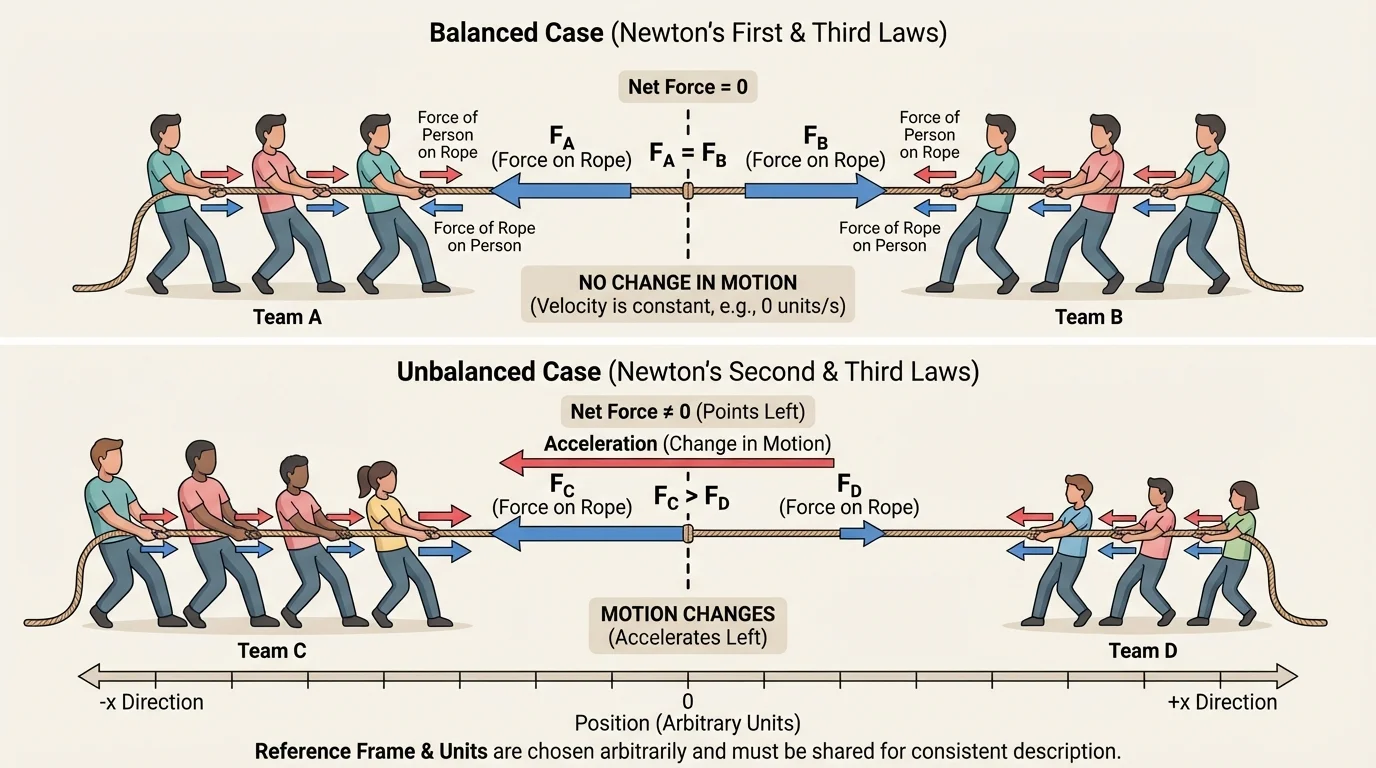
An object may have many forces acting on it at once. The combined effect of all these forces is called net force. As [Figure 2] shows in a tug-of-war example, the net force depends on both the size of the forces and their directions.
If the total force on an object is zero, the object's motion does not change. That means an object at rest stays at rest, and an object already moving keeps moving at the same speed in the same direction. Forces are then called balanced forces.
If the total force is not zero, the object's motion changes. It may speed up, slow down, or turn. Forces are then called unbalanced forces. For example, if one team in tug-of-war pulls harder than the other, the rope and the weaker team begin moving toward the stronger team.
Suppose one student pushes a box to the right with a force of \(10 \textrm{ N}\), and friction pushes to the left with \(10 \textrm{ N}\). The net force is \(0 \textrm{ N}\), so the box's motion does not change. But if the push is \(15 \textrm{ N}\) to the right and friction is \(10 \textrm{ N}\) to the left, then the net force is \(5 \textrm{ N}\) to the right.
This can be written as \(15 - 10 = 5\). The box then changes its motion in the direction of the net force. If it was at rest, it starts moving right. If it was already moving right, it speeds up. If it was moving left, it slows down.
Finding net force in one direction
A toy car is pushed forward by \(8 \textrm{ N}\). Friction acts backward with \(3 \textrm{ N}\). What is the net force?
Step 1: Identify the forces and directions.
Forward force is \(8 \textrm{ N}\). Backward force is \(3 \textrm{ N}\).
Step 2: Subtract because the forces act in opposite directions.
\(8 - 3 = 5\)
Step 3: State the direction.
The net force is \(5 \textrm{ N}\) forward.
The toy car changes its motion forward.
Gravity and support forces also often balance. A book resting on a table is pulled downward by gravity, while the table pushes upward on the book. Those two forces can be equal in size, giving a net force of zero. The book does not fall through the table or fly upward.
The balanced and unbalanced cases in [Figure 2] also help explain sports. A baseball changes speed and direction when a bat exerts an unbalanced force on it. After the ball leaves the bat, other forces such as gravity and air resistance continue to affect its motion.
Mass is the amount of matter in an object. In motion studies, mass measures how strongly an object resists changes in motion. A bowling ball and a tennis ball can both be kicked, but the bowling ball is much harder to speed up because it has more mass.
The change in motion caused by a force is called acceleration. Acceleration means a change in velocity, and velocity includes both speed and direction. So an object accelerates if it speeds up, slows down, or turns.
The main relationship between force, mass, and acceleration is:
\(F = ma\)
Here, \(F\) is net force, \(m\) is mass, and \(a\) is acceleration. This equation tells us two key ideas. For a given mass, a larger force produces a larger acceleration. For a given force, a larger mass produces a smaller acceleration.
If a cart has mass \(2 \textrm{ kg}\) and the net force on it is \(6 \textrm{ N}\), then its acceleration is \(a = \dfrac{F}{m} = \dfrac{6}{2} = 3 \textrm{ m/s}^2\). If the same \(6 \textrm{ N}\) force acts on a cart with mass \(3 \textrm{ kg}\), then \(a = \dfrac{6}{3} = 2 \textrm{ m/s}^2\). The heavier cart accelerates less.
Comparing two masses with the same force
A force of \(12 \textrm{ N}\) acts on two boxes. Box A has mass \(3 \textrm{ kg}\). Box B has mass \(6 \textrm{ kg}\). Find each acceleration.
Step 1: Use \(a = \dfrac{F}{m}\).
Step 2: Calculate Box A.
\(a = \dfrac{12}{3} = 4 \textrm{ m/s}^2\)
Step 3: Calculate Box B.
\(a = \dfrac{12}{6} = 2 \textrm{ m/s}^2\)
Box A accelerates more because it has less mass.
Now keep the mass the same and change the force. If a \(4 \textrm{ kg}\) wagon is pulled with \(8 \textrm{ N}\), its acceleration is \(\dfrac{8}{4} = 2 \textrm{ m/s}^2\). If the pull increases to \(16 \textrm{ N}\), the acceleration becomes \(\dfrac{16}{4} = 4 \textrm{ m/s}^2\). Doubling the force doubles the acceleration when mass stays the same.
This is why trucks need strong engines and why athletes must exert more force to throw a heavy shot put than a light ball. It is also why seat belts matter. In a moving car, your body wants to keep its current motion. The seat belt exerts a force that changes your motion and keeps you from continuing forward.
A fully loaded cargo ship has such a huge mass that even after its engines are reversed, it can take a long distance to slow down. The same force changes its motion much less quickly than it would for a small boat.
These ideas connect directly back to Newton's third law. When two objects exert equal forces on each other, they may still accelerate differently because their masses are different. That is why, in the skateboard example from [Figure 1], a lighter student usually rolls away faster than a heavier student.
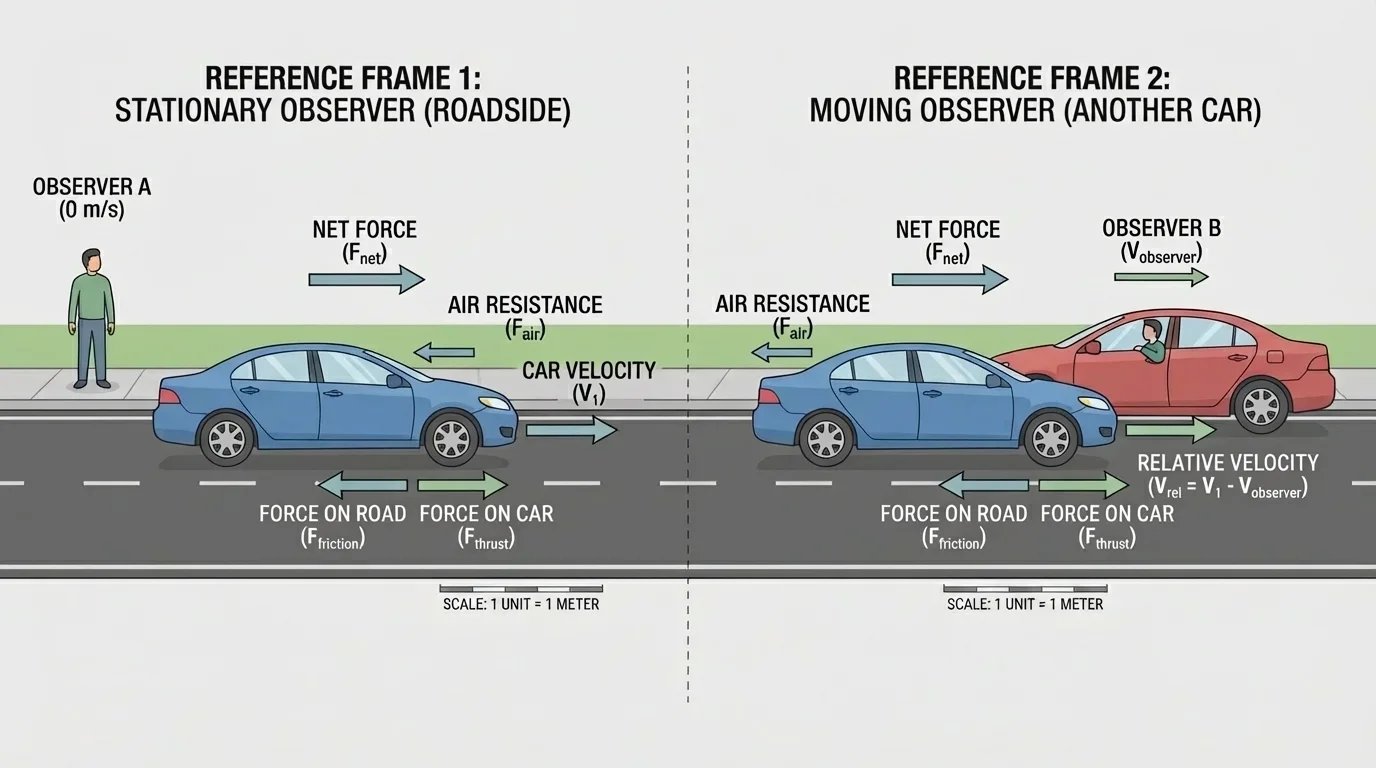
Describing motion requires a reference frame, which is a chosen point of view used to measure position and motion. As [Figure 3] illustrates, a car may look fast to a person standing on the roadside but may seem almost still to someone traveling beside it at the same speed and in the same direction.
This means statements like "the car is moving" are incomplete unless we say relative to what. Relative to the road, the car moves. Relative to a passenger sitting inside the car, the seat may not seem to move at all.
Scientists also use agreed units so other people can understand and compare measurements. Distance might be measured in meters or kilometers. Time might be measured in seconds. Speed might be measured in meters per second, written as \(\textrm{m/s}\). Force is often measured in newtons, written as \(\textrm{N}\).
If one student says a toy car moved "far" and another says it moved "about \(2 \textrm{ m}\) east from the chair," the second description is much more useful because it gives a reference point, a distance, and a direction. Shared choices make scientific communication possible.
| Quantity | What it describes | Common unit |
|---|---|---|
| Distance | How far an object moves | \(\textrm{m}\) |
| Time | How long motion lasts | \(\textrm{s}\) |
| Speed | Distance per time | \(\textrm{m/s}\) |
| Force | Push or pull | \(\textrm{N}\) |
| Mass | Amount of matter | \(\textrm{kg}\) |
Table 1. Common quantities and units used to describe motion and forces.
Reference frames are important in space travel too. Astronauts orbiting Earth are moving very fast relative to Earth's surface, but relative to their spacecraft, they may appear nearly motionless. The point of view matters.
You already know that direction matters in maps and coordinates. Motion uses the same idea: saying "left," "right," "north," "upward," or "downward" can change the meaning completely.
The two viewpoints in [Figure 3] show why scientists must share both units and reference frames. Without that information, two people can describe the same motion in different ways and both be correct from their own perspectives.
Sports are full of force and motion. A tennis player swings harder to give the ball a greater acceleration. A heavier medicine ball requires more force than a tennis ball to achieve the same change in motion. When a basketball player jumps, the player pushes down on the floor, and the floor pushes up on the player.
Transportation depends on these ideas every day. Car designers use brakes to create forces opposite the car's motion. Engineers design tires to provide friction with the road. Airbags and seat belts increase safety by helping control the forces that change a passenger's motion during a sudden stop.
Rockets, jet engines, and even squid in the ocean show Newton's third law. Each moves by pushing matter backward so that the matter pushes the object forward. Nature and technology often use the same basic physics.
Using \(F = ma\) in a real situation
A robot cart has mass \(5 \textrm{ kg}\). Its motor provides a net forward force of \(20 \textrm{ N}\). What is its acceleration?
Step 1: Use the formula.
\(a = \dfrac{F}{m}\)
Step 2: Substitute the values.
\(a = \dfrac{20}{5}\)
Step 3: Calculate.
\(a = 4 \textrm{ m/s}^2\)
The robot cart accelerates at \(4 \textrm{ m/s}^2\).
In engineering, knowing how force affects motion helps people build bridges, elevators, bicycles, amusement park rides, and protective gear. In medicine, understanding force and motion helps explain how bones break, how helmets protect the head, and how prosthetic limbs are designed.
You can observe these ideas with safe classroom materials. Roll two balls with different masses using the same gentle push. The lighter ball usually changes motion more. Push off from a wall while sitting on a wheeled chair, and the chair rolls backward because of the interaction between you and the wall.
One common misunderstanding is thinking that moving objects must always have a force pushing them forward. Actually, if the net force is zero, an object can keep moving at a constant speed in a straight line. On Earth, friction and air resistance often slow moving objects, so it can seem as if force is needed just to keep them going.
Another misunderstanding is mixing up mass and weight. Mass is the amount of matter in an object. Weight is the force of gravity acting on that mass. On the Moon, your mass stays the same, but your weight is less because the Moon's gravity is weaker than Earth's.
Why motion on Earth can be confusing
Everyday life includes friction almost everywhere. That means many objects slow down unless something keeps pushing them. This can hide the deeper rule that changing motion depends on net force, not simply on whether an object is already moving.
Careful thinking about which forces act, on which object they act, and whether they balance helps make sense of situations that first seem tricky.
Suppose two students push identical carts. One cart is empty, and one carries a heavy stack of books. If each student pushes with the same force, the empty cart accelerates more because its mass is smaller. If the heavy cart is to accelerate the same amount, it needs a greater force.
Now think about a swimmer pushing water backward. The swimmer pushes on the water, and the water pushes on the swimmer forward. That is Newton's third law. Whether the swimmer speeds up depends on the net force on the swimmer after including water resistance and other forces.
To describe that swimmer's motion well, you would need a reference frame and units. You might say the swimmer moved \(25 \textrm{ m}\) east across the pool in \(20 \textrm{ s}\), relative to the starting wall. That statement is much clearer than simply saying the swimmer moved "quickly."
Physics becomes powerful when these ideas are combined: forces come in pairs, motion changes when net force is not zero, mass affects how much motion changes, and good measurements require shared reference frames and units.
