A basketball drops through a hoop, a backpack gets lifted onto a desk, and two magnets can snap together without even touching first. These events may look very different, but they all share one big idea: when objects interact, they exert forces on each other, and those forces can transfer energy from one object or system to another.
In science, energy is the ability to cause change, and a force is a push or a pull. These ideas are closely connected. A force can change an object's motion, shape, or position. When that happens, energy is often being transferred, stored differently, or released.
Sometimes the energy transfer is easy to notice. If you kick a soccer ball, energy from your moving leg is transferred to the ball, and the ball speeds up. Sometimes the transfer is less obvious. If you slowly lift a book from the floor to a shelf, the book may end up at rest, but energy has still been transferred to the Earth-book system because the book is now higher above the ground.
Force is a push or pull that one object exerts on another.
Energy transfer is the movement of energy from one object or system to another.
System is the group of objects we choose to study together, such as the Earth and a ball.
A very important rule is that forces always come from interactions. One object cannot exert a force all by itself. If object A pushes, pulls, attracts, or repels object B, then object B also exerts a force on object A. The forces are part of the same interaction.
When two objects interact, several things may happen. Energy may be transferred to an object, transferred from an object, or stored in the system formed by the interacting objects. This is why scientists often talk about systems instead of single objects.
For example, if you push a toy car across the floor, your hand and the car interact. Your hand exerts a force on the car, and the car exerts a force on your hand. Because of that interaction, energy is transferred from your body to the car. The car gains kinetic energy, but some energy also becomes thermal energy because of friction with the floor.
The direction of energy transfer matters. If a force speeds an object up, the object usually gains kinetic energy. If a force slows an object down, the object usually loses kinetic energy, and that energy goes somewhere else, often to thermal energy, sound, or deformation.
You may already know that moving objects have kinetic energy and that position can matter too. This lesson builds on that idea by showing how forces cause those energy changes.
Another key idea is that energy can be stored in fields or in the arrangement of objects. In middle school science, one especially important example is the energy stored in the gravitational field energy of an Earth-object system.
Imagine lifting a bottle from the floor to a table. The bottle and Earth form a system, and raising the bottle increases the gravitational field energy of that system. Your muscles transfer energy to the system by exerting an upward force while the bottle moves upward.
The higher the bottle is raised, the more gravitational field energy the Earth-bottle system has. If the bottle then falls, that stored energy is released. The mechanism that transfers the energy during the fall is the gravitational force. Gravity pulls the bottle downward, and the bottle speeds up as gravitational field energy decreases and kinetic energy increases.
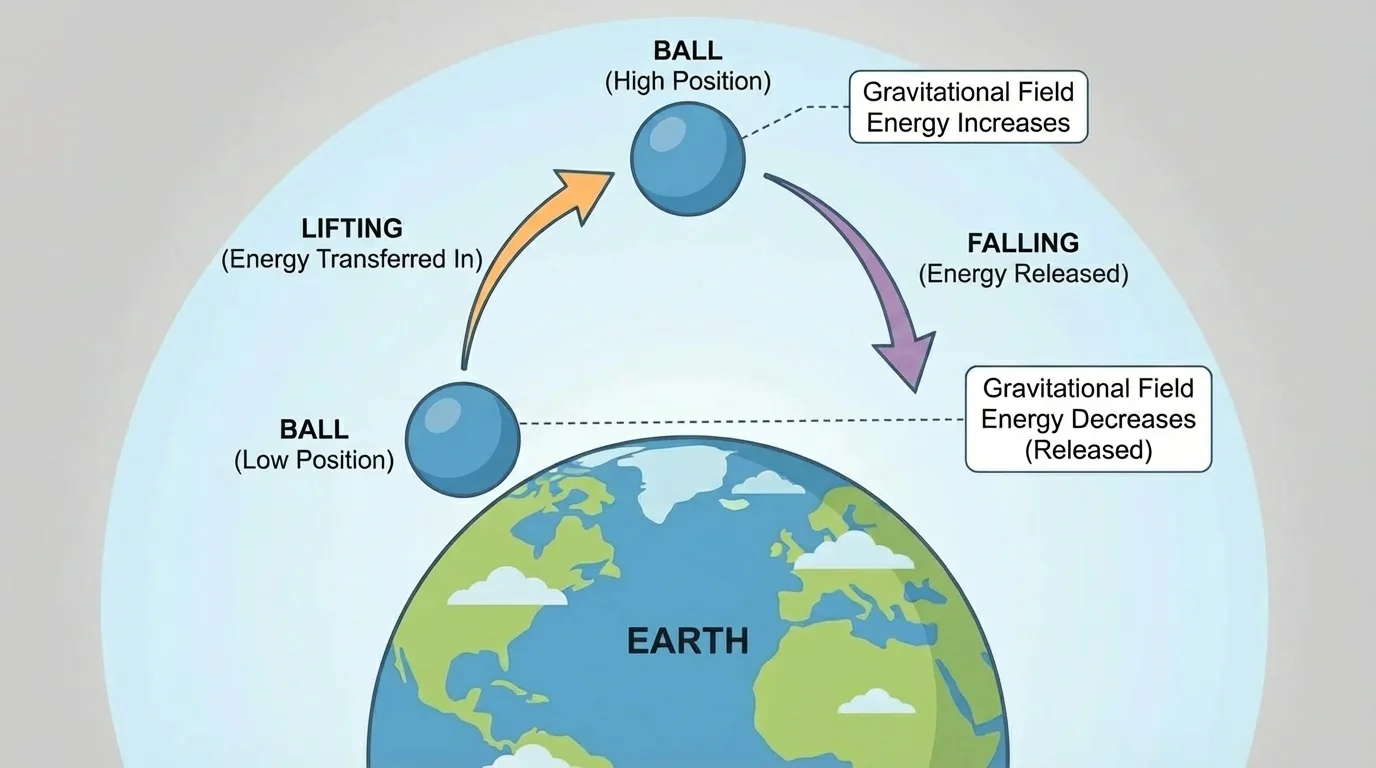
Near Earth's surface, gravitational field energy is often written as
\(E_g = mgh\)
where \(m\) is mass, \(g\) is the strength of gravity near Earth, and \(h\) is height above a reference point.
If a \(2 \textrm{ kg}\) object is lifted \(3 \textrm{ m}\), and we use \(g \approx 9.8 \textrm{ m/s}^2\), then the change in gravitational field energy is \(E_g = 2 \cdot 9.8 \cdot 3 = 58.8 \textrm{ J}\). That means \(58.8 \textrm{ J}\) of energy was transferred to the Earth-object system.
Lifting a backpack
A backpack with mass \(4 \textrm{ kg}\) is lifted \(1.5 \textrm{ m}\) onto a desk. Find the increase in gravitational field energy.
Step 1: Use the formula
Use \(E_g = mgh\).
Step 2: Substitute the values
\(E_g = 4 \cdot 9.8 \cdot 1.5\).
Step 3: Calculate
\(4 \cdot 9.8 = 39.2\), and \(39.2 \cdot 1.5 = 58.8\).
The backpack gains \(58.8 \textrm{ J}\) of gravitational field energy.
Later, when the backpack is lowered, the energy does not disappear. Gravity transfers energy out of the Earth-backpack system, and your arms may absorb some of that energy as they slow the backpack down. This is why lowering something heavy can still make your muscles tired.
The same idea appears in waterfalls, roller coasters, and hydroelectric dams. Water lifted by the Sun's energy during the water cycle gains gravitational field energy high above the ground. As the water falls, gravity transfers that energy into motion, and turbines can convert some of it into electrical energy.
[Figure 2] Scientists often describe energy transfer by a force using the idea of work. In this context, work happens when a force acts on an object and the object moves in the direction of the force. Work is one way to measure how much energy is transferred.
A simple version of the relationship is
\(W = Fd\)
when the force \(F\) is in the same direction as the distance \(d\). The unit of work is the joule, written \(\textrm{J}\).
If you push a box with a force of \(10 \textrm{ N}\) across the floor for \(3 \textrm{ m}\), then \(W = 10 \cdot 3 = 30 \textrm{ J}\). That means \(30 \textrm{ J}\) of energy is transferred by your push.
Not all work adds energy to an object's motion. Friction often does negative work because it acts opposite the direction of motion. If friction removes \(12 \textrm{ J}\) from a sliding object, that energy usually becomes thermal energy in the surfaces that rub together.
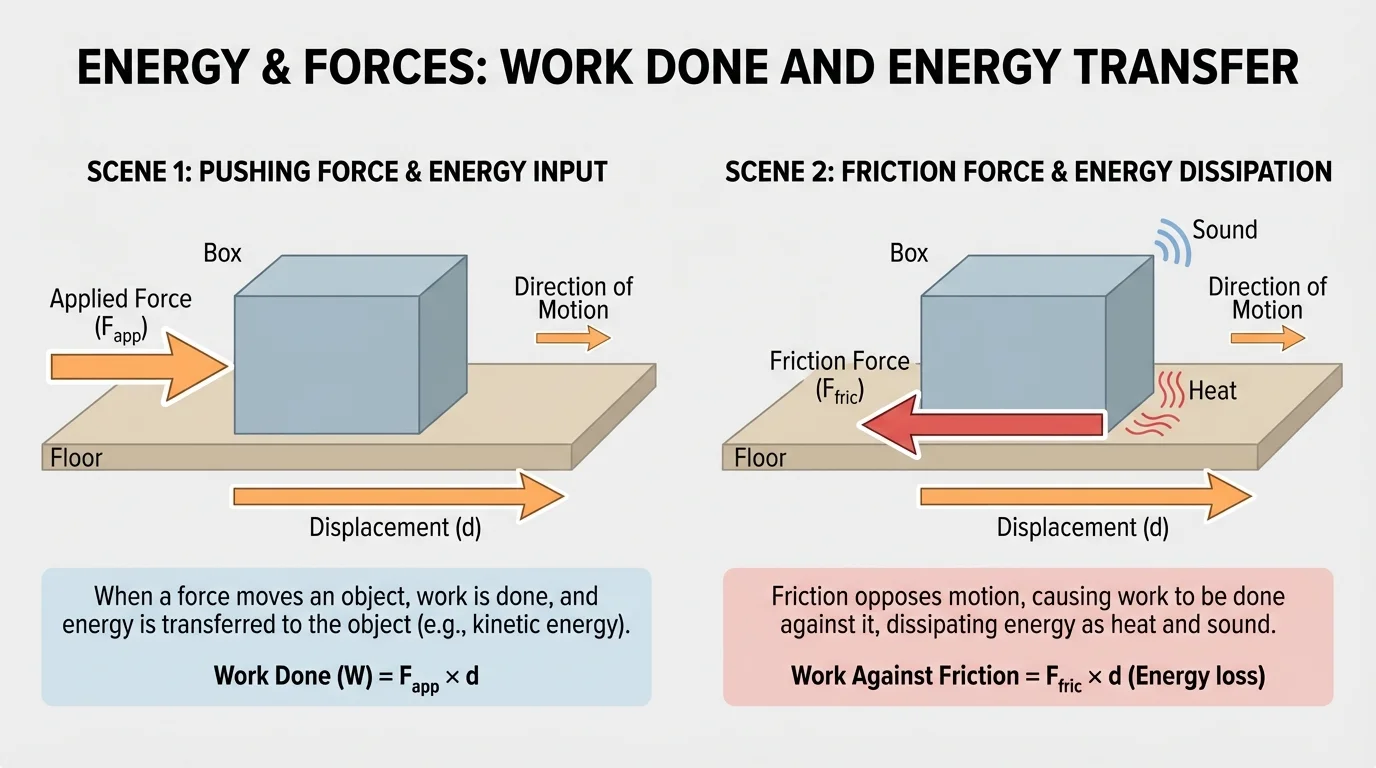
This helps explain why a rolling skateboard slows down if no one keeps pushing it. Friction and air resistance transfer energy from the skateboard's motion to the surroundings.
Positive and negative work
If a force acts in the same direction as motion, it transfers energy to the object. If a force acts opposite the motion, it transfers energy away from the object's kinetic energy. In both cases, forces are responsible for the transfer.
When you connect work to the gravity example, the ideas match nicely. Lifting an object means you do positive work on it, transferring energy into the Earth-object system. During the fall, gravity does positive work on the falling object and its kinetic energy increases.
An object in motion has kinetic energy. The faster it moves, the more kinetic energy it has. The amount also depends on mass. A bowling ball rolling at a certain speed usually has more kinetic energy than a ping-pong ball moving at that same speed.
The formula for kinetic energy is
\[E_k = \frac{1}{2}mv^2\]
where \(m\) is mass and \(v\) is speed.
For example, if a \(1 \textrm{ kg}\) cart moves at \(4 \textrm{ m/s}\), then \(E_k = \dfrac{1}{2} \cdot 1 \cdot 4^2 = 8 \textrm{ J}\). If the speed doubles to \(8 \textrm{ m/s}\), then \(E_k = \dfrac{1}{2} \cdot 1 \cdot 8^2 = 32 \textrm{ J}\). Doubling speed makes the kinetic energy four times larger because speed is squared.
This is why even a small increase in speed can make a moving object much more energetic. In sports, transportation, and safety design, speed matters a lot because of its strong effect on kinetic energy.
A car traveling twice as fast does not just have twice as much kinetic energy. It has about four times as much, which is one reason stopping distances become much longer at higher speeds.
As a falling object drops, the pattern is usually this: gravitational field energy decreases while kinetic energy increases. As we saw earlier in [Figure 1], the gravitational force is the mechanism that causes that transfer.
[Figure 3] Not all forces require touching. Magnetic force and electric force can act across space. Even without contact, these interactions can still transfer energy between objects.
Think about two bar magnets on a smooth table. If you hold one still and bring the other close with like poles facing, they repel. If one magnet is free to move, it can slide away and gain kinetic energy. That kinetic energy came from the interaction between the magnets. Energy was transferred through the magnetic force.
[Figure 3] Charged objects can behave in similar ways. Two balloons rubbed on hair can become electrically charged. If the balloons have the same kind of charge, they repel and move apart. If they have opposite charges, they attract and move together. In each case, electric force transfers energy between the interacting objects.
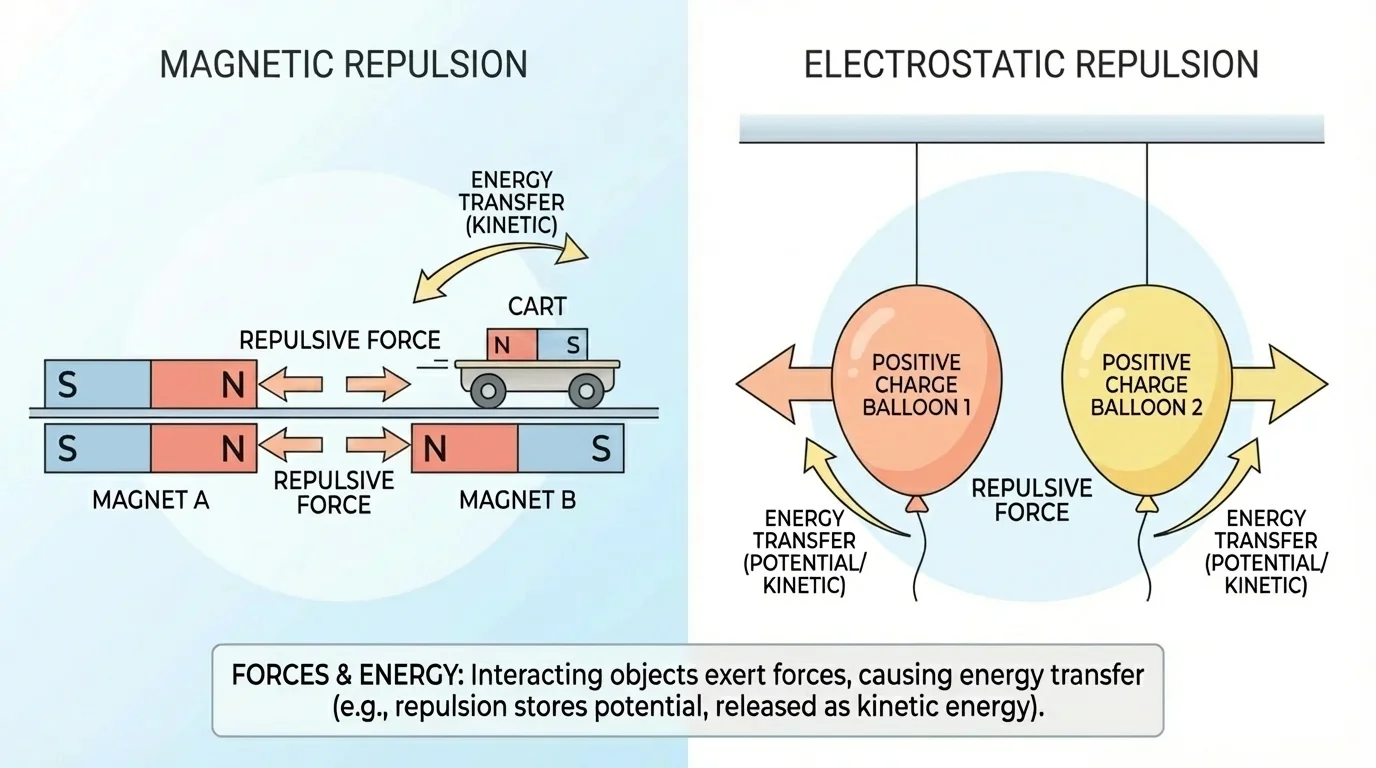
These examples may feel mysterious because the objects do not touch, but the rule is the same: an interaction creates forces, and those forces can transfer energy. Scientists describe these interactions using fields, which are regions around objects where forces can act.
Field is a region around an object where another object can experience a force. Gravitational, magnetic, and electric interactions all involve fields.
Distance matters. Usually, the farther apart interacting objects are, the weaker the force becomes. That is why a magnet strongly affects a paper clip nearby but has much less effect from across the room.
Later, when students study circuits, they learn that electric forces move charges through wires. That movement transfers energy to devices such as lamps, speakers, and phone chargers. The basic idea remains the same as the balloon example: electric interactions can move energy from place to place.
[Figure 4] Many familiar energy transfers involve contact forces. Pushing a shopping cart, hitting a baseball, pedaling a bicycle, and squeezing a sponge all involve direct contact between objects.
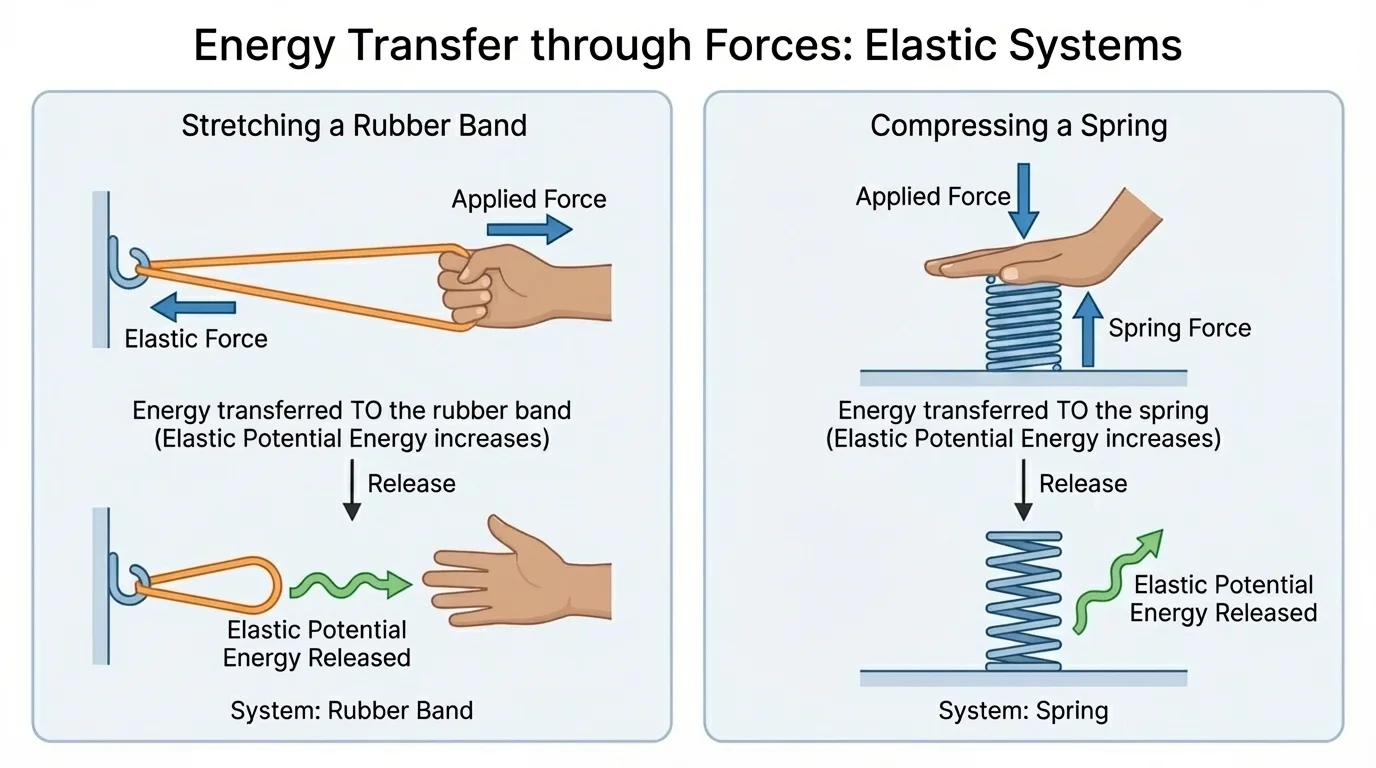
Another important kind of stored energy appears when objects are stretched or compressed. A stretched rubber band or a compressed spring can store energy because forces have changed the shape of the system. When the rubber band or spring is released, the stored energy can transfer back into motion.
If you pull back a slingshot, your hand exerts a force that transfers energy to the stretched band. When you let go, the band exerts a force on the object in the slingshot, transferring energy to it and launching it forward.
Collisions are also interactions with force and energy transfer. When a moving ball hits a wall, the wall exerts a force on the ball and the ball exerts a force on the wall. The ball may bounce, stop, or change shape. Some energy may remain in motion, and some may become sound or thermal energy.
Friction is a contact force that often transfers energy from motion into thermal energy. Rubbing your hands together is a simple example. The forces between the surfaces transfer energy so that the temperature of your hands increases.
Pushing a crate
A student pushes a crate with a force of \(15 \textrm{ N}\) for \(4 \textrm{ m}\) in the same direction as the motion. How much work is done?
Step 1: Choose the formula
Use \(W = Fd\).
Step 2: Substitute the values
\(W = 15 \cdot 4\).
Step 3: Calculate
\(W = 60 \textrm{ J}\).
The push transfers \(60 \textrm{ J}\) of energy.
The spring and rubber band examples connect to many technologies. Archery bows, pogo sticks, trampolines, and mechanical toys all rely on forces storing and releasing energy through stretched or compressed materials.
One of the best science skills is learning to track where energy starts, where it goes, and which force is responsible. Consider a roller coaster climbing a hill. A motor pulls the cars upward, transferring energy to the Earth-coaster system. At the top, the system has more gravitational field energy. As the coaster descends, gravity transfers energy into kinetic energy, so the coaster speeds up.
Now think about a crane lifting steel at a construction site. The crane's motor does work to raise the steel. The Earth-steel system gains gravitational field energy. If the steel were allowed to drop, gravity would transfer that energy into motion, which is why lifting equipment must be carefully controlled.
A loudspeaker offers a different example. Electric forces in the speaker move charges, which cause the speaker cone to vibrate. Those vibrations transfer energy into the surrounding air as sound. The energy changes form several times, but forces are involved at each stage.
Magnets in electric generators provide another powerful example. In a generator, motion and magnetic interactions work together so that energy from moving parts can be transferred into electrical energy. This is part of how wind turbines and some power plants operate.
| Interaction | Force involved | Where energy goes | Example |
|---|---|---|---|
| Object lifted upward | Applied force | Into gravitational field energy | Raising a backpack |
| Object falling | Gravitational force | Into kinetic energy | Dropping a ball |
| Magnet repels magnet | Magnetic force | Into kinetic energy | Magnets sliding apart |
| Charged balloons move | Electric force | Into kinetic energy | Rubbed balloons repelling |
Table 1. Examples of interactions showing which force transfers energy and where that energy goes.
One common mistake is thinking that force and energy are the same thing. They are not. A force is an interaction, while energy is a quantity that can be transferred or stored. Force is the cause of many energy changes, but it is not itself energy.
Another misunderstanding is thinking that only moving objects can have energy. A raised object can have increased gravitational field energy even when it is not moving. A stretched spring can store energy even when it is held still.
Students also sometimes think that if one object exerts a force, the other does not. In fact, the forces come in pairs. If your hand pushes a wall, the wall pushes back on your hand. If Earth pulls on a falling apple, the apple also pulls on Earth. The apple moves much more because its mass is much smaller, but both objects exert forces on each other.
"When objects interact, they change each other."
— A core idea behind forces and energy transfer
A final misunderstanding is believing that energy is "used up." In many cases, it is better to say that energy is transferred or transformed. For example, when friction slows a bicycle, the bicycle's kinetic energy decreases, but that energy is transferred mainly into thermal energy in the tires, road, and air.
Whether the interaction involves gravity, magnetism, electric charge, a push, a pull, a stretch, or friction, the same pattern helps you make sense of it: identify the objects interacting, name the force, and track where the energy is transferred.
This way of thinking is powerful because it works in many situations. It explains why dropped objects speed up, why magnets can move objects from a distance, why springs launch toys, why collisions make sound, and why friction causes warming.
Science becomes clearer when you ask three questions: What objects are interacting? What force is acting? How is energy being transferred or stored? If you can answer those, you can explain a huge number of events in the world around you.
