A powerful earthquake can send vibrations through the entire planet, and those vibrations can reveal what lies thousands of kilometers below your feet. That sounds almost like science fiction, but it is real science. Waves are not just something you see on water. They carry sound to your ears, signals through technology, and clues from deep inside Earth. By learning a few basic wave properties, scientists can determine how loud a sound is, how high or low it seems, and even what hidden rock layers are underground.
A wave is a repeating disturbance that transfers energy from one place to another. In many cases, the material the wave travels through does not move along with the wave. Instead, the particles of the material vibrate or shift back and forth while the energy travels onward.
Think about a stadium wave at a sports event. The wave moves around the stadium, but each person only stands up and sits down in place. Many waves work in a similar way: the pattern travels, but the matter usually does not travel very far with it.
Wave means a repeating disturbance that carries energy. A simple wave has a regular pattern that can be described using its wavelength, frequency, and amplitude.
Medium is the material through which a wave travels, such as air, water, rock, or metal.
Some waves, such as sound and seismic waves, require a medium. These are called mechanical waves. Other waves, such as light, can travel through empty space. This lesson focuses mainly on sound and seismic waves because both are important examples of waves that move through matter.
[Figure 1] A simple wave has parts and measurements that help us describe it. In a wave pattern, the highest points are crests, the lowest points are troughs, the distance from one repeating point to the next is the wavelength, and the height from the rest position to a crest is the amplitude.
Wavelength is the distance between matching parts of a wave, such as crest to crest or trough to trough. It tells you how long one full wave pattern is. For example, if the distance from one crest to the next is 10 cm, then the wavelength is 10 cm.
Frequency tells how many complete waves pass a point in one second. Frequency is measured in hertz, written as Hz. A frequency of 5 Hz means 5 full waves pass by each second. Higher frequency means that more waves pass in the same amount of time.
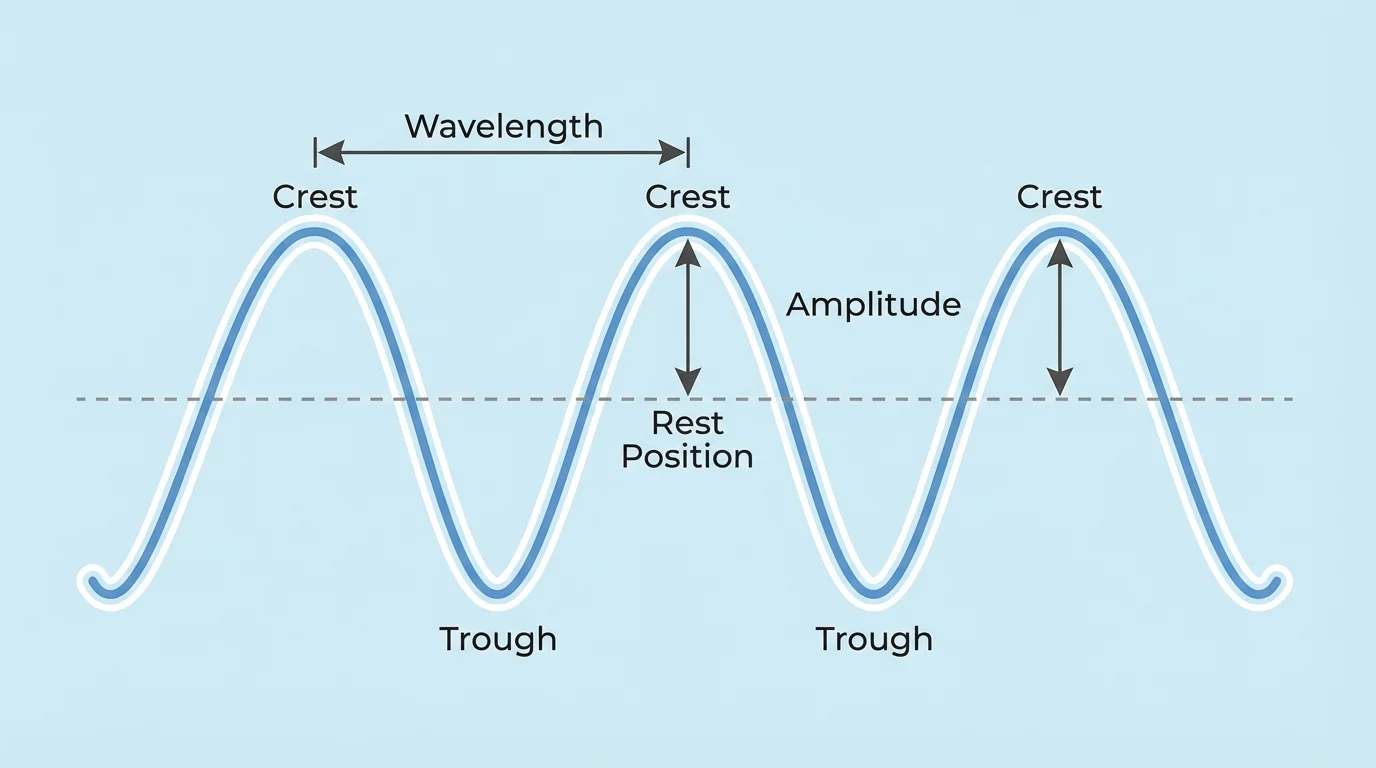
Amplitude measures how far the wave moves away from its rest position. A wave with greater amplitude carries more energy in many situations. If one wave has an amplitude of 2 cm and another has an amplitude of 5 cm, the second wave has the larger amplitude.
Another useful idea is wave speed. This tells how fast the disturbance travels. For many wave situations, wave speed is related to wavelength and frequency by the equation
\[v = f\lambda\]
In this equation, \(v\) is wave speed, \(f\) is frequency, and \(\lambda\) is wavelength.
Using the wave speed formula
A wave has frequency 4 Hz and wavelength 3 m. Find its speed.
Step 1: Write the formula
\(v = f\lambda\)
Step 2: Substitute the values
\(v = 4 \times 3\)
Step 3: Calculate
\[v = 12 \textrm{ m/s}\]
The wave moves at 12 m/s.
This relationship helps scientists connect what they measure to what the wave is doing. Later, geologists use travel times and speeds of seismic waves to estimate how deep a boundary is underground.
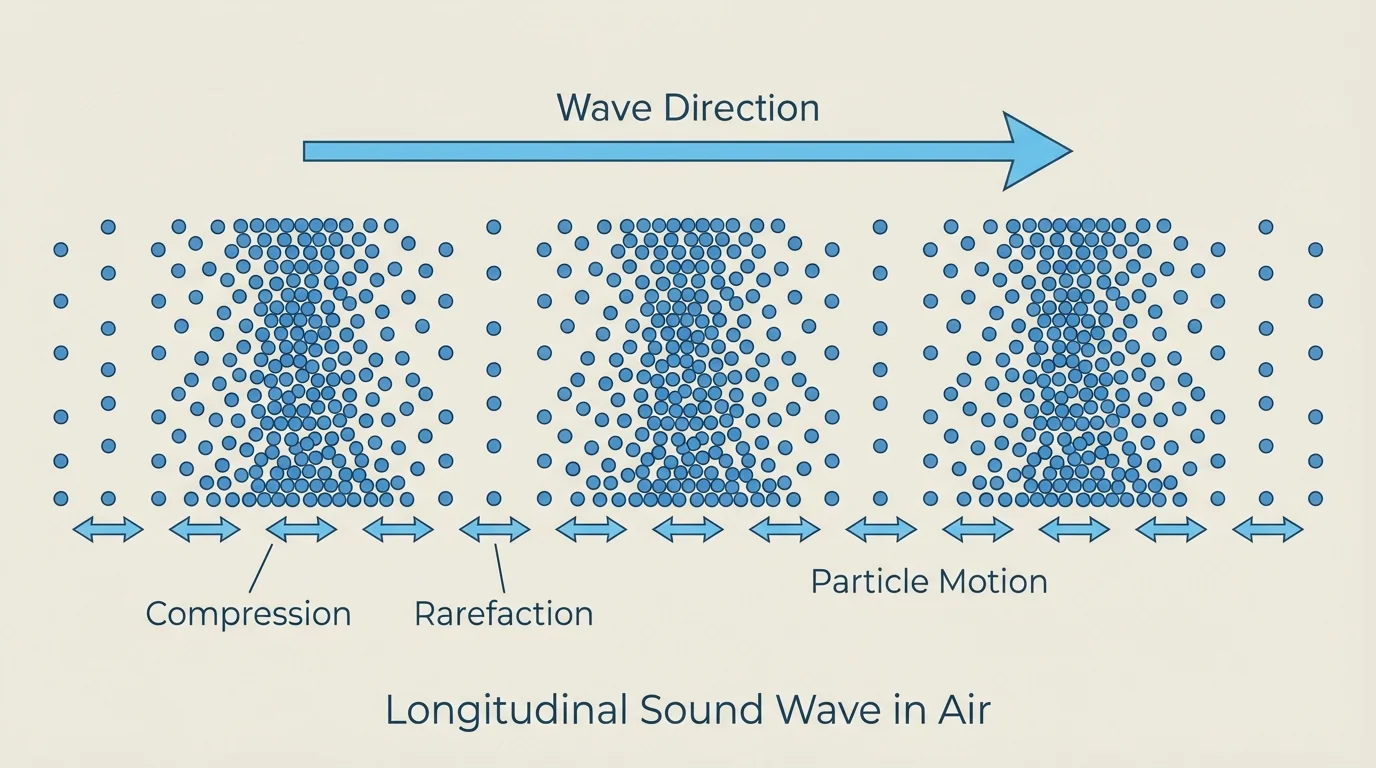
[Figure 2] Sound is a sound wave, and it needs matter to move through. Sound usually travels through air, but it can also travel through water, wood, metal, and rock. Sound is a longitudinal wave, meaning the particles of the medium vibrate back and forth in the same direction the wave travels.
In air, sound travels as a pattern of compressions and rarefactions. A compression is a region where air particles are crowded together. A rarefaction is a region where the particles are farther apart. As a vibrating object, such as a speaker cone or guitar string, pushes on nearby air, it creates this repeating pattern.
Because sound depends on particle vibrations, it cannot travel through empty space. There are no particles in a vacuum to pass the disturbance along. That is why astronauts in space cannot hear each other directly without radios, even if they are close by.
Sound can travel through solids, liquids, and gases, but the speed is different in each medium. In general, sound travels faster when particles are packed more closely and can transfer vibrations more quickly. That is why sound usually travels faster in steel than in air.
Whales use sound to communicate across long distances in the ocean because sound can travel very efficiently through water. Some whale calls can travel hundreds of kilometers.
The need for a medium is one of the most important differences between sound and light. Light from the Sun crosses space to Earth, but sound from the Sun cannot. This simple fact tells us a lot about the kinds of waves found in nature.
For sound, frequency and amplitude connect directly to what people hear. A higher frequency usually means a higher pitch. A lower frequency usually means a lower pitch. A piccolo makes higher-frequency sounds than a tuba.
Amplitude relates to loudness. If a sound wave has greater amplitude, it generally sounds louder. If its amplitude is smaller, it sounds softer. When you gently tap a drum, the amplitude is small. When you strike it hard, the amplitude is larger.
Even though wavelength, frequency, and amplitude are different properties, they work together. If the wave speed stays the same, a higher frequency means a shorter wavelength. Using \(v = f\lambda\), if sound in air moves at about 340 m/s and the frequency is 170 Hz, then the wavelength is \(\lambda = \dfrac{340}{170} = 2 \textrm{ m}\).
Finding wavelength from speed and frequency
A sound wave moves through air at 340 m/s and has frequency 850 Hz. What is its wavelength?
Step 1: Rearrange the formula
From \(v = f\lambda\), we get \(\lambda = \dfrac{v}{f}\).
Step 2: Substitute values
\(\lambda = \dfrac{340}{850}\)
Step 3: Calculate
\[\lambda = 0.4 \textrm{ m}\]
The wavelength is 0.4 m.
Musical instruments are a great example of wave properties in action. A short guitar string usually vibrates at a higher frequency than a long one. Hitting a piano key harder increases amplitude, making the sound louder, but does not greatly change the pitch.
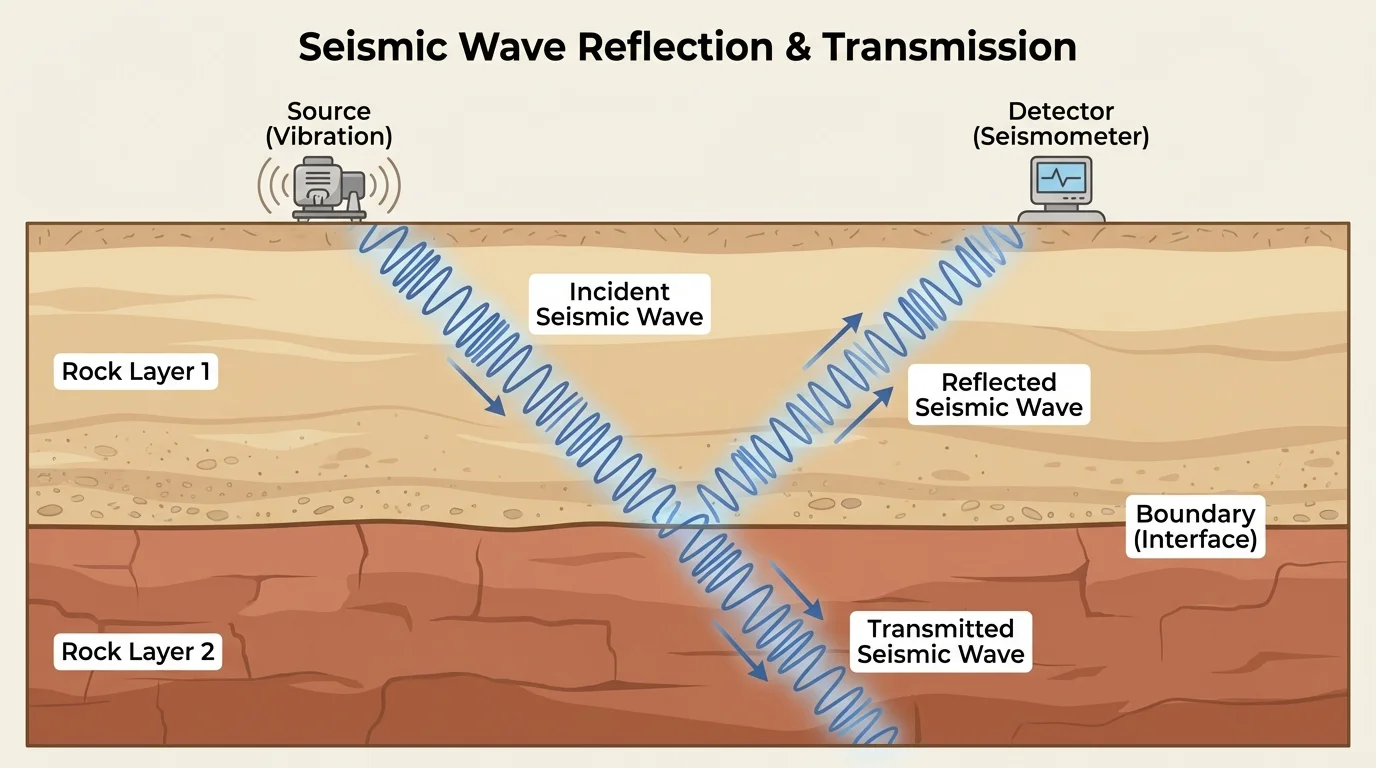
[Figure 3] When a wave reaches a boundary between two materials, some or all of the wave may bounce back. This is called reflection. At a boundary, wave behavior depends on the properties of the materials on each side. A change from one rock layer to another can reflect part of a seismic wave back toward the surface.
You experience reflection when you hear an echo. Your voice creates sound waves that travel through air, strike a surface such as a canyon wall, and return to your ears. Reflection also happens with waves in ropes, water, and underground rock.
Reflection is extremely useful because it provides information about hidden surfaces. If a wave reflects strongly, it often means the wave met a noticeable change in material, such as from soft sediment to harder rock. Scientists can measure how long the reflected wave took to return and use that information to estimate distance.
This idea is similar to sonar on boats and ultrasound in medicine. In each case, waves are sent out, reflections return, and the returning signals help build a picture of something unseen. Geologists do a similar kind of detective work with seismic waves underground.
[Figure 4] Seismic waves are waves produced by earthquakes, volcanic activity, explosions, or other powerful disturbances in Earth. Geologists study the travel paths and reflections of these waves to infer structures deep inside the planet.
There are different kinds of seismic waves. Some travel through Earth's interior, and others move along the surface. Interior seismic waves are especially important for probing deep structure because they pass through layers that humans cannot directly reach.
When seismic waves encounter a boundary between layers, part of the energy may reflect, part may bend, and part may continue onward at a different speed. These changes happen because different layers have different densities, temperatures, and compositions. By studying the times and strengths of returning waves, geologists can identify buried rock layers, faults, and other structures.
Earth itself is layered. It has a crust, mantle, and core. Scientists did not learn this only by digging, because even the deepest mines and drill holes reach just a tiny fraction of Earth's depth. Instead, they learned a great deal by interpreting seismic waves. Some waves pass through certain layers easily, while others slow down, bend, or fail to pass through some materials.
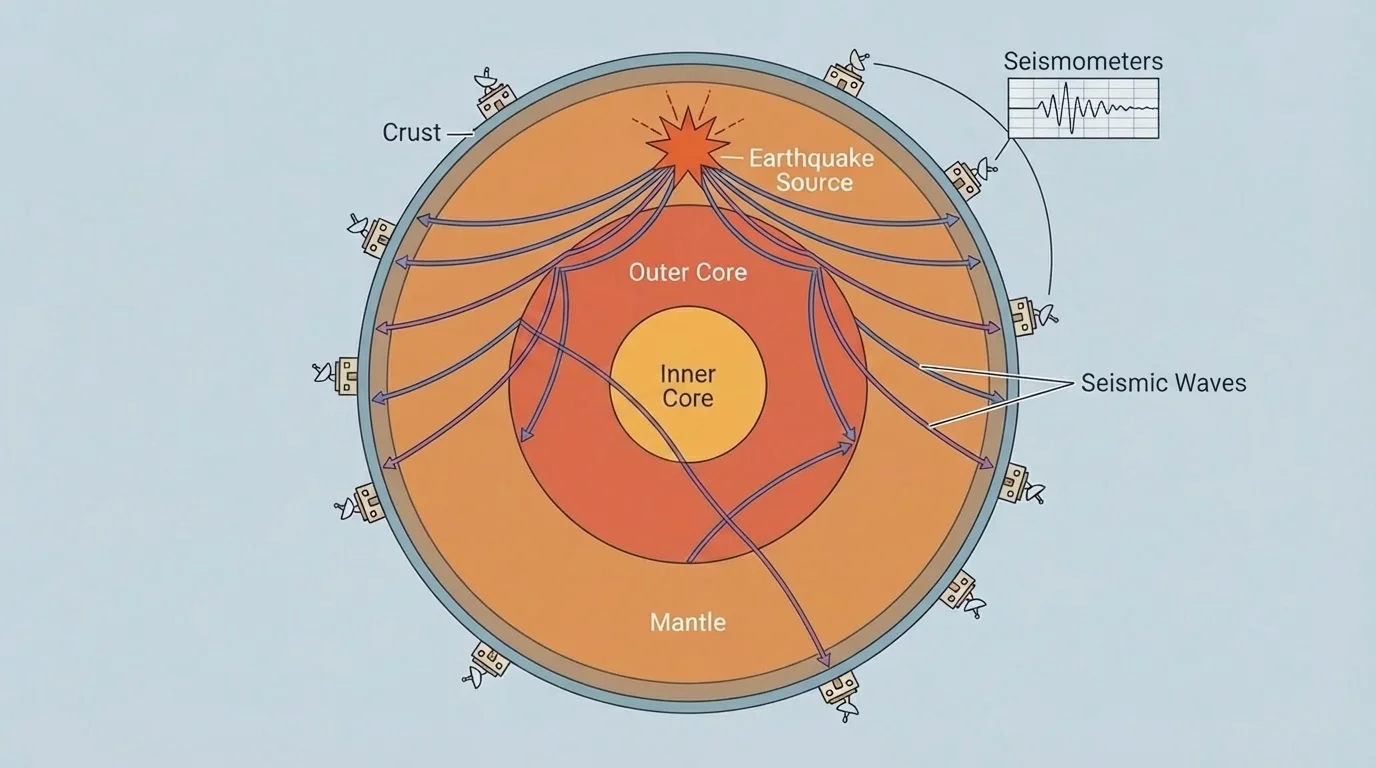
For example, if a wave changes speed at a boundary, its path can curve or bend. If a certain kind of wave does not travel through a layer, that tells scientists something important about that layer's state. Using evidence like this, scientists concluded that Earth's outer core is liquid while the inner core is solid.
How geologists probe deep underground
Geologists record seismic waves with instruments called seismometers. By comparing when waves arrive at different locations and how strongly they reflect, scientists can estimate the depth, shape, and material properties of underground layers. This is one reason earthquakes, while dangerous, also provide valuable scientific information.
Reflection studies are also used on a smaller scale. In oil and gas exploration, in mapping underground water, and in studying earthquake hazards, scientists send controlled vibrations into the ground and record the echoes. The returning patterns help them map structures hidden below the surface. The reflection process shown in [Figure 3] is based on the same basic principle.
Scientists often use wave travel time to estimate distance. If a wave speed is known, the distance can be found with \(d = vt\). For reflected waves, the signal travels to the boundary and back, so the depth is often half of the total travel distance.
Estimating the depth of a rock layer
A seismic wave travels downward, reflects from a boundary, and returns to the detector in 2 s. If the wave speed in the rock is 3{,}000 m/s, how deep is the boundary?
Step 1: Find the total distance traveled
\(d = vt = 3{,}000 \times 2 = 6{,}000 \textrm{ m}\)
Step 2: Recognize that the wave went down and back up
The depth is half the total distance.
Step 3: Divide by 2
\[\textrm{depth} = \frac{6{,}000}{2} = 3{,}000 \textrm{ m}\]
The rock boundary is 3{,}000 m deep.
Measurements like these become more accurate when scientists combine data from many detectors. One reading gives useful information, but many readings from different places create a clearer picture of underground structure, much like using several camera angles gives a better view of a scene.
| Wave property | What it describes | Everyday example | Earth science example |
|---|---|---|---|
| Wavelength | Length of one full wave | Distance between repeating sound patterns | Spacing of seismic wave patterns |
| Frequency | How many waves pass each second | High pitch versus low pitch | Different vibration patterns from earthquakes |
| Amplitude | Size of the wave disturbance | Loud versus soft sound | Strength of ground shaking |
| Reflection | Wave bouncing from a boundary | Echo in a canyon | Seismic echo from rock layers |
Table 1. Comparison of important wave properties and how they appear in everyday life and Earth science.
Waves are central to many technologies and scientific tools. Microphones and speakers work by turning sound waves into electrical signals and back again. Seismometers detect ground motion from seismic waves. Engineers use wave information to test bridges and buildings for hidden cracks.
Doctors use ultrasound, which relies on reflected sound waves, to create images inside the body. Boats use sonar to find objects underwater. Geologists use reflected seismic waves to map underground layers. Although these applications happen in different places, they all depend on the same big idea: waves carry information.
Understanding wave properties also helps protect people. Seismic studies help scientists identify faults and estimate earthquake hazards. Builders can use that knowledge to design structures that better withstand shaking. The wave paths in [Figure 4] are not just scientific diagrams; they represent data that can improve safety and deepen our understanding of the planet.
Energy can be transferred in many ways. Waves are one important way energy moves from place to place without carrying matter along over large distances.
From music to medicine to earthquakes, waves connect many parts of science. Once you understand wavelength, frequency, amplitude, and the need for a medium, you can explain a huge range of real phenomena. The same wave ideas that describe a note from a violin also help scientists investigate regions of Earth no one has ever seen directly.
