A single strawberry plant can send out runners and create new plants nearby. A bird can sing for hours to attract a mate. A bee can carry pollen from one flower to another without "trying" to help the plant at all. Life continues through an enormous variety of strategies, and each strategy helps organisms solve the same basic challenge: producing the next generation.
All living things come from other living things. This may sound obvious, but it leads to a very important idea: if organisms could not reproduce, their species would disappear. Reproduction is the process by which organisms produce offspring. During reproduction, organisms pass biological information from one generation to the next.
That information is stored in molecules of DNA. DNA contains instructions for building and running an organism's body. Those instructions influence traits such as flower color, leaf shape, fur pattern, body size, or eye color. Offspring usually resemble their parents because they inherit DNA from them, but they are not always exactly the same.
Reproduction is the process of making new organisms. Offspring are the young produced by parents. Inherited traits are characteristics passed from parents to offspring through genetic information.
Reproduction is closely connected to growth and development. A seed grows into a mature plant. A fertilized egg develops into an animal. But growth is not controlled by genes alone. Conditions in the local environment also matter. A plant with excellent genes for height still may not grow tall if it lacks water, sunlight, or minerals from the soil.
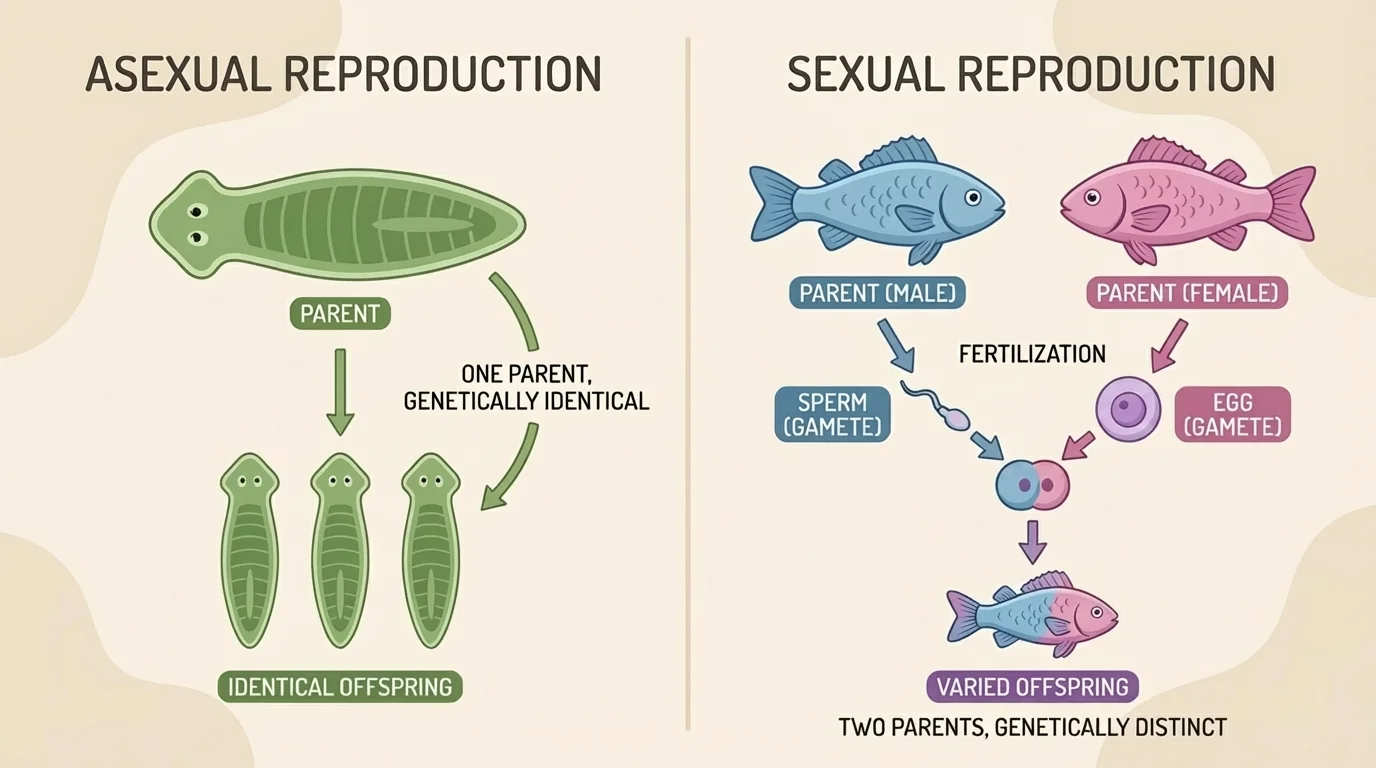
Organisms reproduce in two main ways, and the difference between them, as [Figure 1] shows, affects how much variation appears in the offspring. In sexual reproduction, genetic information from two parents combines. In asexual reproduction, one parent produces offspring without combining genetic information with another parent.
In sexual reproduction, offspring receive half of their genetic information from one parent and half from the other. Because of this mixing, the offspring are similar to their parents but not identical. This variation is important because it means that individuals in a population are not all exactly alike. If conditions change, some may be better able to survive and reproduce.
In asexual reproduction, one organism can produce new individuals that are genetically very similar, and often nearly identical, to itself. Bacteria commonly reproduce by splitting into two cells. Some single-celled organisms do the same. In multicellular organisms, asexual reproduction can happen by budding, fragmentation, or vegetative growth.
A hydra, a small freshwater animal, can reproduce by budding. A tiny outgrowth forms on the parent, grows, and eventually separates. Some sea stars can regrow missing parts, and in certain cases pieces can form new individuals. In plants, a potato tuber can grow into a new potato plant, and a spider plant can form small plantlets on long stems.
Neither type of reproduction is "better" in every situation. Asexual reproduction can be fast and efficient, especially when conditions are stable and an organism is already well suited to its environment. Sexual reproduction is slower and usually requires two parents, but it creates more genetic variation. That variation can help populations handle diseases, predators, and changing environments.
| Type of reproduction | Number of parents | Offspring similarity | Examples |
|---|---|---|---|
| Sexual | Usually 2 | Similar, but not identical | Humans, birds, flowering plants, fish |
| Asexual | 1 | Usually nearly identical | Bacteria, hydra, strawberry runners, potatoes |
Table 1. A comparison of sexual and asexual reproduction.
The contrast in [Figure 1] helps explain why brothers and sisters can look related but still be different from each other, while new plants from one runner often look much more alike.
Why variation matters
When offspring differ from one another, some may have traits that help them survive better in local conditions. For example, if a disease spreads through a population, some individuals may be less affected than others. This does not guarantee survival, but variation gives a species more possibilities.
For middle school science, it is enough to understand that sexual reproduction tends to increase variation and asexual reproduction tends to produce more similar offspring. Both patterns are seen throughout living things.
The instructions in DNA are organized into smaller sections called genes. A gene is a segment of DNA that influences a trait. For example, genes can affect whether a pea plant has purple flowers or white flowers, or whether an animal has long fur or short fur.
Offspring inherit genes from their parent or parents. In sexual reproduction, offspring get a combination of genes from both parents. In asexual reproduction, offspring usually receive a copy of the parent's genes. This is why a young organism often resembles its parents while still having its own unique set of characteristics in sexual reproduction.
Traits are not controlled by just one gene in every case. Many traits are influenced by several genes working together, and some are strongly shaped by the environment. For example, a plant may inherit genes that give it the potential to grow tall, but if it grows in poor soil with little water, it may remain small.
Identical twins in humans begin from the same fertilized egg, so they share nearly the same DNA. Even so, they can still develop differences over time because their experiences and environments are not exactly the same.
Scientists, farmers, and gardeners use knowledge of inherited traits all the time. They may select plants that produce sweeter fruit, resist disease, or survive cold weather. This works because genetic information is passed to the next generation.
Many animals do not simply wait for reproduction to happen. They perform characteristic courtship behaviors, protect territories, care for eggs, or guard their young. These actions, as [Figure 2] illustrates, increase the chances that mating will happen and that offspring will survive long enough to grow.
Bird songs are one common example. Male birds often sing to attract females and to warn rival males to stay away. The song acts like a signal: it shows that the bird is healthy, active, and ready to reproduce. Some birds also perform dances or display bright feathers. Peacocks spread their tails in a striking fan, and many birds of paradise perform elaborate movements.
Other animals use smell, sound, light, or touch. Frogs call loudly near ponds during breeding season. Fireflies flash specific patterns of light to find mates of the same species. Deer and other mammals may compete physically for access to mates. These behaviors use energy and can be risky, but they can improve reproductive success.
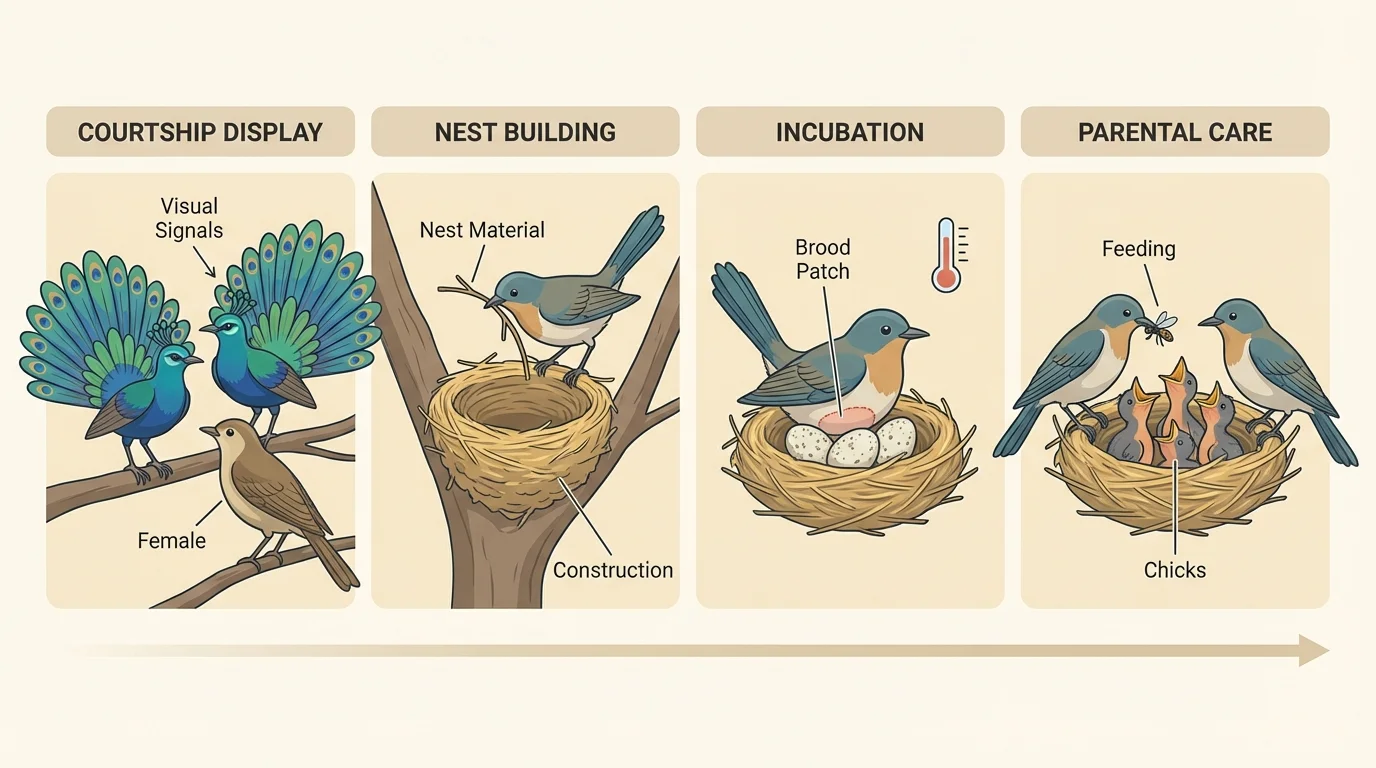
After mating, many animals continue behaviors that help offspring survive. Birds build nests. Alligators guard nests and sometimes help hatchlings reach the water. Penguins take turns protecting eggs from the cold. Mammals such as wolves, elephants, and humans invest a great deal of care in their young.
Not all animals care for their offspring in the same way. Many fish release large numbers of eggs and sperm into the water and provide little or no parental care. In this strategy, survival depends partly on producing many offspring. In contrast, animals that produce fewer young often protect them more carefully.
The scenes in [Figure 2] connect two important ideas: attracting a mate and caring for offspring are both behaviors shaped by survival and reproduction. If a behavior leads to more surviving young, it is more likely to continue in a species over generations.
Real-world example: Sea turtles and survival
Sea turtles lay many eggs on beaches, but only a small number of hatchlings survive to adulthood.
Step 1: The mother turtle lays eggs in sand above the tide line.
Step 2: The eggs develop using warmth from the sand.
Step 3: Hatchlings emerge and move toward the ocean, where many face predators.
Step 4: Because survival is low, producing many eggs increases the chance that some offspring will live long enough to reproduce.
This shows that reproductive behaviors and life strategies differ across species.
Migration can also support reproduction. Some birds travel long distances to reach safe nesting grounds with abundant food. Salmon swim upstream to lay eggs in freshwater. These journeys are difficult, but they place offspring in conditions where survival is more likely.
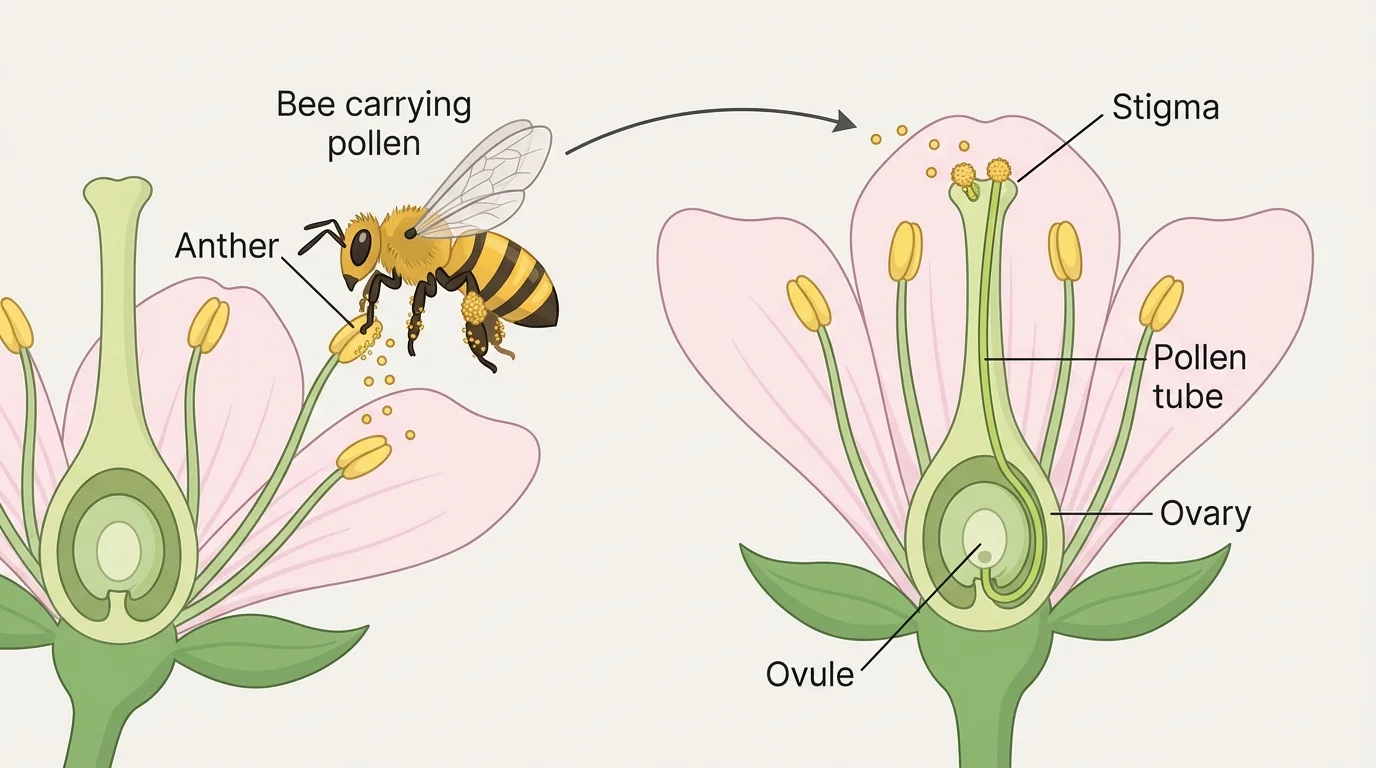
Plants cannot search for mates the way animals can, but they have their own remarkable strategies. In flowering plants, as [Figure 3] shows, specialized structures and animal behavior often work together to move pollen and make seed production possible.
A flower contains reproductive parts. The pollen is produced by the male reproductive structures, often called anthers. The female reproductive structures include the stigma, style, and ovary. When pollen lands on a compatible stigma, the process of pollination has occurred. Then a pollen tube can grow toward an ovule, and fertilization can happen. After fertilization, the ovule can develop into a seed.
Some plants rely on wind to move pollen. Grasses and many trees use this method. Other plants depend on animals such as bees, butterflies, moths, bats, birds, and even beetles. These animals visit flowers to get nectar or pollen for food, and as they move from flower to flower, they transfer pollen.
Flowers often have features that help attract pollinators. Bright colors, strong scents, nectar, and special shapes all increase the chance that the right animal will visit. A hummingbird may be attracted to a red tubular flower. A night-blooming flower with a strong smell may attract moths or bats. These are examples of structures that increase reproductive success.
After seeds form, many plants still need help spreading them. This process is called seed dispersal. Fruits are one important adaptation. Animals eat the fruit and later release the seeds in a different location. Other seeds stick to fur with tiny hooks, like burdock. Some seeds float on water, and some spin or glide through the air.
The flower structures in [Figure 3] also help explain why pollinator declines matter in the real world. If fewer bees visit flowers, some crops produce fewer fruits and seeds. This affects food supplies for people and other animals.
How flower structure supports reproduction
Each flower part has a job. The anther makes pollen. The stigma receives pollen. The ovary contains ovules that can become seeds after fertilization. Petals and scents often help attract pollinators. These structures are not random; they are closely tied to reproduction.
Apples, cucumbers, almonds, pumpkins, blueberries, and many other crops depend greatly on pollinators. This is why farmers may protect bee habitats or bring managed bee colonies near fields during flowering season.
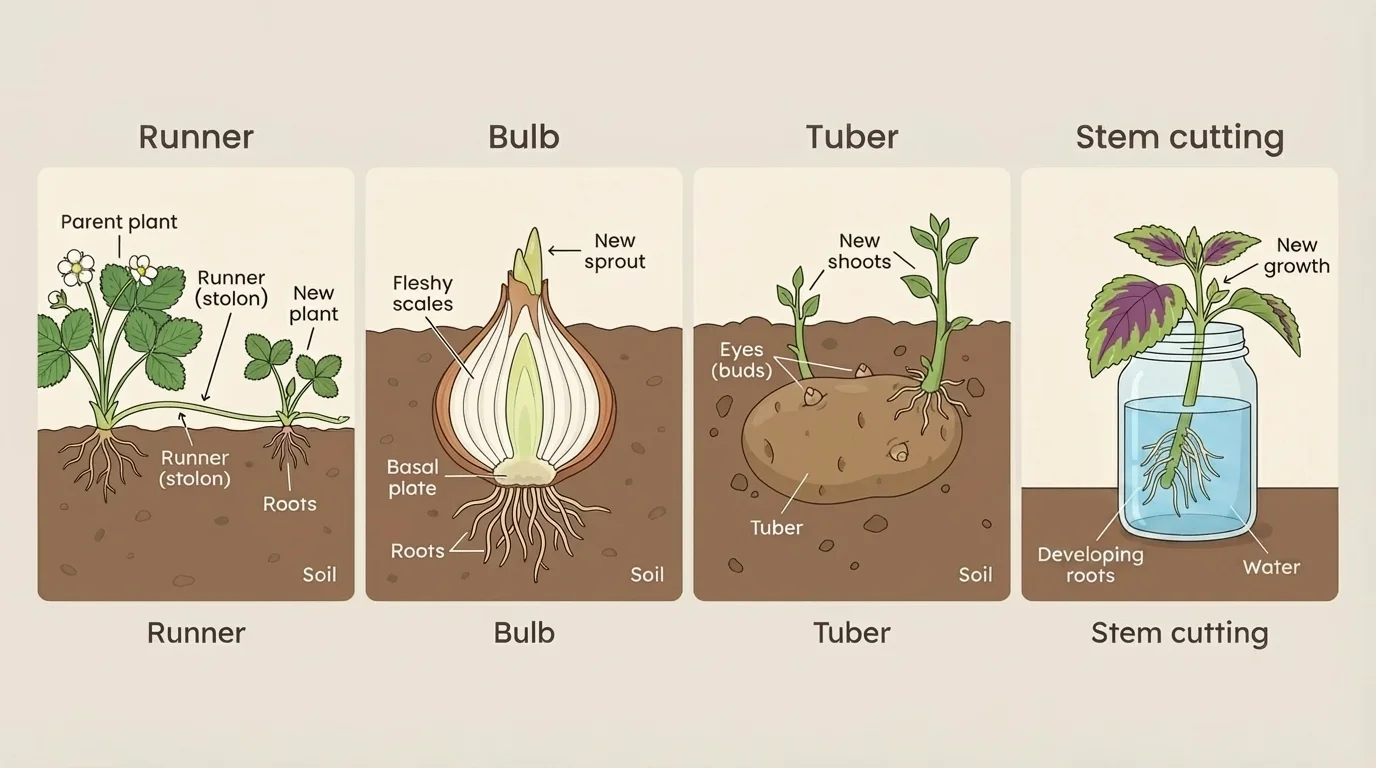
Many plants do not rely only on seeds. They can also reproduce asexually through their roots, stems, or leaves, as [Figure 4] illustrates. This is called vegetative reproduction.
Strawberry plants send out runners, which are horizontal stems that grow along the ground. At certain points, the runner forms roots and shoots, creating a new plant. Potatoes form tubers, which are underground storage stems. The "eyes" of a potato can sprout into new plants. Onions grow from bulbs, and some grasses spread with underground stems called rhizomes.
People use this ability in gardening and farming. A stem cutting from a rose plant can grow roots and become a new plant. Bananas and many seedless crops are often grown from vegetative parts instead of seeds. This is useful when growers want many plants with the same desirable traits.
Asexual reproduction in plants has advantages. It can be quick, and the new plants keep successful traits of the parent. However, because the offspring are so similar genetically, a disease or environmental change may affect them all in the same way.
The comparisons in [Figure 4] make it easier to see that plants have multiple pathways to reproduce: by seeds after pollination or by body parts that grow into new individuals.
Plants need more than just a way to reproduce. They also need water, light, air, minerals, and space to grow from a young stage into a mature organism.
Some non-flowering organisms, such as ferns and mosses, reproduce using spores instead of seeds. Spores are tiny reproductive cells that can grow into new organisms under the right conditions. This adds even more variety to the ways plants and plant-like organisms continue their species.
Once a seed begins to grow, the young plant must survive long enough to become an adult. The first stage is often germination, when the seed starts to sprout. For germination to happen, seeds usually need water, oxygen, and a suitable temperature. Some also need light or darkness.
After germination, roots grow downward and shoots grow upward. The roots absorb water and minerals from the soil. Leaves capture light for photosynthesis, the process by which plants use light energy to make food. A healthy adult plant depends on successful growth at these early stages.
Several local conditions affect plant growth. Light matters because photosynthesis depends on it. Water matters because plant cells need it and because it helps move materials through the plant. Soil provides support and minerals such as nitrogen, phosphorus, and potassium. Temperature affects the speed of growth and chemical reactions inside cells. Space matters because crowded plants compete for light, water, and nutrients.
| Local condition | How it affects plant growth |
|---|---|
| Light | Supports photosynthesis and influences direction of growth |
| Water | Needed for cell processes and transport of materials |
| Soil nutrients | Provide essential minerals for building tissues |
| Temperature | Affects enzyme activity and growth rate |
| Space | Determines how much competition the plant faces |
Table 2. Environmental factors that influence the growth of plants.
Gardeners notice these effects all the time. Tomato plants growing in rich soil with regular watering usually produce more fruit than tomato plants growing in dry, compacted soil. Houseplants bend toward windows because they respond to light. Seedlings growing too close together may become thin and weak because each plant is competing for limited resources.
Real-world example: Two bean plants
Suppose two bean plants come from seeds of the same variety.
Step 1: Plant A grows in soil with enough water, good sunlight, and room for roots.
Step 2: Plant B grows in poor soil, receives little light, and is crowded by weeds.
Step 3: Plant A becomes taller, greener, and stronger because its local conditions support photosynthesis and nutrient uptake.
Step 4: Plant B may survive, but it is likely to remain smaller and produce fewer flowers or seeds.
This comparison shows why environment matters even when plants are closely related.
Plants also respond to seasonal changes. Some trees drop leaves in cold or dry seasons to conserve resources. Many plants flower only when the day length and temperature are suitable. Timing is important because reproduction succeeds best when pollinators, moisture, and temperatures are favorable.
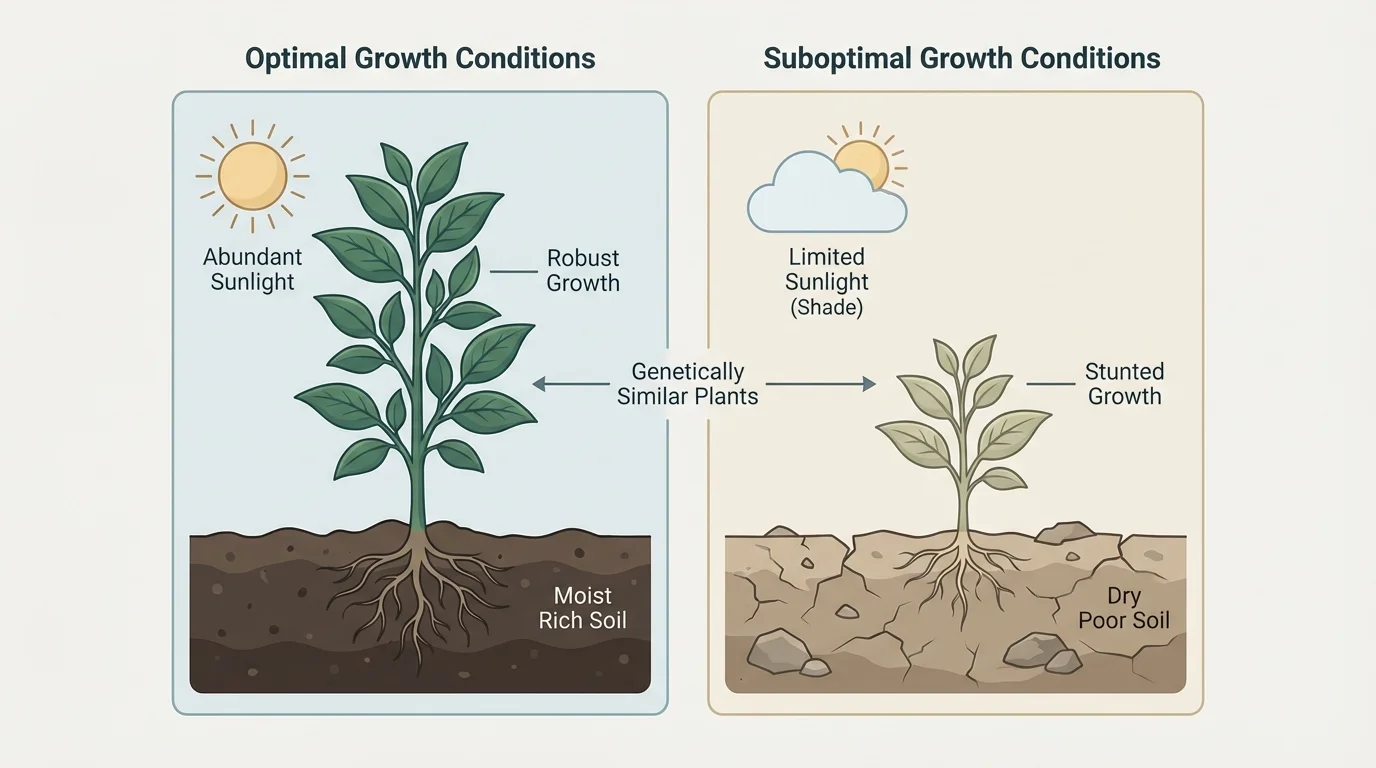
The final form of an adult plant depends on an interaction between genetic factors and local conditions, as [Figure 5] demonstrates. Genes set possibilities and influence traits, but the environment affects how fully those possibilities are expressed.
Think of genes as a set of instructions and the environment as the conditions under which those instructions are carried out. A sunflower may have genes that support tall growth, large leaves, and big flowers. But if it grows in shade with too little water, it may be shorter and produce fewer seeds than a sunflower with the same genes growing in sunny, moist soil.
This interaction is important because it explains why plants of the same species can look different in different places. Dandelions growing through sidewalk cracks are often small and compact. Dandelions growing in rich garden soil can become much larger. The species is the same, but the local conditions differ.
Genetic differences among plants also matter. One corn plant may inherit better resistance to drought than another. One kind of wheat may be better adapted to cold climates. Farmers use this knowledge to choose crop varieties suited for their region.
The comparison in [Figure 5] also helps explain why scientists test plants in different environments. A variety that grows well in one area may not perform as well in another if temperature, rainfall, soil, or pests are different.
Some seeds can remain dormant for years and then germinate when conditions become favorable. This helps plants survive through cold seasons, droughts, or fires.
So when we ask why a plant became tall, short, leafy, weak, productive, or unproductive, the best answer is often: both genes and environment played a role.
These ideas matter far beyond science class. Farmers need pollinators to support crop production. Conservationists protect habitats where animals can court, nest, and raise young. Gardeners choose healthy seeds, proper soil, and good watering schedules. Plant breeders try to develop varieties with useful inherited traits, such as disease resistance or drought tolerance.
Human actions can affect reproduction and growth. Pesticides may harm pollinators if used carelessly. Habitat loss can interfere with animal mating behaviors, migration, or nesting. Climate change can shift flowering times or reduce suitable habitats. When the timing between flowers and pollinators no longer matches, reproduction may decline.
Understanding reproduction also helps in medicine and ecology. Studying genetic inheritance helps scientists understand traits and disorders. Studying reproduction in endangered species helps biologists design better protection plans. Learning how plants grow helps communities improve food production in different climates.
Life continues not by one single method, but through many strategies shaped by structure, behavior, inheritance, and environment. From birdsong to bee pollination to potato tubers to sprouting seeds, reproduction connects every generation of living things to the next.
