Every day, the sky puts on a show that looks simple at first: the Sun rises, moves across the sky, and sets; the Moon changes shape; stars appear at night and seem to drift westward. But here is the surprising part: much of what we think we see is really caused by Earth's own motion. The sky is not spinning around us each day. Instead, our planet is rotating, orbiting the Sun, and traveling through space. By carefully observing patterns, scientists have built models that explain what we see and help us predict what will happen next.
When scientists study space, they often begin the same way anyone else does: by observing. A pattern is something that repeats in a regular and noticeable way. The sky is full of patterns. The Sun appears in the east and disappears in the west each day. The Moon rises and sets on a schedule that shifts over time. Many stars appear in the same groups night after night, while the set of visible stars changes over the course of a year.
These patterns can be observed, described, predicted, and explained with models. For example, if you know where the Sun rises at one time of year, you can predict that its rising point will shift over the next few months. If you know the phase of the Moon tonight, you can estimate what it will look like a week later. Astronomy depends on noticing regularity and then asking why that regularity exists.
Apparent motion is the way an object seems to move in the sky when the motion is actually caused by the movement of Earth, the object, or both. A model is a simplified representation used to explain how something works, such as a globe, a diagram, or a computer simulation of the solar system.
Ancient people used these repeating sky patterns long before telescopes existed. Farmers watched the sky to know when seasons were changing. Sailors used stars to navigate across oceans. Today, even though we have clocks, GPS, and satellites, the same sky patterns still matter. They help scientists track time, predict eclipses, launch spacecraft, and understand our place in space.
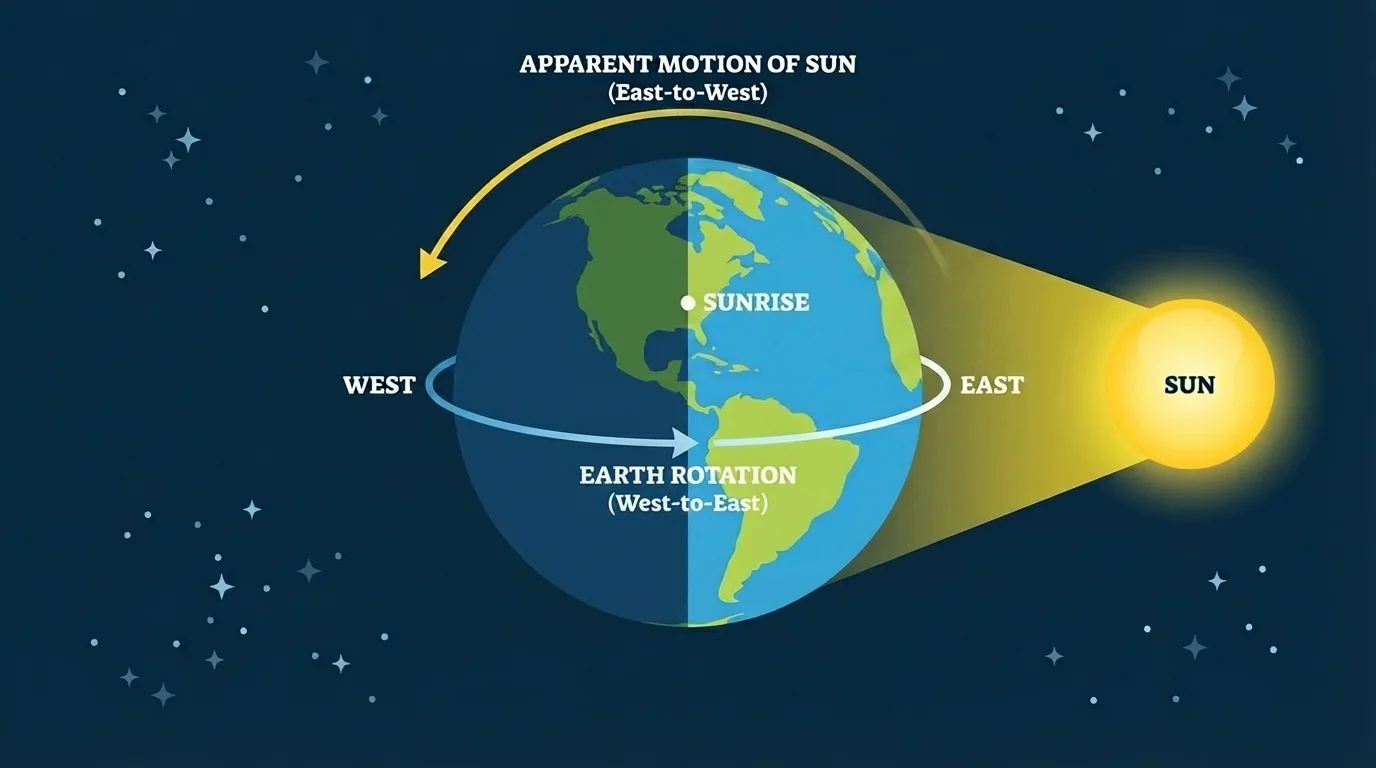
The apparent motion of the Sun across the sky is one of the easiest patterns to notice. As [Figure 1] shows, the Sun appears to travel from east to west because Earth rotates from west to east. Earth makes one full rotation in about 24 hours, which causes day and night.
When your location on Earth faces the Sun, it is daytime. When your location turns away from the Sun, it is nighttime. This means the Sun is not actually circling Earth every day. Instead, Earth's spin makes the Sun seem to move across the sky. This is a powerful example of how a model can explain an observation that might otherwise be misleading.
The Sun's path also changes during the year. In many places, the Sun is higher in the sky during summer and lower during winter. That happens because Earth's axis is tilted as Earth orbits the Sun. A higher Sun angle usually means sunlight is more concentrated and days are longer. A lower Sun angle usually means sunlight is spread out more and days are shorter.
This is why shadows can help tell the time of day and the season. Around noon, when the Sun is highest, shadows are shortest. In winter, even at noon, shadows are often longer than in summer because the Sun does not rise as high in the sky. Sundials work because of this regular connection between the Sun's apparent movement and the rotation of Earth.
Real-world example: estimating daylight change
If students in one city observe that the Sun sets at different times in June and December, they are seeing evidence of Earth's tilt and orbit. Suppose sunset is at about 8:30 p.m. in summer and 4:45 p.m. in winter. The difference is about 3 hours 45 minutes, showing how the Sun's apparent path affects the length of the day.
Step 1: Compare the two times.
From 4:45 p.m. to 8:30 p.m. is 3 hours 45 minutes.
Step 2: Connect the observation to a model.
The longer summer day happens because your part of Earth is tilted more toward the Sun, so the Sun appears to follow a longer path across the sky.
A later callback to [Figure 1] helps make sense of sunrise and sunset in different places on Earth. People in different time zones are simply on different parts of the rotating planet, so they face the Sun at different times.
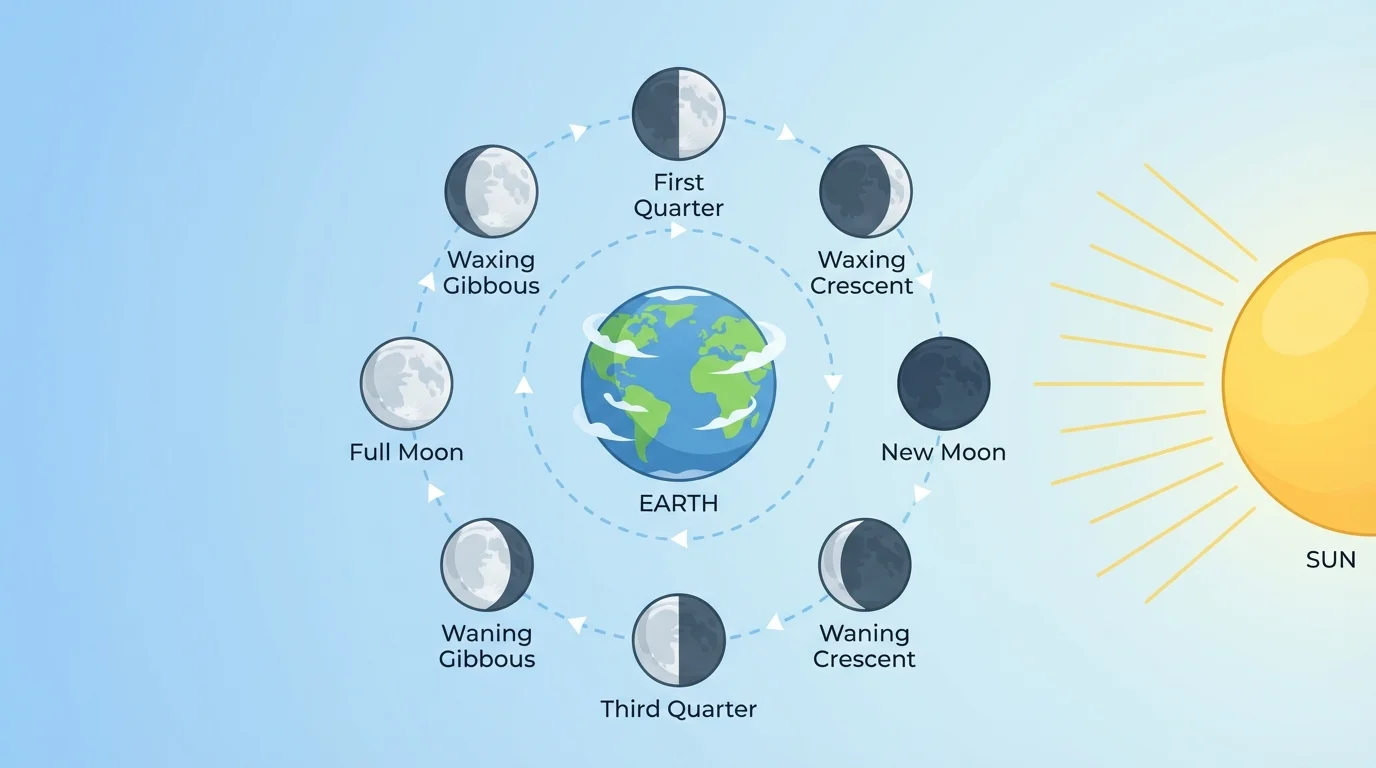
The phases of the Moon form another clear and predictable pattern. As [Figure 2] illustrates, the Moon does not make its own light. It reflects sunlight. Half of the Moon is always lit by the Sun, but from Earth we see different amounts of that lit half as the Moon orbits Earth.
This changing view creates the Moon's phases: new moon, waxing crescent, first quarter, waxing gibbous, full moon, and then the pattern reverses through waning gibbous, third quarter, and waning crescent. The full cycle takes about 29.5 days. That is why many calendars are roughly linked to the Moon's cycle.
The Moon also rises and sets, but not at exactly the same time every day. Because the Moon moves in its orbit around Earth, its position changes from night to night. Sometimes you can see it in the daytime. A common misunderstanding is that the Moon belongs only to the night sky, but it is often visible during the day depending on its phase and position.
The Moon's apparent shape is not caused by Earth's shadow except during a lunar eclipse. Most of the time, phases happen because of geometry: Earth, Moon, and Sun are in different positions relative to one another. A lunar eclipse is much rarer and only happens when Earth moves directly between the Sun and the Moon.
The Moon's motion affects Earth too. The Moon's gravity helps create ocean tides. This is a great example of how objects in space are not isolated. Earth and the Moon are part of a system with constant interactions.
Why phases are predictable
If the Moon completes one cycle of phases in about 29.5 days, then after about half that time, or roughly 14 to 15 days, it changes from new moon to full moon or from full moon back to new moon. This regular timing lets astronomers and calendars predict the Moon's appearance with great accuracy.
Later, when thinking about eclipses, it helps to remember [Figure 2]. The figure makes it clear that phases happen all month long, while eclipses require a much more exact alignment.
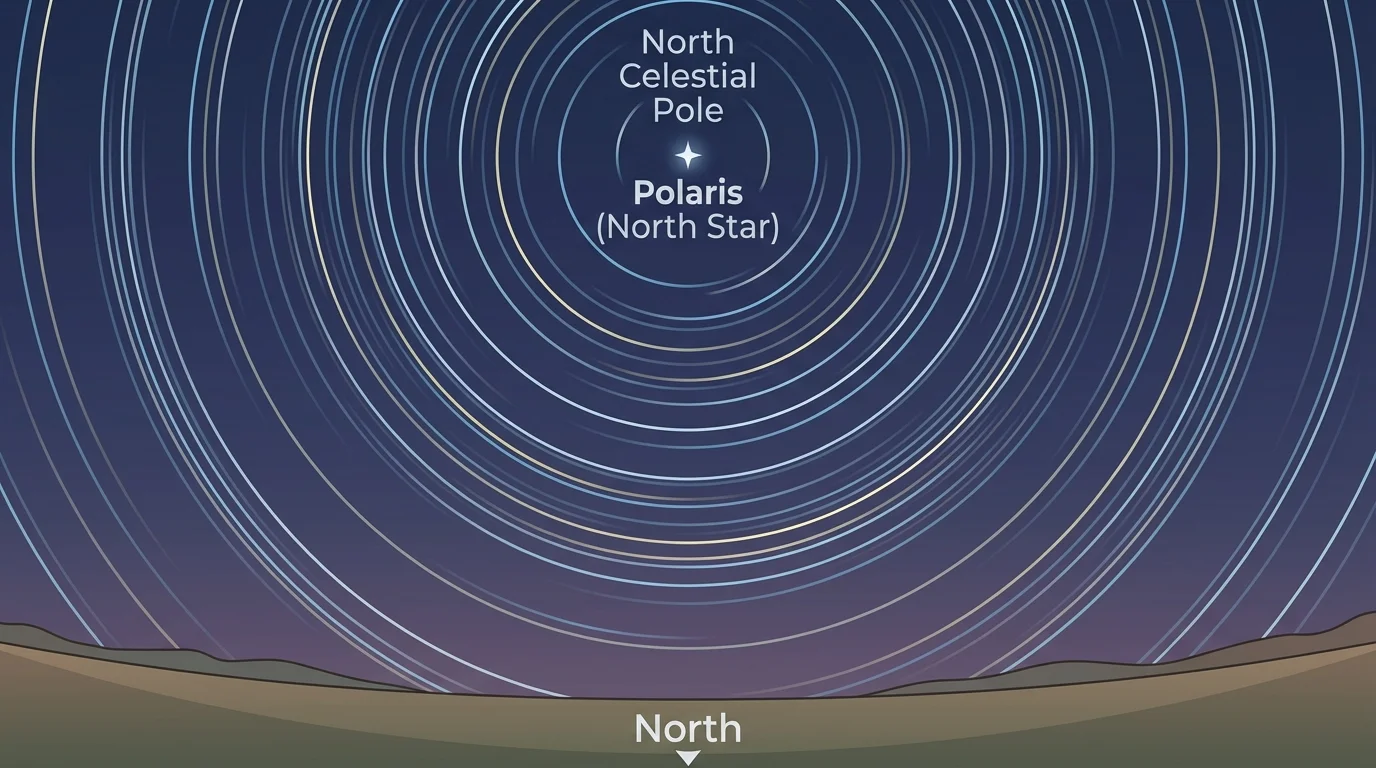
At night, stars also show regular motion. In the Northern Hemisphere, many stars seem to move in curved paths across the sky, and some appear to circle a point near the North Star, or Polaris. As [Figure 3] shows, this apparent movement happens for the same basic reason as the Sun's daily motion: Earth rotates.
Polaris appears almost fixed because it lies nearly in line with Earth's rotational axis. Other stars seem to circle around it during the night. If someone takes a long-exposure photograph, the stars appear as curved trails. The stars are not actually racing around Polaris in a few hours. Earth's rotation creates that appearance.
Groups of stars that seem to form pictures are called constellations. Orion, Scorpius, and Ursa Major are famous examples. These patterns help people identify regions of the sky, even though the stars in a constellation may be at very different distances from Earth.
Not all stars are visible all year. As Earth orbits the Sun, the nighttime side of Earth faces different directions into space during different seasons. That is why some constellations are considered winter constellations and others summer constellations. For example, Orion is often seen in the evening sky during Northern Hemisphere winter, while Scorpius is easier to see in summer.
This seasonal change is an important clue that Earth is moving around the Sun. If Earth stayed still, the night sky would not shift in this yearly pattern. Looking at the stars through the year is like seeing different windows into space as Earth changes position in its orbit.
| Sky object | Common pattern | Main cause |
|---|---|---|
| Sun | Rises in east, sets in west each day | Earth's rotation |
| Moon | Changes phase over about 29.5 days | Moon orbiting Earth and reflecting sunlight |
| Stars | Seem to move westward at night | Earth's rotation |
| Constellations | Visible in different seasons | Earth's orbit around the Sun |
Table 1. Major sky patterns and the motions that explain them.
When people navigate by the stars, they rely on these steady patterns. Sailors once used Polaris to estimate north, and desert travelers used familiar constellations to keep direction. The sky can act like a giant map when you understand its repeated motions, just as seen in [Figure 3].
A model in science is not just a small copy of something. It can be a diagram, a globe, a scaled model, a computer simulation, or even a mental picture. Models are useful because space is too large and too slow-moving for us to observe all at once in everyday life.
For example, a lamp and a globe can model day and night. If the globe rotates while one side faces the lamp, students can see why sunrise and sunset happen. A ball orbiting the globe can model the Moon's phases. No model is perfect, but a good model explains important patterns and helps make predictions.
Earlier studies of motion on Earth show that what we observe depends on where we are standing. In space science, that idea matters a lot: from Earth, the sky seems to move around us, but the larger model reveals that Earth itself is moving.
Scientists test models by checking whether predictions match observations. If a model says a full moon should happen about two weeks after a new moon, observers can check the sky. If a model explains why one constellation is visible in winter but not summer, people can test that over the year. Astronomy became a science by linking patterns, models, and evidence.
Earth is one planet in the solar system, which includes the Sun, eight planets, moons, dwarf planets, asteroids, and comets. The Sun is a star, a huge glowing ball of hot gas that gives off energy. Its gravity holds the solar system together.
The planets travel around the Sun in paths called orbits. An orbit is the curved path one object follows around another because of gravity. Earth takes about 365.25 days to complete one orbit around the Sun. That is why we need leap years: the extra quarter day adds up over time.
Gravity is the force that pulls objects toward one another. The more mass an object has, the stronger its gravitational pull. The Sun has far more mass than any planet, so its gravity dominates the solar system. Earth's gravity holds the Moon in orbit, and the Moon's gravity still affects Earth through tides.
Real-world example: why a year is not exactly 365 days
Earth's orbital period is about 365.25 days.
Step 1: Note the extra part of a day.
Each year adds about 0.25 day beyond 365 days.
Step 2: Combine four years.
After 4 years, the extra time is about 1 full day because 0.25 day added 4 times equals 1 day.
Step 3: Apply it to calendars.
That extra day is added to February during a leap year so the calendar stays aligned with Earth's orbit around the Sun.
The solar system is not arranged like planets lined up in a straight row. It is a vast three-dimensional system with huge distances between objects. Even light, which travels extremely fast, takes about 8 minutes to go from the Sun to Earth. That means when you look at the Sun, you see it as it was about 8 minutes earlier.
Some of the light from stars you see tonight began its journey before you were born. Looking into space is also looking into the past because light takes time to travel.
This idea becomes even more amazing when we study stars beyond our solar system. The farther away an object is, the longer its light takes to reach us.
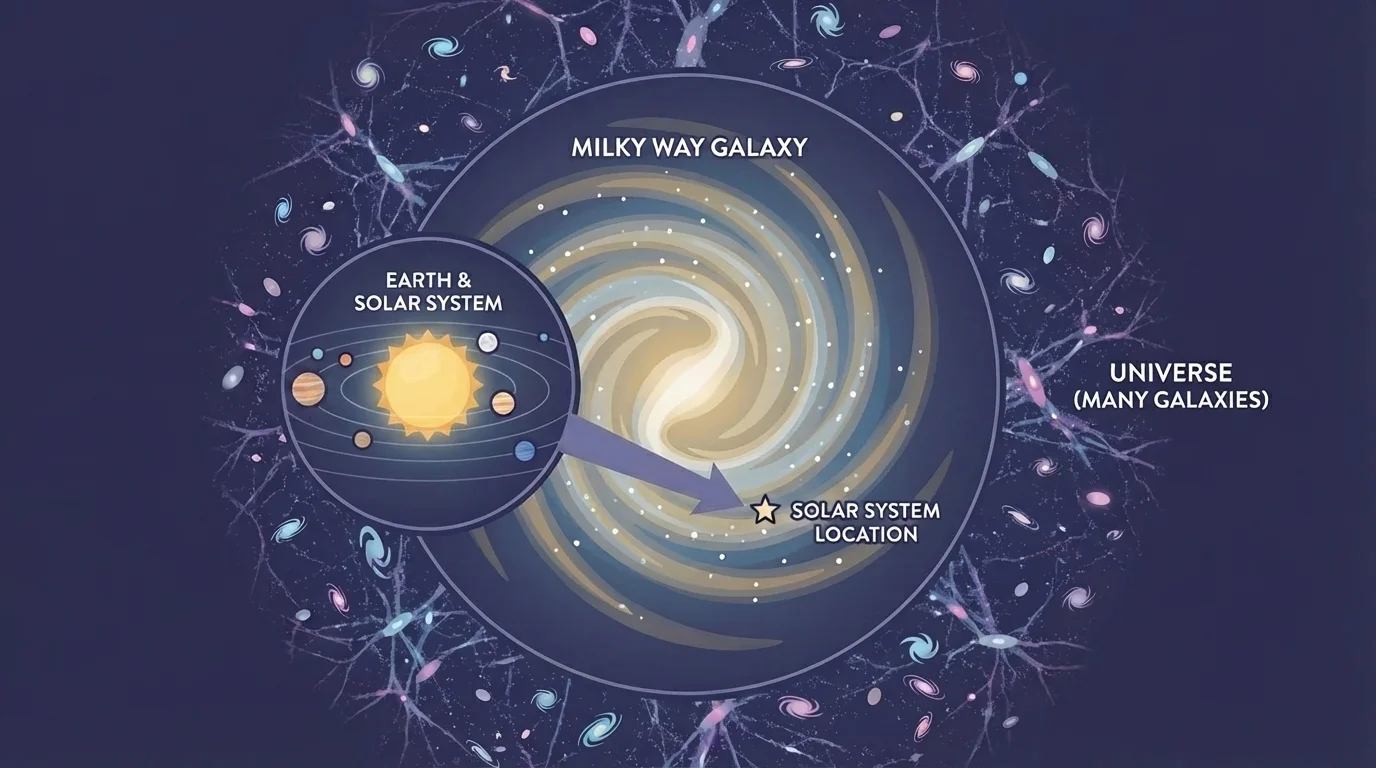
Earth's place in space becomes clearer when we zoom outward, as [Figure 4] shows. Earth is a planet in the solar system. The solar system is part of the Milky Way galaxy, a huge collection of stars, gas, dust, and other matter held together by gravity.
The Milky Way contains billions of stars, and our Sun is just one of them. The solar system lies in one of the Milky Way's spiral arms, not at the center. If the solar system were reduced to a tiny speck on a classroom poster, the galaxy would still be enormous compared with it.
A galaxy is a vast system of stars and other matter held together by gravity. The Milky Way is only one galaxy among many. Scientists observe countless other galaxies in the universe, and they come in different shapes such as spiral, elliptical, and irregular.
The universe includes all space, all matter, all energy, and all galaxies. In other words, the solar system is inside the Milky Way, and the Milky Way is only one small part of the much larger universe. This scale is difficult to imagine, which is why models and diagrams are so helpful.
Stars are not all the same. They differ in size, temperature, color, brightness, and age. Our Sun is important to us, but in the universe it is one ordinary star among billions. Some stars are larger and hotter than the Sun; others are smaller and cooler. Their colors can give clues about their temperatures, with blue-white stars generally hotter than red stars.
When we return to [Figure 4], the nested structure becomes easier to remember: planet, solar system, galaxy, universe. Each level contains the one before it.
Studying the sky is not just about curiosity. Astronomy affects daily life in important ways. Calendars are based on Earth's rotation and orbit, along with the Moon's cycle in some cultures. Navigation has long depended on the Sun and stars. Modern space science also supports satellites used for weather forecasting, communication, mapping, and environmental monitoring.
Engineers must understand Earth's movement and gravity when launching spacecraft. For example, a satellite must be placed in the correct orbit so that it moves around Earth in a predictable way. Weather satellites help track storms, and GPS systems rely on satellites whose positions are carefully measured.
Careful sky observation also teaches us about Earth itself. The changing seasons, the timing of daylight, the cycle of tides, and the effect of light pollution on star visibility all connect our planet to space. City lights can make faint stars harder to see, which reminds us that what humans do on Earth can affect how we observe the universe.
Amateur astronomers still contribute useful observations. People with small telescopes or even careful naked-eye records can track meteor showers, note phases of the Moon, and record planetary positions. Science grows when many observers compare patterns over time.
"We are a way for the universe to know itself."
— Carl Sagan
That idea feels less like poetry and more like science when you understand how much can be learned from simple observations of the sky. By noticing patterns and testing models, humans have discovered that Earth is not the center of everything. It is one world orbiting one star in one galaxy among many.
