A single drop of water can help carve a canyon, grow a forest, form a cave, power a storm, and influence climate across an entire planet. That sounds impossible for one substance, but water is one of Earth's most powerful agents of change. It moves almost everywhere: across land, through soil, inside living things, into the atmosphere, and through the ocean. Because of that constant movement, water links Earth's major systems into one connected whole.
Earth is not a collection of separate parts. The land, oceans, atmosphere, ice, and living things all interact. Water is one of the main substances connecting them. It changes state between solid, liquid, and gas, and each state matters. Liquid water flows in rivers and groundwater. Water vapor moves through the air. Ice stores water in glaciers, snowpacks, and polar regions. Together, these forms of water shape Earth over time scales ranging from a sudden flash flood in a few hours to the carving of a valley over millions of years.
Water matters because it can absorb and release energy, dissolve many materials, and move under the pull of gravity. It can slowly seep through rock cracks or crash against a shoreline with tremendous force. Even tiny droplets in clouds affect weather, while vast ocean currents affect climate over great distances.
Weathering is the breaking down of rock into smaller pieces or changing its minerals at Earth's surface. Erosion is the movement of weathered material from one place to another. Deposition is the dropping of transported sediment when water, wind, or ice loses energy.
These processes are not rare events. They are happening all the time, whether you notice them or not. A muddy stream after heavy rain, a pothole deepened by freezing water, and a sandy beach built by waves are all signs that water is changing Earth's surface.
Water is always on the move in a continuous water cycle, as [Figure 1] shows through the links among ocean, atmosphere, land, plants, and underground flow. Liquid water evaporates from oceans, lakes, rivers, and wet soil. Plants also release water vapor through transpiration. High in the atmosphere, water vapor cools and becomes tiny droplets or ice crystals by condensation and crystallization. When enough water gathers, it falls as precipitation, such as rain, snow, sleet, or hail.
Two main forces drive this cycle: sunlight and gravity. Sunlight provides the energy for evaporation. Gravity pulls precipitation down from the sky and moves water downhill across land. If Earth had gravity but no incoming solar energy, water would not cycle in the same active way. If Earth had sunlight but no gravity, rain would not fall and rivers would not flow downhill. Both are essential.
Some water runs across the surface as streams and rivers. Some soaks into the ground. Some becomes part of snow or ice for a while. Some returns quickly to the air. Water can stay in one place for different amounts of time. A puddle may evaporate in a day, while water frozen in a glacier can remain there for thousands of years.
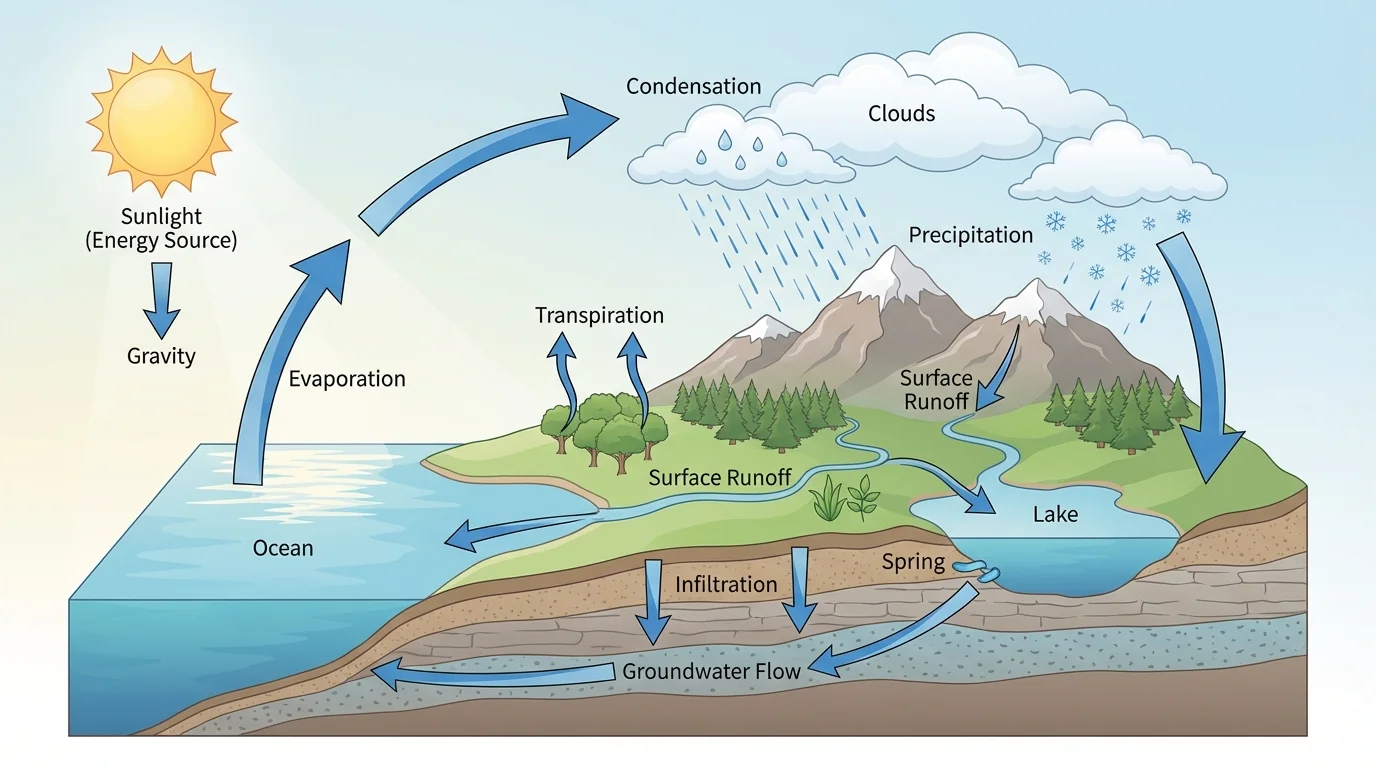
Water changes state because of energy transfer. When liquid water becomes water vapor, it absorbs energy. When water vapor condenses into droplets, it releases energy into the atmosphere. That released energy helps power storms. This is one reason warm ocean water can strengthen large storms such as hurricanes.
Why phase changes matter
Water is unusual because it can store and transfer large amounts of energy when it changes state. Evaporation removes energy from surfaces, which is why sweating cools your skin. Condensation releases energy into the air, which can make rising air even more active in storms. These energy changes connect the water cycle directly to weather and climate.
A simple way to think about Earth's water is as a recycling system with many pathways. The same water molecule in \(H_2O\) could be in the ocean now, inside a plant next week, and later frozen in a snowbank. Earth does not make much new water at the surface; instead, it continually moves and reuses the water it already has.
Once water reaches land, it becomes a powerful surface-changing force. Flowing water wears away rock, picks up sediment, and carries it elsewhere, as [Figure 2] illustrates with a river system from slope to delta. This is why rivers can cut valleys, waterfalls can retreat upstream, and coastlines can change shape over time.
Water causes physical weathering and chemical weathering. In physical weathering, rock is broken into smaller pieces without changing what the rock is made of. One important example is freezing and thawing. Water seeps into cracks, freezes, and expands. Over many cycles, the crack widens. In chemical weathering, water reacts with minerals in rock. Slightly acidic rainwater can dissolve some minerals and weaken rock.
Rainwater naturally becomes a weak acid because it can combine with carbon dioxide in the air to form a small amount of carbonic acid. In simple terms, water and carbon dioxide can combine to form a weak acid in solution. That weak acidity helps dissolve minerals in some rocks, especially limestone. This is a slow process, but over long periods it can greatly change landscapes.
Erosion happens when water moves the weathered material. Fast-moving streams can carry pebbles and sand. Slower water carries finer particles such as silt and clay. When water slows down, it drops the sediment. That is deposition. Sediment can build floodplains, sandbars, beaches, and deltas.
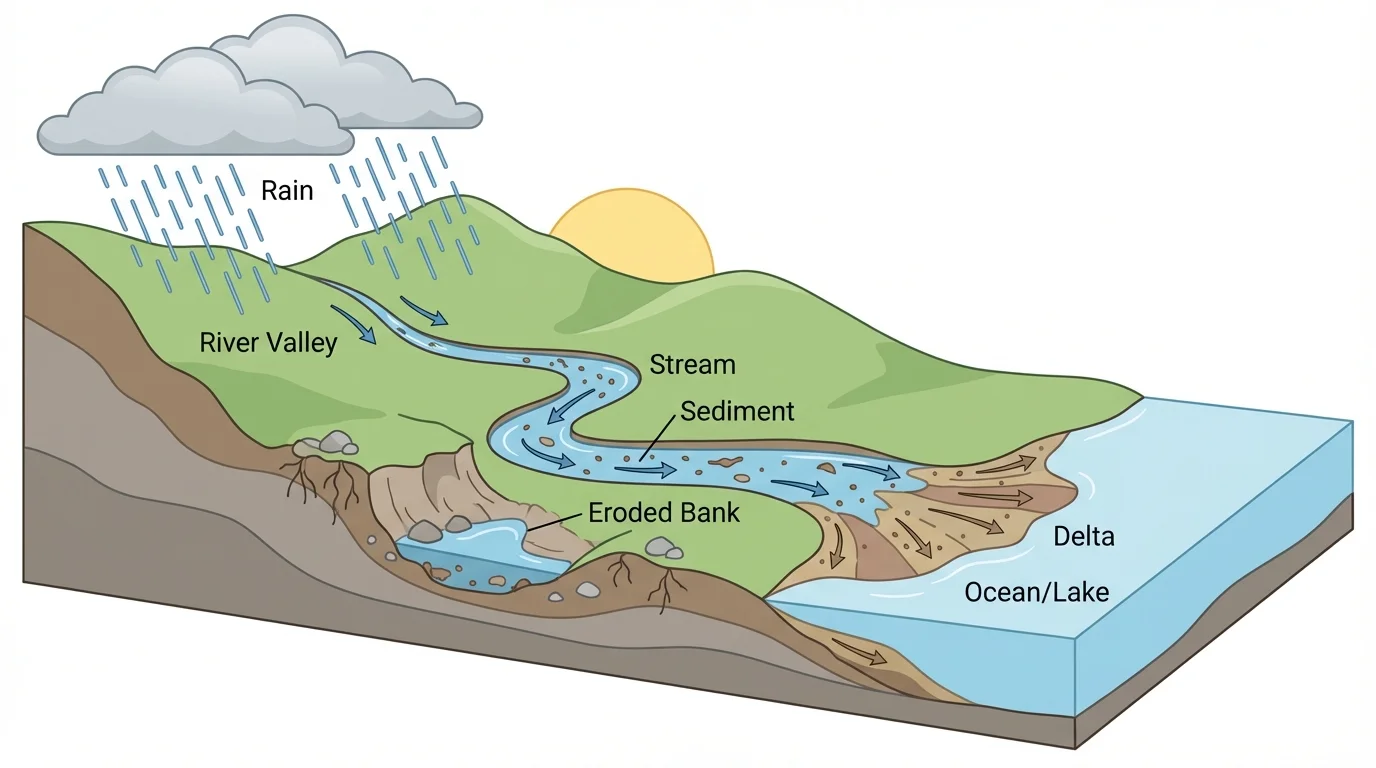
A river's speed helps determine what it can carry. During a flood, a river has more energy and can move larger rocks than it usually can. When the flood ends and the water slows, much of that material is deposited. This is one reason floods can both erode land and leave behind fertile soil.
Real-world example: The Grand Canyon
The Grand Canyon in the United States is one of the clearest examples of water shaping land over a long time.
Step 1: The Colorado River flows downhill, driven by gravity.
Step 2: The river carries sediment that acts like sandpaper, scraping and deepening the channel.
Step 3: Rain, runoff, and weathering on the canyon walls loosen more rock.
Step 4: Over millions of years, erosion removes huge amounts of material and reveals layers of rock.
The canyon forms through the combined effects of moving water, weathering, gravity, and long spans of time.
Coasts also change because of water. Waves erode cliffs, move sand along shorelines, and build beaches in new places. A storm can reshape a beach in a single day, while ordinary wave action keeps adjusting the coast year after year.
Water does not stop shaping Earth when it disappears from sight. Below the ground, groundwater moves through spaces in soil and cracks in rock, as [Figure 3] shows in the cross-section from surface infiltration to aquifer and cave formation. This underground movement can weather rock, transport dissolved minerals, and create remarkable underground features.
When water soaks into the ground, the process is called infiltration. If it reaches a layer of rock or sediment that stores water, it may become part of an aquifer. Aquifers are important because many communities pump groundwater from them for drinking water and farming.
Groundwater is especially important in areas with limestone. Slightly acidic water can dissolve limestone slowly, enlarging cracks into tunnels and chambers. Over time, this can create caves. If the roof of an underground chamber collapses, a sinkhole may form at the surface.
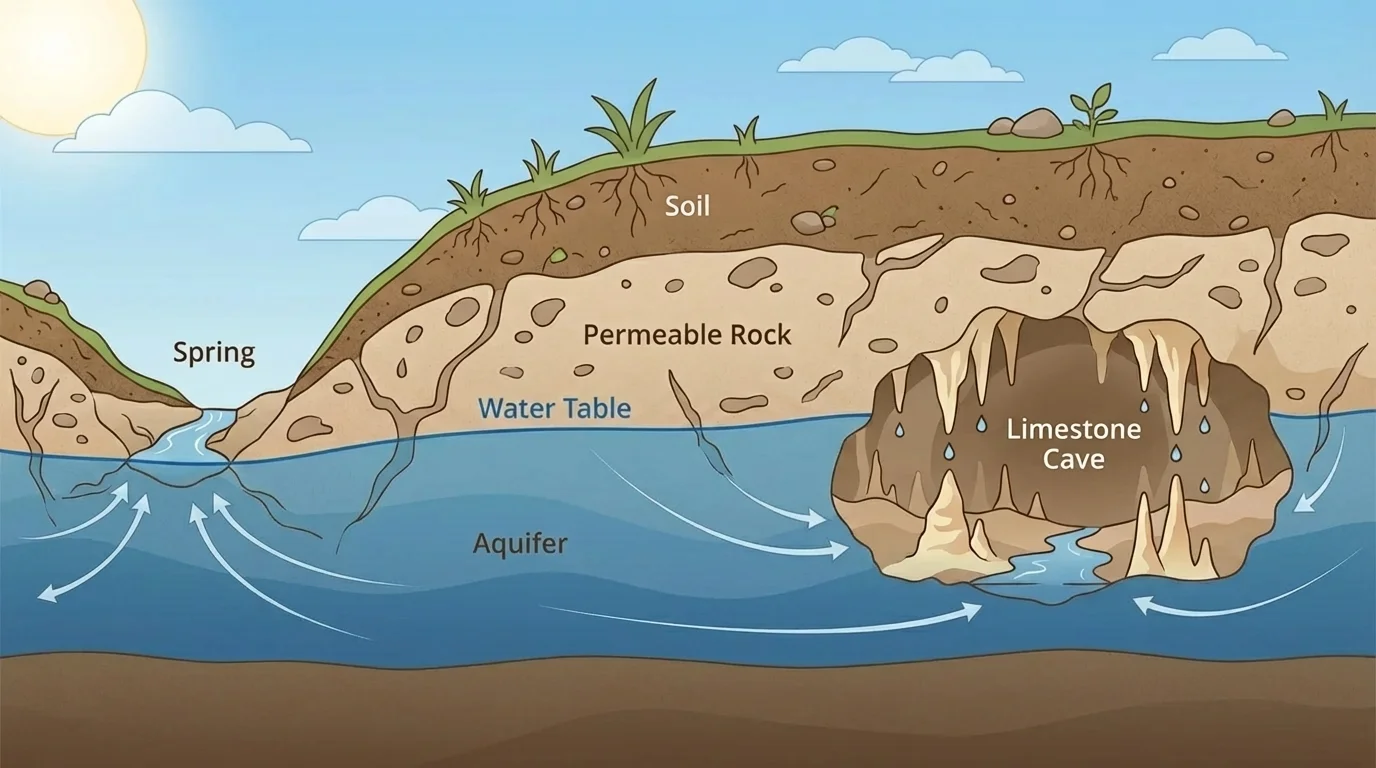
Underground water can also leave minerals behind. When mineral-rich water drips inside caves, it can form stalactites hanging from the ceiling and stalagmites rising from the floor. These features grow very slowly, often over many hundreds or thousands of years.
Because groundwater moves more slowly than river water, underground changes may be harder to notice. But they are still powerful. In some regions, springs emerge where groundwater reaches the surface, feeding streams and wetlands. This shows again that surface water and underground water are connected parts of one system.
Some of the water pumped from deep underground today may have entered the ground hundreds or even thousands of years ago. That means people can use groundwater faster than nature replaces it.
The underground part of the water system also affects what happens above ground. If soils are already full of water, more rain is likely to run off and cause flooding. If groundwater levels drop, plants, springs, and streams may be affected.
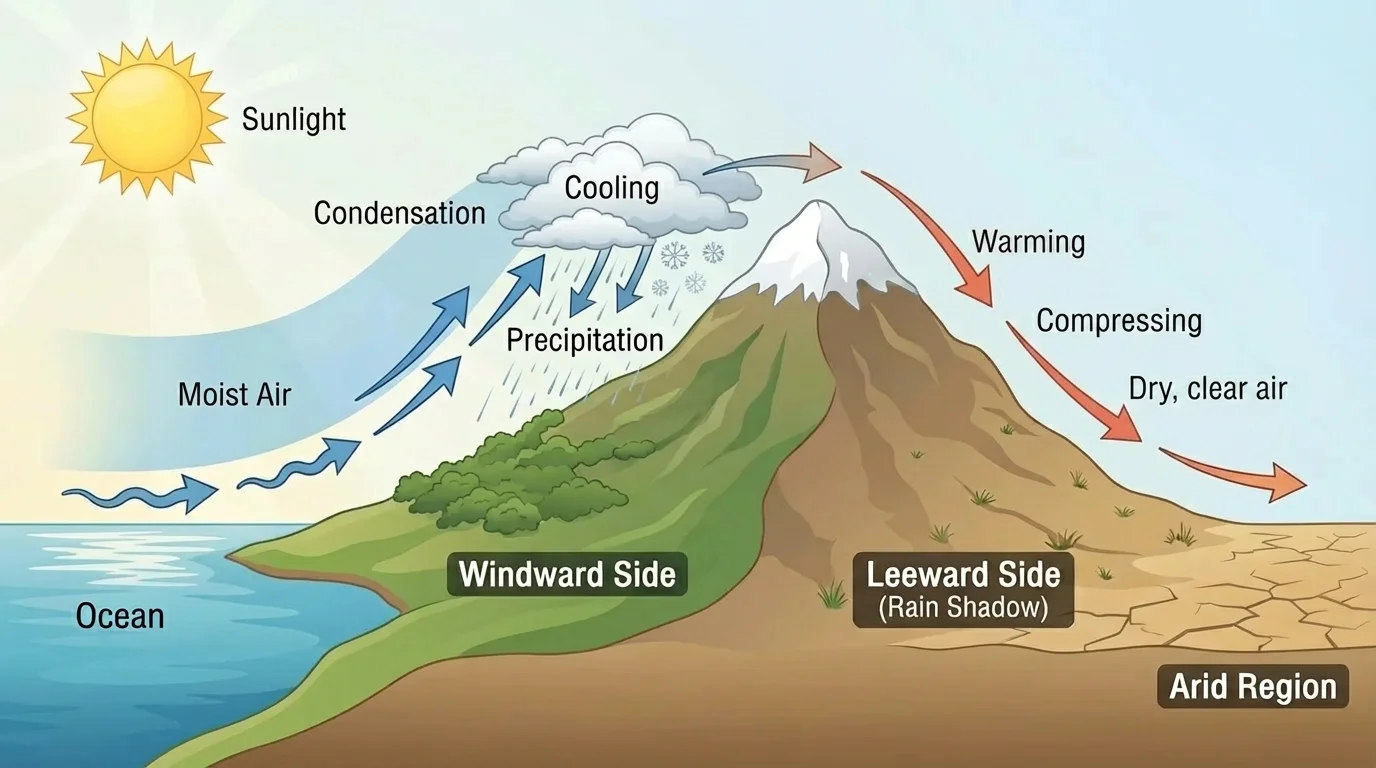
The atmosphere is the part of Earth's system where water helps produce daily weather. The complex movement of water vapor, clouds, and precipitation depends on temperature, air pressure, winds, and landforms. Moist air does not behave the same everywhere, and as [Figure 4] illustrates, mountains can force air upward and change rainfall patterns from one side to the other.
Warm air can hold more water vapor than cold air. When warm, moist air rises, it cools. Cooling causes condensation, forming clouds. If droplets or ice crystals grow large enough, precipitation falls. This is why rising air is so important in weather. Storms often develop where warm air rises rapidly.
Landforms affect weather too. When moist air blows toward a mountain, it rises along the slope. As it rises, it cools and may produce rain or snow on that side. The other side may become much drier, creating a rain shadow. This is why places on different sides of the same mountain range can have very different climates.
Latitude and altitude also matter. Areas near the equator receive more direct sunlight on average, which affects heating, evaporation, and rainfall. Higher elevations are generally cooler, so mountains often have snow even when nearby lowlands are warmer. Local geography, including nearby lakes or oceans, can also influence temperatures and precipitation.
Living things affect atmospheric water as well. Forests release water vapor through transpiration, which can increase humidity and influence cloud formation. In this way, the biosphere interacts with the atmosphere and the water cycle.
We can measure weather using tools such as thermometers, rain gauges, radar, satellites, and weather balloons. But even with powerful technology, weather is difficult to predict perfectly because so many interacting variables are changing at once.
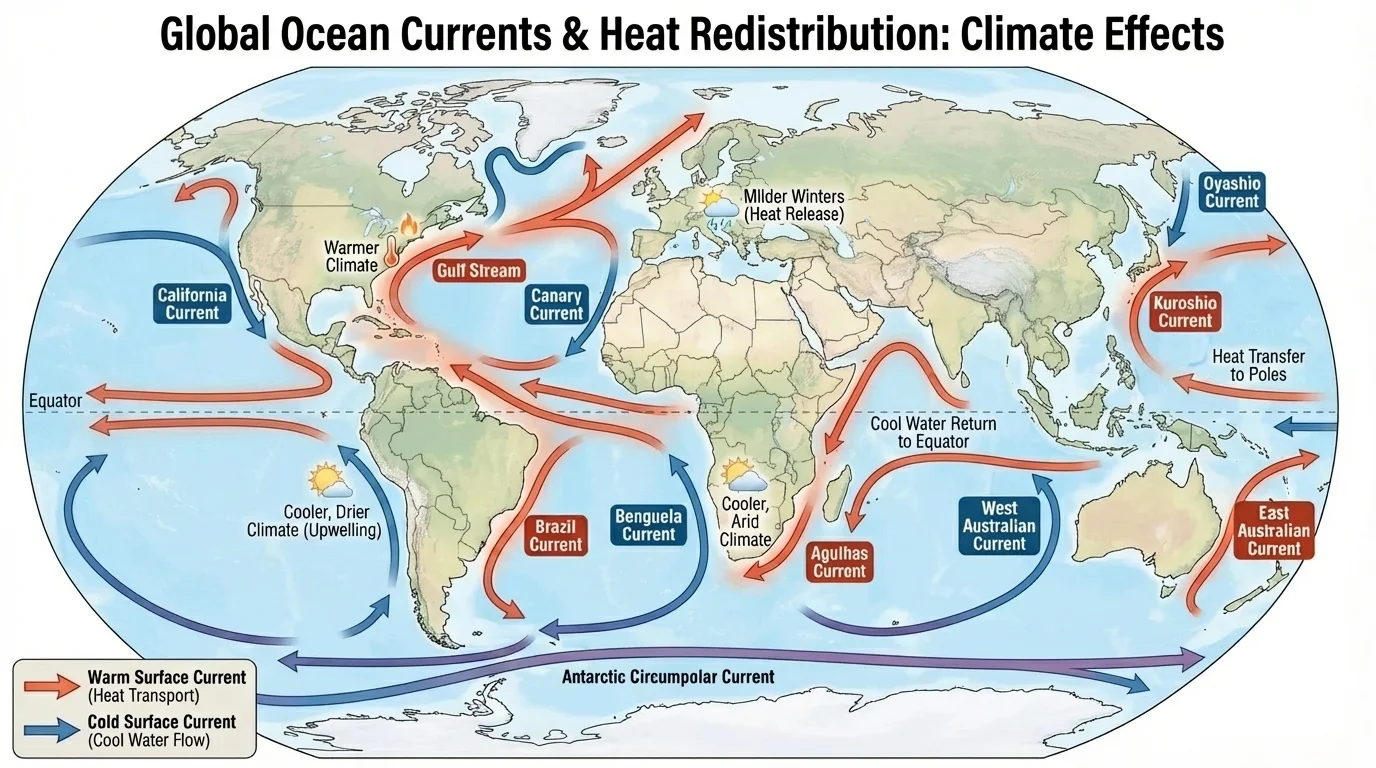
The ocean covers most of Earth's surface and has an enormous effect on weather and climate. Water heats and cools more slowly than land, so the ocean can absorb energy from the Sun, store it, and release it over time. It also redistributes that energy through currents, as [Figure 5] shows with warm and cold flows moving heat across the globe.
This heat storage helps explain why coastal areas often have milder temperatures than inland areas. In summer, the ocean may stay cooler than the land, helping keep nearby coasts cooler. In winter, the ocean may stay warmer than the land, helping nearby coasts remain less cold.
Ocean currents move warm water away from the equator and cold water away from polar regions. These movements affect air temperatures above the water and can influence storms, fog, rainfall, and long-term climate patterns. A place next to a warm current may be much milder than another place at the same latitude next to a cold current.
Sea surface temperatures also affect storms. Tropical storms gain energy from warm ocean water. If ocean temperatures are especially high, storms may strengthen more easily. This does not mean warm water alone creates every storm, but it is one important part of the system.
Ocean as a heat reservoir
The ocean acts like a giant thermal battery. It absorbs solar energy when conditions allow, stores much of that energy, and releases it gradually. Because moving water in the ocean can travel long distances, that stored energy does not stay in one place. It helps connect distant regions of Earth's climate system.
The ocean also exchanges \(CO_2\) with the atmosphere and supports marine life that influences Earth's systems. This means the ocean is not just a background feature. It is an active player in climate, weather, chemistry, and life.
Scientists can often predict general weather patterns very well, but exact outcomes are harder. That is because the atmosphere is a complex system. Tiny changes in temperature, humidity, pressure, or wind can lead to different results later. Because of this complexity, forecasts are often given as probabilities, such as a \(60\%\) chance of rain.
A probabilistic forecast does not mean scientists are guessing randomly. It means they are using data, models, and observations to estimate the most likely outcomes. If many model runs show rain in a region, the chance goes up. If the model results disagree more, confidence is lower.
Climate and weather are related but different. Weather is the short-term condition of the atmosphere, such as today's temperature or tomorrow's rain. Climate is the long-term pattern of weather in a place over many years. A snowy day is weather; a region known for cold winters has a climate pattern.
The complexity of forecasting becomes easier to understand when you think about all the interacting parts: sunlight, ocean temperatures, winds, topography, ice cover, land moisture, and living things. As we saw earlier in [Figure 4], even one mountain range can change where air rises and where rain falls. Across an entire planet, those interactions become extremely complicated.
Water's surface processes matter to people every day. Farmers depend on precipitation, soil moisture, and groundwater. Cities depend on reservoirs, aquifers, and predictable water supplies. Engineers must consider erosion when designing bridges, roads, and dams. Emergency managers track floods, droughts, and storms to protect communities.
Flooding is a clear example of Earth systems interacting. Heavy rain may fall because warm, moist air rises and condenses. If the ground is already saturated, less water infiltrates and more runs off. Rivers then rise quickly, increasing erosion and transporting sediment. In coastal areas, storm surge and waves can add even more damage.
Real-world example: Why one storm causes more flooding than another
Step 1: Compare rainfall totals. More precipitation usually means more water entering the system.
Step 2: Check the soil. Dry ground may absorb more water, but saturated ground allows more runoff.
Step 3: Look at land cover. Pavement prevents infiltration, while forests and wetlands often slow runoff.
Step 4: Consider slope. Steeper land moves water downhill faster because gravity acts more directly on flowing water.
Flood risk depends on many connected factors, not just the amount of rain.
Drought is another example. If an area receives much less precipitation than usual over time, soils dry out, streamflow decreases, crops suffer, and wildfire risk can increase. Because the water cycle connects land, atmosphere, and living things, the effects spread through the whole environment.
People can also change water's natural pathways. Building cities adds pavement, which reduces infiltration and increases runoff. Removing vegetation can increase erosion. Dams change river flow and sediment movement. On the other hand, planting vegetation, protecting wetlands, and designing better drainage systems can reduce damage.
The most important idea is that water is not acting alone. It connects Earth's systems at every scale. Sunlight drives evaporation. Gravity pulls water downhill. The atmosphere moves water vapor. Landforms redirect wind and runoff. Oceans store and transport heat. Ice locks up water and reflects sunlight. Living things return water to the air and change the land surface.
Understanding one event often requires looking at the whole system. A river flood may begin with atmospheric conditions over an ocean. A cave may form because rainwater absorbs \(CO_2\), enters the soil, and dissolves rock underground. A local climate may depend on latitude, mountains, and nearby currents, as shown earlier in [Figure 5]. Earth works through interactions, not isolated parts.
This is why scientists study Earth as a system. Whether they are examining a raindrop, a watershed, a cave, or a global current, they are asking how water moves, how energy flows, and how those processes shape the planet over time. Water helps write Earth's history, and it will continue to shape Earth's future.
