A modern car can go from highway speed to a stop in seconds, yet the difference between a survivable crash and a fatal one often comes down to a brilliant engineering idea: do not eliminate the change in motion—stretch it out. That is why airbags inflate, helmets compress, and package padding crushes. The science behind these devices is not mysterious—it comes from forces, motion, and momentum—and the engineering challenge is to design something that reduces the force acting during a collision without failing in some other way.
Collisions are everywhere in daily life. A phone dropped onto a floor collides with the ground. A baseball glove catches a fast-moving ball. A bicycle helmet protects a rider during impact. A spacecraft landing system must reduce force when touching down. In all of these situations, an object's motion changes quickly, and that change can create a very large force.
The central design problem is this: when a moving object collides and must slow down or stop, how can a device be built so that the force on the object is as small as possible? Engineers answer this by combining physics with testing. They study how objects interact, create prototypes, evaluate results, and refine the design.
Safety devices are not meant to break the laws of physics. A rider's head still has to slow down in a helmet impact, and a car passenger still has to stop when a crash ends the car's motion. The goal is to control how that stopping happens.
You already know that motion can change in speed, direction, or both. You also know that unbalanced forces cause acceleration. During a collision, these ideas become especially important because the motion changes in a very short time.
In collision design, scientists and engineers focus on the object or system they want to protect. That might be a person, a vehicle, a piece of equipment, or a fragile product being shipped. The best design depends on the system and on what counts as success.
Newton's second law connects force to acceleration. In a simple algebraic form, it is written as
\(F = ma\)
where force equals mass times acceleration. Since acceleration is the rate of change of velocity, a large change in velocity happening very quickly means a large acceleration, and therefore a large force.
A collision often involves a sudden change in velocity. If a skateboard and rider moving at speed come to rest after hitting a barrier, their velocity changes from some positive value to zero. If that change happens almost instantly, the acceleration is very large in magnitude, so the force is large. If a safety device makes the stopping take longer, the acceleration becomes smaller, which reduces the force.
Acceleration is the rate at which velocity changes. Collision is an interaction in which two objects exert forces on each other for a short time. Macroscopic object means an object large enough to be seen directly, such as a car, helmet, ball, or package.
For example, suppose a cart of mass \(2 \, \textrm{kg}\) changes its velocity by \(4 \, \textrm{m/s}\). If that happens in a very short time, the acceleration is large. If the acceleration were \(20 \, \textrm{m/s}^2\), then the net force would be \(F = ma = 2 \times 20 = 40 \, \textrm{N}\). If a bumper design caused the same velocity change with an acceleration of only \(8 \, \textrm{m/s}^2\), then the force would be \(F = 2 \times 8 = 16 \, \textrm{N}\). The motion change is similar, but the force is much smaller.
This is why engineers do not think only about stopping an object. They think about controlling the rate of stopping.
Another key idea is momentum, which depends on mass and velocity. Momentum is written as
\(p = mv\)
where \(p\) is momentum, \(m\) is mass, and \(v\) is velocity. A more massive object or a faster object has more momentum.
During a collision, momentum changes. If an object comes to rest, its final momentum is zero, so its momentum has decreased. In a closed system, the total momentum of all interacting objects is conserved, meaning that the momentum lost by one part of the system is gained by another part. This helps us predict motion during collisions.
Suppose a \(1.5 \, \textrm{kg}\) ball is moving at \(6 \, \textrm{m/s}\). Its momentum is \(p = mv = 1.5 \times 6 = 9 \, \textrm{kg }\cdot\textrm{ m/s}\). If it is caught and brought to rest, its momentum changes by \(9 \, \textrm{kg }\cdot\textrm{ m/s}\). That change must come from the interaction between the ball and the glove, hands, and player's body.
Notice something important: reducing force does not mean avoiding a momentum change. The momentum still changes. The engineering goal is to make that change happen in a safer way.
Why momentum matters in design
If two designs stop the same object from the same starting speed, they must produce the same overall change in momentum. The safer design is usually the one that increases the time of interaction or spreads the force over a larger area, lowering the force on any one part of the object or person.
This is one reason catching a ball by moving your hands backward feels better than catching it with stiff hands. The ball's momentum still goes to zero, but the stopping happens over a longer time and distance.
Engineers often analyze collision safety using impulse, as [Figure 1] illustrates in a simple comparison between a rigid stop and a padded stop. Impulse connects force, time, and momentum change. In algebraic form,
\[F \Delta t = \Delta p\]
where \(F\) is average force, \(\Delta t\) is collision time, and \(\Delta p\) is change in momentum. If \(\Delta p\) stays the same, increasing \(\Delta t\) reduces the average force.
That idea is the heart of many safety devices. If a moving object must lose a certain amount of momentum, a design that makes the collision last longer can reduce the force. Padding, crumpling, stretching, compressing, and bending are all ways to increase the interaction time.
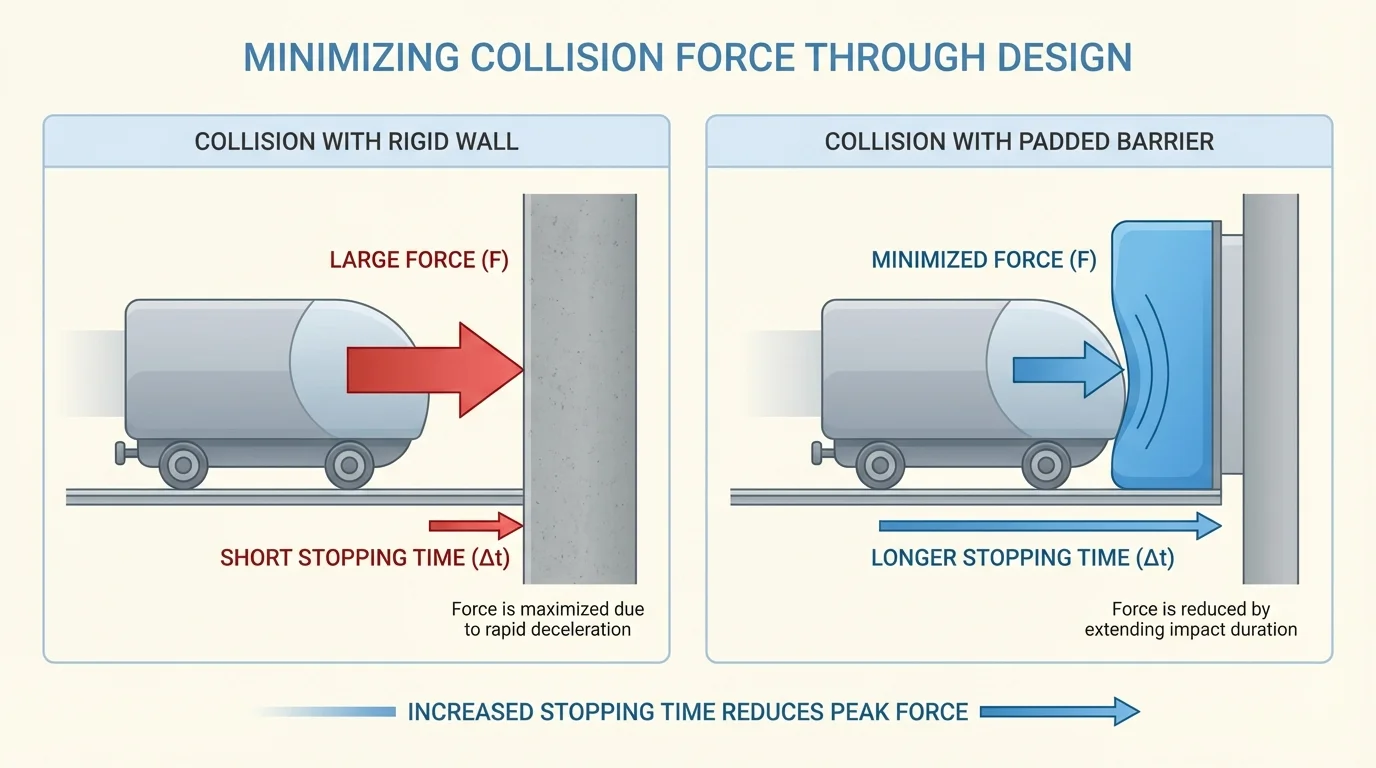
A numeric example makes this clear. Suppose an object's momentum changes by \(12 \, \textrm{kg }\cdot\textrm{ m/s}\). If the collision lasts \(0.02 \, \textrm{s}\), then the average force is \(F = \dfrac{\Delta p}{\Delta t} = \dfrac{12}{0.02} = 600 \, \textrm{N}\). If a device increases the collision time to \(0.10 \, \textrm{s}\), then the average force becomes \(F = \dfrac{12}{0.10} = 120 \, \textrm{N}\). The force is much smaller even though the momentum change is the same.
Designers also reduce force by spreading it over a larger area. A seat belt spreads the stopping force across stronger parts of the body rather than concentrating it in one small region. A snowshoe spreads force over a large area so a person sinks less into snow. In collision safety, area matters because concentrated force can cause more damage.
Another major strategy is deformation. Some materials deform, or change shape, during impact. That is not always a failure. In many devices, controlled deformation is the feature that makes them work. Foam in a helmet crushes. A car's front end crumples. Bubble wrap compresses. The shape change absorbs energy and increases stopping time.
Later, when comparing different devices, the contrast in [Figure 1] remains useful: the rigid collision stops motion quickly, while the padded collision produces a longer interaction and a smaller force.
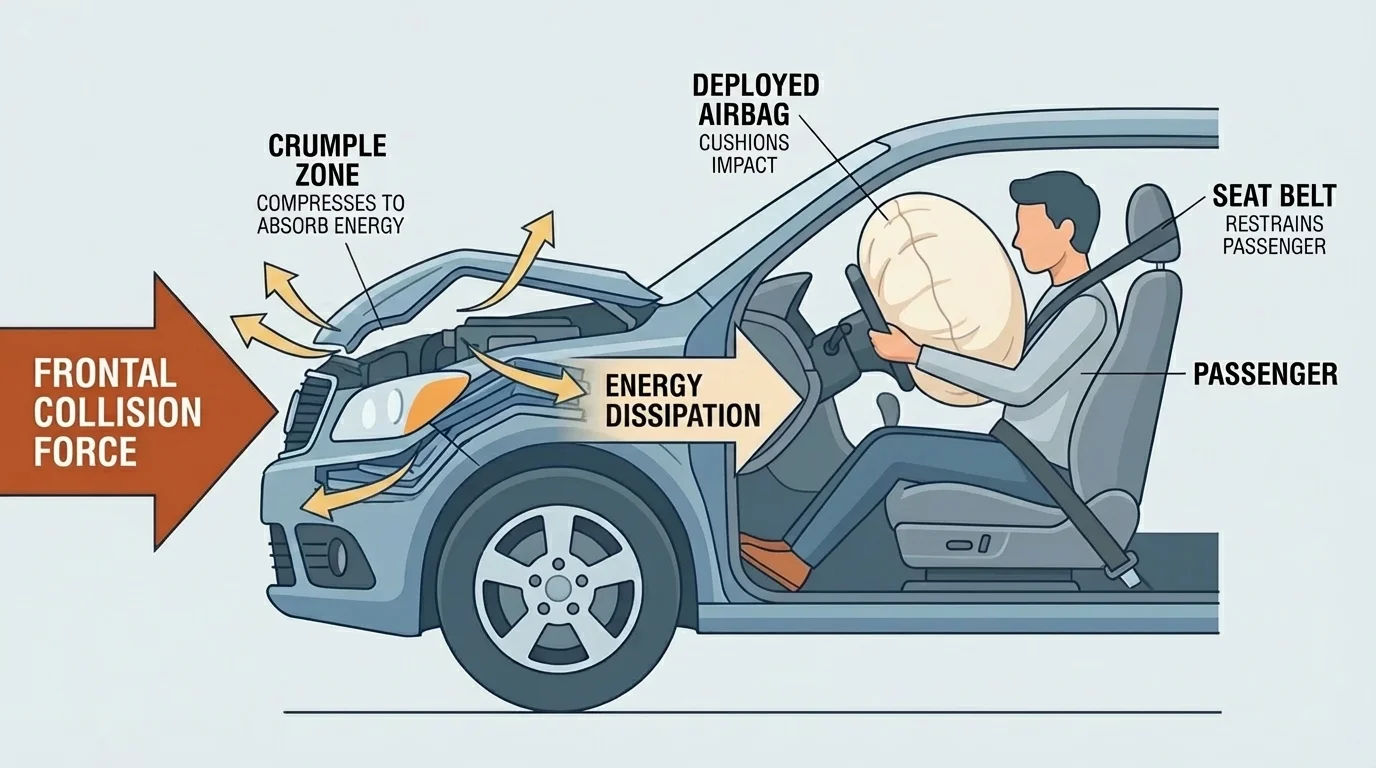
Modern safety engineering rarely relies on one feature alone. A vehicle crash, for example, is managed by several devices working together, as [Figure 2] shows. Engineers design the passenger compartment, seat belt, airbag, and crumple zones as a system rather than as isolated parts.
Seat belts keep passengers from continuing forward when the car stops suddenly. Without a seat belt, the passenger's body keeps moving until it collides with the dashboard, windshield, or another part of the interior. The seat belt provides the force needed to change the passenger's momentum, and it spreads that force across the chest and pelvis.
Airbags do not replace seat belts; they work with them. An airbag increases the time over which a person's head and upper body come to rest and helps distribute the force over a larger area. This reduces the average force on the body.
Crumple zones are parts of a vehicle designed to deform during a crash. Their job is not to stay perfectly rigid. Their job is to collapse in a controlled way so that the collision lasts longer and less force is transmitted to the occupants.
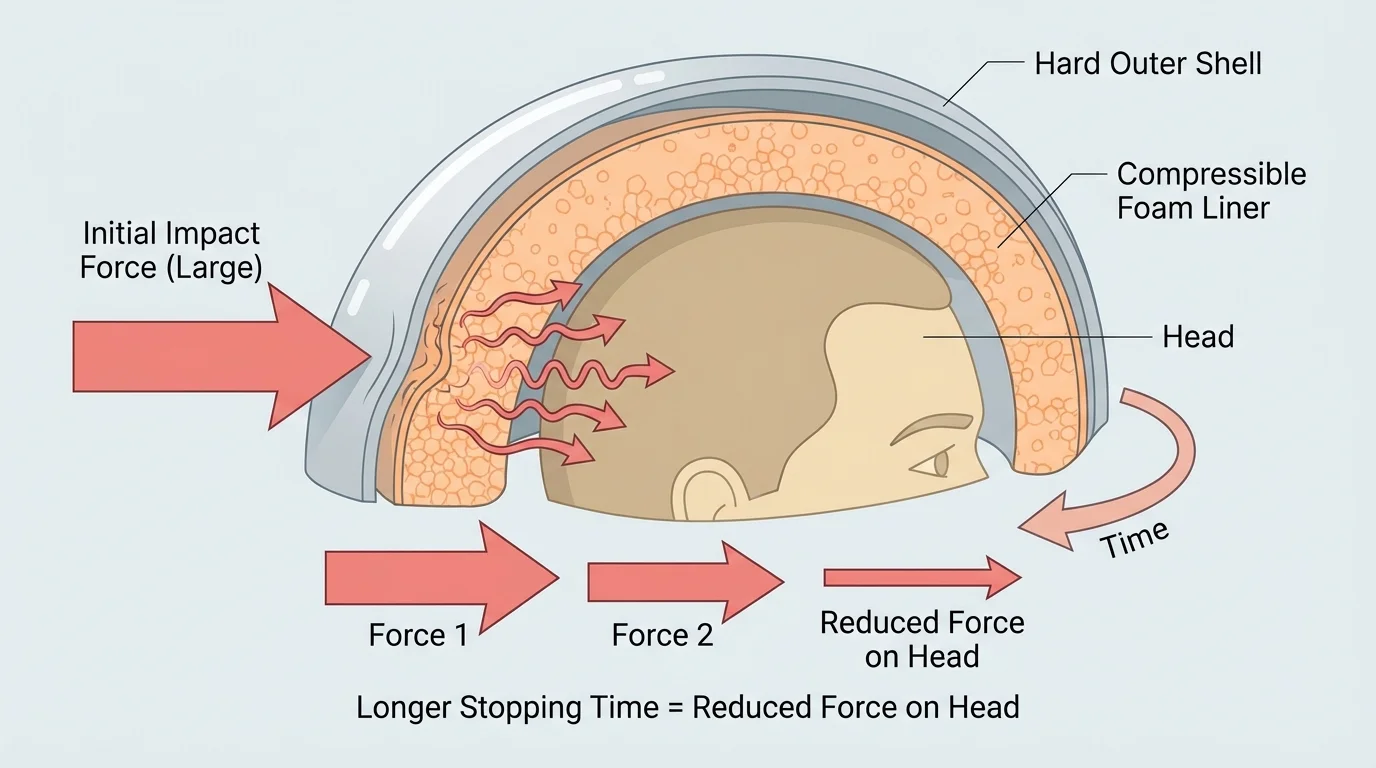
Helmets use a hard outer shell and a softer inner liner. The shell helps distribute the impact and resist penetration, while the foam liner compresses to increase stopping time. A good helmet does not make the head "not collide"; it makes the collision less damaging.
Package padding protects fragile objects during shipping. Foam inserts, cardboard structures, air pillows, and molded trays all reduce force by increasing the distance and time over which the object slows down. A company shipping scientific instruments or glassware uses the same physics as a company designing athletic gear.
Barriers and cushions along roads or racetracks are also engineered to manage collisions. A rigid wall causes a very short stopping time. A barrier designed to deform or redirect the motion can reduce force and lower injury risk.
| Device | Main strategy | How it reduces force |
|---|---|---|
| Seat belt | Increase stopping time and spread force | Stops the body over a longer time and across stronger body areas |
| Airbag | Increase stopping time and area | Cushions impact and lowers pressure on one small region |
| Crumple zone | Controlled deformation | Lengthens collision time by crushing |
| Helmet | Compression of liner | Foam deforms and reduces force on the head |
| Package padding | Compression and support | Protects objects by extending stopping distance and time |
Table 1. Comparison of common devices that minimize force during collisions.
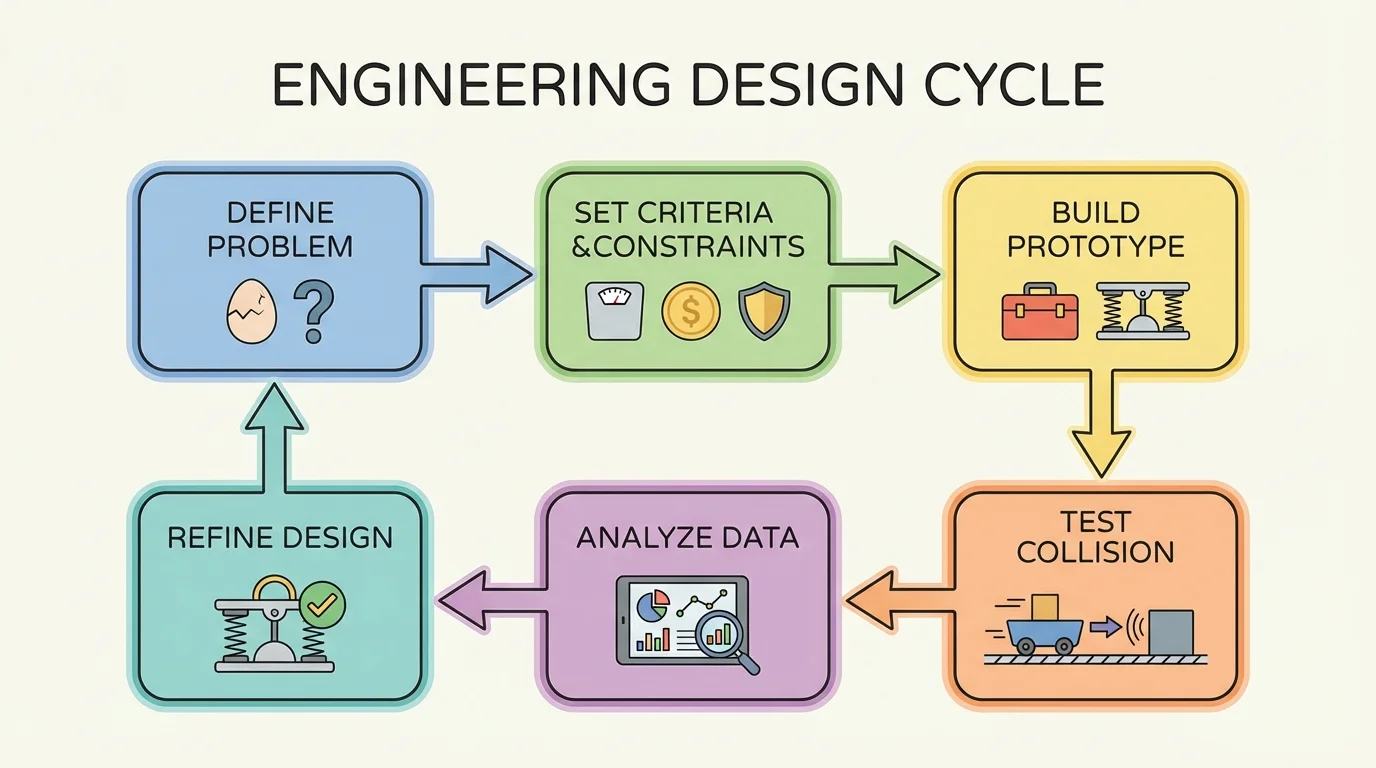
Engineers do not stop after building a first prototype. They test, measure, compare, and revise, as [Figure 3] shows in the design cycle. A good design is one that meets clear criteria while staying within real constraints.
Criteria are the features a design must achieve. For example, a helmet must reduce force on the head, fit properly, remain stable during use, and work in likely impact situations. Constraints are limitations such as mass, cost, size, materials, comfort, and manufacturability.
Evaluation can be qualitative or algebraic. A qualitative evaluation might compare which package material appears to protect a dropped object better and explain why. An algebraic evaluation might compare average forces using \(F \Delta t = \Delta p\) or \(F = ma\).
Refinement means improving the design based on evidence. If a prototype bumper reduces force well but is too heavy, engineers may switch materials. If a helmet liner reduces force but cracks too easily, they may alter thickness or foam density. If a seat belt is safe but uncomfortable, designers must find a balance that keeps people willing to wear it correctly.
Testing should match the real problem. A device for protecting a laptop during shipping should be tested with drops similar to shipping conditions. A football helmet should be tested for repeated impacts, not just a single hit. A race car barrier should be evaluated for the speeds and angles expected on the track.
Some of the safest engineering designs intentionally sacrifice part of the device to protect something more valuable. A car's front end may be designed to crumple so the passenger space stays more intact.
When engineers compare designs, they also think about trade-offs. A very soft material may reduce force in one kind of collision but fail in a larger impact. A thick protective layer may work well but become too bulky or expensive. Real design means choosing the best solution under realistic conditions.
Simple algebra can help compare devices without going beyond the level needed for this topic. The key is to focus on relationships between force, time, mass, acceleration, and momentum change.
Example 1: Comparing two bumpers
A cart experiences a momentum change of \(15 \, \textrm{kg }\cdot\textrm{ m/s}\) in a collision. Bumper A makes the collision last \(0.03 \, \textrm{s}\). Bumper B makes it last \(0.09 \, \textrm{s}\). Which bumper produces the smaller average force?
Step 1: Use the relationship between impulse and momentum change.
\[F = \frac{\Delta p}{\Delta t}\]
Step 2: Calculate force for Bumper A.
\[F_A = \frac{15}{0.03} = 500 \, \textrm{N}\]
Step 3: Calculate force for Bumper B.
\[F_B = \frac{15}{0.09} \approx 167 \, \textrm{N}\]
Bumper B produces the smaller average force because it increases collision time more.
This comparison shows a powerful design rule: when the momentum change is fixed, longer stopping time means smaller average force.
Example 2: Helmet padding and acceleration
A \(5 \, \textrm{kg}\) test mass inside a helmet system slows with an acceleration of \(60 \, \textrm{m/s}^2\) without added padding, but with improved padding the acceleration is reduced to \(25 \, \textrm{m/s}^2\). Compare the forces.
Step 1: Use Newton's second law.
\(F = ma\)
Step 2: Compute the force without added padding.
\[F_1 = 5 \times 60 = 300 \, \textrm{N}\]
Step 3: Compute the force with improved padding.
\[F_2 = 5 \times 25 = 125 \, \textrm{N}\]
The improved padding lowers the force from \(300 \, \textrm{N}\) to \(125 \, \textrm{N}\).
Even though both designs stop the same mass, the one that reduces acceleration also reduces force.
Example 3: Choosing package material
A fragile instrument of mass \(4 \, \textrm{kg}\) is dropped, and the packaging must bring it to rest. Design X causes an average stopping force of \(240 \, \textrm{N}\). Design Y causes an average stopping force of \(140 \, \textrm{N}\). If the instrument can safely withstand at most \(180 \, \textrm{N}\), which design is acceptable?
Step 1: Compare each force to the safety limit of \(180 \, \textrm{N}\).
Step 2: Evaluate Design X.
Since \(240 > 180\), Design X is not acceptable.
Step 3: Evaluate Design Y.
Since \(140 < 180\), Design Y is acceptable.
Design Y better minimizes the force on the instrument.
These examples are simple, but they represent real engineering logic: compare predicted forces, judge whether the forces stay below a limit, and then refine the design if needed.
One common misconception is that a safer device must always be softer. Softness can help, but only if the material behaves correctly during the actual collision. A material that compresses too easily may "bottom out," meaning it crushes completely and then behaves more like a rigid stop.
Another misconception is that if momentum is conserved, force does not matter. Momentum conservation helps describe the motion of the system, but injuries and damage depend strongly on force and how it is distributed over time and area.
It is also incorrect to think that preventing deformation is always best. As seen earlier in [Figure 2], controlled deformation in a crumple zone is often what makes the system safer. The question is not whether deformation happens, but whether it happens in the right place and in the right way.
A strong design protects the important part of the system. In a car, the front end may crumple while the passenger compartment stays more rigid. In a helmet, the foam liner may crush while the head experiences less force. In shipping, the box corners may deform while the product stays intact.
"The best safety design does not stop physics; it works with physics."
That principle guides refinement. Engineers ask: Which part should deform? How much? Over how much time? At what cost? With what mass? Under which impact conditions?
Sports safety gives a clear example of system-level design. A modern helmet, as [Figure 4] shows, combines an outer shell, an energy-absorbing liner, and a retention system. The shell helps manage the initial contact, while the liner compresses to lengthen stopping time and reduce force on the head.
Transportation engineering uses the same ideas on a larger scale. Cars, buses, trains, and even elevator safety systems are built to manage changes in momentum and reduce harmful forces. On highways, guardrails and crash attenuators are designed to redirect or slow vehicles in ways that reduce damage.
Product design also depends on collision science. Companies that ship electronics, medical devices, or laboratory tools must prevent damaging impacts during loading and transport. A package that looks wasteful may actually be carefully engineered to reduce force to a safe range while keeping total mass and cost low.
Even space exploration depends on this topic. Landing systems for probes and rovers use crushable materials, retro-rockets, airbags, or leg mechanisms to reduce the force during touchdown. The exact technology changes, but the scientific goal stays the same: make the change in motion happen with less force.
Looking back to [Figure 3], these applications all follow the same engineering cycle: define the problem, test the design, analyze the evidence, and refine. Looking back to [Figure 4], they also rely on structural features that deliberately increase stopping time or spread force.
When you evaluate any collision-reducing device, ask four questions. What momentum change must occur? Over how much time does it occur? How is the force distributed? What evidence shows the design works under realistic conditions? Those questions connect the physics to the engineering.
