A roller coaster at the top of a hill is nearly still, yet it clearly has the ability to speed up dramatically. A glowing metal rod may sit motionless on a lab bench, yet it can burn your hand because something energetic is happening inside it. These situations seem very different, but physics explains both with one powerful idea: energy we observe at the large, everyday scale can be accounted for as a combination of energy associated with motion and energy associated with relative position.
That statement matters because energy is not always obvious. Sometimes you can see it in a moving skateboard or a swinging pendulum. Sometimes it is less visible, as in the jiggling motion of particles in warm matter or in the arrangement of objects that can interact, such as a book held above the floor or a stretched spring. To make sense of these situations, scientists use models—simplified representations that highlight what matters most in a system.
Many students first think of energy as something like "power" or "fuel." Those ideas are related, but in physics, energy is more precise. Energy is a property of a system that helps us describe what can change. A system might speed up, warm up, rise, fall, stretch, compress, or cause another object to move. Even when energy is not directly visible, its effects are.
This is why models are essential. A model lets us describe what is happening beneath the surface of an event. If a ball falls, a simple visual story says, "It drops because gravity pulls it." An energy model goes further: it explains that the ball-Earth system changes from energy associated with relative position to energy associated with motion. If a cup of soup cools, an energy model helps us think about particles in the soup and particles in the surrounding air exchanging energy through countless collisions.
You already know that matter is made of particles and that objects interact through forces. Those two ideas are the foundation of energy models: particles can move, and interacting objects can have energy because of their positions relative to one another.
When scientists say energy is conserved, they mean the total energy of a closed system does not disappear. It may change form, move from one part of the system to another, or become less obvious, but it is still accounted for.
A system is the object or collection of objects you choose to study. Everything outside it is the surroundings. This choice matters. If you study only a falling ball, you may describe energy entering the ball from outside. If you study the ball and Earth together, you can describe the change as happening within the system: energy associated with the ball-Earth positions changes into motion energy.
Thinking in terms of systems prevents a common mistake: talking as if energy belongs only to a single object. In many cases, it does not. Energy associated with position often belongs to a pair or group of interacting objects. A book above the floor has gravitational energy because of the book-Earth relationship, not because the book alone "contains" that energy in isolation.
System means the object or set of objects being studied. Conservation of energy means the total energy of a closed system remains constant, even when energy changes form or moves between parts of the system. Model means a simplified representation used to explain and predict how a system behaves.
In this topic, the key energy accounts are broad and qualitative. At the macroscopic scale, we often describe energy as either energy of motion or energy of relative position. At the particle scale, matter can also have energy because its particles are moving. These ideas connect the visible world and the invisible particle world.
Kinetic energy is energy associated with motion, and [Figure 1] shows that this idea applies both to whole objects and to the particles that make up matter. A soccer ball crossing a field has motion energy because the entire ball is moving. But a cup of hot tea also has energy associated with motion because the particles inside it are moving randomly.
At the everyday scale, motion energy is easiest to notice when an object changes speed. A moving bicycle can coast, collide, or climb a hill. In each case, energy associated with motion can decrease or increase. The faster an object moves, the more strongly we usually notice its ability to cause changes.
At the particle level, motion is not usually visible to the eye. The particles in solids vibrate, the particles in liquids slide past one another, and the particles in gases move more freely. When matter gets warmer, the average motion of its particles increases. That is why temperature is related to particle motion. A hot pan on a stove may look still, but its particles are moving more energetically than those in a cooler pan.
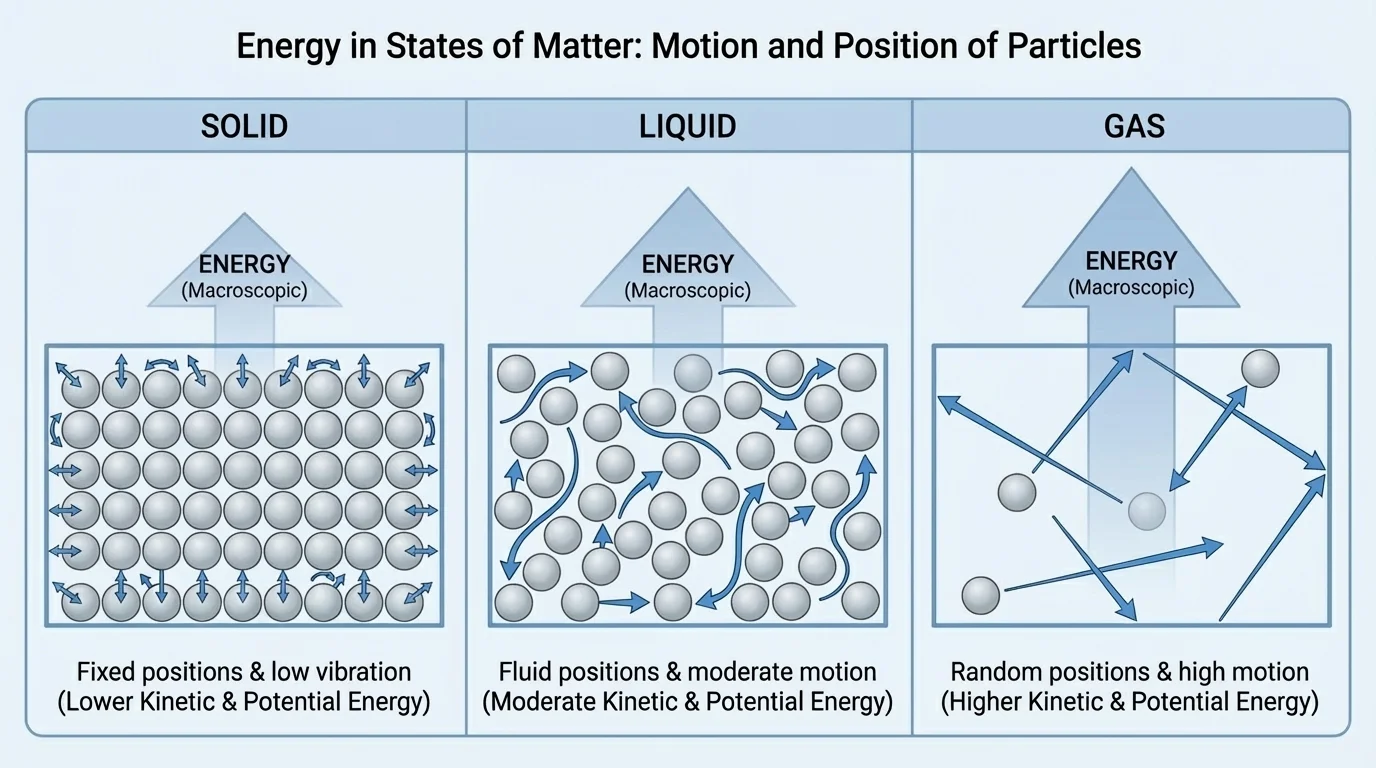
This particle view helps explain heating. If a fast-moving object collides with a slower-moving one, or if one object is compressed or rubbed in a way that increases microscopic motion, some energy can end up as increased particle motion. We often describe that outcome as thermal energy increasing, but the underlying model is still about motion of particles.
Later, when you analyze warming, cooling, impact, or compression, the particle model in [Figure 1] remains useful because it reminds us that not all motion energy is the organized motion of a large object. Some of it is disorganized microscopic motion spread among countless particles.
A meteor can glow intensely as it rushes through the atmosphere because interactions during its motion increase particle motion in the surrounding gas and in the meteor's surface. The bright streak is a dramatic sign that energy is being redistributed, not created from nothing.
Although scientists sometimes classify energies into many categories, a powerful unifying idea is that motion energy can be tracked from one scale to another. A falling hammer has visible motion. When it hits metal, part of that organized motion can become sound, deformation, and increased microscopic particle motion in the hammer and the metal.
Potential energy refers to energy associated with the relative positions of interacting objects, and [Figure 2] illustrates several important examples. This energy is not about motion at that moment. Instead, it is about arrangement—where objects are compared with one another in a system where interactions matter.
One familiar example is gravitational energy. A backpack on a high shelf can fall because of its position relative to Earth. A diver on a platform has energy associated with the diver-Earth system. If the diver steps off, that position energy can change into motion energy as the diver speeds up.
Another example is elastic energy. A stretched rubber band, compressed spring, or bent diving board has energy associated with the relative positions of its parts. When released, that arrangement changes, and energy can become motion energy of another object or of the material itself.
A third example involves electric interactions. Two like electric charges pushed close together have energy because of their relative positions. If released, they move apart. You do not need chemical details to see the general principle: interacting objects can have energy because of how they are arranged.
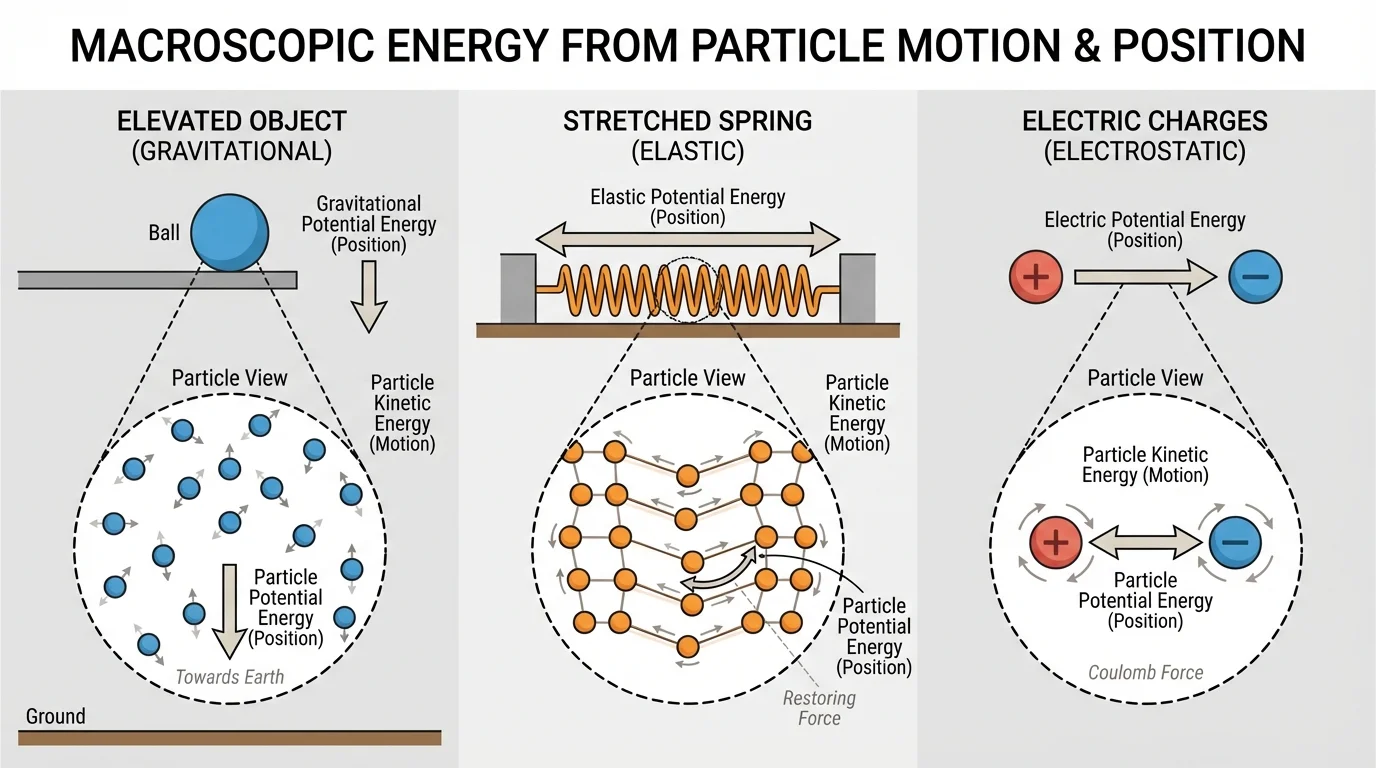
A key idea is that position energy belongs to the system of interacting objects, not to one object by itself. The elevated ball and Earth form a gravitational system. The stretched bow and arrow form an elastic system. The arrangement matters because interactions depend on distance, shape, or relative location.
This is why the same object can have different energy accounts in different situations. A book resting on the floor does not have the same gravitational energy relative to Earth as it does when held on a ladder. The object is the same, but the relative position in the system has changed, just as [Figure 2] emphasizes across different examples.
Energy of position is about relationships. If changing the arrangement of objects in a system could lead to motion or other changes, then the system may have energy associated with relative position. The interaction might be gravitational, elastic, or electric, but the common idea is that the system's configuration matters.
Thinking this way helps unify many topics in physics. A raised roller coaster, a compressed spring toy, and separated electric charges seem unrelated at first. Yet all are examples of systems where energy depends on relative position and can later appear as motion.
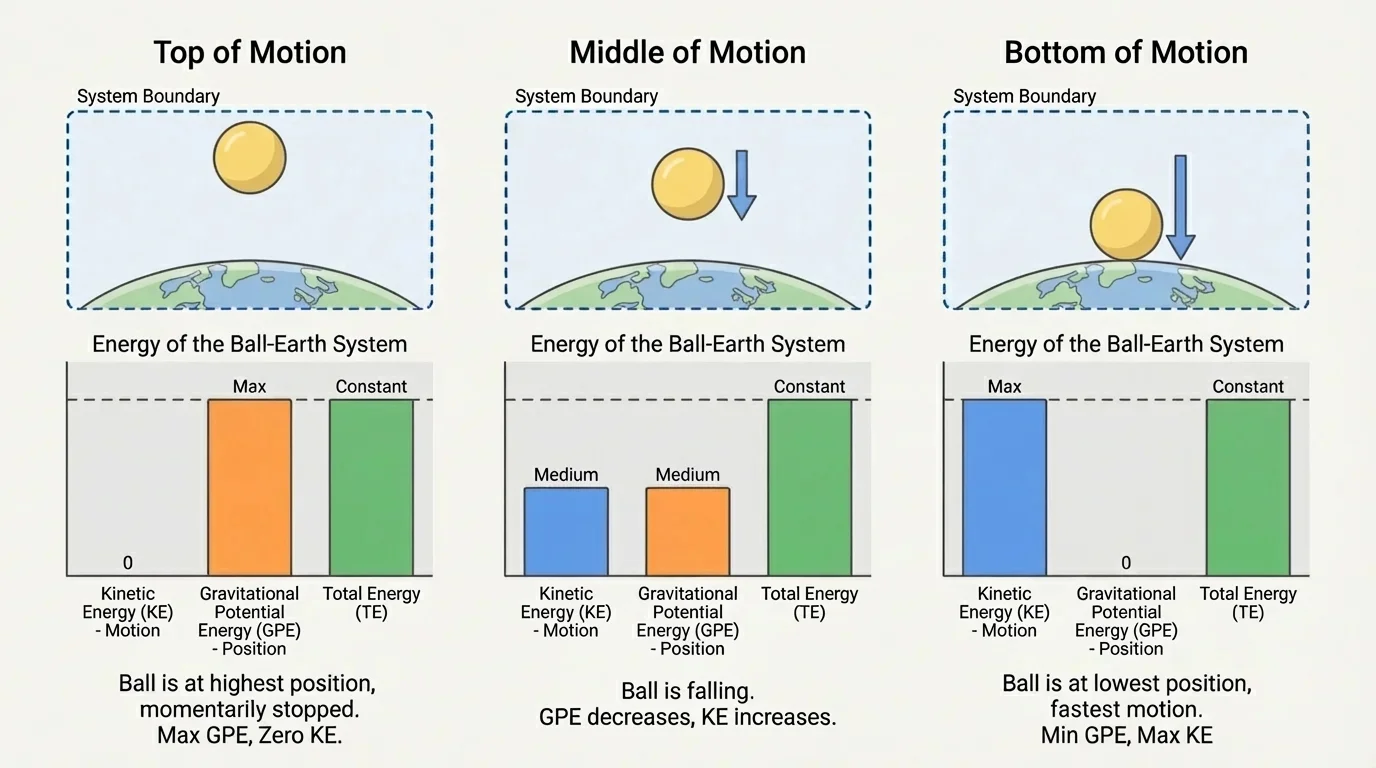
Scientists do more than name energy forms; they use visual and conceptual tools to track them. One useful approach, shown in [Figure 3], is an energy bar chart. In such a model, you compare the amount of energy associated with motion and position at different moments. Another helpful tool is a system diagram, where you mark the objects included in the system and the important interactions between them.
Suppose a ball is held above the ground and then released. Early on, the energy bar for position is large and the motion bar is small. As the ball falls, the position bar shrinks and the motion bar grows. Right before impact, the motion bar is large. If the ball bounces back up, the process partly reverses.
These diagrams do not need exact numbers to be useful. Their purpose is to show patterns and conservation. As one account of energy decreases, another increases. The total is still tracked. This is especially powerful when the energy is not obvious to the eye, such as when motion energy spreads into particle motion after an impact.
Particle models are another major tool. They help explain why a fast-moving cart may slow down after a collision while the colliding materials become warmer. At the macroscopic level, the cart loses organized motion. At the particle level, particles in the materials may gain more random motion.
Using several models together is often best. A system diagram tells you what to include. An energy bar chart helps you track what changes. A particle model explains hidden microscopic motion. When used together, these models make energy conservation much easier to understand.
Qualitative energy model: ball dropped from a height
Step 1: Choose the system.
Use the ball and Earth as one system so gravitational energy is inside the system description.
Step 2: Describe the start.
The ball is held high and is nearly at rest, so the system has mostly energy associated with relative position and very little energy associated with motion.
Step 3: Describe the motion.
As the ball falls, energy associated with relative position decreases while energy associated with motion increases.
Step 4: Describe the impact.
At impact, some organized motion can become particle motion, sound, and deformation, depending on what is included in the system.
The same event can be modeled in more than one correct way, as long as the system is clear and all energy changes are accounted for consistently.
A pendulum provides a classic example. At the highest point of its swing, the bob has very little motion but substantial energy associated with position in the bob-Earth system. As it swings downward, that position energy changes into motion energy. At the lowest point, the motion energy is greatest. As it rises again, motion energy changes back into position energy.
A skateboarder in a half-pipe behaves similarly. Near the top edge, speed is small and position energy is large. Near the bottom, speed is large and position energy is smaller. Watching skilled athletes makes energy conservation almost visible: height trades for speed, then speed trades back for height.
The bar-chart model from [Figure 3] works well here too. Even though the pendulum, skateboarder, and falling ball are different systems, the same pattern appears: energy shifts between position and motion while the total remains accounted for.
These examples are powerful because they connect abstract physics to things you can observe directly. If an object speeds up while moving to a lower position, the energy model strongly suggests that energy associated with relative position is changing into motion energy.
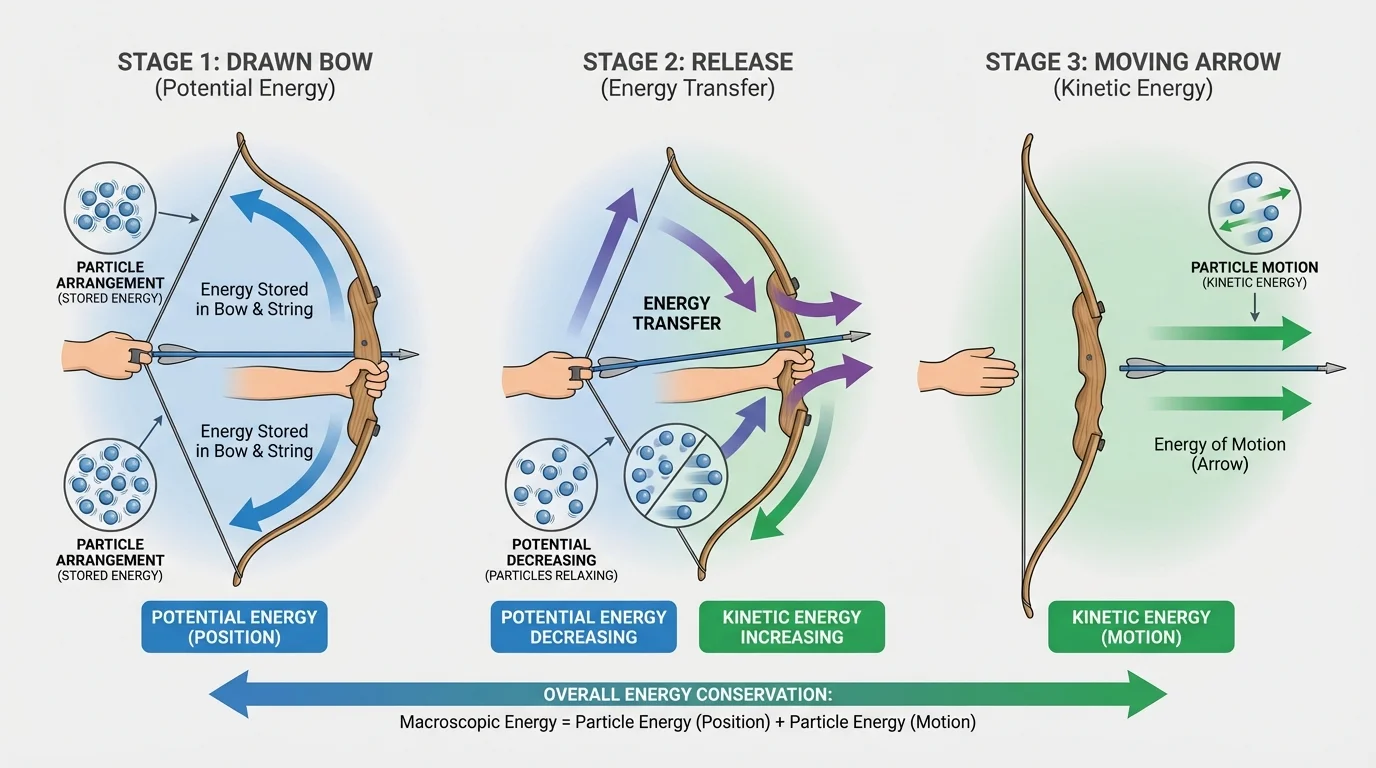
[Figure 4] A stretched bow is a clear example of how an elastic system stores energy through shape and position. In the drawn bow-and-arrow system, the bent bow and stretched string are in a configuration that can produce rapid motion when released.
When the archer lets go, the bow changes shape toward its original form. During that change, energy associated with relative position in the elastic system becomes motion energy of the arrow and parts of the bowstring. The arrow speeds away even though there is no visible "fuel tank" attached to it. The system's arrangement is what matters.
A trampoline works in a related way. When a jumper lands, the trampoline mat stretches. The jumper slows down as motion energy is transferred into elastic energy associated with the stretched mat and springs. Then the trampoline recoils, and that energy becomes motion energy again, launching the jumper upward.
This same reasoning applies to toy launchers, car suspension systems, and protective sports padding. If a material bends, stretches, or compresses, it may temporarily account for energy as part of its changed configuration. The bow sequence in [Figure 4] helps make that invisible storage idea concrete.
Real-world application: vehicle suspension
When a car goes over a bump, the wheels and springs move rapidly. The suspension system changes shape and briefly stores energy associated with relative position. This reduces the violent motion transmitted to the passengers and helps keep the tires in contact with the road.
Engineers use these ideas constantly. They design systems that control how quickly energy shifts between motion and elastic position, because that timing affects safety, comfort, and performance.
Not every energy change is as visible as a swinging pendulum or flying arrow. Sometimes organized motion becomes microscopic particle motion. For example, if you quickly compress air in a bicycle pump, the pump can become warm. Why? The particles in the gas end up moving more energetically.
Similarly, when two objects collide, they may not bounce perfectly. Some of the large-scale motion can become increased particle motion in the materials, along with sound and temporary deformation. From far away, it may look as though some motion energy "vanished," but the particle model explains where that energy is accounted for.
This is a major scientific insight: heating is not something mysterious added to matter from nowhere. Often it is the result of changes in particle motion caused by interactions. A macroscopic event can therefore be understood by connecting what you see to what particles are doing.
"Energy cannot be created or destroyed, only transformed and transferred."
— A central principle of physics
That principle is especially useful when energy seems to disappear. If a moving cart slows, ask where the energy went. If a gas warms during compression, ask what changed for its particles. The answers often lie in shifting from a large-scale model to a particle-scale one.
Energy descriptions depend on the chosen system, and [Figure 5] makes this clear by comparing two ways to analyze the same dropped ball. If the system includes only the ball, then the ball's motion energy increases because energy is transferred into it by interaction with Earth. If the system includes the ball and Earth together, then the change can be described internally: gravitational position energy becomes motion energy.
Neither description is automatically wrong. The important thing is consistency. You must clearly define what is inside the system and then account for all energy changes accordingly. This is a habit used throughout science and engineering because it prevents confusion.
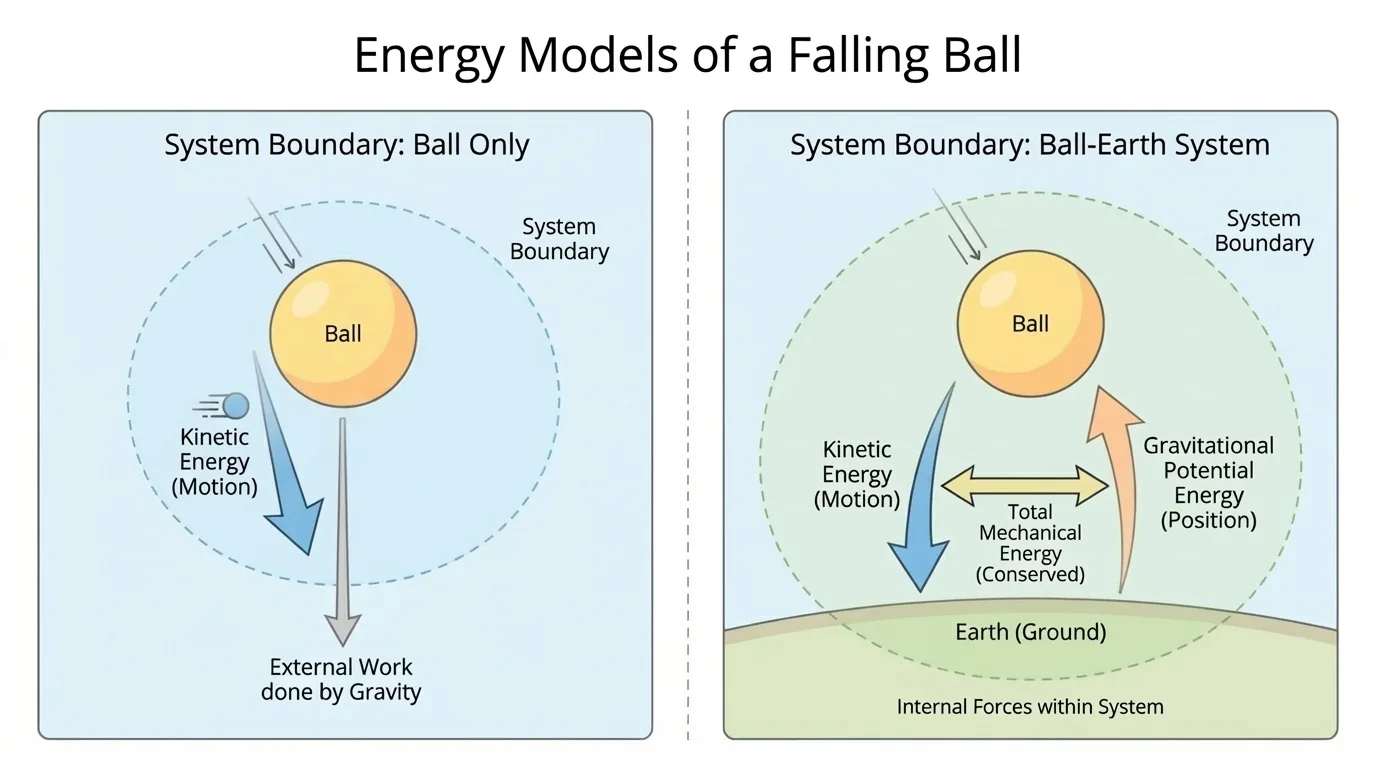
This idea also helps explain why position energy is relational. The ball alone does not fully account for the gravitational situation. The ball-Earth pair does. The system-boundary comparison in [Figure 5] makes that relationship easier to see.
When solving energy problems later in physics, one of the first and most important decisions will often be: What is my system? The answer determines how you describe the energy involved.
Energy models are not just classroom tools. Engineers use them to design safer vehicles, more efficient machines, and more reliable structures. In earthquake engineering, buildings are designed to flex so that some motion energy is temporarily accounted for in elastic deformation rather than causing catastrophic failure.
In sports science, coaches and equipment designers think carefully about how energy moves through a system. A pole vaulter converts running motion into elastic deformation of the pole, then back into upward motion. A baseball bat transfers energy to the ball, while also vibrating and warming slightly because not all energy remains in the ball's forward motion.
In spaceflight, a spacecraft moving in a gravitational field constantly trades energy associated with position for motion and back again. Orbital motion is a stunning real-world reminder that these ideas scale from playground swings to planetary systems.
Modern shock absorbers, protective helmets, and landing systems are all designed around one key question: how can energy be redirected so that dangerous motion becomes safer forms of energy change over a controlled time?
Even weather involves these ideas. Rising and sinking air, moving ocean water, and vibrating ground during seismic waves all involve energy accounts based on motion and position. The same core model keeps reappearing across very different phenomena.
One common misconception is that energy gets "used up." A better statement is that energy becomes less useful for a particular purpose or becomes spread into less obvious forms, such as random particle motion. The total energy is still accounted for.
Another misconception is that stored energy sits inside one object like water in a bottle. In many important cases, especially gravitational and electric situations, the energy belongs to a system of interacting objects because it depends on their relative positions.
A third misconception is that motion energy only refers to obvious large-scale movement. In fact, the random motion of particles in warm matter is also part of the story. This is one reason particle models are so important in modern science.
Once you see energy as a property of systems that can be tracked through motion and position, many events become easier to explain. A moving object, a stretched material, a falling mass, and a warming substance all fit into one connected framework.
