Your phone charger, a hydroelectric dam, a bicycle generator, and even the muscles in your body all do the same fundamental job: they convert energy. Modern technology depends on this idea. Engineers rarely ask whether energy can be created, because it cannot. Instead, they ask a more useful question: How can we transform available energy into a form we want, within limits of cost, materials, size, and safety?
Designing a device that converts energy is both a science problem and an engineering problem. Science explains what energy is, how it moves, and why it is conserved. Engineering uses that understanding to build something that works under real conditions. In school, those conditions usually include specific materials, limited time, and a clear goal, such as lifting a small mass, producing light, spinning a fan, or moving an object a measurable distance.
Very few devices simply "use energy." More accurately, they convert it. A flashlight converts chemical energy stored in a battery into electrical energy, then into light and thermal energy. A speaker converts electrical energy into sound. A wind turbine converts the kinetic energy of moving air into electrical energy. Once you begin looking for it, energy conversion appears everywhere.
This matters because different forms of energy are useful in different situations. Chemical energy is convenient for storage in batteries and fuels. Electrical energy is excellent for transporting energy through wires and powering electronics. Mechanical energy is useful for motion. Light is useful for illumination or signaling. Thermal energy can be useful for heating, but in many devices it is partly an unwanted byproduct.
Some of the most important inventions in history, from the steam engine to the electric motor, were powerful not because they created energy, but because they converted it into forms people could control more effectively.
When engineers design a device, they begin by deciding what output is wanted. If the goal is motion, the design must produce mechanical energy. If the goal is brightness, the design must produce light. If the goal is charging a battery, the design must produce electrical energy. The desired output determines what counts as success.
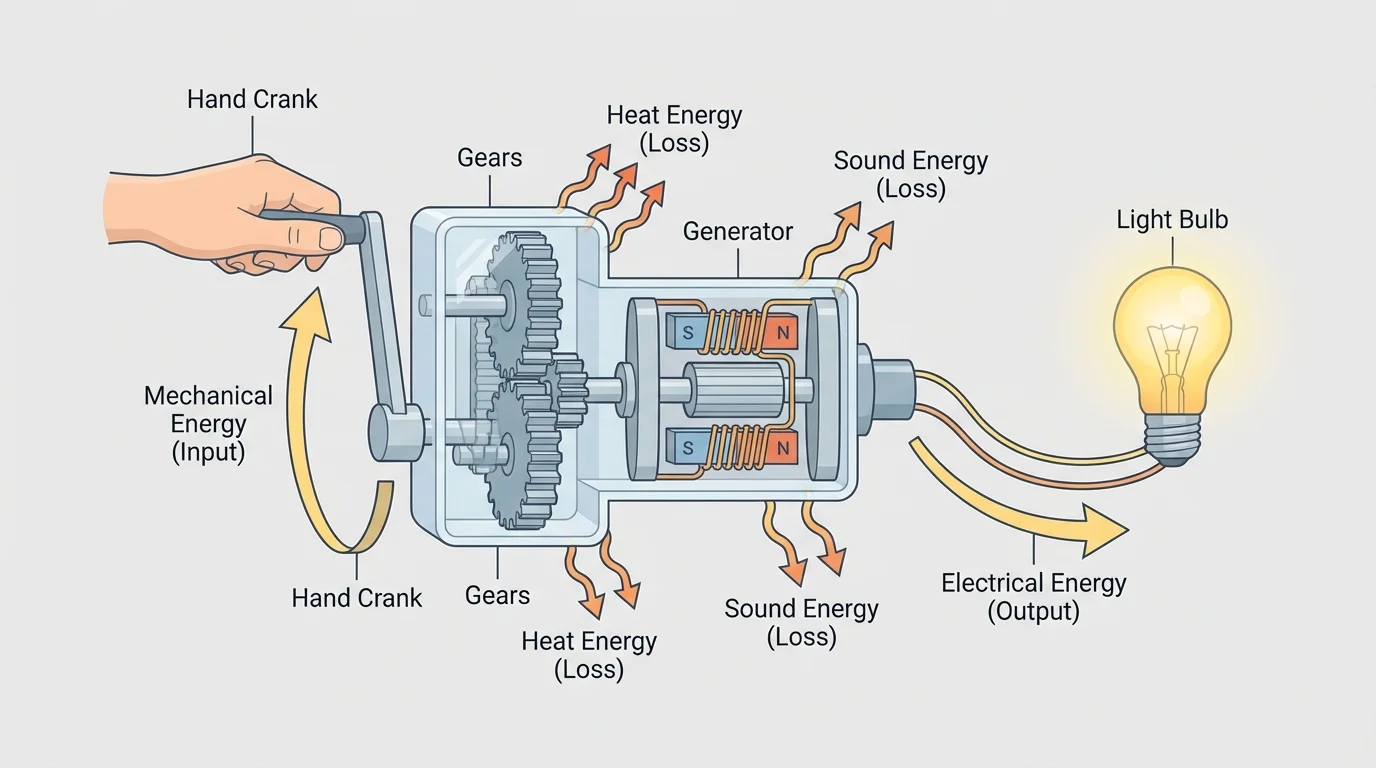
Energy is a quantitative property of a system connected to motion, position, fields, and interactions of matter and radiation. In simpler terms, it is something a system has that can be transferred and transformed. In every energy-converting device, there is an input, a process, and one or more outputs, as [Figure 1] shows for a simple generator system.
System means the object or set of objects we are studying. Energy transfer occurs when energy moves from one object or place to another. Energy conversion occurs when energy changes form, such as from chemical to electrical energy. Conservation of energy means the total energy of a closed system remains constant even though its form may change.
Suppose a student turns a hand crank connected to a small generator. The student provides mechanical energy. The generator converts part of that energy into electrical energy. That electrical energy may then power a bulb or buzzer. But not all the input becomes the desired output. Some energy becomes thermal energy because of friction in the crank and resistance in the wires. Some may become sound. When all outputs are included, the total output energy equals the total input energy, but the useful part may be only a fraction of the total.
A simple way to describe this relationship is with the idea of total useful output for a given input. If a device receives an input energy of \(100\ \textrm{J}\) and delivers \(60\ \textrm{J}\) of useful motion, the rest appears in other forms such as heat and sound. We can express efficiency as \(\textrm{efficiency} = \dfrac{\textrm{useful output}}{\textrm{total input}}\). For this case, \(\textrm{efficiency} = \dfrac{60}{100} = 0.60 = 60\%\). At this level, the key idea is not advanced calculation, but recognizing that output must be compared fairly using the same input.
No real device is \(100\%\) efficient. Friction, resistance, deformation, and sound all redirect some energy into forms that may not help achieve the goal. This is why a motor gets warm, why a bouncing ball eventually stops, and why a light bulb produces heat as well as light.
Different devices convert different pairs or chains of energy forms. A battery-powered toy car converts chemical energy in the battery to electrical energy, then to mechanical energy in the motor, and finally to kinetic energy of the moving car. A solar calculator converts light energy to electrical energy. A glow stick converts chemical energy to light. A rubber-band-powered launcher stores elastic potential energy and converts it to kinetic energy when released.
Some devices involve several steps, not just one. Consider a small solar-powered fan. Sunlight is absorbed by a solar cell, which produces electrical energy. That electrical energy powers a motor. The motor turns the blades, producing mechanical motion of the fan and kinetic energy in moving air. During each step, some energy also becomes thermal energy.
Useful output depends on the goal. In a lamp, light is the useful output and thermal energy is often less useful. In a heater, thermal energy is the useful output. In a speaker, sound is useful. The same energy form can be useful in one device and wasted in another.
This idea is important when evaluating designs. A device is not "good" just because it produces a lot of energy in total. It is good if it converts a large enough portion of the input into the output you want, while still meeting the constraints of the task.
As we saw with the generator in [Figure 1], every design also has unintended outputs. Engineers try to reduce these losses, but they can never eliminate them completely.
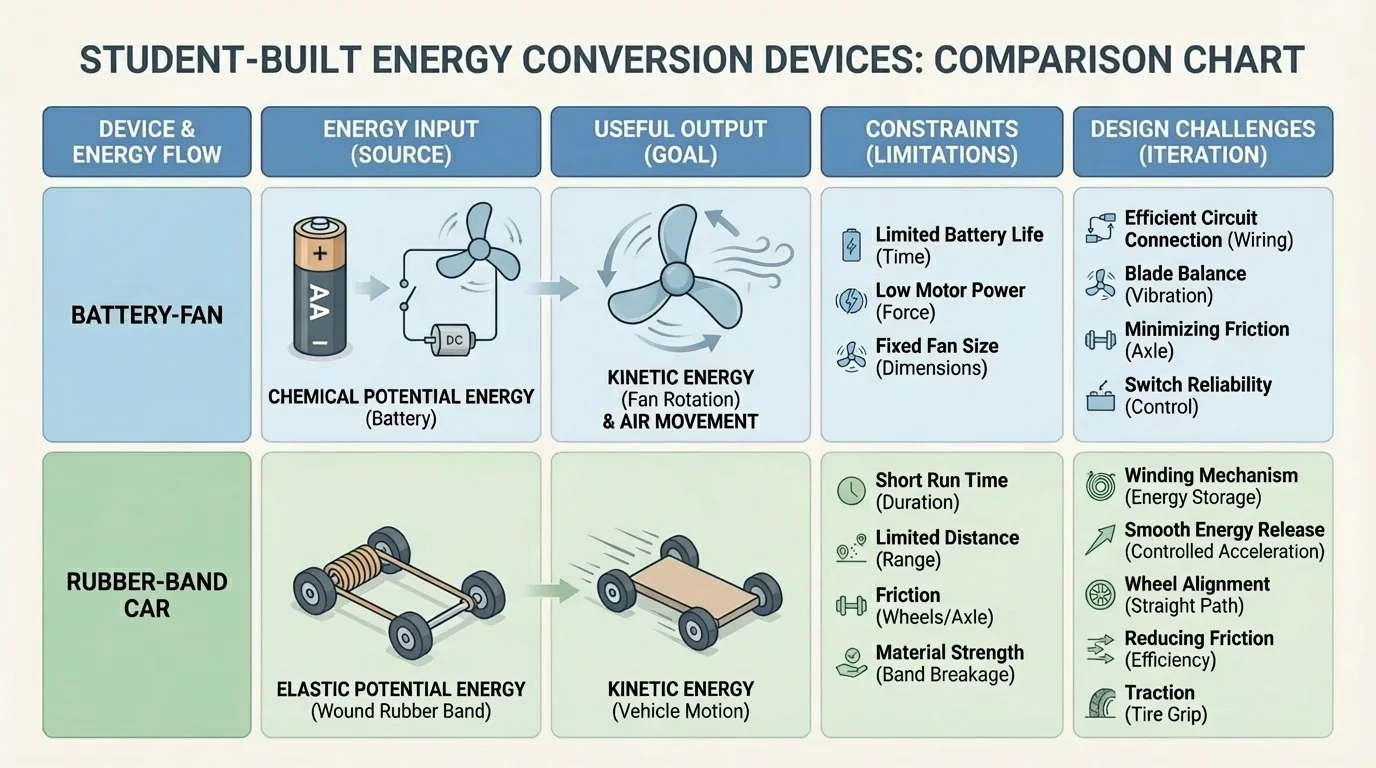
An engineer does not begin with unlimited freedom. Every design challenge includes constraints and criteria. Constraints are the limits: available materials, maximum mass, cost, dimensions, time, safety rules, or the requirement to use only the materials provided. Criteria are the standards for success: move the farthest, lift the greatest load, shine the brightest, or produce the highest total useful output for a given input. Choosing among ideas depends on comparing both, as [Figure 2] illustrates.
For example, suppose students must build a device from a small motor, wires, cardboard, tape, a battery holder, and a switch. One team may design a fan that converts electrical energy into kinetic energy of air. Another may design a wheel system that converts electrical energy into motion across a surface. Both are possible, but their performance will depend on stability, friction, mass, and how well the parts fit together.
Trade-offs are unavoidable. A larger fan blade may move more air, but it may also be heavier and harder for the motor to turn. A lighter car may move farther, but it might be less stable. A tighter rubber band may store more elastic potential energy, but it may also break more easily or be harder to reset. Engineering is often about balancing these competing factors rather than finding a perfect answer.
| Design idea | Energy input | Desired output | Possible constraints | Likely challenge |
|---|---|---|---|---|
| Battery fan | Electrical | Moving air | Blade size, battery life, safety | Too much mass on motor shaft |
| Rubber-band car | Elastic potential | Motion of car | Wheel alignment, mass, materials | Friction at axles |
| Hand-crank light | Mechanical | Light | Gear ratio, grip, wiring | Energy lost as heat and sound |
| Solar spinner | Light | Rotation | Light intensity, panel angle | Weak output in low light |
Table 1. Examples of student-scale energy-conversion device ideas with typical inputs, outputs, constraints, and challenges.
Good planning means stating the problem clearly before building. If the goal is to lift a load, define the load and the height. If the goal is motion, define the distance or speed measure. If the goal is brightness, define how it will be judged. Clear criteria make testing fair and improvement possible.
A first model is called a prototype. A prototype is not the final device. It is a testable version built so that design ideas can be evaluated using evidence. In science and engineering, evidence matters more than guessing.
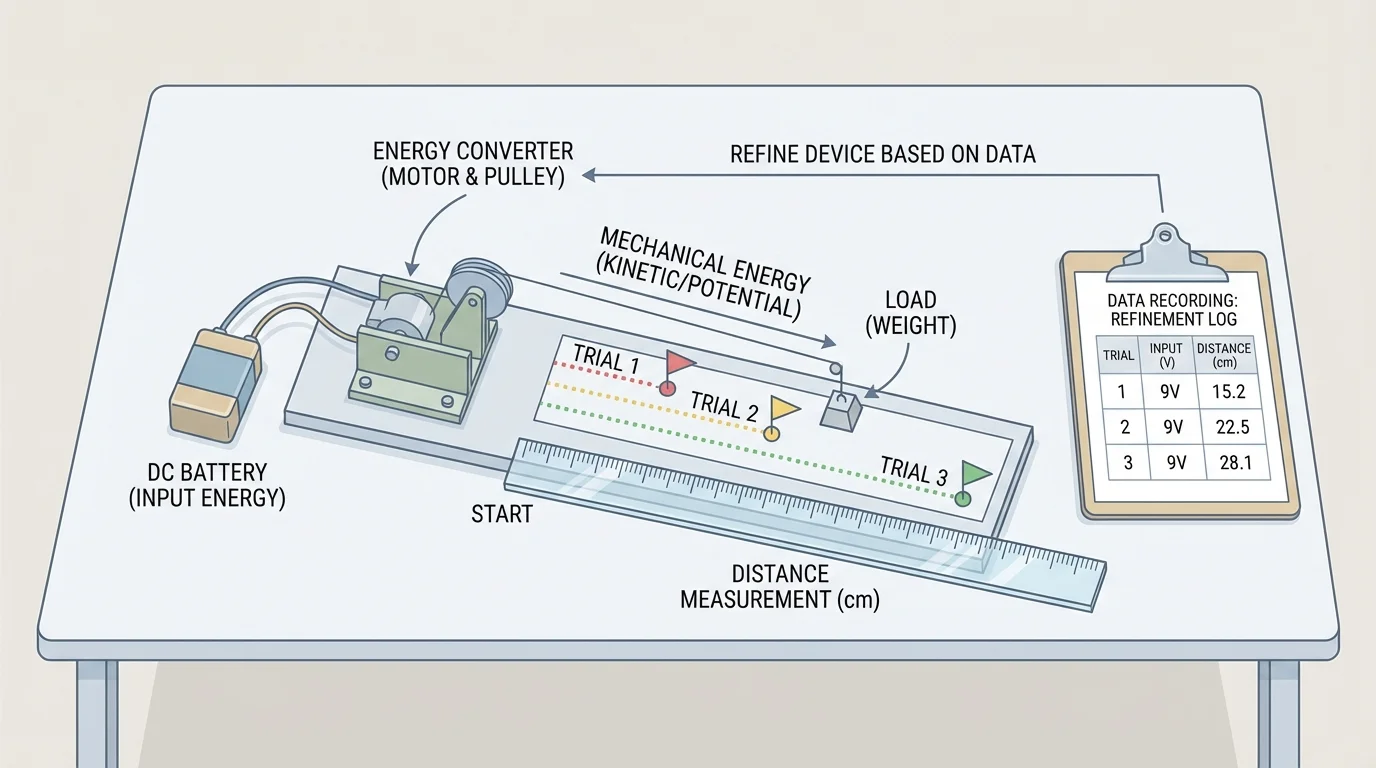
Testing must be fair. That means changing one important factor at a time and keeping the input the same when comparing trials, as [Figure 3] demonstrates. If one trial uses one battery and another uses two batteries, the outputs cannot be compared directly as though the designs alone caused the difference.
Fair tests depend on controlling variables. If you want to know whether blade shape affects fan performance, keep the motor, battery, and blade material the same while changing only the blade shape.
Suppose a battery-powered lifting device raises washers. If each trial uses the same battery pack and starts from the same position, students can compare how many washers are lifted to the same height. If one design lifts \(5\) washers and a refined design lifts \(8\) washers with the same input, the refined design has greater useful output under those conditions.
Consider another example using a rubber-band car. If each trial uses the same number of turns of the axle, then distance traveled can serve as a measure of total useful output. If trial results are \(1.8\ \textrm{m}\), \(2.0\ \textrm{m}\), and \(1.9\ \textrm{m}\), the average output distance is \(\dfrac{1.8 + 2.0 + 1.9}{3} = \dfrac{5.7}{3} = 1.9\ \textrm{m}\). Repeating trials helps reduce the effect of random error.
Measurements do not need to be overly complex. Within the assessment boundary, the important idea is evaluating total output for a given input using the provided materials. Students are not expected to perform advanced energy accounting for every part. Instead, they use observable results such as distance moved, load lifted, or time a light remains on under controlled conditions.
Example: Comparing two fan designs
Two student groups build battery-powered fans with the same motor and the same battery input. They test how many paper strips each fan can lift in a standard setup.
Step 1: State the fixed input.
Each fan uses one identical battery pack for each trial.
Step 2: Record the useful output.
Design A lifts \(4\) strips. Design B lifts \(6\) strips.
Step 3: Compare the outputs fairly.
Because the input is the same, the higher output suggests Design B converts more of the electrical input into useful motion of air.
Design B performs better for this criterion, though it may still produce heat and sound as less useful outputs.
The same logic applies when building electrical, mechanical, elastic, or light-powered devices. The question is always: with the same input and the same allowed materials, which design produces the better total useful output?
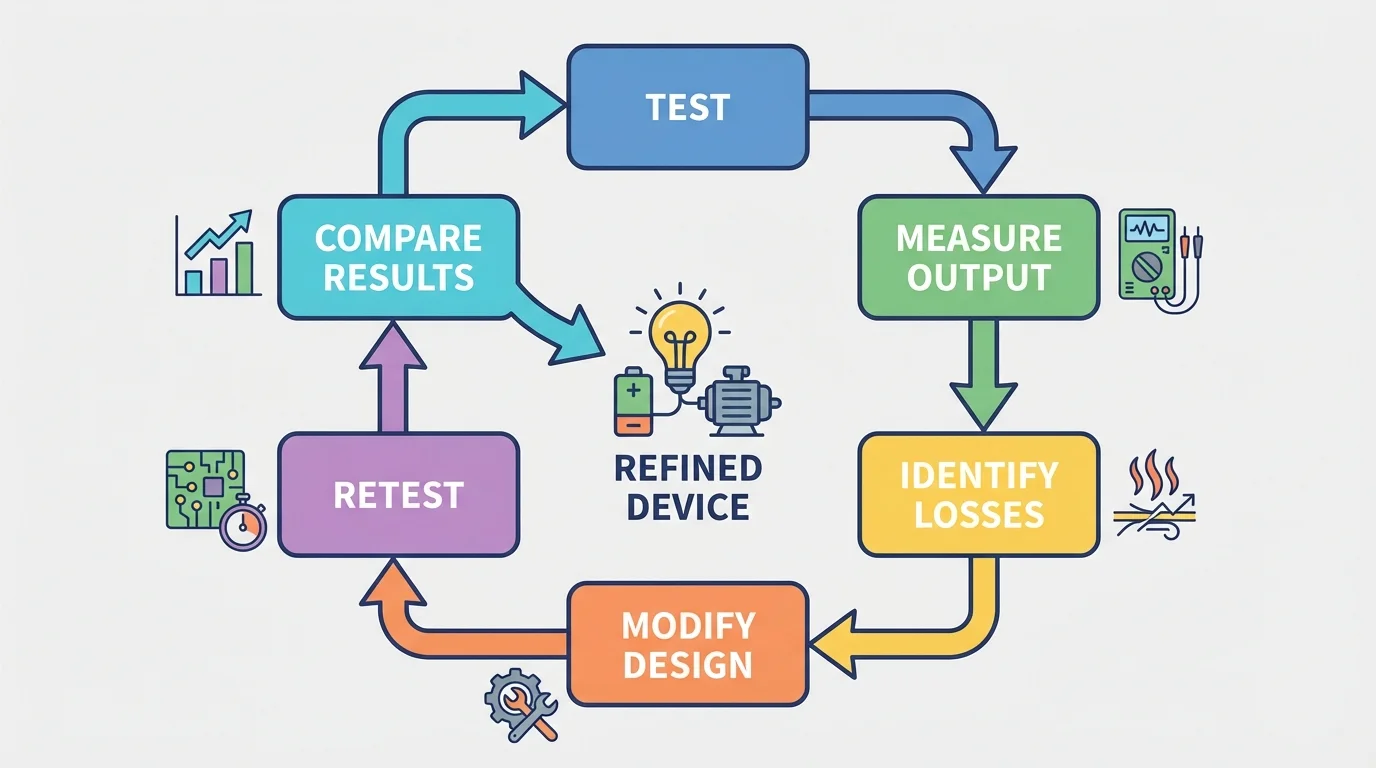
The most important part of engineering often happens after the first test. Refinement means improving a design based on evidence. It is an iterative process, as [Figure 4] shows: test, identify weaknesses, change the design, and test again.
If a wheel-based device veers sideways, the problem may be misalignment rather than lack of energy input. If a fan blade bends, too much energy may be going into vibration instead of useful air motion. If a hand-crank generator feels difficult to turn, friction or poor gearing may be wasting energy. Good refinement focuses on the most important source of poor performance.
One common target for improvement is friction. Friction converts kinetic energy into thermal energy. In some cases, friction is helpful, such as tire grip on the floor. In other cases, it reduces the useful output by resisting motion. Smoother axles, better alignment, and secure connections can reduce unwanted friction.
Another target is efficiency. Efficiency compares useful output to total input. If a student device receives \(20\ \textrm{J}\) of input and gives \(8\ \textrm{J}\) of useful output, then \(\textrm{efficiency} = \dfrac{8}{20} = 0.40 = 40\%\). If a redesign increases useful output to \(12\ \textrm{J}\) with the same input, the new efficiency is \(\dfrac{12}{20} = 0.60 = 60\%\). The design has improved because more of the same input becomes useful output.
Evidence-based redesign means every change should have a reason. Instead of changing many parts at once, engineers usually change one feature, test it, and compare results. That makes it possible to identify which modification actually improved performance.
Refinement does not always mean making something larger or more powerful. Sometimes the best improvement is reducing mass, improving stability, tightening connections, or simplifying the design so less energy is lost.
Classroom devices may be small, but they reflect the same principles used in major technologies. In a wind turbine, moving air turns blades, which rotate a shaft and generator to convert kinetic energy into electrical energy. In regenerative braking, a vehicle's motion helps drive a generator, converting kinetic energy into electrical energy that can be stored in a battery. In a phone charger, electrical energy from an outlet is converted and controlled so that chemical energy can be stored in the battery.
Emergency flashlights with hand cranks are especially good examples. Just like the model in [Figure 1], a person provides mechanical input by turning a handle. The device converts that input into electrical energy, which can light an LED or charge a small internal battery. The design must balance comfort, durability, energy output, and cost.
Example: Improving a rubber-band vehicle
A student vehicle travels \(1.2\ \textrm{m}\) with a fixed number of rubber-band twists. The student notices the wheels wobble.
Step 1: Identify the likely energy loss.
Wobbling suggests some elastic potential energy is being redirected into sideways motion, vibration, and friction.
Step 2: Make one evidence-based change.
The student straightens the axle and secures the wheels.
Step 3: Retest with the same input.
The redesigned car now travels \(1.7\ \textrm{m}\) with the same number of twists.
The greater distance indicates a better conversion of stored elastic energy into forward motion.
Solar panels on satellites, hydroelectric stations, and electric guitars all involve energy conversion, but the same core rules apply: identify the input, define the useful output, recognize losses, and optimize under constraints.
Energy conversion devices must be built safely. Rotating parts should be secured. Electrical connections should be used as directed. Heat-producing devices should be monitored. Stored elastic energy should be released carefully. Safety is itself a design constraint, not an afterthought.
Clear scientific reasoning also matters. If a design performs better, students should connect that improvement to physical causes: less friction, stronger alignment, lower mass, better light capture, or a more effective transfer of energy. Claims such as "the device created extra energy" are incorrect. A better device converts energy more effectively; it does not break the law of conservation of energy.
"Energy cannot be created or destroyed, only transformed from one form to another."
— Fundamental principle of physics
When engineers work within material limits, they are doing something realistic. Actual technology is always developed under constraints. The challenge is not to make a perfect machine, but to make the best possible one from the available resources and for a clearly defined purpose.
