A phone screen responds to your finger without a visible push. A magnet can pull a paper clip across a desk. In both cases, an object changes motion even though nothing obvious connects the objects. That is one of the most powerful ideas in physics: forces can act across space through fields, and those fields are also associated with energy.
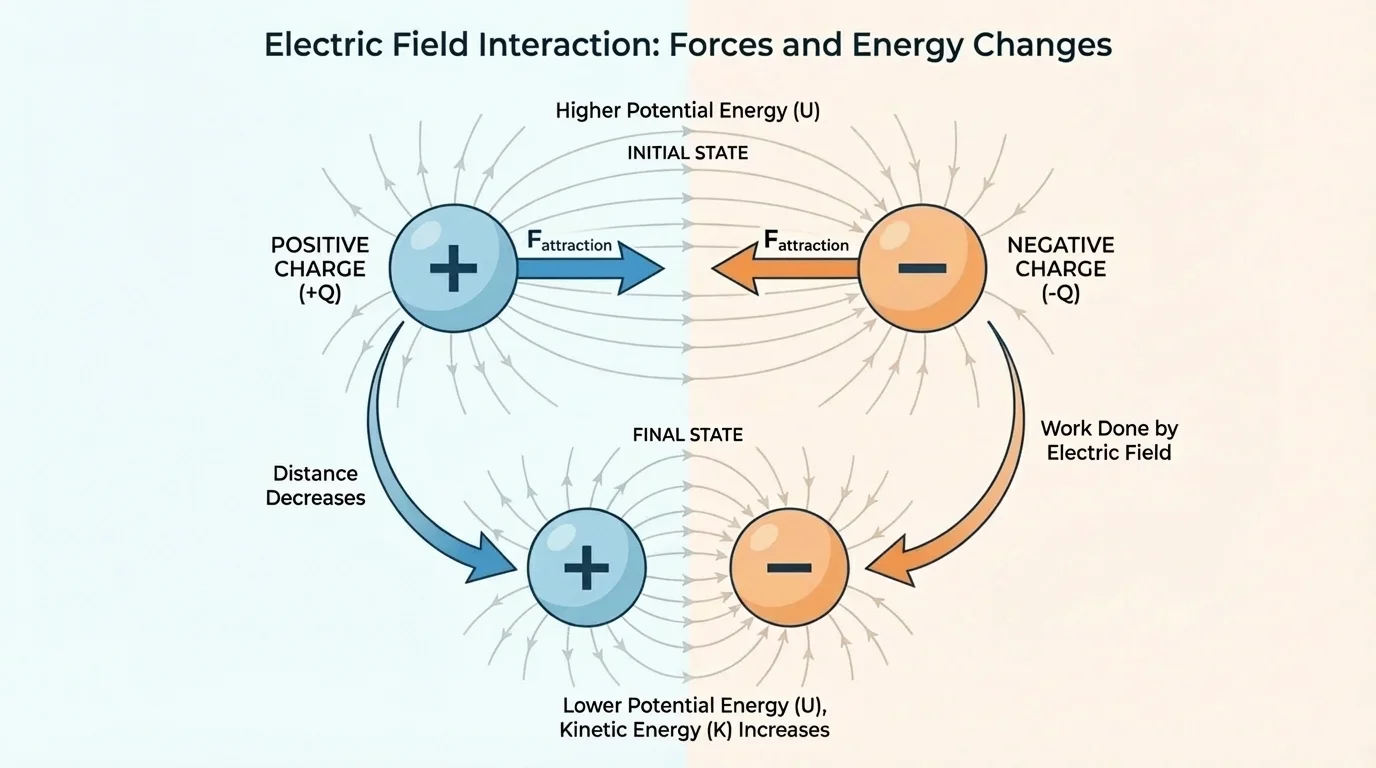
When two objects interact without touching, physicists often use a field model. A field describes how one object changes the space around it so another object experiences a force there. In a two-object system, that means one object creates a field and the second object responds to it, as [Figure 1] illustrates for electric interaction.
This model helps answer two questions at the same time: What force acts? and How does energy change? Instead of imagining a mysterious action at a distance, we treat the region around an object as having physical significance. If a second object enters that region, the field can transmit energy across space and change the object's motion.
For this topic, the system is limited to two objects. That means we focus only on how one object interacts with one other object through an electric field or a magnetic field. This boundary matters because it keeps the model clear and prevents extra forces from additional objects from complicating the explanation.
Field is a model used to describe how one object can exert a force on another object across space.
Electric field is the field produced by electric charge.
Magnetic field is the field produced by magnets or moving electric charges.
Potential energy is stored energy associated with the positions of objects in a system.
A field is not a solid substance, and it is not an invisible rod pushing things around. It is a scientific model that helps us predict forces and energy changes. Field lines that you may see in diagrams are also part of the model. They show direction and relative strength, but they are not physical strings in space.
An object with electric charge creates an electric field around it. If a second charged object is nearby, it feels an electric force. The rule for charge interaction is simple: like charges repel, and opposite charges attract. A positive charge and a negative charge pull toward one another. Two positive charges push away from each other, and two negative charges also push away.
The size of the force depends on two main things: the amount of charge on each object and the distance between them. A common equation for the magnitude of the electric force between two point charges is Coulomb's law:
\[F = k\frac{|q_1q_2|}{r^2}\]
Here, \(F\) is the force, \(q_1\) and \(q_2\) are the charges, \(r\) is the distance between their centers, and \(k\) is Coulomb's constant. The inverse-square relationship is important: if the distance doubles, the force becomes one-fourth as large.
Numeric example: electric force between two charges
Suppose two small charged spheres have charges \(q_1 = 2.0 \times 10^{-6} \textrm{ C}\) and \(q_2 = -3.0 \times 10^{-6} \textrm{ C}\), separated by \(r = 0.20 \textrm{ m}\). Find the magnitude of the electric force.
Step 1: Write the equation.
Use \(F = k\dfrac{|q_1q_2|}{r^2}\), with \(k = 8.99 \times 10^9 \textrm{ N}\cdot\textrm{m}^2/\textrm{C}^2\).
Step 2: Multiply the charges.
\(|q_1q_2| = |(2.0 \times 10^{-6})(-3.0 \times 10^{-6})| = 6.0 \times 10^{-12}\)
Step 3: Square the distance.
\(r^2 = (0.20)^2 = 0.040\)
Step 4: Substitute and solve.
\(F = \dfrac{(8.99 \times 10^9)(6.0 \times 10^{-12})}{0.040} \approx 1.35 \textrm{ N}\)
The force magnitude is \(1.35 \textrm{ N}\). Because the charges are opposite, the force is attractive.
The direction of the force is just as important as the size. In a two-object system, each object exerts a force on the other. These forces are equal in magnitude and opposite in direction. That matches Newton's third law. If the objects are free to move, both can accelerate.
Electric interactions are common in everyday life. Static cling happens because clothing can gain electric charge through friction. A charged balloon can attract hair or a wall. The attraction is the result of the field, not of direct contact. Photocopiers and laser printers also rely on electric forces to place toner in the right locations.
Air can suddenly become conductive during a lightning strike because the electric field grows strong enough to cause charges to move through the air. That dramatic event is still an electric interaction across space.
When opposite charges move closer together, the electric potential energy of the two-object system decreases. If nothing prevents motion, that lost potential energy usually becomes kinetic energy, so the objects speed up. When like charges are forced closer together, the potential energy increases because work must be done against the repulsive force.
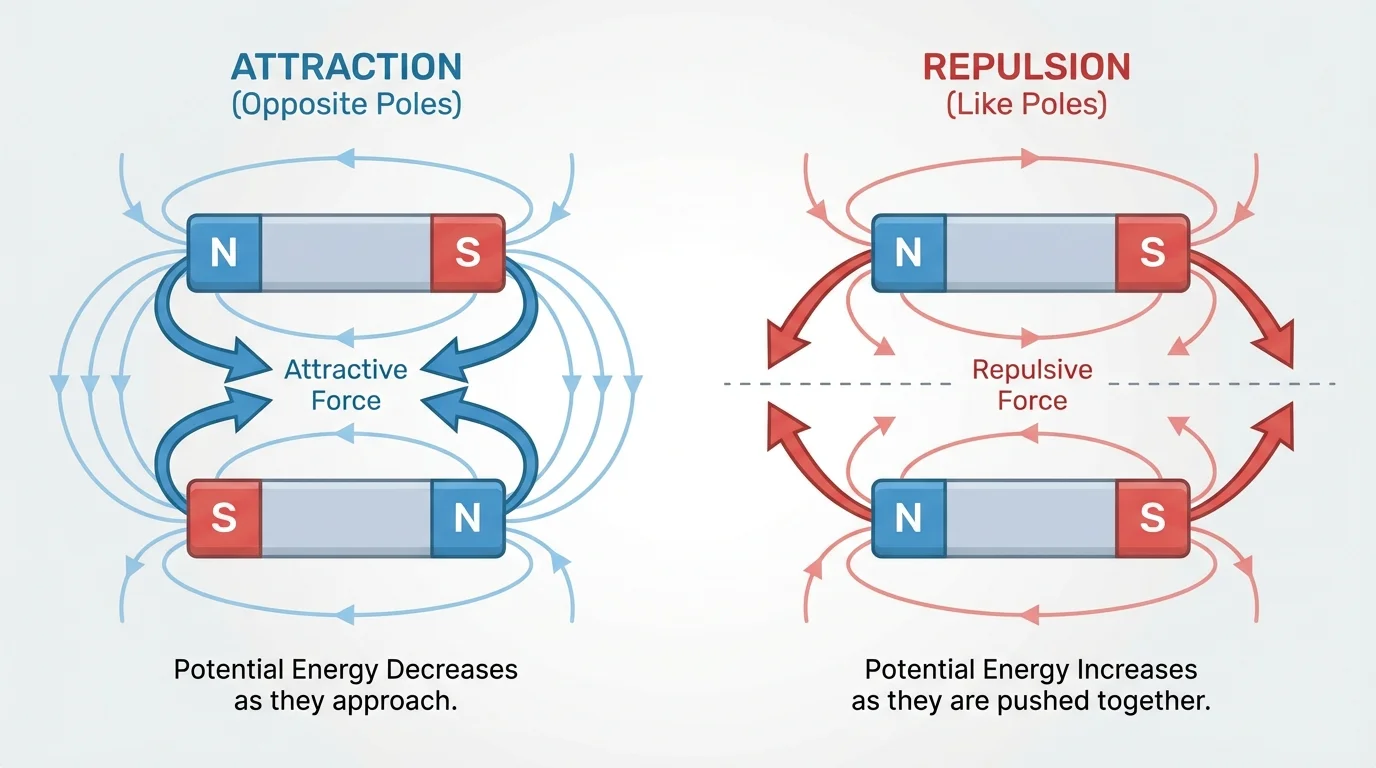
A magnetic field is produced by magnets or by moving charges. In high school models, a simple case uses two magnets as the two objects. As [Figure 2] shows, each magnet has a north pole and a south pole. Opposite poles attract, while like poles repel. Orientation matters strongly in magnetic interactions.
If you bring the north pole of one bar magnet near the south pole of another, the magnets pull together. If you bring north near north, they push apart. The pattern resembles electric charge interactions, but magnets are not the same as isolated positive and negative charges. In ordinary magnets, poles come in pairs.
The magnetic field model explains why a paper clip can move toward a magnet without being touched. In that two-object model, the magnet creates a field, and the paper clip responds to it. A compass needle also turns because Earth's magnetic field exerts a torque on the magnetized needle, although a full compass situation can involve more than two objects if analyzed in detail.
Magnetic interactions are essential in technology. Speakers use magnetic forces to move a cone and create sound. Electric motors rely on magnetic interactions to produce rotation. Magnetic resonance imaging, or MRI, uses very strong magnetic fields to help form medical images. Even though real devices are complex, each part can often be understood by analyzing a simpler two-object magnetic interaction first.
Magnetic interaction and energy
When two magnets move into an arrangement they naturally prefer, such as opposite poles facing, the system's potential energy decreases. If they are free to move, they speed up. If you force like poles together, you increase the system's potential energy by doing work against the magnetic force.
This is why two magnets can suddenly move together. The magnetic field is associated with stored energy, and as the magnets move, that stored energy changes form. Sometimes the final energy becomes motion, and then sound or thermal energy when the magnets collide.
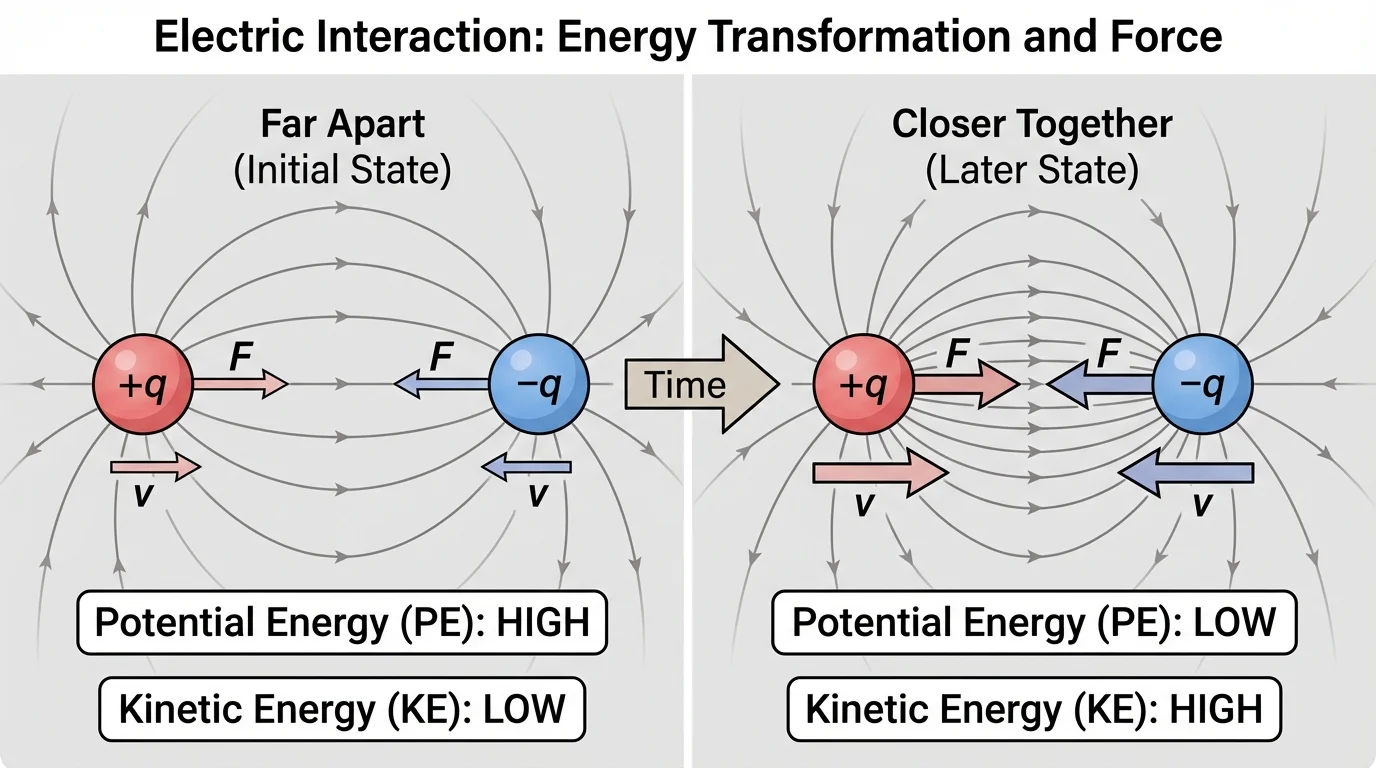
The idea that fields contain energy is one of the deepest parts of this topic. In a two-object system, the energy is not thought of as sitting only inside one object or the other. Instead, the system has potential energy because of the relative positions of the two objects in the field, as [Figure 3] illustrates for opposite charges moving closer together.
If two opposite charges start far apart and are released, they accelerate toward each other. Their electric potential energy decreases. At the same time, their kinetic energy increases. Energy is conserved: it changes form rather than appearing from nowhere.
For many high-school situations, the basic energy idea can be written as:
\[\Delta E_{\textrm{system}} = 0\]
if no energy leaves or enters the system. In practical terms, that often means a decrease in potential energy matches an increase in kinetic energy. For example, if the potential energy of a two-object electric system decreases by \(0.40 \textrm{ J}\), then the total kinetic energy of the objects increases by \(0.40 \textrm{ J}\), assuming no energy is lost to sound or heating.
Numeric example: energy change in an electric interaction
Two opposite charges are released from rest. The electric potential energy of the system changes from \(0.90 \textrm{ J}\) to \(0.30 \textrm{ J}\). Find the change in kinetic energy if no energy leaves the system.
Step 1: Find the change in potential energy.
\(\Delta U = 0.30 - 0.90 = -0.60 \textrm{ J}\)
Step 2: Use conservation of energy.
If total energy stays constant, then \(\Delta K = -\Delta U\).
Step 3: Solve.
\(\Delta K = -(-0.60) = 0.60 \textrm{ J}\)
The kinetic energy increases by \(0.60 \textrm{ J}\).
The same logic works for magnetic interactions. If two attracting magnets move closer together, the system's magnetic potential energy decreases and kinetic energy increases. As we saw in the electric case in [Figure 3], the key is to track how position changes in the field are linked to energy changes.
To build a good model, start by identifying the two objects only. Then decide whether the interaction is electric or magnetic. Next, describe the field each object produces or responds to, and predict whether the force is attractive or repulsive.
After that, track energy. Ask whether the objects are moving into a lower-potential-energy arrangement or whether work must be done to push them into a higher-potential-energy arrangement. This turns the field model from a picture into a tool for explanation.
| Situation | Force between objects | What happens to potential energy if they move naturally? |
|---|---|---|
| Opposite electric charges | Attraction | Decreases as they move closer |
| Like electric charges | Repulsion | Decreases as they move farther apart |
| Opposite magnetic poles | Attraction | Decreases as they move closer |
| Like magnetic poles | Repulsion | Decreases as they move farther apart |
Table 1. Comparison of force direction and potential energy trends in simple two-object electric and magnetic interactions.
A strong model also includes clear cause-and-effect language. For example: "Object A creates an electric field. Object B is in that field, so Object B experiences a force toward A. As the objects move closer, the system's electric potential energy decreases and kinetic energy increases." That sentence ties together field, force, motion, and energy in one explanation.
Modeling example: two repelling charges
Consider two small positive charges released from rest near each other.
Step 1: Identify the interaction.
Both objects are positively charged, so the electric force is repulsive.
Step 2: Predict motion.
Each charge accelerates away from the other because each is in the other's electric field.
Step 3: Track energy.
As the distance between them increases, the system's electric potential energy decreases and kinetic energy increases.
This model explains both why the objects move and where the energy comes from.
Scientists and engineers use models like this constantly. The exact shape of a real object may be complicated, but a simpler two-object model often captures the most important physics first.
Electrostatic spray painting uses electric fields to help paint spread evenly over a surface. In a simplified two-object model, paint droplets have charge and the target surface has an opposite charge or induced charge pattern, so the droplets are attracted. This reduces waste and improves coating quality.
Touchscreens also rely on electric interactions. Your finger changes the electric field near the screen, and the device detects that change. The full technology is complex, but the underlying idea still depends on electric fields and the movement of charge.
Magnetic levitation trains depend on magnetic forces that can push objects apart or pull them into stable positions depending on the design. A full train system involves many interacting parts, but the basic principle can still be introduced with just two magnetic objects exerting forces through a magnetic field.
From earlier force lessons: force can change an object's velocity, and from earlier energy lessons: when one form of energy decreases while another increases by the same amount, total energy is conserved.
Medical imaging, audio devices, industrial sorting equipment, and electric motors all rely on the same core idea: a field can transfer energy across space from one object to another. That is why field models are so important in both science and engineering.
One common misconception is that fields "use up" energy as they act. A better description is that the system's energy changes form. Potential energy associated with the field and positions of the objects can become kinetic energy, thermal energy, or sound.
Another misconception is that field lines are literally present in space. They are drawings used to represent the direction a positive test charge would move in an electric field or the orientation a north magnetic pole would tend to point in a magnetic field. The lines help us visualize the model, as earlier shown in [Figure 1] and [Figure 2], but they are not physical threads.
It is also important not to overextend the model. This lesson stays within the assessment boundary of two objects. Real systems often involve many charges, many magnets, or continuous distributions of matter, but those cases are beyond the intended scope here.
"The important thing is not to stop questioning. Curiosity has its own reason for existing."
— Albert Einstein
In physics, the field model answers a very natural question: how can one object affect another across empty space? For electric and magnetic interactions, the answer is that the field carries the interaction and is tied to the energy of the system.
