A single photo sent from a phone can cross continents in seconds, be copied thousands of times without visibly changing, and still look almost identical to the original. That is not just convenience; it is a major scientific and engineering achievement. Modern communication depends on turning sounds, images, and data into forms that waves and electronic systems can carry efficiently. To evaluate the advantages of digital transmission and storage, you need to understand not only what digital technology does, but why it often performs better than older methods.
In physical science, information can be carried by waves. Radio waves carry wireless internet and phone calls. Light waves in optical fibers carry huge amounts of internet traffic. Electrical signals move through wires in devices and networks. What matters is that these systems must represent information in a form that can travel, be received, and be interpreted accurately.
Whenever you stream music, store homework in the cloud, use GPS, or send a text, you rely on digital transmission and digital storage. These systems are so common that it is easy to forget they solve serious problems. Information can be weakened, distorted, or lost as it travels. Storage can fade, scratch, demagnetize, or become corrupted. Engineers choose digital methods because they often reduce these problems and make information easier to protect, share, and process.
Still, the word advantage does not mean "always best in every situation." A strong evaluation asks questions such as: How accurate is the system? How much noise can it tolerate? How much energy does it use? How easily can the information be copied, compressed, encrypted, or recovered? Scientific thinking means comparing evidence, not just assuming newer technology is automatically better.
Waves transfer energy and can also carry information. Key wave ideas such as frequency, wavelength, amplitude, and interference help explain why signals may become distorted during transmission.
When waves are used to transmit information, changes in the wave represent changes in the message. A microphone, for example, converts sound waves into an electrical signal. A speaker does the reverse. In between, devices may process that information digitally so it can be sent more accurately and stored more efficiently.
An analog signal changes continuously. A vinyl record, an older radio broadcast, or the changing voltage from a simple microphone can represent information in a smooth, continuous way. A digital signal, by contrast, represents information using distinct values, most commonly the binary digits 0 and 1. The difference between a continuously varying signal and a signal built from discrete values helps explain many digital advantages.
[Figure 1] shows this process visually. To make information digital, a system usually measures an analog signal at regular intervals and converts those measurements into numbers. This process is called sampling. If a sound wave is sampled often enough, the digital version can reproduce the original sound very closely. The basic idea is not that digital systems magically eliminate the original wave, but that they turn the wave into data that can be stored, copied, and transmitted in a more controlled form.
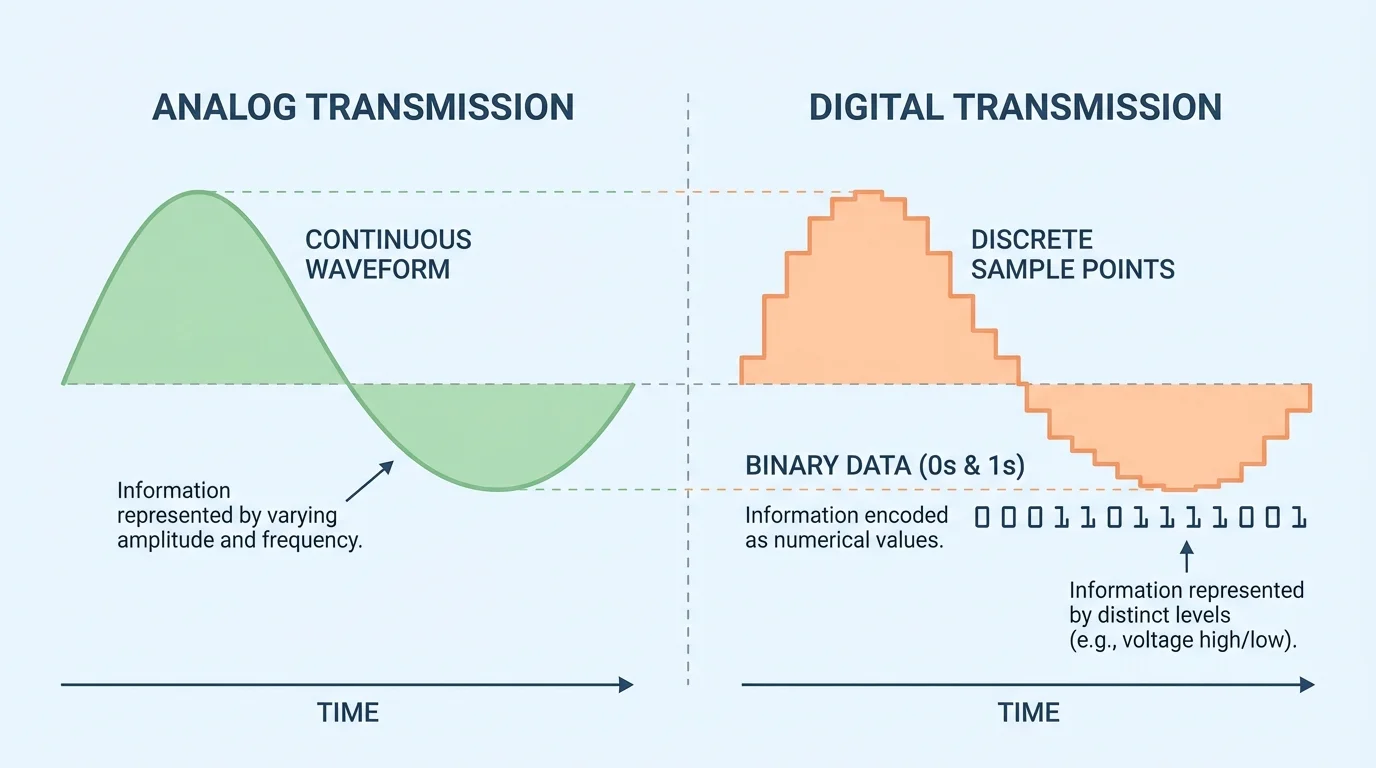
Suppose a temperature sensor measures a changing signal and records it as digital values. In a very simple system, it might store only two states, such as 0 or 1, while a more detailed system might store longer bit patterns such as 101101. Those bits can represent letters, colors in an image, or parts of a song. Because the information is encoded into countable states instead of a continuously changing line, devices can often tell more clearly whether a signal has changed enough to matter.
Bit is the smallest unit of digital information and can have a value of either 0 or 1.
Byte is a group of 8 bits, often used to represent one character or a small unit of data.
Encoding is the process of representing information in a specific form so it can be transmitted, stored, or processed.
A key reason this matters is noise. Noise is any unwanted disturbance added to a signal. It may come from other electronic devices, natural interference, weak connections, or signal loss over long distances. In an analog system, even small distortions directly change the signal. In a digital system, if the receiver can still distinguish whether the intended bit is a 0 or a 1, the original information can often be recovered exactly.
The first major advantage of digital information is reliability. If an analog signal is copied again and again, small errors usually build up each time. If a digital file is copied correctly, the copy can be exactly the same as the original. A song file can be duplicated many times with no gradual loss in sound quality, unlike repeated copying of analog cassette tapes.
The second major advantage is resistance to degradation. Real transmission channels add noise, weaken signals, and create interference. Digital systems are not immune to these effects, but they are easier to design so that the receiver can reconstruct the intended message. This is one reason text messages, computer files, and digital television can work well even when signals are not perfect.
The third major advantage is efficient processing. Once information is in digital form, computers can compress it, search it, sort it, analyze it, and encrypt it. Compression reduces file size. For example, a raw image file may be much larger than a compressed image format. Engineers weigh this advantage against possible losses in quality for some compression methods.
Why exact copying matters
Digital systems treat information as patterns of bits. If the pattern is preserved, the information is preserved. That makes digital storage especially powerful for science, business, medicine, and communication, where exact replication of records is often essential.
A fourth advantage is high storage density. Modern storage devices can hold enormous amounts of data in very small spaces. A smartphone can store thousands of photos, hours of video, and many apps because digital information is packed into tiny physical states inside memory chips.
A fifth advantage is error detection and correction. Engineers can add extra bits to help detect whether data changed during transmission or storage. If a message is sent with a known pattern, the receiver can test whether that pattern still matches. In some systems, the original message can even be corrected automatically. This ability is one of the strongest reasons digital transmission is valuable in space exploration, internet communication, and data centers.
Case study: Why a digital photo can be shared repeatedly
A student takes a photo and sends it to five friends, who each save and forward it again.
Step 1: The camera converts light into digital data.
Each pixel is stored as numbers that describe color and brightness.
Step 2: The file is transmitted as bits.
As long as the system correctly receives the bit pattern, the image remains unchanged.
Step 3: The file is copied again.
Unlike an analog photocopy of a photocopy, a correct digital copy does not become blurrier just because it was copied many times.
This is an important practical advantage of digital storage and transmission.
That does not mean digital systems are perfect. If too many bits are lost, the file may glitch, freeze, or become unreadable. The important point is that digital systems often maintain quality much better up to a threshold, while analog systems often decline gradually the whole time.
Digital information still depends on physical waves. In a complete communication chain, information is created by a source, encoded into a signal, sent through a channel, received, and then decoded. The channel may be a metal wire carrying electrical pulses, an optical fiber carrying light pulses, or open air carrying radio waves.
[Figure 2] traces this process in a phone call. For example, during a phone call your voice begins as a sound wave in air. The microphone converts it into an electrical signal. The phone samples that signal, turns it into binary data, and sends it by radio waves to a cell tower. The network routes the information, and the receiving phone converts the data back into sound. Although the user experiences a conversation, the system is constantly translating between physical waves and digital information.
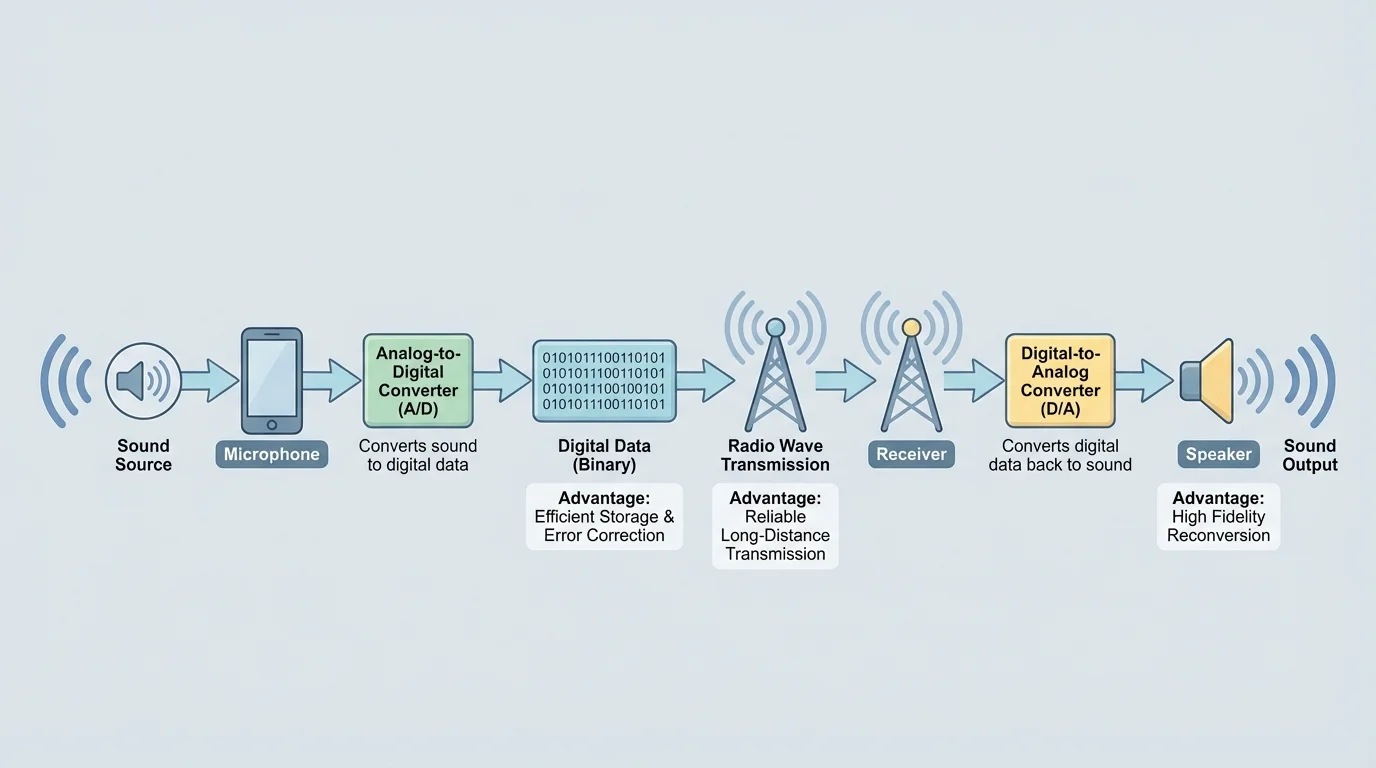
One advantage of digital transmission is that repeaters and routers can regenerate the signal instead of merely amplifying all the noise along with it. In analog systems, amplification boosts both the message and the distortion. In digital systems, equipment can read the incoming bits and send out a cleaner version of the intended pattern, provided the original remains readable.
This is especially important over long distances. Fiber-optic cables carry internet traffic as pulses of light. Light can weaken over distance, but digital network equipment can restore the data pattern. That makes global communication more dependable. The same logic applies to satellites, deep-space probes, and wireless networks, where signals may be weak or delayed.
The amount of information sent per second is called the data rate, although in everyday contexts people sometimes loosely use bandwidth to mean something similar. In practical communication systems, greater bandwidth usually allows more information to be transmitted in less time. Digital methods make it easier to manage and route this information efficiently.
Space missions use digital communication because signals from distant spacecraft are extremely weak by the time they reach Earth. Error-correcting methods help scientists recover valuable data from across the solar system.
The comparison from [Figure 1] still matters here: because digital signals rely on distinguishable states, the receiver can often decide whether each state was meant to be one value or another. That simple idea supports everything from streaming video to secure banking.
Digital storage works by assigning physical states to bit values. Different storage technologies use different physical mechanisms, but they all represent information with patterns that correspond to 0s and 1s. The three major categories are magnetic storage, optical storage, and solid-state storage.
[Figure 3] compares these methods. Magnetic storage includes hard disk drives. These store bits by magnetizing tiny regions of material in different directions. Optical storage, such as CDs, DVDs, and Blu-ray discs, stores data in patterns that affect how laser light reflects. Solid-state storage, such as flash drives and solid-state drives, stores information using electrical charge trapped in memory cells.
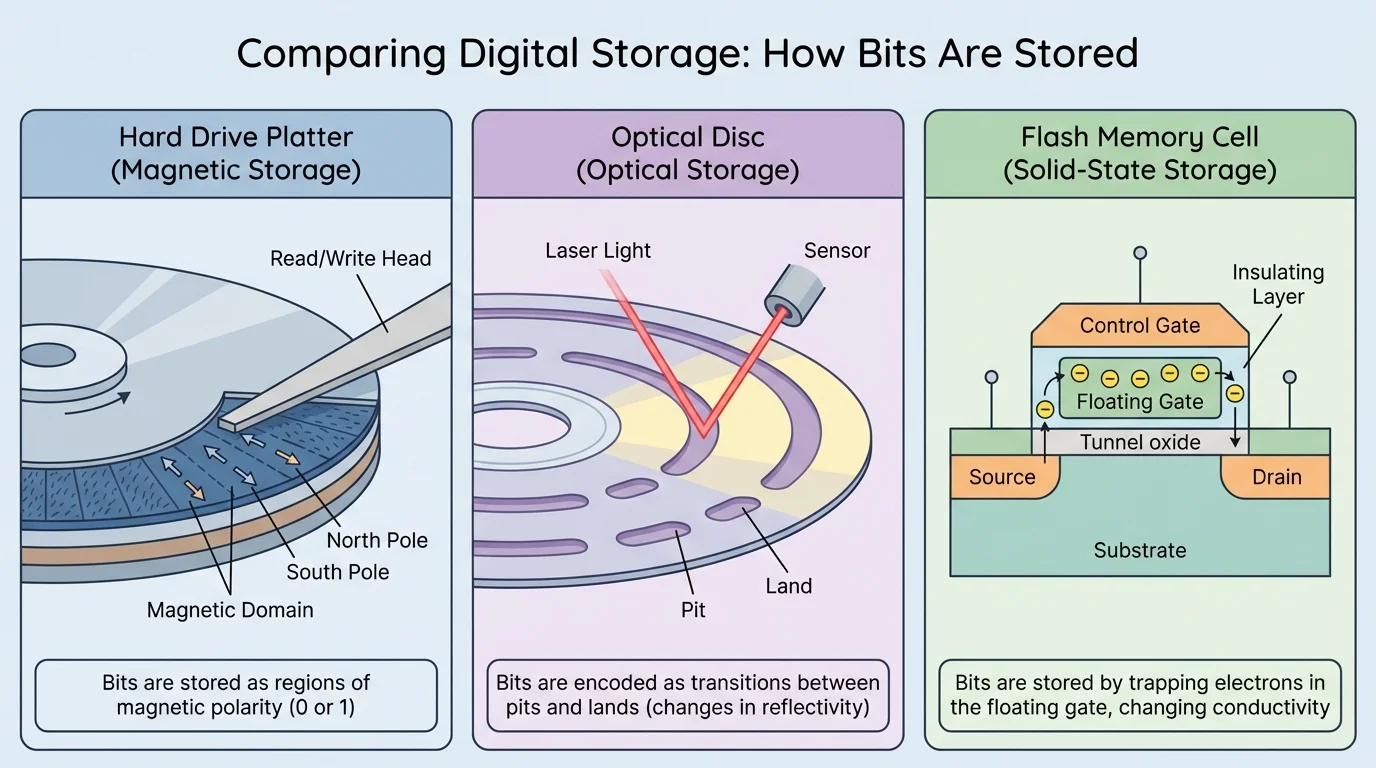
Digital storage offers several strong advantages. First, it allows fast retrieval. A computer can search millions of stored values quickly. Second, it supports compact storage. Third, it allows exact duplication and backup. Fourth, it supports integration with software tools, making information easy to edit, organize, and analyze.
Different storage systems still have different strengths and weaknesses.
| Storage type | How bits are stored | Advantages | Limitations |
|---|---|---|---|
| Magnetic | Magnetic orientation | Large capacity, relatively low cost | Mechanical parts, vulnerable to shock |
| Optical | Laser-read surface patterns | Useful for media distribution, removable | Slower, can scratch |
| Solid-state | Electrical charge in memory cells | Fast access, durable, no moving parts | Often higher cost per unit of storage |
Table 1. Comparison of major digital storage technologies and their typical advantages and limitations.
When engineers evaluate the "advantage" of digital storage, they ask more than whether it works. They compare speed, durability, cost, capacity, energy use, and reliability over time. A data center may choose one type of storage for long-term archives and another for fast-access computing tasks.
Real-world example: Medical imaging
Hospitals store X-rays, MRI scans, and CT images digitally because those files must be copied, transmitted, and examined accurately.
Step 1: The scan is produced as digital data.
Each image contains detailed numerical information about brightness and structure.
Step 2: The file is stored and backed up.
Doctors in different locations can access the same image without degrading the original.
Step 3: Software can analyze the image.
Digital tools can zoom, enhance contrast, and measure structures more easily than with film alone.
Here, the advantage of digital storage is not only convenience but also precision and accessibility.
The comparison in [Figure 3] also reveals an important scientific idea: even though the physical mechanisms differ, all digital systems depend on stable, measurable states that can represent binary information reliably.
Good evaluation involves asking whether digital systems are better for a specific purpose, not treating "digital" as automatically superior. For example, digital audio can be copied perfectly, edited easily, and streamed efficiently. However, creating and maintaining digital systems requires hardware, energy, mining of materials, and electronic waste management. Those factors matter too.
Security is another issue. Digital information can be encrypted, which is a major advantage for privacy and secure communication. But digital systems can also be hacked, tracked, or affected by software failures. A notebook can be lost, but a database breach can expose millions of records at once.
There are also limits related to quality. If sampling is too slow or compression is too aggressive, digital representations may lose detail. Engineers must choose design settings carefully. A scientific instrument collecting data from earthquakes or stars may need very high precision, while a video call may prioritize speed over perfect image quality.
How engineers judge a communication or storage system
Engineers compare systems using criteria such as signal quality, capacity, speed, noise resistance, cost, energy use, durability, security, and ease of error correction. The best system depends on which criteria matter most in the situation.
Another useful idea is the trade-off between continuous degradation and threshold failure. Analog systems often become steadily noisier. Digital systems may remain very accurate until errors exceed what the system can correct, at which point the quality may suddenly drop. That is why digital video may look perfect and then freeze, rather than slowly becoming fuzzier in the way older analog television often did.
Digital transmission and storage support modern science, medicine, transportation, entertainment, and emergency response. Streaming services send compressed digital audio and video across large networks. Weather satellites collect and transmit digital images of storms. Air traffic systems rely on rapid exchange of digital information. Scientific observatories store enormous data sets that researchers can analyze with computers.
Cloud storage is another strong example. Files are stored digitally on remote servers and can be accessed from many devices. This gives users flexibility and backup protection, but it also raises questions about privacy, energy use, and who controls the data. A full evaluation includes both the technical advantages and the broader consequences.
In disaster response, digital communication can be lifesaving. Emergency teams can share maps, coordinates, images, and live updates quickly. Because digital systems can integrate many types of information into one network, they improve coordination. The flow of information through a communication chain, like the one in [Figure 2], becomes especially important when speed and accuracy matter.
"The value of information depends on how accurately, quickly, and reliably it can be shared."
Even everyday school life reflects these ideas. A shared class document can be updated instantly, stored in multiple places, and recovered from backup. That convenience comes from the scientific and engineering strengths of digital systems: exact copying, rapid transmission, and flexible processing.
To evaluate advantages well, ask questions like these: Is the information likely to face interference? Does it need to be copied many times? Must it be stored for years? Does it need to stay private? How quickly must it be transmitted? Can some loss of detail be accepted? How much energy and cost are reasonable?
These questions help move from simple opinions to evidence-based judgment. For one task, the biggest advantage may be accuracy. For another, it may be speed or storage capacity. In still another case, the main concern may be whether the system can recover from errors. Evaluation means matching the technology to the purpose.
Understanding waves, signals, and encoding makes that evaluation stronger. Digital systems are powerful not because they ignore physics, but because they use physical systems in clever ways. They turn information into forms that can travel through waves and be stored in stable states, then recover that information with impressive accuracy.
