Your phone can send a message across a city, a remote control can change a TV channel without touching it, and sunlight can power a calculator with no moving parts. These all seem like very different technologies, yet they depend on the same big idea: waves can move energy and information from one place to another. Modern life works because engineers have learned how to generate waves, guide them, detect them, and interpret the ways they interact with matter.
A wave is a disturbance that transfers energy from one place to another. Some waves also carry information. When you speak into a phone, your voice creates sound waves in air. The phone converts that pattern into electrical signals, then into electromagnetic waves that travel to a cell tower or a router. At the other end, a receiving device reconstructs the pattern so another person hears your voice.
Technologies use waves because waves are excellent messengers. Depending on the type of wave, they can travel through materials such as air, water, and glass, and some can also travel through empty space. They can also be changed in controlled ways. A wave can be made stronger or weaker, faster or slower, more spread out or more tightly packed. Those changes can represent information such as sound, images, distance, location, or power.
Energy is the ability to cause change, and information is an organized pattern that can be communicated or interpreted. Waves are important because they can carry both at the same time: a wave from the Sun brings energy to Earth, while a radio wave can carry encoded music or speech.
There are two broad categories of waves that matter here. Mechanical waves require a medium, such as air or water, to travel. Sound is the main example in this lesson. Electromagnetic waves do not require a medium and can travel through empty space. Radio waves, microwaves, infrared, visible light, ultraviolet, X-rays, and gamma rays all belong to this family.
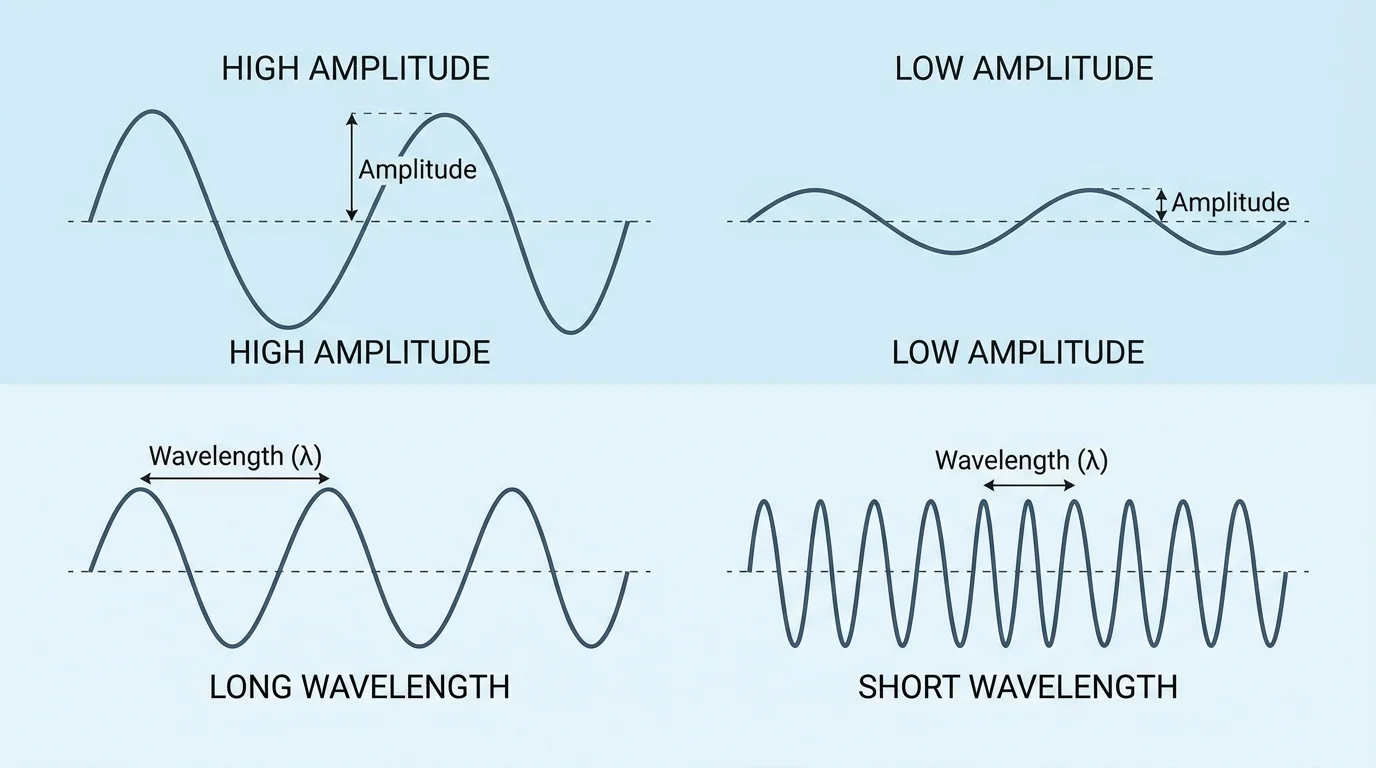
To describe wave-based technologies clearly, scientists use a few key properties. The shape and spacing shown in [Figure 1] help connect the terms amplitude, wavelength, and frequency to what a wave actually looks like. Amplitude is the size of the disturbance, wavelength is the distance between repeating points such as crest to crest, and frequency is how many wave cycles pass a point each second.
Frequency is measured in hertz, where \(1 \textrm{ Hz}\) means one cycle per second. A low-frequency sound may be a deep bass note, while a high-frequency sound may be a whistle. For electromagnetic waves, lower frequencies include radio waves and higher frequencies include visible light and beyond. Devices are often designed to work best in a certain frequency range.
Wave speed depends on the wave type and the medium. A useful relationship is
\[v = f\lambda\]
where \(v\) is wave speed, \(f\) is frequency, and \(\lambda\) is wavelength. For example, if a sound wave in air travels at about \(340 \textrm{ m/s}\) and has frequency \(170 \textrm{ Hz}\), then its wavelength is \(\lambda = \dfrac{340}{170} = 2 \textrm{ m}\). That means each repeating part of the wave is about \(2 \textrm{ m}\) long.
Wave energy transfer is often related to amplitude. A louder sound usually has greater amplitude than a quieter sound. Greater light intensity generally means more energy arriving each second. Engineers use this idea when designing microphones, speakers, antennas, and sensors, because devices must respond to wave intensity without being damaged or overwhelmed.
A wave can be continuous, like a musical tone, or pulse-like, like a camera flash or a radar signal. Pulses are especially useful for timing. If a pulse is sent out and reflected back, the travel time reveals distance. This basic idea appears in sonar, radar, and medical ultrasound.
Frequency is the number of wave cycles passing a point each second. Wavelength is the distance between matching points on a repeating wave. Amplitude describes the size of the disturbance, often linked to the wave's intensity. Electromagnetic radiation is energy carried by oscillating electric and magnetic fields.
The electromagnetic spectrum includes many technologies students already use. Radio and Wi-Fi use lower-frequency electromagnetic waves. Remote controls usually use infrared. Cameras detect visible light. Medical imaging can use X-rays. The underlying physics is unified: each device either emits, receives, or modifies waves.
Waves are useful not just because they travel, but because they interact with materials in predictable ways, as [Figure 2] illustrates. When a wave reaches matter, several things can happen. It can be reflected, absorbed, transmitted, refracted, scattered, or diffracted. The result depends on both the wave and the material.
Reflection happens when a wave bounces off a surface. A mirror reflects visible light. A wall can reflect sound, creating an echo. Radar systems depend on radio waves reflecting from airplanes, storms, or cars. Ultrasound depends on sound reflecting from tissues inside the body.
Absorption occurs when a material takes in wave energy. Dark clothing in sunlight absorbs more light energy and warms up more quickly. Acoustic foam absorbs sound and reduces echoes. Solar panels absorb light energy and convert some of it into electrical energy.
Transmission means a wave passes through a material. Glass transmits visible light well, which is why windows work. Some plastics transmit infrared, making them useful in remote-control systems. Different materials allow different wavelengths to pass through, so material choice matters in engineering.
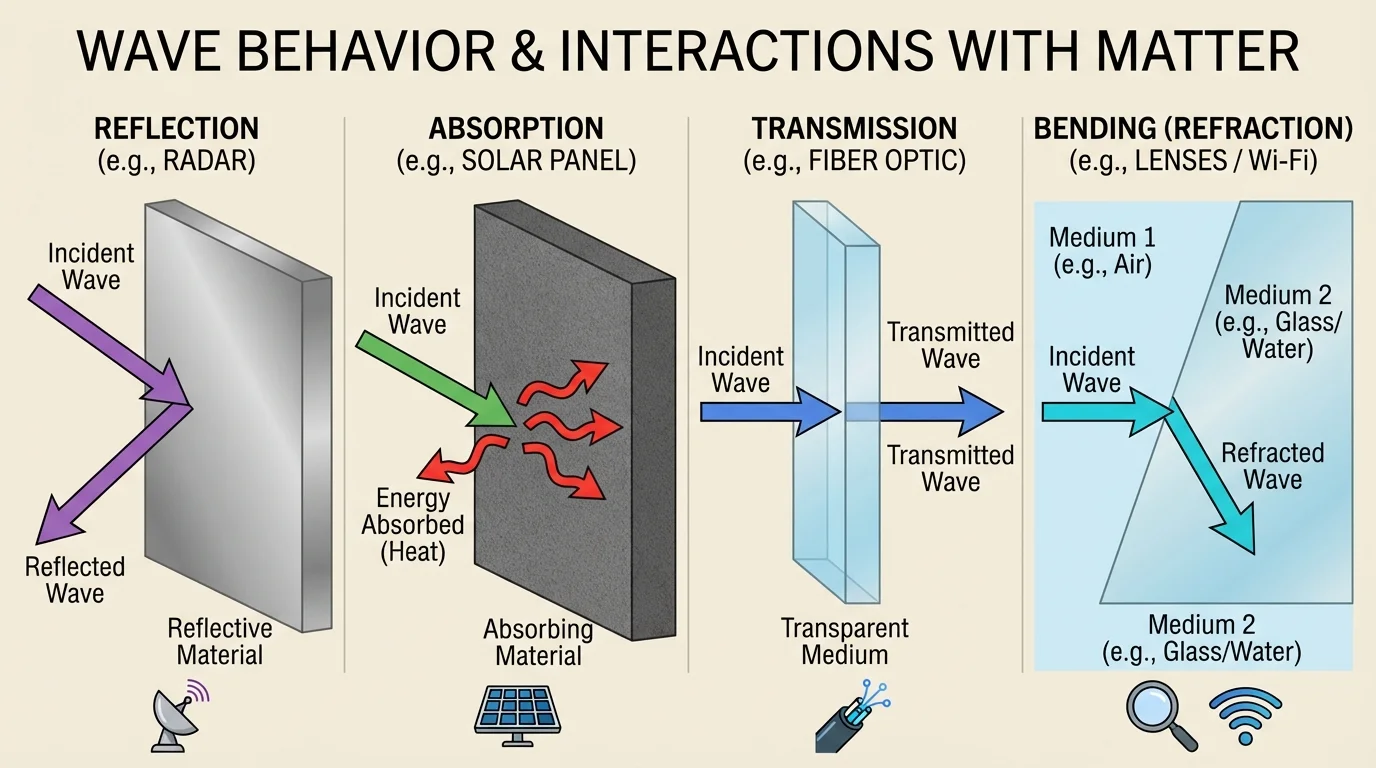
Refraction is the bending of a wave when it enters a different medium and changes speed. Light bends when it passes from air into water or glass. Lenses in eyeglasses, cameras, and microscopes rely on refraction to focus light. Fiber-optic systems also depend on controlling how light behaves at boundaries between materials.
Interference happens when waves overlap. Sometimes they combine to make a larger wave; this is constructive interference. Sometimes they partially or completely cancel; this is destructive interference. Noise-canceling headphones work by producing sound waves that interfere destructively with incoming noise. The same principle helps engineers reduce unwanted signals in communication systems.
Diffraction is the spreading of waves around edges or through openings. Sound waves often diffract enough that you can hear someone around a corner. Light diffracts too, but its smaller wavelength usually makes the effect less obvious in everyday life. Wi-Fi signals can bend and scatter around obstacles, which is one reason a signal may still reach nearby rooms.
Microwave oven doors have a metal mesh that blocks microwaves while still letting visible light pass through. The design works because different wavelengths interact differently with the same material structure.
These interactions also explain why no single material is perfect for every device. A material that is excellent for reflecting radio waves may not be useful for transmitting visible light. Engineers select materials based on the wavelengths involved and on whether the goal is to reflect, absorb, guide, or detect the wave.
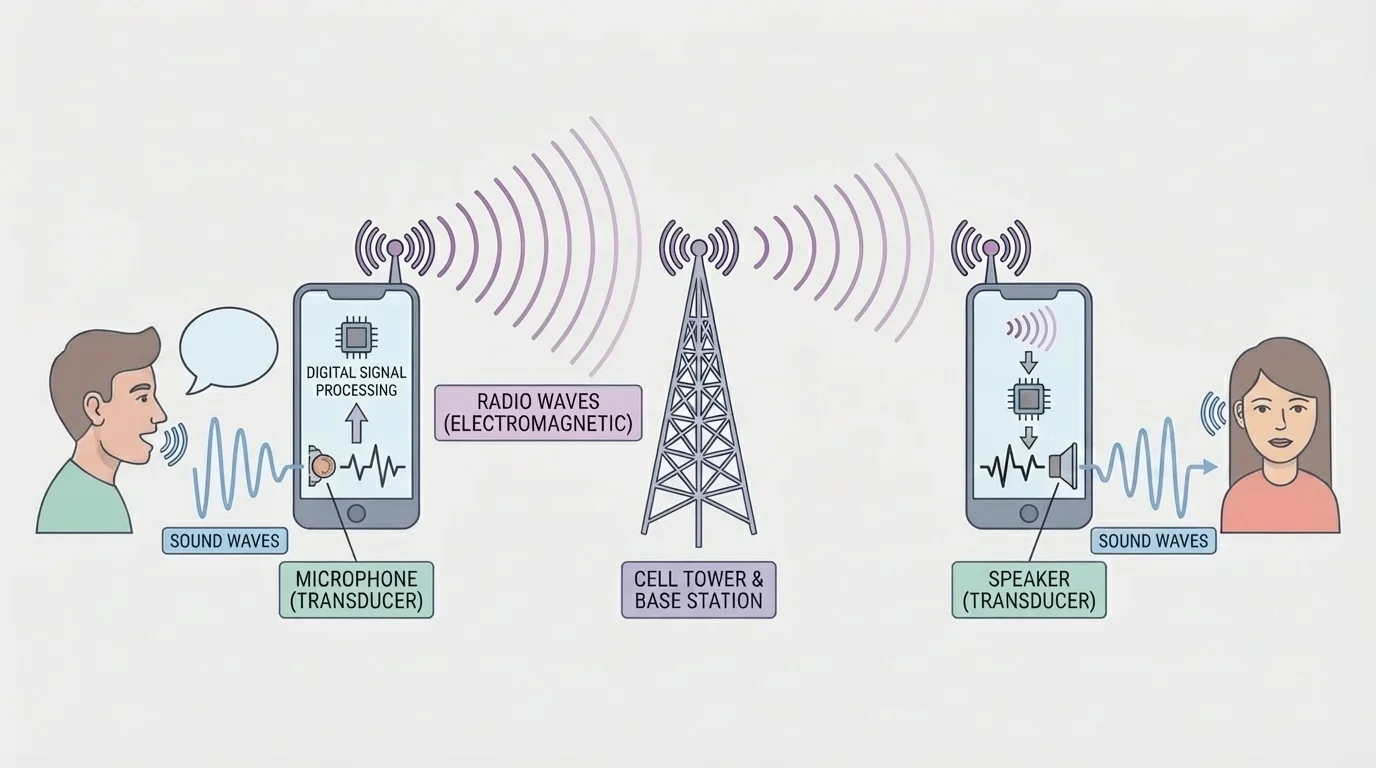
Technology becomes especially powerful when a device can encode information into a wave and then decode it later. The communication chain in [Figure 3] shows the central idea: information begins in one form, is converted into a wave-friendly signal, travels, and is then reconstructed by a receiver.
A microphone is a good starting example. Sound waves from a voice hit a thin diaphragm inside the microphone. The diaphragm vibrates, and those vibrations are converted into an electrical signal that changes over time in the same pattern as the sound. That electrical pattern contains the information from the original voice.
A speaker does the reverse. An electrical signal makes part of the speaker vibrate back and forth, creating sound waves in air. Together, microphones and speakers demonstrate that information can move between mechanical waves and electrical systems without losing its pattern.
Encoding and decoding are the heart of communication technology. Encoding means changing information into a form that can travel efficiently, such as electrical pulses, radio waves, or light pulses. Decoding means converting the received pattern back into a useful form such as sound, text, or an image. The important point is not the exact electronics but the preserved pattern.
Radio communication uses electromagnetic waves as carriers. A transmitter produces a radio wave and varies some part of that wave to represent information. For a grade-level qualitative view, you can think of the signal as being changed in a controlled pattern so that the receiver can distinguish one message from another. Cell phones, broadcast radio, Bluetooth, and Wi-Fi all rely on this idea.
Digital communication often uses pulses instead of smooth continuous changes. In a very simple model, one pulse pattern may represent \(1\) and another may represent \(0\). Long messages, photos, and videos are broken into huge strings of such patterns. The wave itself carries those patterns from place to place.
Light can also carry information. In a fiber-optic cable, a laser or LED sends pulses of light. If a pulse arrives, the detector may interpret it as one state; if no pulse arrives, it may interpret the other. Because light can change very rapidly, fiber optics can carry enormous amounts of information.
As shown earlier in [Figure 1], wave properties matter here too. Higher-frequency electromagnetic waves can support different communication uses than lower-frequency ones, and amplitude changes can affect how clearly a receiver detects a signal. The exact engineering is complex, but the wave principles remain the same.
Many technologies are receivers first. They do not just emit waves; they detect incoming waves and convert them into something usable. An antenna, for example, is designed to interact strongly with certain electromagnetic waves. Incoming radio waves cause electric charges in the antenna to move, producing an electrical signal that circuits can process into audio, data, or video.
Cameras capture information carried by visible light. Light reflects from objects and enters the camera through a lens. The lens focuses the light onto a sensor. Different points on the sensor receive different intensities and colors, allowing the device to reconstruct an image. This is possible because matter interacts with light differently depending on color and intensity.
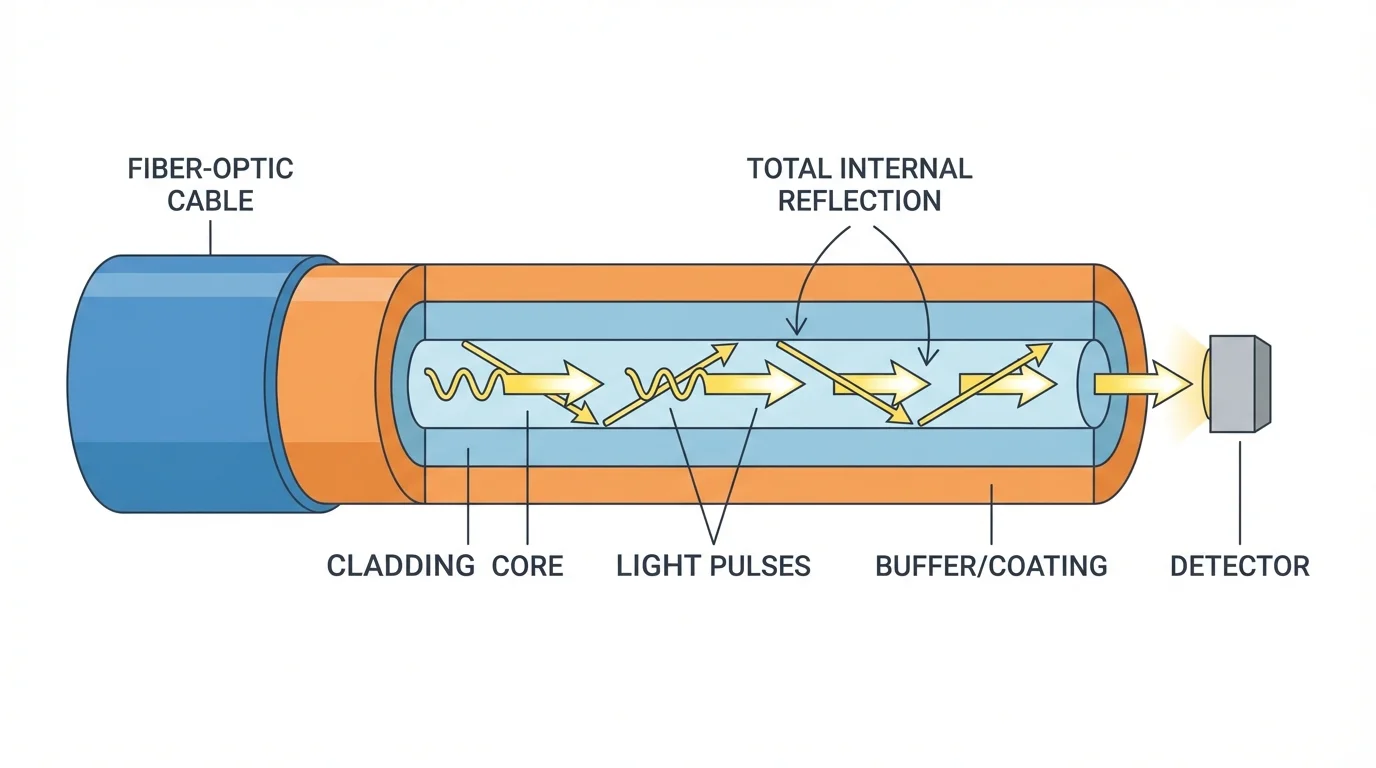
Fiber-optic communication is a special case because the device both guides and captures light. The guided path in [Figure 4] shows how the cable keeps light signals from escaping easily. Light travels through a central core and reflects internally at boundaries so the signal stays mostly confined to the cable over long distances.
A detector at the far end of the fiber captures the arriving light and converts it into an electrical signal. If a light pulse is detected within an expected time interval, the system reads one pattern; if not, it reads another. This lets fiber-optic networks carry internet traffic, video calls, and streaming media.
Photovoltaic cells in solar panels capture energy from light rather than information from a message. When sunlight is absorbed by the cell, electrical charges begin to move, producing electric current. For this lesson, the key idea is qualitative: incoming electromagnetic waves transfer energy to matter, and the material is designed to convert part of that energy into electrical energy.
A simple power idea is expressed by
\[P = \frac{E}{t}\]
where \(P\) is power, \(E\) is energy transferred, and \(t\) is time. If sunlight transfers \(200 \textrm{ J}\) of energy to a small device in \(10 \textrm{ s}\), then the average power is \(P = \dfrac{200}{10} = 20 \textrm{ W}\). Devices that absorb more wave energy each second receive more power.
Real-world example: Why a TV remote works
A remote control sends information using infrared waves.
Step 1: A button press causes the remote to emit a patterned burst of infrared light.
Step 2: The TV sensor absorbs that infrared signal and converts it into an electrical signal.
Step 3: The TV decodes the pattern as a command such as power, volume, or channel change.
The device works because the wave carries information in a recognizable pattern, and the receiver is designed for that wavelength range.
The same basic logic applies to barcode scanners, infrared thermometers, motion sensors, and environmental monitors. The device detects a wave, measures some property of it, and then uses that measurement to infer information about the world.
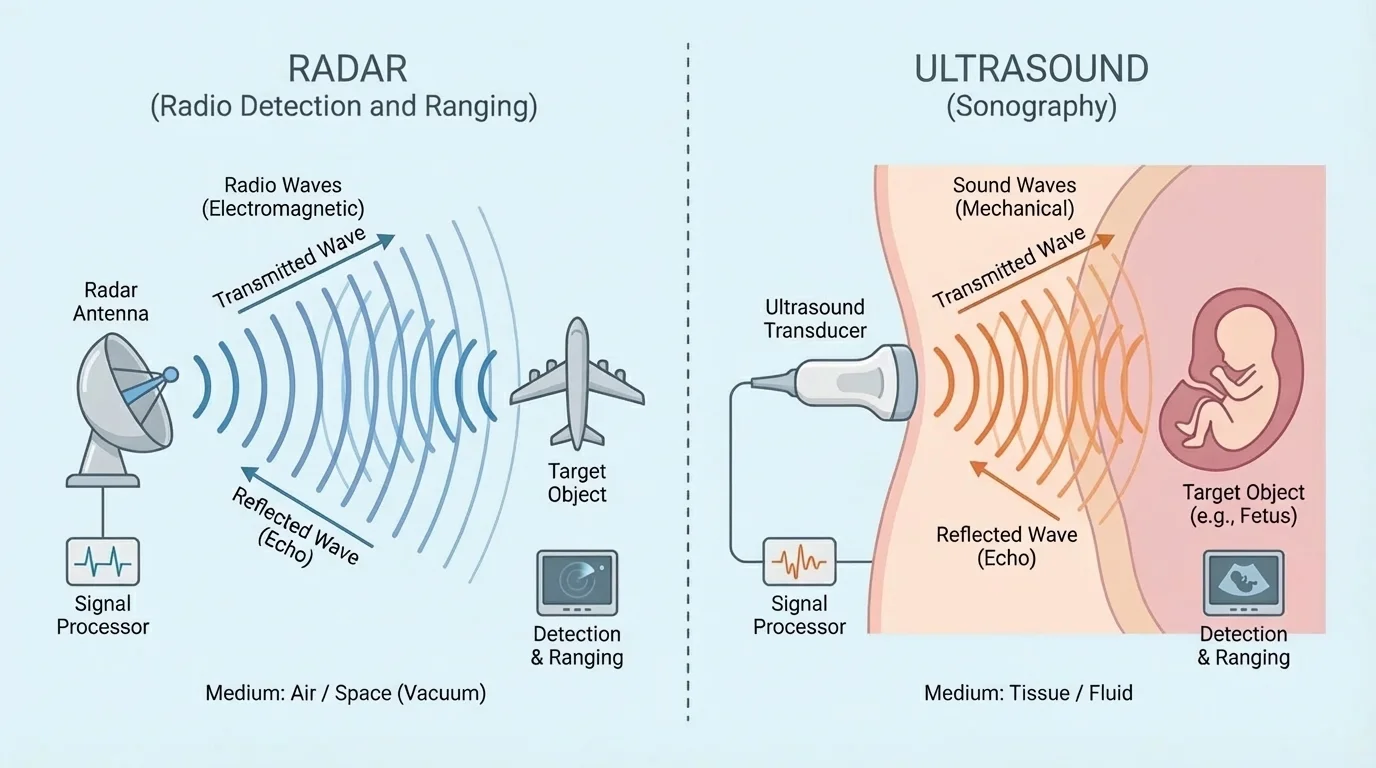
Some of the most impressive technologies both send waves out and analyze what comes back, as [Figure 5] shows. These are active sensing systems. Instead of waiting for a signal, they create one, direct it toward a target, and read the returning wave.
Radar sends out radio waves and detects echoes reflected from objects. If the returning pulse takes a certain time to come back, the system can determine distance qualitatively: longer return time means the object is farther away. Police speed detectors, weather radar, and aircraft tracking all use this principle.
Ultrasound uses high-frequency sound waves. A probe sends sound into the body, and some of the waves reflect from boundaries between tissues. The returning echoes are used to build an image. This is possible because different tissues reflect and transmit sound differently.
Sonar is similar to ultrasound but is used mainly underwater. Ships use sonar to detect depth or locate objects because sound travels effectively in water. Again, the key idea is wave emission, reflection, and detection.
Cell phone systems combine many wave principles at once. A phone microphone converts sound to electrical patterns. The phone encodes those patterns into electromagnetic signals. Antennas send and receive the waves. Towers route the information, and the receiving phone decodes it and drives a speaker. What feels like an ordinary conversation is really a layered system of wave conversions.
Medical imaging and astronomy also depend on capturing waves from matter. X-ray images form because different tissues absorb X-rays by different amounts. Radio telescopes collect faint radio waves from space. Thermal cameras detect infrared radiation emitted by objects and convert those differences into images showing temperature patterns.
This echo-based comparison highlights a general engineering strategy: send a wave, let it interact with matter, and study the returning pattern. That same strategy appears in submarine navigation, weather forecasting, autonomous vehicles, and industrial inspection.
Real devices do not work perfectly. Signals weaken with distance because wave energy spreads out and may be absorbed by matter. Walls, rain, metal surfaces, and interference from other devices can reduce signal quality. That is why a phone call may drop in an elevator, why Wi-Fi changes from room to room, and why storms matter for some communication systems.
Noise is any unwanted signal that makes the desired information harder to detect. Static on a radio, grain in an image, and background hum in a recording are all forms of noise. Engineers reduce noise using filters, shielding, error correction, and better signal design.
Numeric example: Using wave speed qualitatively
A Wi-Fi signal in air travels at about \(3.0 \times 10^8 \textrm{ m/s}\). If its frequency is about \(2.4 \times 10^9 \textrm{ Hz}\), what is its wavelength?
Step 1: Use the relationship \(v = f\lambda\).
Step 2: Rearrange to \(\lambda = \dfrac{v}{f}\).
Step 3: Substitute values: \(\lambda = \dfrac{3.0 \times 10^8}{2.4 \times 10^9} = 1.25 \times 10^{-1} \textrm{ m}\).
The wavelength is \(0.125 \textrm{ m}\), or \(12.5 \textrm{ cm}\). This helps explain why the size and spacing of antennas and obstacles matter for signal behavior.
Materials are also chosen for safety and performance. Some environments require shielding that blocks certain electromagnetic waves. Recording studios use materials that absorb sound. Protective eyewear can reduce harmful ultraviolet exposure. Hospitals carefully control the use of high-energy radiation such as X-rays so that the benefits of imaging outweigh the risks.
Not all wave technologies are mainly about information. Some focus on energy transfer, such as microwave ovens and solar panels. Others focus on both, such as a thermal camera that captures information about infrared energy emitted by objects. The distinction often depends on what the receiving device is designed to measure.
Even though the most important understanding here is qualitative, a few relationships help explain technology clearly. The formula \(v = f\lambda\) shows that if wave speed in a medium stays about the same, then increasing frequency means decreasing wavelength. This matters because shorter and longer wavelengths interact differently with objects and openings.
For timing-based systems, travel time reveals distance. If a pulse goes out and returns, the wave has covered a round trip. For example, if a sound pulse in air travels at about \(340 \textrm{ m/s}\) and returns in \(0.20 \textrm{ s}\), the total distance traveled is \(d = vt = 340 \times 0.20 = 68 \textrm{ m}\). The object is about half that distance away, so it is about \(34 \textrm{ m}\) away. This is the idea behind echo location and range finding.
The same relationship between wave behavior and matter appears throughout the lesson. Reflection supports radar and imaging. Absorption supports heating and solar energy capture. Transmission supports windows, lenses, and signal passage. Refraction supports focusing and fiber optics. Interference supports noise cancellation and signal control.
| Technology | Wave type | Main interaction with matter | Main purpose |
|---|---|---|---|
| Radio broadcast | Electromagnetic radio waves | Transmission and detection by antennas | Carry audio information |
| Wi-Fi | Electromagnetic microwaves | Transmission, reflection, interference | Carry digital data |
| Remote control | Infrared electromagnetic waves | Emission and absorption by sensor | Send commands |
| Camera | Visible light | Reflection from objects and focusing by lens | Capture images |
| Solar panel | Visible and infrared light | Absorption | Capture energy |
| Ultrasound | Sound waves | Reflection and transmission in tissue | Build internal images |
| Radar | Electromagnetic radio waves | Reflection from objects | Detect position and motion |
| Fiber optics | Visible or infrared light | Guided internal reflection and detection | Carry digital information |
Table 1. Comparison of common technologies, the waves they use, the wave interactions involved, and their main purpose.
Once you notice these patterns, wave technology appears everywhere: headphones, smoke detectors, satellite links, medical scanners, GPS receivers, touchless thermometers, and wireless chargers. The specific devices differ, but the scientific foundation is the same. Waves transfer energy. Their patterns can represent information. Their interactions with matter let devices send, guide, detect, and interpret signals.
