Your body began as a single fertilized cell, yet it now contains trillions of cells arranged into tissues, organs, and systems that allow the organism to think, move, breathe, and heal. That fact is one of biology's most astonishing ideas: a complex organism is built and maintained not by making brand-new kinds of matter, but by repeating the work of cells. To understand how this happens, biologists use models that show two linked processes: mitosis, which increases cell number, and differentiation, which produces specialized cells with different jobs.
These two processes are not the same thing, but together they explain how a multicellular organism grows from a tiny beginning and keeps functioning over time. Mitosis makes more cells. Differentiation gives many of those cells specific identities and roles. Without mitosis, a fertilized egg could never become an embryo, a child, or an adult. Without differentiation, an organism might have many cells, but they would not be organized into working parts such as skin, muscle, blood, and nerve tissue.
In complex organisms, growth happens because cells divide. A fertilized egg first divides into two cells, then four, then eight, and so on. The total number rises quickly. If a cell population doubles repeatedly, then after only a few rounds the count becomes much larger. For example, starting with one cell, after three rounds of division there are \(2^3 = 8\) cells, and after ten rounds there are \(2^{10} = 1{,}024\) cells. Real organisms are more complicated than this simple pattern, but the model helps show why repeated division is powerful.
Growth, however, is not just about making a bigger mass of identical cells. A liver cell and a neuron are both living human cells, yet they differ in shape, internal structures, and function. The path from one cell to a functioning organism therefore requires both increased cell number and increasing specialization.
Mitosis is the type of cell division that produces new body cells for growth, repair, and replacement. The daughter cells are genetically similar to the original cell.
Differentiation is the process by which unspecialized cells become specialized in structure and function.
Stem cell is a relatively unspecialized cell that can both divide and, under the right conditions, become different cell types.
Tissue is a group of similar cells working together. An organ is a structure made of multiple tissues working together, and an organ system is a group of organs that cooperate to carry out major life functions.
[Figure 1] A useful scientific model does not copy every detail of reality. Instead, it highlights the relationships that matter most. For this topic, a model should make clear that one cell can produce many cells by mitosis, and that many of those cells can later become specialized. That is enough to explain the big biological idea without memorizing every step of chromosome movement or the detailed molecular controls of gene activity.
A branching model helps visualize how cell number increases in a growing organism. In such a model, one original body cell divides into two daughter cells, each of those divides again, and the branching continues. The key message is that mitosis allows one starting cell to generate a large population of cells that can be used to build tissues and organs.
In body growth, the daughter cells produced by mitosis are similar to the parent cell in their genetic information. That matters because the cells of one organism need consistent instructions. If the cells in your skin, muscles, and stomach all came from different genetic starting points, coordinated growth and function would be impossible. Mitosis preserves continuity while increasing number.
We can turn this idea into a very simple numerical model. Suppose one cell divides once every cycle. The number of cells after each cycle can be represented by \(1, 2, 4, 8, 16, 32, ...\). This does not mean real bodies grow in a perfect mathematical doubling pattern forever, because some cells stop dividing and others die. But the model reveals the central role of repeated division in producing many cells from very few.
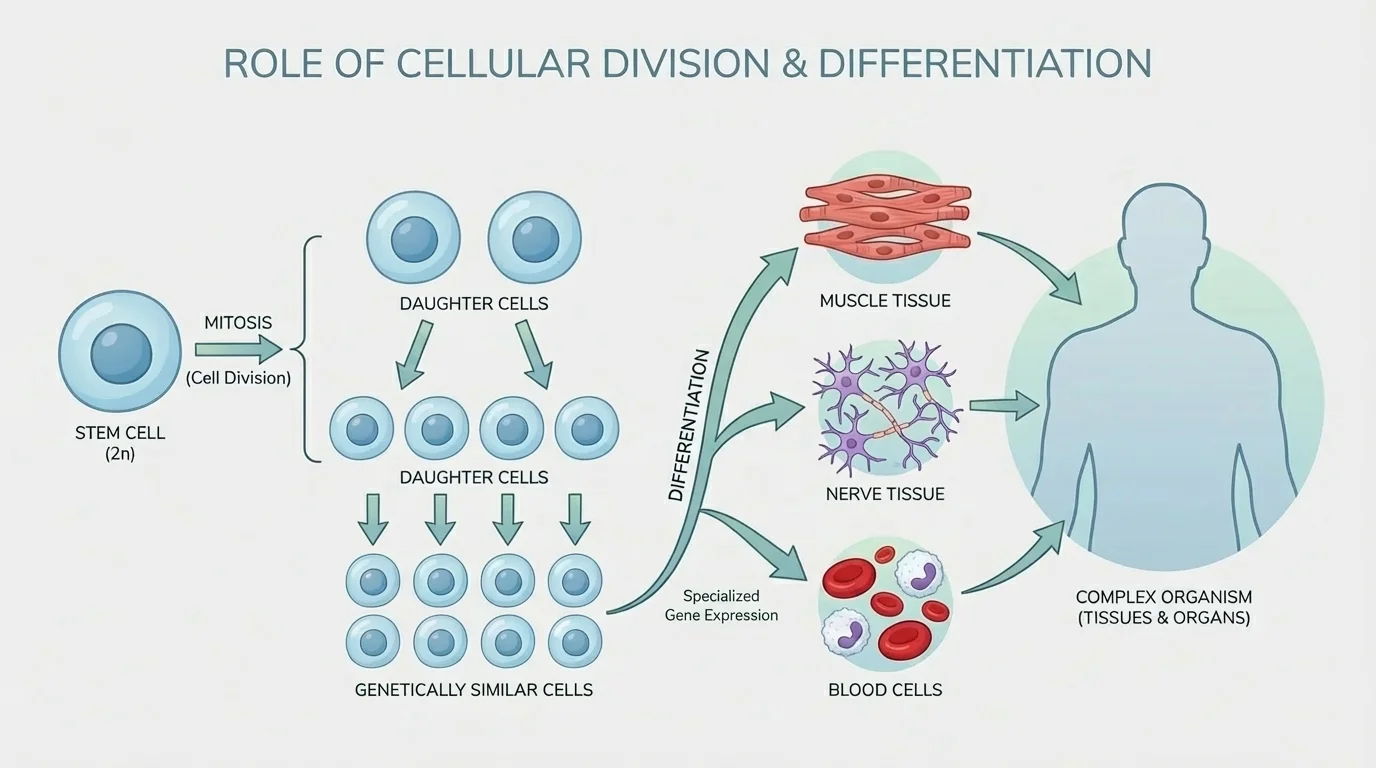
Another important feature of this model is that it explains why early development can proceed rapidly. In the early embryo, many rounds of cell division happen as the organism begins to form its basic body plan. Later, division continues in more controlled ways in different regions of the body. The same general process supports both early growth and later maintenance.
Modeling cell number increase
Consider a simplified model in which a starting cell undergoes four rounds of mitosis.
Step 1: Start with one cell.
The initial number is \(1\).
Step 2: Double the number after each round.
After one round: \(2\); after two rounds: \(4\); after three rounds: \(8\); after four rounds: \(16\).
Step 3: Interpret the result.
The model shows how quickly cell number can increase through repeated mitosis, even from a single starting cell.
Although real organisms do not follow this exact pattern forever, the example captures the basic growth idea.
The same logic applies throughout life. Your body does not only grow during childhood; it also constantly replaces cells that wear out. The same process that helped build the body in the first place continues to help maintain it.
Once enough cells exist, they do not all remain alike. Differentiation creates a variety of specialized cell types from relatively unspecialized starting cells. This is why a complex organism is more than a pile of repeated units. The cells become different because they take on different structures and functions.
[Figure 2] Think about three examples. A muscle cell is built to shorten and generate force. A neuron is shaped to transmit electrochemical signals over long distances. A red blood cell is specialized to transport oxygen efficiently. These cells come from the same organism and contain the same basic genetic blueprint, yet they are not interchangeable. Their forms match their jobs.
That connection between structure and function is one of the most important themes in biology. Specialized cells help the whole organism survive because different tasks require different designs. The long branching shape of a neuron would not help it carry oxygen the way a red blood cell does. A red blood cell's shape would not allow it to contract like muscle tissue. Differentiation therefore creates functional diversity.
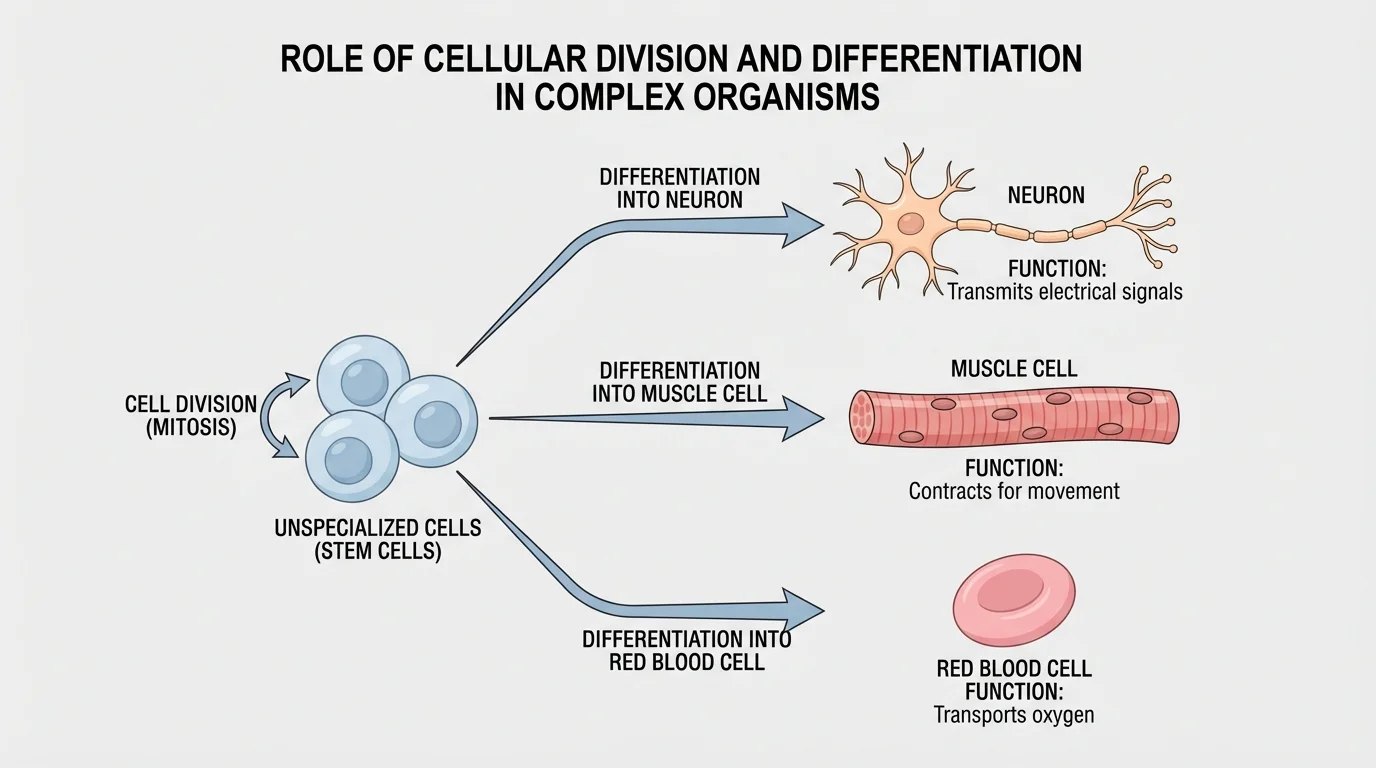
A useful way to model differentiation is to start with a small group of unspecialized cells and draw arrows toward several specialized outcomes. Each branch represents a developmental path. The model is not meant to show every molecular detail. Instead, it emphasizes the idea that one population of cells can produce multiple specialized cell types needed in a body.
Same organism, different cell jobs
Complex organisms depend on a division of labor among cells. Mitosis increases the workforce, but differentiation assigns jobs within that workforce. Together, these processes make it possible for one organism to digest food, circulate blood, respond to the environment, and repair damaged tissues at the same time.
The importance of differentiation becomes even clearer when we compare single-celled and multicellular life. A single-celled organism must perform all life functions within one cell. In a multicellular organism, different cell types share the work. That specialization increases efficiency and makes larger, more complex bodies possible.
[Figure 3] The levels of organization in a complex organism help explain how mitosis and differentiation scale up from cells to the whole body. Similar specialized cells form tissues. Multiple tissues combine to form organs. Organs work together in organ systems. The organism depends on all these levels functioning together.
For example, cardiac muscle cells are specialized cells. Groups of those cells form cardiac muscle tissue. That tissue becomes part of the heart, an organ. The heart works with blood vessels and blood in the circulatory system. Mitosis provided the many cells needed to build these structures, and differentiation produced the specialized cell types that make the system functional.
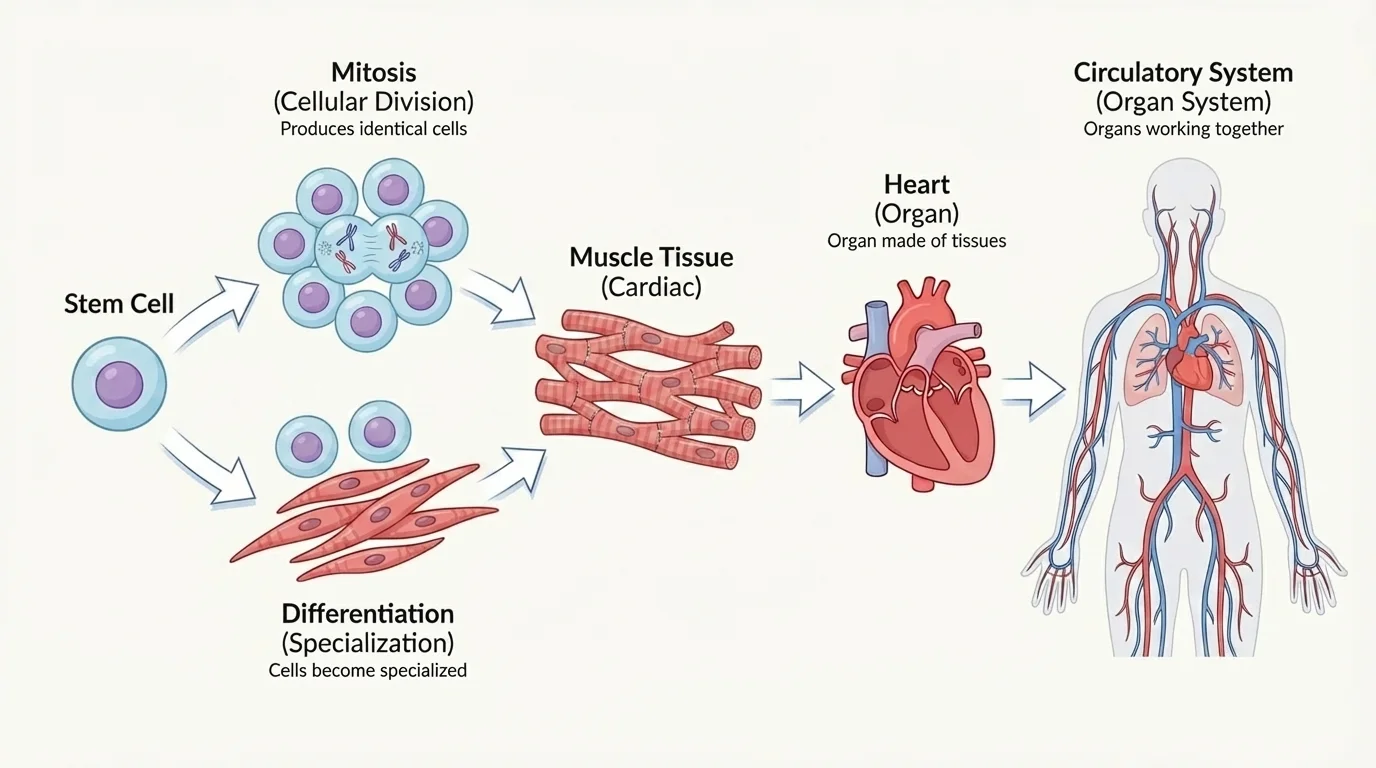
This organization is one reason complex organisms can do things that no single cell could do alone. A coordinated heart can pump blood through a large body. Lungs can exchange gases. The digestive system can break down food and absorb nutrients. The nervous system can process information and coordinate responses. None of this is possible without first producing enough cells and then making those cells different in useful ways.
Early development provides a striking example. An embryo starts as a tiny cluster of dividing cells. Over time, groups of cells become committed to different roles and contribute to the body's major structures. The final organism is not assembled from outside like a machine in a factory. It develops from within as cells divide, interact, and specialize.
| Level | Description | Example |
|---|---|---|
| Cell | Smallest unit of life | Muscle cell |
| Tissue | Group of similar cells working together | Muscle tissue |
| Organ | Structure made of multiple tissues | Heart |
| Organ system | Organs working together | Circulatory system |
| Organism | The complete living individual | Human |
Table 1. Levels of biological organization in a complex multicellular organism.
[Figure 4] Growth is only half the story. Maintenance depends on regular cell replacement and repair. Many cells in your body do not last your entire lifetime. Skin cells are lost from the surface. Cells lining the digestive tract experience constant wear. Blood cells are continually replaced. Mitosis keeps supplying new cells where they are needed.
Consider your skin. It acts as a protective barrier, but the outermost cells are exposed to friction, sunlight, and injury. New cells produced in deeper layers divide and move upward, eventually replacing those that are shed. Without this continual production, your protective barrier would weaken.
Now consider a cut on your hand. After injury, cells near the damaged area divide to help fill in the gap. New tissue forms, and the wound closes over time. The body does not heal by magic; it heals because cells can reproduce and contribute to tissue repair.
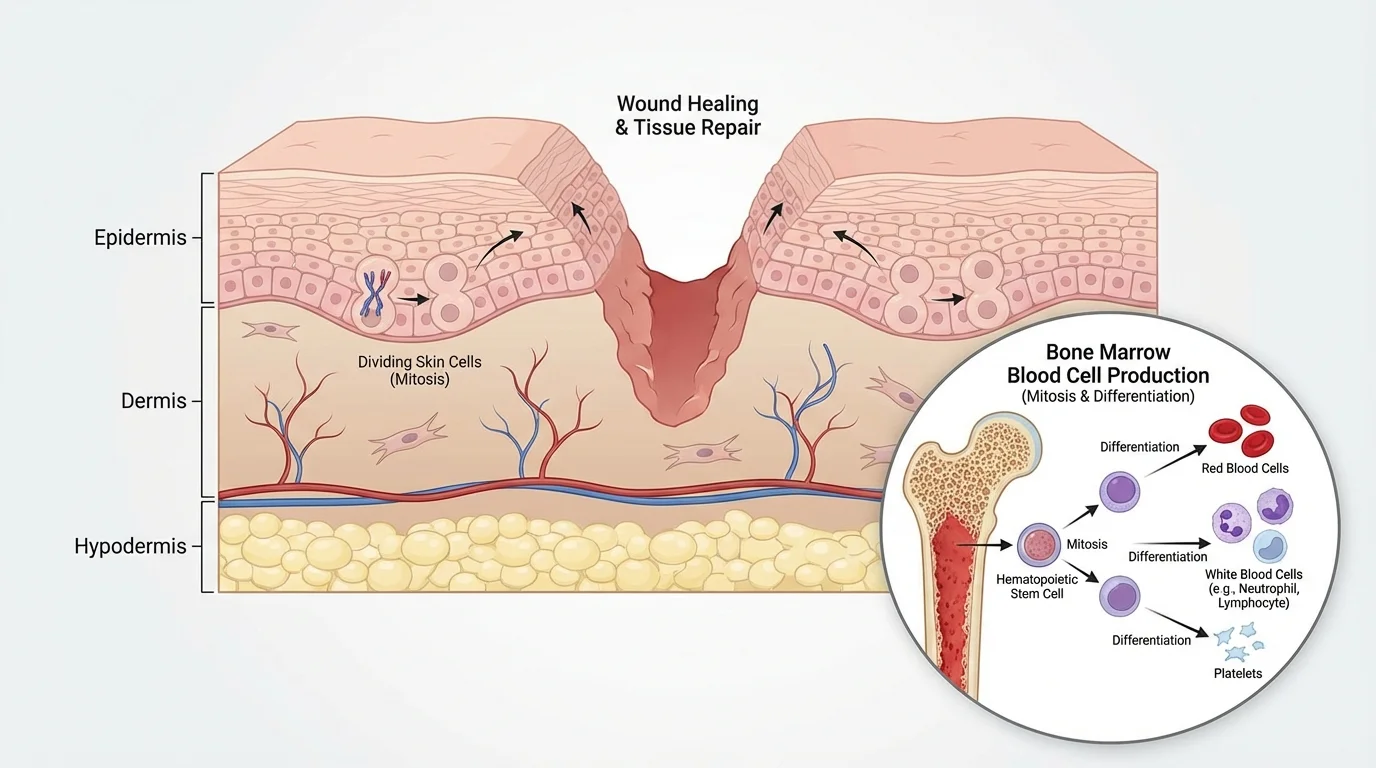
Blood formation is another powerful example. Certain tissues in bone marrow produce new blood cells throughout life. These include cells that transport oxygen and cells that help defend against disease. If cell division in bone marrow stopped, the body would quickly struggle to survive because old blood cells would not be replaced.
Your intestinal lining is renewed remarkably quickly. This rapid turnover helps maintain a surface that can keep absorbing nutrients while dealing with constant mechanical and chemical stress from food and digestion.
Maintenance also depends on the right balance. Too little cell division can slow healing or cause tissue loss. Too much cell division can become dangerous. The body must regulate when and where cells divide so that tissues stay functional and organized.
Cancer is a major example of what can happen when normal control of cell division breaks down. In general terms, cancer involves cells dividing when they should not, ignoring the usual limits that keep tissues organized. The result can be a mass of abnormal cells that disrupts normal body function.
Problems with differentiation can also cause serious effects. If cells do not become the right type at the right time, tissues may not form properly or may fail to function as they should. A body needs not just more cells, but the right cells in the right places.
These problems help show why mitosis and differentiation must work together. Uncontrolled mitosis without proper specialization does not build a healthy organism. Differentiation without enough cell production cannot support growth or repair. The body depends on both quantity and quality.
Cells are the basic unit of life, and structure relates to function. This earlier idea is essential here: specialized structures allow specialized tasks, while cell division provides the number of cells needed for those tasks.
The same comparison helps us return to earlier models. In [Figure 1], the branching pattern explains how cell number can rise quickly. In [Figure 2], the branching paths explain how cells can take on different roles. Together, the two models account for both growth and specialization.
Modern medicine depends heavily on understanding these processes. Bone marrow transplants, for example, rely on cells that can divide and generate needed blood cell types. This makes them a powerful example of how unspecialized cells can help restore essential functions in patients with damaged blood-forming tissues.
Wound healing research also depends on studying how cells divide and organize into tissue. Doctors and biomedical engineers investigate ways to encourage effective repair after burns, surgery, or severe injury. Artificial skin and tissue-engineering approaches aim to support the body's natural ability to replace lost cells.
Regenerative medicine goes even further by exploring how damaged tissues might be repaired using stem cells or specially prepared biological materials. Although this field is still developing, its central idea is straightforward: if scientists understand how organisms naturally produce and maintain tissues through cell division and differentiation, they can better support healing when the body is injured or diseased.
Case study: healing after a sports injury
A student tears skin and damages some tissue in a bicycle crash.
Step 1: Immediate damage removes or injures cells.
The tissue can no longer function normally in the injured area.
Step 2: Nearby cells and tissue-specific stem cells divide.
Mitosis increases the number of cells available for repair.
Step 3: New cells take on suitable roles in the healing tissue.
Differentiation helps restore the specialized structure needed for protection and function.
This example shows that recovery from everyday injuries depends on the same biological principles that build the body during development.
Even cancer treatment connects to these ideas. Many therapies target rapidly dividing cells because abnormal mitosis is a core problem in cancer. At the same time, researchers try to protect healthy tissues that also need regular cell division, such as bone marrow and the intestinal lining. This balance is one reason treatment can be challenging.
Scientific models are useful because they simplify reality enough to make it understandable. A cell-division tree model, for instance, clearly shows how one cell can become many. A differentiation branching diagram clearly shows how similar starting cells can become different specialized types. These are strong models because they reveal patterns and relationships that are otherwise hard to picture.
Still, models have limits. A simple growth model may suggest that every cell keeps dividing forever, which is not true. A differentiation diagram may imply that development follows only one neat path, when real organisms involve many interactions among tissues and signals. Good science requires recognizing both what a model explains well and what it leaves out.
That is why biologists often use more than one model for the same topic. One model may be best for showing increase in cell number. Another may be best for showing specialization. A third may show how tissues fit together in an organ. When these models are combined, they create a much clearer picture of how complex organisms are produced and maintained.
The hierarchy in [Figure 3] and the repair process in [Figure 4] together show an important truth: organisms are not static. They are active systems that continuously build, renew, and organize themselves. Mitosis supplies cells, differentiation assigns roles, and the resulting tissues and organs keep life going.
