A forest can lose trees to a storm, a pond can dry up in summer, and a coral reef can bleach during a heat wave—yet some ecosystems recover while others reorganize into something very different. That raises a powerful scientific question: what keeps an ecosystem stable, and what pushes it into change? The answer is not a single species or a single factor. Ecosystems are shaped by many interacting parts, and scientists evaluate those parts by examining claims, evidence, and reasoning.
An ecosystem is a system made of living organisms and the nonliving environment they interact with. In stable conditions, ecosystems tend to maintain relatively consistent numbers and types of organisms. This does not mean that every population stays exactly the same from day to day. Real ecosystems always fluctuate. A rabbit population may rise in spring and drop in winter. A lake may have more algae in one season than another. Stability means the overall system remains within a range rather than collapsing or transforming completely.
Scientists describe this as dynamic stability. The ecosystem changes, but not so much that it becomes a different ecosystem. A grassland can still be a grassland even if rainfall varies from year to year. A kelp forest can still remain a kelp forest even as fish numbers shift somewhat over time. The key idea is that under stable conditions, interactions among organisms and environmental factors tend to keep the system from drifting too far in one direction, as [Figure 1] later illustrates.
Biotic factors are the living parts of an ecosystem, such as plants, animals, fungi, and microbes. Abiotic factors are the nonliving parts, such as sunlight, temperature, water, soil, salinity, and nutrients. A disturbance is an event or change that disrupts ecosystem structure or resource availability. Carrying capacity is the largest population size of a species that an environment can support over time with available resources.
When scientists evaluate a statement about ecosystem stability, they do more than ask whether it sounds reasonable. They examine the claim, the evidence, and the reasoning. A claim is the statement being made. Evidence is the data or observations that support it. Reasoning explains why the evidence supports the claim using scientific ideas. This structure helps separate strong explanations from weak ones.
In ecology, evidence often comes from long-term observations. Scientists may record population sizes, rainfall, temperature, species diversity, fire frequency, or nutrient levels. They may compare one year to another or one location to another. If the same kinds of organisms remain present and their populations stay within a relatively narrow range over time, that supports a claim of stability. If major shifts occur and persist, that supports a claim of ecosystem change.
Evidence can come in different forms: field measurements, photographs over time, satellite data, species surveys, and especially graphs of population trends. A graph can reveal whether populations fluctuate around a stable average, whether a sharp decline follows a disturbance, or whether one group becomes dominant after conditions change. The strength of the evidence depends on quality, duration, and relevance. A single short observation is weaker than a long-term dataset that shows a clear trend.
Claim-Evidence-Reasoning in ecology means asking three linked questions: What is being argued? What observations support it? Why do those observations make sense scientifically? For example, if a claim says a lake remains stable because fish, aquatic plants, and nutrient levels stay within expected ranges, then the evidence should include those measurements, and the reasoning should explain how those interacting factors help the lake resist large changes.
Good reasoning does not just repeat the data. It connects the evidence to an ecological principle. For example, if plant growth falls during drought, the reasoning might explain that water is an abiotic factor limiting primary productivity, which then affects herbivores and predators. That is stronger than simply saying, "The graph went down."
Stability depends on a web of interactions through links among producers, consumers, decomposers, and abiotic resources. Plants and algae capture energy, herbivores feed on producers, predators feed on consumers, and decomposers return nutrients to soil or water. At the same time, sunlight, temperature, water, and nutrient availability affect how much life the system can support.
One major stabilizing factor is resource availability. If water, space, nutrients, and food remain relatively consistent, populations are less likely to crash. Another is feedback among populations. If a prey population rises, predator populations may also rise later because more food is available. As predation increases, prey numbers may fall back toward earlier levels. These interacting changes can keep populations within a range instead of allowing unlimited growth.
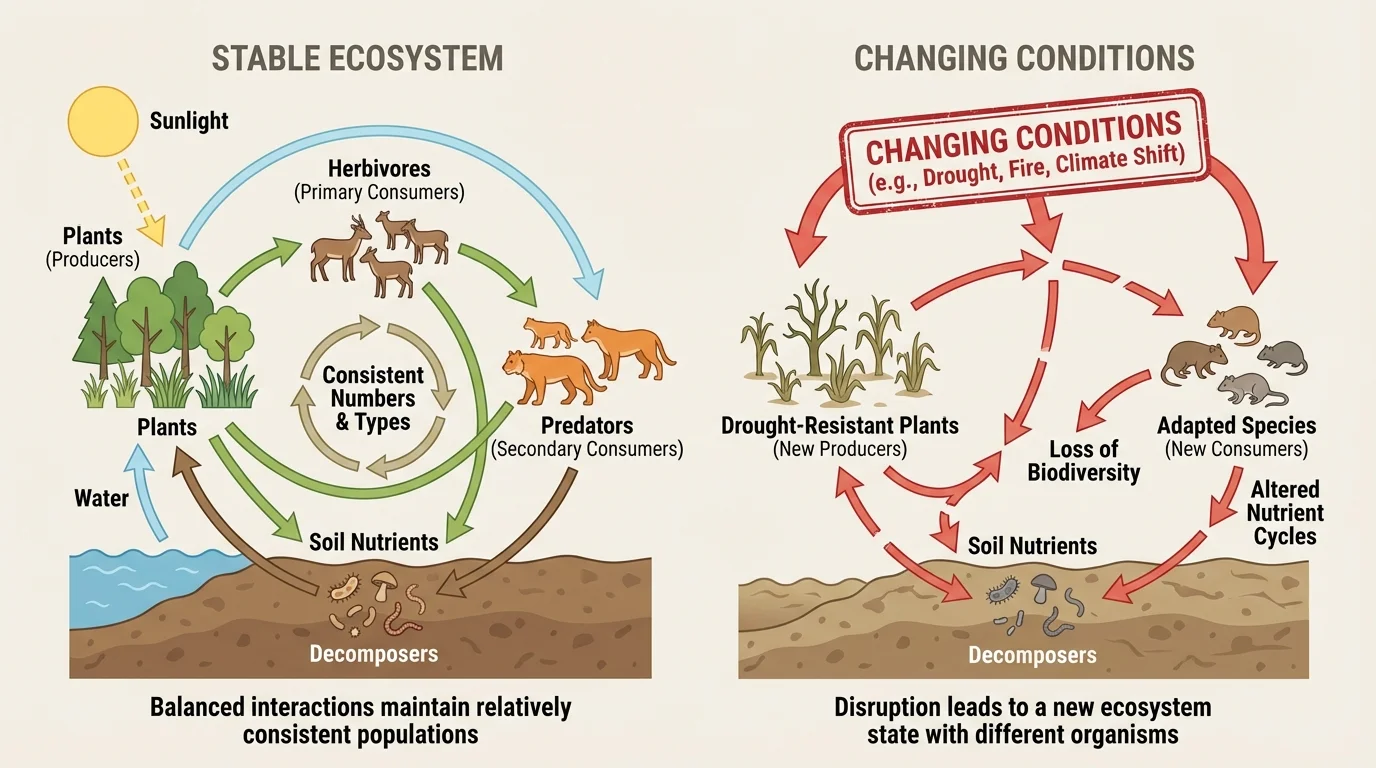
Food web structure also matters. In a more complex food web, organisms may have multiple food sources or multiple predators. This can make the ecosystem more resilient because a change in one population does not necessarily disrupt the entire system. If one insect species declines, a bird may still feed on another. If one plant species suffers in dry conditions, others may continue growing and supporting herbivores.
Decomposers such as fungi and bacteria are often overlooked, but they are essential for stability. They break down dead matter and recycle nutrients, making them available again to producers. Without decomposition, nutrients would remain locked in waste and dead organisms, and productivity would decline. Stability therefore depends not only on visible organisms like trees and deer but also on hidden processes in soil and water.
Abiotic conditions shape the entire system. A desert remains different from a rainforest largely because temperature and water availability are different. Even within one ecosystem, small abiotic changes can shift population sizes. For example, lower rainfall can reduce plant growth, which can reduce insect numbers, which can reduce bird populations. The ecosystem may still remain recognizable, but the interactions reveal how tightly biotic and abiotic factors are connected.
Some old-growth forests have structural features that support ecosystem stability. Large trees, layered canopies, deep soils, and diverse decomposer communities can help buffer the effects of normal yearly variation in temperature and rainfall.
This is why the idea of "balance of nature" should be used carefully. Ecosystems are not perfectly balanced in a frozen way. They are active systems with many changes happening at once. Their stability comes from ongoing interactions and limits, not from stillness.
[Figure 2] One of the most useful kinds of ecological evidence is a population graph. When scientists evaluate whether an ecosystem is stable, they often look for trends over time rather than isolated values. A population that rises and falls slightly around a similar level over many years may indicate relative stability. A population that drops sharply and stays low may indicate a major change in the ecosystem.
Suppose a graph shows grasses, rabbits, and foxes in a prairie over ten years. If each population fluctuates but remains present, and no species becomes permanently absent, this supports the claim that the prairie remains stable under those conditions. Now suppose a prolonged drought begins in year six. Grass abundance drops, rabbit numbers decline soon after, and fox numbers later decrease as prey becomes scarce. If the graph shows a long-lasting shift instead of recovery, the evidence supports a claim that changing abiotic conditions altered the ecosystem.
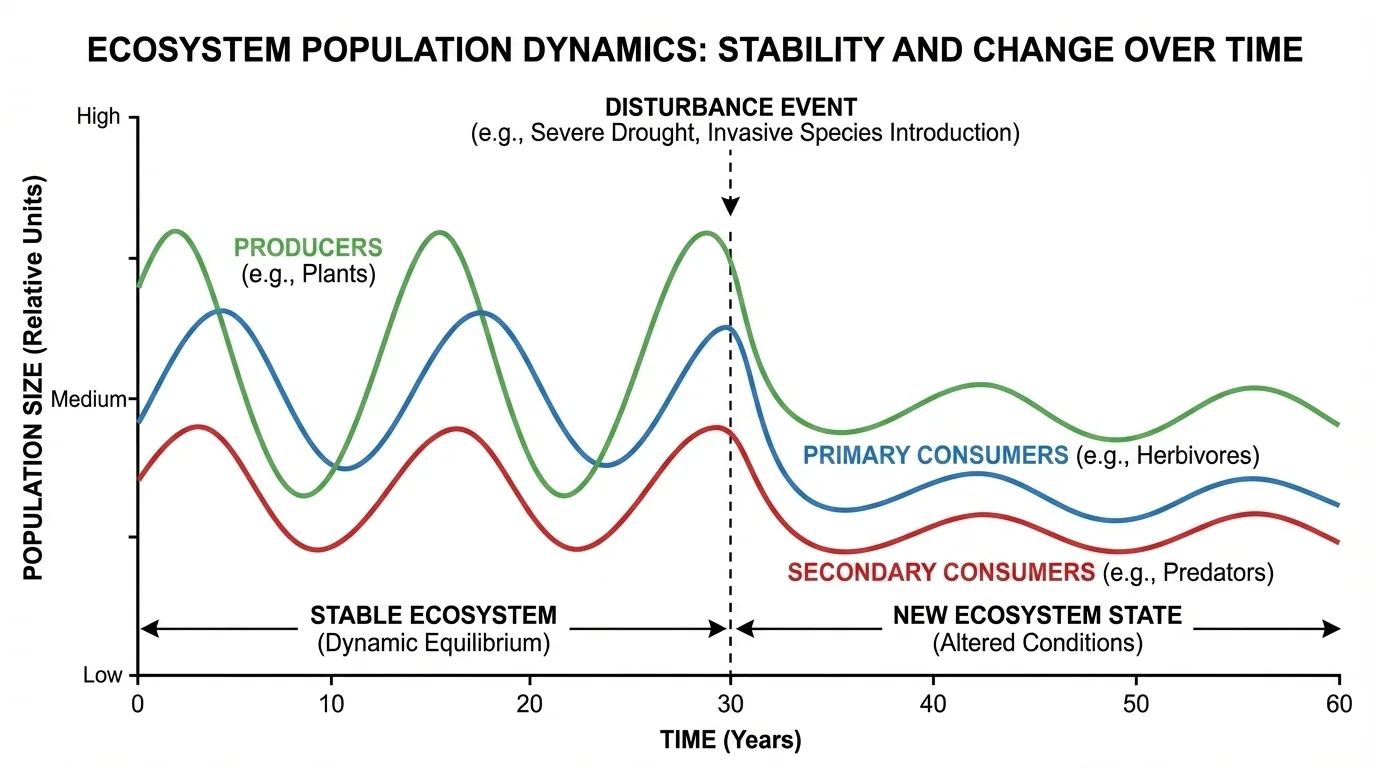
Graphs are especially useful because they help distinguish between short-term variation and long-term change. A one-year dip might not mean much by itself. A multi-year trend can be much more informative. If a wetland bird population drops briefly after a storm but returns to previous levels, that suggests resilience. If the population declines for many years after water diversion changes the wetland, that suggests a deeper ecosystem shift.
When interpreting graphs, scientists ask careful questions. Are multiple populations changing together? Does the timing of the change match a known disturbance? Is the trend temporary or persistent? Is there supporting evidence from abiotic data such as temperature, salinity, or rainfall? Strong evidence usually comes from patterns that fit together rather than from a single line on a graph.
Case study: evaluating a graph-based claim
Claim: "A pond ecosystem remained stable for five years, then changed into a different ecosystem after fertilizer runoff increased."
Step 1: Examine the evidence.
Suppose graph data show stable fish, insect, and aquatic plant populations for years 1 through 5. In year 6, algae increase rapidly, oxygen levels decline, fish populations fall, and some aquatic plants disappear.
Step 2: Identify the pattern.
The first five years show relatively consistent numbers and types of organisms. After runoff increases, several linked changes occur and continue over time rather than returning quickly to earlier levels.
Step 3: Evaluate the reasoning.
The reasoning is strong if it explains that fertilizer runoff changes nutrient levels, which changes primary production and water conditions, affecting many populations across the pond ecosystem.
This is stronger than saying only that "the pond looked greener," because it includes multiple connected lines of evidence and a scientific explanation.
Using trends from graphs is not about memorizing exact numbers. It is about seeing ecological patterns: persistence, fluctuation, decline, recovery, and replacement.
Ecosystems can remain relatively stable for long periods, but disturbances can disrupt that stability. Disturbances may be natural, such as wildfire, hurricanes, droughts, floods, and volcanic eruptions, or they may be caused by human activity, such as pollution, deforestation, overfishing, habitat fragmentation, and climate change.
[Figure 4] A disturbance can alter both living and nonliving parts of the ecosystem. A fire may remove vegetation, expose soil, change temperature near the ground, and alter water retention. A marine heat wave can stress corals, reduce reef structure, and change which fish species can survive there. A dam can change water flow, sediment movement, and oxygen levels, affecting entire river communities.
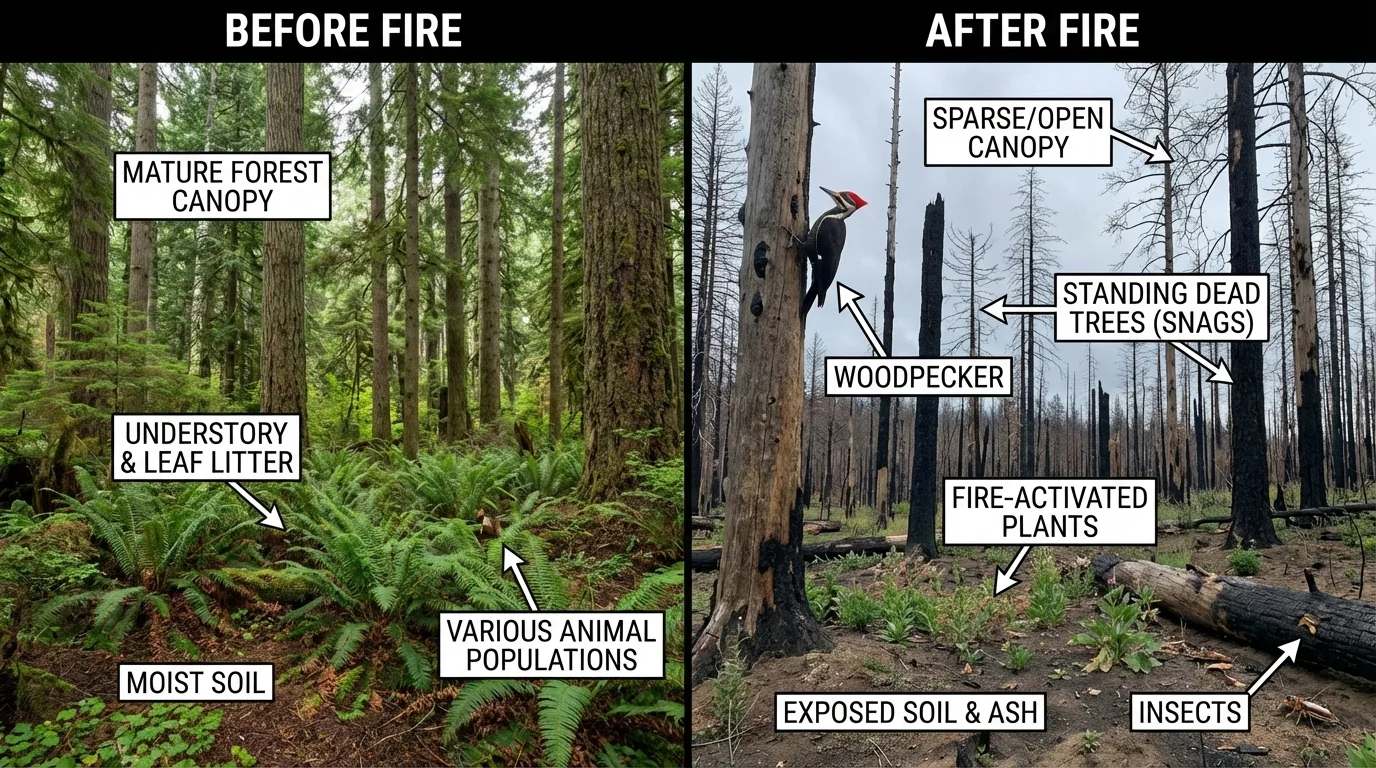
Not every disturbance creates a new ecosystem. Some disturbances are part of an ecosystem's normal pattern. Certain grasslands and pine forests experience periodic fire and still recover their characteristic organisms. Stability does not mean "never disturbed." It means the ecosystem can often absorb some disturbance and remain within its general form.
But if conditions change enough, or for long enough, the system may shift. A long drought can convert a wetland into dry grassland. Repeated coral bleaching can transform a coral-dominated reef into an algae-dominated one. Invasive species can change food webs, resource use, and habitat structure so strongly that native communities no longer dominate.
Population changes in ecosystems are not isolated events. A change in one factor can ripple across many levels of the system. Earlier study of limiting factors and interdependence helps explain why a change in water, temperature, or nutrients can affect entire communities.
Disturbance intensity, frequency, and duration all matter in determining whether an ecosystem recovers or shifts. A mild flood may have little long-term effect. Repeated severe floods may repeatedly reset the system. A short heat wave may be survivable; years of warming can reorganize the ecosystem. Scientists therefore evaluate not only whether a disturbance happened, but how much, how often, and for how long.
A new ecosystem forms when the numbers and types of organisms shift enough that the system's overall structure and function become different. The new system is not just the old one with fewer organisms. It has different dominant species, different interactions, and often different abiotic conditions as well.
Consider a shallow lake receiving increasing nutrient runoff over many years. At first, plants, fish, insects, and microorganisms may remain in relative balance. As nutrients continue increasing, algal blooms may become more frequent, water clarity may decrease, oxygen may drop, and fish communities may change. Eventually, the lake may no longer support the same plant and animal community. The ecosystem has shifted.
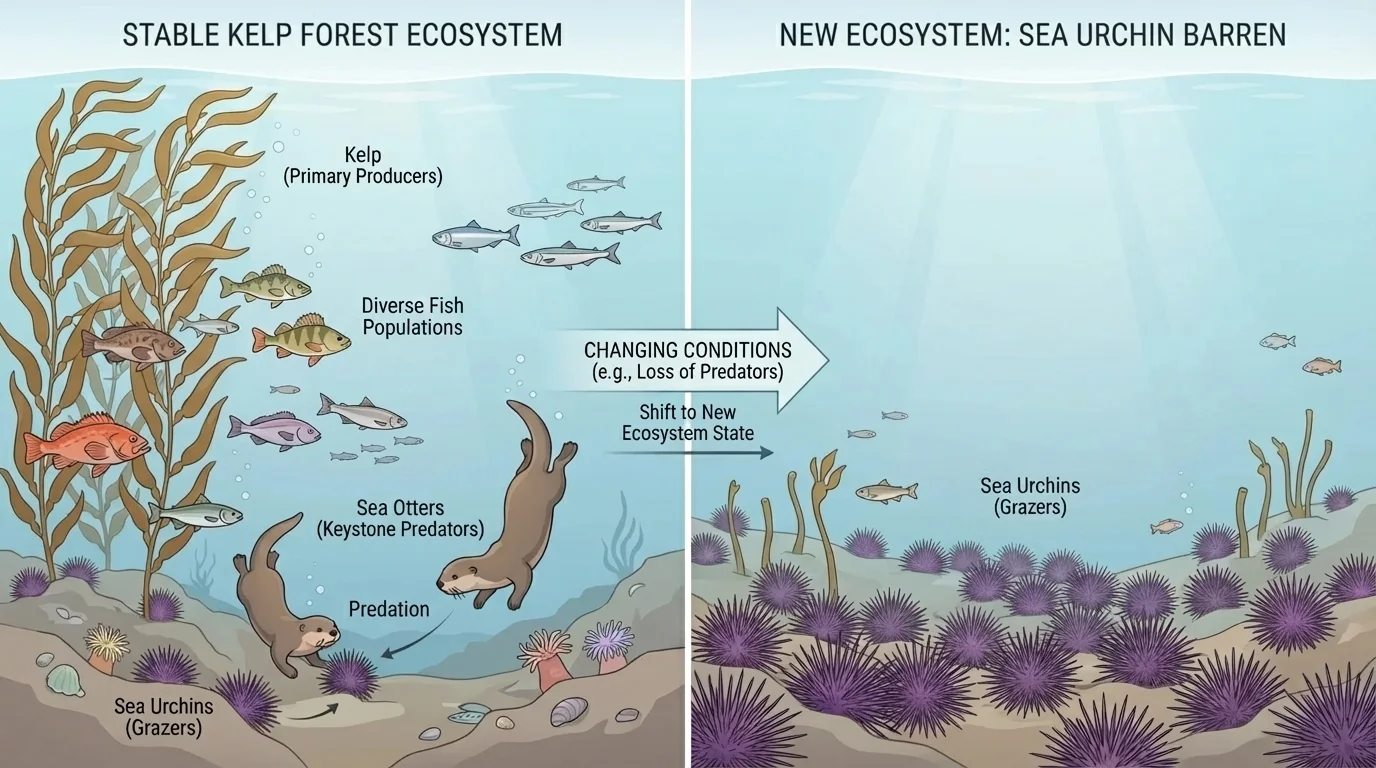
Another example comes from coastal systems. Kelp forests support fish, invertebrates, and many predators. If pressures such as warming, disease in predator populations, or overgrazing by sea urchins become intense enough, kelp may decline sharply. Once kelp disappears, the habitat changes. Many associated species also decline or leave. The result is an urchin-dominated barren with different numbers and types of organisms.
Resilience refers to how well an ecosystem can recover after disturbance and return to its earlier pattern. If resilience is high, recovery is more likely. If resilience is low, change may push the system past a threshold into a new state. Scientists often look for evidence of recovery versus persistence of a new pattern when deciding whether a true ecosystem shift has occurred.
Stable conditions do not guarantee permanence. An ecosystem may appear stable for decades because interactions among populations and abiotic factors keep change within limits. However, once conditions move outside those limits, the same interactions can produce a very different outcome. Stability and change are both products of interaction, not opposites that occur by accident.
This is why scientists are careful with the phrase "maintain relatively consistent numbers and types of organisms." The word relatively matters. Ecosystems are variable. What matters is whether the pattern remains within a recognizable range or shifts into a persistently different one.
A strong ecological claim is specific. "The forest changed" is too vague. "The forest remained stable after one storm because tree, bird, and insect populations returned to earlier ranges within three years" is much stronger. It identifies a time frame, multiple populations, and a measurable pattern.
Evidence is strongest when it includes several relevant observations. For ecosystem questions, that often means combining population trends with abiotic data. If a claim states that drought caused a grassland shift, strong evidence might include decreased rainfall, reduced plant cover, declines in herbivore populations, and later changes in predator numbers. The pattern should fit the claim.
Reasoning must clearly connect the evidence to ecological principles. For example, if rainfall decreases, plant productivity may decline because water is a limiting abiotic factor. Lower plant productivity reduces food for herbivores, which affects predators. That chain of explanation makes the claim scientifically coherent.
Weak reasoning often appears in two forms. The first is a data jump: making a large claim from limited evidence. If one species declines, that alone does not prove the whole ecosystem has changed. The second is a missing mechanism: listing data without explaining how the ecological system connects them. Good science asks for both pattern and explanation.
| Claim quality | What it looks like | Evaluation |
|---|---|---|
| Strong claim | Specific, measurable, tied to a time scale | Can be tested with data |
| Strong evidence | Multiple relevant observations, often over time | Supports or challenges the claim clearly |
| Strong reasoning | Uses ecological ideas to connect evidence and claim | Explains why the evidence matters |
| Weak explanation | Vague wording, too little data, or no ecological connection | Not reliable |
Table 1. Characteristics of strong and weak scientific explanations about ecosystems.
Notice that the best explanations usually consider both biotic and abiotic drivers. If a student explains only predator-prey relationships but ignores drought, pollution, or temperature change, the explanation may be incomplete. Ecosystems are complex systems, so good reasoning usually reflects that complexity.
Yellowstone National Park is often discussed as an example of interacting ecosystem drivers. When wolf populations were absent for many years, elk browsing pressure changed patterns of vegetation in some areas. After wolves returned, the system showed shifts in herbivore behavior and vegetation recovery in certain places. Scientists evaluate these changes carefully using long-term evidence, because no single species explains the whole ecosystem. Climate, stream flow, plant growth, and other animals also matter.
Case study: coral reef bleaching
Claim: "Repeated marine heat waves can shift a coral reef into a different ecosystem."
Step 1: Identify evidence.
Coral cover declines after repeated high-temperature events, algae increase, and fish communities change over multiple years.
Step 2: Check whether the change persists.
If coral does not recover and algae remain dominant, the reef is no longer functioning like the earlier coral-dominated system.
Step 3: Judge the reasoning.
The reasoning is strong if it explains that increased temperature is an abiotic driver that alters habitat structure and therefore changes the numbers and types of organisms supported by the reef.
This case shows how a changing abiotic condition can reshape a complex biological community.
Kelp forests provide another strong example. As we saw earlier in [Figure 4], a kelp-dominated system supports many organisms because kelp provides food and habitat. If kelp declines and does not recover, the entire community can shift. This is not merely a population dip. It is a reorganization of the ecosystem.
Freshwater lakes also demonstrate ecosystem transitions. Clear-water lakes with abundant submerged plants can change into murky, algae-dominated systems when nutrient input becomes too high. Long-term graphs of water clarity, plant abundance, fish populations, and oxygen levels help scientists decide whether the change is temporary or whether a new ecosystem state has formed.
Understanding ecosystem stability is not only an academic exercise. It affects agriculture, fisheries, forestry, drinking water, and conservation. If managers know which interactions help maintain stability, they can make better decisions. Protecting wetlands can reduce flood damage and preserve habitat. Managing nutrient runoff can help keep lakes from shifting into low-oxygen systems. Conserving predators can help maintain food web structure in some ecosystems.
Climate change makes this topic especially urgent. Rising temperatures, altered rainfall patterns, stronger storms, and ocean warming are changing abiotic conditions across the planet. Some ecosystems may remain relatively stable for a time, while others may cross thresholds into new states. Evaluating evidence carefully helps scientists predict risk and guide responses.
"Everything is connected to everything else."
— A core ecological principle
That principle is not just poetic. It is a scientific warning that ecosystem claims should never be evaluated in isolation. A convincing explanation looks at networks of interaction, recognizes the role of environmental conditions, and pays attention to patterns over time.
When you evaluate a claim about ecosystem stability, ask three questions. What exactly is being claimed? What evidence supports it, especially from trends over time? Why does the evidence make sense in terms of ecological interactions? Those questions lead to stronger science and a deeper understanding of how living systems persist, change, and sometimes become something new.
