A forest can look healthy for years and then change rapidly after one new road, one polluted stream, or one invasive species arrives. That is one of the most important ideas in environmental science: ecosystems are often stable until key interactions are disrupted. Because humans are now changing land, water, air, and climate at large scales, solving environmental problems is not just about "helping nature." It is about understanding systems deeply enough to design solutions that actually work.
Everyday human activities shape the environment. Driving cars releases gases such as \(\textrm{CO}_2\), using fertilizers can send excess nitrogen and phosphorus into waterways, and clearing land for buildings or farms can remove habitat that species need to survive. These actions do not affect only one organism at a time. They can alter food webs, water cycles, soil quality, temperature, and the availability of shelter and breeding sites.
When biodiversity declines, ecosystems usually become less resilient. Biodiversity includes variation in species, genes, and ecosystems. A system with many species often has overlapping roles: if one species declines, another may partly fill its function. When diversity is reduced, the whole system may become more vulnerable to disease, drought, invasive species, or extreme weather.
Environmental impact is any change to living systems or nonliving conditions caused by human activity.
Biodiversity is the variety of life at different levels, including genetic variation, species diversity, and ecosystem diversity.
Disturbance is an event or change that disrupts ecosystem structure or function, such as fire, flood, pollution, or habitat fragmentation.
Reducing these impacts requires more than good intentions. It requires careful design, evidence-based evaluation, and revision. A solution that works in one place may fail in another because ecosystems differ in climate, species, soil, water flow, and human land use.
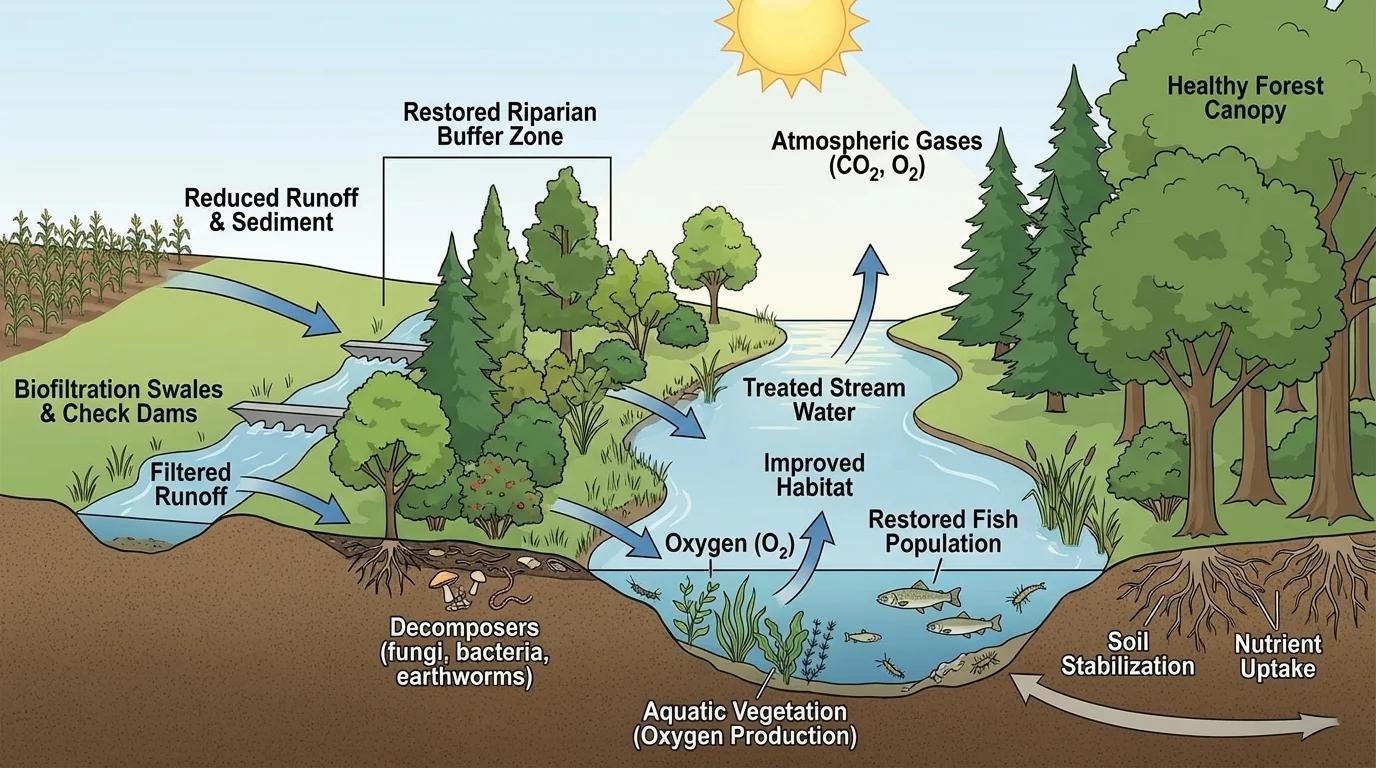
[Figure 1] An ecosystem is a network of interactions among organisms and their physical environment. In a stream, fish depend on insects for food, insects depend on algae or leaf litter, algae depend on light and nutrients, and all of them depend on water temperature, oxygen levels, and flow rate. Living and nonliving parts are linked so tightly that changing one factor can trigger many other changes.
Some ecosystems recover quickly from disturbance. Others recover slowly or may shift into a very different state. For example, if too many trees are removed from a watershed, soil erosion may increase, sediment may cloud streams, aquatic plants may receive less light, and fish populations may decline. If this continues long enough, the system may not return to its original form even if the cutting stops.
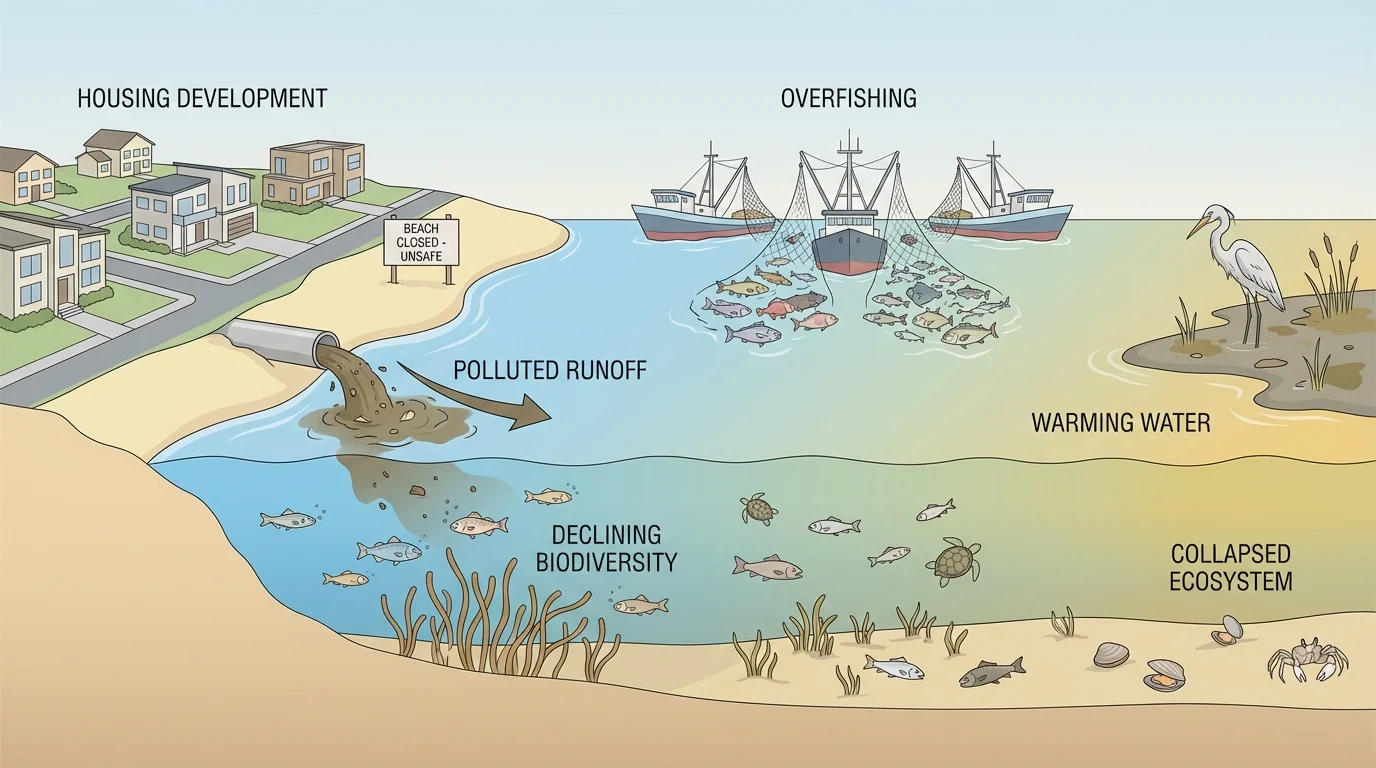
Resilience is an ecosystem's ability to absorb disturbance and still maintain basic structure and function. For example, a resilient grassland may recover after a fire. A damaged coral reef exposed to pollution, overfishing, and warming water may lose resilience and struggle to recover. The response depends on the complexity of interactions, the intensity of the disturbance, and how often it occurs.
Scientists also watch for tipping points. A tipping point is a threshold beyond which change accelerates or becomes difficult to reverse. Lakes, for instance, can shift from clear to algae-dominated when nutrient input becomes too high. Small increases in pollution may seem manageable at first, but once a threshold is crossed, oxygen levels can crash and many organisms may die.
Why interactions matter more than single causes
Environmental problems are rarely caused by just one factor. A species may decline not only because of habitat loss, but also because roads divide populations, pollutants weaken health, and climate change shifts breeding seasons. Effective solutions must account for these interacting causes rather than treating each issue in isolation.
This systems view is essential for designing solutions. If a plan reduces one problem but worsens another, it is not truly successful. For example, building a dam may produce low-carbon electricity but can also block fish migration, alter sediment transport, and change downstream habitats.
[Figure 2] Human disturbances often happen together, not separately. In one coastal region, a marsh may be drained for development, runoff may carry fertilizer and oil into the water, fishing pressure may reduce predator populations, and rising temperatures may stress species at the same time. This combined pressure can affect a single ecosystem in multiple connected ways.
Habitat loss and fragmentation are among the biggest threats to biodiversity. Habitat loss removes the places where organisms live. Fragmentation breaks large habitats into smaller isolated patches. Even if some habitat remains, species may have trouble finding food, mates, or migration routes.
Pollution includes chemicals, plastics, excess nutrients, noise, and thermal pollution. Fertilizer runoff can increase nitrogen and phosphorus in lakes, causing eutrophication. In that process, algae grow rapidly, and when they die, decomposers use oxygen while breaking them down. Dissolved oxygen may drop so far that fish cannot survive.
Climate change changes temperature, precipitation, sea level, and the frequency of extreme events. Some species shift their ranges toward cooler regions or higher elevations. Others cannot move fast enough, especially when habitats are fragmented.
Overexploitation happens when organisms are removed faster than populations can recover. Overfishing, excessive logging, and wildlife trade are examples. Invasive species can also transform ecosystems by outcompeting native organisms, spreading disease, or changing habitat conditions.
These impacts are especially serious because they can interact. A population stressed by pollution may be less able to survive a heat wave. A fragmented habitat may prevent species from moving in response to climate change. This is why environmental solutions must be designed as responses to complex systems, not simple lists of problems.
A strong solution is not just one that sounds helpful. It must meet specific criteria and stay within real-world constraints. Criteria are the standards used to judge success, such as reducing pollution, protecting species, or lowering costs. Constraints are limits such as budget, laws, available land, technology, and community acceptance.
Most environmental decisions involve trade-offs. A city might want to replace pavement with green spaces to reduce flooding and heat, but land is limited and construction costs matter. A farmer may want to reduce fertilizer runoff, but crop yield and food production must still remain high. The goal is rarely perfection. The goal is a solution that improves conditions significantly without creating larger problems elsewhere.
| Possible solution | Main benefit | Possible trade-off | Key evidence needed |
|---|---|---|---|
| Wetland restoration | Improves habitat and filters runoff | Requires land and long-term maintenance | Species return, water quality data |
| Wildlife crossing | Reduces roadkill and reconnects habitat | High construction cost | Animal movement, collision rates |
| Buffer strips on farms | Reduce sediment and nutrient runoff | Less land for crops | Nutrient levels, erosion rates |
| Plastic reduction policy | Lowers waste entering ecosystems | Behavior and industry changes needed | Waste volume, litter surveys |
Table 1. Examples of environmental solutions, their benefits, trade-offs, and evidence used to judge success.
Another important feature is scale. Some solutions work best at the local level, such as restoring a stream bank. Others need regional or global cooperation, such as reducing greenhouse gas emissions. Good design matches the scale of the solution to the scale of the problem.
Some restored wetlands remove pollutants so effectively that they act like living water-treatment systems while also providing habitat for birds, amphibians, and insects.
Because ecosystems are dynamic, solutions should also be flexible. Conditions can change over time, and what worked under one climate pattern or land-use pattern may need revision later.
[Figure 3] Environmental problem-solving often uses the same engineering design process applied in other fields. The process is iterative: identify the problem, research the system, propose possible solutions, test them, evaluate results, and refine the design. It is not a straight line from idea to success.
Step 1: Define the problem clearly. "Pollution is bad" is too vague. A better problem statement is: "A local pond has recurring algae blooms because stormwater runoff carries excess nutrients into the water, reducing dissolved oxygen and harming fish."
Step 2: Research the system. Students or scientists need to understand what organisms live there, where pollutants come from, how water moves, and what seasonal changes occur. Baseline data matter because improvement cannot be measured without knowing the starting condition.
Step 3: Generate possible solutions. For the pond, ideas might include rain gardens, improved storm drains, fertilizer restrictions, vegetated buffer zones, or educational campaigns for nearby residents.
Step 4: Select a design based on evidence, criteria, and constraints. A rain garden might be chosen because it is affordable, fits available space, and reduces runoff before water reaches the pond.
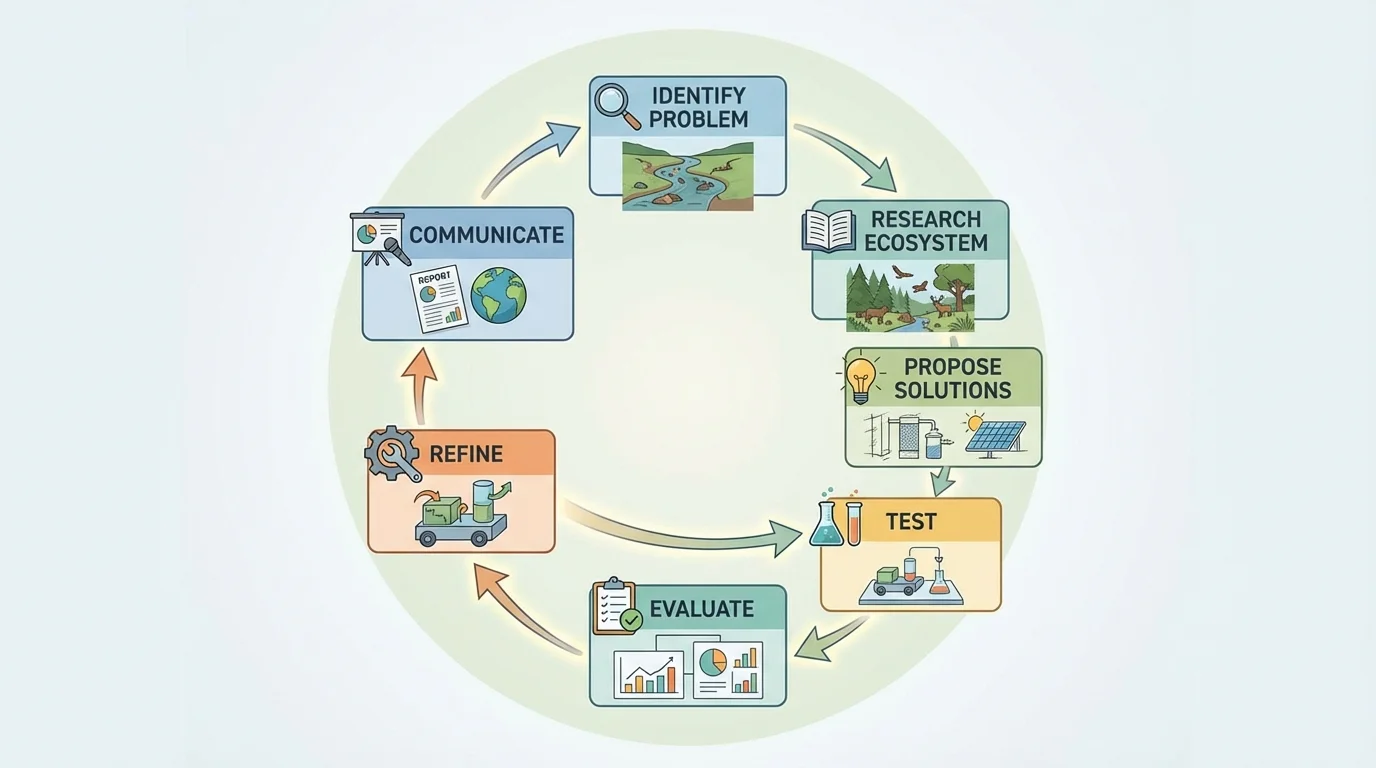
Step 5: Test and monitor. In environmental science, testing may involve pilot programs, small-scale trials, or computer models. A small rain garden can be installed first to see how much runoff it captures before the city builds many more.
Case study: Designing a runoff-reduction solution
A school parking lot sends stormwater into a nearby stream. The design team compares runoff before and after adding permeable pavement and a planted swale.
Step 1: Define a simple measure of success.
Suppose the runoff volume during a storm decreases from \(120 \textrm{ m}^3\) to \(72 \textrm{ m}^3\).
Step 2: Calculate the reduction.
The change is \(120 - 72 = 48 \textrm{ m}^3\).
Step 3: Find the percent reduction.
\[\textrm{Percent reduction} = \frac{48}{120} \times 100 = 40\%\]
A \(40\%\) reduction suggests the design is helping, but the team still needs more evidence, such as sediment levels, plant survival, maintenance cost, and stream health.
Notice that the calculation alone is not enough. A solution may reduce runoff but fail if maintenance is too expensive or if introduced plants are not suited to the site. Design always connects scientific evidence with practical decision-making.
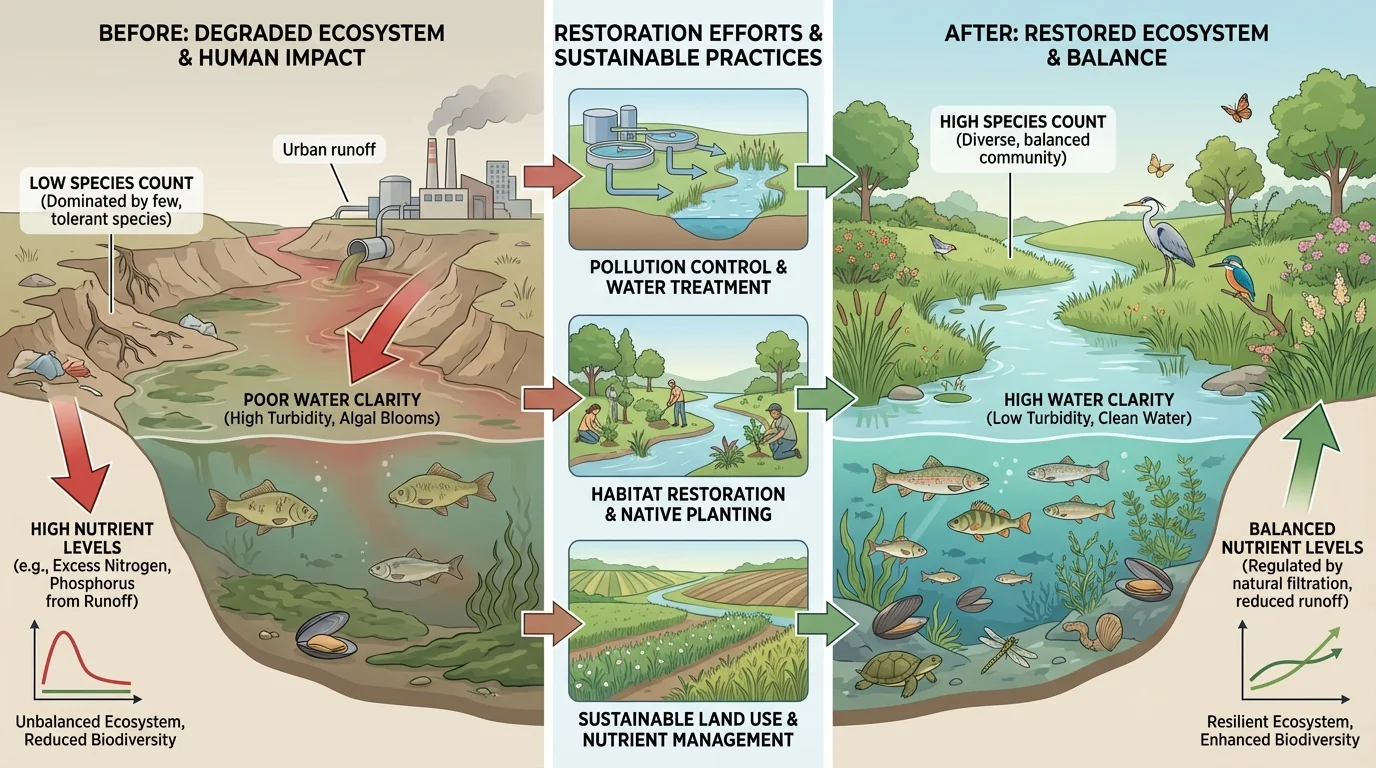
A solution is evaluated by comparing results with the original criteria. If the goal is to improve water quality, then students should measure variables related to water quality rather than relying on appearance alone. "Before" and "after" data can reveal whether a restoration project truly improves conditions.
Common environmental indicators include species richness, population size, dissolved oxygen, pH, turbidity, nutrient concentration, soil erosion rate, and area of intact habitat. If a restored stream has more insect species, clearer water, and lower nitrate levels, those are stronger signs of success than a single observation.
Sometimes a simple formula helps organize evidence. As [Figure 4] suggests, if a habitat patch grows from \(15 \textrm{ ha}\) to \(21 \textrm{ ha}\), the percent increase is
\[\textrm{Percent increase} = \frac{21 - 15}{15} \times 100 = 40\%\]
That \(40\%\) increase may improve breeding space or food availability, but the evaluation should still ask whether species are actually using the habitat.
Evaluation also requires attention to unintended consequences. For example, planting fast-growing trees might reduce erosion quickly, but if those trees are nonnative and spread aggressively, they could reduce native biodiversity. Likewise, replacing conventional lights with brighter LEDs may save energy but still disrupt nocturnal animals if lighting is not carefully directed.
Evidence must be reliable and long-term
Environmental conditions vary naturally from season to season and year to year. That means one measurement is rarely enough. Reliable evaluation uses repeated observations, fair comparisons, and enough time to distinguish real improvement from short-term fluctuation.
Scientists often compare treated sites with untreated sites called controls. If both places experience the same weather, but only the treated site improves, confidence in the solution increases. This is one reason environmental science combines field observation with careful experimental design.
Few environmental solutions work perfectly on the first attempt. Adaptive management is an approach in which decisions are adjusted as new evidence appears. This is especially useful in ecosystems because they are complex and can respond in unexpected ways.
Suppose a town installs nesting boxes to help a declining bird species. After a year, the boxes remain mostly empty. Evaluation may reveal that the boxes are in poor locations, face the wrong direction, or are vulnerable to predators. The solution is then refined by changing placement, design, or surrounding habitat conditions.
Refinement can also involve combining solutions. A river restoration project might begin with bank stabilization, then add native plants, then reduce upstream pollution sources after monitoring shows that bank work alone is not enough. Improvement comes through cycles of observation, redesign, and further testing.
Cause-and-effect relationships in biology are often multistep. A change in one abiotic factor, such as water temperature, can alter oxygen levels, species behavior, reproduction, and competition. Keep that chain of effects in mind when judging whether a solution addresses the actual cause of a problem.
This iterative approach is more realistic than expecting one permanent fix. Environmental systems change with climate, land use, population growth, and species movement, so long-term success depends on ongoing adjustment.
Wetland restoration: Wetlands act like sponges and filters. They slow floodwater, trap sediment, and absorb some pollutants. In many regions, restoring wetlands has improved bird habitat while lowering nutrient pollution in downstream water. As seen earlier in [Figure 4], success is judged through measurable changes such as species counts and nutrient levels, not just by whether the site looks greener.
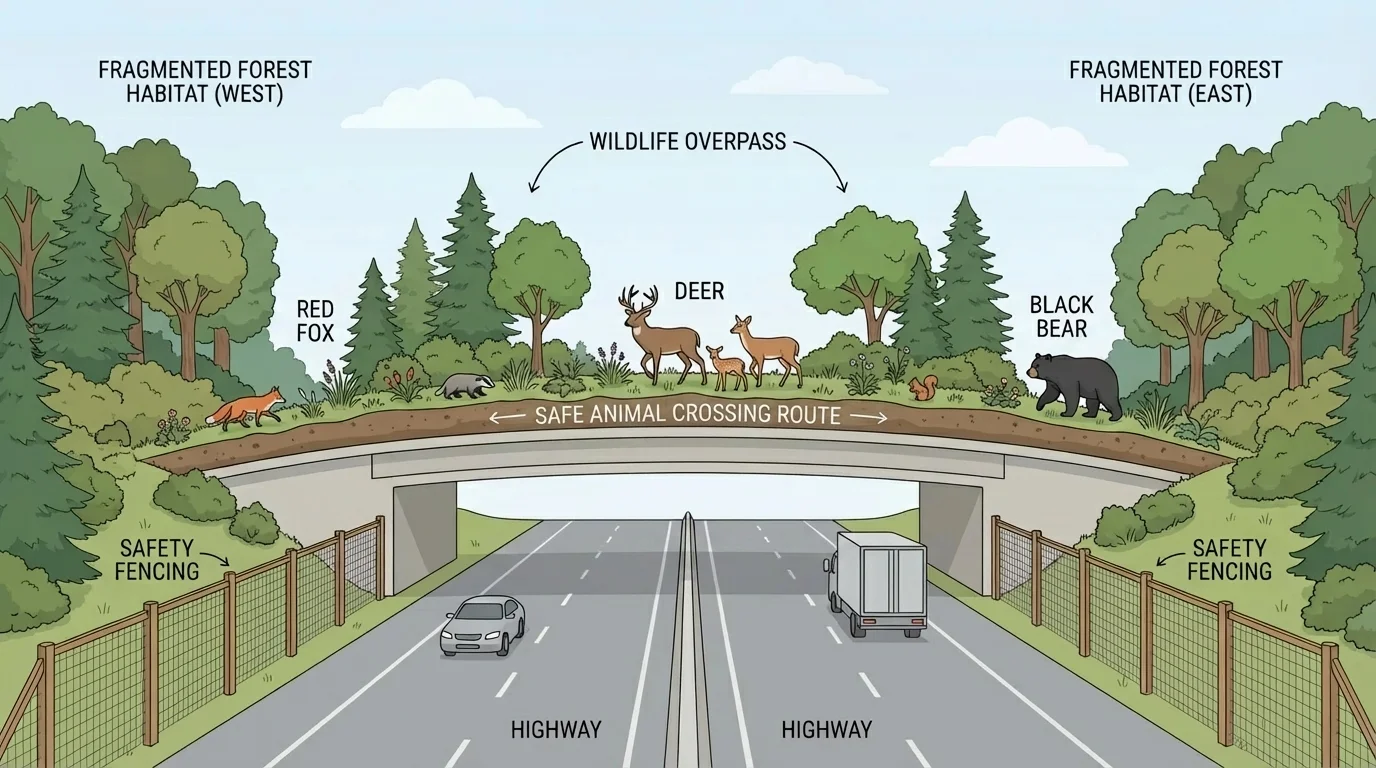
[Figure 5] Wildlife crossings: Roads divide habitats and increase animal deaths from collisions. Overpasses and underpasses allow animals to cross safely, reconnecting fragmented populations.
Wildlife crossings: Roads divide habitats and increase animal deaths from collisions. In the habitat-fragmentation problem introduced earlier, a wildlife overpass can link two forest patches separated by a highway. When these structures are placed in the right locations and combined with fencing, collisions often decrease and movement between habitats increases.
Sustainable agriculture: Farmers can reduce environmental impacts with cover crops, contour planting, drip irrigation, reduced tillage, and buffer strips near streams. These practices can decrease erosion and runoff while maintaining productivity. The best design depends on local soil, rainfall, and crop type.
Plastic reduction strategies: Communities reduce plastic pollution through bans on certain single-use items, refill systems, better waste collection, and public education. The effectiveness of these solutions is measured by changes in litter counts, recycling rates, and the amount of plastic reaching rivers or coastlines.
Urban biodiversity design: Cities can support life by planting native vegetation, creating pollinator corridors, protecting tree canopy, reducing nighttime light pollution, and replacing some hard surfaces with green infrastructure. These solutions help insects, birds, and even human residents by reducing heat and improving air quality.
Case study: Evaluating a wildlife crossing
A region recorded \(250\) deer-vehicle collisions per year before building a wildlife overpass and fencing. After construction, collisions fell to \(90\) per year.
Step 1: Find the decrease.
The reduction is \(250 - 90 = 160\) collisions per year.
Step 2: Calculate percent reduction.
\[\textrm{Percent reduction} = \frac{160}{250} \times 100 = 64\%\]
Step 3: Interpret the result.
A \(64\%\) drop is strong evidence that the crossing helps, but researchers should also monitor animal movement, breeding success, and whether multiple species use the structure.
These examples show that the same design logic applies across many contexts: define the problem, understand the system, test evidence-based solutions, and refine them as conditions change.
Environmental decisions are also social decisions. A factory's pollution may affect nearby neighborhoods more than distant communities. A flood-control project may protect one area while moving risk elsewhere. For this reason, solution design should include the people most affected by the problem.
Environmental justice focuses on fair treatment and meaningful involvement of all people in environmental decision-making. Communities differ in income, infrastructure, political influence, and exposure to risk. A technically effective solution is incomplete if it ignores who benefits, who pays, and who carries the remaining burden.
Students can contribute by collecting local data, participating in restoration projects, reducing resource use, and communicating evidence clearly. But individual action matters most when linked to larger systems, such as school policies, city planning, and regional conservation efforts.
"What we call the environment is everything that isn't us."
— Often attributed to Albert Einstein, but the source is uncertain
That idea is powerful partly because it is misleading. Humans are not separate from ecosystems. We are part of them. Designing better environmental solutions means recognizing that human survival, economic systems, and biodiversity are interconnected. When a solution protects soil, water, climate stability, and habitat, it is not only helping other species. It is protecting the systems that make human life possible.
