A single penguin standing alone in Antarctic cold can lose heat rapidly, but thousands packed together can survive blizzards that would be deadly to one bird by itself. That contrast captures a major idea in biology: sometimes what an organism does with others changes its chances of staying alive and leaving offspring. To evaluate that idea scientifically, we need more than a general statement that "groups help." We need evidence, careful comparisons, and clear reasoning.
Behavior is one of the ways organisms interact with their environment. Some behaviors are carried out by one organism acting alone, while others depend on communication, coordination, or cooperation among many members of the same species. When biologists study group behavior, they ask questions such as: Does it reduce the risk of predation? Does it help organisms find food? Does it protect young? Does it improve chances of mating? The strongest conclusions come from observations and data that connect behavior to survival and reproduction.
Behavior is an organism's response to internal or external stimuli. Individual behavior is carried out by one organism acting on its own, such as a lone tiger stalking prey. Group behavior involves interactions among members of the same species, such as a wolf pack hunting together or a bee colony defending the hive.
Understanding this topic requires paying attention to outcomes. A behavior matters in evolution if it changes the likelihood that an individual survives long enough to reproduce, or if it affects how many offspring survive and reproduce later. A useful way to think about this is that survival and reproduction are connected: an organism that survives longer may have more opportunities to mate, and offspring that receive better protection are more likely to reach adulthood.
Behavior is not the same thing as body structure, but the two often work together. A gazelle's speed is a physical trait, while running in a herd and responding to alarm signals is behavior. The trait may help the animal escape, but the behavior can improve the odds even more by increasing awareness of danger and confusing predators. In biology, this matters because natural selection acts on differences in success. If a behavior consistently helps organisms survive and reproduce, that behavior is more likely to persist in the population.
Scientists often evaluate behavioral evidence by comparing outcomes. For example, they may compare attack success on isolated prey versus prey in a herd, or compare chick survival in solitary nests versus colonies. The central question is not simply whether a behavior exists, but whether there is evidence that it changes biological success.
From earlier studies of ecology and evolution, recall that organisms interact with both biotic factors, such as predators and competitors, and abiotic factors, such as temperature and wind. Group behavior often helps organisms deal with both kinds of challenges.
When evaluating evidence, it is also important to avoid overclaiming. Not every group is beneficial in every situation. Some group behaviors improve survival but create competition for food. Others improve reproduction but increase disease spread. A careful biological argument weighs evidence for both advantages and disadvantages.
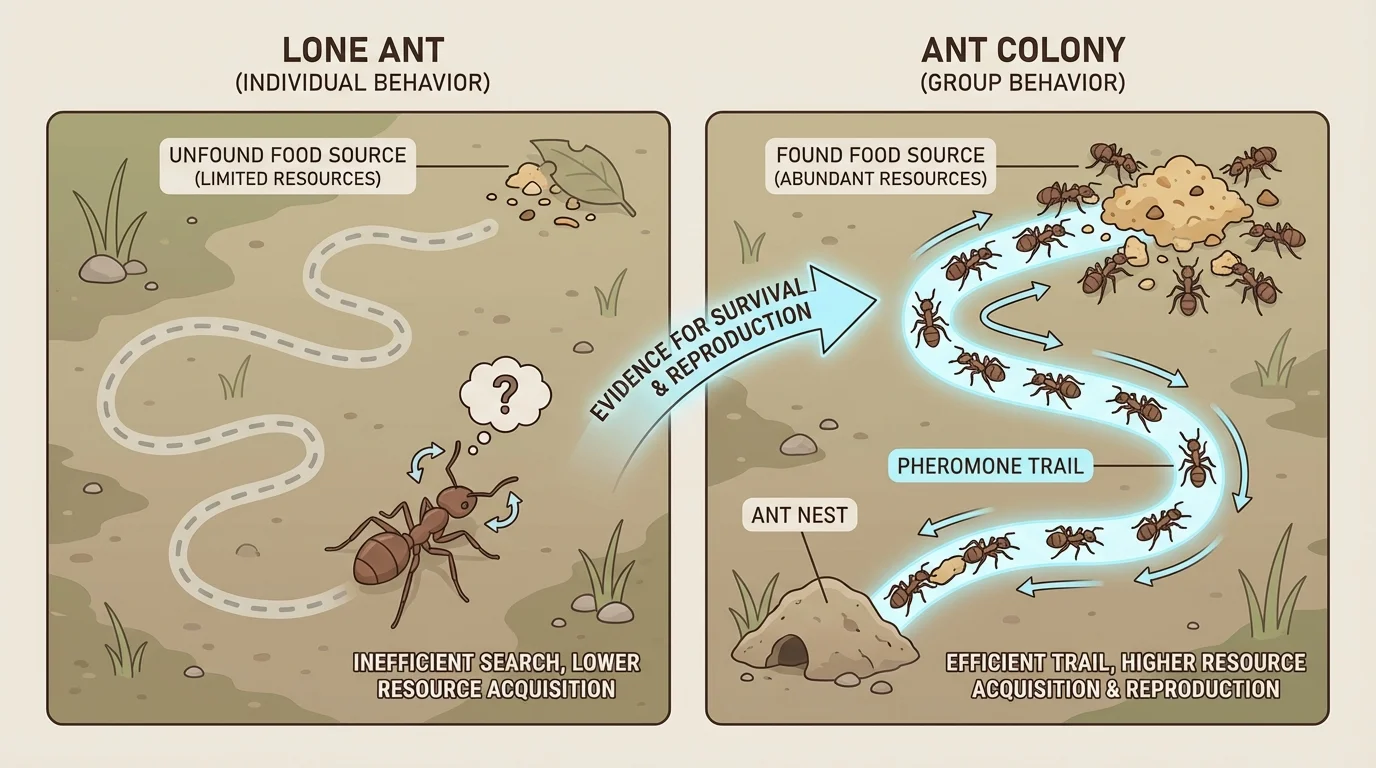
Group behavior occurs when the actions of one organism depend on, influence, or coordinate with the actions of others in the same species. The contrast between solo and coordinated action, as shown in [Figure 1], helps identify whether a behavior is truly social. A lone animal searching, hiding, feeding, or migrating by itself is showing individual behavior. A set of organisms moving, signaling, defending, or caring for young together is showing group behavior.
For example, one ant wandering randomly in search of food is acting individually. A line of ants following a chemical trail to food is acting as a group. In that case, each ant's movement is influenced by signals left by others. The behavior is coordinated, and the group can gather food more efficiently than isolated individuals.
Another example is hunting. A single lioness can hunt alone, so that is individual behavior. When several lions surround prey and attack in coordinated roles, that is group behavior. The difference is not just the number of animals present. The difference is that the behavior involves interaction and coordination.
Biologists use evidence to distinguish these categories. Signs of group behavior include communication signals, role division, synchronized movement, and measurable changes in outcomes when individuals act together. Later, when we evaluate examples, this distinction remains essential: if no interaction among organisms is involved, the behavior should not be classified as group behavior.
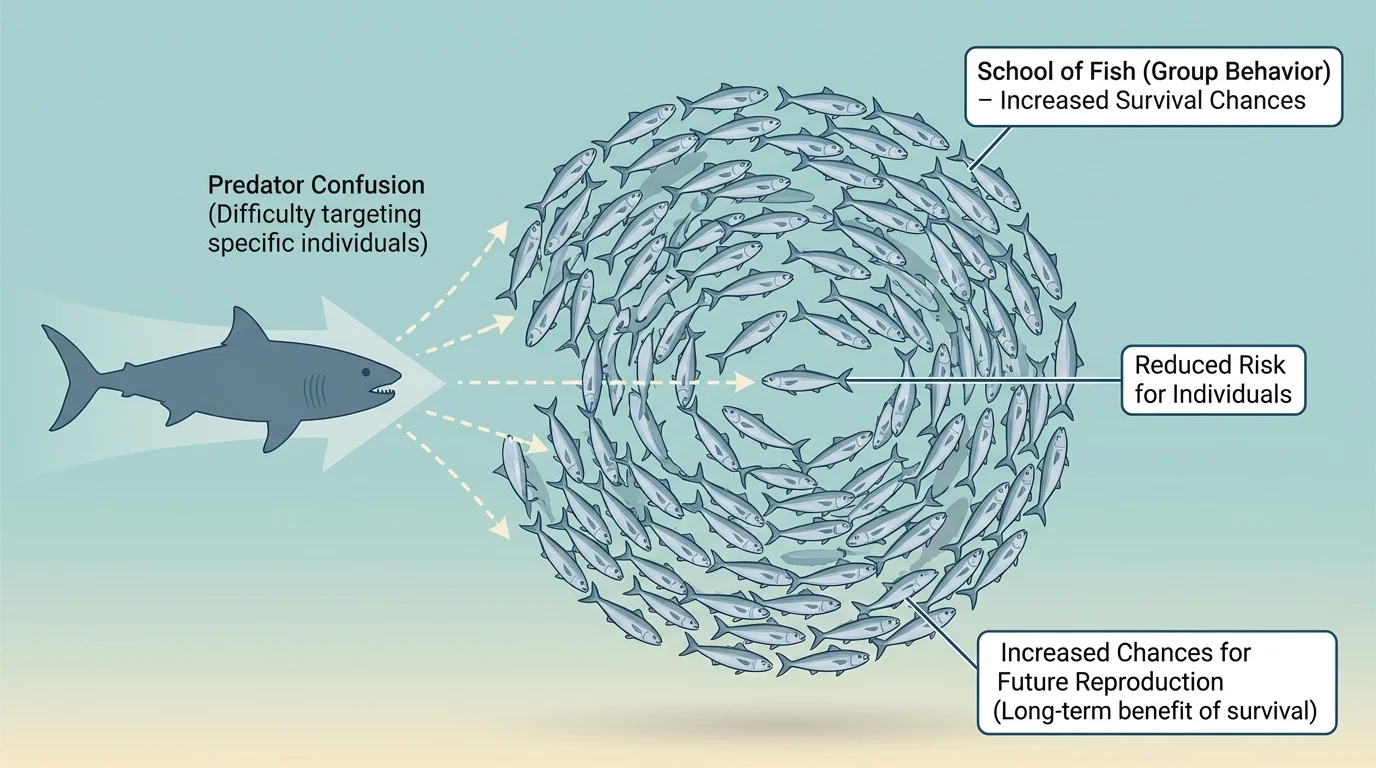
Many forms of coordination improve survival by reducing the risk of predation. As [Figure 2] illustrates, fish in schools often move as one shifting body rather than as separate individuals. This can make it harder for a predator to focus on one target. It may also lower the chance that any one individual is captured because the predator faces many moving animals at once.
This benefit is supported by evidence from field observations and experiments. Predators often succeed more often when prey are isolated than when they are in a tightly organized group. Three important ideas help explain this. First, the dilution effect means that in a large group, the risk to any one individual may be reduced because the predator can capture only a small fraction of the group. Second, the vigilance effect means that more eyes and ears can detect danger sooner. Third, the confusion effect means coordinated motion can overwhelm a predator's ability to track a single prey item.
Herding mammals such as zebras and wildebeest provide strong examples. Individuals at the edges may face higher risk, but the group as a whole benefits from earlier predator detection and more confusion during attack. Birds in flocks also gain protection, especially when rapid turning and synchronized flight make capture difficult.
Group behavior can also improve survival through defense. Musk oxen form defensive circles with calves in the center. Meerkats post sentinels that watch for danger while others forage. Honeybees defend the hive collectively. In each case, evidence comes from the fact that individuals are safer because the group shares the cost of detection or defense. A lone meerkat must stop feeding to scan for danger, but with a sentinel system, some can feed while another watches.
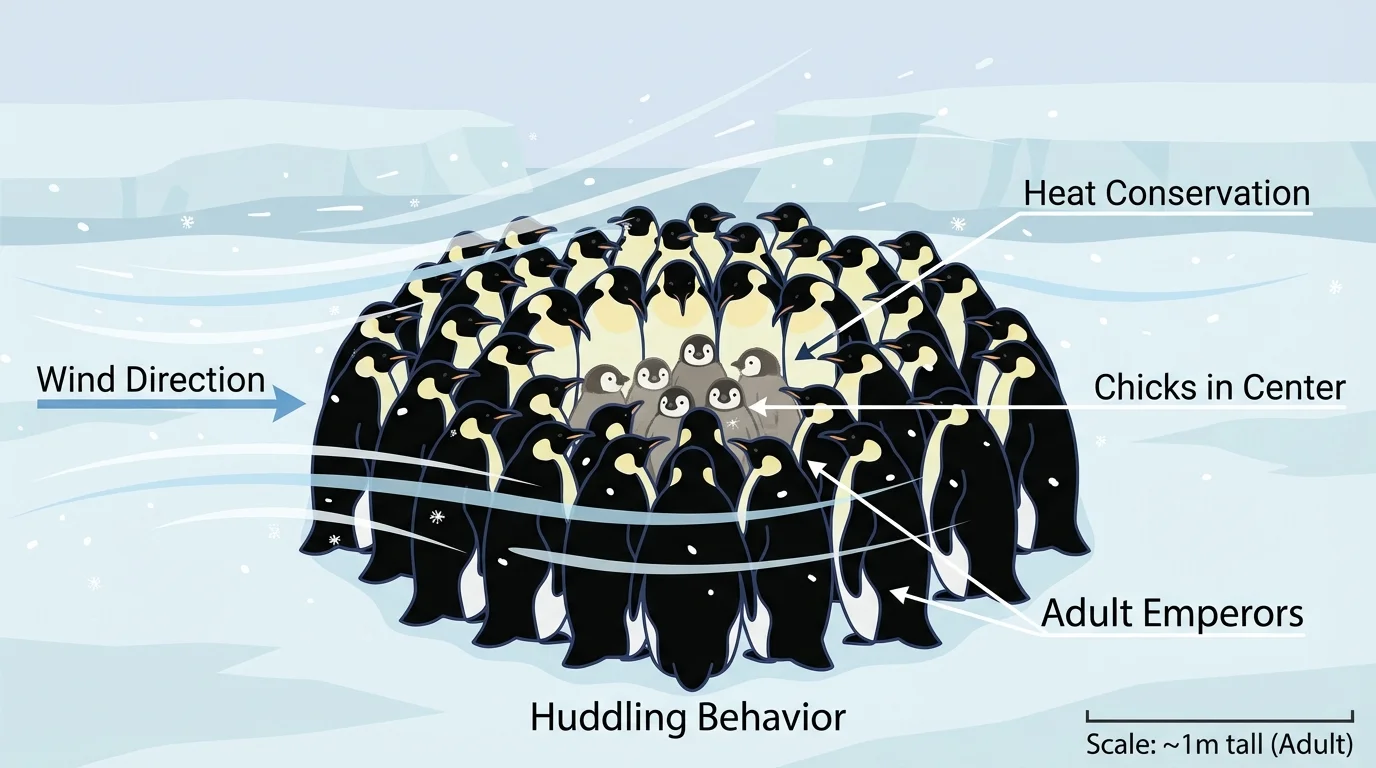
Thermoregulation is another survival benefit. Emperor penguins huddle to reduce heat loss in one of the harshest climates on Earth. By crowding together and rotating positions, they decrease exposure to wind and cold. A penguin alone would lose energy more quickly and face a greater risk of death. Group behavior, in this case, helps individuals endure an abiotic challenge rather than a predator.
Some honeybees can raise the temperature around an invading hornet by swarming it and vibrating their bodies. The attackers may die from overheating, while the bees survive because their heat tolerance is slightly higher.
Evidence for survival benefits does not need to be complicated. If researchers observe that individuals in groups are attacked less often, survive severe weather more often, or spend more time feeding because others help watch for danger, that evidence supports the claim that group behavior increases survival.
Survival alone is not enough in biology; the ultimate measure of success includes producing offspring that also survive. Social interactions affect reproductive success in many species, and [Figure 3] connects this idea to one of the clearest examples: when adults cluster and protect young together, more offspring may survive to maturity.
One way group behavior improves reproduction is by helping organisms attract mates. In some bird species, males gather in display areas called leks, where females compare several males in one place. This is group behavior because the display depends on multiple individuals being present together, even though the males compete. The group setting increases the chance that females will encounter potential mates and choose among them efficiently.
Another major example is cooperative care of young. Wolves live and hunt in packs, and pack members may help feed and protect pups. In some bird species, older siblings or additional adults help bring food to nestlings. In social insects such as ants, bees, and termites, many individuals perform specialized roles that support reproduction of the colony. Workers may not reproduce directly, but their actions help related offspring survive.
Colonial nesting also provides evidence for reproductive benefits. Seabirds that nest in large colonies can reduce the chances that predators will take eggs or chicks from every nest. A predator may capture a few young, but many offspring survive because there are too many nests to attack effectively. This is another example of the dilution effect, now applied to offspring survival.
The penguin example remains useful here. As seen earlier in harsh-weather survival, the huddle also protects eggs and chicks from freezing conditions. In that way, the same group behavior can support both adult survival and offspring survival. This is important because biological success often depends not just on producing offspring, but on keeping them alive long enough to develop.
To evaluate evidence, scientists look for observations that connect behavior to outcomes. Consider wolves. A single wolf may struggle to capture large prey such as elk, but a pack can surround, chase, and exhaust an animal much larger than any one wolf. If pack hunting leads to more successful kills, then group behavior increases food intake, which can support adult survival and pup growth. That is evidence-based reasoning.
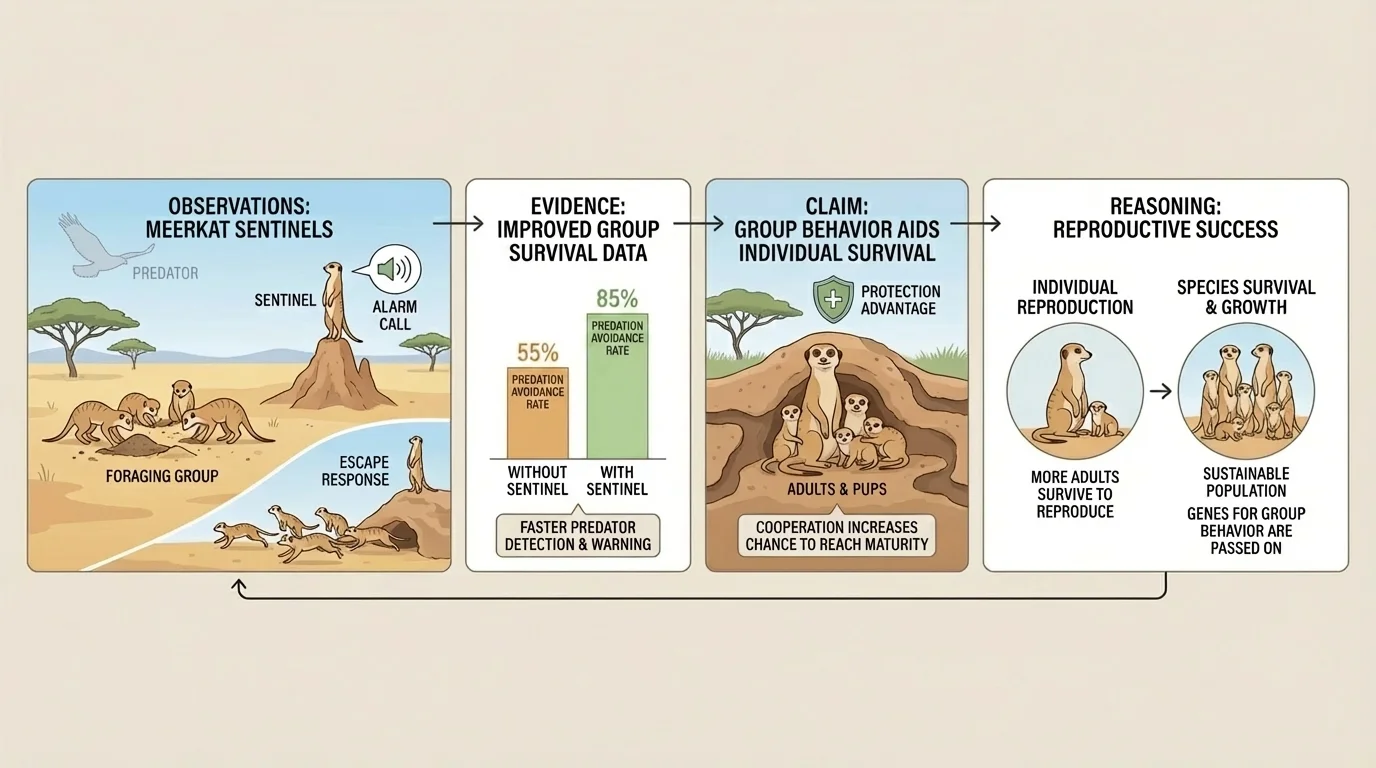
Meerkats provide another strong case. Researchers have observed sentinel behavior, in which one or more individuals watch for predators and give alarm calls. The evidence is not just that calls occur; it is that foraging individuals respond quickly, spend less time scanning, and can escape more effectively after warnings. This supports the argument that sentinel behavior improves survival chances for members of the group.
Case study: evaluating a fish school
Suppose researchers observe two situations in the same habitat: isolated fish and fish in schools.
Step 1: Record the observation
Predators attack isolated fish more successfully than tightly grouped fish.
Step 2: Identify the evidence
The evidence is the difference in capture rate between solitary and grouped fish.
Step 3: Make a claim
Schooling behavior improves survival chances for individual fish.
Step 4: Add reasoning
Because fish in a school move together, predators have a harder time targeting one fish, and each individual is less likely to be caught.
This argument is logical because it connects the observed pattern directly to a survival outcome.
Social insects also offer excellent evidence. In honeybee colonies, workers collect food, regulate hive temperature, and defend the hive. The colony survives because tasks are shared. Even though not every bee reproduces, the group behavior supports the survival and reproduction of the colony's genetic line through the queen and developing young.
When looking at these examples, it helps to ask three questions. What is the behavior? What is the evidence for its outcome? What conclusion is reasonable based on that evidence? Those questions keep biological arguments focused and grounded.
Group living is not automatically beneficial. If it were, every species would live in large social groups. Instead, evidence shows trade-offs. Organisms in groups may compete more intensely for food, water, space, or mates. Diseases and parasites can also spread more easily when many individuals live close together. These costs help explain why group behavior evolves in some situations but not others.
For example, a bird colony may protect eggs from predators, but if food near the colony becomes scarce, parents may need to travel farther to feed chicks. A herd may detect predators quickly, but it may also attract attention because a large moving group is easy to spot. A wolf pack may capture large prey, but the food must be shared among many members.
These trade-offs matter when evaluating evidence. If a behavior increases survival in one context but reduces it in another, the best argument is not absolute. Instead, the conclusion should match the evidence: group behavior is beneficial under certain environmental conditions or for certain life stages.
| Behavior | Possible benefit | Possible cost |
|---|---|---|
| Schooling in fish | Reduced predation risk | Competition for food |
| Colonial nesting in birds | Protection of eggs and chicks | Faster disease spread |
| Pack hunting in wolves | Capture of larger prey | Food must be shared |
| Huddling in penguins | Reduced heat loss | Crowding and limited movement |
Table 1. Examples of common benefits and costs associated with group behavior.
The key point is not that group behavior is always good. The key point is that scientists evaluate whether the evidence shows a net advantage for survival or reproduction in a particular situation.
Scientific arguments are strongest when they move clearly from observation to conclusion. The structure in [Figure 4] shows this process: identify the behavior, state the evidence, make a claim, and explain the reasoning that links the evidence to the claim. This helps keep arguments logical rather than based on opinion.
A good argument might sound like this: "Meerkat sentinel behavior increases group survival because observers give alarm calls, and group members respond by reaching shelter more quickly." Notice that the argument includes the behavior, the evidence, and the biological outcome.
A weaker argument would say only, "Meerkats live in groups, so groups are helpful." That statement is too broad and lacks specific evidence. In science, broad claims need support. Observations, comparisons, and patterns make the argument stronger.
This approach also helps distinguish group from individual behavior. If one animal survives because it is fast, that may be true, but it is not evidence for group behavior. To support a claim about group behavior, the evidence must involve interactions among members of the same species and show a measurable outcome connected to survival or reproduction.
Later, when evaluating examples such as the fish school in [Figure 2] or penguin huddles in [Figure 3], the same logic applies. The figure is not the argument by itself. The argument comes from connecting the observed interaction to a biological effect using evidence.
Claim, evidence, and reasoning form a useful framework for biological explanation. A claim answers the question, the evidence provides observations or data, and the reasoning explains why that evidence supports the claim using biological ideas such as predation, cooperation, or offspring protection.
Being precise matters. If the evidence shows that grouped prey are caught less often, then the claim should be about reduced predation risk. If the evidence shows that more chicks survive in colonies, then the claim should be about improved reproductive success. The conclusion should match the evidence exactly.
Group behavior is not just an interesting feature of wild animals. It matters in conservation biology, wildlife management, and even agriculture. If a species depends on migration in groups, nesting colonies, or social cooperation, then habitat fragmentation can do more than reduce population size. It can break the social structure needed for survival and reproduction.
For example, if breeding colonies are disturbed, fewer offspring may survive even when adult animals remain present. If herd routes are blocked, individuals may become isolated and more vulnerable to predators. Understanding group behavior helps scientists design conservation strategies that protect not just organisms, but also the interactions those organisms rely on.
"In biology, survival is rarely just about strength; it is often about connection."
Humans also depend on group behavior, although in far more complex cultural ways. Teamwork, communication, and shared defense are familiar in human societies. While human behavior includes social rules, learning, and technology that go far beyond most other species, the basic idea is similar: cooperation can change the outcome for individuals and the group.
When biologists evaluate group behavior, they stay focused on evidence. Does the group reduce danger? Improve feeding? Protect offspring? Increase access to mates? Those are the questions that turn an observation into a scientific explanation.
