A single human cell contains a molecular instruction system so compact that if you stretched the DNA from one cell end to end, it would be about 2 meters long. Yet that same DNA helps explain why a student may have a parent's hair texture, a grandparent's dimples, or a family tendency toward a certain blood type. One of the most important questions in biology is not just what traits are inherited, but how the instructions for those traits are stored, organized, and passed on.
When biologists study heredity, they ask clarifying questions such as: How is the information for a trait stored? Where is that information found in a cell? How do parents pass different versions of that information to offspring? Why do brothers and sisters resemble each other but still differ in many ways? Answering those questions requires understanding the relationship between DNA, genes, chromosomes, proteins, and traits.
Living things produce offspring that inherit biological information from previous generations. This is why puppies resemble dogs, oak seedlings resemble oak trees, and human children usually share many features with their parents. The passing of characteristics from parents to offspring is called heredity.
Inherited traits do not appear randomly. Parents pass along genetic information in reproductive cells, and offspring receive a combination of that information. The resulting organism is similar to its parents because it carries instructions from both of them. At the same time, offspring are not exact copies because the combinations of inherited information differ.
Cells are the basic units of life, and most cells contain a nucleus. The nucleus stores much of the cell's genetic material. Understanding that location helps connect visible traits to invisible molecular instructions.
When you notice family resemblances, such as similar eye color, attached or detached earlobes, or widow's peak patterns, you are seeing evidence that traits depend partly on inherited information. Still, inheritance is not as simple as copying one parent. Many traits are influenced by information from both parents, and many are also shaped by environmental conditions.
[Figure 1] The main molecule that stores inherited information is DNA, short for deoxyribonucleic acid. In organisms such as humans, DNA is found mainly in the nucleus. The relationship among DNA, genes, and chromosomes is easiest to understand as levels of organization: chromosomes are made of DNA, and genes are specific segments of DNA that contain instructions.
A chromosome is a tightly coiled package of DNA and associated proteins. Coiling matters because DNA molecules are extremely long, and cells need a compact way to organize and manage them. Humans usually have 46 chromosomes in most body cells, arranged in 23 pairs. One chromosome of each pair comes from the mother, and the other comes from the father.
A gene is a section of DNA that carries instructions for making a product, usually a protein. You can think of a chromosome as a very long book, DNA as the language it is written in, and a gene as one specific recipe or instruction set within that book. Different genes affect different characteristics.
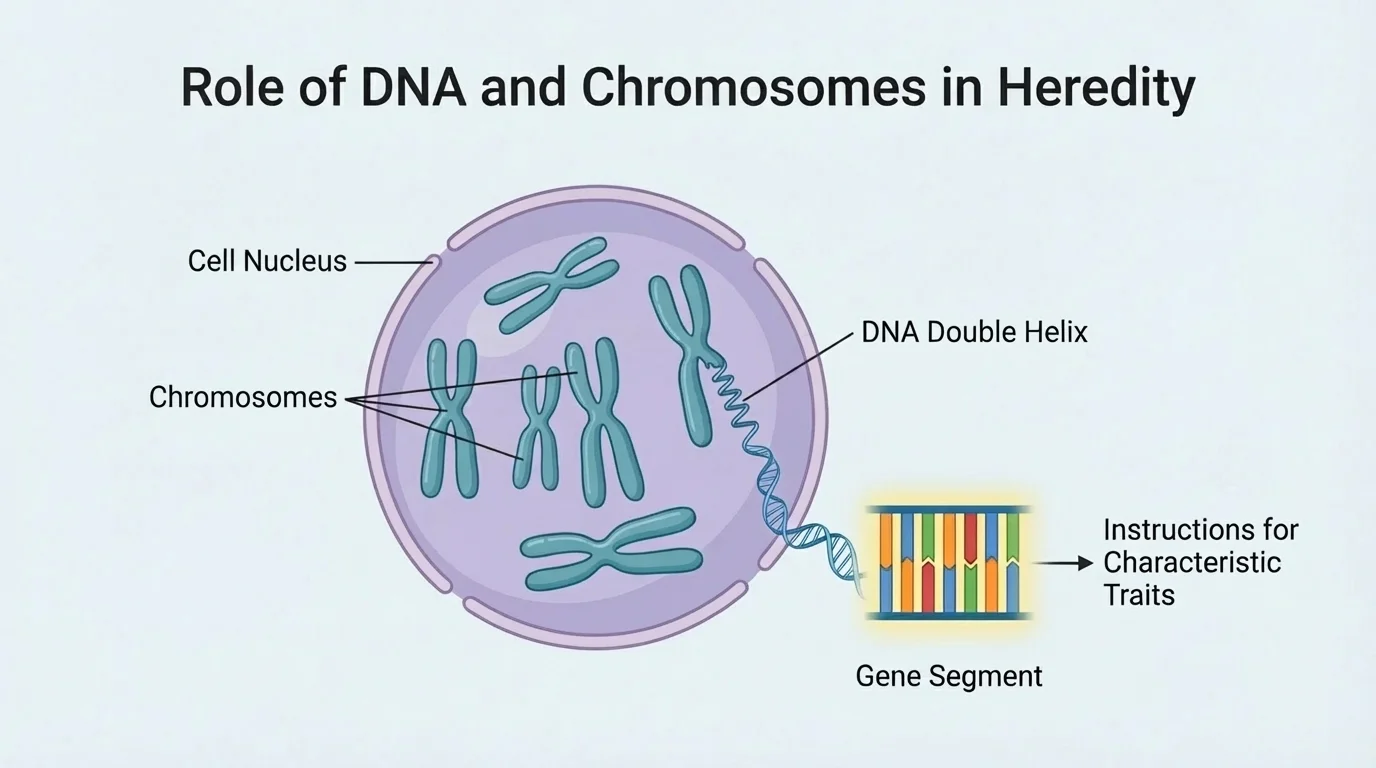
DNA itself has a specific structure. It is often described as a double helix, like a twisted ladder. The sequence of its chemical building blocks acts as information. Just as changing letters in a sentence can change meaning, changing the DNA sequence in a gene can change the instructions that gene provides.
DNA is the molecule that stores hereditary information in living things.
Chromosomes are organized packages of DNA found in cells.
Genes are segments of DNA that contain instructions, often for making proteins.
Trait means an observable characteristic of an organism, such as flower color, blood type, or hair texture.
Not every stretch of DNA is a gene, but genes are among the most important parts because they contain coded instructions. This is why biologists often ask a clarifying question such as: If a trait runs in a family, which gene or genes are involved, and on which chromosome are they located? Questions like this connect a visible characteristic to a physical location in the genetic material.
[Figure 2] A trait does not usually come directly from DNA alone. Instead, the pathway from gene to trait can be followed through the products of genes. Genes provide instructions for making molecules, especially proteins, and those proteins help build structures and control processes in cells.
Proteins do many jobs. Some form structures, such as parts of hair or skin. Some act as enzymes that speed up chemical reactions. Others help cells send signals, move materials, or produce pigments. Because proteins influence how cells work, genes influence traits by affecting which proteins are made, how much is made, or what form the protein has.
For example, consider a gene involved in pigment production. If that gene provides instructions for a working protein that helps produce pigment, the organism may develop a darker color in a particular tissue. If a different version of the gene leads to less pigment production, the resulting trait may appear lighter. The DNA sequence affects the protein, and the protein affects the characteristic.
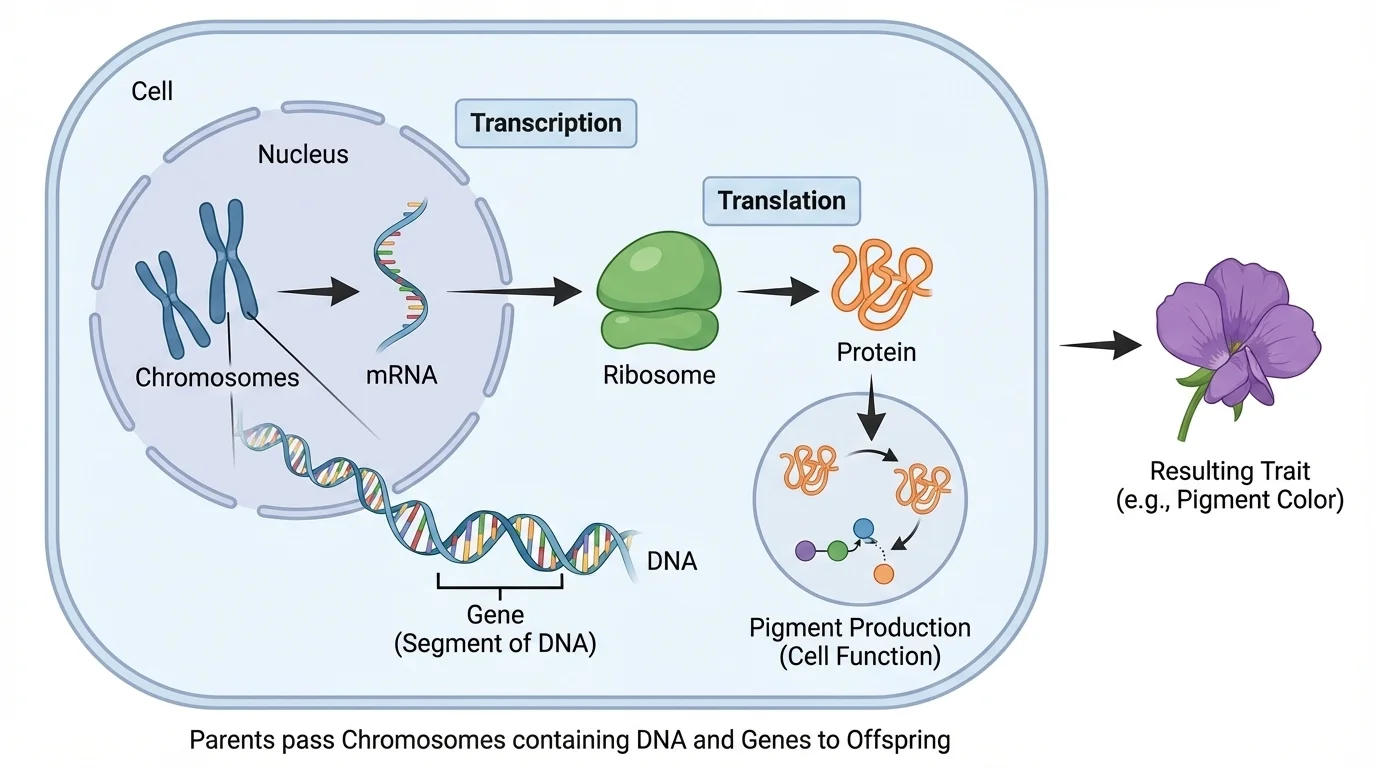
This gene-to-protein-to-trait relationship helps explain why a tiny molecular difference can sometimes lead to a noticeable physical difference. It also explains why traits can be biological, not just external. Blood type, lactose tolerance, and some inherited disorders are also linked to genes because proteins affect body chemistry and cell behavior.
However, it is important not to oversimplify. Some traits are influenced by a single gene, but many traits involve multiple genes acting together. Height is a classic example. It is affected by many genes related to growth, bone development, hormone signaling, and metabolism. This means asking good scientific questions often requires moving beyond "Which gene causes this?" to "Which genes contribute, and how do they interact?"
Some differences in DNA sequence between humans are tiny, but they are enough to contribute to visible variation such as freckles, hair texture, and aspects of facial shape. Small molecular changes can have large effects when they alter important proteins.
The same logic applies across organisms. In plants, genes affect traits such as flower color, seed shape, and drought tolerance. In dogs, genes influence coat color, ear shape, body size, and behavior tendencies. In each case, inherited DNA contains instructions that influence the proteins that shape the organism.
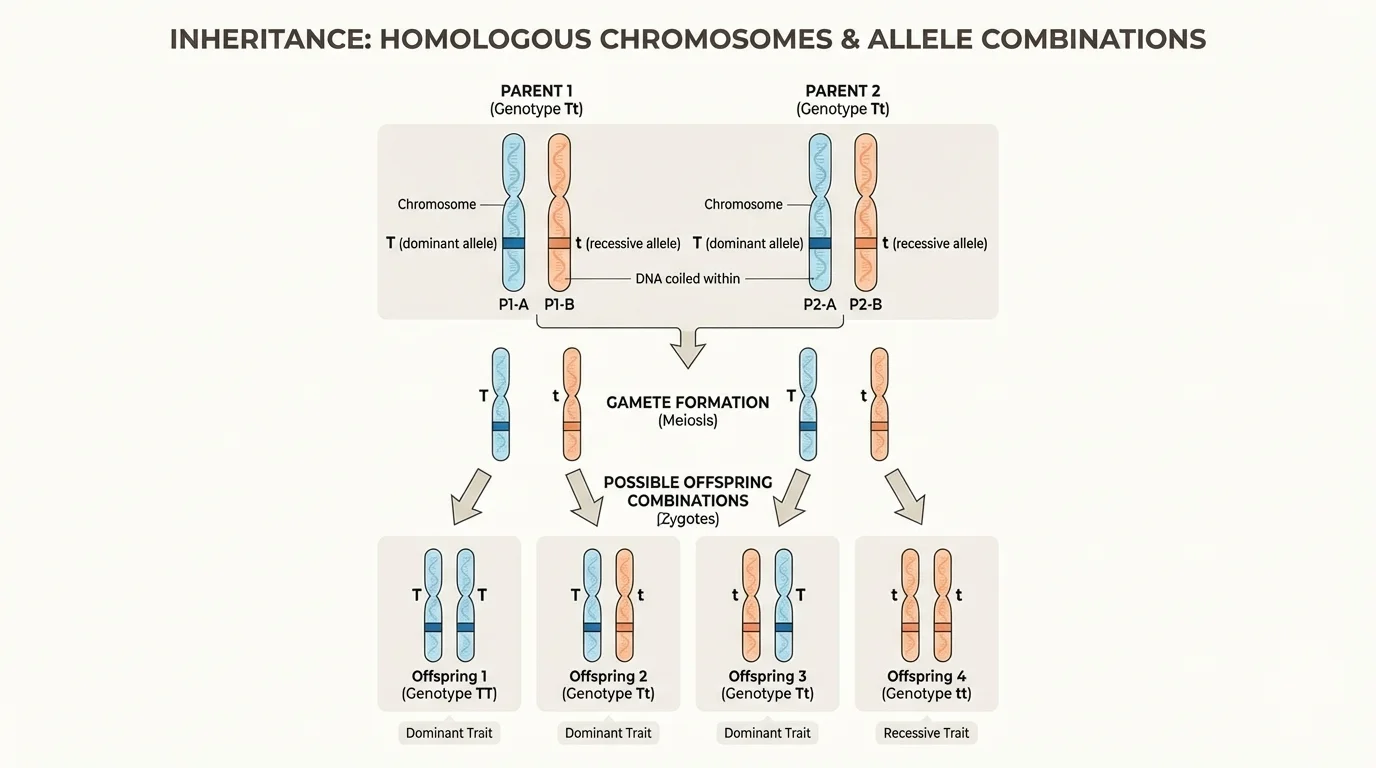
[Figure 3] Brothers and sisters often share many features because they inherit DNA from the same parents, but they are usually not identical. The reason is that each parent contributes one chromosome from each pair, and different combinations can be passed to different offspring. This leads to variation in the combinations of gene versions that offspring receive.
Different versions of a gene are called alleles. A person may inherit one allele from one parent and a different allele from the other parent. The specific pair of alleles contributes to the trait that appears. For some traits, one allele may strongly influence the outcome; for others, the interaction is more complex.
Because chromosome combinations differ from one offspring to another, siblings can receive different mixes of alleles. One child may inherit alleles associated with curly hair and another may inherit alleles associated with straighter hair. One may receive a combination linked to taller adult height potential, while another receives a different combination. This is one major reason why genetic variation exists within families.
Family resemblance and variation
Consider a family in which both parents carry different alleles of a gene that influences whether dimples develop.
Step 1: Identify the source of similarity
Both children inherit chromosomes from the same mother and father, so both are likely to resemble the same family members in some ways.
Step 2: Identify the source of difference
Each child receives a different combination of parental chromosomes and alleles, so one child may show dimples while another may not.
Step 3: Clarify the relationship
The trait difference does not mean one child is "less related." It means inherited combinations differ even within the same family.
This example shows why inherited information explains both resemblance and variation.
Identical twins are a special case because they begin with nearly the same genetic information. Even then, differences can still develop over time because environmental factors and life experiences also matter. That idea becomes especially important for traits such as body mass, athletic performance, and some health outcomes.
The chromosome model in [Figure 1] also helps here: genes are not floating randomly in a cell. They are physically arranged on chromosomes, and offspring inherit chromosome sets that carry many genes at once. This means one inherited chromosome contributes instructions for numerous traits, not just one.
Science is not only about memorizing facts. It is also about asking good questions that make relationships clearer. In genetics, useful questions often connect different levels of explanation: molecule, cell, organism, and generation.
Examples of strong clarifying questions include: Which trait is being observed? Is the trait likely influenced by one gene or many? What evidence suggests the trait is inherited? Where is the relevant gene located? What proteins does that gene help produce? How might a change in DNA alter the protein and therefore the trait? Is the observed variation entirely genetic, or might environmental factors also contribute?
These questions help students avoid shallow explanations. If someone says, "A child has brown eyes because of DNA," that statement is partly true but incomplete. A better explanation asks which inherited gene versions are involved, how those genes affect pigment-related proteins, and how those proteins influence the appearance of the iris.
Clarifying relationships in biology means connecting evidence across levels. A visible trait such as plant height can be traced to cell behavior, which depends on proteins, which depend on genes, which are segments of DNA organized on chromosomes passed down from earlier generations.
This practice is useful when reading family pedigrees, comparing plant varieties, or evaluating claims in news stories about genetics. If a headline says scientists found "the gene for intelligence" or "the gene for athletic ability," a careful reader should question that claim. Most complex human traits involve many genes and environmental influences, not a single simple cause.
[Figure 4] Not all variation comes from DNA alone, and this comparison makes that idea clearer. Some traits are strongly inherited, some are strongly environmental, and many result from both. Understanding this prevents a common mistake: assuming every difference between organisms must be caused by genes.
Eye color is influenced mainly by inherited genes. A scar, by contrast, is caused mainly by environmental events such as injury. Height depends on both genes and environment. A person may inherit genes associated with tall stature, but nutrition, illness, and overall health during development can affect how fully that genetic potential is expressed.
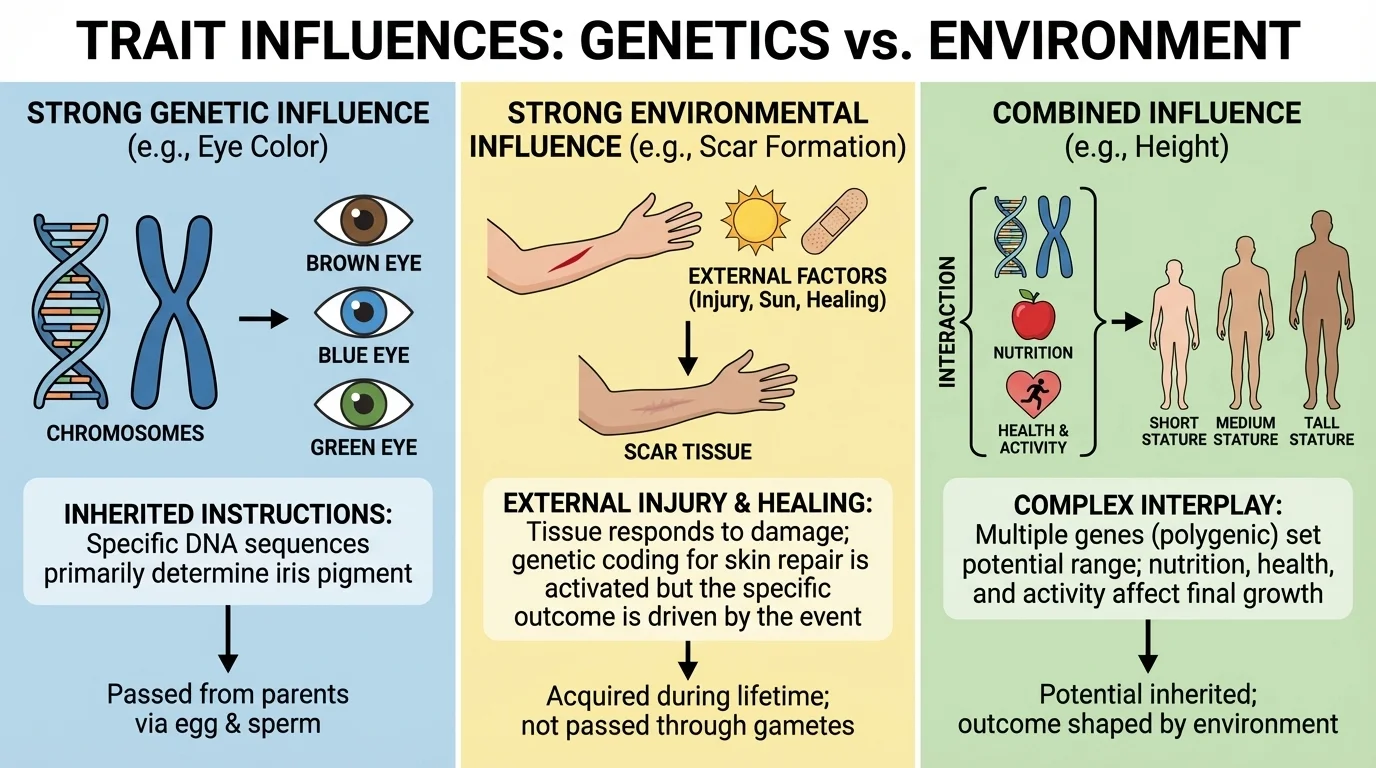
Skin tone provides another useful example. Genes strongly influence baseline pigmentation, but sunlight exposure can change appearance by increasing melanin production. Athletic performance is also shaped by both inherited traits and training. A student may inherit muscle fiber tendencies or body proportions that are helpful in certain sports, but practice, coaching, nutrition, and motivation still matter greatly.
| Trait example | Genetic influence | Environmental influence |
|---|---|---|
| Blood type | Very strong | Very low |
| Scar presence | Low | Very strong |
| Height | Strong | Strong |
| Skin pigmentation after sun exposure | Strong | Strong |
| Language spoken | None as an inherited trait | Very strong |
Table 1. Examples comparing the relative influence of genes and environment on different traits.
The distinction matters in medicine, agriculture, and ecology. If a trait is mostly genetic, scientists often study inheritance patterns and genes. If a trait is strongly environmental, researchers focus more on conditions such as diet, temperature, toxins, or social experience. If both are important, scientists investigate their interaction. The mixed-pattern chart in [Figure 4] helps organize these comparisons.
Understanding DNA and chromosomes is not just classroom knowledge. It affects medical diagnosis, crop improvement, conservation, forensic science, and family health decisions. Doctors may look for inherited gene variants that raise the risk of certain conditions. Plant breeders may select parent plants with desired gene combinations to increase yield or drought resistance. Conservation biologists may monitor genetic diversity to help endangered populations remain healthy across generations.
In medicine, genetic testing can sometimes identify whether a person carries a version of a gene linked to a disease. That does not always mean the disease will definitely appear, especially when environmental factors are involved, but it can help guide prevention and treatment. This is another case where asking clarifying questions is essential: Does a genetic variant guarantee a trait, or does it only change probability?
Real-world case: selective breeding in crops
Step 1: Identify desired traits
A farmer wants corn plants with high yield and drought tolerance.
Step 2: Choose parent plants
Plants showing those traits are selected because they likely carry useful alleles.
Step 3: Observe offspring
Offspring are examined to see which inherited combinations produce the strongest results.
This process depends on the fact that traits in one generation are linked to genetic information inherited from previous generations.
Forensic scientists also use DNA because individuals usually have distinct DNA patterns. While this lesson does not focus on forensic methods, the application depends on the same core principle: DNA stores information that can be inherited and compared.
One misunderstanding is that a chromosome carries only one trait. In reality, a chromosome contains many genes, and each gene may contribute to one or more characteristics. Another misunderstanding is that one gene always produces one obvious trait. Some genes affect multiple traits, and many traits involve multiple genes.
A third misunderstanding is that inherited means unchangeable. Inherited information matters greatly, but traits can still be influenced by environment. For example, someone may inherit genes linked to strong bone growth, but nutrition and exercise help determine the final outcome. Likewise, someone may inherit a risk for a disease, but lifestyle and medical care can still affect whether and how strongly that risk appears.
Finally, it is incorrect to think that a trait must appear in every generation to be inherited. Some alleles can be passed along without being obvious in every individual. That is why geneticists study both visible traits and underlying inheritance patterns.
The inheritance patterns represented by chromosome combinations in [Figure 3] help explain why a trait can reappear after seeming absent in one generation. The information may still be present in the family line even when the visible characteristic is not obvious in every person.
"The characteristics of one generation depend on genetic information inherited from previous generations."
That idea is central to modern biology. DNA stores the information, genes provide specific instructions, chromosomes organize those genes, and inherited combinations of chromosomes help explain both family resemblance and variation. By asking precise questions, scientists can clarify how the molecular level connects to the organism level and how one generation is biologically linked to the next.
