If every living thing on Earth shared some part of its history with every other living thing, what evidence would you expect to find? Scientists do not answer that question by guessing. They compare genes, body structures, fossils, and patterns of relatedness. What is striking is that these very different kinds of evidence point in the same direction: life has changed over time, and modern species are connected by common ancestry.
In science, explanations are judged by empirical evidence—observations and measurements collected from the natural world. Scientific ideas become powerful when multiple independent sources of evidence support the same conclusion. Biological evolution is one of those ideas. It is supported not by a single fossil, one DNA test, or one body part, but by a broad pattern seen across many kinds of data.
When scientists communicate about evolution, they make a claim, support it with evidence, and explain the connection using reasoning. For example, a scientist might claim that whales and other mammals share an ancestor. The evidence could include similarities in DNA sequences, shared anatomical patterns in the skeleton, and fossils that show whale ancestors with hind limbs. The reasoning is that these shared features are best explained by inheritance from earlier populations.
Biological evolution is the change in inherited characteristics of populations over generations. Common ancestry means that different species share ancestors in the past. Descent with modification describes how descendants resemble their ancestors but also accumulate differences over time.
These ideas help explain both the unity of life and its diversity. Unity means organisms share many basic features, such as DNA as genetic material and similar cell processes. Diversity means species differ in appearance, physiology, behavior, and environment. Evolution connects those two facts: organisms are similar because of shared ancestry, and different because populations changed over long periods of time.
The phrase common ancestry does not mean every species alive today came directly from another modern species. Humans did not come from modern chimpanzees, for example. Instead, humans and chimpanzees share an ancestor that lived in the past. That ancestral population gave rise, through branching lines of descent, to different descendant groups.
Evolution also does not mean that all change is random in every sense. Mutations can introduce variation, but the evidence emphasized here is not about every mechanism. The focus is on how scientists know evolution happened and how they communicate that knowledge using observable evidence from genes, anatomy, cladograms, and fossils.
From earlier biology study, recall that DNA stores hereditary information in sequences of nucleotides, proteins are built from amino acids, and traits can be inherited. Those ideas make it possible to compare species at both the molecular and anatomical levels.
One reason the evidence is convincing is that it is consilient: separate lines of investigation converge on the same pattern. A fossil record can suggest a relationship, and DNA data can support that same relationship independently. This makes the scientific case much stronger than relying on a single clue.
Molecular comparisons provide some of the most direct evidence for evolutionary relationships. As [Figure 1] shows, when scientists compare DNA or protein sequences from different species, they look for positions that match and positions that differ. Species with more similar sequences usually share a more recent common ancestor than species with more differences.
This idea works because descendants inherit DNA from their ancestors. Over time, mutations can change some parts of a sequence. If two species split from a common ancestor recently, fewer differences have had time to accumulate. If they split much earlier, more differences are expected. The comparison is not based on a single nucleotide or one amino acid alone, but on patterns across many positions and often across many genes or proteins.
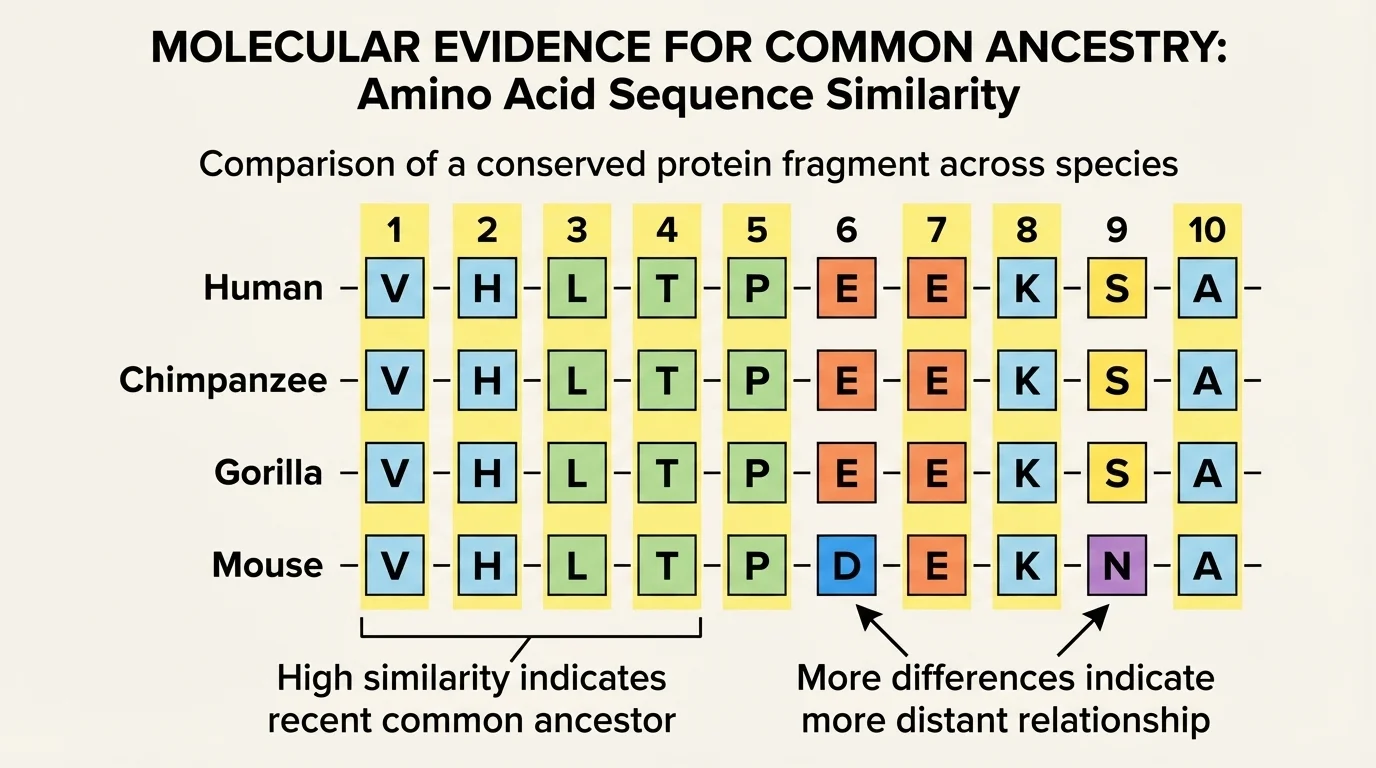
For example, humans and chimpanzees have extremely similar DNA sequences across much of their genomes. Humans also share many genes with mice, but there are more differences. This does not mean mice are unrelated to humans. It means the human-mouse common ancestor lived much earlier than the human-chimpanzee common ancestor.
Amino acid sequences in proteins can also be compared. Because proteins are encoded by genes, similar protein sequences can reflect shared ancestry. A well-known example involves the protein cytochrome c, found in many organisms. Species with more similar cytochrome c amino acid sequences tend to be more closely related. Molecular evidence is especially useful because it can be measured precisely and compared across many organisms.
Case study: comparing molecular evidence
Suppose scientists compare a short section of DNA from four species and count the number of differences from a human sequence.
Step 1: Record the differences.
Chimpanzee differs at 2 positions, gorilla at 4 positions, mouse at 15 positions.
Step 2: Interpret the pattern.
Fewer differences suggest a more recent common ancestor with humans. More differences suggest a more distant common ancestor.
Step 3: State the conclusion clearly.
Based on this sequence, chimpanzee is most closely related to human, gorilla is next, and mouse is more distantly related.
This does not prove relationships from one short sequence alone, but it becomes powerful when many genes show the same pattern.
Molecular evidence has real-world importance. Researchers track the evolution of viruses by comparing genetic sequences from different samples. In public health, sequence data can reveal whether outbreaks are linked and how strains are changing over time. The same reasoning used for broad evolutionary history helps scientists understand rapidly changing populations today.
Later, when scientists build relationship diagrams, the pattern of sequence similarity seen in [Figure 1] becomes one of the strongest inputs for deciding which species branch together.
Anatomy offers another major line of evidence. As [Figure 2] illustrates, scientists do not judge relatedness only by what a structure does. They also examine how it is built. The most important comparison here is between homologous structures and analogous structures.
Homologous structures are body parts in different species that share an underlying pattern because they were inherited from a common ancestor. Their functions may be different, but their basic structure reveals relatedness. The forelimbs of humans, bats, whales, and cats are classic examples. They perform different tasks—grasping, flying, swimming, and walking—but they contain corresponding bones arranged in similar ways.
Analogous structures are body parts that have similar functions but evolved independently in different groups. Bird wings and insect wings both allow flight, but they do not share the same underlying structure inherited from a common winged ancestor. Their similarity reflects similar selective pressures, not close shared ancestry.
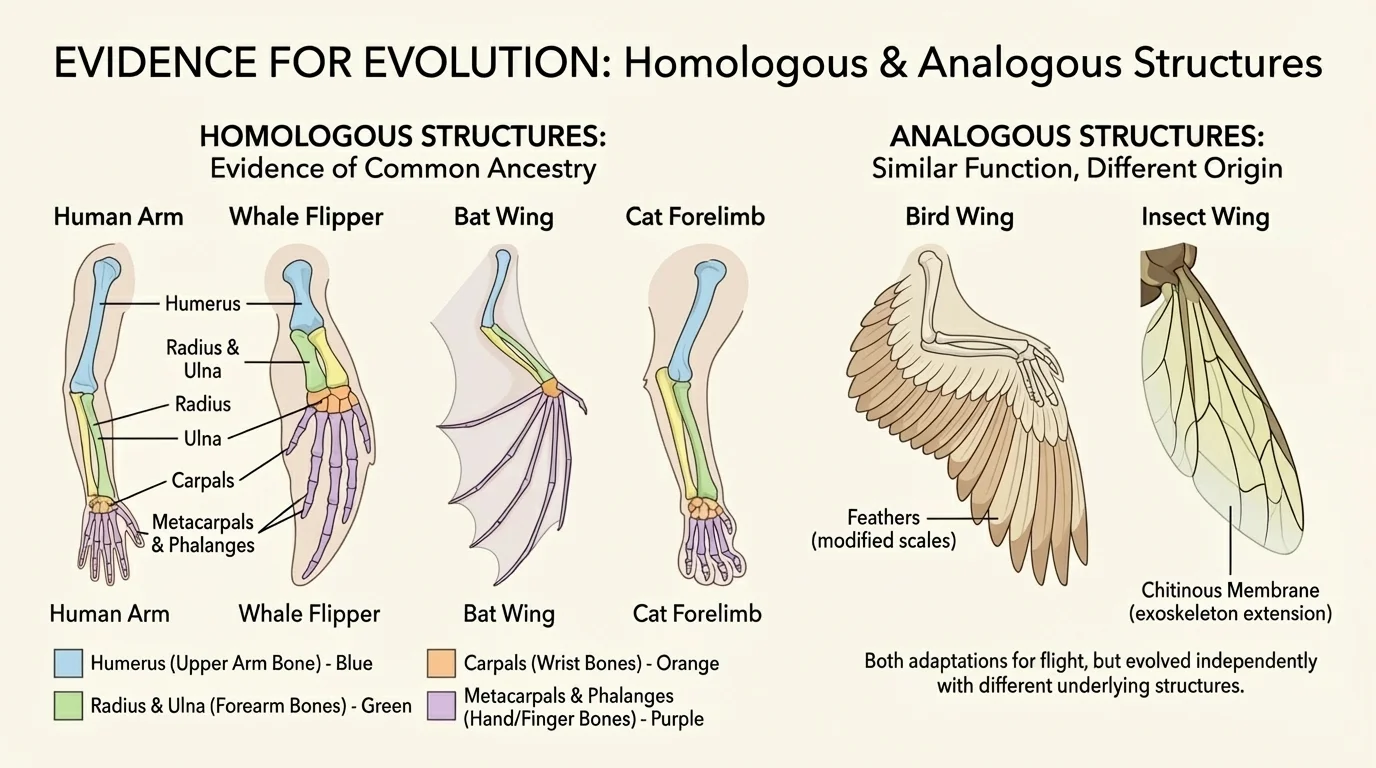
This distinction matters because outward similarity can be misleading. A shark and a dolphin both have streamlined bodies and fins, which help them move efficiently through water. But the shark is a fish, while the dolphin is a mammal. If you examine deeper anatomy and other evidence, the dolphin shares more ancestry with other mammals than with sharks.
Homologous structures provide strong evidence of descent with modification. Over time, the same ancestral structure can be reshaped for different environments and functions. This helps explain how evolution can produce diversity while preserving detectable patterns of inheritance.
The bones in a bat wing and a human arm correspond so closely that biologists can identify matching parts even though one is adapted for flight and the other for handling objects. That deep structural similarity is one reason anatomy supports common ancestry so strongly.
When students first learn this topic, a common mistake is to assume that similar function always means close relationship. The comparison in [Figure 2] shows why scientists look beneath surface appearance to the structural plan of the organism.
Scientists need a clear way to communicate relationships among species, and a cladogram does that visually. As [Figure 3] shows, a cladogram is a branching diagram that represents hypotheses about evolutionary relationships based on shared characteristics and other evidence such as DNA sequences.
Each branch point, or node, represents a common ancestor shared by the groups that branch from it. Species that share a more recent branch point are interpreted as more closely related than species whose common branch point is deeper in the diagram. Cladograms do not usually show exact dates unless additional information is added. Their main purpose is to show patterns of relatedness.
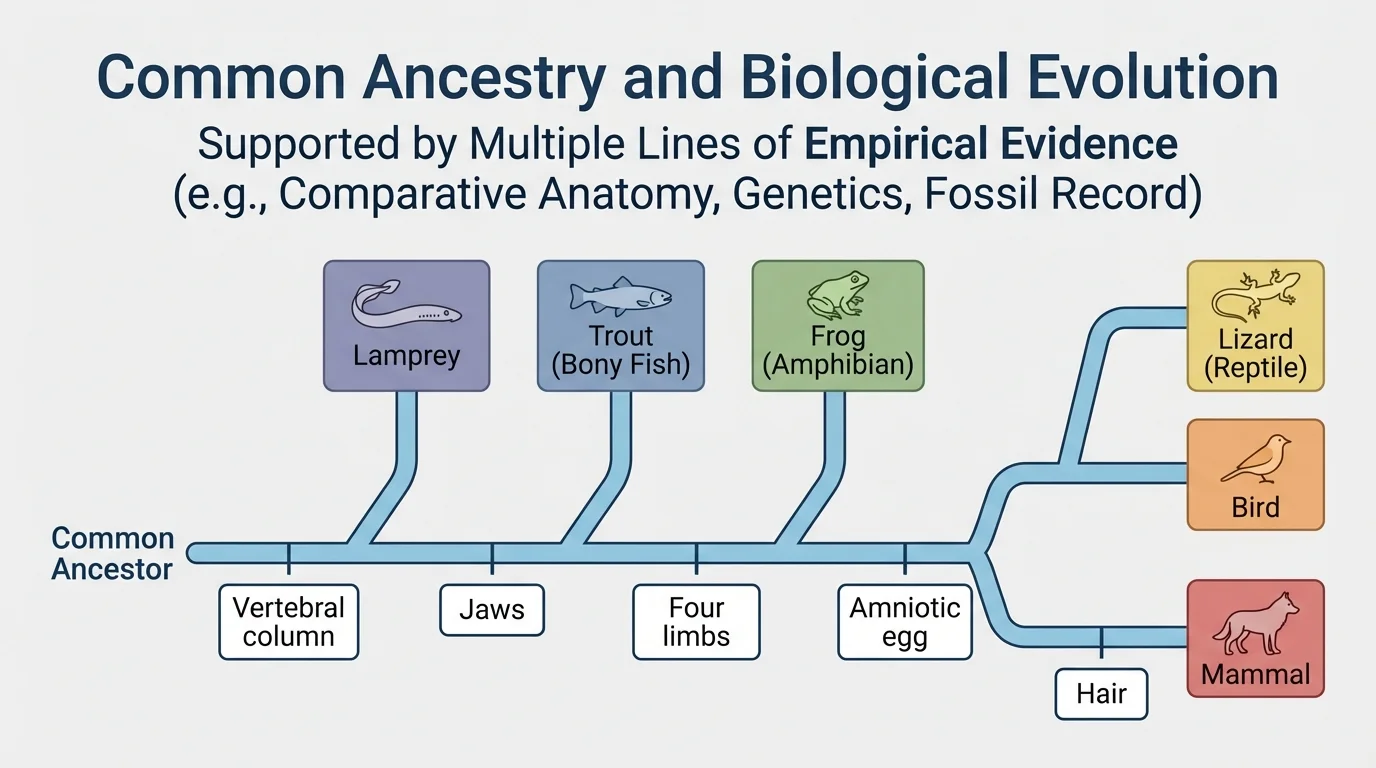
Suppose a cladogram includes fish, amphibians, reptiles, birds, and mammals. Shared traits such as vertebrae, four limbs, amniotic eggs, or hair can be placed along branches. If mammals share a branch with other amniotes but have hair as a trait unique to their group, the diagram communicates both shared ancestry and distinct evolutionary history.
Cladograms become especially strong when multiple lines of evidence agree. If anatomical comparisons suggest one branching pattern and DNA sequences support the same pattern, confidence increases. A cladogram is not just a sketch; it is a scientific model built from evidence.
How to read a cladogram
Read from the root toward the branch tips. Look for shared branch points, not for which species is "higher" or "more advanced." All living species at the tips have been evolving for the same amount of time since their last common ancestor. A cladogram shows relatedness, not a ladder of progress.
A frequent misunderstanding is to read a cladogram as if one modern species turned into another modern species. That is not what the diagram means. Instead, two modern groups share an ancestor at a branch point in the past. The molecular patterns described earlier, including those like the sequence comparison in [Figure 1], often help determine where those branch points are placed.
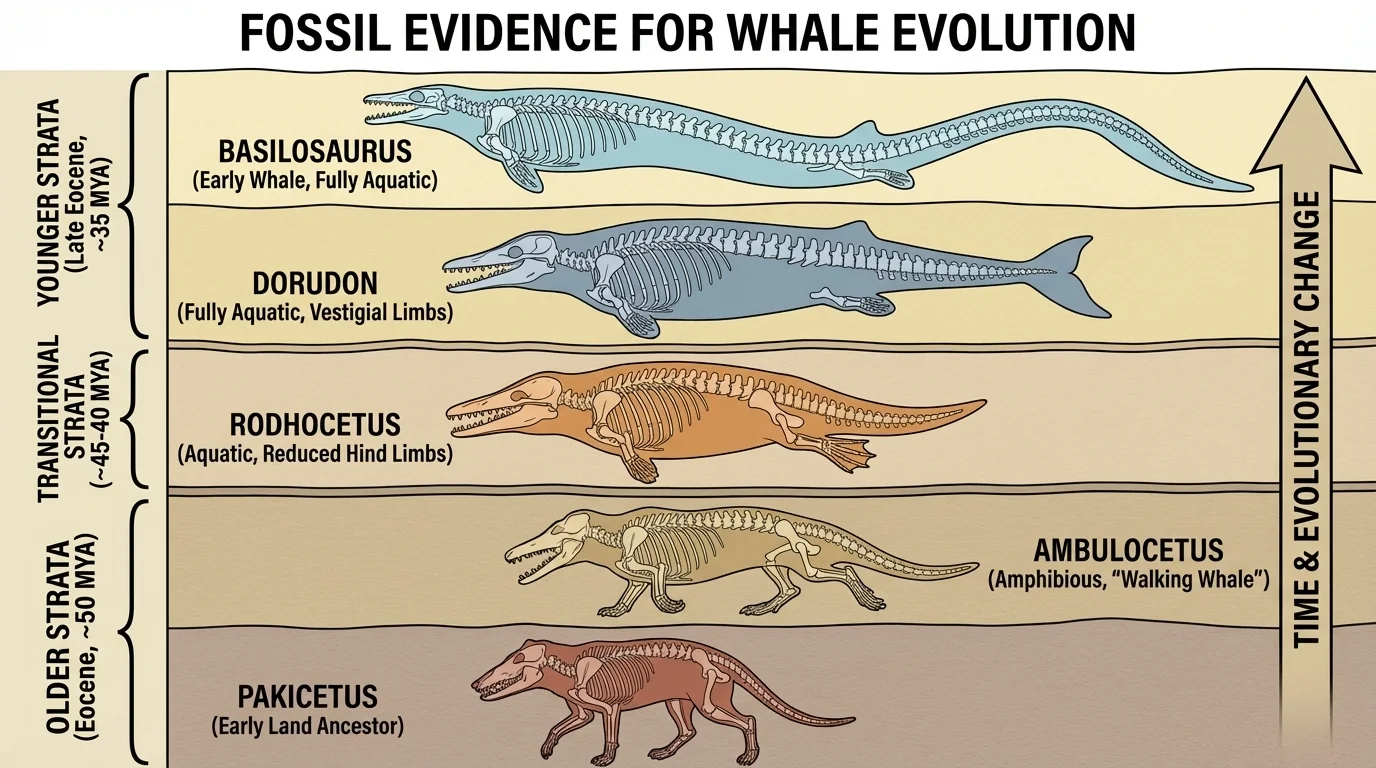
The fossil record adds something the other lines of evidence cannot provide as directly: a time sequence. As [Figure 4] shows, fossils are found in rock layers, and deeper layers are generally older than the layers above them. This allows scientists to compare organisms from different times in Earth's history.
Fossils reveal that life in the past was different from life today. They also show patterns of appearance, change, and extinction. Some fossils display mixtures of traits that connect major groups. These are often called transitional fossils, not because they are halfway to a predetermined goal, but because they preserve combinations of ancestral and derived features.
One important example comes from whale evolution. Fossils of early whale ancestors show features linked to land mammals, while later fossils show increasingly aquatic adaptations. Some early forms had functional hind limbs, while later whales had reduced hind limbs and body shapes better suited to swimming. This sequence supports the idea that modern whales descended from terrestrial ancestors.
Another example is the fossil record of horses, which shows changes over time in body size, teeth, and toe number. Fossils do not provide every organism that ever lived, and the record is incomplete. However, incomplete does not mean useless. Even an incomplete record can reveal large-scale patterns that strongly support evolution.
Fossils become especially powerful when they agree with molecular and anatomical evidence. In whale evolution, for instance, fossils show the sequence of anatomical change through time, while modern anatomy and DNA comparisons place whales within the mammal lineage. The pattern in [Figure 4] therefore works together with other evidence rather than standing alone.
The strongest scientific explanations are supported by more than one line of evidence. For common ancestry and biological evolution, four especially important sources are DNA and amino acid sequences, homologous and analogous structures, cladograms, and fossils. Each contributes a different kind of information.
| Evidence type | What scientists compare | What it helps show | Typical strength |
|---|---|---|---|
| DNA and amino acid sequences | Order of nucleotides or amino acids | Degree of genetic similarity and likely relatedness | Precise, measurable molecular data |
| Homologous structures | Underlying body plans | Shared ancestry despite different functions | Links structure to descent with modification |
| Analogous structures | Similar functions with different structures | Independent evolution of similar traits | Prevents misleading conclusions from appearance alone |
| Cladograms | Branching patterns based on shared evidence | Hypotheses of evolutionary relationships | Organizes many data sources clearly |
| Fossil record | Organisms in rock layers through time | Chronological sequence of change and extinction | Adds historical timing and transitional forms |
Table 1. Comparison of major lines of evidence used to support common ancestry and biological evolution.
Think of these sources as different witnesses describing the same event from different angles. A single witness might miss something, but if many independent witnesses agree on the major pattern, confidence grows. In the same way, evolution is supported because genes, skeletons, fossils, and branching diagrams repeatedly tell a consistent story.
Claim, evidence, and reasoning example
Claim: Birds and reptiles share common ancestry.
Step 1: Evidence from anatomy
Birds and reptiles share anatomical features such as the amniotic egg and certain skeletal characteristics.
Step 2: Evidence from cladograms
Cladograms built from multiple traits place birds within a branch closely related to reptiles.
Step 3: Evidence from fossils
Fossils such as feathered dinosaurs show combinations of traits that connect ancient reptile groups with birds.
Step 4: Reasoning
The most consistent explanation for these shared patterns is inheritance from common ancestors rather than separate, unrelated origins.
Notice that a strong scientific communication does not just list facts. It explains why those facts matter. That is what turns data into evidence.
Evidence for common ancestry is not just about the distant past. It matters in medicine, agriculture, and conservation. When scientists compare viral genomes, they can identify how strains are related and monitor changes. When researchers study bacterial proteins or DNA, they can trace relationships among strains and understand how groups diversify.
Conservation biology also uses evolutionary evidence. Protecting biodiversity involves understanding how populations and species are related. If two endangered populations are genetically distinct, that information can influence conservation planning. Evolutionary relationships can help scientists decide which populations preserve especially important genetic diversity.
"Nothing in biology makes sense except in the light of evolution."
— Theodosius Dobzhansky
Even drug development and biomedical research rely on shared ancestry. Scientists often study genes or proteins in other organisms because homologous genes can provide clues about human biology. The same common ancestry that links species across millions of years also makes many biological discoveries transferable between organisms.
To communicate scientific information well, be precise about the evidence and careful about the claim. Avoid saying that one piece of evidence "proves" evolution all by itself. A stronger statement is that multiple lines of evidence support common ancestry and biological evolution. Scientific conclusions are based on the weight of evidence, not on a single dramatic example.
It is also important to avoid mixing up relationship and resemblance. Similar-looking organisms are not always closely related, and different-looking organisms can be closely related if they inherited an underlying structure or sequence pattern from a shared ancestor. That is why homologous structures, sequence comparisons, and cladograms are so useful together.
When writing or speaking about this topic, an effective structure is simple: state the claim, name the evidence, and connect it with reasoning. For example: "Humans and chimpanzees share a recent common ancestor because their DNA sequences are highly similar, they share homologous anatomical structures, and cladograms built from multiple data sets place them on nearby branches." That statement is clearer and more scientific than a vague claim based on opinion.
