A hospital can use a powerful antibiotic, kill nearly all the bacteria causing an infection, and still end up with a new problem: the surviving bacteria may be more resistant than the original population. That is not because the bacteria "tried" to become stronger. It happens because evolution works through a powerful and often unforgiving process. When scientists explain evolution, they often focus on four linked factors: organisms can produce more offspring than the environment can support, individuals differ in heritable ways, resources are limited, and those with helpful traits leave more offspring. Over time, that changes populations.
Evolution is one of the most important ideas in biology because it explains both the unity of life and its diversity. All living things share basic features such as DNA, cells, and the need to reproduce, but species also show enormous differences in body form, behavior, and survival strategies. Natural selection helps explain how these differences arise and persist.
Before looking at the four factors, it is important to understand what biologists mean by change through time. A single organism is born with a certain set of genes. During its lifetime, it may grow, learn, or become injured, but those changes do not mean the organism has evolved. Evolution refers to changes in a population across generations, especially in how common certain inherited traits become.
A population is a group of organisms of the same species living in the same area. If a trait that helps survival or reproduction becomes more common generation after generation, the population has evolved. The individual organisms did not choose the trait, and they did not change because they needed to. Instead, individuals with certain inherited traits were more likely to survive and reproduce, so those traits became more frequent in the population.
Natural selection is the process in which individuals with heritable traits that improve survival or reproduction in a particular environment tend to leave more offspring than other individuals. Over many generations, those beneficial traits become more common in the population.
This idea can feel counterintuitive because daily life makes us focus on individuals. In sports, school, and work, we often talk about personal effort and improvement. In evolution, however, the key question is not whether one organism worked harder. The question is whether inherited differences affected survival and reproduction strongly enough to change the population over time.
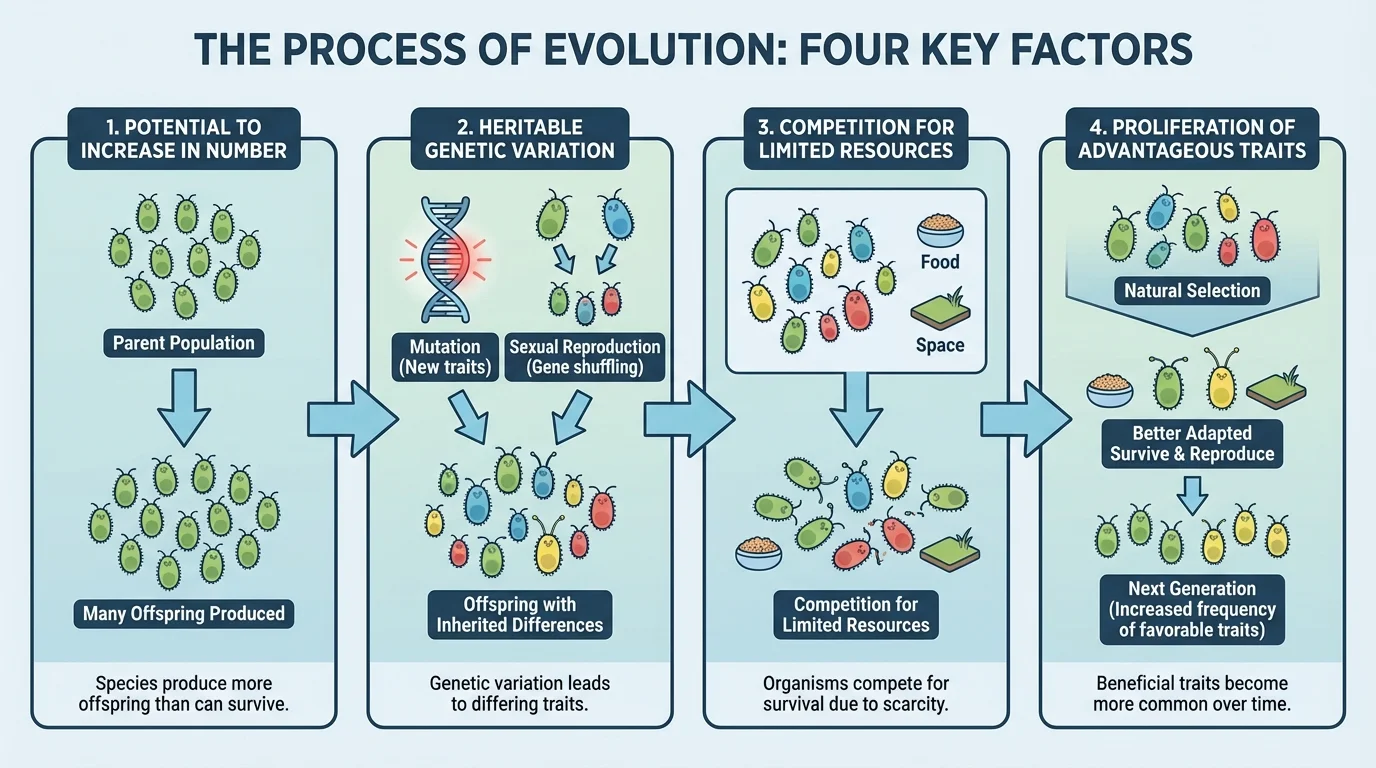
The process of natural selection works as a chain of causes, as [Figure 1] shows. If any one part of the chain is missing, evolution by natural selection cannot be explained fully. Organisms must produce enough offspring that not all will survive, those offspring must differ in heritable ways, they must face competition because resources are limited, and the individuals with advantageous traits must leave more offspring.
These four factors are not separate explanations competing with one another. They are parts of one mechanism. Overproduction creates pressure. Heritable variation creates differences. Competition means not every organism succeeds equally. Differential survival and reproduction cause the helpful traits to increase in frequency.
When biologists construct an explanation of evolution, they rely on evidence from observations, experiments, fossils, anatomy, genetics, and living populations. In this lesson, the focus stays on how those four factors drive change through natural selection.
The first factor is the potential for a species to increase in number. Many organisms produce more offspring than will ever survive to adulthood. A fish may lay thousands of eggs. A plant may release hundreds of seeds. Even mammals, which usually have fewer young, often produce more offspring over time than the environment can support.
This matters because if every offspring survived and reproduced successfully, populations would grow extremely quickly. In reality, most do not survive. Some are eaten, some cannot find food, some do not resist disease, and some fail to reproduce. The fact that populations have the potential to grow faster than they actually do creates the conditions for natural selection.
Elephants reproduce much more slowly than bacteria, yet even elephant populations could grow rapidly if every calf survived and reproduced successfully. The environment prevents this from happening by limiting food, water, space, and other necessities.
The key idea is not just "many offspring are born." It is that more offspring are produced than can be supported. This overproduction is one reason natural populations usually remain within environmental limits rather than increasing forever.
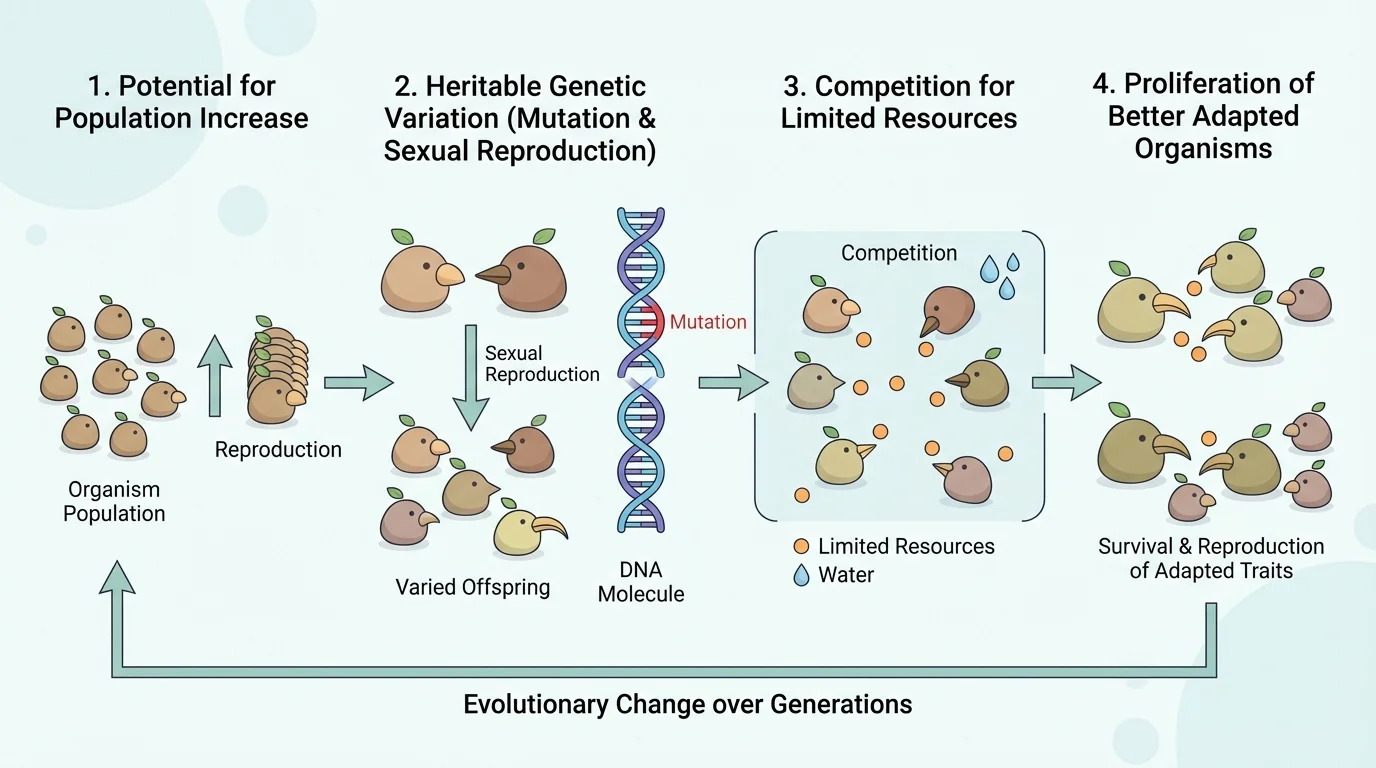
[Figure 2] The second factor is genetic variation, the inherited differences among individuals in a population. Variation is the raw material for evolution, and two major sources of that variation are mutation and sexual reproduction. Without heritable differences, natural selection would have nothing to act on.
A mutation is a change in DNA. Mutations can happen for many reasons, including errors during DNA copying or exposure to certain environmental factors. Most mutations are neutral or harmful, but some create a new trait that can be beneficial in a particular environment. For example, a mutation in bacteria may produce resistance to an antibiotic.
Sexual reproduction also increases variation by shuffling genes from two parents into new combinations. Siblings can look and behave differently because they inherit different combinations of alleles from their parents. Even if no new mutation occurs, sexual reproduction creates new trait combinations in offspring.
Not all variation matters equally for evolution. For natural selection to produce evolutionary change, the variation must be heritable, meaning it can be passed from parents to offspring. A scar from an injury is a difference between individuals, but it is not inherited. A genetically determined fur color, beak shape, or enzyme structure can be inherited and therefore can affect evolution.
Why heritability matters
If a trait helps an organism survive but cannot be passed on, that trait will not become more common in future generations through natural selection. Evolution depends on inherited information moving from one generation to the next.
Variation can affect structures, physiology, and behavior. One bird may have a slightly deeper beak. One rabbit may have fur that provides better camouflage. One bacterium may produce a protein that allows it to survive a drug. Small differences can matter greatly when environmental pressures are strong.
The third factor is competition for limited resources. Food, water, territory, shelter, nesting sites, and mates are not unlimited. Because more individuals are born than can all survive, organisms must compete directly or indirectly for what they need.
Competition does not always look like physical fighting. A seedling growing in shade may lose access to sunlight because nearby plants absorb it first. A bird with a beak less suited to available seeds may get less food. A bacterium that cannot survive a medicine is effectively removed from competition within the body. In every case, the environment sets limits that prevent equal success for all individuals.
The environment includes both living and nonliving factors. Predators, parasites, disease-causing organisms, temperature, rainfall, and nutrient supply all influence which traits are helpful. A trait that is useful in one environment may be less useful in another. That is why natural selection depends on context.
Genes influence traits, and traits can affect how an organism interacts with its environment. The environment does not create a needed trait on demand; instead, it favors some already-existing inherited variations over others.
Competition creates what biologists sometimes call selective pressure. This means that environmental conditions make some traits more favorable than others. Selective pressures do not "plan" future change. They simply affect which organisms survive and reproduce more successfully.
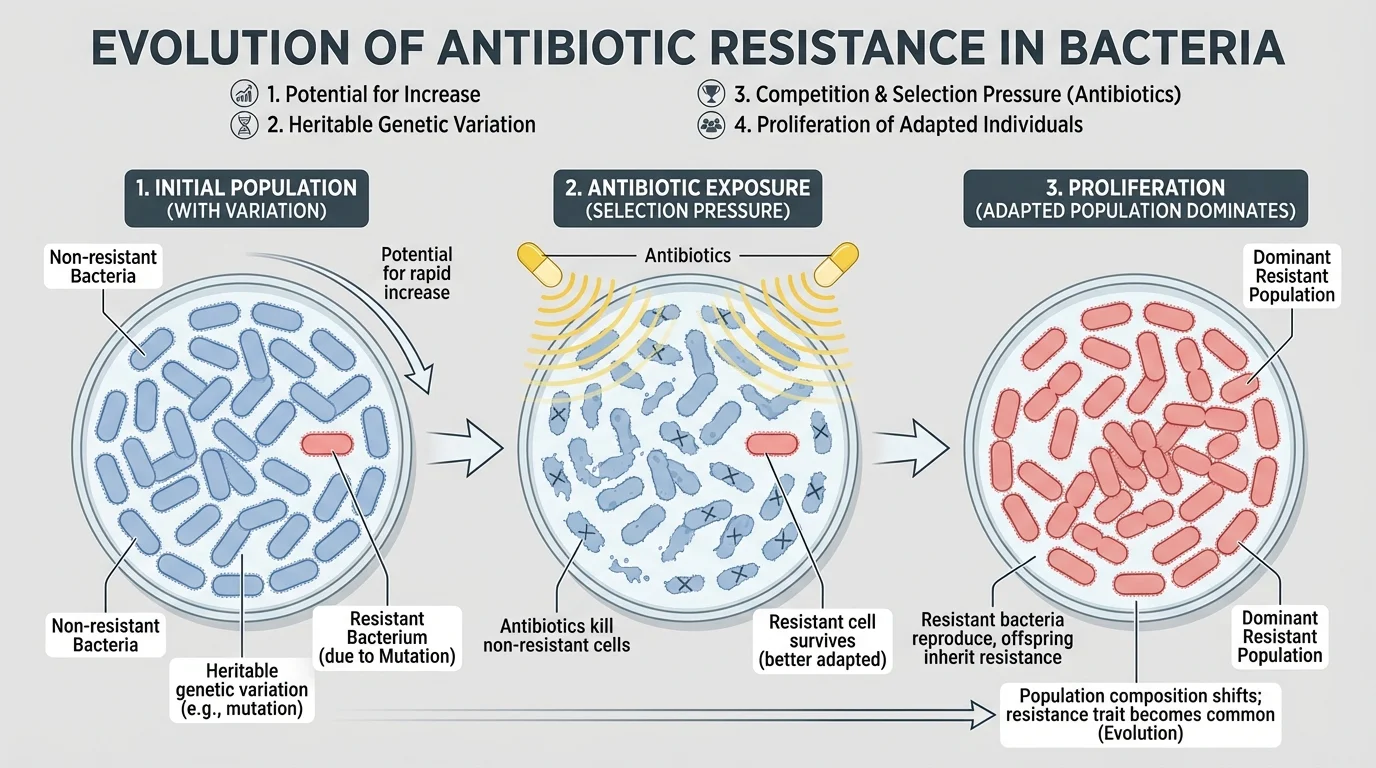
[Figure 3] The fourth factor is the proliferation of organisms that are better able to survive and reproduce in the environment. This is the direct action of natural selection. If individuals with one inherited trait tend to survive longer, secure more resources, or produce more offspring than others, that trait is more likely to increase in the population.
This is sometimes described as differential survival and reproduction. The word "differential" means that success is unequal. Organisms do not all leave the same number of offspring. Even a small advantage can matter if it continues over many generations.
Suppose a population of insects includes both green and brown individuals living on green leaves. Birds can see the brown insects more easily, so green insects are eaten less often. If color is inherited, the green insects will on average leave more offspring. Generation after generation, the proportion of green insects can increase. The insects did not change color because they wanted to hide; inherited color differences already existed, and selection favored one variant.
Case study: A changing insect population
A population starts with 100 insects: 40 green and 60 brown. Birds eat more brown insects because they are easier to see on leaves.
Step 1: Start with variation.
The population already contains different inherited color traits: green and brown.
Step 2: Apply selective pressure.
Predation acts as the selective pressure because birds catch the more visible insects more often.
Step 3: Compare reproductive success.
If more green insects survive to reproduce, then a larger fraction of the next generation inherits the green trait.
Step 4: Observe population change.
After many generations, the proportion of green insects may rise from 40 out of 100 to a much larger share of the population.
The important result is a population-level shift in inherited traits, not a change within individual insects.
The same logic applies broadly. A trait that improves feeding, escaping predators, resisting disease, tolerating heat, or attracting mates can become more common if it is inherited and increases reproductive success in that environment.
To construct a full explanation of evolution by natural selection, it helps to connect the four factors in order. First, organisms produce more offspring than can all survive. Second, those offspring differ in heritable traits because of mutation and sexual reproduction. Third, limited resources create competition and selective pressure. Fourth, individuals with traits that improve survival and reproduction leave more offspring, so those traits become more common over generations.
This can be expressed as a population trend. If the frequency of a helpful inherited trait in one generation is represented by a proportion such as \(0.20\), or \(20\%\), and individuals with that trait leave more offspring, the proportion may rise over generations to \(0.35\), \(0.50\), or higher. This kind of change is evolution at the population level.
The process is not random in its outcome with respect to survival. Mutations arise without regard to need, but natural selection consistently favors traits that fit the current environment better. That is why populations often appear well adapted to their surroundings.
Evidence-based explanations are strongest when they connect the four factors to real observations. Biologists do not simply claim that evolution occurs; they examine measurable changes in populations, inherited traits, and reproductive success.
One classic example involves the evolution of color variation in peppered moth populations in England. Before heavy industrial pollution, lighter-colored moths were harder to see on lichen-covered trees. During the industrial period, soot darkened many tree surfaces, and darker moths became less visible to predators. Because color was inherited and affected survival, the more camouflaged form became more common in many places. This is evidence that environmental conditions can shift which traits are favored.
Another strong example is the evolution of antibiotic resistance in bacteria. Bacterial populations can grow rapidly, and mutations sometimes produce resistance. When an antibiotic is used, many bacteria die, but a few resistant ones may survive. Those survivors reproduce, and the next generation contains a larger proportion of resistant bacteria.
This example includes all four factors clearly. Bacteria have a huge potential to increase in number. They show heritable variation due to mutation. They face intense competition and selective pressure when antibiotics kill susceptible cells. Resistant bacteria survive and reproduce more successfully, so resistance becomes more common.
Galápagos finches provide another line of evidence. Different finch populations vary in beak size and shape. In years when only harder seeds are common, birds with stronger, deeper beaks may survive at higher rates. If beak traits are inherited, later generations can contain a greater proportion of birds with those advantageous beaks. Careful measurements of finch populations over time have provided direct evidence of natural selection in action.
How scientists build an explanation from evidence
Step 1: Observe variation.
Scientists identify inherited differences such as color, beak depth, or drug resistance.
Step 2: Measure environmental pressure.
They determine what limits survival, such as predators, food type, or antibiotics.
Step 3: Compare outcomes.
They record which individuals survive and reproduce more successfully.
Step 4: Track generations.
They test whether the frequency of the advantageous trait increases over time.
When all four steps are supported by evidence, the explanation for natural selection becomes very strong.
Later, when considering medical treatment, the same pattern remains essential: treatment does not create the resistance because bacteria need it. Instead, treatment selects for resistant variants already present in the population.
Biological evidence can come from field observations, controlled experiments, DNA analysis, and long-term population studies. The most useful evidence shows that a trait is inherited, that individuals differ in that trait, that environmental conditions affect survival or reproduction, and that the trait becomes more or less common over generations.
For example, if researchers find that birds with slightly larger beaks survive drought better because they can crack the remaining hard seeds, and if the offspring of those birds also tend to have larger beaks, then a shift in average beak size over later generations supports natural selection. The explanation is strongest when it links trait variation, environmental pressure, and reproductive success.
| Type of evidence | What it shows | How it supports natural selection |
|---|---|---|
| Observed trait differences | Individuals are not identical | Provides the variation selection can act on |
| Inheritance studies | Traits pass from parents to offspring | Shows changes can persist across generations |
| Survival or reproduction data | Some individuals leave more offspring | Demonstrates differential success |
| Population change over time | Trait frequencies shift | Shows evolution occurring in the population |
Table 1. Evidence types that support explanations of evolution by natural selection.
When these forms of evidence line up, the explanation becomes much more convincing than any single observation alone.
One common misunderstanding is that organisms evolve because they need to. Need does not create a mutation. Mutations occur first, and selection acts afterward on the resulting variation.
Another misunderstanding is that natural selection means only the strongest survive. In biology, "fit" does not simply mean large, aggressive, or powerful. Fitness means reproductive success in a particular environment. A small organism can be more fit than a larger one if it leaves more surviving offspring.
It is also incorrect to say that all individuals in a population change at once. Evolution changes the distribution of traits in the population over generations. Some individuals survive and reproduce more than others, causing inherited traits to become more or less common.
"It is not the strongest of the species that survives, nor the most intelligent, but the one most responsive to change."
— Commonly attributed to Charles Darwin
That statement is often paraphrased loosely, but its core idea fits natural selection well: success depends on how inherited traits match the environment, not on some universal idea of superiority.
Natural selection is not just an idea about the distant past. It affects medicine, agriculture, and conservation today. Doctors must consider antibiotic resistance when treating infections. Farmers may observe insect pests evolving resistance to pesticides. Conservation biologists study whether populations have enough genetic variation to adapt to changing conditions such as rising temperatures or new diseases.
In medicine, understanding natural selection helps explain why patients are told to use antibiotics properly. If treatment is misused, susceptible bacteria may die while resistant ones survive and multiply. The population then shifts toward resistance, much like the change shown earlier in [Figure 3].
In agriculture, breeders often use heritable variation to develop crops with desirable traits such as drought tolerance or disease resistance. Although artificial selection is guided by humans rather than the environment alone, it still depends on inherited variation and differential reproduction. This comparison also helps reinforce the central role of heritable traits in any selection process.
Many life-saving drugs become less effective over time if resistant populations spread. That is one reason scientists monitor bacterial evolution so closely in hospitals and communities.
Across all these examples, the same core logic remains: populations contain inherited variation, environments create pressures, and some traits spread because their carriers leave more offspring.
