An antibiotic that once treated an infection effectively can become less effective within a few decades because bacteria evolve resistance. That fact is both medically serious and scientifically powerful: it shows that evolution is not just a story from the distant past. It is an ongoing process. To explain it clearly, scientists ask a precise question: how do environmental conditions cause some inherited traits to become more common in a population over time?
Natural selection explains both the unity and diversity of life. All living things share basic features such as DNA, cells, and common biochemical processes, yet species also show extraordinary differences in color, shape, behavior, physiology, and ecological role. The reason is that populations live in different environments, face different challenges, and experience different patterns of survival and reproduction.
When biologists construct an explanation for adaptation, they do not just say that a species "changed." They connect evidence to a mechanism. The mechanism is natural selection: individuals in a population vary, some of those differences are inherited, and in a particular environment some inherited traits increase the chance of surviving and producing offspring. Over many generations, those traits become more common.
Natural selection is the process by which inherited traits that improve survival or reproduction in a particular environment become more common in a population over generations.
Adaptation is an inherited characteristic that increases an organism's chances of surviving and reproducing in a specific environment. The term can also describe the process by which populations become better suited to their environment over time.
Population means a group of individuals of the same species living in the same area and capable of interbreeding.
A key idea is that environments do not "give" organisms what they need. Instead, environments act like filters. Traits already present in a population may become more or less common depending on which traits help organisms survive and reproduce under those conditions.
To understand evolution by natural selection, start with a population, not a single organism. Within that population there is variation in traits such as size, color, speed, disease resistance, or behavior. As [Figure 1] shows, if some of those traits affect survival or reproduction, natural selection can gradually change how common those traits are in the population.
Suppose a beetle population includes both green and brown individuals. If birds can more easily spot brown beetles on green leaves, brown beetles are eaten more often. Green beetles survive at a higher rate and leave more offspring. If beetle color is inherited, more green beetles appear in later generations. The population becomes better matched to its environment.
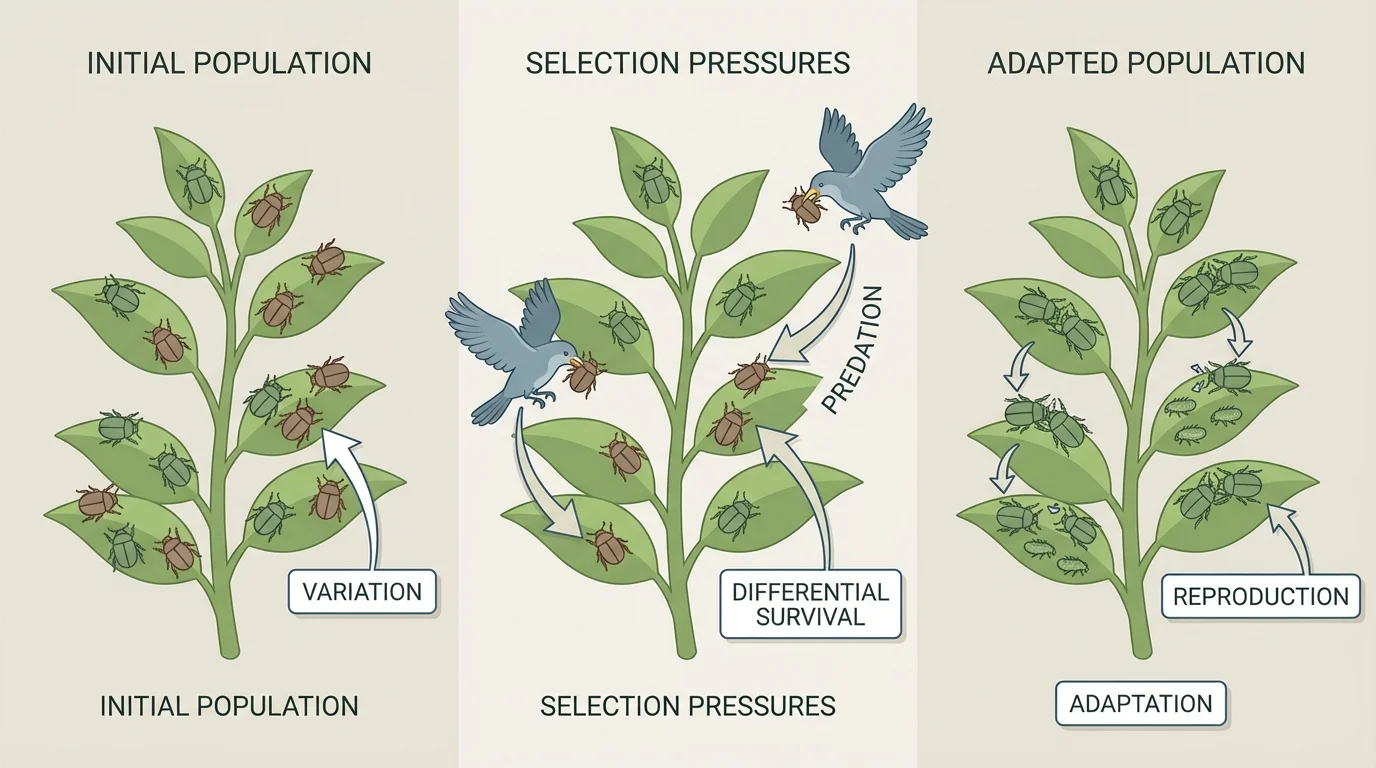
This process does not require planning, need, or intention. Beetles do not decide to become green. The environment does not redesign them. The population already contains differences, and selection changes the frequency of those differences over time.
How selection produces adaptation
Natural selection acts on individuals because individuals either survive and reproduce or they do not. But the long-term result appears at the population level, because the proportion of inherited traits changes from one generation to the next. That is why biologists say populations evolve, while natural selection acts on individuals.
In this topic, an evidence-based explanation must connect three ideas: trait variation, environmental pressure, and differential reproductive success. If one of those links is missing, the explanation is incomplete.
Natural selection does not happen just because organisms exist. Several conditions are required. First, individuals in a population must differ in their traits. Second, at least some of those differences must be inherited, meaning they can be passed from parents to offspring through genes. Third, more offspring are produced than can survive, creating competition. Fourth, individuals with certain inherited traits must survive or reproduce more successfully than others.
These conditions can be summarized as a chain of cause and effect. If there is heritable variation, and if the environment causes some variants to leave more offspring, then trait frequencies can change in later generations. Without heritable variation, selection cannot build adaptation.
Not every change in a population is caused by natural selection. Some changes happen by chance, especially in small populations. However, when a trait consistently improves success in a specific environment and becomes more common as a result, natural selection is the best explanation.
Genes are segments of DNA that influence traits. Different versions of a gene are called alleles. A trait can be affected by one gene, many genes, and also environmental conditions, but for natural selection to produce evolutionary change, the trait must have a heritable component.
Mutation is the original source of new genetic variation. Mutations are random changes in DNA. Most are neutral or harmful, but some create differences that can become useful in a given environment. Recombination during sexual reproduction also creates new combinations of existing alleles.
The phrase selective pressure refers to an environmental factor that influences which individuals survive and reproduce. Predators, disease, temperature, water availability, food type, pollution, and competition can all act as selective pressures.
A trait is not simply "good" or "bad" on its own. Its value depends on context. Thick fur is helpful in a cold climate but may be disadvantageous in a hot one. Camouflage that works on dark volcanic rock may fail on pale sand. A beak shape that cracks hard seeds may be useful during drought but less useful when small soft seeds are abundant.
This is why adaptation is always tied to a specific environment. If conditions change, the traits favored by selection may also change. A population that was well adapted under one set of conditions may become less well adapted under another.
Some evolutionary changes can be observed within human lifetimes. Insects have evolved resistance to pesticides, bacteria have evolved resistance to antibiotics, and some animal populations have shifted breeding times as climate patterns change.
Environmental influence includes reproduction, not just survival. A trait that helps an organism attract mates, defend territory, or care for offspring can also increase reproductive success and become more common.
One of the most common mistakes is saying that individual organisms evolve because they need to. Individuals can acclimate, learn, grow, or heal, but they do not evolve genetically during their lifetime. Evolution is a change in the genetic makeup of a population across generations.
Consider a simplified numerical example. Suppose a population of 100 mice includes 40 dark mice and 60 light mice. If dark mice survive predators better on dark rock, they may produce more offspring. After several generations, the population might include 70 dark mice and 30 light mice. No single mouse changed color because of need. Instead, the frequency of the dark-color trait increased in the population.
This population-level thinking is central to adaptation. An adaptation becomes common not because every organism develops it, but because organisms that already have the trait leave more descendants.
Tracing a population change
A plant population shows variation in drought tolerance. At the start, 25 out of 100 plants carry a trait that allows deeper root growth.
Step 1: Identify the starting frequency.
The drought-tolerant trait appears in \(\dfrac{25}{100} = 0.25\), or \(25\%\), of the population.
Step 2: Apply environmental pressure.
During several dry years, plants with deeper roots survive and reproduce more often than shallow-rooted plants.
Step 3: Compare later generations.
After many generations, 60 out of 100 plants show the drought-tolerant trait. The new frequency is \(\dfrac{60}{100} = 0.60\), or \(60\%\).
This evidence supports the explanation that drought acted as a selective pressure, leading to adaptation in the population.
When scientists write explanations, they often describe this as a change in allele frequency, although visible traits can also be used when the genetics are known or strongly inferred.
Scientific explanations must be supported by evidence, not just by plausible stories. Useful evidence includes field observations, measurements of survival and reproduction, controlled experiments, fossil sequences, DNA comparisons, and long-term studies of changing populations.
For example, biologists may compare trait frequencies before and after an environmental change. They may track which individuals survive a disease outbreak. They may analyze DNA to determine whether resistant individuals carry a specific mutation. They may also compare populations in different habitats to see whether different environments favor different traits.
Strong evidence-based explanations usually include a claim, the evidence supporting that claim, and the reasoning that connects the evidence to the scientific principle of natural selection.
| Type of evidence | What it can show | Example |
|---|---|---|
| Direct observation | Which individuals survive or reproduce more | Birds eat more visible insects |
| Experimental data | Cause-and-effect relationships | Antibiotic treatment kills non-resistant bacteria |
| Genetic evidence | Which alleles are linked to a trait | Mutation associated with resistance |
| Fossil evidence | Change over long periods | Shifts in body form through time |
| Comparative studies | Different environments favor different traits | Different beak sizes on islands with different food sources |
Table 1. Common forms of evidence used to explain natural selection and adaptation.
As seen earlier in [Figure 1], one powerful pattern is repeated across many organisms: visible or vulnerable individuals leave fewer offspring when a particular environment makes their trait disadvantageous.
The rock pocket mouse provides a classic example of how environment influences survival and reproduction, as [Figure 2] illustrates. In the southwestern United States, some mice live on dark lava flows while others live on light-colored desert sand and rock. These mice show heritable variation in fur color.
Owls and other predators hunt using sight. On dark lava, dark mice are harder to see, while light mice are more visible. On pale ground, the pattern reverses: light mice are better camouflaged, and dark mice stand out more. This means predation creates different selective pressures in different habitats.
Genetic studies show that fur color differences are linked to mutations affecting pigmentation. In dark habitats, alleles for dark fur become more common because dark mice survive and reproduce more successfully. In light habitats, alleles for light fur are favored.
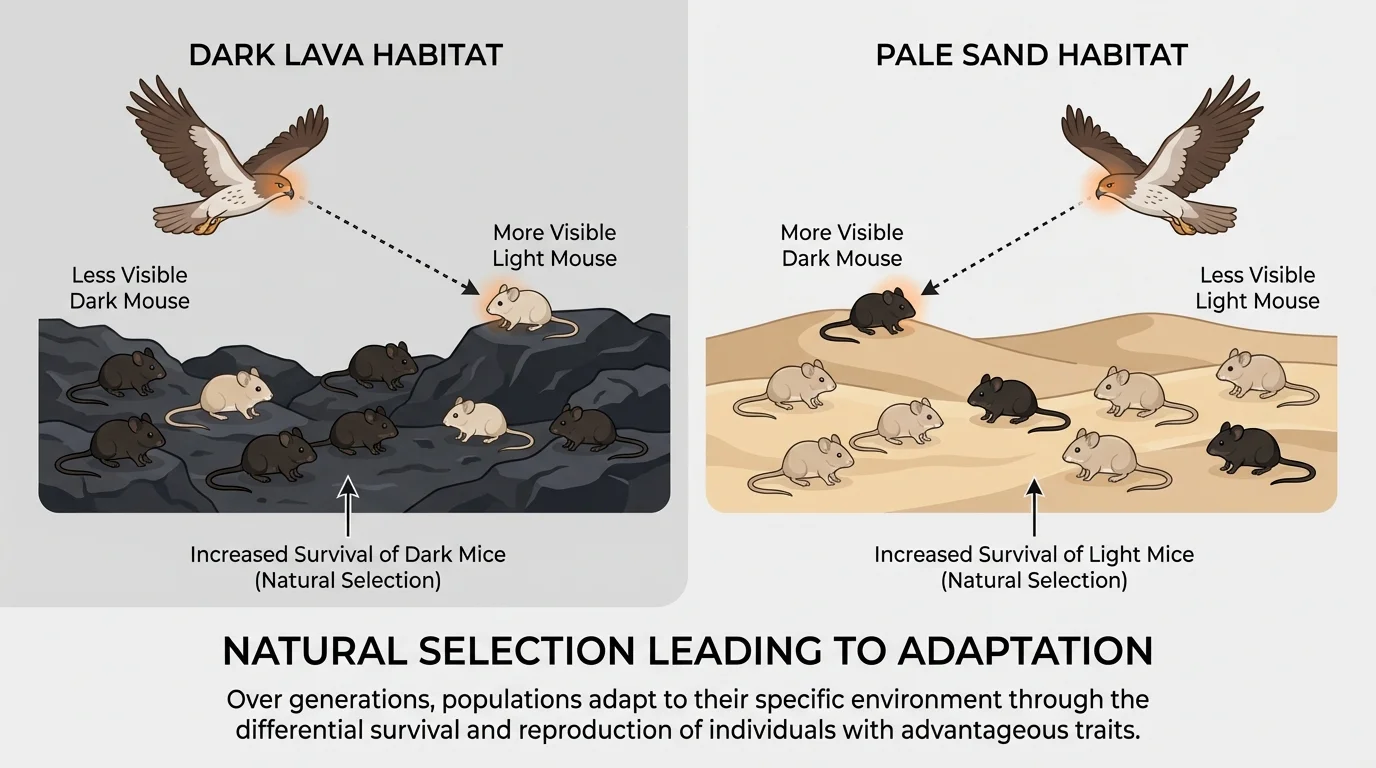
This is strong evidence for adaptation because the trait, the environmental difference, and the survival advantage all align. The explanation is not just that dark mice exist, but that dark mice leave more offspring on dark backgrounds. Later, when considering how selection depends on context, [Figure 2] remains important because it shows the same trait can be helpful in one place and harmful in another.
Antibiotic resistance is one of the clearest modern examples of evolution by natural selection, and [Figure 3] shows the basic pattern. A bacterial population may contain variation because of random mutations. Some bacteria may carry a mutation that reduces the antibiotic's effect.
When an antibiotic is used, most bacteria without resistance die. Resistant bacteria are more likely to survive. Because bacteria reproduce rapidly, the survivors can produce a large new population in a short time. The next generation contains a much higher proportion of resistant bacteria.
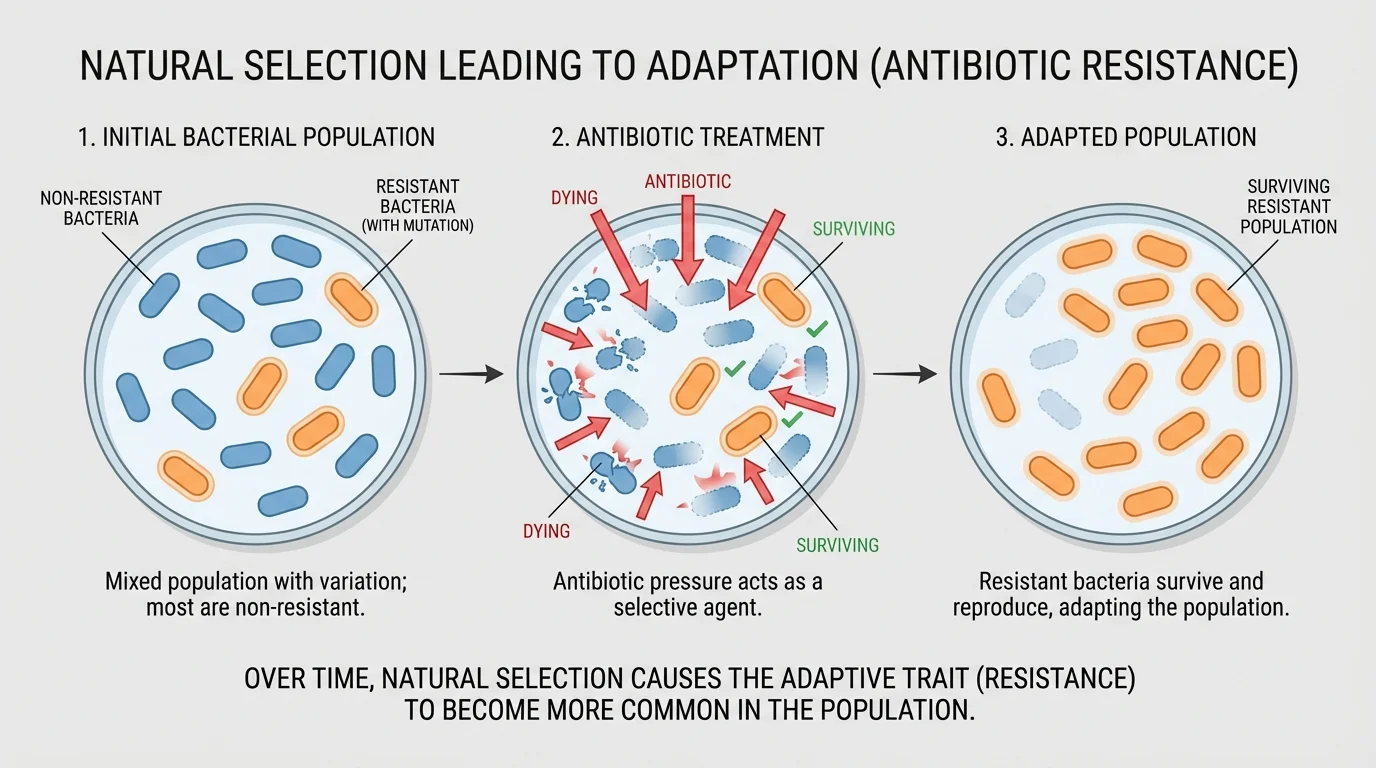
The antibiotic does not create the needed mutation in response to the bacteria's "need." Instead, the mutation is already present in some cells or arises randomly. The antibiotic acts as the selective pressure that favors resistant individuals.
This example matters far beyond biology class. In medicine, understanding natural selection helps explain why antibiotics should be used correctly. If treatment is stopped too early, surviving bacteria may reproduce and spread resistance. The same logic applies to pesticide resistance in agriculture and antiviral resistance in some diseases.
Claim-evidence-reasoning using antibiotic resistance
Step 1: Claim
Bacterial populations can become adapted to the presence of an antibiotic through natural selection.
Step 2: Evidence
Before treatment, a few bacteria in the population carry a resistance mutation. After treatment, most non-resistant bacteria die, while resistant bacteria survive and reproduce.
Step 3: Reasoning
Because resistance is inherited by daughter cells and resistant bacteria leave more offspring in the antibiotic environment, the resistance trait becomes more common over generations.
The same logic connects back to camouflage examples like [Figure 1]: in both cases, individuals with an inherited advantage leave more descendants, so the population changes.
On the Galápagos Islands, finch populations show variation in beak size and shape. As [Figure 4] shows, this variation becomes especially important when the environment changes. During drought years, small soft seeds may become scarce, while larger harder seeds remain.
Finches with deeper or stronger beaks can crack hard seeds more effectively, so they are more likely to survive and reproduce during those years. Researchers Peter and Rosemary Grant collected detailed data showing that after drought, the average beak size in some finch populations increased.
This is a valuable example because it combines field observation with measurable change. Scientists recorded which birds survived, what food was available, and how beak traits shifted in the next generation. That combination of evidence makes the explanation strong.
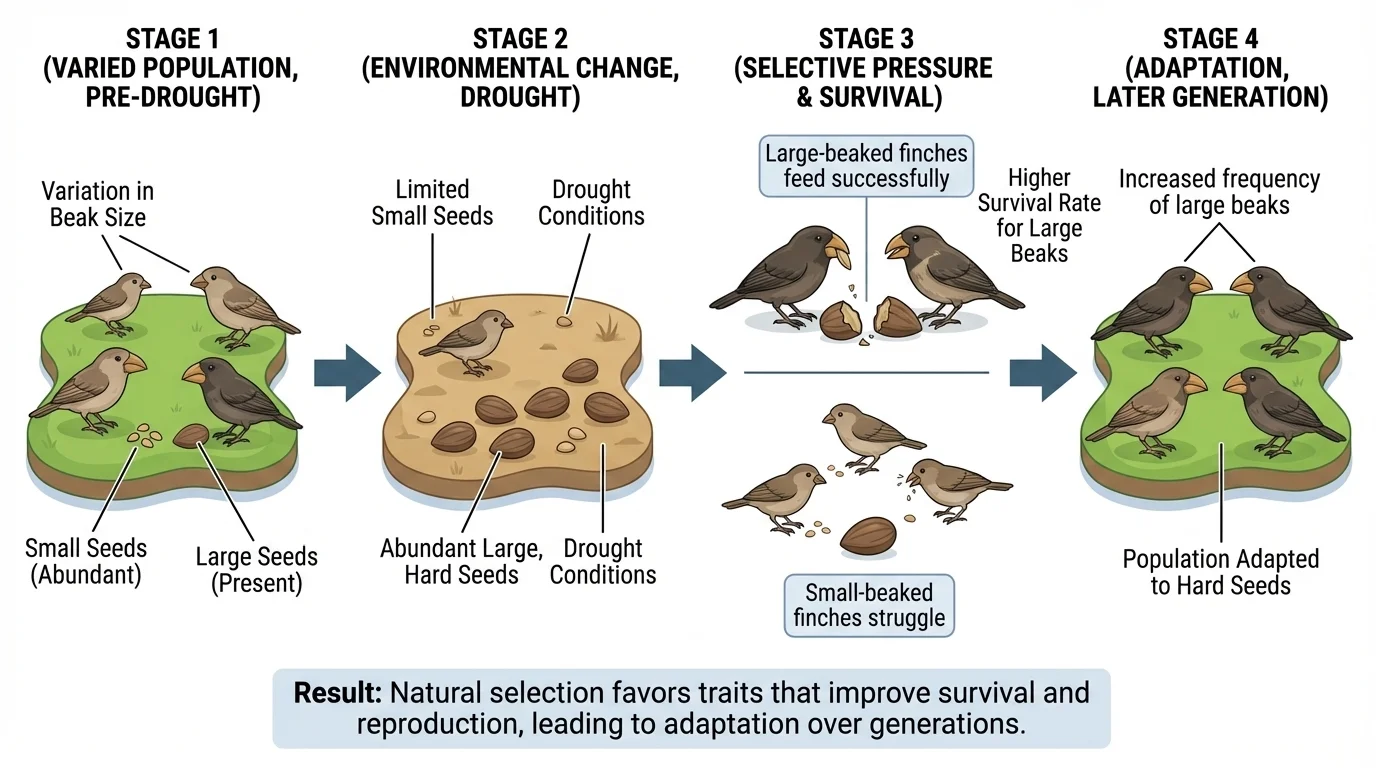
The finch example also shows that adaptation is dynamic. If environmental conditions shift again, different beak traits may be favored. Natural selection does not move toward a perfect final form; it tracks what works better under current conditions.
One misconception is that organisms evolve because they try to adapt. Effort does not create heritable genetic change. Another is that evolution always produces more complex organisms. Natural selection favors whatever improves reproductive success in a given environment, whether that leads to greater complexity, simplicity, or no obvious change in appearance.
Another common misunderstanding is the phrase "survival of the fittest." In biology, fitness means reproductive success, not just strength, speed, or aggression. An organism is biologically fit if it leaves more viable offspring than others. Camouflage, disease resistance, timing of reproduction, and mate choice can all affect fitness.
The rock pocket mice in [Figure 2] make this clear: the "fittest" mice are not the strongest in an absolute sense, but the ones whose fur color best matches their habitat and therefore helps them avoid predators.
"It is not the strongest of the species that survives, nor the most intelligent that survives. It is the one most adaptable to change."
— Commonly attributed to Charles Darwin
Even though this quotation is not a direct line from Darwin's published work, it captures an important truth: environmental change can shift which traits are favored.
To construct a convincing explanation for adaptation, state a clear claim, support it with evidence, and explain how the evidence demonstrates natural selection. A strong explanation usually answers these questions: What variation existed? Which traits were inherited? What environmental pressure was present? Which organisms survived or reproduced more? How did the population change over generations?
For example, a strong explanation of finch adaptation would not stop at "finches developed larger beaks." It would say that finches already varied in beak size, drought changed the available food supply, birds with larger beaks survived better on harder seeds, and because beak traits were heritable, larger beaks became more common in later generations.
In the same way, [Figure 3] supports an explanation only when paired with reasoning: resistant bacteria survive antibiotic treatment, pass resistance to descendants, and therefore increase in frequency in the population.
Claim, evidence, and reasoning
A claim states what happened. Evidence provides observations or data. Reasoning uses scientific principles to connect the evidence to the claim. In evolution, the reasoning usually depends on heredity, variation, and differential survival or reproduction.
Scientists often strengthen explanations by considering alternative causes. Could the pattern be random? Could migration explain the change? Could the trait be caused only by environment and not heredity? The best explanation is the one most strongly supported by the evidence.
Humans constantly alter environments, and those changes can drive natural selection. Urban pollution, climate change, habitat fragmentation, overuse of antibiotics, and pesticide application all create new selective pressures. Some species adapt quickly, while others cannot keep pace.
In conservation biology, understanding adaptation helps scientists decide how to protect genetic diversity. Populations with more genetic variation are often better able to respond to environmental change. In agriculture, breeders and farmers must manage pest resistance. In public health, doctors and researchers monitor the evolution of pathogens to guide treatment strategies.
Natural selection is therefore not only a foundational idea in biology but also a practical tool for solving real-world problems. It helps explain why flu viruses are monitored yearly, why overprescribing antibiotics is risky, and why protecting diverse populations matters for the future of ecosystems.
