Tree bark darkens because of pollution. A lake warms by just a few degrees. A mountain range rises and splits a population in two. These shifts may seem local or gradual, but they can change the history of life. The same kind of environmental change can help one species flourish, drive another to extinction, and over long spans of time contribute to the formation of entirely new species. Biology becomes most powerful when we do not just memorize these outcomes, but examine the evidence that supports them.
Environmental conditions include factors such as temperature, rainfall, food supply, predators, disease, available shelter, competition, and the chemistry of air, water, or soil. Organisms do not respond to these factors in exactly the same way. Individuals in a population vary. Some variation is inherited, and when a trait improves survival or reproduction under a particular set of conditions, that trait can become more common over generations.
To evaluate claims about evolution and population change, scientists ask careful questions: What changed in the environment? Which organisms were affected? Did survival or reproduction change? Is there evidence over many generations? Are there multiple lines of evidence pointing to the same conclusion? Those questions matter because a scientific claim is stronger when it is supported by repeated observations, experiments, fossils, genetic data, and long-term records rather than by a single dramatic example.
A population is a group of individuals of the same species living in the same area. A species is generally defined as a group of organisms that can interbreed and produce fertile offspring. Environmental change affects populations first, because individuals either survive and reproduce or fail to do so.
Natural selection is the process by which individuals with inherited traits that are better suited to their environment tend to survive and reproduce more successfully than others. Speciation is the formation of new species over time, usually after populations become genetically different and reproductively isolated. Extinction is the permanent disappearance of a species.
Evidence in biology can come from different sources. Direct observations in living populations can show that certain traits become more common after an environmental shift. Fossils reveal organisms that lived in the past and how forms changed through time. DNA comparisons show how closely related different groups are and help scientists reconstruct common ancestry. Laboratory experiments and field studies test how environmental factors affect survival, reproduction, and mutation rates. The strongest scientific explanations usually combine several of these forms of evidence.
It is also important to separate adaptation from short-term adjustment. If a lizard basks in the sun to warm itself, that is a behavior of an individual. If, over many generations, lizards with traits that help them tolerate heat leave more offspring and those traits spread through the population, that is evolutionary change. This distinction helps explain why some claims involve immediate population increases while others involve long-term speciation or extinction.
Some environmental changes create opportunities. A species may find more food, fewer predators, less competition, or new habitat. In those cases, the number of individuals can increase. This happens when the changed environment improves survival rates, reproduction rates, or both. If more individuals survive to reproductive age and produce offspring, population size can rise.
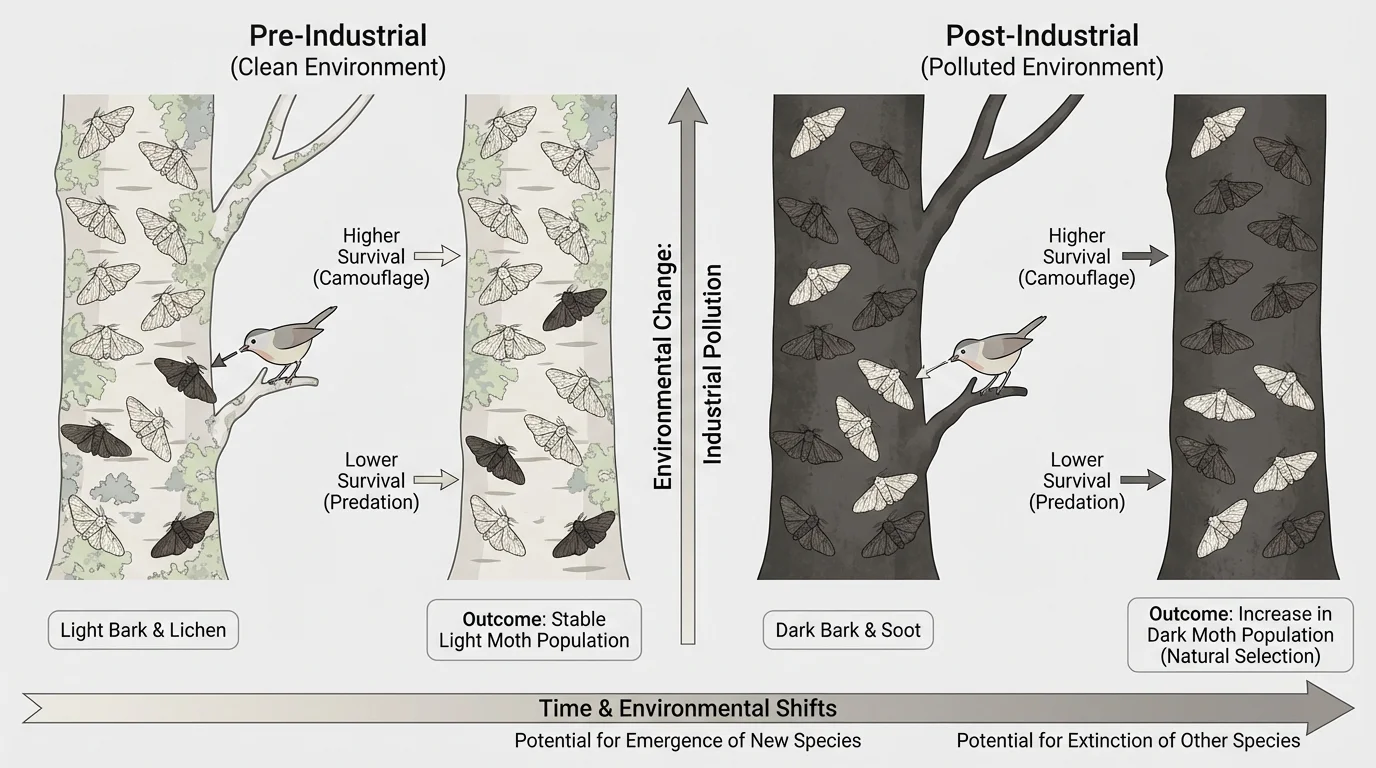
[Figure 1] One classic example is the peppered moth in England. Before heavy industrial pollution, many tree trunks were light-colored because they were covered with lichens. Light-colored moths were better camouflaged, while darker moths were easier for birds to see. During the Industrial Revolution, soot darkened tree bark and killed many lichens. Under those new conditions, darker moths became harder to spot, survived more often, and increased in number. Later, when pollution controls reduced soot and lichens returned, the pattern shifted again. This is strong evidence because the environmental change, the trait difference, and the change in survival were all documented.
Population increases can also happen when humans unintentionally create favorable conditions. White-tailed deer populations have increased in some regions because predators were removed, forests were fragmented into edge habitats they can use, and suburban landscaping provided food. Similarly, some pest insects and rodents thrive in cities where food waste is abundant. These examples show that environmental change does not have to be natural to affect evolution and population size.
Another kind of evidence comes from organisms that expand when temperature or nutrient conditions change. Harmful algal blooms can increase when water becomes warmer or when excess nutrients from fertilizers run into lakes and coastal waters. Not every increase is evolutionary in the long term, but these events still show how environmental conditions can rapidly favor some species over others. If the conditions persist, natural selection may then favor individuals best suited to the altered environment.
A useful way to think about this is that population size depends on births, deaths, immigration, and emigration. Environmental conditions strongly influence the first two. If a drought reduces plant growth, herbivores may decline. If a mild winter increases food availability and survival, some populations may increase. The moth example in [Figure 1] makes this clearer: camouflage changed the likelihood of being eaten, which changed survival and, over generations, the number of individuals with certain traits.
Case study: antibiotic resistance in bacteria
Bacteria reproduce quickly, so environmental change can lead to visible evolutionary change in a short time.
Step 1: A bacterial population contains inherited variation. A few individuals may carry genes that make them less affected by an antibiotic.
Step 2: The antibiotic changes the environment. Susceptible bacteria die, but resistant bacteria survive at a higher rate.
Step 3: The surviving resistant bacteria reproduce. After many generations, resistant individuals make up a larger share of the population.
This evidence supports the claim that environmental conditions can increase the number of resistant individuals within a population. It also matters in medicine because overuse of antibiotics favors resistant strains.
When evaluating such claims, scientists look for before-and-after data, measurable differences in survival or reproduction, repeatable patterns, and evidence that the traits involved are heritable. Without heritability, a temporary population increase may not tell us much about evolution.
The emergence of a new species usually takes much longer than a population increase. It requires that populations diverge genetically until they no longer interbreed successfully. Environmental change can start or accelerate this process, especially when it separates populations or exposes them to different selective pressures.
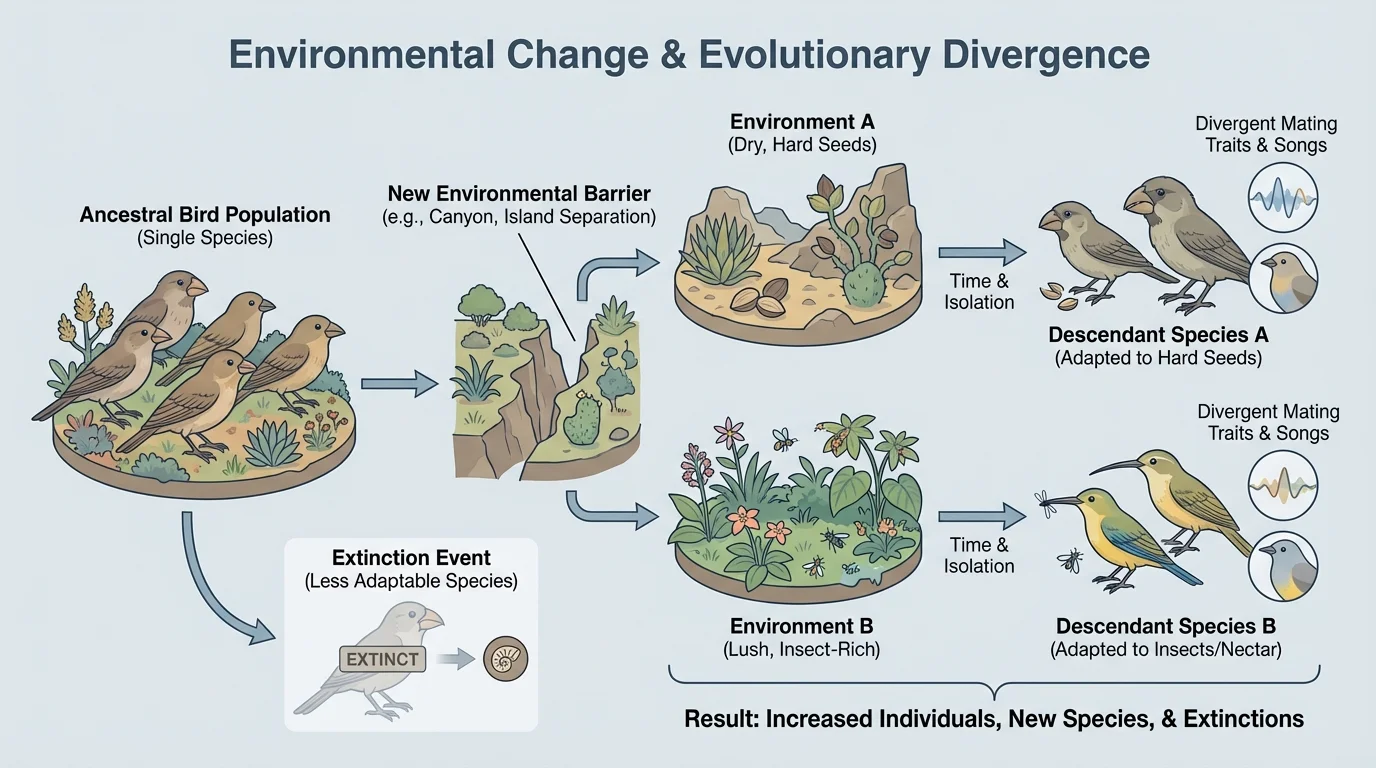
[Figure 2] One major pathway is reproductive isolation. If a river changes course, a glacier advances, a mountain range rises, or a group of organisms colonizes an island, members of one population may become geographically separated from others. Once gene flow is reduced or stopped, the two groups experience different mutations, different selective pressures, and often different behaviors. Over many generations, these differences can become large enough that even if the groups meet again, they no longer mate successfully.
Darwin's finches on the Galápagos Islands provide strong evidence. These birds likely descended from a common ancestral population. Different islands had different food sources and environmental conditions. Over time, populations evolved distinct beak sizes and shapes that matched their diets. Genetic evidence supports their close relationship, while anatomical differences and behavior show divergence. The environment did not instantly create new species; instead, environmental differences guided natural selection across many generations.
African cichlid fishes in the Great Lakes provide another striking case. Lakes can contain many closely related cichlid species that differ in color, jaw shape, feeding strategy, and habitat use. Changes in water level, light conditions, and habitat structure may isolate groups or alter selection pressures. Researchers use DNA evidence, observations of mating behavior, and ecological data to infer how these species diversified.
Speciation does not always require a physical barrier. Sometimes populations living in the same general area begin using different resources, breeding at different times, or preferring different mates. Over time, those differences can also reduce gene flow. However, for high school biology, geographic separation is often the clearest model because the evidence is easier to track.
The fossil record also supports the claim that new species emerge over time. Fossils reveal transitional forms and sequences in which related organisms change gradually or in branching patterns. Scientists compare the age of rock layers, anatomical structures, and increasingly, molecular clocks based on DNA differences. No single fossil proves speciation by itself, but patterns across many fossils and many lineages strongly support evolutionary branching.
The idea of divergence becomes easier to visualize when compared with [Figure 2]. Once two populations experience different environments and stop exchanging genes, each population follows its own evolutionary path. Over long timescales, that can produce new species with distinct traits, ecological roles, and behaviors.
Some new plant species can form much faster than animal species when errors in cell division create extra sets of chromosomes. This process is called polyploidy and can instantly prevent successful breeding with the original population.
Even in fast cases, scientists still need evidence. They examine chromosome numbers, breeding compatibility, genetic divergence, and ecological differences before concluding that a true new species has formed.
Environmental change does not guarantee success. If conditions shift too far, too fast, or in too many ways at once, a species may be unable to survive. A species is at risk of extinction when individuals cannot find enough food, avoid predators, tolerate new temperatures, resist disease, or reproduce successfully under the new conditions.
[Figure 3] Rate matters. Evolution by natural selection works across generations, so species with long generation times may struggle when environments change rapidly. Large mammals, many trees, and specialized species often cannot adapt as quickly as bacteria or insects. If a wetland dries, a coral reef overheats, or an island forest is cleared, populations may decline before beneficial traits can spread widely enough to matter.
The fossil record documents many extinctions. Some were linked to dramatic events such as asteroid impact or massive volcanic eruptions, which changed climate and food webs. Others occurred more gradually as environments shifted over long periods. Fossils provide evidence that extinction is a normal part of Earth's history, but current extinction rates are strongly influenced by human activity, including habitat destruction, pollution, overharvesting, climate change, and the spread of invasive species.
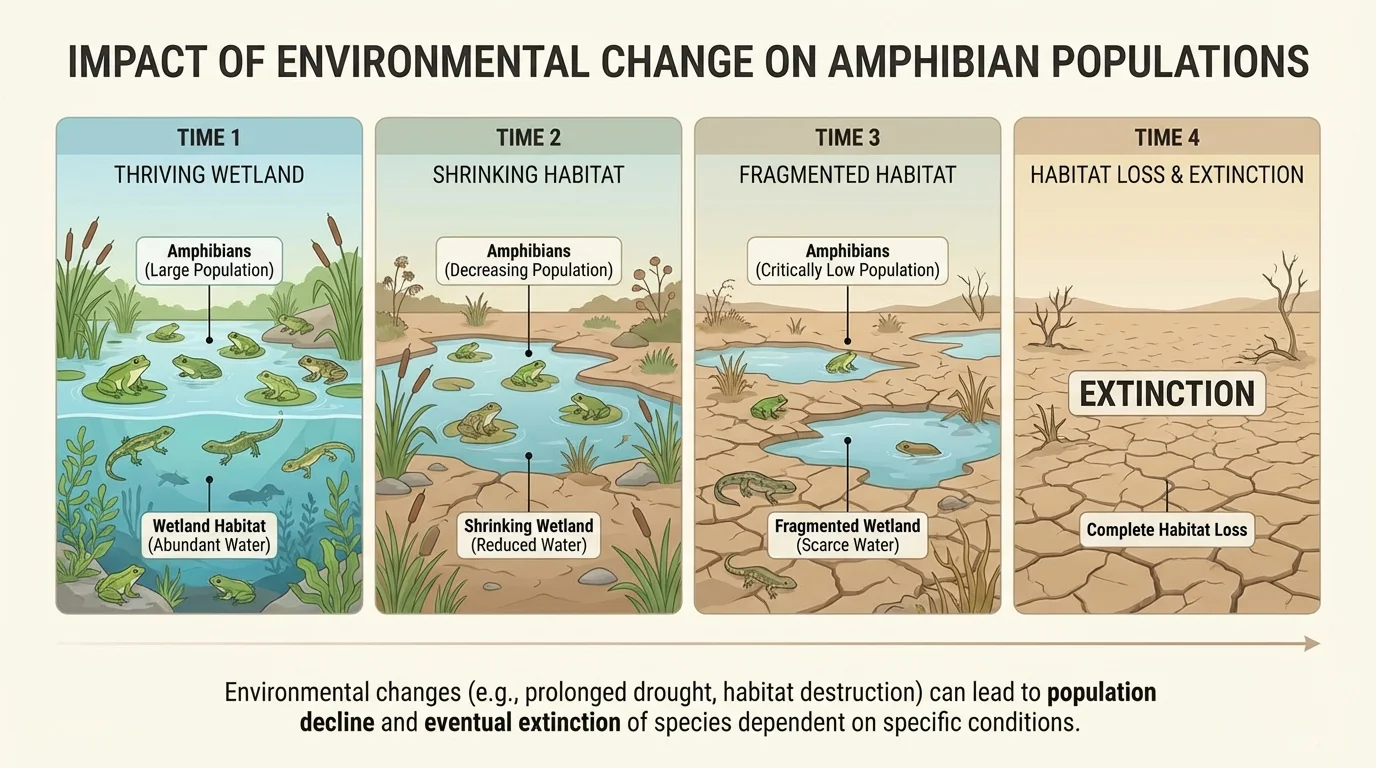
Modern examples are especially powerful because scientists can collect direct data. Amphibians are declining worldwide due to habitat loss, pollution, climate stress, and a fungal disease called chytridiomycosis. Coral reefs are suffering from bleaching when ocean temperatures rise. During bleaching, corals lose the symbiotic algae that provide much of their energy. If heat stress continues, many corals die. These cases support extinction claims because researchers can measure environmental change, physiological stress, reduced reproductive success, and long-term population decline.
Specialization often increases extinction risk. A species adapted to one narrow set of conditions may thrive while those conditions last, but become vulnerable if they disappear. Generalists, by contrast, can often use a wider range of foods or habitats. The shrinking-habitat pattern shown in [Figure 3] helps explain why specialists in wetlands, reefs, or alpine zones may be hit especially hard when those systems change.
Why some species survive while others disappear
Extinction risk depends on several interacting factors: how much variation exists in the population, how fast the environment changes, how quickly the species reproduces, whether it can migrate to suitable habitat, and whether humans reduce or increase the stress. Evolution is powerful, but it is not unlimited. Natural selection can only work with the variation already present or produced by mutation.
Evaluating extinction evidence also requires caution. A species may become locally absent without being globally extinct. Scientists therefore use repeated surveys, historical records, habitat assessment, and sometimes environmental DNA sampled from water or soil to determine whether a species still exists in an area.
The best biological explanations do not rely on a single type of evidence. Scientists compare field observations, experiments, fossils, genetic relationships, and long-term datasets. When independent lines of evidence point to the same conclusion, confidence in the claim increases.
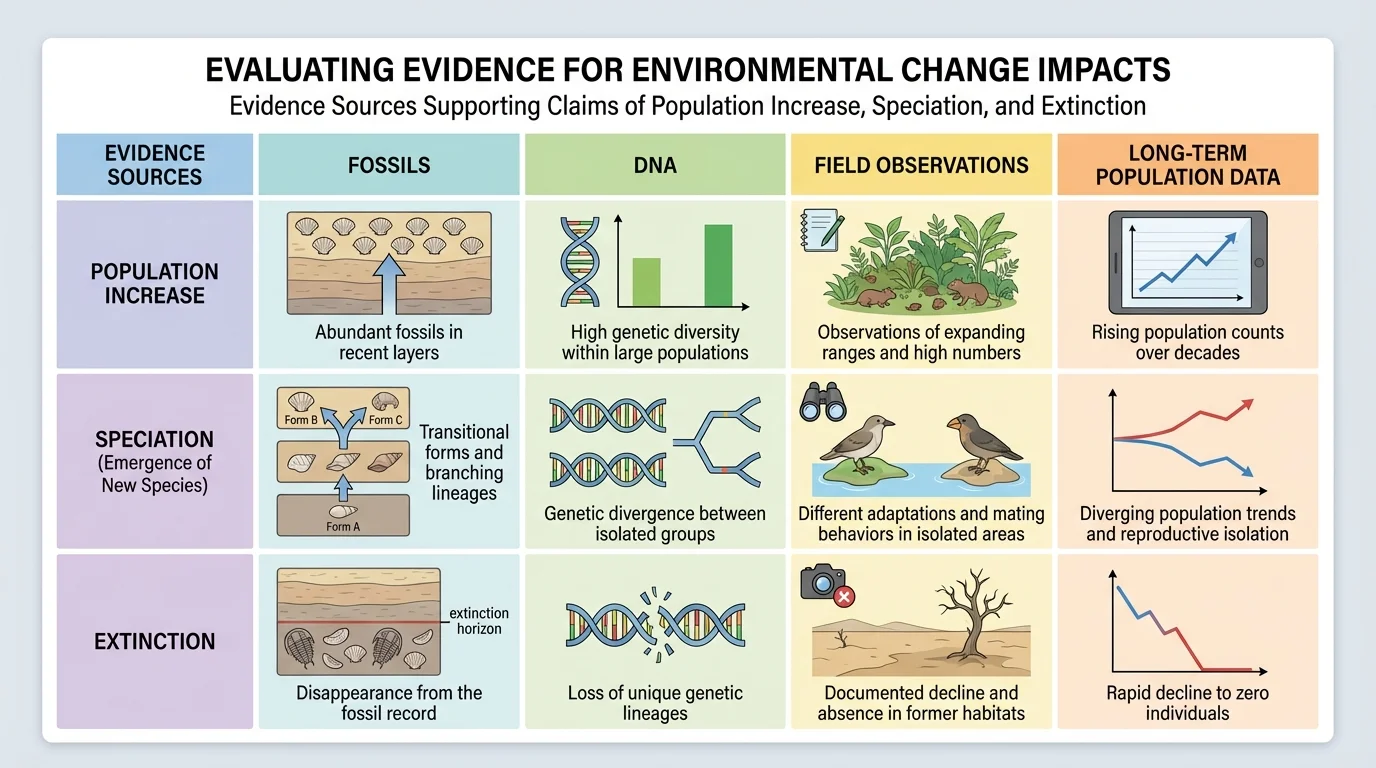
[Figure 4] For example, a claim that environmental change increased a population is strongest when researchers can show a specific environmental shift, measure increased survival or reproduction, and rule out alternative explanations. A claim about speciation is strongest when scientists can demonstrate reduced gene flow, accumulating genetic differences, ecological divergence, and evidence that the groups no longer interbreed successfully. A claim about extinction is strongest when there is long-term evidence of decline, an identified environmental pressure, and exhaustive searches showing the species is gone.
| Claim | Strong evidence | Why it matters |
|---|---|---|
| Population increase | Field counts, survival data, reproduction data, trait frequency changes | Shows that the new conditions favor some individuals or groups |
| New species over time | DNA divergence, reproductive isolation, fossil patterns, ecological differences | Shows branching evolution rather than simple short-term change |
| Extinction | Long-term decline records, habitat loss data, fossil disappearance, repeated failed surveys | Shows that a species could not persist under changed conditions |
Table 1. Evidence commonly used to support claims about population increase, speciation, and extinction.
One challenge in science is distinguishing correlation from causation. If a bird population declines during a hot decade, heat may be involved, but other factors such as disease, food shortages, or habitat fragmentation may also matter. Scientists use controlled experiments when possible and carefully designed observational studies when experiments are not possible. They look for mechanisms, not just patterns.
Another challenge is timescale. Population increases may be visible in a few years. Speciation may take thousands or millions of years. Extinction may be rapid in some cases and prolonged in others. The evidence we use depends on the timescale involved. Fossils are especially useful for deep time, while satellite imagery, tagging studies, and DNA sequencing are especially useful for modern populations. The evidence framework summarized in [Figure 4] helps compare which tools fit which kind of claim.
These ideas are not limited to textbook examples. Conservation biologists use them to predict which species are most at risk as climates shift and habitats become fragmented. Public health experts use evolutionary evidence to track how pathogens respond to drugs. Farmers and agricultural scientists study how pests adapt to pesticides and how crop varieties respond to drought, salinity, and disease.
Restoration ecology also depends on evaluating evidence. If a damaged habitat is restored, scientists ask whether native species return, whether food webs recover, and whether the conditions support long-term reproduction rather than only short-term survival. In this way, understanding environmental change helps guide practical decisions about protected areas, wildlife corridors, fisheries, and ecosystem management.
Evolution does not happen because organisms "try" to change. Variation already exists in populations, and the environment influences which inherited traits are more likely to be passed on. Over many generations, that process can increase some populations, split lineages into new species, or contribute to extinction.
The central idea is both simple and profound: environmental conditions influence survival and reproduction, but the outcomes vary. Some species benefit, some diverge, and some disappear. The scientific task is to examine the evidence carefully enough to determine which outcome is happening and why.
