One of the most remarkable facts in science is that when astronomers look far into space, they are also looking far into the past. The light from distant galaxies has traveled for millions or even billions of years before reaching Earth, so telescopes do much more than show us what is "out there." They let us investigate the history of the universe itself. From that evidence, scientists built the Big Bang theory, the leading explanation for how the universe began in an extremely hot, dense state and then expanded over time.
The Big Bang theory is not just an account of beginnings. It is an explanation supported by measurable evidence. Three of the most important clues come from the study of spectra, the motion of distant galaxies, and the composition of matter in the universe. A fourth major clue, the cosmic microwave background, strengthens that explanation even more. Together, these observations form a powerful scientific argument.
In everyday speech, people sometimes use the word "theory" to mean a guess. In science, a theory is very different. A scientific theory is a well-supported explanation based on evidence, testing, and repeated observations. The Big Bang theory does not mean that scientists know every detail about the universe. It means that the main idea of an expanding universe that was once much hotter and denser is strongly supported by data.
Big Bang theory is the scientific explanation that the universe began in an extremely hot, dense state and has been expanding and cooling over time.
Evidence in science is information from observations or experiments that supports or challenges an explanation.
The theory does not say that the universe exploded like a bomb into empty space from one location. Instead, it says that space itself has been expanding. That difference matters. When astronomers say galaxies are moving away from one another on large scales, they mean the distances between them increase as space expands.
Almost everything astronomers know about stars and galaxies comes from light. Light carries information about an object's temperature, composition, motion, and distance. Since light takes time to travel, a galaxy that is 100 million light-years away is seen as it was 100 million years ago.
This is why astronomy is such a powerful historical science. Geologists read Earth's past in rocks. Astronomers read cosmic history in light. By comparing light from nearby stars, distant galaxies, and faint radiation left over from the early universe, scientists can build an evidence-based timeline of cosmic change.
Recall that light behaves as a wave. One important property of a wave is its wavelength, the distance from one crest to the next. Different wavelengths of visible light correspond to different colors, with red light having a longer wavelength than blue light.
Modern observatories use spectroscopes, digital detectors, and computer analysis to separate incoming light into detailed patterns. That process is similar to how a prism separates white light into a rainbow, but scientific instruments can measure wavelengths far more precisely than the human eye.
A light spectrum is a band or pattern of light arranged by wavelength, and astronomers treat these patterns like fingerprints, as [Figure 1] shows. Every chemical element interacts with light in a specific way, so elements can be identified by the lines they produce or absorb.
There are three common kinds of spectra. A continuous spectrum contains all wavelengths in a smooth band. An emission spectrum shows bright lines at specific wavelengths. An absorption spectrum shows dark lines where certain wavelengths are missing because atoms absorbed them. If astronomers observe a star's absorption lines and those lines match the known pattern for hydrogen or helium, they can conclude that those elements are present in the star.
This method is one reason the study of stars matters so much. The same physical laws that govern atoms in a laboratory on Earth also apply in distant stars. When scientists compare known atomic spectra with starlight, they find that stars contain many of the same elements found on Earth, especially hydrogen and helium.
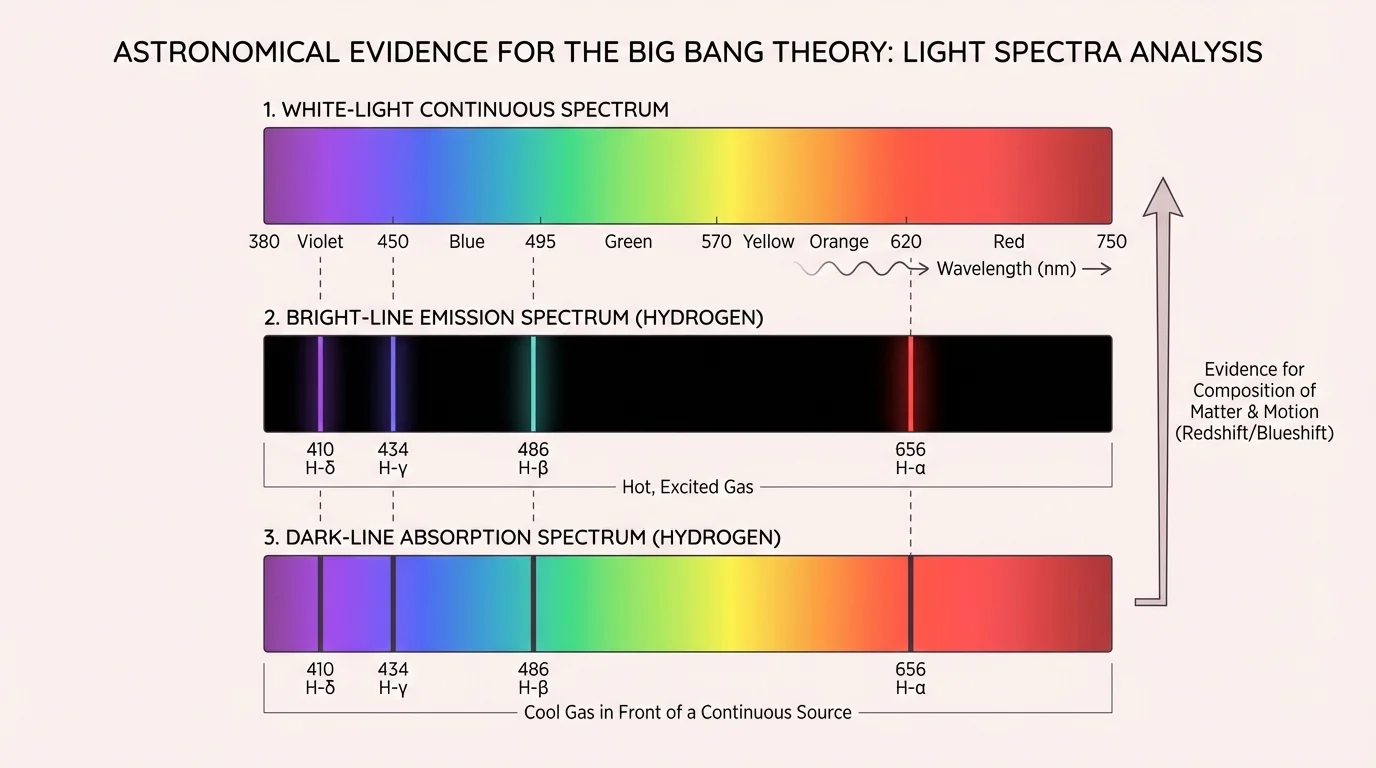
For example, hydrogen produces a distinctive set of spectral lines. If those lines appear in a star's spectrum, the star contains hydrogen. Helium, sodium, calcium, and iron each have their own patterns as well. This is how astronomers can determine stellar composition without ever touching the star.
The same spectra also reveal motion. If the entire pattern of lines shifts slightly toward longer wavelengths, the source is moving away. If it shifts toward shorter wavelengths, the source is moving closer. This connection between light and motion becomes one of the most important pieces of evidence for the Big Bang.
Numeric example: wavelength shift
Suppose a particular spectral line of hydrogen is measured in a lab at wavelength \(500 \textrm{ nm}\).
Step 1: Use a simple redshift relationship
For small shifts, astronomers often describe redshift with the relationship below.
In astronomy, the simplified redshift formula is
\[z = \frac{\lambda_{\textrm{observed}} - \lambda_{\textrm{rest}}}{\lambda_{\textrm{rest}}}\]
If a line has a rest wavelength of \(500 \textrm{ nm}\) and is observed at \(525 \textrm{ nm}\), then \(z = \dfrac{525 - 500}{500} = \dfrac{25}{500} = 0.05\). That positive value means the light is redshifted, so the object is moving away from us.
When astronomers observe the redshift of distant galaxies, they find that most galaxies show their spectral lines shifted toward longer wavelengths, as [Figure 2] illustrates. Longer wavelengths correspond to the red end of the visible spectrum, so this shift is called redshift.
This idea is closely related to the Doppler effect. You may have heard it when an ambulance passes by: the siren sounds higher as it approaches and lower as it moves away. Light behaves in a similar way. If a galaxy is moving away, the light waves are stretched, increasing their wavelength. If it is moving closer, the wavelengths are compressed.
In the 1920s, Edwin Hubble and other astronomers found that distant galaxies are generally redshifted. Even more importantly, more distant galaxies tend to show greater redshift. This means they are receding faster. That relationship can be written as
\(v = H_0 d\)
where \(v\) is recession speed, \(d\) is distance, and \(H_0\) is the Hubble constant.
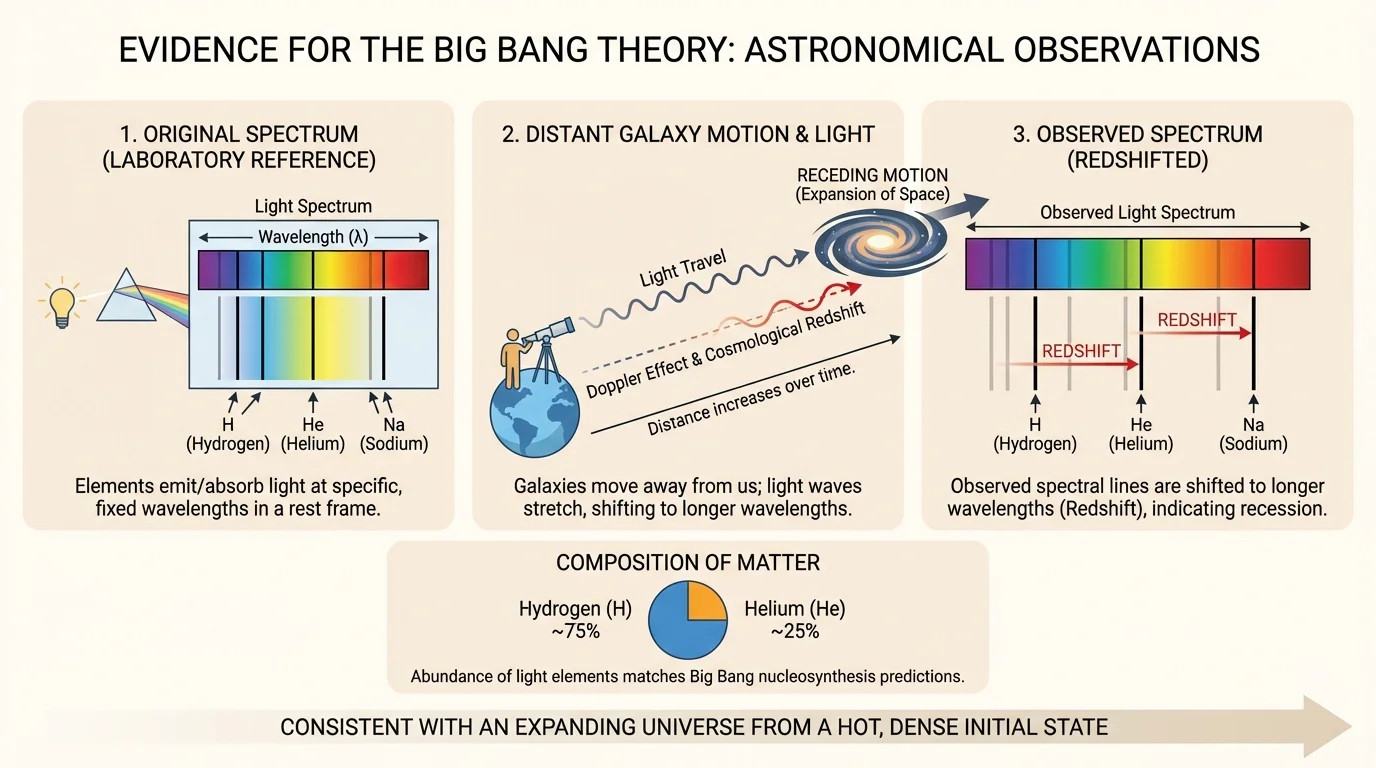
This equation does not mean every galaxy moves through space in the same simple way as a car on a highway. Instead, it describes a large-scale pattern: the universe is expanding. Galaxies that are farther away have had more expanding space between us and them, so their light usually shows larger redshifts.
A simple numerical example helps. If we use a rough value of \(H_0 = 70 \dfrac{\textrm{km/s}}{\textrm{Mpc}}\), then a galaxy at \(100 \textrm{ Mpc}\) has an approximate recession speed of \(v = 70 \times 100 = 7{,}000 \textrm{ km/s}\). A galaxy at \(200 \textrm{ Mpc}\) would have \(v = 70 \times 200 = 14{,}000 \textrm{ km/s}\). The more distant galaxy recedes faster, matching the expansion pattern.
Why redshift supports expansion
If galaxies in many directions are mostly redshifted, the universe is not static. A static universe would not produce this widespread pattern. Redshift shows that, on large scales, space is expanding and carrying galaxies farther apart over time.
Later, when scientists connect this evidence back to the early universe, they reason in reverse: if the universe is expanding now, then it must have been smaller, denser, and hotter in the past. The spectral evidence is therefore not just about galaxy motion; it is also evidence about cosmic history.
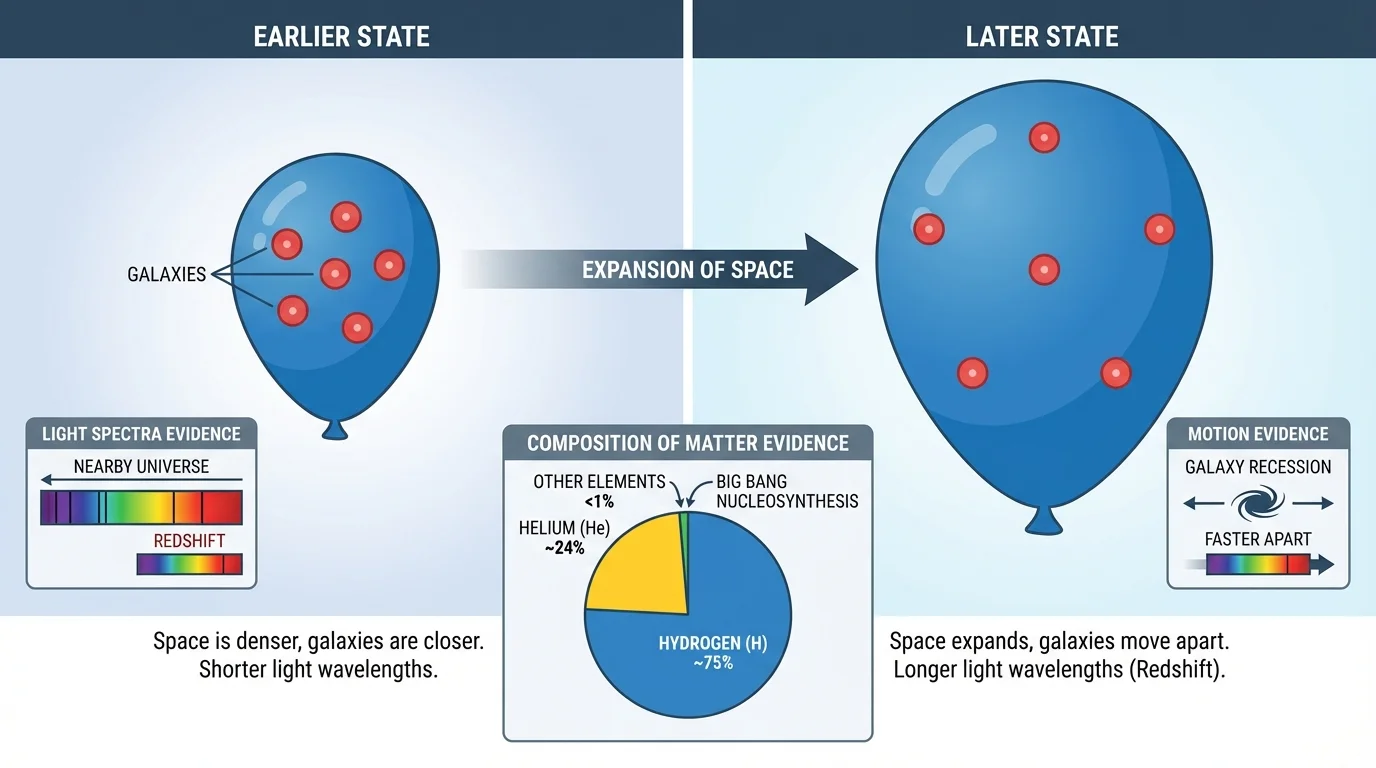
If the distance between galaxies increases with time, as [Figure 3] shows through the expanding-space analogy, then running the cosmic "movie" backward suggests that matter and energy were once packed much closer together. This does not prove every detail of the earliest moment, but it strongly supports the conclusion that the universe began in a very hot, dense state.
A useful analogy is the surface of an inflating balloon with dots drawn on it. As the balloon expands, every dot moves farther from the others, even though no single dot is the center of the expansion on the surface itself. In a similar way, galaxies become more separated as space expands. The balloon analogy is not perfect, but it helps show why the Big Bang is about expanding space, not an explosion from one spot into empty surroundings.
Because an expanding universe cools over time, the early universe would have been much hotter than it is now. At high temperatures, matter and radiation behaved very differently from what we see today. That hot early state is essential for explaining the next line of evidence: the kinds of matter found throughout the universe.
Scientists estimate the universe's age by studying expansion rates, stellar evolution, and background radiation. While exact values are refined with better data, the broad conclusion remains the same: the universe has changed over immense spans of time, and the evidence points back to a much younger, hotter cosmos.
The composition of matter in the universe also supports the Big Bang theory. Observations show that ordinary matter in the universe is made mostly of hydrogen, with a large amount of helium and only small amounts of heavier elements. That pattern is not random.
According to Big Bang theory, the early universe was hot enough for nuclear reactions to occur during its first few minutes. In that brief period, protons and neutrons combined to form mostly hydrogen nuclei and helium nuclei, with tiny amounts of lithium. This process is called nucleosynthesis. The theory predicts that the universe should end up with far more hydrogen than helium and only traces of certain other light elements. Observations match that prediction remarkably well.
Nucleosynthesis is the formation of atomic nuclei. In the early universe, it produced mostly hydrogen and helium nuclei shortly after the universe began.
The abundance of hydrogen and helium matters because it is a measurable result. If the universe had not gone through a hot, dense early phase, scientists would need another explanation for why these light elements are so common everywhere they look. The Big Bang provides that explanation.
A simplified comparison is helpful:
| Type of element | Main origin | Importance to Big Bang evidence |
|---|---|---|
| Hydrogen | Mostly early universe | Very high abundance fits Big Bang predictions |
| Helium | Early universe and stars | Large abundance supports a hot beginning |
| Lithium | Small amount from early universe | Trace amount is consistent with predictions |
| Carbon, oxygen, iron, and heavier elements | Stars and stellar explosions | Show later chemical enrichment of the universe |
Table 1. Comparison of major element origins and their role in supporting Big Bang theory.
This is where stellar astronomy connects directly to cosmology. By studying stellar spectra, astronomers identify what stars are made of. Those data show that stars are rich in hydrogen and helium, exactly what we would expect in a universe that began with an abundance of light elements.
The Big Bang does not explain every element in the periodic table. It mainly explains the earliest production of the lightest elements. Heavier elements such as carbon, oxygen, silicon, and iron are produced later inside stars through nuclear fusion and during stellar explosions.
All stars, including the Sun, undergo stellar evolution. They form, spend most of their lives fusing hydrogen into helium, and then change depending on their mass. Massive stars can build heavier elements in their cores. When some of them explode as supernovae, they scatter those elements into space, where they can later become part of new stars, planets, and even living things.
The iron in your blood, the calcium in your bones, and the oxygen you breathe were all produced by earlier generations of stars. Big Bang theory explains why the universe started with mostly light elements, while stellar evolution explains how the chemical diversity needed for planets and life appeared later.
This distinction is important. If someone asks, "If the Big Bang made the universe, where did heavier elements come from?" the answer is that the Big Bang set the initial conditions and created mostly light matter, while stars changed that matter over billions of years. The evidence from stellar spectra supports both parts of that story.
As seen earlier in [Figure 1], spectral lines allow scientists to identify elements in stars. That same technique reveals both the original abundance of light elements and the later presence of heavier elements formed through stellar evolution.
Another major clue is the cosmic microwave background, often shortened to CMB. It is faint radiation arriving from all directions in space, as shown in [Figure 4]. This radiation is the leftover glow from the early universe.
Early in cosmic history, the universe was so hot and dense that light could not travel freely for long distances. Matter and radiation constantly interacted. As the universe expanded and cooled, it eventually reached a stage where atoms formed and light could move more freely. That ancient light has been traveling ever since.
Because the universe expanded, the wavelengths of that early light were stretched dramatically. What began as much higher-energy radiation has been redshifted into microwaves. Today, sensitive instruments detect it as a nearly uniform background with a temperature of about \(2.7 \textrm{ K}\).
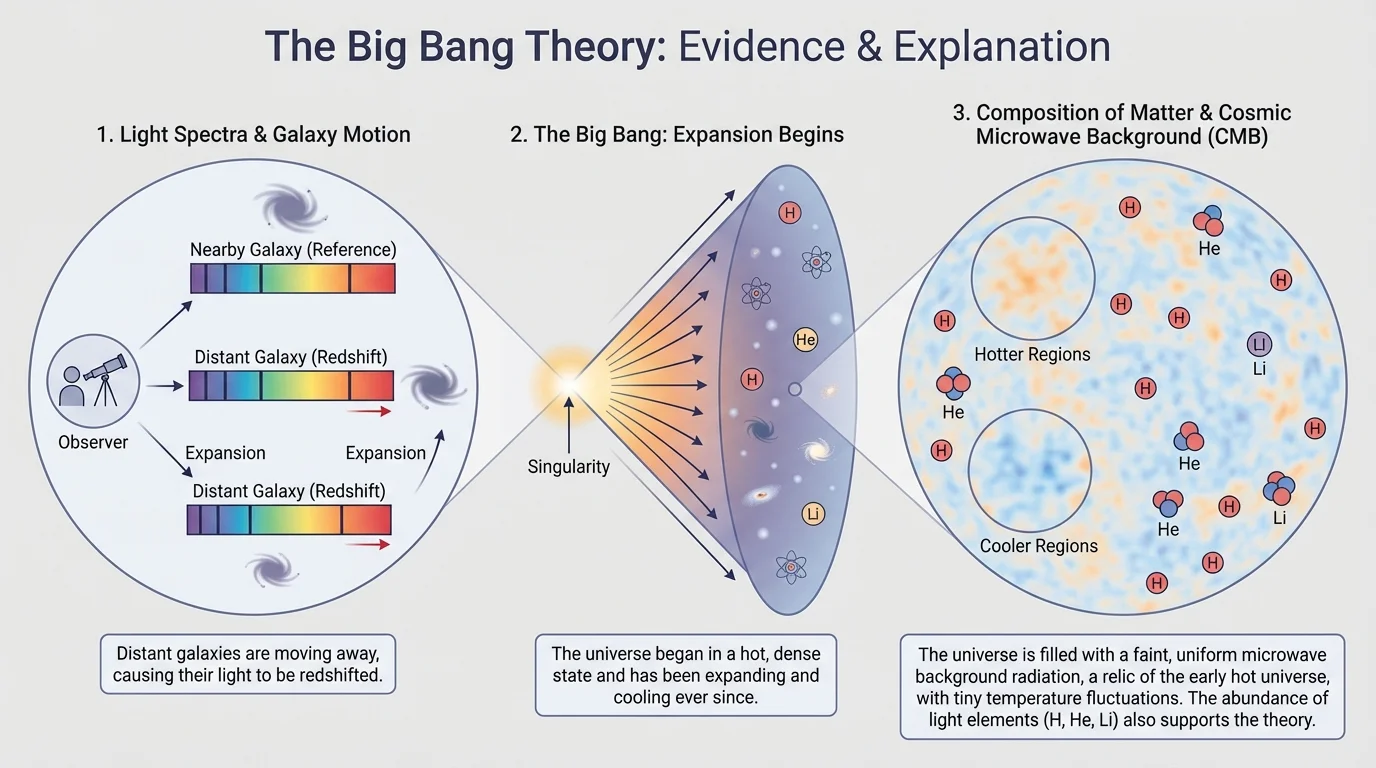
The CMB is powerful evidence because it is exactly the kind of leftover radiation scientists would expect from a hot early universe. If the universe had always been roughly as it is now, this background glow would be very difficult to explain.
The CMB is not perfectly uniform. It has tiny variations in temperature. Those small differences are important because they show that the early universe was not perfectly smooth. However, detailed mapping of galaxy and cluster distributions is beyond the scope here. The key idea is that the CMB supports the existence of a hot, dense beginning and later cosmic change.
Science becomes strongest when different lines of evidence point to the same conclusion. The Big Bang theory is persuasive because several independent observations support it at the same time.
First, spectra show what stars and galaxies are made of and how they are moving. Second, widespread redshift reveals that the universe is expanding. Third, the large abundance of hydrogen and helium matches what a hot early universe should produce. Fourth, the cosmic microwave background provides a relic signal from that hot early phase.
Building a scientific explanation
A strong scientific explanation connects observations into a logical model. For the Big Bang, astronomers do not rely on one surprising fact. They combine spectral evidence, redshift, element abundances, and background radiation into one coherent explanation of cosmic history.
Notice how each clue supports the others. Redshift implies expansion. Expansion implies a denser past. A denser, hotter past explains why the universe began with mostly light elements. A hot early universe also predicts leftover radiation, which is observed as the CMB. This kind of evidence chain is what makes the explanation scientifically powerful.
When you connect the redshift pattern from [Figure 2] with the expanding-space idea in [Figure 3], the logic becomes clear: the universe is changing over time rather than remaining static. Then the matter evidence and relic radiation tell us what that earlier state was like.
The evidence for the Big Bang comes from technology as much as from ideas. Spectroscopes split light into measurable wavelengths. Telescopes on mountains and in space detect very faint sources. Radio telescopes and microwave detectors observe wavelengths our eyes cannot see. Computers process huge amounts of data to identify patterns too subtle for direct inspection.
These tools matter beyond astronomy. Detector technology, image processing, cryogenic systems, and signal analysis developed for astronomy also influence medicine, communications, environmental monitoring, and engineering. The same careful analysis used to detect tiny shifts in spectra can improve sensors and imaging systems in other fields.
Real-world application example: reading a star's light
An astronomer records a star's spectrum and notices strong hydrogen absorption lines and a slight shift toward longer wavelengths.
Step 1: Identify composition
The hydrogen absorption pattern shows that hydrogen is present in the star's outer layers.
Step 2: Identify motion
The shift toward longer wavelengths indicates redshift, so the star or galaxy is moving away relative to the observer.
Step 3: Connect to larger ideas
If many distant galaxies show similar redshift patterns, the evidence supports expansion of the universe.
This is how one measurement of light can reveal both what an object is made of and how it moves.
That combination of observation, instrumentation, and interpretation is one of the clearest examples of science in action. Astronomers cannot run a laboratory experiment on the whole universe, but they can test predictions by comparing them with what the universe actually shows.
The Big Bang theory explains the evolution of the universe from an early hot, dense state. It does not answer every philosophical question, such as why anything exists at all. It also does not necessarily describe what happened before the earliest known stage, if "before" is even a meaningful concept in that context.
Another misconception is that the Big Bang means galaxies are flying away from a central point in ordinary empty space. As the expanding-space analogy in [Figure 3] helps show, the theory describes space itself changing over time. Also, while galaxy observations matter, detailed mapped distributions of galaxies and clusters are not needed here to justify the theory's core explanation.
What matters most for this topic is that the Big Bang theory is constructed from evidence. Students should think like scientists: What observations are made? What patterns appear? What explanation best fits all the evidence? In this case, the best-supported explanation is that the universe has expanded and cooled from an early hot, dense state.
