A spacecraft can travel millions of kilometers and still arrive at the right planet at the right time. That is not luck. It happens because orbital motion follows patterns that can be described with mathematics and modeled with computation. Once scientists understand the forces and relationships involved, they can predict where a planet, moon, comet, or satellite will be in the future with remarkable accuracy.
When astronomers predict an eclipse, when engineers place a satellite in orbit, or when a mission targets Mars, they rely on the same big idea: moving objects in space follow the laws of physics. In the solar system, the most important force controlling large-scale orbital motion is gravity.
Prediction does not mean memorizing where everything is. It means using a model, which is a mathematical or computational representation of a real system. A model may be an equation, a graph, a data table, or a computer simulation. Each one helps us answer questions such as: How fast does an object move? How long does one orbit take? What happens if the object is farther from the Sun?
From earlier physics, remember that a force can change an object's motion, and that velocity includes both speed and direction. Orbital motion depends on both ideas: gravity provides the force, and the object's changing direction means its velocity is constantly changing even if its speed stays nearly constant.
In this topic, the most useful predictions involve one orbiting object and a much more massive central object, such as Earth around the Sun or the Moon around Earth. That keeps the system simple enough to analyze clearly while still matching many real situations in astronomy.
The force that pulls orbiting objects toward each other is called gravitational force. Newton described it with a mathematical relationship that depends on two masses and the distance between their centers:
\[F_g = G\frac{m_1 m_2}{r^2}\]
In this equation, \(F_g\) is gravitational force, \(G\) is the gravitational constant, \(m_1\) and \(m_2\) are the masses of the two objects, and \(r\) is the distance between them. The equation shows two important patterns. First, if one or both masses increase, the force increases. Second, if the distance increases, the force decreases very quickly because distance is squared.
Inverse-square relationship means that when distance becomes larger, the effect becomes smaller according to the square of the distance. If distance doubles from \(r\) to \(2r\), the force becomes \(\dfrac{1}{4}\) as large because \((2r)^2 = 4r^2\).
[Figure 1] This inverse-square pattern explains why Mercury feels a much stronger pull from the Sun than Neptune does. It also explains why satellites in low Earth orbit move differently from satellites much farther out.
Example: comparing gravitational force at two distances
If an object is moved from distance \(r\) to distance \(2r\) from a planet, how does the gravitational force change?
Step 1: Write the proportional relationship
Because \(F_g \propto \dfrac{1}{r^2}\), force depends on the inverse square of distance.
Step 2: Compare the new force to the original
At \(2r\), the force becomes \(\dfrac{1}{4}\) of the original force.
The new gravitational force is one-fourth as large.
This helps explain why distant planets move more slowly in their orbits and take much longer to complete one revolution around the Sun.
An orbit forms because gravity pulls an object inward while the object already has forward motion. If there were no gravity, a planet or satellite would continue in a straight line because of inertia. If there were no forward motion, it would fall directly inward. Orbit happens because both effects act at the same time.
This idea is sometimes described as continuous free-fall. A satellite is always falling toward Earth, but Earth's surface curves away beneath it. As a result, the satellite keeps falling around Earth instead of crashing straight down. The same basic idea applies to Earth orbiting the Sun.
For a nearly circular orbit, gravity provides the inward force needed to keep the object moving in a curved path. That inward force is often called centripetal force, meaning the center-seeking force that changes the direction of motion.
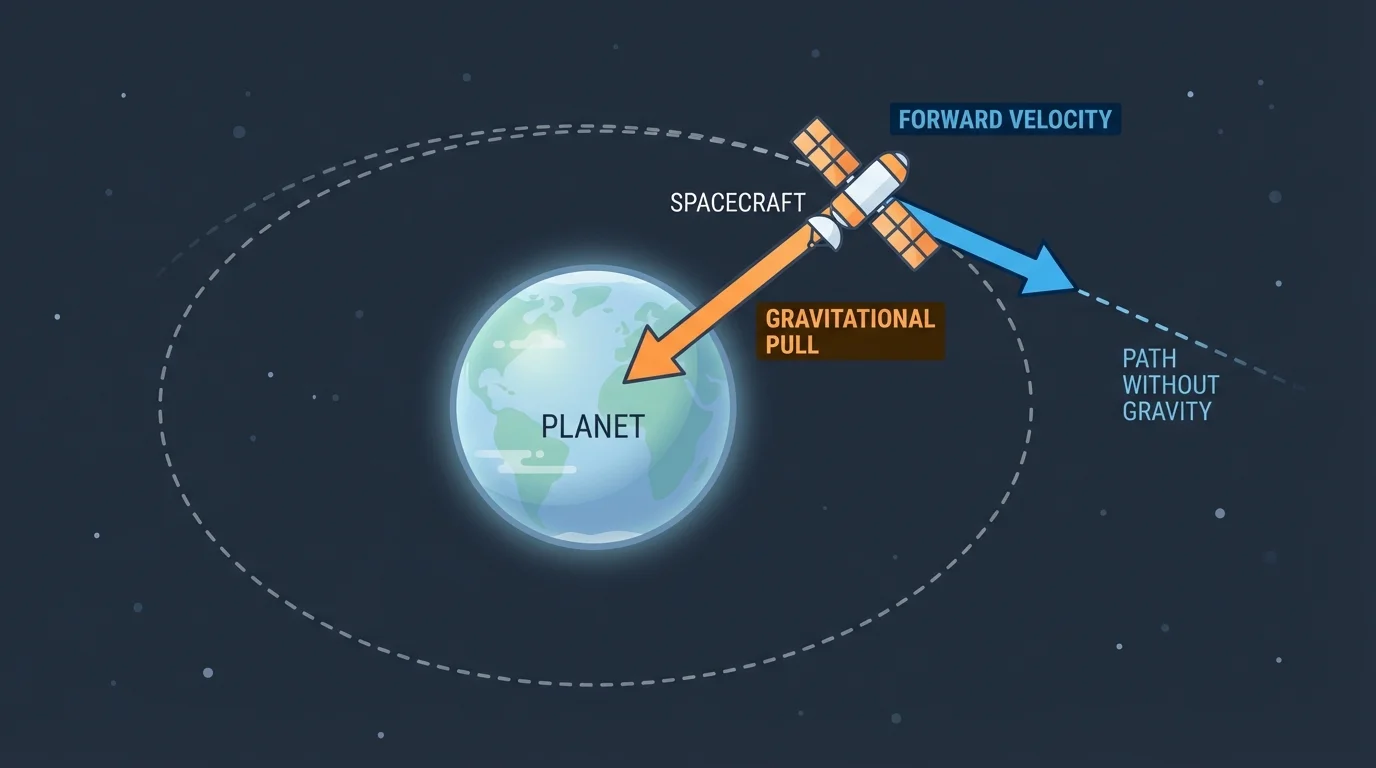
Notice something subtle but important: an object in orbit may be moving at high speed, yet gravity still controls its motion because gravity changes the direction of the velocity. A change in direction is a change in velocity, so the object is accelerating even if its speed does not change much.
Orbit as a balance of motion and force
An orbit is not a place with no gravity. In fact, gravity is the reason the orbit exists. The forward motion of the object keeps it from falling straight in, and gravity keeps it from flying off in a straight line. Mathematical models of orbital motion work because this balance follows predictable rules.
That is why astronauts in orbit appear weightless even though Earth's gravity is still acting on them strongly. They are falling around Earth along with their spacecraft.
To predict motion, scientists often begin with equations. For a circular orbit, the gravitational force provides the centripetal force. Setting those equal gives:
\[G\frac{Mm}{r^2} = \frac{mv^2}{r}\]
Here \(M\) is the mass of the central object, such as the Sun or Earth, \(m\) is the orbiting object's mass, \(r\) is orbital radius, and \(v\) is orbital speed. The orbiting object's mass appears on both sides and cancels, which means that for a given central body and orbital radius, orbital speed does not depend on the mass of the satellite or planet.
Solving for speed gives:
\[v = \sqrt{\frac{GM}{r}}\]
This equation shows that as orbital radius increases, orbital speed decreases. Objects closer to the Sun or Earth must move faster to remain in orbit.
Example: how orbital speed changes with distance
Suppose one satellite orbits Earth at radius \(r\), and another orbits at radius \(4r\). Compare their speeds.
Step 1: Use the speed relationship
From \(v = \sqrt{\dfrac{GM}{r}}\), speed is proportional to \(\dfrac{1}{\sqrt{r}}\).
Step 2: Compare the two radii
If the radius becomes \(4r\), then speed changes by a factor of \(\dfrac{1}{\sqrt{4}} = \dfrac{1}{2}\).
The more distant satellite moves at half the speed of the closer satellite.
This is why the International Space Station, which is relatively close to Earth, moves very quickly, while distant satellites move more slowly.
Another useful equation connects orbital speed to orbital period, the time needed for one complete orbit. For a circular orbit, the distance traveled in one orbit is the circumference \(2\pi r\), so
\[T = \frac{2\pi r}{v}\]
Substituting a smaller speed for a larger radius leads to longer periods for more distant orbits.
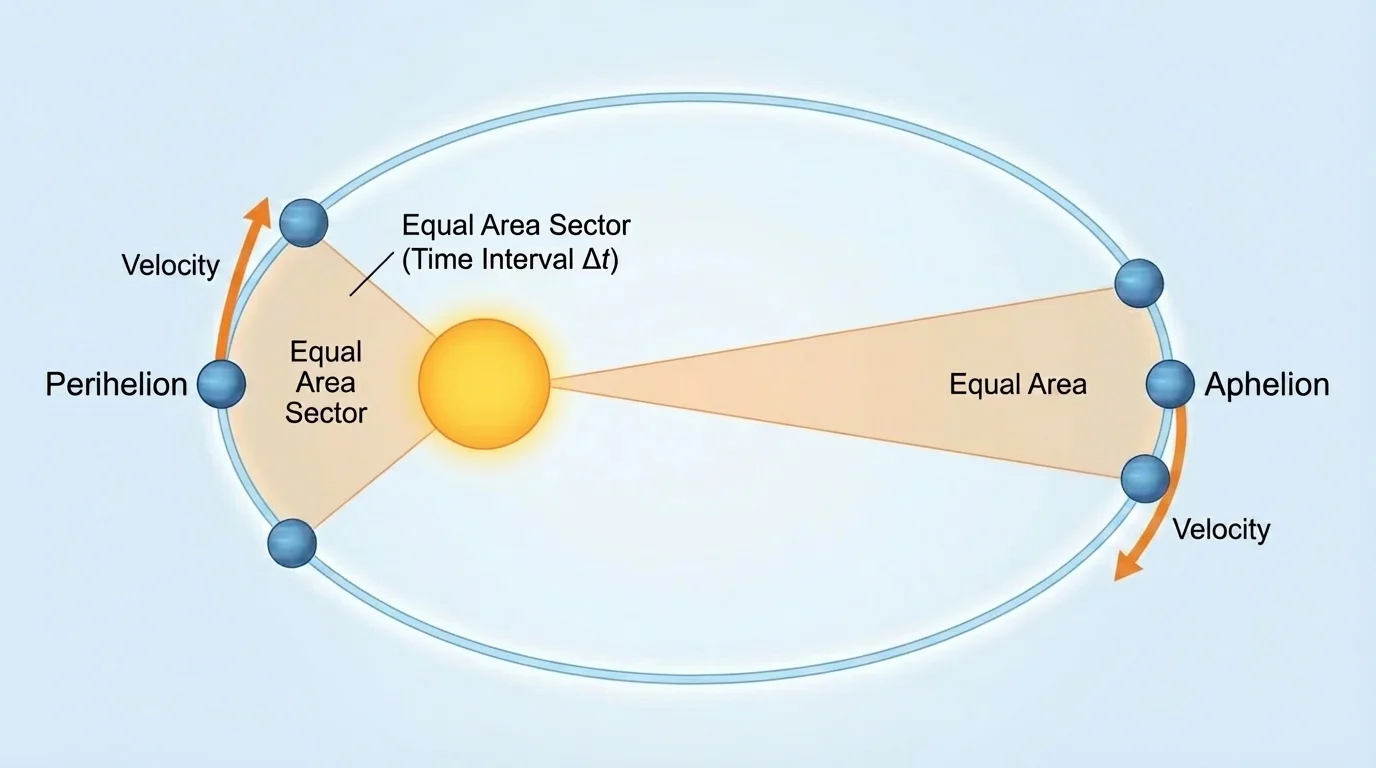
[Figure 2] Long before modern spaceflight, Johannes Kepler discovered patterns in planetary motion from astronomical observations. His laws still guide orbital prediction today. Many solar system orbits are not perfect circles but ellipses, and objects do not move at exactly the same speed all the way around.
Kepler's First Law: Planets move in ellipses with the Sun at one focus. An ellipse looks like a stretched circle. The position where a planet is closest to the Sun is called perihelion, and the position farthest from the Sun is called aphelion.
Kepler's Second Law: A line from the Sun to a planet sweeps out equal areas in equal times. This means planets move faster when they are closer to the Sun and slower when they are farther away.
Kepler's Third Law: The square of the orbital period is proportional to the cube of the orbit's semi-major axis:
\[T^2 \propto r^3\]
For objects orbiting the same central body, this can be written as a comparison:
\[\frac{T_1^2}{r_1^3} = \frac{T_2^2}{r_2^3}\]
This law is especially useful because it allows predictions without needing calculus and without analyzing many-body interactions. If you know one object's orbit around the Sun, you can estimate another object's orbital period from its distance.
Example: using Kepler's third law
Earth is \(1\) astronomical unit from the Sun and has period \(1\) year. A planet is \(4\) astronomical units from the Sun. What is its orbital period?
Step 1: Write the comparison
Use \(\dfrac{T_1^2}{r_1^3} = \dfrac{T_2^2}{r_2^3}\) with \(T_1 = 1\), \(r_1 = 1\), and \(r_2 = 4\).
Step 2: Substitute values
\(\dfrac{1^2}{1^3} = \dfrac{T_2^2}{4^3}\), so \(1 = \dfrac{T_2^2}{64}\).
Step 3: Solve
Multiply by \(64\): \(T_2^2 = 64\). Then \(T_2 = 8\).
The planet's orbital period is \(8\) years.
This explains why outer planets take so long to orbit the Sun. Neptune, for example, is much farther away than Earth, so its orbital period is far longer.
Kepler discovered his laws by analyzing detailed observations made by Tycho Brahe. The mathematics came after the data pattern, which is a powerful reminder that scientific laws often grow out of careful measurement.
Later, Newton showed that Kepler's laws can be explained by gravity. That connection between observation and physics is one of the great achievements of science.
Mathematics gives compact relationships, but computation lets us apply them repeatedly and efficiently. A computer model can calculate position, speed, and period for many points in time and display the pattern in a table or graph. A graph is especially useful because it makes trends visible for orbital period versus orbital distance.
[Figure 3] Even a simple spreadsheet can serve as a computational model. For example, students can enter values of orbital radius and use formulas to compute speed or period for objects orbiting the same central body. Changing one number lets the whole table update instantly.
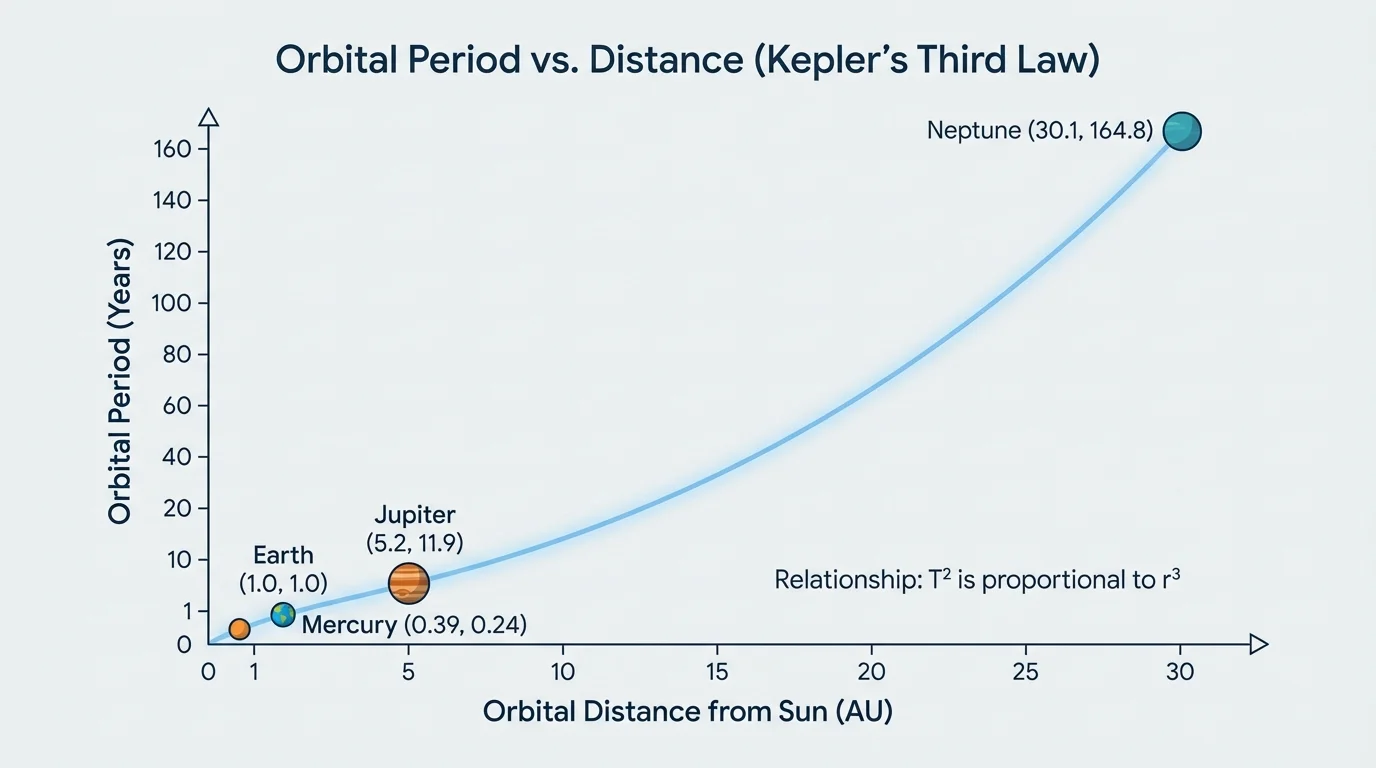
The power of computation is not that it replaces physics. It makes the physics easier to test, compare, and visualize. If a model predicts that doubling distance makes period much longer, the graph and data table make that pattern easier to interpret than words alone.
| Object | Average distance from Sun | Orbital period |
|---|---|---|
| Mercury | About \(0.39\) AU | About \(0.24\) year |
| Earth | \(1.00\) AU | \(1.00\) year |
| Jupiter | About \(5.20\) AU | About \(11.86\) years |
| Neptune | About \(30.1\) AU | About \(164.8\) years |
Table 1. Sample orbital distances and periods for planets orbiting the Sun.
These values are not random. They follow the pattern of Kepler's third law. A computational representation lets scientists compare observed values with predicted ones and check whether the model matches reality.
To make these models useful, you need to know what the equations are saying physically. Here is a direct calculation using the gravitational equation.
Example: finding how force changes when mass changes
Suppose a moon of mass \(m\) orbits a planet of mass \(M\) at distance \(r\). If the moon's mass doubles to \(2m\) while the distance stays the same, what happens to the gravitational force?
Step 1: Start with the equation
\(F_g = G\dfrac{Mm}{r^2}\)
Step 2: Replace \(m\) with \(2m\)
\(F'_g = G\dfrac{M(2m)}{r^2} = 2G\dfrac{Mm}{r^2}\)
Step 3: Compare old and new force
\(F'_g = 2F_g\)
The gravitational force doubles.
That result may seem surprising at first because the moon's mass does not affect the orbital speed equation for a given orbit. The reason is that a more massive moon feels more gravitational force, but it also has more inertia. The combined effect leads to the same orbital speed at the same distance from the same central body.
Not all orbits have the same shape or speed pattern. Planets usually have nearly circular or only mildly elliptical orbits, while some comets follow very stretched ellipses. That means a comet can move very quickly near the Sun and much more slowly when far away.
[Figure 4] Moons orbit planets, planets orbit the Sun, and artificial satellites orbit Earth. The same physical ideas apply in all of these two-body systems: gravity depends on mass and distance, while orbital motion depends on both force and forward velocity.
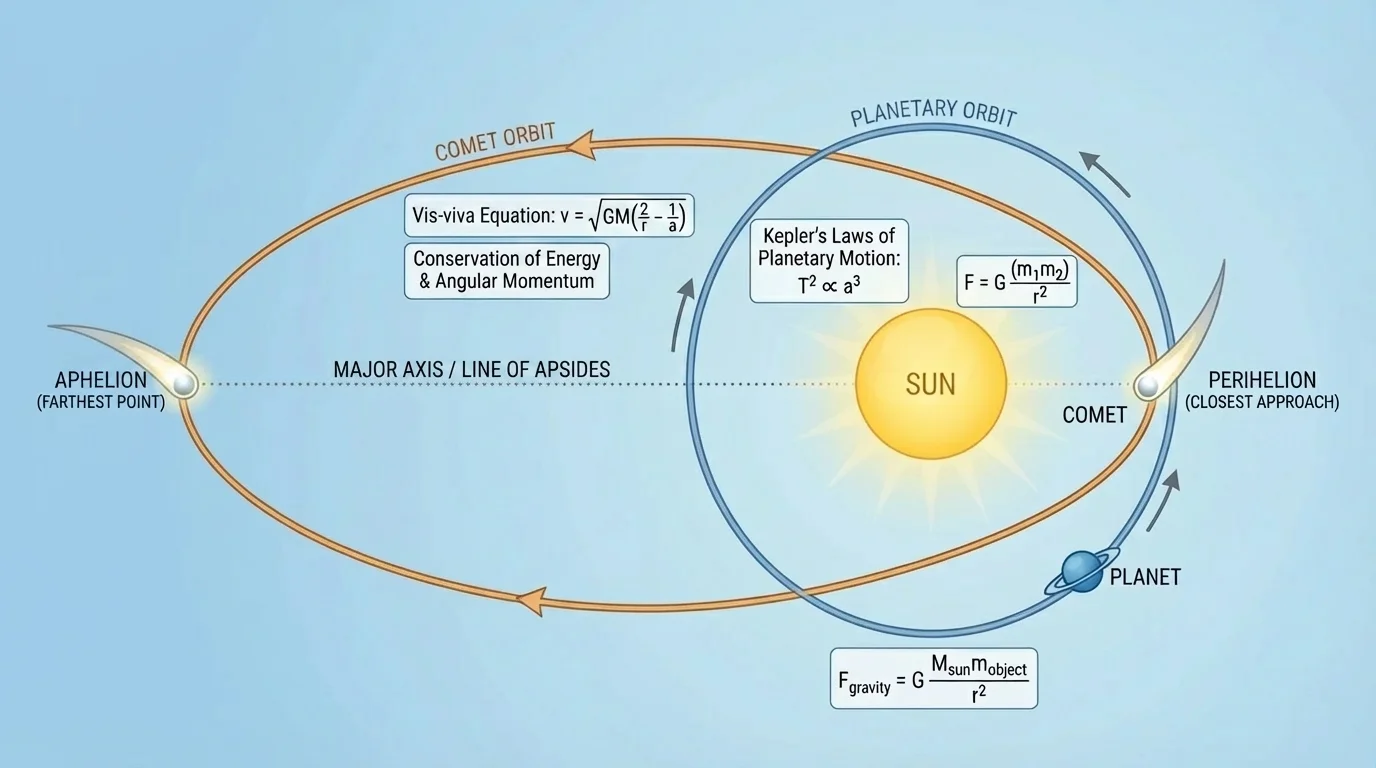
The comparison also helps explain why some objects are easier to predict than others. A planet in a nearly circular orbit around the Sun follows a very regular pattern. A comet in a highly elongated orbit still follows the same laws, but its changing speed is more dramatic.
Looking back to [Figure 2], the faster motion near perihelion is exactly what Kepler's second law predicts. Looking back to [Figure 1], the curved path still comes from the same combination of forward motion and inward gravitational pull.
Orbital prediction has major practical value. Space agencies use it to send probes to other planets, predict close approaches, and time rocket launches. Communication and weather satellites must be placed into specific orbits so they pass over useful regions or stay in the same relative position above Earth.
Astronomers also use orbital models to estimate masses. If they know how long a moon takes to orbit a planet and how far away it is, they can infer information about the planet's mass. In this way, observing motion reveals hidden properties of solar system objects.
Why predictions can work so well
The solar system looks complicated, but many useful predictions come from simple models. A two-body model captures the dominant interaction in many cases, and the resulting equations describe strong regular patterns. More advanced models can refine the prediction, but the basic laws already explain a great deal.
Even eclipse prediction depends on orbital modeling. The Earth-Moon-Sun system is more complex than a single two-body example, but the same underlying principles of gravitational motion and repeating orbital patterns make such predictions possible.
Every model has limits. In this lesson, the mathematical representations stay within an important boundary: they do not go beyond two-body situations and do not require calculus. That means we use equations and proportional reasoning that are accurate and powerful for many situations, but we do not try to solve full many-body interactions in detail.
Real solar system motion can include small deviations caused by other planets, changing distances in elliptical orbits, and nonuniform conditions. Still, the simple models remain extremely valuable because they capture the main behavior and allow strong predictions.
That is one of the deepest ideas in science: a model does not need to include every detail to be useful. It needs to represent the most important relationships clearly enough to explain and predict what happens.
"The book of nature is written in the language of mathematics."
— Galileo Galilei
When students use equations, graphs, and computational tools to study orbits, they are doing the same kind of reasoning used in astronomy and aerospace engineering. They are turning patterns in motion into predictions about the universe.
