Almost everything from Earth's earliest chapter has been damaged, buried, melted, or recycled. That may seem like a major scientific obstacle, yet geologists and planetary scientists have still built a strong account of how Earth formed about \(4.54 \textrm{ billion years ago}\). They do it the way detectives solve a case with missing footage: by comparing clues from many places. Ancient minerals inside old rocks, fragments of meteorites, samples from the Moon, and images of other planetary surfaces all preserve pieces of a story that Earth itself has partly erased.
Earth is a geologically active planet. Its crust is broken into moving plates, volcanoes recycle material from the interior, erosion wears down old surfaces, and metamorphism changes rocks under heat and pressure. Because of these processes, the earliest crust has mostly been destroyed or altered. This is very different from the Moon, where no global plate tectonics reshapes the surface and ancient impact scars remain visible for billions of years.
That means scientists cannot rely on one perfect rock layer that records the entire beginning of Earth. Instead, they combine evidence from several sources and ask whether those sources agree. This is an example of scientific reasoning: building the best explanation from available evidence, testing that explanation, and revising it when new data appear.
Scientific reasoning is the process of using evidence, logic, and testable explanations to understand natural events. In Earth science, it often means comparing different kinds of evidence that formed at different times and places.
Evidence includes observations, measurements, rock samples, isotope data, and images from spacecraft that help support or challenge an explanation.
To reconstruct early Earth, scientists depend heavily on three evidence categories: ancient Earth materials, meteorites, and other planetary surfaces. Each source has strengths and limits. Rocks from Earth can show what happened on our planet directly, but many are altered. Meteorites can preserve very old solar system material, but they do not record Earth-specific events. Other worlds, such as the Moon and Mars, help scientists compare what happens when a planet or moon preserves ancient surfaces better than Earth does.
Some of the most valuable Earth materials are tiny crystals called zircons. These minerals can survive processes that destroy the rocks around them. Certain zircons from Australia are about \(4.4 \textrm{ billion years old}\), making them among the oldest known Earth materials. They are not complete records of Earth's earliest history, but they preserve rare evidence from an otherwise poorly preserved interval of Earth's past.
Meteorites are equally important. A meteorite is a rock from space that survives passage through the atmosphere and lands on Earth. Many meteorites formed very early in solar system history. Some are thought to preserve material close to the original building blocks of planets. If Earth formed from the same solar nebula as these objects, then meteorites can reveal the approximate age and composition of the material from which Earth grew.
Scientists also compare Earth with the Moon, Mars, Mercury, and asteroids. These worlds preserve craters, volcanic plains, and ancient crusts differently. By studying them, researchers can test ideas about impacts, crust formation, and planetary cooling. Comparative planetology is powerful because the laws of physics and chemistry operate across the solar system.
Some meteorites are older than any intact rock found on Earth. They preserve minerals that formed when the solar system itself was still taking shape.
When multiple kinds of evidence point to the same conclusion, confidence increases. For example, the age of many primitive meteorites, the ages of lunar samples, and isotopic studies of Earth all support a solar system origin around \(4.56 \textrm{ billion years ago}\), with Earth forming soon after.
The leading model for solar system origin is the nebular theory. It explains that the solar system formed from a cloud of gas and dust that collapsed under gravity. As the cloud contracted, it spun faster and flattened into a disk. The Sun formed in the center, while smaller particles in the disk collided and stuck together.
As [Figure 1] shows, Earth formed within this disk through countless collisions among growing solid bodies. Those growing bodies included dust grains, pebbles, larger rocky chunks, and then planetesimals, which are small early bodies that can be several kilometers across. Repeated collisions built larger objects called protoplanets. This process is called accretion. It was highly energetic. Every impact released energy, heating the young Earth.
Scientists infer this sequence from computer models, observations of disks around other stars, the composition of meteorites, and the ages of early solar system solids. Young stars observed today often have dusty disks around them, which gives modern evidence that planet formation is a common process rather than a one-time mystery.
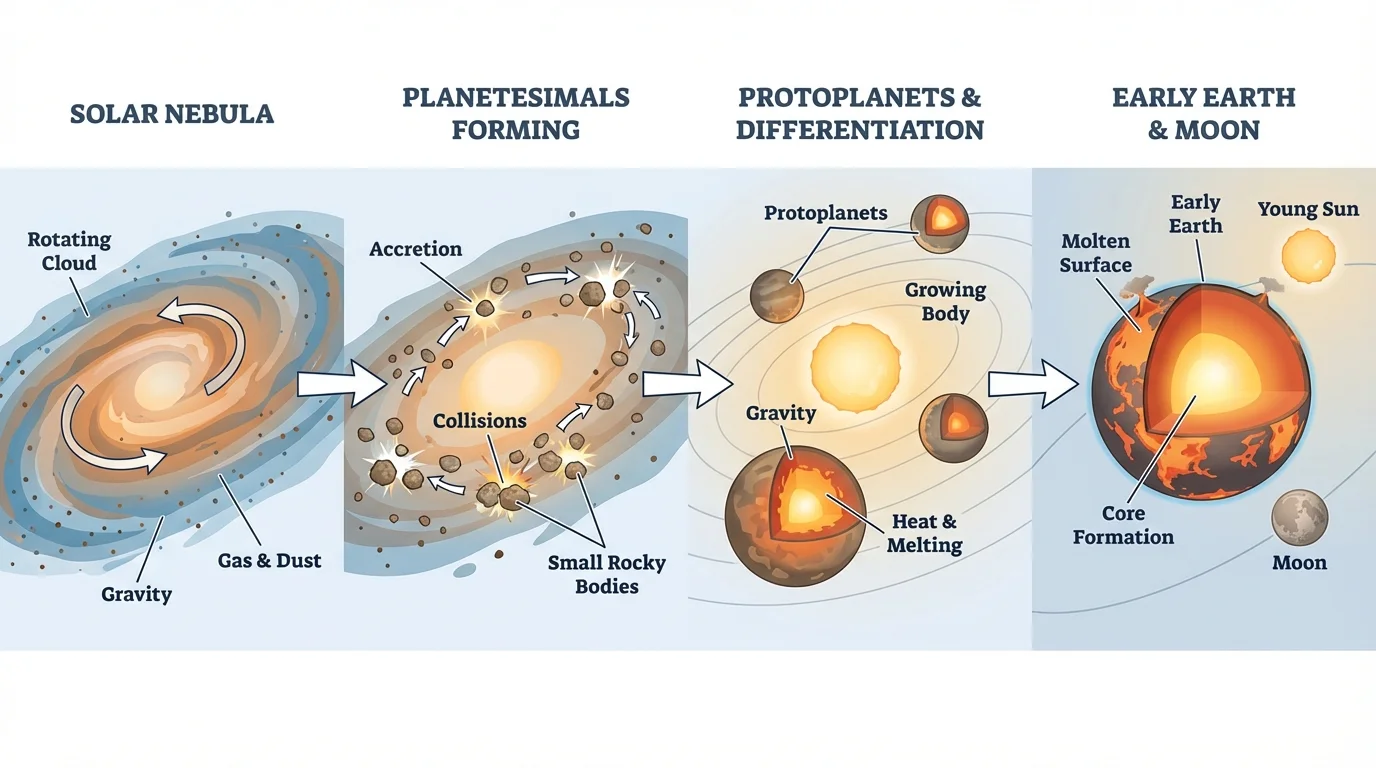
Accretion helps explain why early Earth was hot. Gravitational energy from incoming material was converted to heat. Radioactive decay also added heat, especially from short-lived isotopes present early in solar system history. Large impacts could melt huge portions of the planet's outer layers.
One especially important collision likely involved a Mars-sized body striking the early Earth. According to the giant impact hypothesis, debris from this event later formed the Moon. This idea is supported by the similar isotopic composition of Earth and Moon rocks and by computer simulations of such a collision. Later in the lesson, the comparison between Earth and the Moon becomes important again, as seen in [Figure 4].
One of the strongest tools in Earth science is radiometric dating. Some isotopes are unstable and change into other isotopes at predictable rates. By measuring the ratio of parent isotopes to daughter isotopes in a mineral, scientists can estimate how much time has passed since that mineral formed.
As [Figure 2] illustrates, the key idea is the half-life, the time required for half of a radioactive isotope to decay. If a sample starts with a certain amount of parent atoms, then after one half-life, half remain; after two half-lives, one-quarter remain; after three half-lives, one-eighth remain. The relationship can be written as
\[N = N_0\left(\frac{1}{2}\right)^n\]
where \(N_0\) is the original amount of parent isotope, \(N\) is the amount remaining, and \(n\) is the number of half-lives.
For example, if a mineral contains \(\dfrac{1}{8}\) of its original parent isotope, then \(\dfrac{1}{8} = \left(\dfrac{1}{2}\right)^3\), so \(n = 3\). If the isotope's half-life is \(1.3 \textrm{ billion years}\), then the mineral's age is \(3 \times 1.3 = 3.9 \textrm{ billion years}\).
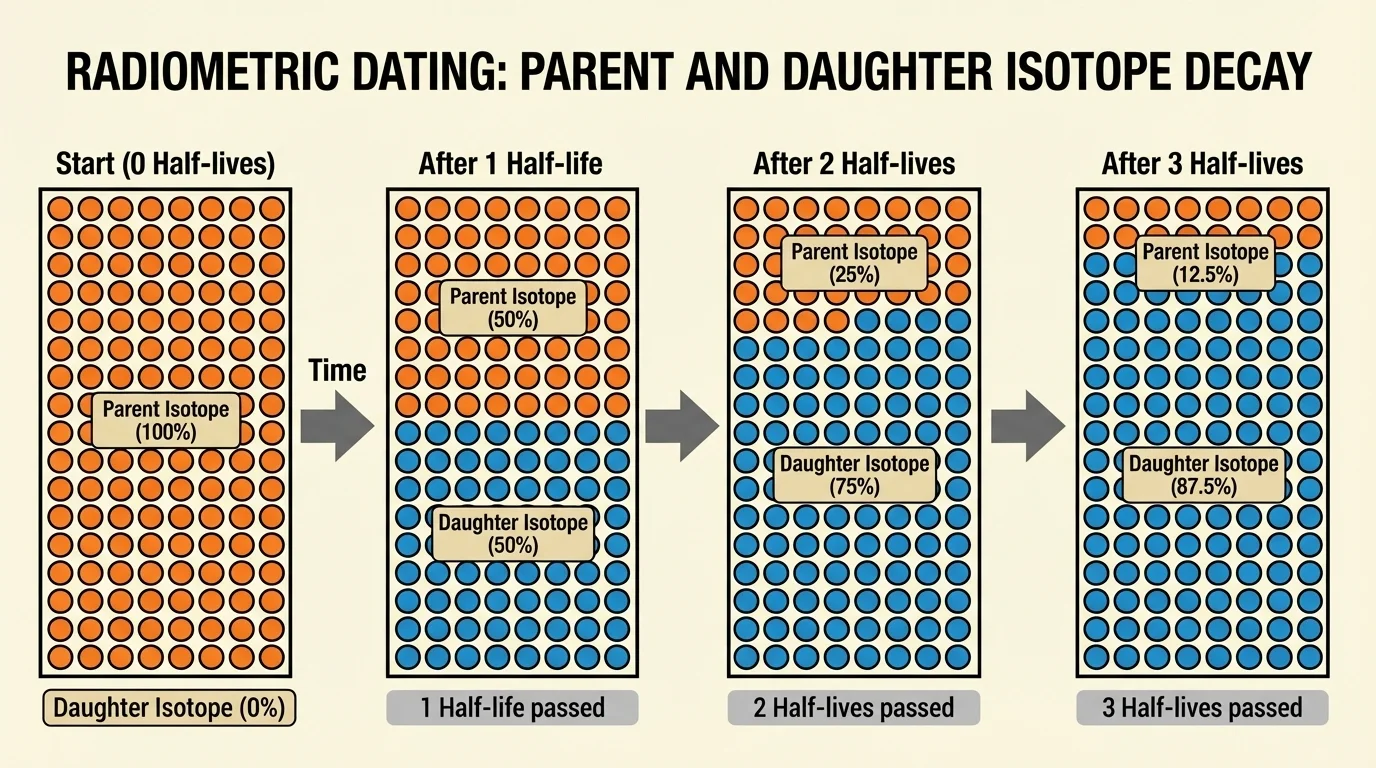
Different isotopes are useful for different timescales. Uranium-lead dating is especially important for zircons because zircon crystals often contain uranium atoms when they form but reject lead, making them excellent natural clocks. Meteorites dated with several isotope systems yield ages near \(4.56 \textrm{ billion years}\). Because Earth formed from the same early solar system material, scientists use these data, along with Earth and Moon evidence, to estimate Earth's age at about \(4.54 \textrm{ billion years}\).
Using half-life to estimate age
A mineral sample has \(25\%\) of its original parent isotope remaining. The isotope used has a half-life of \(700 \textrm{ million years}\).
Step 1: Convert the remaining fraction
\(25\% = \dfrac{1}{4}\).
Step 2: Determine the number of half-lives
Because \(\dfrac{1}{4} = \left(\dfrac{1}{2}\right)^2\), the sample has passed through \(2\) half-lives.
Step 3: Calculate the age
The age is \(2 \times 700 = 1{,}400 \textrm{ million years}\).
The sample is 1.4 billion years old.
Radiometric dating is most reliable when scientists use several minerals or isotope systems and compare the results. If different methods agree, the age estimate becomes much stronger. This cross-checking is a major part of scientific practice.
Early Earth did not remain a uniform ball of mixed material. As internal temperatures rose, much of the young planet melted. In a molten or partly molten Earth, dense materials could sink while lighter materials rose. This process of differentiation produced the layered planet shown in [Figure 3]: an iron-rich core, a rocky mantle, and eventually a crust.
Density was the key. Iron and nickel are denser than many silicate minerals, so they tended to move inward. This process released even more heat through friction and compression. Scientists infer differentiation from Earth's internal structure, from seismic evidence, and from the composition of meteorites that appear to come from bodies that also separated into metal cores and rocky mantles.
The result was a planet with a metallic core at the center. That core later became crucial for generating Earth's magnetic field, which helps shield the surface from charged particles from space. The mantle above it remained hot and slowly convecting, and the outer crust formed as the surface cooled.
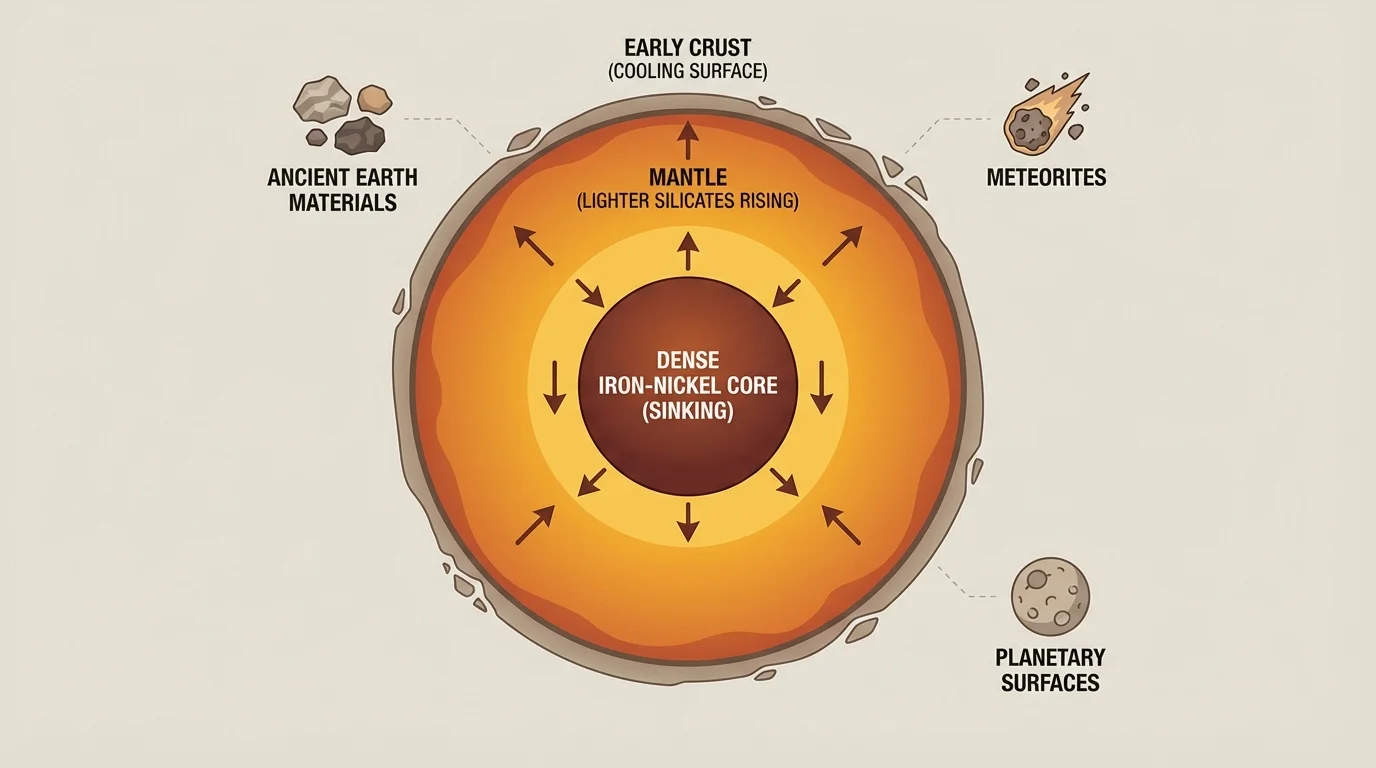
This layered structure matters because it affected everything that came later: volcanism, tectonics, atmosphere formation, and the cycling of materials. When scientists model early Earth, they must account for differentiation because a layered planet behaves very differently from an unmixed one.
Why meteorites help reveal Earth's interior history
Some meteorites are fragments of parent bodies that differentiated. Iron meteorites likely come from cores of shattered early bodies, while stony meteorites may represent mantle or crustal material. By comparing these samples with Earth's structure, scientists gain clues about how common differentiation was in the early solar system.
Later evidence from seismic waves confirmed that Earth is still layered internally. This is a reminder that explanations about early Earth are not based on a single clue but on many independent kinds of evidence that reinforce one another, including the structure first introduced in [Figure 3].
The earliest eon of Earth history is called the Hadean. The name suggests extreme conditions, and for good reason. Earth was hotter, impacts were more common, and parts of the surface may have existed as magma oceans at times. Yet it would be a mistake to imagine the entire Hadean as permanently molten everywhere. The oldest zircons suggest that crust and perhaps liquid water appeared surprisingly early.
As Earth cooled, water vapor released by volcanic activity could condense to form oceans. Some water may also have been delivered by impactors such as water-rich asteroids. The exact balance is still debated, but isotopic studies help scientists test these ideas. The early atmosphere was also very different from today's. It likely contained gases such as \(\textrm{CO}_2\), \(\textrm{H}_2\textrm{O}\) vapor, nitrogen, and smaller amounts of other volcanic gases, with little free oxygen.
The next eon, the Archean, saw the stabilization of the first long-lived crustal fragments and the appearance of the earliest widely accepted evidence of life. Ancient rocks from cratons preserve clues to this era. A craton is a stable, ancient part of continental crust that has survived for billions of years.
Relative dating tells which rocks or events are older or younger than others, while absolute dating gives a numerical age. Earth scientists use both. Rock layers, cross-cutting relationships, and crater counts help with relative dating, while radiometric methods provide numerical ages.
The transition from a violent young planet to one with oceans, crust, and eventually life did not happen instantly. It unfolded over hundreds of millions of years. This timescale matters. In human history, a hundred years feels long; in planetary history, \(100 \textrm{ million years}\) can mark only one stage in a much larger transformation.
The rock record is the collection of rocks and structures that preserve evidence of past events. On Earth, the rock record is incomplete because tectonics and erosion continuously rewrite it. Still, some of the oldest surviving rocks and minerals provide remarkable information.
Zircons can record the age of crystallization and sometimes the conditions under which they formed. Isotopes of oxygen in ancient zircons suggest interaction with liquid water, which implies that some crust and water were present early in Earth history. This does not mean Earth looked like the modern world, but it suggests a more complex Hadean environment than a permanently glowing magma surface.
Relative dating also helps. If one rock cuts across another, the cutting rock is younger. If one layer lies above another in an undisturbed sequence, the lower layer is generally older. These ideas help scientists organize events even when exact ages are unavailable.
| Evidence source | What it can reveal | Main limitation |
|---|---|---|
| Ancient zircons | Ages of early crust and clues to water interaction | Crystals are tiny and preserve only partial information |
| Ancient craton rocks | Early continental crust, metamorphism, tectonic history | Often altered by heat and pressure |
| Meteorites | Age and composition of early solar system materials | Do not directly record Earth-specific surface events |
| Lunar samples and surfaces | Impact history and ancient crust preserved with little recycling | Not Earth, so comparisons must be made carefully |
| Mars and asteroid observations | Planetary cooling, volcanism, and crater preservation | Different sizes and histories from Earth |
Table 1. Major evidence sources used to reconstruct Earth's formation and early history.
Because rocks are often changed after they form, geologists rarely rely on one measurement. They examine textures, minerals, isotopes, structural relationships, and regional context. A strong scientific account is built when multiple lines of evidence support the same explanation without contradiction.
The contrast between surfaces in [Figure 4] reveals something important: Earth and the Moon formed in the same neighborhood of the solar system, but they preserve history very differently. The Moon's ancient highlands are still covered with craters, while Earth's surface has been reshaped by erosion, volcanism, oceans, and plate tectonics. This is why scientists often study the Moon to understand the impact environment of the early inner solar system.
Crater counting is a useful relative dating method on worlds with old preserved surfaces. In general, more craters usually indicate an older exposed surface. Lunar crater counts, combined with radiometric ages from returned samples, help scientists estimate when different lunar regions formed. Those estimates then help calibrate ages for surfaces on other solid worlds.
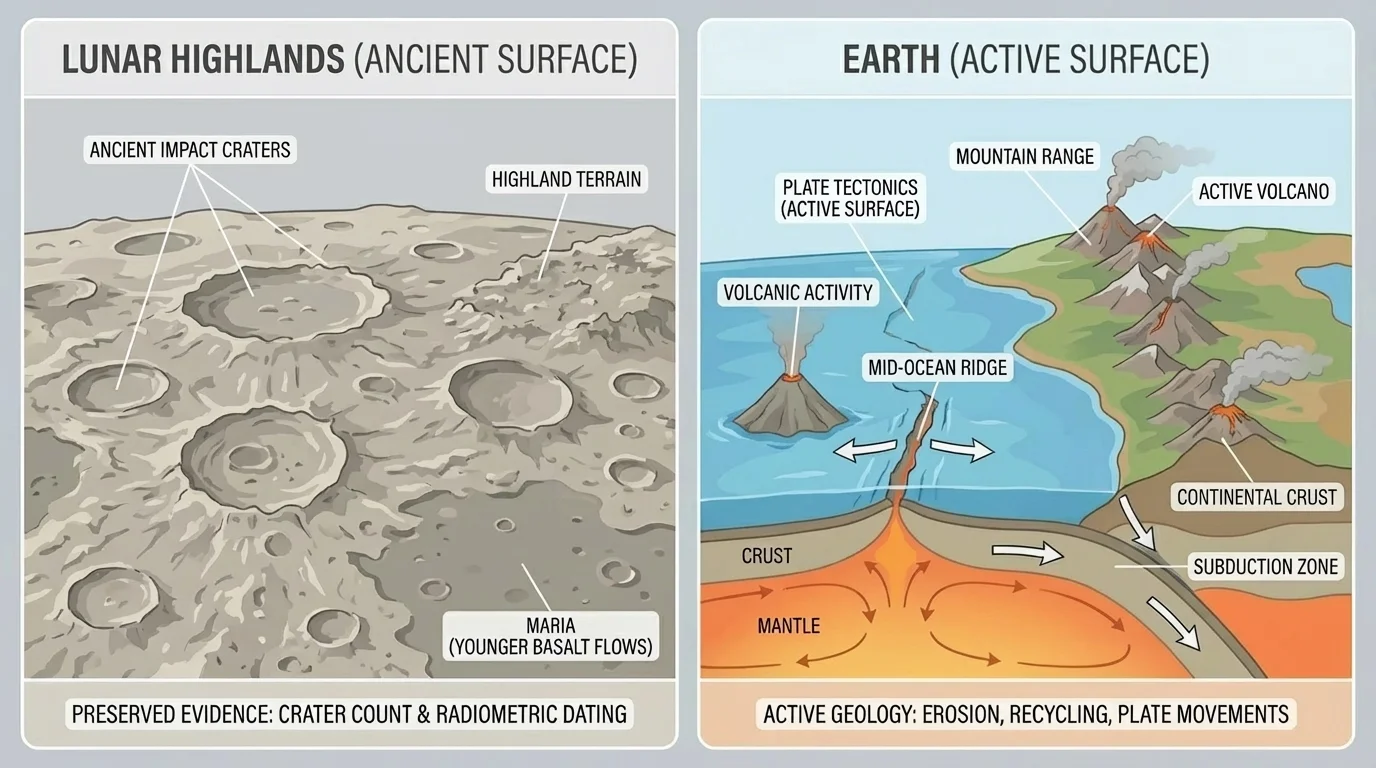
Scientists have proposed that the early solar system experienced a period of especially intense impacts. Whether that spike was sharp or more spread out is still debated, but lunar evidence is central to the discussion. Earth probably experienced many of the same impacts, yet most direct traces have been erased.
Mars also contributes evidence. It preserves enormous volcanoes, ancient valleys, and crustal regions much older than most of Earth's surface. Asteroids preserve primitive materials that changed little since the solar system's early days. By comparing these worlds, scientists test whether a proposed process is unique to Earth or part of a broader planetary pattern.
The Moon is also central to understanding Earth itself. The giant impact hypothesis helps explain why the Moon is large relative to Earth, why Earth's rotation and tilt have their present characteristics, and why Moon rocks share important chemical similarities with Earth. The preserved cratering on the Moon, seen earlier in [Figure 4], also reminds us how much of Earth's earliest surface record has been lost.
A scientific account of Earth's formation is not a story invented first and supported later. It is built from evidence and tested against observations. For example, if Earth formed by accretion, then scientists should find early solar system solids in meteorites with ages older than Earth's oldest crust. They do. If early Earth differentiated, then a metal-rich core and silicate mantle should exist. Seismic evidence and density measurements support that. If the Moon formed from a giant impact, then Earth-Moon compositions should show specific similarities. They do, although details are still actively researched.
Uncertainty is not weakness. It is part of science. Scientists may debate exact timing, the intensity of early bombardment, or the source of Earth's water, but these debates occur within a framework supported by strong evidence. New samples, new instruments, and new missions can sharpen or revise the account.
"The good thing about science is that it's true whether or not you believe in it."
— Neil deGrasse Tyson
What matters most is how explanations are justified. Claims must match the evidence, be open to testing, and fit with established physical laws. This approach is what makes the account of Earth's early history scientific rather than speculative.
Studying Earth's formation is not just about the distant past. Understanding differentiation helps geologists explain why certain metals are concentrated in particular parts of Earth. Knowledge of ancient crustal evolution supports mineral and resource exploration. Investigating early atmospheres and oceans helps scientists understand climate systems and habitability.
Planetary science missions also depend on these ideas. When spacecraft collect samples from asteroids or map Mars, scientists compare those data with Earth and meteorite evidence. The goal is not only to understand other worlds but also to better understand our own. The same reasoning used to reconstruct Earth's beginning is now used to ask whether rocky planets around other stars might also form oceans, atmospheres, and conditions suitable for life.
There is also a practical lesson in method. The reconstruction of Earth's early history shows how science works when evidence is incomplete. Researchers gather clues, test models, compare independent data sources, and revise explanations carefully. That skill matters far beyond geology—in medicine, engineering, climate science, and any field where decisions depend on interpreting complex evidence.
