If Earth were sliced open like a peach, the inside would not look calm or simple. Beneath your feet is a planet with moving rock, sinking slabs, rising hot material, a liquid metal layer, and a solid center nearly as hot as the Sun's surface. That hidden motion helps explain why continents shift, volcanoes erupt, and ocean floors are continuously recycled. Earth may seem solid and unchanging in everyday life, but on geologic time scales it is constantly reorganizing itself from the inside out.
The key idea is that Earth's interior is not just layered; it is active. Heat inside the planet causes matter to move. As hot material rises and cooler material sinks, rock in the mantle slowly circulates. This process, called thermal convection, is one of the main ways matter cycles within Earth. Scientists cannot travel to the core, so they build models using indirect evidence. These models explain how and why Earth changes over time.
Earth's surface features are connected to processes deep below. Mountain ranges, ocean trenches, volcanic arcs, and spreading ridges all reflect movement within Earth's layers. Some effects happen suddenly, such as volcanic eruptions or large earthquakes. Others unfold over millions of years, such as the opening of an ocean basin or the collision of continents. Understanding Earth's interior helps explain both kinds of change.
These processes also show how Earth's systems interact. Internal heat affects rock motion. Rock motion affects plate movement. Plate movement changes the surface, atmosphere, oceans, and sometimes climate. A volcanic eruption, for instance, can release ash and gases quickly, while repeated volcanism over very long time scales helps build land and recycle materials between Earth's surface and interior.
Temperature affects particle motion and density. In many materials, heating causes particles to spread out slightly, lowering density, while cooling causes particles to pack more closely, raising density. Differences in density can produce movement under gravity.
That basic physical idea is essential for understanding Earth's mantle. Although mantle rock is solid on short time scales, over millions of years it can flow slowly. This means hot mantle material can rise and cooler mantle material can sink, creating a large-scale circulation system inside the planet.
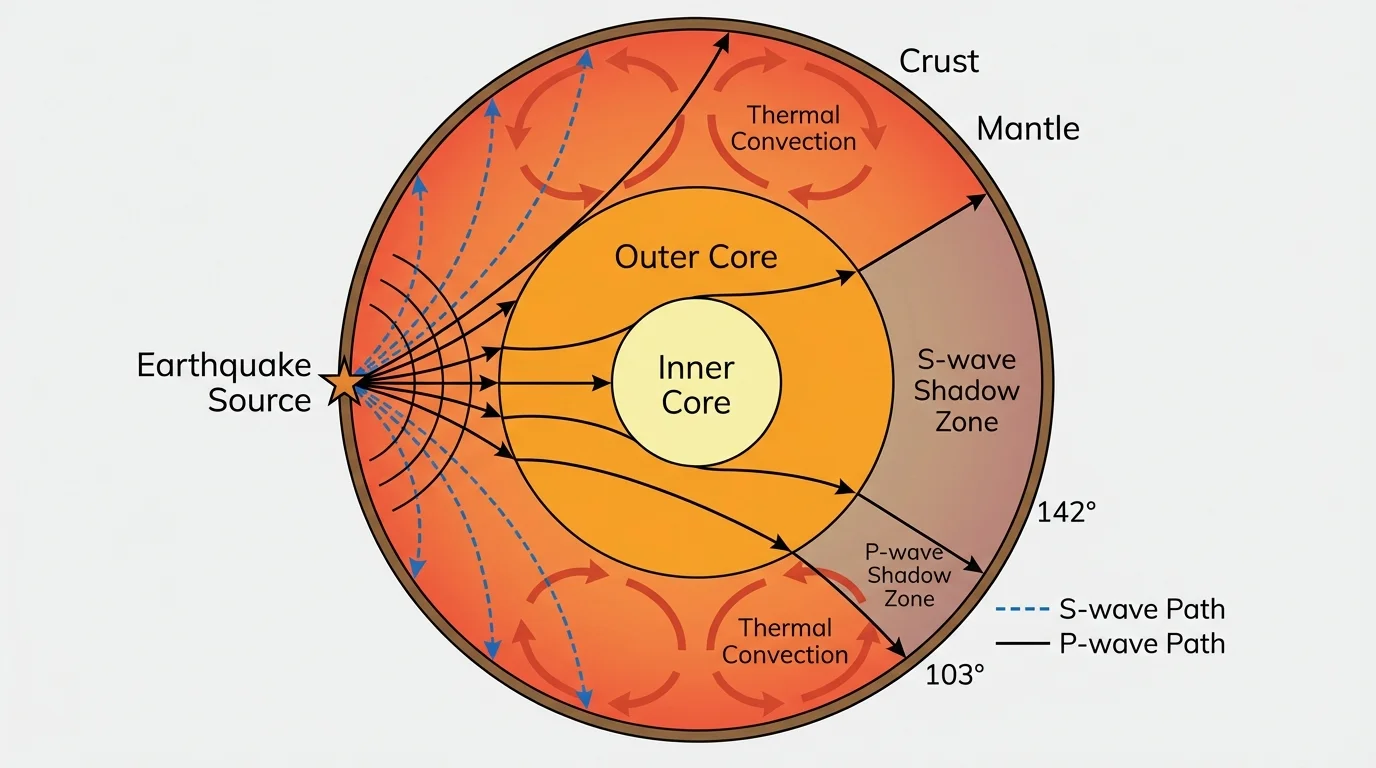
Scientists infer Earth's internal structure from several types of evidence, and [Figure 1] illustrates one of the most important: seismic waves. When earthquakes occur, they send energy through Earth. These waves travel at different speeds through different materials, and some types cannot pass through liquids. By measuring when waves arrive at stations around the world, scientists can infer where layers begin and end.
There are two major body-wave types used in this evidence. P-waves can travel through solids and liquids. S-waves can travel only through solids. When scientists noticed that S-waves do not pass through part of Earth's deep interior, they concluded that the outer core must be liquid. Changes in P-wave speed and direction also reveal boundaries between the crust, mantle, outer core, and inner core.
Another clue comes from density. Earth's average density is much greater than the density of surface rocks. That means denser materials must be concentrated deeper inside the planet. Iron and nickel are much denser than common crustal rocks, so scientists infer that much of the core is made of these metals.
Meteorites also provide evidence. Some meteorites are thought to preserve material similar to the early solar system matter that formed planets. Their composition supports the idea that rocky planets like Earth separated into layers, with dense metal sinking inward and lighter rocky material remaining above.
Earth's magnetic field provides additional evidence about the deep interior. The field is generated by the movement of liquid metal in the outer core. That means the outer core cannot be solid throughout. [Figure 1] also remains useful because it shows how wave behavior reveals physical differences among layers that cannot be seen directly.
Seismic waves are vibrations produced by earthquakes that travel through Earth. Their speeds, paths, and ability or inability to pass through certain materials provide evidence about the planet's internal layers.
Density is mass per unit volume. In Earth science, density differences help explain why some materials rise while others sink.
Scientific knowledge of Earth's interior is therefore not guesswork. It is based on measurements, patterns, and models that fit the evidence. The model is powerful because it explains multiple observations at once.
Earth is a layered planet, and [Figure 2] shows the basic arrangement of the major internal layers. The outermost layer is the crust, a thin rocky shell. Below it lies the mantle, which makes up most of Earth's volume. Deeper still are the outer core and inner core.
The crust is relatively thin compared with the rest of Earth. Oceanic crust is generally thinner and denser, while continental crust is thicker and less dense. Beneath the crust, the mantle is made mostly of silicate rocks rich in magnesium and iron. Although it is solid rock, it behaves plastically over long periods, meaning it can deform and flow slowly.
The outer core is liquid and composed mainly of iron and nickel. The inner core is solid, even though it is hotter, because pressure at Earth's center is extremely high. This combination of temperature and pressure shows that whether matter is solid or liquid depends on more than temperature alone.
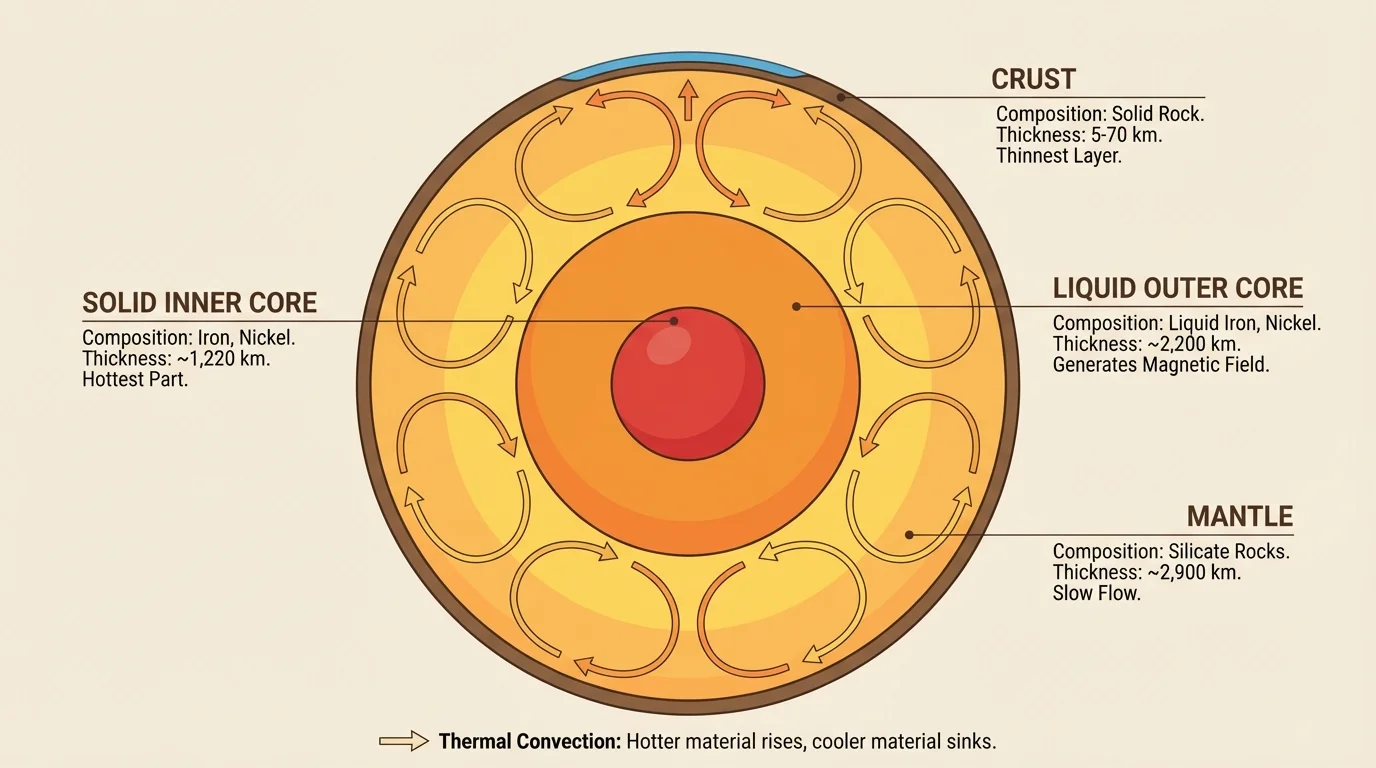
Scientists sometimes describe Earth by composition and sometimes by physical behavior. Compositionally, the main layers are crust, mantle, and core. Mechanically, scientists also discuss the rigid lithosphere and the softer asthenosphere within the upper mantle. That mechanical view helps explain plate motion because rigid plates move over weaker material below.
The model in [Figure 2] is not just about naming layers. It helps explain why different materials move differently, how heat travels, and why the mantle can convect while the outer core flows as a liquid metal layer.
| Layer | Main composition or material | Physical state | Role in Earth processes |
|---|---|---|---|
| Crust | Silicate rock | Solid | Forms surface plates |
| Mantle | Magnesium- and iron-rich silicate rock | Mostly solid but slowly flowing | Site of convection and matter cycling |
| Outer core | Iron and nickel | Liquid | Helps generate magnetic field |
| Inner core | Iron and nickel | Solid | Dense central region under high pressure |
Table 1. Major Earth layers, their materials, physical states, and roles in internal processes.
Thermal convection cannot happen without a source of heat. Earth's internal heat comes mainly from two sources: leftover heat from the planet's formation and heat released by radioactive decay of unstable isotopes inside Earth. As these isotopes break down, they release energy that warms surrounding material.
Temperature generally increases with depth. This increase is called the geothermal gradient. The exact rate varies by location and depth, but the overall pattern matters: deeper parts of Earth are hotter than shallower parts. That temperature difference creates the conditions for convection.
Heat moves through Earth in different ways. Near the surface, conduction transfers heat through direct contact between particles. In parts of Earth where material can move slowly, convection becomes important. Convection is especially significant in the mantle because the mantle is thick and able to flow over geologic time.
Using density to connect temperature and motion
Suppose a sample of cooler mantle rock has a density of \(3.4 \textrm{ g/cm}^3\), while a nearby hotter sample has a density of \(3.3 \textrm{ g/cm}^3\).
Step 1: Compare the densities.
The hotter material has the lower density because \(3.3 < 3.4\).
Step 2: Predict motion under gravity.
Lower-density material tends to rise relative to higher-density material, while higher-density material tends to sink.
Step 3: Connect to Earth.
In the mantle, heating from below can make rock slightly less dense, promoting upward movement. Cooling near the top can make rock denser, promoting sinking.
This density contrast helps drive convection even though the rock moves extremely slowly.
Because mantle rock is under enormous pressure, it does not behave like boiling water. Its movement is much slower and more subtle. Still, the same basic principle applies: warmer, less-dense material rises, and cooler, denser material sinks.
The central process of this lesson is mantle convection. In a convection system, heat from deeper inside Earth warms mantle material. As it warms, its density decreases slightly, so it rises. Near the upper mantle, that material cools, becomes denser, and eventually sinks again. This continuous circulation is called a convection current.
As [Figure 3] shows, the word cycling is important. Matter in the mantle is not staying in one place forever. Rock material moves upward, sideways, downward, and then deeper again over very long time scales. This is not a quick loop like water boiling in a pot. It is an incredibly slow circulation that can take millions of years, but it still counts as matter cycling because material is transported through Earth's interior.
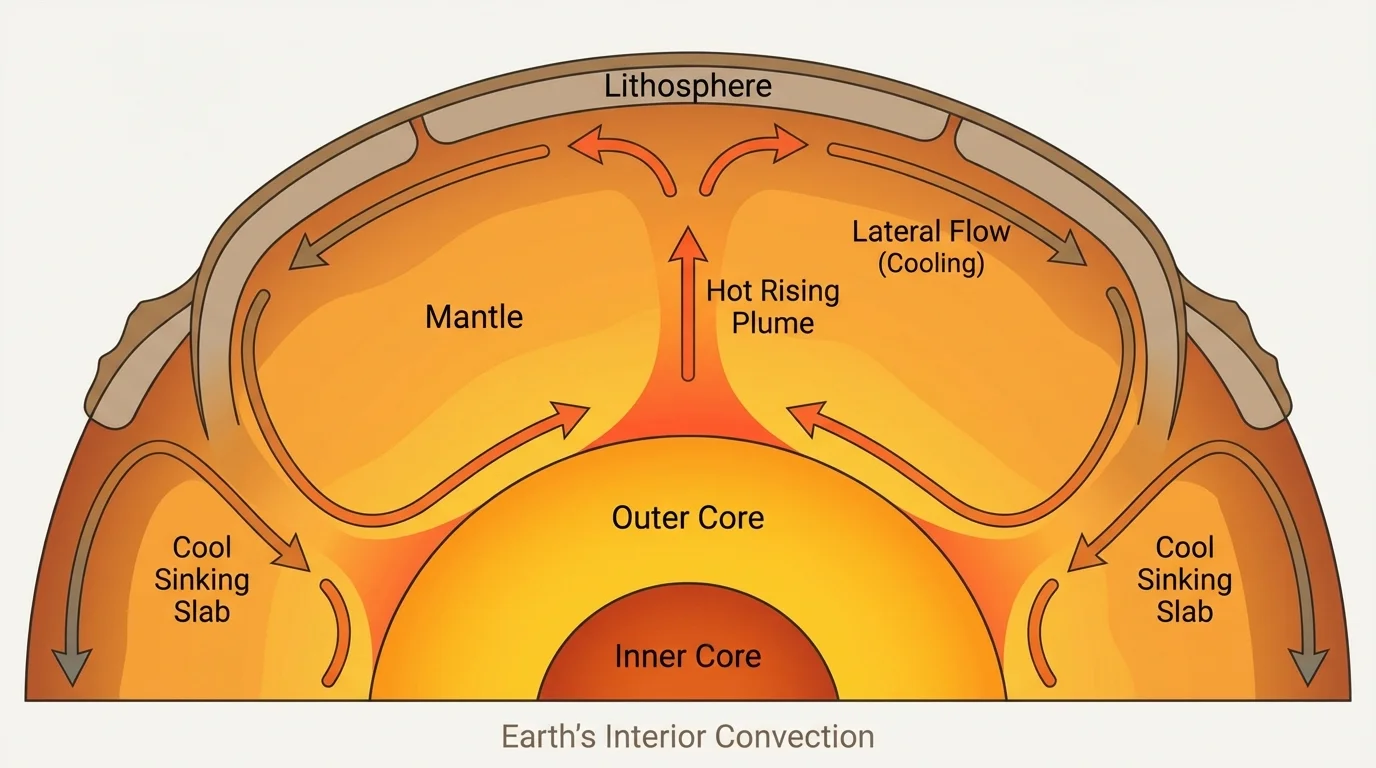
Convection helps transfer heat from Earth's interior toward the surface. That heat transfer is one reason Earth remains geologically active. Without internal heat and convection, Earth's surface would look very different: less volcanism, less plate movement, and a much slower rate of crustal recycling.
It is important to be precise: the mantle does not melt everywhere, and giant open chambers of liquid rock do not circulate through the whole mantle. Instead, mostly solid rock deforms slowly. On short time scales it seems rigid, but on geologic time scales it can flow enough for convection to occur.
Why convection cycles matter
Thermal convection is both a heat-transfer process and a matter-transfer process. Heat moves upward through the circulation, and the rock itself also changes position. That means Earth is not only losing internal heat; it is constantly redistributing material within its interior.
Later surface processes depend on this internal circulation. Rising mantle material and sinking cooler material create a dynamic interior that can push, pull, and recycle Earth's outer layers over immense spans of time.
Earth's rigid outer shell is broken into plates, and [Figure 4] connects plate behavior to the slow flow of mantle material below. Although scientists continue to investigate the exact balance of forces, convection in the mantle is a major part of the model used to explain plate motion.
At a mid-ocean ridge, hot mantle material rises. As plates move apart, magma forms new oceanic crust. This is one way matter from deeper Earth reaches the surface. Over time, this process builds new seafloor.
At subduction zones, denser oceanic lithosphere sinks back into the mantle. This returns surface material to Earth's interior. In that sense, the crust itself becomes part of the larger convection-driven matter cycle. New crust forms at ridges, moves across ocean basins, and is eventually recycled downward.
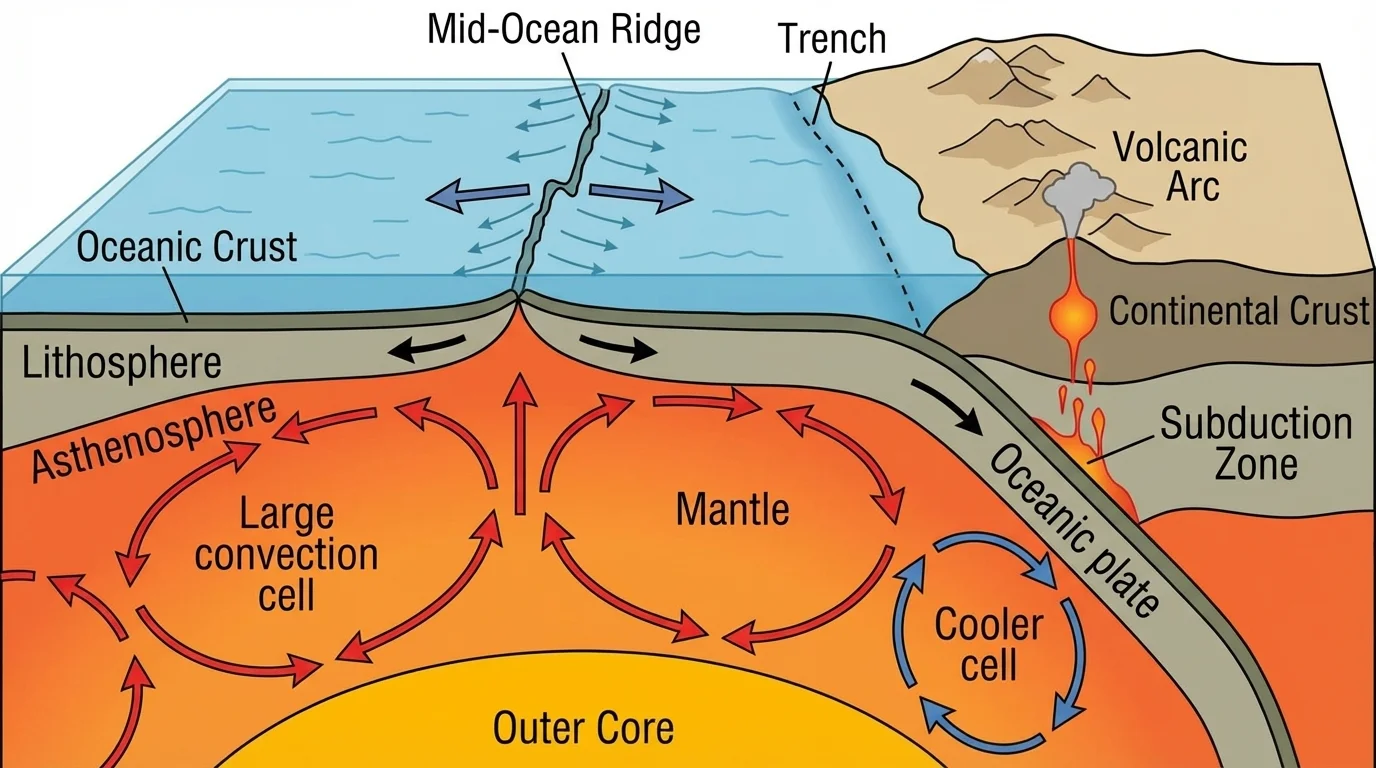
Volcanoes often occur where subducting plates release water into the mantle above them, lowering melting temperatures and producing magma. Earthquakes are also common along plate boundaries because moving plates interact, lock, and suddenly slip. These dramatic events are surface signs of deep internal processes.
This model also helps explain feedback effects in Earth systems. For example, subduction recycles material into the mantle, which can later contribute to volcanism. Volcanic eruptions can quickly alter local environments, while the long-term movement of plates reshapes continents and ocean basins over millions of years.
A scientific model is a simplified representation used to explain observations and make predictions. Models of Earth's interior combine evidence from seismic waves, rock properties, high-pressure experiments, gravity data, and magnetic studies. No model includes every detail, but a strong model accounts for the major patterns scientists observe.
For example, if Earth were the same material all the way through, seismic waves would not show the sharp changes that they do. If the outer core were solid, S-waves would behave differently. If there were no internal heat differences, convection would not occur and plate movement would be much harder to explain. A useful model must fit all of these facts at once.
The deepest humans have drilled into Earth is only about \(12 \textrm{ km}\), which barely scratches the crust compared with Earth's radius of about \(6{,}371 \textrm{ km}\). Almost everything known about deeper layers comes from indirect evidence and modeling.
Models also improve as new data appear. Seismic imaging has become detailed enough to reveal slabs sinking into the mantle and regions of unusually hot mantle rising upward. This does not mean the basic model is wrong; it means the model becomes more detailed and more powerful with better evidence.
The Pacific Ring of Fire is one of the clearest examples of how interior processes affect the surface. Around the edges of the Pacific Ocean, many plates meet. Subduction drives frequent earthquakes and volcanism. These events may seem local and sudden, but they are linked to convection and material cycling deep within Earth.
Mid-ocean ridges provide another example. These underwater mountain chains mark places where mantle material rises and new oceanic crust forms. Most of Earth's volcanic activity actually happens beneath the oceans, out of sight but central to how Earth recycles matter.
Hotspot volcanism, such as in Hawaii, may reflect mantle plumes—columns of especially hot rising mantle material. Even though plume details are still studied, the broader idea remains the same: hotter material from depth can rise and affect the surface. Earth is dynamic because its interior transports both heat and matter.
Scientists often use simple relationships to quantify ideas in Earth science. One essential relationship is density:
\[\rho = \frac{m}{V}\]
Here, \(\rho\) is density, \(m\) is mass, and \(V\) is volume. Density helps explain why some Earth materials tend to rise while others sink.
Density calculation with mantle-like material
A rock sample has a mass of \(330 \textrm{ g}\) and a volume of \(100 \textrm{ cm}^3\). Find its density.
Step 1: Use the density formula.
Substitute into \(\rho = \dfrac{m}{V}\).
Step 2: Calculate.
\[\rho = \frac{330}{100} = 3.3 \textrm{ g/cm}^3\]
Step 3: Interpret the result.
A density of \(3.3 \textrm{ g/cm}^3\) is consistent with a dense rock material. If a nearby rock is denser, that denser material would tend to sink relative to this sample.
Another idea is heat flow. A complete treatment is more advanced, but the basic trend is straightforward: heat moves from hotter regions to cooler ones. Earth's interior is hotter than its surface, so energy tends to move outward. Convection is one of the main ways that outward transfer happens in the mantle.
When students build a model of Earth's interior, the goal is not to memorize a picture. The goal is to explain observations: why seismic waves change, why layers differ, why some material rises, why some sinks, and how those movements cycle matter through Earth's layers over long periods of time.
"The present is the key to the past."
— A guiding idea in geology
This idea matters here because modern earthquakes, volcanic eruptions, and plate motion provide clues to the same interior processes that have operated for millions of years. By studying those clues, scientists can reconstruct the hidden engine inside the planet.
