A small change in Earth's energy budget can reshape glaciers, shift rainfall belts, and move ecosystems across continents. That may sound surprising, because the climate system is enormous, but it works according to a basic idea: if more energy enters Earth's systems than leaves, the planet tends to warm; if more energy leaves than enters, the planet tends to cool. Climate science often begins with that simple statement and then builds a model that explains why the balance changes.
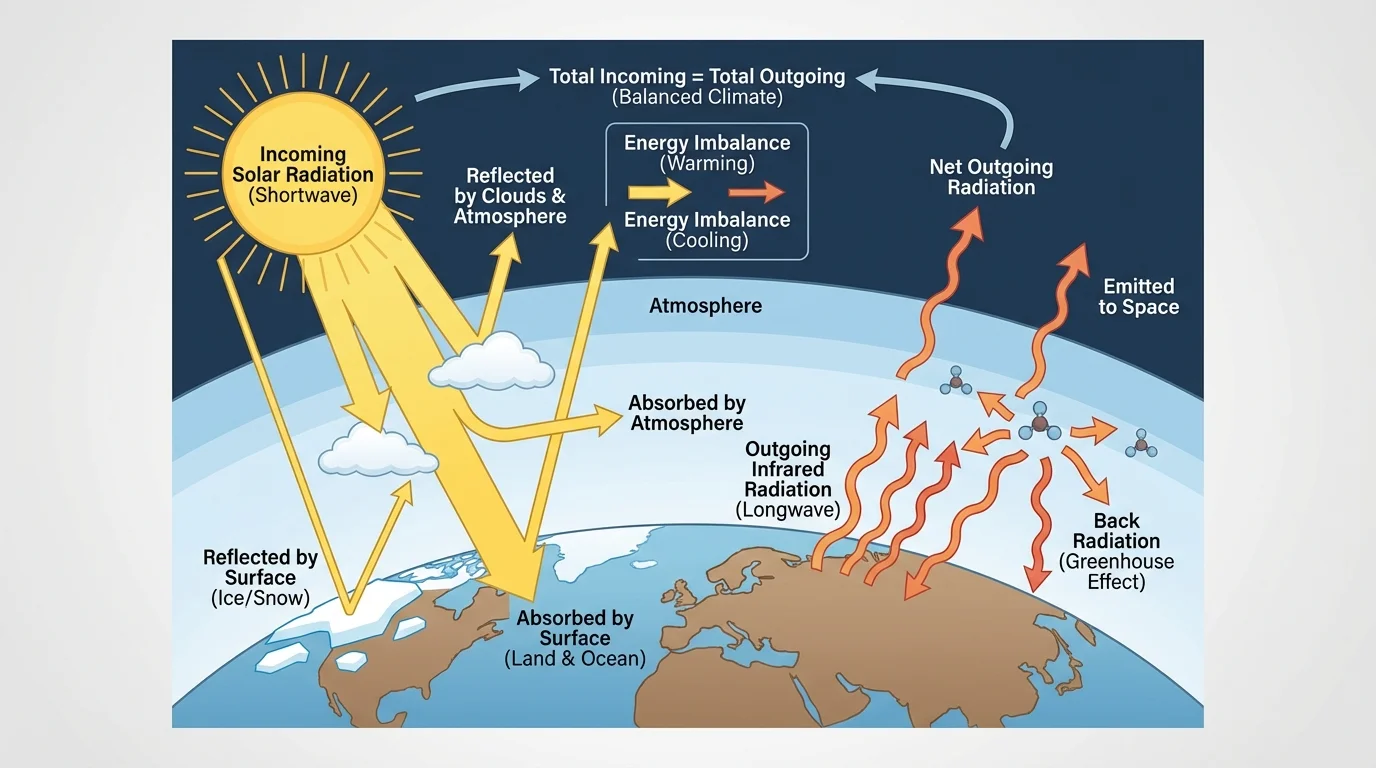
To understand climate, start with energy budget, the balance between incoming energy from the Sun and outgoing energy from Earth to space. In the climate model shown in [Figure 1], sunlight enters the Earth system, some is reflected back to space, and the rest is absorbed by the atmosphere, land, and oceans. Earth then releases energy outward mainly as infrared radiation.
If incoming and outgoing energy are equal on average, climate is relatively stable. If incoming energy becomes greater than outgoing energy, the system gains energy and warms. If outgoing energy becomes greater than incoming energy, the system loses energy and cools. This is not just about air temperature. Extra energy can warm oceans, melt ice, and change how water moves through the atmosphere.
A model is useful because it simplifies a complicated system without losing the key relationships. Earth's actual climate involves countless interactions, but a model helps us track the main pathways of energy. Instead of memorizing isolated facts, we can ask a powerful question: What changed the flow of energy into or out of Earth's systems?
Climate is the long-term pattern of temperature, precipitation, and other atmospheric conditions in a region or across Earth as a whole.
Energy budget is the balance between energy entering Earth from the Sun and energy leaving Earth for space.
Feedback is a process that either amplifies or reduces an initial change in a system.
Weather and climate are related but not identical. Weather describes short-term conditions, such as a stormy week or a heat wave. Climate describes patterns over much longer periods. A cold day does not disprove global warming, just as one winning game does not define an entire sports season. Climate models focus on long-term averages and trends in energy flow.
A useful climate model includes several connected parts of Earth's system: the atmosphere, hydrosphere, cryosphere, geosphere, and biosphere. Energy enters mainly from the Sun, moves among these systems, and is stored or released in different ways.
The atmosphere absorbs and emits radiation and transports heat through winds. The oceans store large amounts of thermal energy and move it through currents. Land surfaces absorb sunlight at different rates depending on color, texture, and moisture. Ice and snow strongly reflect sunlight. Living organisms affect the carbon cycle, water cycle, and surface cover, which can influence energy flow.
One reason climate changes can be delayed is that different parts of the system respond at different speeds. As [Figure 2] shows, air temperatures can change quickly, but oceans warm and cool more slowly because water has a high specific heat. Ice sheets can take even longer to grow or shrink. Because of these different response times, climate change is not always immediate even when the energy balance shifts.
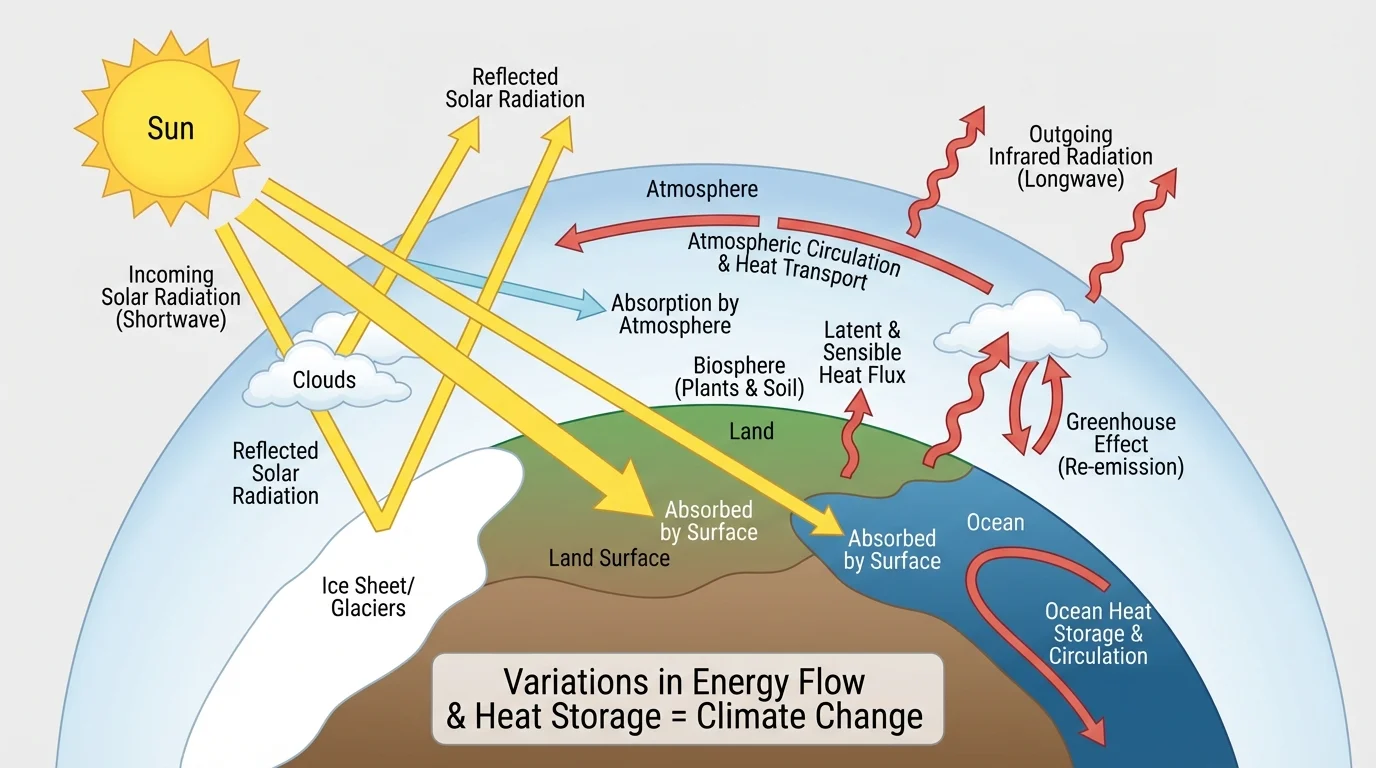
This model represents the climate system using arrows and reservoirs. Arrows show energy transfers. Reservoirs show where energy is stored. This is similar to modeling money moving through a bank account system: deposits, withdrawals, and stored balances all matter. In climate, the "currency" is energy.
Energy can be transferred and transformed, but it is conserved. In Earth science, that means energy is not mysteriously appearing or disappearing inside the climate system; instead, scientists track where it comes from, where it goes, and how long it stays stored.
This model becomes especially powerful when we examine what controls energy entering Earth and energy leaving Earth. Those controls explain why climate can shift over time, sometimes rapidly and sometimes very slowly.
Not all incoming solar energy is absorbed. Some is reflected back to space. The fraction that reflects depends strongly on albedo, which is a measure of reflectivity. Bright surfaces such as snow, ice, and thick clouds have high albedo. Darker surfaces such as forests or open ocean usually have lower albedo and absorb more sunlight.
This matters because a surface with high albedo sends more energy away before it can warm the system. A snowy region therefore affects climate differently from a dark asphalt city. The difference is easy to notice in daily life: a black car parked in sunlight gets hotter than a white one because it absorbs more energy.
Incoming energy also varies by latitude and season. Near the equator, sunlight is more direct, so more energy reaches each square meter of surface. Toward the poles, sunlight arrives at a lower angle and spreads over a larger area, reducing the amount of energy absorbed per unit area. Seasonal changes occur because Earth's axis is tilted, changing day length and sun angle through the year.
Clouds and airborne particles can also affect incoming energy. Some clouds reflect large amounts of sunlight and cool the surface below. Tiny particles in the atmosphere, called aerosols, can reflect or scatter sunlight as well. Volcanic eruptions are an important example. When volcanic ash and sulfur-rich particles enter the atmosphere, more sunlight can be reflected back to space for a period of time, reducing the energy reaching Earth's surface.
Numeric example: reflected and absorbed solar energy
Suppose a surface receives \(100 \textrm{ units}\) of solar energy. If its albedo is \(0.30\), then \(30\%\) is reflected and the rest is absorbed.
Step 1: Calculate reflected energy
Reflected energy is \(0.30 \times 100 = 30\) units.
Step 2: Calculate absorbed energy
Absorbed energy is \(100 - 30 = 70\) units.
If the same incoming sunlight falls on a darker surface with albedo \(0.10\), then only \(10\) units are reflected and \(90\) units are absorbed. That difference can change local and global climate over time.
Changes in incoming absorbed energy do not have to be huge to matter. Over long periods, even small imbalances can add up, especially when feedbacks strengthen the original change.
Earth is not a one-way energy trap. It continuously radiates energy back to space. After Earth's surface absorbs solar energy, it warms and emits infrared radiation. This outgoing energy is essential; without it, the planet would just keep heating.
The atmosphere affects how easily this infrared radiation escapes. Certain gases, including \(\textrm{CO}_2\), water vapor, and methane, absorb and re-emit infrared radiation. These greenhouse gases do not stop energy from leaving forever, but they slow the rate at which some energy escapes to space. That makes the lower atmosphere and surface warmer than they would be otherwise.
This process is known as the greenhouse effect. It is a natural and necessary part of Earth's climate. Without greenhouse gases, Earth would be much colder. However, if the concentration of these gases increases, the rate of outgoing energy loss can decrease for a time, shifting the energy budget toward warming until the system adjusts.
How changing outgoing energy affects climate
If Earth absorbs more energy than it emits, the climate system gains energy. Surface temperatures rise, ocean temperatures rise, and ice can melt. Eventually, a warmer Earth emits more infrared radiation, which pushes the system back toward balance, but that adjustment can take a long time because oceans and ice respond slowly.
A simplified way to think about the energy budget is with the relationship \(E_{\textrm{net}} = E_{\textrm{in}} - E_{\textrm{out}}\). For example, if Earth absorbs \(240\) units of energy and emits \(239\) units, the net gain is \(240 - 239 = 1\) unit. That may seem small, but spread over the whole planet and repeated over time, it represents a major climate shift.
The basic energy-budget diagram in [Figure 1] remains useful here because it shows that climate can change either by altering incoming absorbed sunlight or by altering outgoing infrared radiation. Both pathways matter.
Climate change is rarely a simple one-step process. Once an initial change happens, feedback loops can either amplify that change or reduce it. A positive feedback increases the original change, while a negative feedback weakens it.
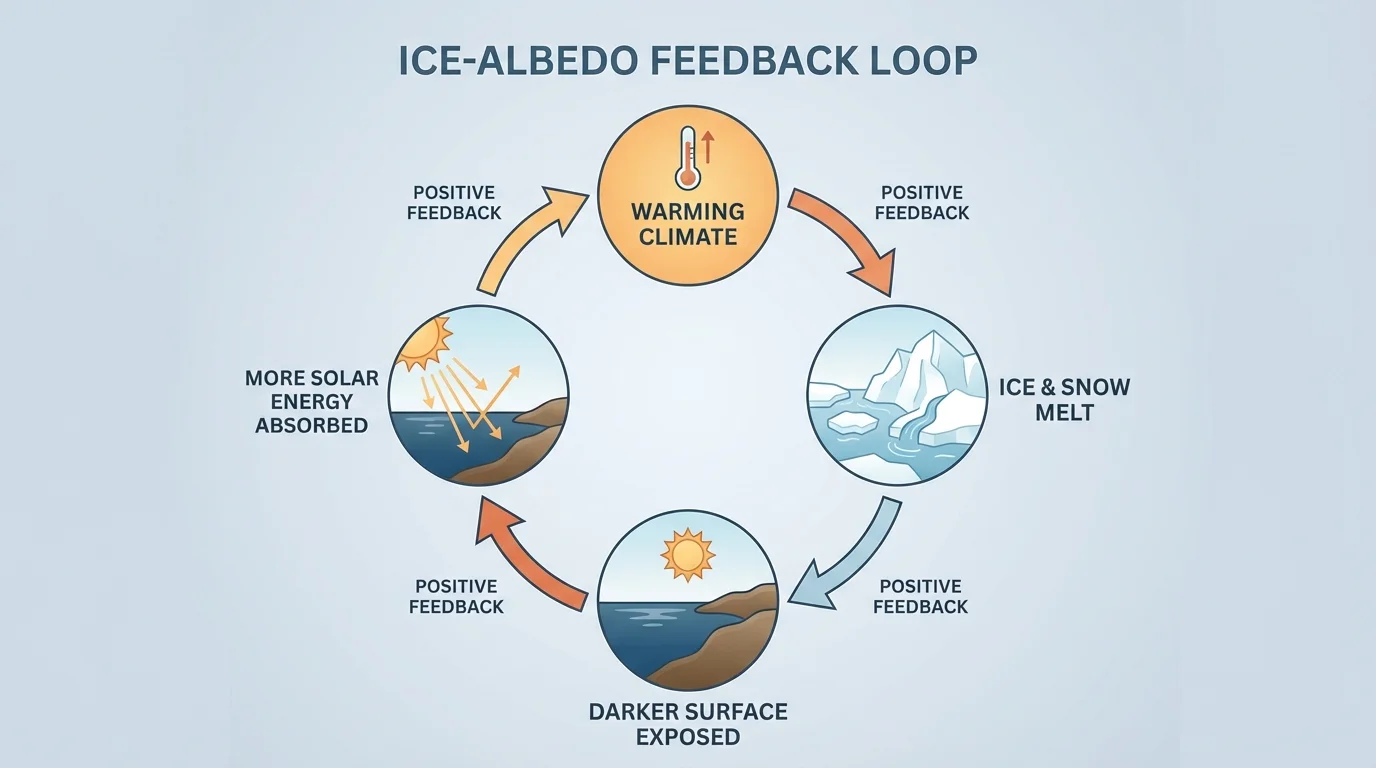
As [Figure 3] shows, one of the clearest positive feedbacks is the ice-albedo feedback. If temperature rises, snow and ice melt. That exposes darker land or ocean water. Darker surfaces absorb more solar energy, which leads to more warming, which causes more melting. The cycle reinforces itself.
Another important positive feedback involves water vapor. Warmer air can hold more water vapor, and water vapor is itself a greenhouse gas. So warming can increase water vapor, which can strengthen the greenhouse effect and lead to additional warming. This does not mean water vapor starts climate change by itself; rather, it acts mainly as a feedback to an initial change.
Negative feedbacks also exist. For example, as Earth warms, it emits more infrared radiation to space. That increased energy loss tends to reduce the initial imbalance. In this way, the climate system has stabilizing processes as well as amplifying ones.
Cloud feedbacks are more complex. Some clouds reflect sunlight and cool Earth, while others trap outgoing infrared radiation and warm it. The overall effect depends on cloud type, altitude, thickness, and location. This is one reason climate modeling requires careful observation and testing.
Large volcanic eruptions can cool parts of the planet for a few years because particles high in the atmosphere reflect incoming sunlight. This is a reminder that not all climate drivers produce warming; some temporarily push the energy budget in the opposite direction.
The feedback model in [Figure 3] helps explain why climate changes can accelerate after they begin. A small initial shift in energy flow can trigger larger downstream effects when Earth's systems respond in ways that reinforce the original trend.
Earth's systems, being dynamic and interacting, produce feedback effects on very different time scales. Some changes are sudden, some unfold over thousands of years, and others operate over millions of years. Recognizing time scale is essential to making sense of climate patterns.
As [Figure 4] shows, sudden changes can happen after major volcanic eruptions. Ash and aerosols entering the atmosphere may reduce incoming solar energy for a short time, leading to temporary cooling. These effects are fast compared with most climate processes, but they usually do not last for many decades.
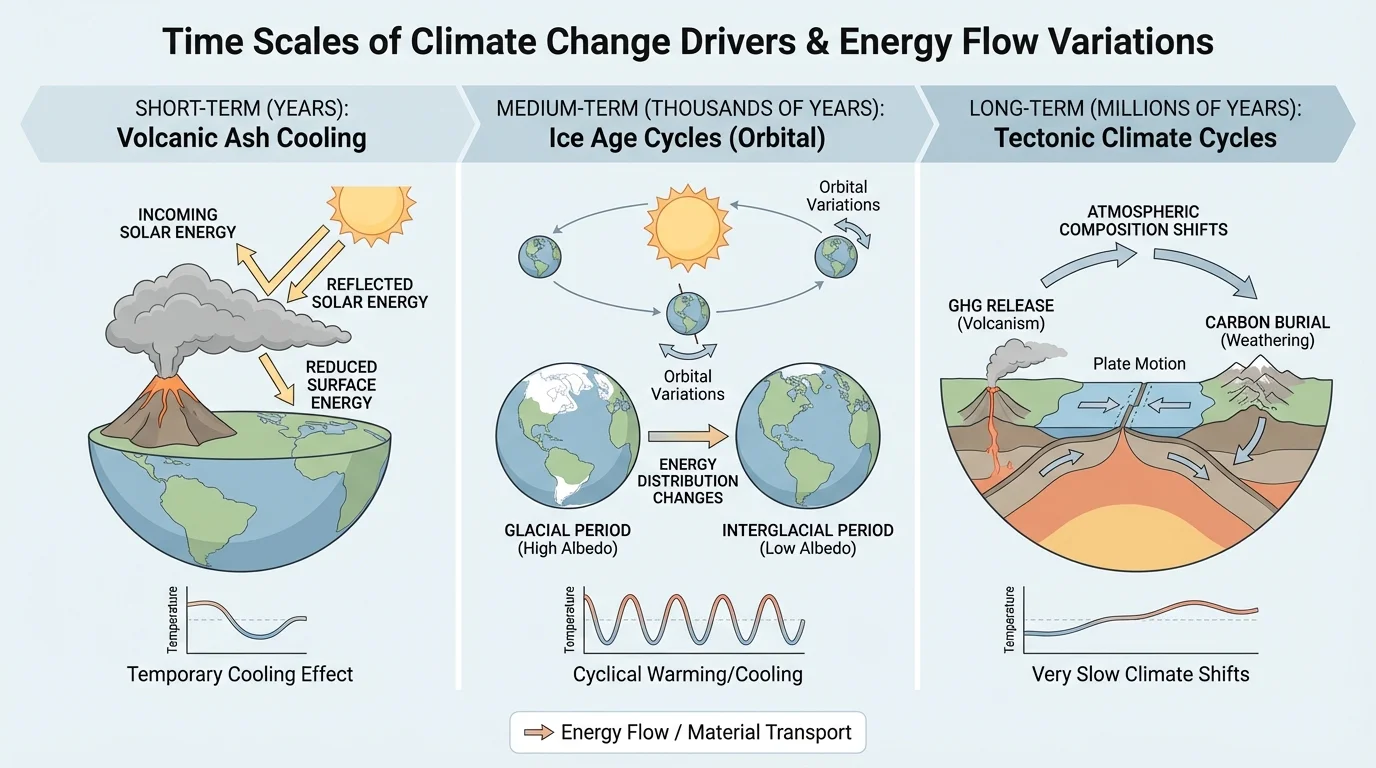
Intermediate time-scale changes include glacial and interglacial cycles, often called ice age cycles. Over thousands of years, changes in Earth's orbit, tilt, and precession alter the distribution of solar energy across latitudes and seasons. These changes can trigger feedbacks involving ice cover, albedo, greenhouse gases, and ocean circulation, leading to major climate shifts.
Very long-term changes are linked to tectonic processes. The movement of continents, mountain building, and changes in seafloor spreading can affect ocean circulation, weathering rates, and atmospheric composition over millions of years. These processes are far too slow to notice directly in a human lifetime, but they are part of Earth's climate story.
The timeline in [Figure 4] makes an important point: the same basic energy-flow model applies across all these scales. What changes is the driver, the speed of the response, and which feedbacks become most important.
When the flow of energy into and out of Earth's systems changes, scientists observe climate changes in several major ways. One is surface temperature. If Earth gains more energy than it loses, average surface temperatures tend to rise over time. If Earth loses more than it gains, they tend to fall.
A second observable change is in precipitation patterns. A warmer atmosphere can change evaporation, cloud formation, and storm tracks. Some regions may become wetter, while others become drier. The key idea is that a shift in energy flow affects the movement of water through the climate system.
A third indicator is glacial ice volume. Glaciers and ice sheets respond strongly to long-term temperature changes. When melting exceeds accumulation, glacial ice volume decreases. During cooler periods, ice can expand.
A fourth indicator is sea level. Sea level can rise when land-based ice melts and adds water to the oceans. It can also rise because warmer water expands. This means sea level is linked directly to changes in energy stored in the climate system.
A fifth indicator is biosphere distribution. As climate zones shift, organisms often shift as well. Species may move toward cooler latitudes, higher elevations, or regions with more suitable rainfall patterns. Forest boundaries, grasslands, and marine ecosystems can all change location when climate changes.
| Observed climate change | How energy-flow changes can affect it |
|---|---|
| Surface temperatures | More net absorbed energy generally raises temperatures over time. |
| Precipitation patterns | Changing energy alters evaporation, atmospheric circulation, and storm behavior. |
| Glacial ice volumes | Warming increases melting and can reduce long-term ice storage. |
| Sea levels | Melting land ice and warming ocean water both contribute to higher sea level. |
| Biosphere distribution | Plants and animals shift as temperature and rainfall zones move. |
Table 1. Major observable climate changes linked to changes in Earth's energy flow.
These observations are especially valuable because they provide evidence that a model is working. If a model predicts warming, changing rainfall patterns, shrinking glacial ice, rising sea level, and shifting ecosystems, scientists can compare those predictions with real measurements.
Consider a modern warming example. If greenhouse gas concentrations increase, outgoing infrared radiation is initially reduced. That creates a net energy gain for the climate system. Over time, surface temperatures rise, glaciers lose mass, sea level rises, and some species ranges shift. This chain of reasoning follows directly from the energy-budget model.
Case study: a warming shift in the energy budget
Step 1: Start with a balanced system
Suppose incoming absorbed energy is \(240\) units and outgoing energy is also \(240\) units. Net change is \(240 - 240 = 0\).
Step 2: Change outgoing energy
If greenhouse gases reduce outgoing energy to \(238\) units while incoming absorbed energy stays at \(240\), the net gain becomes \(240 - 238 = 2\) units.
Step 3: Interpret the result
Those extra \(2\) units do not vanish. They are stored in the climate system, contributing to warming, ice melt, ocean warming, and related climate changes.
The numbers are simplified, but the logic matches how scientists reason about climate.
Now consider a volcanic example. A major eruption adds reflective particles to the atmosphere. More incoming sunlight is reflected, so less solar energy is absorbed. The climate system temporarily loses energy relative to what it did before, and surface temperatures may drop for a short period. That is a sudden climate forcing acting mainly on the "energy in" side of the model.
For an ice age example, a gradual orbital change can alter where and when sunlight is strongest. That small shift may begin a cooling trend in high latitudes. Snow and ice then expand, increasing albedo. As shown earlier by the feedback logic in [Figure 3], more reflection can reinforce cooling and help grow large ice sheets over long periods.
A scientific model is not a guess. It is a structured representation of reality that helps explain patterns, test ideas, and make predictions. Climate models range from simple diagrams to complex computer simulations, but they all depend on the same core principle: climate changes when the balance of energy entering and leaving Earth's systems changes.
Simple models are especially important in learning because they reveal cause and effect. The systems model in [Figure 2] shows that the atmosphere does not act alone; oceans, land, ice, and life all interact. The energy-budget model in [Figure 1] shows the two main pathways for climate change: changing absorbed solar energy or changing outgoing infrared energy. The time-scale comparison in [Figure 4] shows that the same ideas apply across years, thousands of years, and millions of years.
When students use a model well, they do more than repeat facts. They can explain why a darker surface absorbs more energy, why volcanic particles may cool climate temporarily, why greenhouse gases affect outgoing radiation, and why feedbacks can intensify changes. Most importantly, they can connect those causes to measurable outcomes: surface temperatures, precipitation patterns, glacial ice volumes, sea levels, and biosphere distribution.
"To understand climate, follow the energy."
That short statement captures the heart of the topic. Climate is not random. It is the result of energy moving through a dynamic Earth system whose parts interact, store energy, exchange it, and respond over different time scales.
