A single spoonful of healthy soil can contain billions of living organisms. That fact is easy to overlook, but it points to a huge truth: life on Earth works as a network, not as isolated species. Humans eat from that network, build from it, breathe because of it, and even find beauty and meaning in it. At the same time, human activity is changing that network faster than many species can adapt. Understanding biodiversity is therefore not only about protecting rare organisms; it is about understanding the living systems that support civilization itself.
Biodiversity is the variety of life on Earth, and it exists at several levels. It includes variation within a species, differences among species, and the variety of ecosystems across a region or the whole planet. This idea connects strongly to biological evolution: all living things share common ancestry, yet evolutionary processes have produced an enormous diversity of forms, behaviors, and ecological roles.
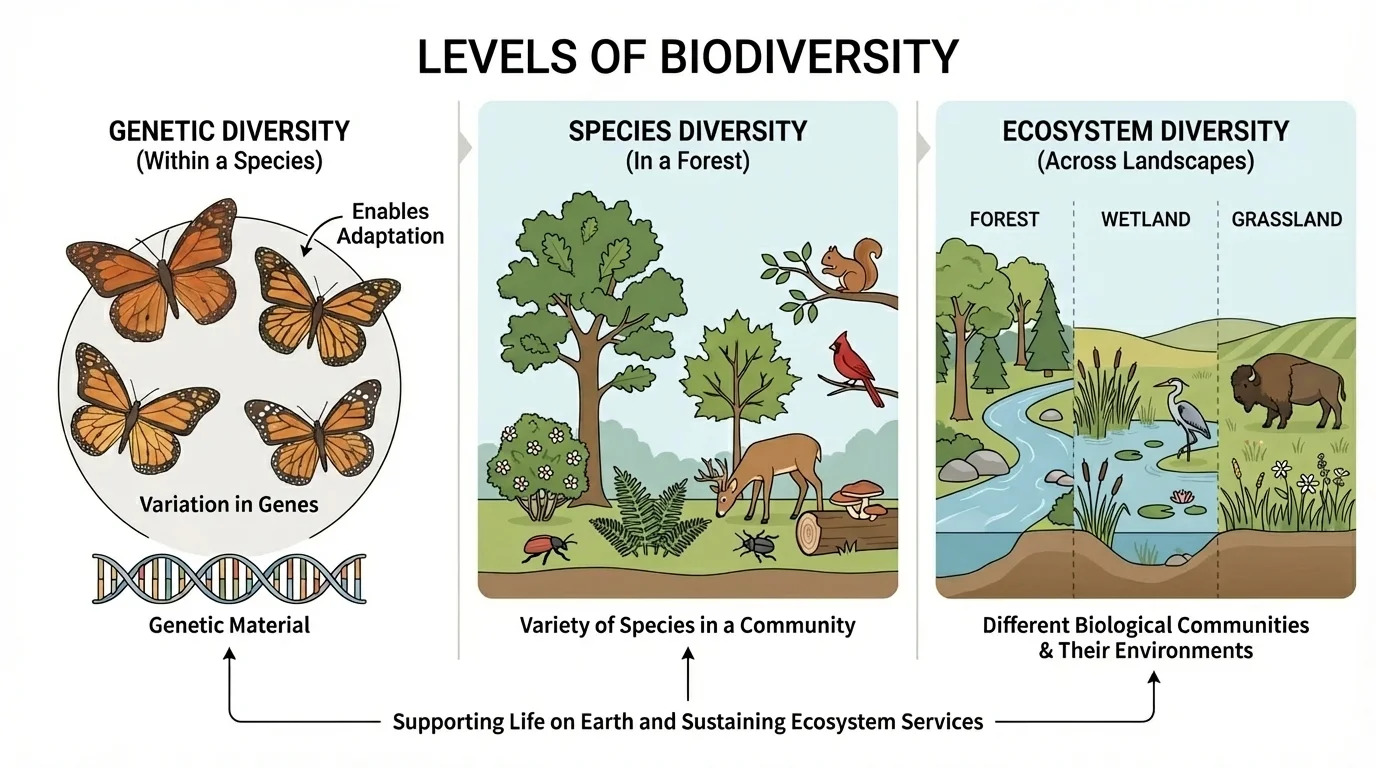
[Figure 1] Biologists often describe three major levels of biodiversity. Genetic diversity refers to variation in DNA within a species. Species diversity refers to the number and relative abundance of different species in an area. Ecosystem diversity refers to the variety of habitats, communities, and ecological processes, such as deserts, coral reefs, grasslands, wetlands, and forests.
These levels matter because living systems are not interchangeable. A population of wolves with low genetic diversity may be less able to resist disease. A forest with fewer species may lose key pollinators or decomposers. A region with only one type of habitat supports fewer ecological interactions than a landscape containing streams, meadows, forests, and marshes.
Biodiversity also reflects the history of life. Natural selection, mutation, migration, and speciation have produced both unity and diversity. The forelimbs of bats, whales, cats, and humans share the same basic bone pattern because of common ancestry, yet they function differently because populations evolved in different environments. In the same way, biodiversity represents both the connectedness of life and the many ways life has adapted to survive.
Genetic diversity is the variation in inherited traits within a species or population.
Species diversity is the variety of species in an area, including how many species there are and how evenly individuals are distributed among them.
Ecosystem diversity is the variety of habitats, communities, and ecological processes in a region.
When biodiversity declines, the effects can appear at any of these levels. A species does not have to go fully extinct for biodiversity to be damaged. If a fish population becomes very small, its genetic diversity may shrink. If one dominant plant replaces many native plants, species diversity falls. If a wetland is drained for development, ecosystem diversity is reduced.
People sometimes think of nature as something separate from human life, but nearly every part of daily life depends on living systems. Food is the most obvious example. Humans depend on crops such as wheat, rice, maize, potatoes, fruits, and vegetables, but we also depend on the biodiversity around those crops. Wild pollinators, soil microbes, predators of crop pests, and plants used in breeding programs all contribute to agriculture.
Medicine provides another powerful example. Many drugs come from living organisms or were developed from chemicals first found in them. Compounds from fungi have led to antibiotics. Chemicals from plants have contributed to medicines used for pain relief, heart conditions, and cancer treatment. If species disappear before they are studied, potential medical discoveries may disappear with them.
Biodiversity also provides ecosystem services, the benefits people obtain from ecosystems. Some services are direct, such as food, timber, fibers, and fish. Others are less visible but just as important: water purification by wetlands, carbon storage in forests, nutrient recycling by decomposers, flood reduction by coastal marshes, and oxygen production through photosynthesis. Even when people never notice these processes, they depend on them every day.
How biodiversity becomes a human benefit
Different species perform different ecological jobs. Pollinators move pollen between flowers, decomposers break down dead matter, predators help control prey populations, and plants capture solar energy and build the organic matter that supports food webs. The greater the variety of organisms performing these roles, the more likely an ecosystem is to keep functioning even when conditions change.
Cultural benefits matter too. Landscapes rich in biodiversity provide places for recreation, tourism, art, scientific curiosity, and spiritual reflection. National parks, coral reefs, mountain forests, and wildlife reserves often inspire a sense of wonder that goes beyond economics. A forest trail, a coastline full of seabirds, or the seasonal return of migrating monarch butterflies can shape identity and community life.
That is why conserving biodiversity is not only about saving distant rainforests or unusual animals. It is also about protecting fisheries, maintaining fertile farmland, reducing disaster risk, preserving clean water, and sustaining places people value for beauty and meaning.
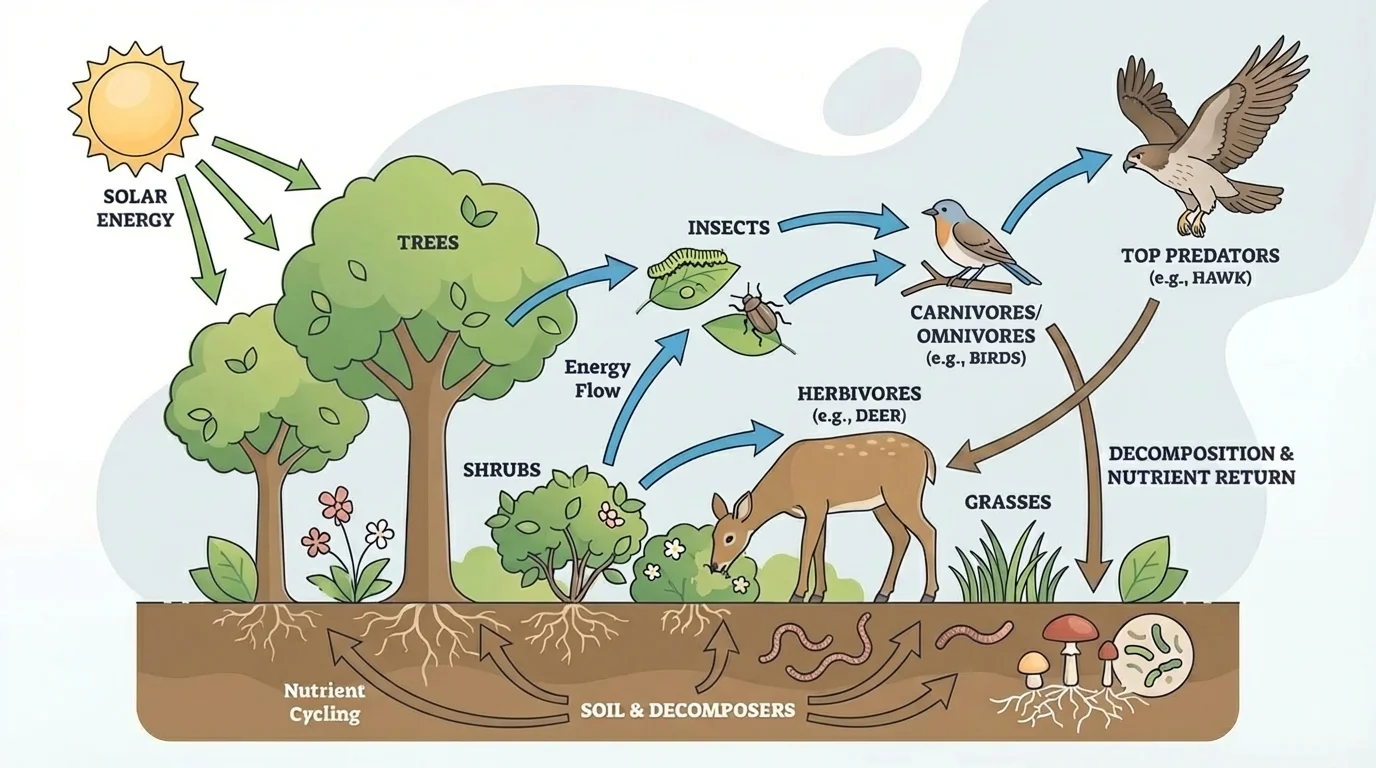
In ecosystems, species interact through feeding, competition, cooperation, decomposition, and habitat building. These connections form a food web that shows how energy and matter move through such a network. Plants and algae capture light energy. Herbivores eat producers. Carnivores eat herbivores and other consumers. Decomposers such as fungi and bacteria break down dead material, returning nutrients to the soil and water.
[Figure 2] An ecosystem with more biodiversity often has greater resilience, meaning it can resist disturbance or recover after it. If one pollinator species declines, another may partially fill its role. If one plant species suffers from drought, others may continue growing and help hold soil in place. This does not mean species are fully replaceable; many are not. But diversity can provide a kind of ecological backup system.
Productivity is also linked to biodiversity. In many ecosystems, a variety of species uses resources more completely than a single species alone. For example, some plants have shallow roots, while others have deep roots. Some grow better in shade, while others thrive in direct sunlight. Together they can capture more water, nutrients, and light, increasing total biomass production.
Consider a coral reef. Corals build the physical structure, algae provide energy through symbiosis, fish graze on algae, predators regulate populations, and countless invertebrates recycle nutrients. Remove enough parts of that system, and the reef can shift from a vibrant, productive habitat to a degraded area dominated by algae. The same pattern applies in forests, grasslands, lakes, and estuaries: biodiversity supports the interactions that keep ecosystems functioning.
Some keystone species influence ecosystems far more than their numbers suggest. Sea otters, for example, help protect kelp forests by eating sea urchins, which would otherwise overgraze the kelp.
Scientists sometimes describe these roles using the idea of an niche, the way a species lives and functions in its environment. Two species may appear similar but occupy different niches by feeding at different times, nesting in different places, or using different resources. As shown earlier in [Figure 2], ecosystem stability depends on many such roles being filled.
Human society depends on biodiversity, yet human activity is now one of the main drivers of its decline. The major causes are often grouped into six broad categories and are best understood as interacting pressures rather than isolated problems: overpopulation, overexploitation, habitat destruction, pollution, introduction of invasive species, and climate change.
[Figure 3] Overpopulation increases demand for land, water, energy, food, and materials. As the human population grows and consumption rises, more forests are cleared, more freshwater is withdrawn, and more waste is generated. Population growth does not affect all places equally, but globally it intensifies pressure on ecosystems.
Overexploitation happens when organisms are removed faster than their populations can recover. Overfishing is a classic example. If fish are harvested beyond sustainable levels, population sizes drop, age structures change, and entire food webs may shift. Poaching of elephants for ivory, overharvesting of tropical hardwoods, and collection of wild animals for trade are other examples.
Habitat destruction is one of the largest threats to biodiversity. Urban expansion, roads, dams, mining, and agriculture can fragment habitats into smaller pieces. Even when a habitat is not completely destroyed, fragmentation can isolate populations, making it harder for individuals to find mates, migrate, or maintain genetic diversity.
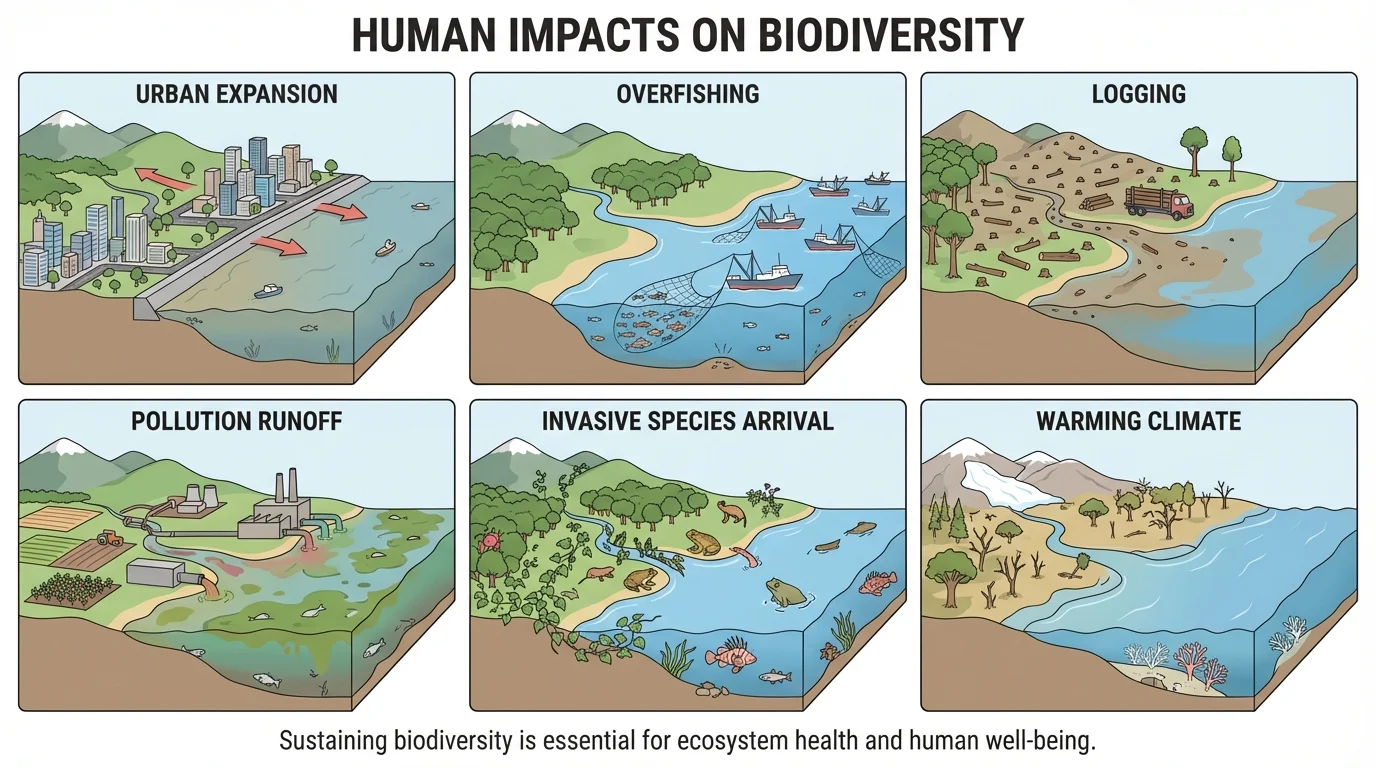
Pollution affects biodiversity in many forms: plastic waste, pesticides, excess fertilizer, oil spills, heavy metals, and air pollution. Fertilizer runoff can trigger algal blooms in lakes and coastal waters. When algae die and decompose, oxygen levels may fall so low that fish and other organisms cannot survive. Combustion of fossil fuels releases \(\textrm{CO}_2\), contributing to climate change and ocean acidification.
Invasive species are organisms introduced to places where they are not native and where they spread rapidly, often because they lack natural predators or competitors. Zebra mussels in North America, cane toads in Australia, and brown tree snakes on Guam have all disrupted native ecosystems. Invasive species can outcompete native species, spread disease, or alter habitats.
Climate change is now intensifying many other threats. As average temperatures rise, precipitation patterns shift, glaciers melt, sea levels rise, and extreme events such as heat waves and intense storms become more common. Species adapted to narrow temperature ranges may be forced to migrate, adapt quickly, or decline. Coral bleaching is a dramatic example: when water becomes too warm, corals lose the symbiotic algae they depend on for energy.
Natural selection can help populations adapt over generations, but it only works when there is heritable variation and enough time. Rapid environmental change can outpace evolution, especially in small or isolated populations.
These threats often act together. A forest species might first lose habitat to deforestation, then face stress from hotter temperatures, and then encounter new parasites or invasive competitors. Because the pressures combine, biodiversity loss is often faster and more severe than any one factor alone would suggest.
Pollinator decline shows how biodiversity loss can affect food systems directly. Many crops depend on bees, butterflies, birds, bats, and other pollinators. Habitat loss, pesticide exposure, parasites, and climate shifts have reduced some pollinator populations. If pollinator diversity drops, crop yields and fruit quality may decline, especially in plants that rely heavily on animal pollination.
Tropical deforestation offers another example. Rainforests contain immense species diversity, much of it still not fully studied. When forests are cut for cattle ranching, timber, mining, or plantations, not only do species lose habitat, but carbon stored in vegetation and soil may be released as \(\textrm{CO}_2\). This links habitat destruction to global climate change.
Case study: Wolves in Yellowstone National Park
The reintroduction of wolves to Yellowstone revealed how one species can influence many others.
Step 1: Wolves reduced and changed elk grazing patterns.
Step 2: With less intense browsing in some areas, willow and aspen recovered.
Step 3: Improved vegetation supported beavers, birds, and other species, changing parts of the ecosystem.
This is an example of a trophic cascade, in which changes at one feeding level affect many others.
Marine ecosystems show similar patterns. Overfishing large predators can alter food webs, allowing some prey species to increase dramatically while reducing others. Coral reef loss reduces habitat for fish, lowers coastal protection from waves, and damages tourism economies. The lesson is consistent across ecosystems: when biodiversity changes, ecological processes and human systems change too.
Invasive species can reshape entire islands and lakes. On Guam, the accidental introduction of the brown tree snake led to major declines in native birds. Without those birds, seed dispersal changed, affecting forest regeneration. This shows that the loss of one group of organisms can influence plant communities and ecosystem structure over time.
Sustaining biodiversity requires more than protecting a few famous species. It involves maintaining habitats, ecological interactions, and evolutionary potential across landscapes and generations. A systems approach combines conservation, restoration, sustainable resource use, scientific monitoring, and community involvement.
[Figure 4] Protected areas such as national parks, marine reserves, and wildlife refuges can preserve habitats and reduce direct exploitation. However, protected areas work best when they are large enough, well-managed, and connected by wildlife corridors that allow migration and gene flow between populations.
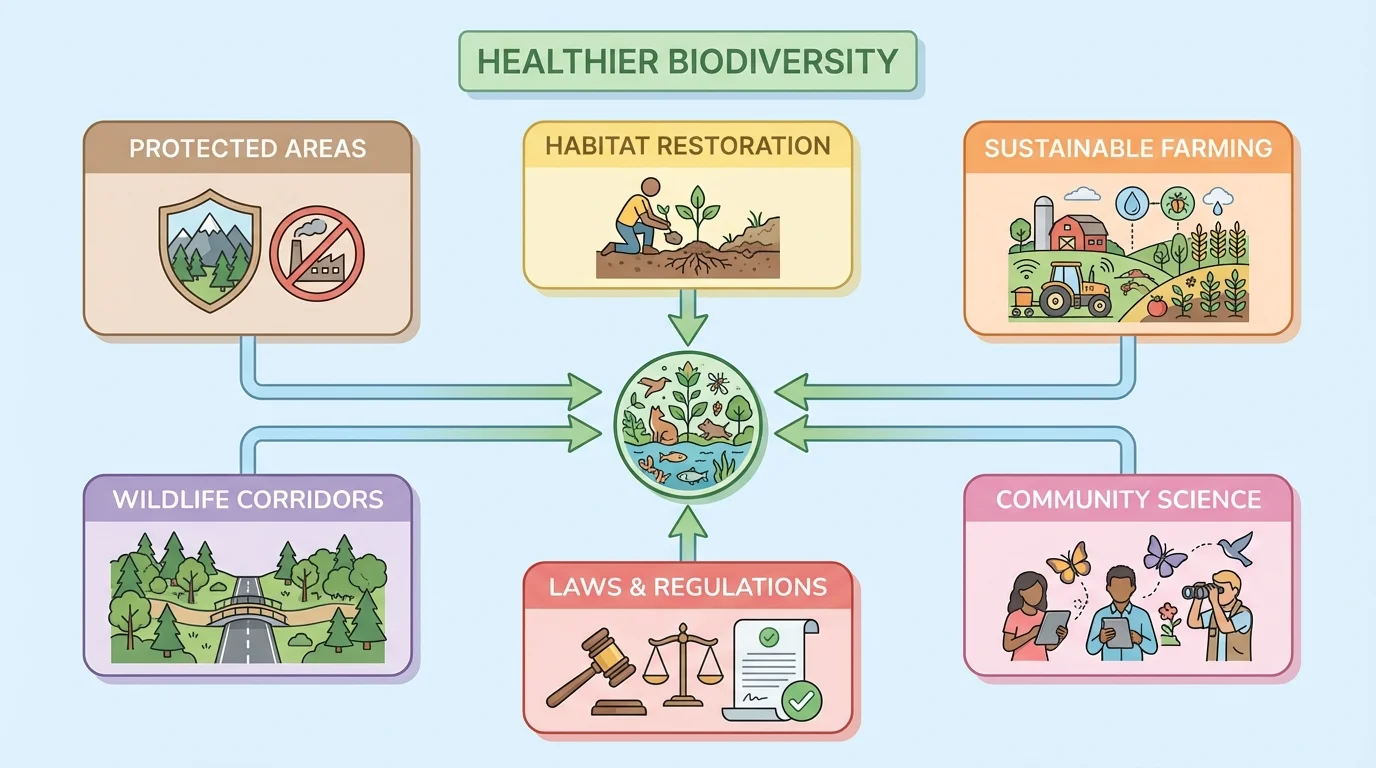
Habitat restoration aims to rebuild damaged ecosystems. Examples include planting native trees, restoring wetlands, removing obsolete dams, rebuilding oyster reefs, and reintroducing native species. Restoration may not recreate the exact original ecosystem, but it can recover important functions such as water filtration, pollination, and wildlife habitat.
Sustainable use means using biological resources at rates that do not cause long-term decline. Sustainable forestry, fishery quotas based on population data, crop rotation, reduced pesticide use, and soil conservation are examples. In fisheries, if a population can replace approximately the number of individuals removed each year, harvesting may remain sustainable; if removal consistently exceeds replacement, decline is likely.
Why genetic diversity matters in conservation
Conservation is not only about keeping species names on a list. Populations need enough individuals and enough genetic variation to reproduce successfully and adapt to future changes such as disease, drought, or warming temperatures. A species with very low genetic diversity may survive temporarily but remain highly vulnerable.
Laws and international agreements also matter. Limits on hunting, trade restrictions for endangered species, water quality rules, and emissions policies can reduce pressures on biodiversity. Scientific research helps identify which species are at risk and which habitats are most important to protect. Citizen science projects, such as bird counts or amphibian monitoring, can contribute valuable data.
Indigenous and local communities often hold detailed ecological knowledge developed over long periods of interaction with land and water. In many places, biodiversity conservation improves when this knowledge is respected and combined with modern science. Sustainable management is strongest when it includes the people who live closest to ecosystems.
Individual actions may seem small, but they scale up. Choices about diet, energy use, transportation, waste, landscaping, and consumer products affect biodiversity. Planting native species, reducing single-use plastics, supporting sustainable fisheries, and protecting local habitats all contribute. As shown earlier in [Figure 4], conservation works best when multiple strategies reinforce one another.
Biodiversity supports more than survival; it supports quality of life. Green spaces improve mental health, reduce urban heat, and provide places for exercise and recreation. Coastal wetlands protect communities from storm surges. Forests influence rainfall and water supplies. Diverse agricultural systems can improve food security and reduce the risks of crop failure.
There is also an ethical question. Humans are one species among millions, yet our actions can determine whether others persist or disappear. Many people argue that species and ecosystems have value beyond human use. Others focus on practical reasons alone. In real policy decisions, both kinds of arguments often matter.
"We abuse land because we regard it as a commodity belonging to us. When we see land as a community to which we belong, we may begin to use it with love and respect."
— Aldo Leopold
The landscapes people protect are often the same places that shape memory, culture, and imagination. Mountain ranges, wetlands full of migratory birds, old-growth forests, and coral coasts are not just collections of organisms. They are living systems that provide services, sustain economies, and inspire people. Protecting biodiversity therefore means preserving both ecological function and human possibility.
The central idea is clear: humans depend on biodiversity, but human actions are putting it at risk. Sustaining biodiversity is essential because ecosystem functioning and productivity depend on the diversity of life and its interactions. If biodiversity is maintained, ecosystems are more likely to remain stable, productive, and capable of supporting life on Earth, including our own.
