A roller coaster climbs slowly, then races downward. A phone charger transfers energy through electric interactions. A satellite remains in orbit because of gravity acting through empty space. These situations look very different, yet they all depend on the same powerful idea: when objects that interact through a field change their relative positions, the energy stored in that field changes.
That idea is one of the most important ways physicists understand energy. Energy is not only kinetic energy or heat. It can also be stored in the arrangement of objects. If the arrangement changes, the stored energy can increase or decrease. This is why lifting a backpack, separating charged particles, or pushing magnets together can require work. The energy does not disappear; it is transferred into or out of the field-object system.
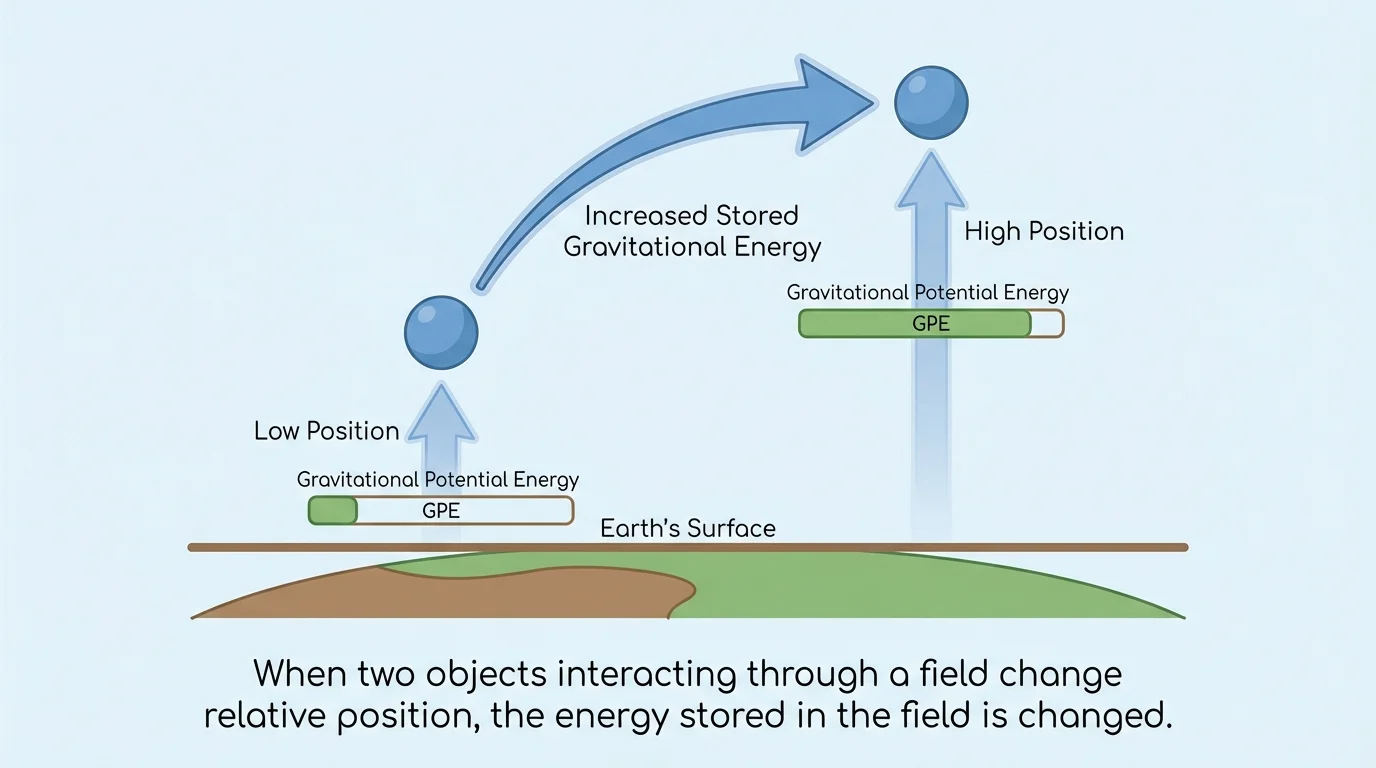
When two objects interact, their positions relative to each other matter. A book on the floor and the same book on a shelf are made of the same material and may both be at rest, but the Earth-book system does not store the same amount of energy in those two arrangements. The higher position stores more gravitational potential energy because the relative position in the gravitational field has changed.
This is the central idea behind potential energy: energy stored because of position, arrangement, or configuration. In this topic, the configuration involves objects interacting through a field. The field may be gravitational, electric, or magnetic. As the objects move closer together or farther apart, or shift into a new arrangement, the energy stored in the field changes.
Field means a region of space in which an object can exert a force on another object without direct contact.
Potential energy is stored energy associated with the positions or arrangement of interacting objects.
Relative position means where objects are compared to one another, not just where one object is by itself.
It is important to notice that this energy belongs to the system of interacting objects. For example, gravitational potential energy is not stored only in the falling rock and not only in the Earth. It belongs to the Earth-rock system. That system idea helps prevent common mistakes later.
A field is a way to describe how one object affects the space around it. [Figure 1] illustrates this idea with gravitational and electric interactions. If another object enters that region, it can experience a force even though the objects are not touching.
The gravitational field is created by mass. Electric fields are created by electric charge. Magnetic fields are created by magnets, electric currents, and moving charges. In each case, the interaction can act across space. That is why a dropped pencil falls before it ever touches the ground, and why two charged objects can push or pull each other without contact.
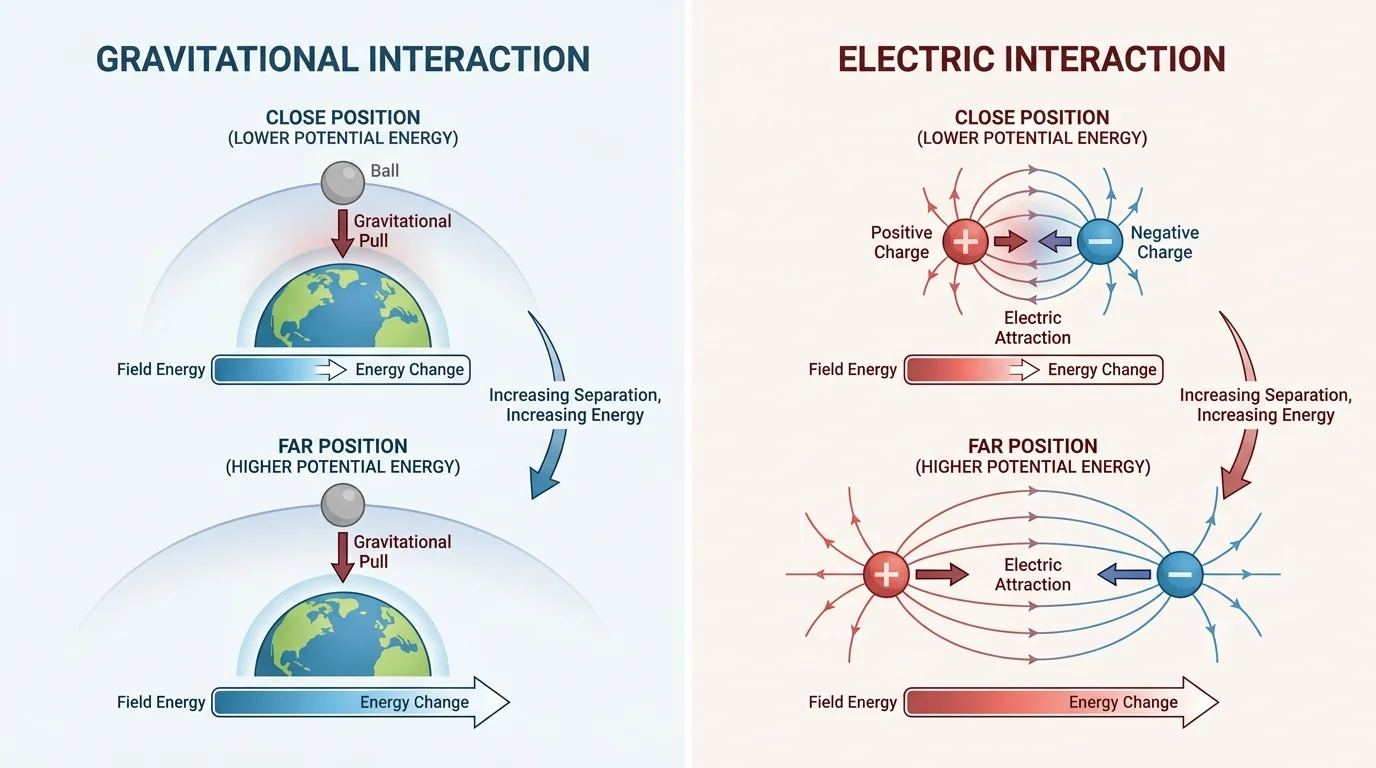
Fields help us keep track of energy transfer. If work is done to move interacting objects into a new position, the field energy changes. Lifting an object upward stores more energy in the gravitational field. Pulling opposite charges apart stores more energy in the electric field. Letting them move back together can release that stored energy into motion, sound, heat, or light.
One useful way to think about this is that fields provide a kind of "energy landscape." Some positions are high-energy arrangements, and some are low-energy arrangements. Systems often move naturally toward lower-energy arrangements unless energy is added from outside.
Recall that work is energy transfer by a force acting through a distance. When you do work on a system by changing the positions of interacting objects, you can increase the energy stored in that system.
This idea explains why effort is needed to lift, stretch, separate, or compress objects and systems. Even when nothing seems to be moving afterward, energy may have been stored in the changed arrangement.
In everyday life, the most familiar field energy change is gravitational.
[Figure 2] Near Earth's surface, an object higher above the ground has more energy stored in the Earth-object interaction. The stored energy changes because the object's relative position relative to Earth has changed.
For situations near Earth's surface, the change in gravitational potential energy is often written as
\[\Delta U = mg\Delta h\]
Here, \(\Delta U\) is the change in gravitational potential energy, \(m\) is mass, \(g\) is the gravitational acceleration near Earth, about \(9.8 \textrm{ m/s}^2\), and \(\Delta h\) is the change in height.
If a \(2 \textrm{ kg}\) book is lifted by \(1.5 \textrm{ m}\), then the increase in gravitational potential energy is \(\Delta U = (2)(9.8)(1.5) = 29.4 \textrm{ J}\). That means \(29.4 \textrm{ J}\) of energy has been transferred into the Earth-book system.
Worked example: lifting a backpack
A student lifts a \(6 \textrm{ kg}\) backpack from the floor to a shelf \(1.2 \textrm{ m}\) higher. Find the change in gravitational potential energy.
Step 1: Choose the formula.
Use \(\Delta U = mg\Delta h\).
Step 2: Substitute the values.
\(\Delta U = (6)(9.8)(1.2)\)
Step 3: Calculate.
\(\Delta U = 70.56 \textrm{ J}\)
The gravitational potential energy increases by about \(70.6 \textrm{ J}\).
This equation works well when \(g\) is nearly constant, such as for objects close to Earth's surface. For planets, moons, and satellites over very large distances, gravity still stores energy through relative position, but the exact relationship is more complex because the gravitational force changes noticeably with distance.
The same principle applies to water behind a dam. Water stored high above the turbines has greater gravitational field energy. As it falls, that stored energy changes into kinetic energy of moving water, then into electrical energy in the generator. Hydroelectric power depends directly on changes in relative position in a field.
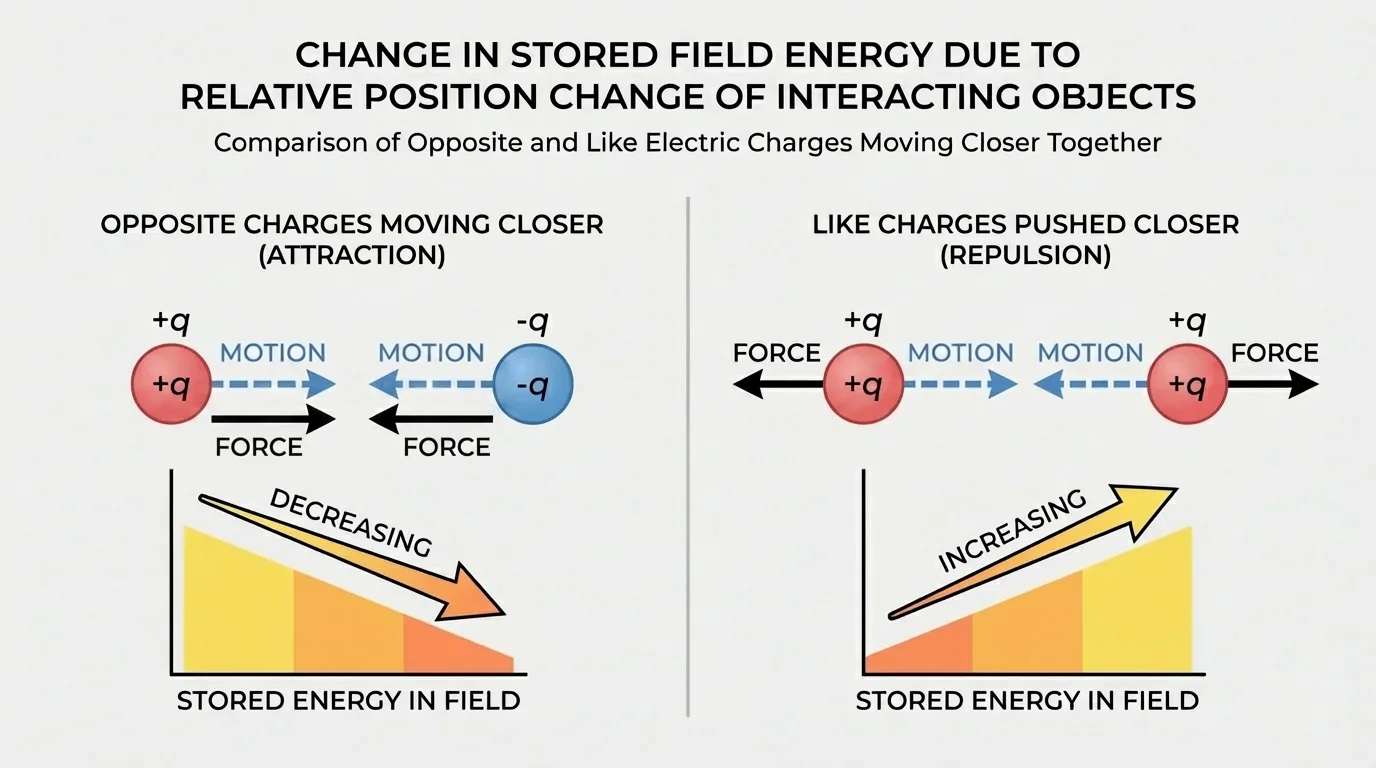
[Figure 3] Electric fields also store energy, and the amount depends on the positions of charges.
Unlike charges attract, while like charges repel. Because of that, moving charges into new positions can either require energy or release energy.
Suppose a positive charge and a negative charge are far apart. If they move closer together on their own, the electric field energy decreases, and that lost field energy usually appears as kinetic energy. But if you pull them apart against attraction, you must do work, increasing the energy stored in the electric field.
Now consider two positive charges. They repel each other. Pushing them closer together requires work, so the energy stored in the electric field increases. If you let them go, they move apart and the stored electric energy decreases while their kinetic energy increases.
This is the physical basis of many technologies. A battery separates charges chemically, storing energy as electric potential energy. When a circuit is connected, charges move through the electric field and energy is transferred to devices such as lights, speakers, and processors. Lightning is another dramatic example: separated charges in clouds and on the ground create a large electric field. When the charge arrangement changes suddenly, enormous energy is released.
Why opposite and like charges behave differently
Energy changes depend on whether the force helps the motion or resists it. If a system moves in the direction the force naturally pulls it, field energy tends to decrease. If an external agent forces the system into a less natural arrangement, field energy increases. That is why opposite charges moving together lower electric potential energy, while like charges pushed together raise it.
In electric systems, scientists often use electric potential and voltage to describe how much energy per charge can be transferred. Even when those ideas are studied in more detail later, the core idea remains the same: changing relative position in an electric field changes the energy stored by the system.
Magnetic fields also allow energy storage and energy transfer through position. If you push two like poles of magnets together, it becomes harder as they get closer. That means you are doing work on the system and increasing the energy stored in the magnetic field. If you release them, they spring apart and the stored energy changes into motion.
With opposite poles, the situation is reversed. They attract each other, so when they move together naturally, magnetic field energy decreases. You feel this directly if you try to pull magnets apart. Your muscles transfer energy into the magnet system as you separate them against the magnetic force.
Magnetic field energy matters in generators, motors, speakers, maglev transportation, and medical imaging. In a loudspeaker, changing electric current changes the magnetic field, which moves a coil and then the speaker cone. The result is sound energy. In this chain, field interactions are essential to the energy transfer.
MRI machines use extremely strong magnetic fields to interact with atoms in the body. The images doctors see depend on precise changes in energy associated with those field interactions.
At this level, magnetic potential energy is usually discussed in qualitative terms rather than with a simple formula. The important idea is still the same: the relative position and arrangement of interacting objects affect the energy stored in the field.
[Figure 4] The principle of conservation of energy says that the total energy in a closed system remains constant.
When objects change position in a field, energy often transfers between potential energy and kinetic energy.
Drop a ball from a height. As it falls, gravitational potential energy decreases while kinetic energy increases. Ignoring air resistance, the total remains constant. The same logic applies when opposite charges accelerate toward each other: electric field energy decreases while kinetic energy increases.
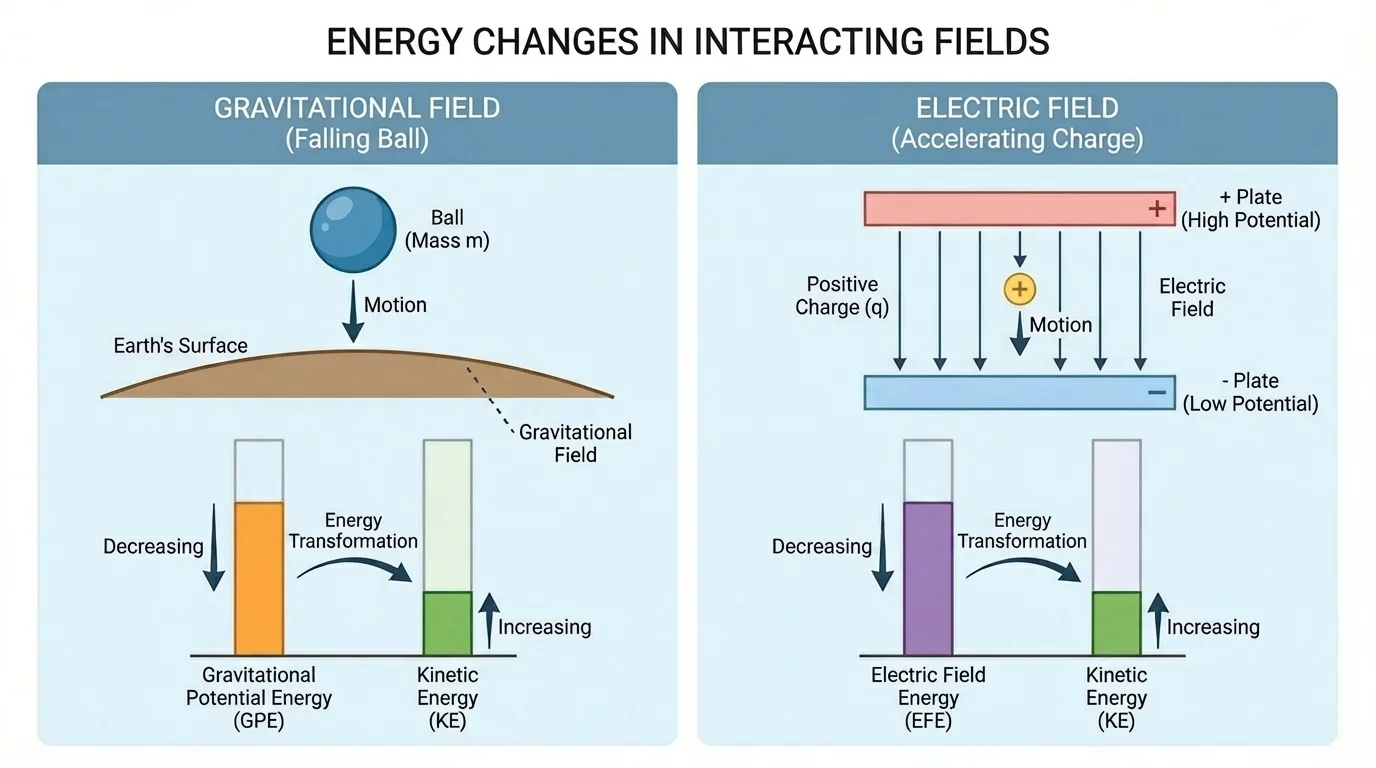
If friction, air resistance, or electrical resistance is present, some energy is also transferred to thermal energy or sound. Energy is still conserved. It is just spread into more forms. This is why machines are never perfectly efficient; some of the energy you want in one form ends up in forms that are less useful for the task.
This idea becomes clearer when you think back to the earlier examples. The higher ball in [Figure 2] stores more gravitational energy before the fall begins, and the charge arrangements in [Figure 3] determine whether motion releases or requires energy. Different fields, same conservation principle.
"Energy cannot be created or destroyed, only transformed from one form to another."
— First Law of Thermodynamics
This idea is one reason field energy is so powerful as a concept. It lets us explain motion that begins without contact. The energy did not appear from nowhere. It was already stored in the arrangement of the interacting objects.
Students often ask, "Where is the energy actually stored?" In modern physics, the best answer is that the energy is associated with the field and the interacting system. It is not helpful to assign all of it to just one object. A raised object has more gravitational potential energy because of its relationship with Earth, not because it carries some separate substance called energy inside itself.
This system view also explains why the choice of reference matters. For gravitational potential energy near Earth, we often choose a zero level for convenience, such as the floor, the ground, or a lab table. Only changes in potential energy affect energy transfer calculations. If one group chooses the floor as zero and another chooses the basement as zero, both can still correctly predict motion as long as they use their reference consistently.
| Field type | What creates it | How position change affects stored energy | Common result when energy decreases |
|---|---|---|---|
| Gravitational | Mass | Higher separation from Earth usually means more stored energy near the surface | Object speeds up while falling |
| Electric | Charge | Depends on charge signs and separation | Charges accelerate |
| Magnetic | Magnets or moving charges | Depends on pole arrangement and distance | Magnets move together or apart |
Table 1. Comparison of how different fields store energy when interacting objects change relative position.
Thinking in terms of systems is especially useful in engineering. A crane lifting steel, a capacitor in a circuit, and a pumped-storage hydroelectric station all involve energy being stored in a field-based arrangement and later released in a controlled way.
Field energy is not just a classroom idea. It is part of major technologies and natural processes. In hydroelectric dams, water at greater height stores more gravitational energy. In roller coasters, cars are pulled to a high position so gravity can later convert stored energy into motion. In satellites and planetary motion, changing distance in a gravitational field changes the energy of the system.
Electric field energy appears in capacitors, batteries, transmission lines, and thunderstorms. Capacitors store energy by separating charge. Camera flashes, defibrillators, and some backup power systems rely on that stored electric energy being released rapidly. In medicine, a defibrillator transfers energy to the heart through an electric field to help restore a normal rhythm.
Magnetic field energy appears in motors, transformers, induction cooktops, and data storage devices. When electric current changes, the magnetic field changes, and energy can be transferred efficiently from one part of a system to another. Modern power grids depend on this principle.
Real-world example: water behind a dam
A dam holds back \(500 \textrm{ kg}\) of water that will fall an average of \(20 \textrm{ m}\) through turbines. Estimate the decrease in gravitational potential energy.
Step 1: Use the gravitational energy formula.
\(\Delta U = mg\Delta h\)
Step 2: Substitute values.
\(\Delta U = (500)(9.8)(20)\)
Step 3: Calculate.
\(\Delta U = 98{,}000 \textrm{ J}\)
The water loses \(98{,}000 \textrm{ J}\) of gravitational potential energy, which can be transferred into electrical energy and thermal energy.
Even sports use this idea. In pole vaulting, energy is stored in the vaulter-pole-Earth system as the vaulter bends the pole and changes position; a diver on a platform stores gravitational energy before the jump; and a basketball player jumping for a rebound must transfer chemical energy from muscles into gravitational potential energy to raise the body's center of mass.
Sometimes the most important quantity is not the total energy but the change. For gravity near Earth, the formula \(\Delta U = mg\Delta h\) gives that change directly. If \(\Delta h\) is positive, the energy increases. If \(\Delta h\) is negative, the energy decreases.
For example, if a \(3 \textrm{ kg}\) tool falls \(4 \textrm{ m}\), then \(\Delta h = -4 \textrm{ m}\). The change in gravitational potential energy is \(\Delta U = (3)(9.8)(-4) = -117.6 \textrm{ J}\). The negative sign means the system has lost gravitational potential energy.
Worked example: falling tool
A \(3 \textrm{ kg}\) tool falls from a scaffold by \(4 \textrm{ m}\). Find the change in gravitational potential energy.
Step 1: Write the formula.
\(\Delta U = mg\Delta h\)
Step 2: Insert the values, using a negative height change.
\(\Delta U = (3)(9.8)(-4)\)
Step 3: Compute the result.
\(\Delta U = -117.6 \textrm{ J}\)
The gravitational potential energy changes by \(-117.6 \textrm{ J}\), meaning it decreases.
In electric systems, calculations can become more advanced, but the same logic applies: work done against electric forces increases stored electric energy, and motion in the direction of electric forces decreases it. In later courses, you may use equations involving charge, electric field, and voltage to calculate exact values.
As shown earlier in [Figure 1], the idea does not depend on physical contact. The key is interaction through a field. If the force exists across space and the relative position changes, then the stored field energy can change too.
One common mistake is to say that energy is "used up" when an object falls or when charges move together. A better statement is that stored field energy decreases and is transferred into other forms, usually kinetic energy and then thermal or sound energy.
Another mistake is to think potential energy belongs to a single object. In fact, it belongs to the interacting system. That is why phrases such as "the Earth-object system" or "the charge pair" are more accurate than talking about one isolated object storing all the energy.
A third misunderstanding is to assume a field is not real because it is invisible. Many important things in physics are invisible but measurable. We cannot see gravity directly either, yet we can measure acceleration, force, and energy changes. Fields are models with strong predictive power, supported by experiments and technology.
Finally, students sometimes mix up force and energy. Force tells how strongly objects push or pull. Energy tells the capacity to cause change or do work. Related objects in a field can exert force at a position, and moving through that force can change the energy stored in the system.
