A violin string, a Wi-Fi signal, and a breaking ocean wave seem like completely different things. Yet all of them are described by the same powerful idea: the distance between wave crests and the number of crests passing each second are linked by the speed of the wave. That relationship helps explain why a high musical note sounds different from a low one, why light changes direction in glass, and how phones, radios, and fiber-optic systems carry information across huge distances.
Waves are one of nature's great carriers of energy and information. Sound waves move through air to bring speech and music to your ears. Light waves bring images to your eyes. Radio waves carry news, GPS signals, and streaming data. Even earthquakes send energy through Earth as seismic waves.
Although these waves are different in important ways, they share common measurable properties. If you understand how wavelength, frequency, and speed fit together, you gain a tool for understanding both everyday experiences and advanced technology.
From earlier work with motion, speed tells how far something travels in a certain time. Waves also have a speed, but what moves forward is the disturbance or pattern, not necessarily the material itself.
That last idea is crucial. In many waves, the medium vibrates in place while the wave pattern moves through it. A stadium wave is a good analogy: the pattern travels around the stadium, but the people mostly move up and down rather than circling the arena.
A wave is a repeating disturbance that transfers energy from one place to another. In a water wave, the water mainly moves up and down while the disturbance travels across the surface. In a sound wave, air particles vibrate back and forth while the disturbance moves outward. The basic features of a wave include its amplitude, spacing, and rate of repetition.
The wavelength, written as \(\lambda\), is the distance from one point on a wave to the next identical point, such as crest to crest or compression to compression. The frequency, written as \(f\), is the number of wave cycles passing a point each second. Its unit is the hertz, where \(1 \textrm{ Hz} = 1\) cycle per second. Another useful quantity is the amplitude, which measures the maximum displacement from equilibrium. Amplitude is related to the wave's energy, but it is not the same as wavelength or frequency.
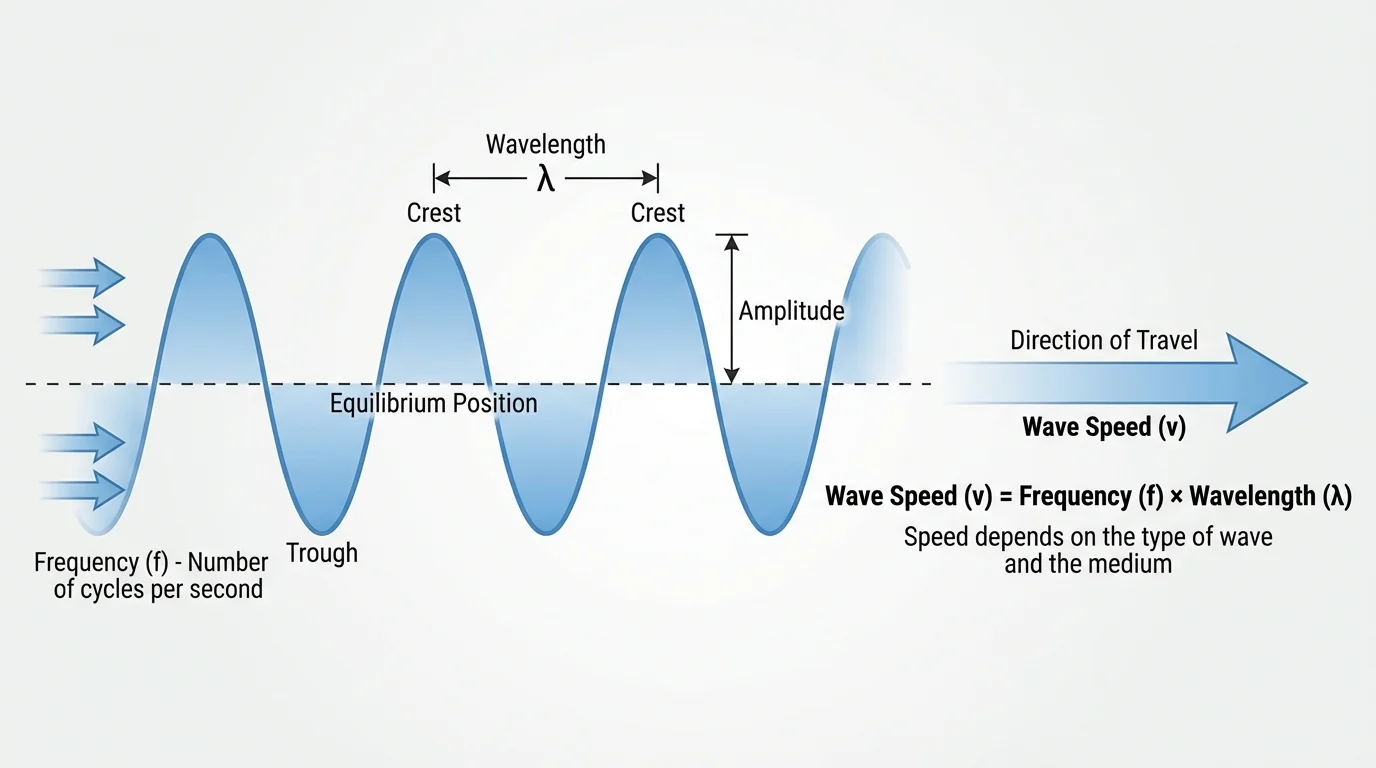
The period, written as \(T\), is the time for one complete cycle. Frequency and period are inverses of each other:
\[f = \frac{1}{T}\]
If a wave has a frequency of \(5 \textrm{ Hz}\), then its period is \(T = \dfrac{1}{5} = 0.2 \textrm{ s}\). That means one complete wave cycle takes \(0.2\) seconds.
Wavelength is the distance between matching points on successive cycles of a wave.
Frequency is the number of cycles that pass a point each second.
Wave speed is how fast the wave disturbance travels through a medium or through space.
Be careful not to confuse these quantities. A wave can have a large amplitude and a low frequency, or a small amplitude and a high frequency. These are separate properties. In music, frequency affects pitch, while amplitude affects loudness.
The central relationship for this topic is
\[v = f\lambda\]
Here, \(v\) is wave speed, \(f\) is frequency, and \(\lambda\) is wavelength. This equation says that wave speed equals how many waves pass each second multiplied by the length of each wave.
This makes sense if you think about distance traveled in one second. If \(10\) wave crests pass a point each second and each wavelength is \(2 \textrm{ m}\), then the disturbance travels \(10 \times 2 = 20 \textrm{ m}\) in one second. So the speed is \(20 \textrm{ m/s}\).
When the speed stays constant, wavelength and frequency must change in opposite ways. If frequency increases, wavelength decreases. If frequency decreases, wavelength increases. That is why high-frequency sounds generally have shorter wavelengths than low-frequency sounds in the same medium.
Why inverse change happens
If the wave speed in a medium is fixed, the wave cannot simply move faster because the source vibrates faster. Instead, more wave cycles must fit into the same amount of space, so the wavelength becomes shorter. Mathematically, if \(v\) stays constant, then increasing \(f\) forces \(\lambda\) to decrease so that the product \(f\lambda\) remains the same.
Suppose sound travels through air at about \(340 \textrm{ m/s}\). A sound with frequency \(170 \textrm{ Hz}\) has wavelength \(\lambda = \dfrac{340}{170} = 2 \textrm{ m}\). If the frequency doubles to \(340 \textrm{ Hz}\), the wavelength becomes \(\lambda = \dfrac{340}{340} = 1 \textrm{ m}\). The speed stays the same, but the spacing between wave cycles shrinks.
Wave speed is not determined by frequency alone. It depends on the type of wave and the medium through which it travels. This is one of the most important ideas in wave physics.
For mechanical waves, the speed depends on the properties of the medium. Mechanical waves need matter to travel. Sound waves depend on how compressible the medium is and how much inertia the particles have. Waves on a string depend on the string's tension and mass per unit length. Water waves depend on gravity, water depth, and other factors.
For electromagnetic waves, no material medium is required. Light, radio waves, microwaves, X-rays, and other electromagnetic waves can travel through a vacuum. In a vacuum, all electromagnetic waves travel at the same speed:
\[c \approx 3.0 \times 10^8 \textrm{ m/s}\]
In materials such as glass, water, or air, electromagnetic waves usually travel more slowly than they do in a vacuum.
Lightning and thunder come from the same event, but you usually see lightning first because light travels vastly faster than sound. The delay between them gives a rough clue to how far away the storm is.
Different media often produce very different wave speeds. Sound travels at about \(343 \textrm{ m/s}\) in air near room temperature, about \(1{,}480 \textrm{ m/s}\) in water, and much faster in many solids. This is why underwater sound can travel long distances and why seismic waves reveal information about Earth's interior.
| Wave type | Needs a medium? | Typical speed depends on | Example |
|---|---|---|---|
| Sound wave | Yes | Elasticity and density of medium | Speech through air |
| Wave on a string | Yes | Tension and mass per unit length | Guitar string vibration |
| Water surface wave | Yes | Depth, gravity, and surface conditions | Ocean swell |
| Electromagnetic wave | No | Electric and magnetic properties of medium | Visible light, radio |
Table 1. Comparison of several wave types and the factors that affect their speeds.
[Figure 2] Waves are often classified by how the particles of the medium move relative to the direction the wave travels. The two major categories are transverse waves and longitudinal waves.
In a transverse wave, the motion of the medium is perpendicular to the direction of travel. A wave on a rope is a classic example: the rope moves up and down while the disturbance moves horizontally. Electromagnetic waves are also transverse.
In a longitudinal wave, the motion of the medium is parallel to the direction of travel. Sound waves in air are longitudinal. Air molecules move back and forth, creating regions of compression and rarefaction that spread outward.
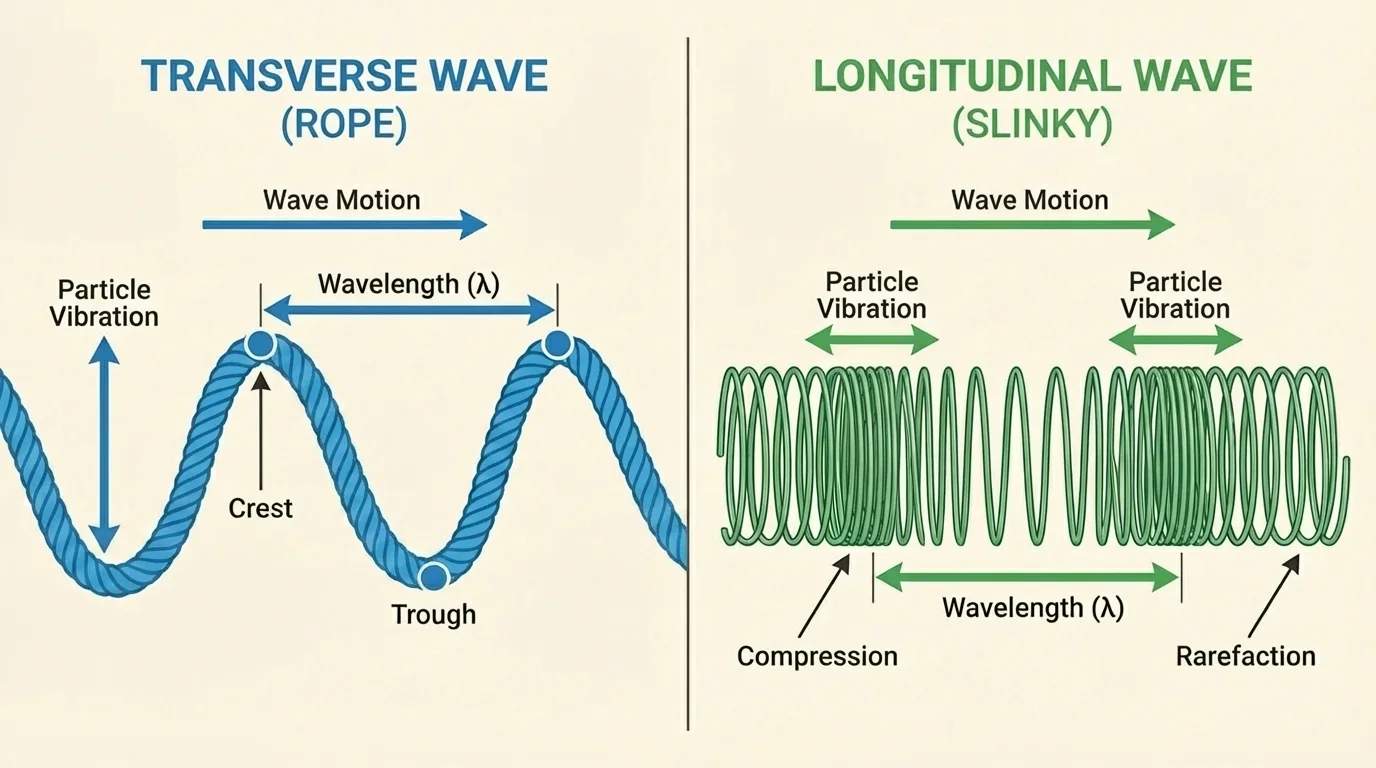
The same equation, \(v = f\lambda\), works for both transverse and longitudinal waves. For a sound wave, wavelength is the distance between compressions. For a rope wave, it is the distance between crests. The form of the wave looks different, but the relationship among speed, frequency, and wavelength remains the same.
This is a beautiful pattern in science: one mathematical idea can describe many different physical systems.
Using the wave equation is straightforward once you identify the known quantities and the medium involved.
Example 1: Finding the wavelength of a sound wave in air
A sound has frequency \(680 \textrm{ Hz}\) and travels in air at \(340 \textrm{ m/s}\). Find its wavelength.
Step 1: Choose the equation
Use \(v = f\lambda\).
Step 2: Rearrange for wavelength
\(\lambda = \dfrac{v}{f}\)
Step 3: Substitute values
\(\lambda = \dfrac{340}{680} = 0.5 \textrm{ m}\)
The wavelength is \[\lambda = 0.5 \textrm{ m}\]
A higher-pitched sound in the same air would have a higher frequency and therefore a shorter wavelength.
Example 2: Finding frequency on a string
A wave travels along a stretched string at \(24 \textrm{ m/s}\). The wavelength is \(3 \textrm{ m}\). Find the frequency.
Step 1: Start with the wave equation
\(v = f\lambda\)
Step 2: Rearrange for frequency
\(f = \dfrac{v}{\lambda}\)
Step 3: Substitute
\(f = \dfrac{24}{3} = 8 \textrm{ Hz}\)
The frequency is \[f = 8 \textrm{ Hz}\]
Notice that if the same string wave speed remained \(24 \textrm{ m/s}\) but the source vibrated faster, the wavelength would have to get shorter.
Example 3: Electromagnetic wave in a vacuum
A radio wave in a vacuum has frequency \(1.0 \times 10^8 \textrm{ Hz}\). Find its wavelength.
Step 1: Use the speed of electromagnetic waves in a vacuum
\(v = c = 3.0 \times 10^8 \textrm{ m/s}\)
Step 2: Rearrange the equation
\(\lambda = \dfrac{v}{f}\)
Step 3: Substitute
\(\lambda = \dfrac{3.0 \times 10^8}{1.0 \times 10^8} = 3.0 \textrm{ m}\)
The wavelength is \[\lambda = 3.0 \textrm{ m}\]
That result connects directly to radio broadcasting and wireless communication, where different frequencies correspond to different wavelengths and uses.
[Figure 3] One of the most interesting situations occurs when a wave passes from one medium into another. At that boundary, the wave speed often changes because the new medium has different physical properties. A slower speed in the new medium leads to a change in wavelength.
For waves produced by a continuous source, the frequency usually stays the same when crossing into a new medium. The source is still vibrating at the same rate, so the number of cycles produced each second does not suddenly change. Instead, the wavelength adjusts to fit the new speed.
If a wave enters a medium where it travels more slowly, then with frequency fixed, the wavelength becomes shorter. If it enters a medium where it travels faster, the wavelength becomes longer.
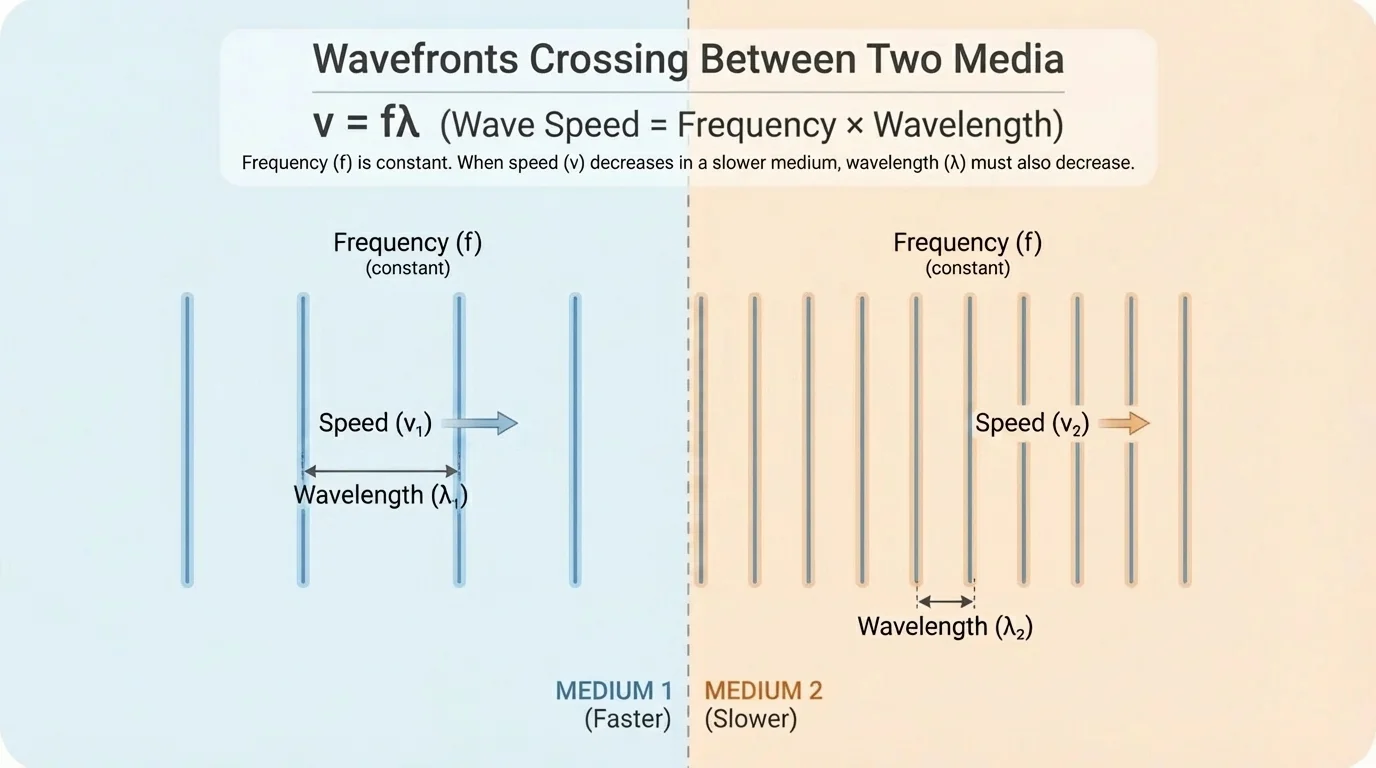
This idea explains many familiar effects. Light slows down when entering glass from air, so its wavelength decreases in the glass while its frequency stays constant. Sound moving from warm air into cooler air can also change speed, affecting wavelength.
Suppose a wave has frequency \(50 \textrm{ Hz}\) and travels at \(10 \textrm{ m/s}\) in one medium. Its wavelength is \(\lambda = \dfrac{10}{50} = 0.2 \textrm{ m}\). If it enters another medium and slows to \(5 \textrm{ m/s}\) while the frequency remains \(50 \textrm{ Hz}\), then the new wavelength is \(\lambda = \dfrac{5}{50} = 0.1 \textrm{ m}\). The wave cycles are now packed closer together.
Waves are essential to modern communication systems. Radio stations transmit electromagnetic waves with specific frequencies, and receivers are designed to detect certain ranges. Cell phones send and receive signals at selected frequencies so that information can be encoded and separated efficiently. In each case, the relationship \(v = f\lambda\) helps engineers design antennas and transmission systems.
Fiber-optic communication uses light traveling through thin strands of glass. Because light slows down in glass compared with vacuum, its wavelength inside the fiber differs from its wavelength in empty space. Engineers exploit these properties to send vast amounts of data as pulses of light.
Medical ultrasound also depends on wave behavior. Ultrasound machines send high-frequency sound waves into the body and detect echoes. Higher frequencies can produce sharper detail, but they also tend to have shorter wavelengths and different penetration properties. Choosing the right frequency is a practical engineering and medical decision.
Musical instruments provide another clear example. A flute, violin, or guitar produces different notes by changing the frequencies of vibrations. As we saw earlier in [Figure 1], wavelength describes the spacing of the wave pattern, while amplitude relates more to intensity. A louder note is not necessarily a higher note.
Information transfer by waves
To send information, a system changes some property of a wave in a controlled way. Radio systems can vary amplitude or frequency. Fiber optics can send rapid light pulses. The wave itself is the carrier, and understanding its speed, wavelength, and frequency helps control how efficiently the information moves.
Sonar on ships uses sound waves in water. Since sound travels faster in water than in air, the wavelengths for a given frequency are different underwater. This matters when designing systems to detect objects, map the seafloor, or communicate over long distances.
A frequent mistake is to think that increasing frequency always increases speed. That is not generally true. In a given medium, speed is usually set by the medium's properties, not by how fast the source vibrates. Changing frequency usually changes wavelength instead.
Another misconception is confusing amplitude with frequency. Amplitude measures the size of the disturbance. Frequency measures how often the disturbance repeats. In sound, larger amplitude usually means louder sound, while higher frequency usually means higher pitch.
Some students also assume all waves need matter to travel. That is true for mechanical waves, but not for electromagnetic waves. Sunlight reaches Earth through the vacuum of space because electromagnetic waves do not require a material medium.
"The same physical principle can describe many seemingly different phenomena."
— A central idea of physics
The comparison between wave types in [Figure 2] helps make this point clear. Rope waves and sound waves look different and involve different motions, yet both obey the same speed-frequency-wavelength relationship.
A stretched rope or slinky can make the wave relationship visible. If one student shakes the rope slowly, the frequency is low and the crests are farther apart. If the student shakes faster while the rope tension stays about the same, the frequency increases and the wavelength decreases. The speed along the rope remains mostly determined by the rope and its tension, not by the shaking rate.
You can also observe wave ideas in music software or a tone generator. Increasing the frequency raises the pitch. If the sound is traveling through the same air, the speed is nearly unchanged, so the wavelength becomes shorter. This links the equation directly to something you can hear.
Bats and dolphins use high-frequency sound for echolocation. The shorter wavelengths of these sounds help them detect small objects and fine details in their environments.
These examples show that wave physics is not just abstract. It shapes hearing, vision, communication, navigation, medical imaging, and scientific measurement.
