A single bacterium can divide again and again. A pair of rabbits can produce many offspring in a short time. A plant can release thousands of seeds. If living things can reproduce so quickly, why is Earth not buried under endless layers of bacteria, rabbits, and plants? The answer reveals one of the most important ideas in ecology: every environment has limits.
In nature, populations are always pushed by two forces at once. One force is the biological ability of organisms to survive and reproduce. The other force is the reality that food, water, space, light, nutrients, and protection are finite. That tension determines how many individuals of a species can live in a given place and how stable that population will be over time.
An ecosystem is more than a collection of organisms. It includes all the living things in an area and the nonliving parts of that environment as well. Forests, coral reefs, grasslands, deserts, ponds, and even a decaying log can all be ecosystems. The living parts are called biotic factors, while the nonliving parts are called abiotic factors. Together, these factors shape which organisms can survive and how large their populations can become.
Carrying capacity is the maximum population size of a species that an ecosystem can sustainably support over time. It depends on available resources, environmental conditions, and interactions with other organisms.
Population means all individuals of the same species living in the same area at the same time. Abundance refers to the number of individuals present.
To understand population limits, it helps to start with a simple truth: resources are not infinite. A lake contains only so much dissolved oxygen, sunlight, and nutrients. A forest contains only so many nesting sites, seeds, and sheltered spaces. Even when resources seem plentiful, they can become scarce as population size rises. The result is that no population can grow forever under real environmental conditions.
When a population first enters a new area with abundant resources, it may increase very rapidly. This is especially common when predators are absent or when a species has just begun to recover after a disturbance. In those early stages, births may greatly exceed deaths. But rapid increase creates new pressure. More organisms require more food, more water, more territory, and more energy. Waste also accumulates, and diseases can spread more easily in crowded conditions.
The important point is that reproductive potential is not the same as long-term population size. Many species could produce enormous numbers if every offspring survived. In reality, most do not survive. A fish may release thousands of eggs, but only a tiny fraction become adults. An oak tree may drop hundreds of acorns, yet only a few seedlings establish successfully. The environment acts like a filter, allowing only a certain number of individuals to persist.
This is why ecologists study not just how organisms reproduce, but also what limits them. The abundance of a species in an ecosystem is the result of both opportunity and restriction. Population size reflects the balance between births and immigration on one side, and deaths and emigration on the other.
Every ecosystem contains networks of interactions. Plants, algae, and some bacteria often capture energy through photosynthesis, using sunlight, \(\textrm{CO}_2\), and \(\textrm{H}_2\textrm{O}\) to build organic molecules. Herbivores eat producers, carnivores eat other animals, decomposers break down dead material, and nutrients cycle back into the environment. These relationships mean that the carrying capacity of one species is often tied to the abundance of many others.
Abiotic conditions matter just as much. Temperature, rainfall, soil composition, pH, salinity, oxygen levels, and sunlight can all limit life. A cactus may thrive where water is scarce, but a fern may not. Trout need cold, oxygen-rich water, while other fish tolerate warmer conditions. Organisms are adapted to certain ranges, and outside those ranges, survival and reproduction decline.
Because ecosystems are interconnected, a change in one factor can ripple across the whole system. A drought reduces plant growth. Reduced plant growth lowers food supply for herbivores. Fewer herbivores may then reduce predator populations. Carrying capacity is therefore not an isolated number; it emerges from a web of relationships.
Finite resources create ecological limits
Every population depends on energy and matter moving through an ecosystem. Because resources enter ecosystems in limited amounts and are used by many organisms, populations face unavoidable constraints. Carrying capacity is the ecological expression of those constraints.
One useful way to think about this is to compare an ecosystem to a stadium with a fixed number of seats, food vendors, exits, and water fountains. [Figure 1] If the crowd stays within what the stadium can handle, things function smoothly. If too many people enter, supplies run low, movement becomes difficult, and safety problems appear. Ecosystems work differently in detail, but the basic idea of limited support is similar.
Ecologists use the term carrying capacity to describe the population size an environment can sustainably support over time. This is not usually a perfectly fixed number. Instead, it often shifts with seasons, weather patterns, natural disasters, migrations, and human activity.
For example, a grassland may support more deer after a season of heavy rainfall because plant growth increases. The same grassland may support fewer deer during drought. A pond may support fewer fish if pollution lowers oxygen levels. In other words, carrying capacity depends on current conditions, not just on the species itself.
Populations may also fluctuate around carrying capacity rather than staying exactly at it. If a population overshoots the available resources, starvation, stress, or disease may cause a decline. After that decline, resources may recover and the population may rise again. This kind of dynamic balance is common in real ecosystems.
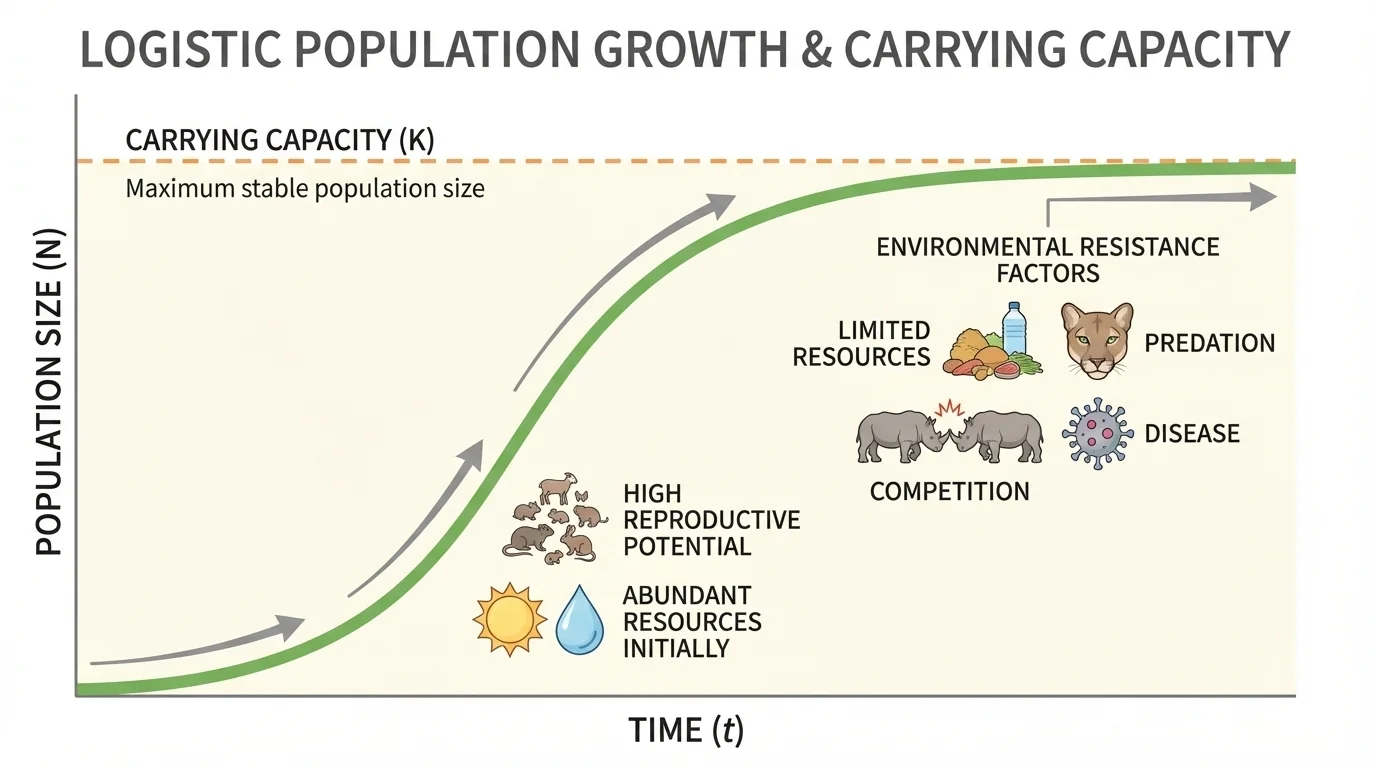
The idea becomes even clearer when compared to a bacterial culture in a Petri dish. At first, bacteria have abundant nutrients and space, so the population grows rapidly. Later, nutrients are used up and waste builds up. Growth slows and may stop. Although the organisms still have the ability to reproduce, the environment no longer supports further increase.
This is why carrying capacity is fundamentally about sustainability. A population can temporarily exceed the amount an ecosystem can support, but it usually cannot remain above that level for long. Long-term survival depends on whether enough resources remain available for continued reproduction and survival.
Different species are limited by different resources. For plants, major limiting resources include sunlight, water, soil nutrients such as nitrogen and phosphorus, space for roots, and suitable temperature. For animals, key limits include food supply, clean water, territory, shelter, nesting sites, and mates. Aquatic organisms may also be limited by dissolved oxygen, salinity, and water temperature.
Some resources are obvious, but others are easy to overlook. A bird population may not be limited by food at all if nesting cavities are scarce. A plant population may have enough water but fail because pollinators are absent. A sea turtle population may be constrained by the number of safe egg-laying beaches rather than by adult food supply alone.
These limits often interact. If food decreases, organisms become weaker. Weaker organisms may become more vulnerable to predators and disease. If shelter is scarce, exposure to temperature extremes may increase mortality. Ecological limits rarely operate in isolation.
| Type of organism | Common limiting resources | Example |
|---|---|---|
| Plants | Light, water, soil nutrients, space | Dense forest canopy reduces light for seedlings |
| Herbivores | Food plants, water, shelter, territory | Deer populations decline when winter forage is scarce |
| Predators | Prey availability, territory, den sites | Wolf numbers depend partly on elk abundance |
| Aquatic organisms | Dissolved oxygen, temperature, nutrients | Fish kills occur when oxygen levels fall too low |
Table 1. Examples of common limiting resources for different groups of organisms.
Resource limits help explain why the same species can be abundant in one habitat but rare in another. [Figure 2] Conditions may appear similar at first glance, yet a single missing requirement can drastically lower population size.
Some desert annual plants remain dormant as seeds for years. They grow rapidly only when enough rain arrives, which means the carrying capacity for those plants can swing dramatically from one year to the next.
That is one reason ecologists pay close attention to the exact factor in shortest supply. A population may be held back by the scarcest essential resource, even when other resources are abundant.
Not all limits come from nonliving conditions. Living interactions can be just as important. In many ecosystems, predation, competition, and disease work together to regulate population size. These are major limiting factors because they reduce survival, reproduction, or both.
Predation occurs when one organism kills and eats another. Predators can keep prey populations from growing too large. This does not mean predators usually eliminate prey completely. More often, predator and prey populations influence each other over time. If prey numbers rise, predators may have more food and increase. If predator numbers rise, prey mortality may increase.
Competition happens when organisms require the same limited resource. Members of the same species may compete for food, territory, nesting sites, or mates. Different species may also compete. For example, grasses and young tree seedlings may compete for light, water, and soil nutrients. When competition intensifies, some individuals get fewer resources and are less likely to survive or reproduce.
Disease can spread especially quickly in crowded populations. Pathogens such as bacteria, fungi, viruses, and parasites often move more easily when organisms live close together. A disease outbreak can rapidly lower abundance, especially if individuals are already stressed by poor nutrition or environmental change.
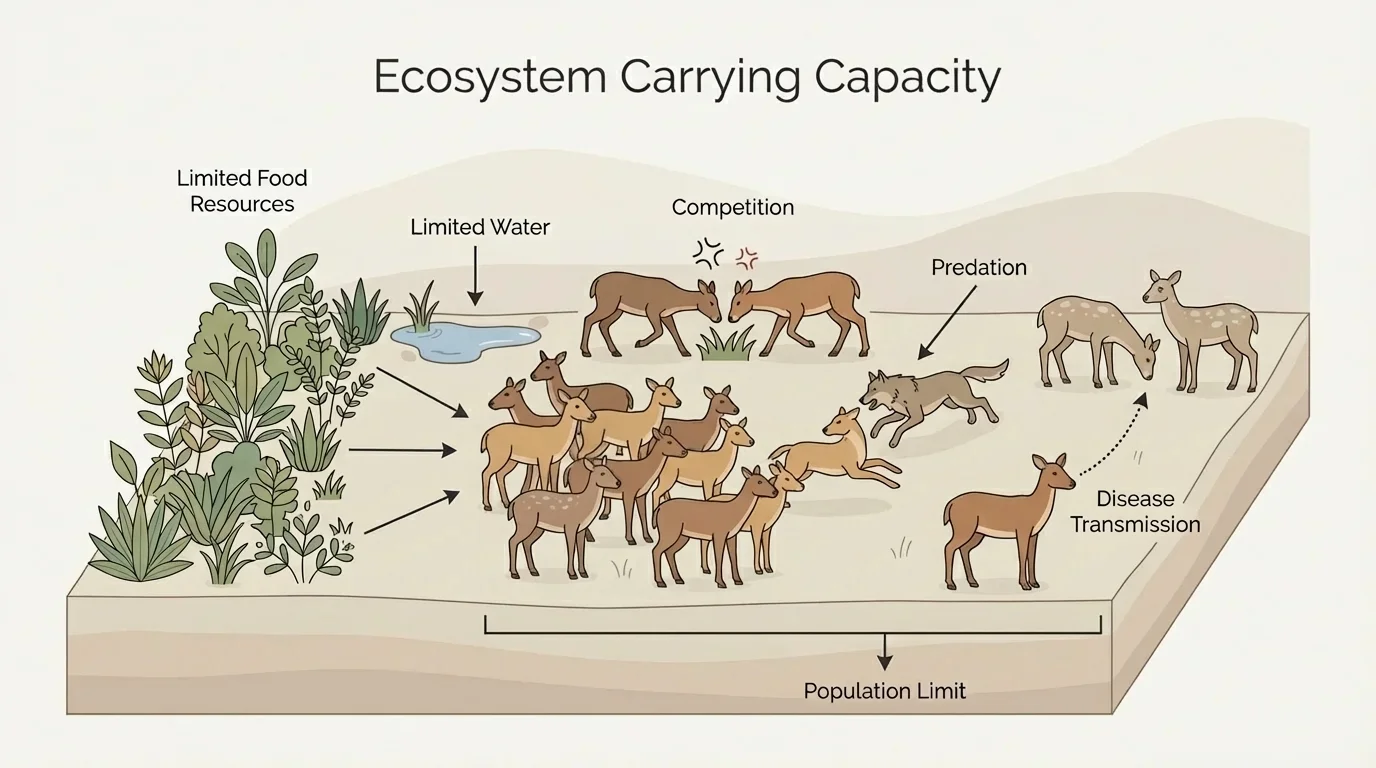
A classic real-world example involves deer populations in areas where predators are absent. If deer numbers grow beyond what vegetation can support, overgrazing may occur. As food becomes scarce, individuals become malnourished, disease can spread more easily, and winter mortality rises. The lack of one limiting factor, predation, may allow other limiting factors to become stronger.
Biotic limits also shape evolution. If predators consistently catch the slowest individuals, traits related to speed or camouflage may become more common over generations. If competition is intense, organisms with traits that help them use resources efficiently may have an advantage. Ecology and evolution are closely linked through survival and reproduction.
Later, when comparing types of limiting factors, the interaction web remains useful because it shows that real populations are constrained by multiple pressures at once, not by a single simple cause.
[Figure 3] Ecologists often divide limiting factors into two broad categories. Density-dependent factors become stronger as population density increases. Density-independent factors affect populations regardless of how crowded they are.
Density-dependent factors include competition for food and space, spread of infectious disease, and some forms of predation. These factors intensify when more individuals occupy the same area. For example, if a rabbit population doubles in a field of fixed size, each rabbit may have less food available. Crowding also makes contact between individuals more frequent, which can help diseases spread.
Density-independent factors include droughts, floods, hurricanes, wildfires, freezes, and many human-caused disturbances such as oil spills or habitat destruction. A severe freeze can kill organisms whether the population is dense or sparse. A wildfire may destroy habitat across a large area regardless of how many animals were living there.
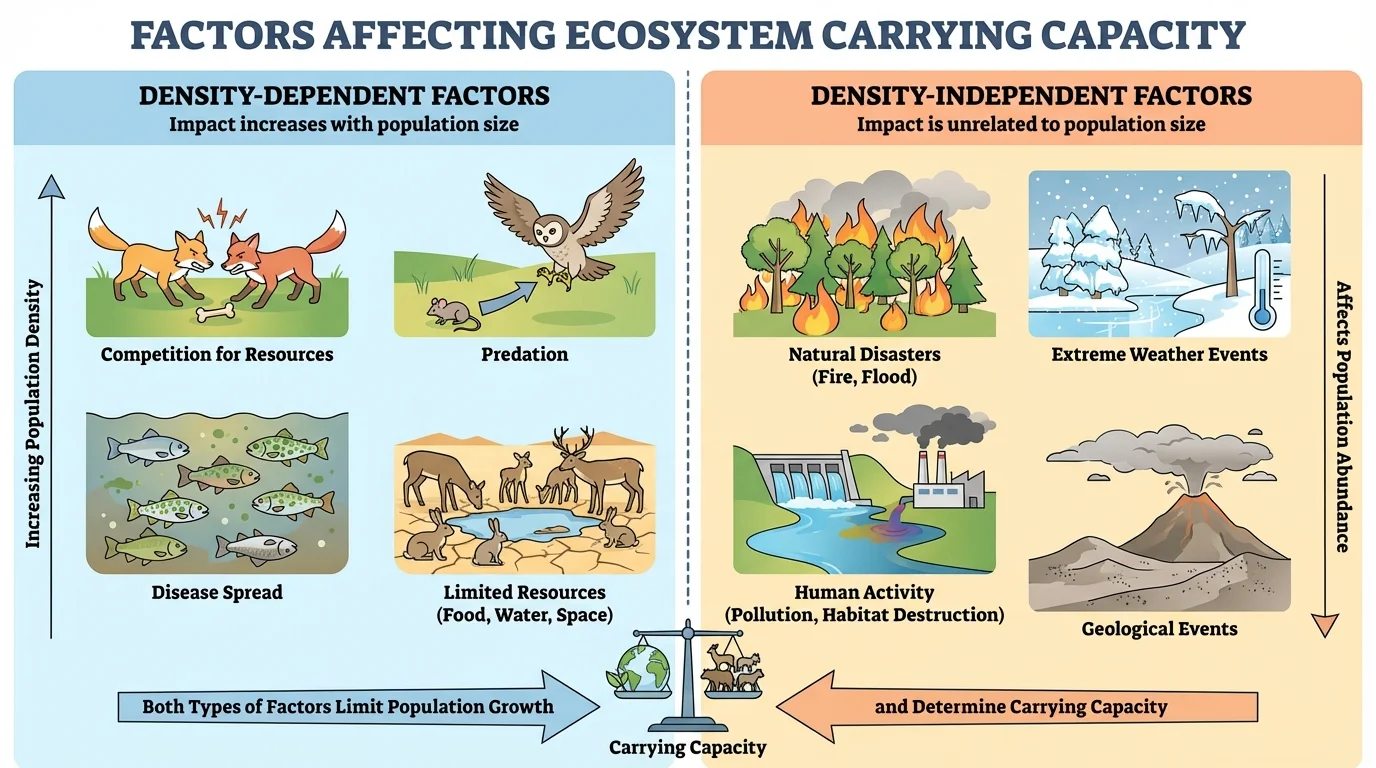
Both types matter. A drought may reduce plant growth, which lowers food supply. That creates stronger competition among herbivores, a density-dependent effect triggered by a density-independent event. Nature often combines the two.
| Factor type | How it works | Examples |
|---|---|---|
| Density-dependent | Effects increase as population density rises | Competition, disease spread, some predation |
| Density-independent | Effects occur regardless of population density | Drought, storms, fire, pollution events |
Table 2. A comparison of density-dependent and density-independent limiting factors.
This distinction helps scientists predict how populations may respond to change. If a population crash is caused mainly by disease, reducing crowding may help recovery. If the crash is caused by habitat destruction, recovery depends more on whether the habitat itself returns.
Numerical example: estimating population growth with a limit
A pond has a fish population of 80. Under good conditions, the fish increase quickly, but the pond can support only about 200 fish in the long run.
Step 1: Identify the two ideas
The fish have the ability to reproduce rapidly, so the population can rise. But the pond has a carrying capacity of about 200 because resources and environmental conditions are limited.
Step 2: Compare current size to the limit
The current population is below the carrying capacity because \(80 < 200\). This means growth is likely if conditions remain favorable.
Step 3: Predict what happens over time
The population may rise from 80 toward 200. As it gets closer to 200, growth should slow because resources become more limited.
This pattern is characteristic of logistic growth rather than unlimited growth.
As populations approach carrying capacity, small changes in birth rate, death rate, or resource supply can have large ecological consequences. A population living close to its limit may be especially vulnerable to drought, disease, or habitat disturbance.
When resources are abundant and limits are weak, populations can show exponential growth. In this pattern, the larger the population becomes, the faster it increases. If the rate stayed unchecked, the graph would rise in a steep J-shape. This often happens only for a limited time, such as when bacteria first enter a fresh nutrient medium or when an invasive species first arrives in a habitat with few enemies.
In reality, growth usually slows as limiting factors intensify. This produces logistic growth, in which population size increases rapidly at first and then levels off near carrying capacity. The S-shaped pattern is one of ecology's most important models, and the graph in [Figure 1] shows exactly this transition from rapid growth to stabilization.
A simplified way to express exponential population growth is with the idea that change depends on how many individuals are already present. In words, more individuals can produce more offspring. Logistic growth adds the idea that growth is reduced as the population approaches carrying capacity. One common model is
\[\frac{dN}{dt} = rN\left(1 - \frac{N}{K}\right)\]
where \(N\) is population size, \(r\) is the intrinsic growth rate, and \(K\) is carrying capacity.
If \(N\) is much smaller than \(K\), then \(1 - \dfrac{N}{K}\) is close to 1, so growth can be rapid. If \(N\) gets close to \(K\), then \(1 - \dfrac{N}{K}\) gets close to 0, so growth slows. For example, if \(N = 50\) and \(K = 200\), then \(1 - \dfrac{N}{K} = 1 - \dfrac{50}{200} = 1 - 0.25 = 0.75\). Growth is still fairly strong. But if \(N = 190\) and \(K = 200\), then \(1 - \dfrac{N}{K} = 1 - \dfrac{190}{200} = 0.05\), so growth is much slower.
These models are simplified, but they help scientists organize real observations. Actual populations may fluctuate, overshoot, crash, or recover, depending on environmental conditions and interactions with other species.
Carrying capacity becomes easier to understand when applied to real systems. [Figure 4] In Yellowstone National Park, the abundance of elk is connected to plant productivity, winter severity, habitat conditions, and predation by wolves. No single factor explains elk numbers by itself. Population size emerges from the interaction of all of them.
In lakes and coastal waters, nutrient runoff from farms can trigger algal blooms. At first, extra nutrients may seem to increase production. But when algae die and decomposers break them down, dissolved oxygen can drop sharply. Fish and other organisms may then die because the water can no longer support them. In that case, carrying capacity for oxygen-demanding species falls.
On islands, introduced species often reveal ecological limits dramatically. If a herbivore is introduced where native plants have no defenses and predators are absent, the population may grow rapidly at first. Then overconsumption of vegetation causes a crash. Such overshoot-and-collapse patterns show what happens when population growth outruns resource renewal.
Energy flows through ecosystems, while matter cycles. Because energy transfer between trophic levels is not perfectly efficient, ecosystems can support fewer top predators than producers. This is one reason food-web structure affects carrying capacity.
Even microbial ecosystems show the same principles. Yeast growing in a sugar solution can increase quickly, but once sugar is depleted and waste products accumulate, population growth slows. The organisms have not lost the biological machinery to reproduce; they have reached environmental limits.
Humans can change carrying capacity in both directions. Agriculture, irrigation, fertilizers, medicine, and technology can increase the carrying capacity for some human populations. At the same time, deforestation, pollution, overfishing, urban expansion, and climate change can reduce carrying capacity for many wild species.
Consider fisheries. If fish are harvested faster than they reproduce, the population may fall below a sustainable level. If habitat is also damaged, the carrying capacity of the ecosystem drops further. Managers therefore try to estimate population size, reproduction rates, and ecosystem limits before setting catch levels.
Habitat fragmentation is another major issue. A forest broken into small patches may still contain trees, but it may no longer provide enough territory, breeding sites, or food web stability for large mammals or specialized birds. The environment may look present, yet its capacity to support certain species has declined.
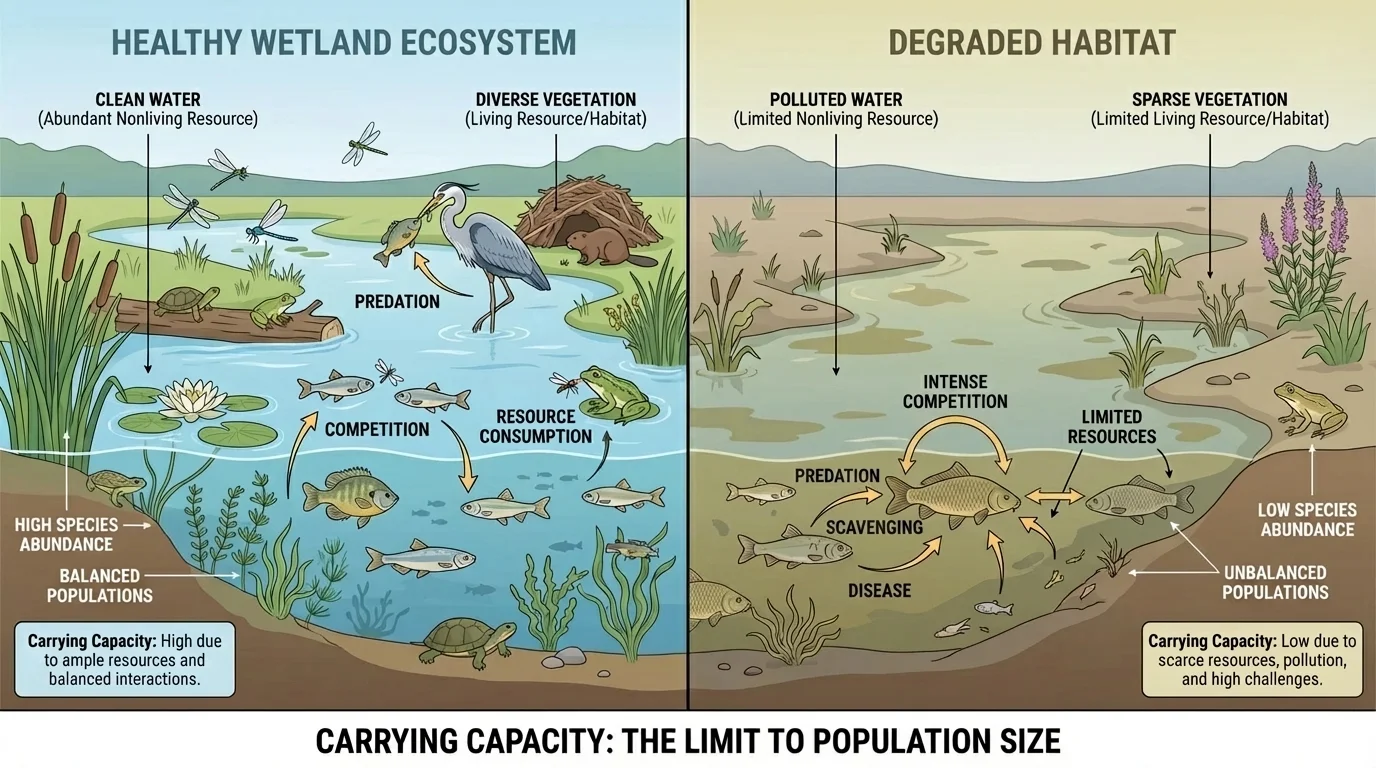
Human activity can also alter limiting factors in indirect ways. Climate change can shift rainfall patterns, raise temperatures, acidify oceans, and change migration timing. Invasive species may introduce new competition or predation. Pollution can weaken organisms, making them more vulnerable to disease. These changes reshape abundance across entire ecosystems.
Conservation biology often focuses on restoring carrying capacity by protecting habitat, reconnecting fragmented landscapes, removing invasive species, reducing pollution, and preserving biodiversity. When ecologists restore wetlands, replant forests, or improve river flow, they are often trying to rebuild the conditions that let populations persist.
We can also return to the contrast in [Figure 4] to see a key idea: population size is not just about how many organisms are born, but about whether the environment continues to provide the resources and conditions those organisms need.
Understanding carrying capacity helps explain why wildlife populations fluctuate, why some endangered species are difficult to recover, why disease outbreaks can spread rapidly in crowded conditions, and why sustainable resource management matters. It connects ecology to agriculture, medicine, conservation, and environmental policy.
It also challenges a common misconception. A large population is not always a healthy one. If that population has exceeded the ecosystem's support, it may be heading toward starvation, disease, or collapse. In contrast, a smaller stable population may be healthier because it is living within ecological limits.
The central lesson is both simple and profound: organisms have the potential to produce far more offspring than ecosystems can support. Because resources are finite and challenges such as predation, competition, and disease are constant, every ecosystem has limits. Those limits shape which species are common, which are rare, and how life is distributed across the planet.
