A lone animal can be fast, quiet, and hard to notice. So why do so many species evolve the opposite strategy and gather into packs, flocks, schools, colonies, and herds? The answer is one of evolution's most interesting patterns: in many environments, being part of a group increases the chance of surviving long enough to reproduce. Sometimes the benefit goes even further. An individual may improve the survival of close relatives who carry many of the same genes, making group behavior an important product of natural selection.
Group behavior refers to the actions of organisms living or acting together in a coordinated way. These groups may be temporary, such as a flock of birds that forms during migration, or highly organized and long-lasting, such as an ant colony. Group living is not random crowding. It usually involves patterns of communication, spacing, defense, feeding, or care of young that affect survival and reproduction.
From an evolutionary point of view, a trait tends to spread if it increases fitness, meaning reproductive success. Fitness is not about strength or health alone. A behavior is evolutionarily successful if it helps an organism leave more surviving offspring, directly or indirectly. That is the key idea behind the evolution of social behavior.
Fitness is an organism's success in passing its genes to the next generation. Social behavior includes interactions among members of the same species that affect survival, reproduction, or both.
Not all species gain the same advantage from grouping. Whether social living evolves depends on the environment, the availability of food, predator pressure, the need to care for offspring, and the structure of the species itself. In open grasslands, for example, large herbivores often survive better in herds because many eyes can detect danger. In other situations, such as when food is scarce and spread out, living alone may be more efficient.
Natural selection does not "plan" ahead. It acts on variation in behavior. If some individuals are more likely to stay near others, warn group members of danger, share care of offspring, or cooperate in finding food, and those behaviors increase the number of surviving descendants, then over generations those tendencies can become more common.
Behavioral evolution often involves a balance between benefits and costs. A group may help members find food, avoid predators, and protect young, but it can also increase competition and disease transmission. If the total benefit is greater than the cost on average, group behavior may be favored. In simple terms, when the net effect is positive, natural selection can favor social living. We can think of that idea conceptually as benefits minus costs, or \(B - C > 0\), even though real ecosystems are far more complex than a single equation.
Why evolution can favor social behavior
For a behavior to evolve, it does not have to help every individual in every situation. It only has to increase reproductive success on average across generations. This is why behaviors such as alarm calling, cooperative hunting, or shared parental care can persist even when they sometimes involve risk.
Ecology matters here. Group behavior is part of how organisms interact with one another and with their environment. [Figure 1] A school of fish changes the way predators hunt. A bee colony changes plant pollination patterns. A wolf pack can influence the size and movement of prey populations, which then affects plant communities. Social behavior is therefore not just about individuals; it can shape whole ecosystems.
One major reason group living evolves is protection from predators. In a group, individuals can detect danger earlier because many animals are watching at once. This is called increased vigilance. If one gazelle notices a lion, the whole herd may react. In a school of fish, rapid turning by a few individuals can trigger the movement of hundreds, making it difficult for a predator to isolate one target.
Groups also reduce the chance that any one individual will be attacked. This is sometimes called the dilution effect: when many individuals are present, the risk to each one may decrease. Herding animals, nesting seabirds, and swarming insects all benefit from this principle in certain contexts.
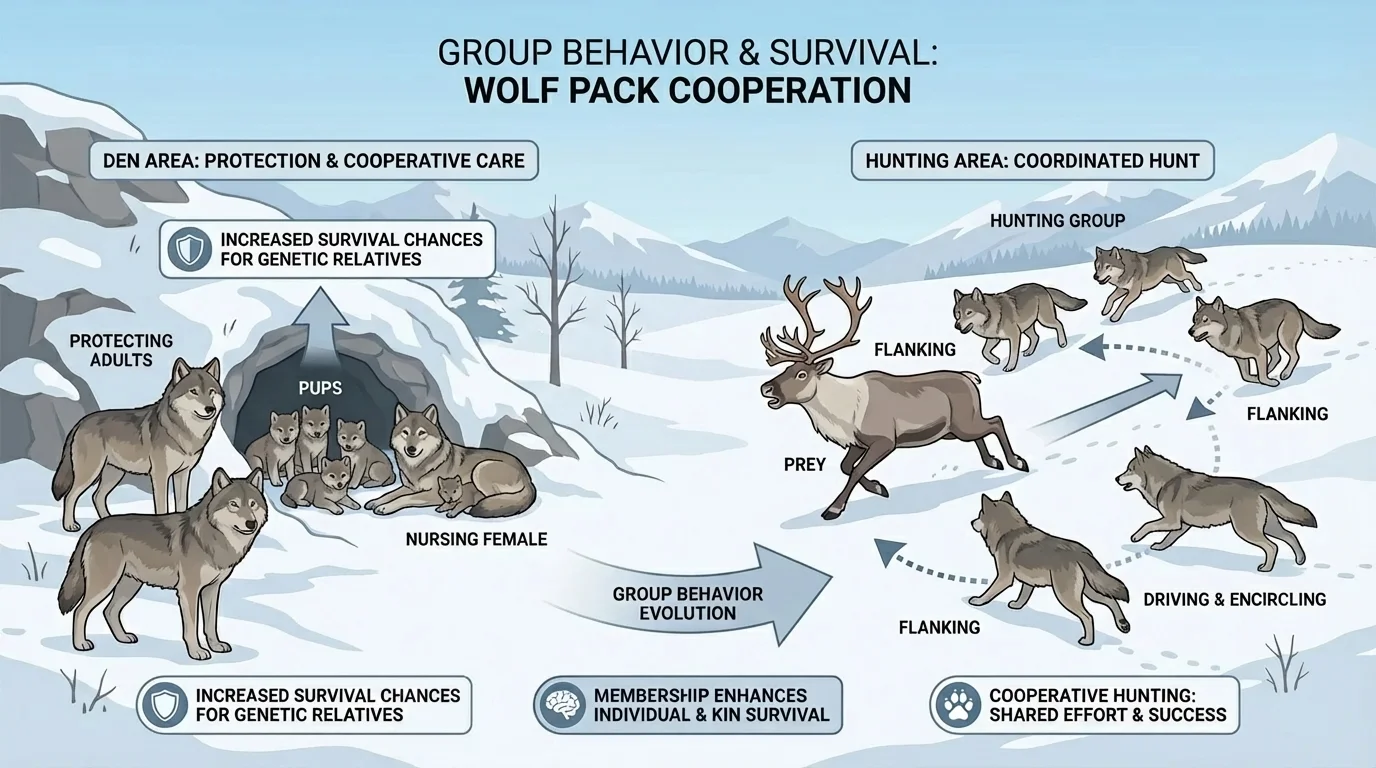
Another major advantage is improved feeding. Wolves hunting large prey such as elk can be more successful in packs than when alone because members can surround, chase, and exhaust prey. Orcas also coordinate hunts, using roles and timing that no single individual could perform as effectively. In birds, information sharing matters too. If one individual finds a rich feeding area, others may follow, increasing the efficiency of the group.
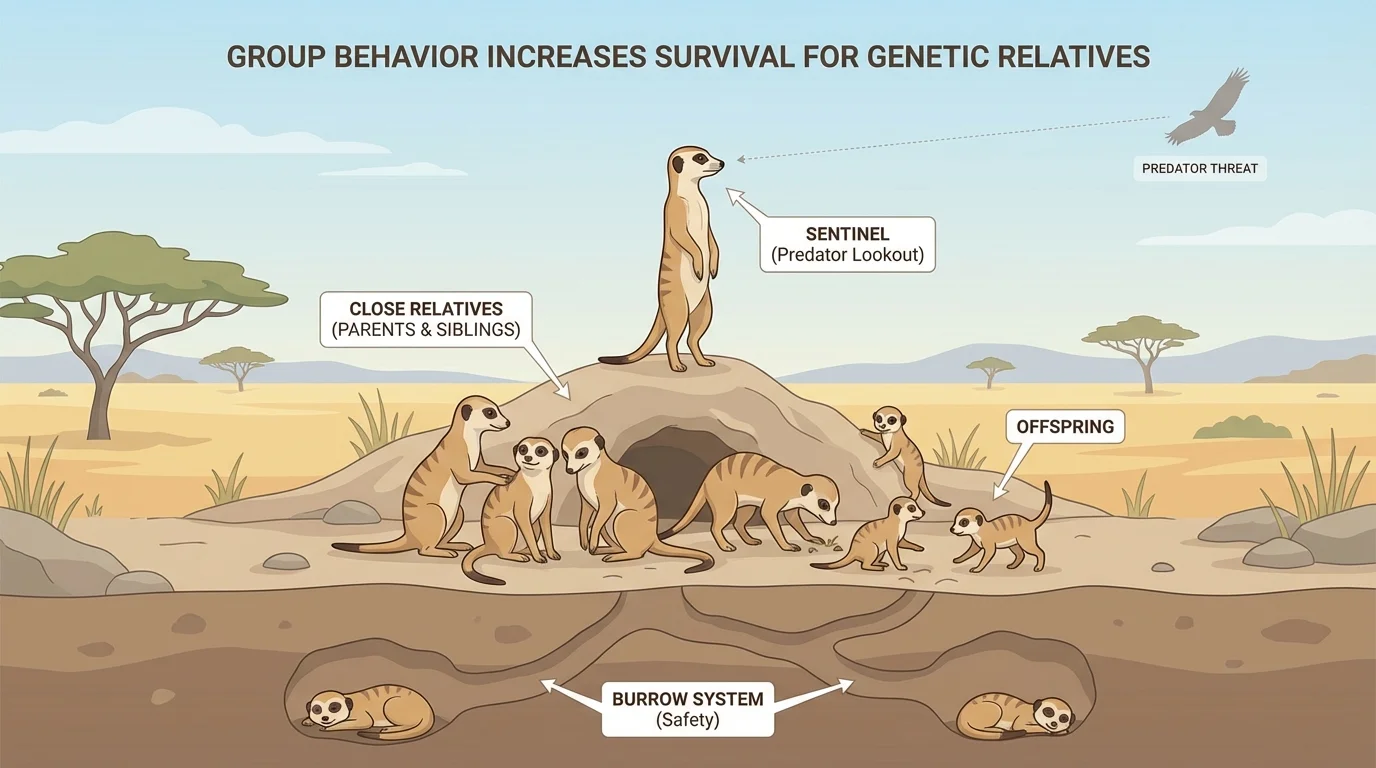
Group living can also help with caring for offspring. In meerkat groups, some adults act as sentinels while others forage. In many bird species, older siblings or unrelated adults may help feed chicks. This increases the chances that offspring survive long enough to reproduce. In harsh climates, grouping provides physical benefits as well. Emperor penguins huddle to reduce heat loss, rotating positions so that exposure to cold is shared across the group.
Communication is often part of these advantages. Calls, body movements, scent signals, and visual displays help groups coordinate. A warning call can save seconds, and in predator-prey interactions, seconds matter. The hunting success of a pack, the escape pattern of a fish school, and the defense of a nesting colony all depend on signals moving quickly through the group, much like information passing through a network.
Prairie dogs use alarm calls that differ depending on the type of predator. Their calls can communicate whether the threat is from the air or ground, allowing group members to respond in different ways.
The same principle seen in wolves and fish applies broadly across ecosystems. As we saw in [Figure 1], a group can combine protection and food gathering at the same time, making social living especially powerful when predators are dangerous and prey is difficult to capture.
Some group behaviors seem puzzling at first. Why would an animal risk itself to help another? Part of the answer comes from kin selection. Close relatives share many genes, so helping relatives survive and reproduce can still help copies of an individual's genes enter the next generation.
This idea leads to inclusive fitness, which includes both direct reproduction and the reproduction of relatives that an individual helps. For example, a meerkat standing guard is exposed to danger, but if its warning call saves siblings, nieces, nephews, or offspring, the behavior may still be favored by natural selection.
Biologists often summarize the logic of kin selection using Hamilton's rule:
\(rB > C\)
Here, \(r\) is relatedness between the helper and the individual being helped, \(B\) is the reproductive benefit to the relative, and \(C\) is the reproductive cost to the helper. If the weighted benefit is greater than the cost, helping behavior can evolve.
Applying Hamilton's rule
Suppose an individual can help a full sibling raise extra offspring.
Step 1: Identify the values.
For full siblings, relatedness is often about \(r = 0.5\). Suppose the help provides a benefit of \(B = 4\) extra surviving offspring to the sibling, while the helper gives up a chance to produce \(C = 1\) offspring.
Step 2: Substitute into the rule.
\(rB = 0.5 \times 4 = 2\).
Step 3: Compare with the cost.
Since \(2 > 1\), the inequality \(rB > C\) is true.
This means the helping behavior can be favored by natural selection under these conditions.
Kin selection does not explain all cooperation, but it explains a great deal of helping behavior in family groups. Ground squirrels, meerkats, naked mole-rats, and many birds show patterns in which relatives help protect or raise one another. The family structure in [Figure 2] makes this easier to understand: helping nearby relatives is not just kindness in a human sense; it can be a genetically successful strategy.
Cooperation occurs when individuals work together in ways that benefit both or all participants. Cooperative hunting in lions and wolves is a classic example. Each member may spend energy and face risk, but each may also gain access to prey that would be hard to catch alone.
Altruism is more specific. It refers to behavior that benefits another individual while imposing a cost on the actor. Alarm calls can be altruistic if the caller attracts attention to itself while warning others. Some altruistic behavior is explained by kin selection, and some by repeated interactions in which helping now leads to help later.
The most extreme form of social living is eusociality. Eusocial species, such as many ants, bees, termites, and some mole-rats, show division of labor, cooperative care of young, and reproductive specialization. In a bee colony, the queen lays eggs, while workers gather food, defend the nest, regulate temperature, and care for larvae.
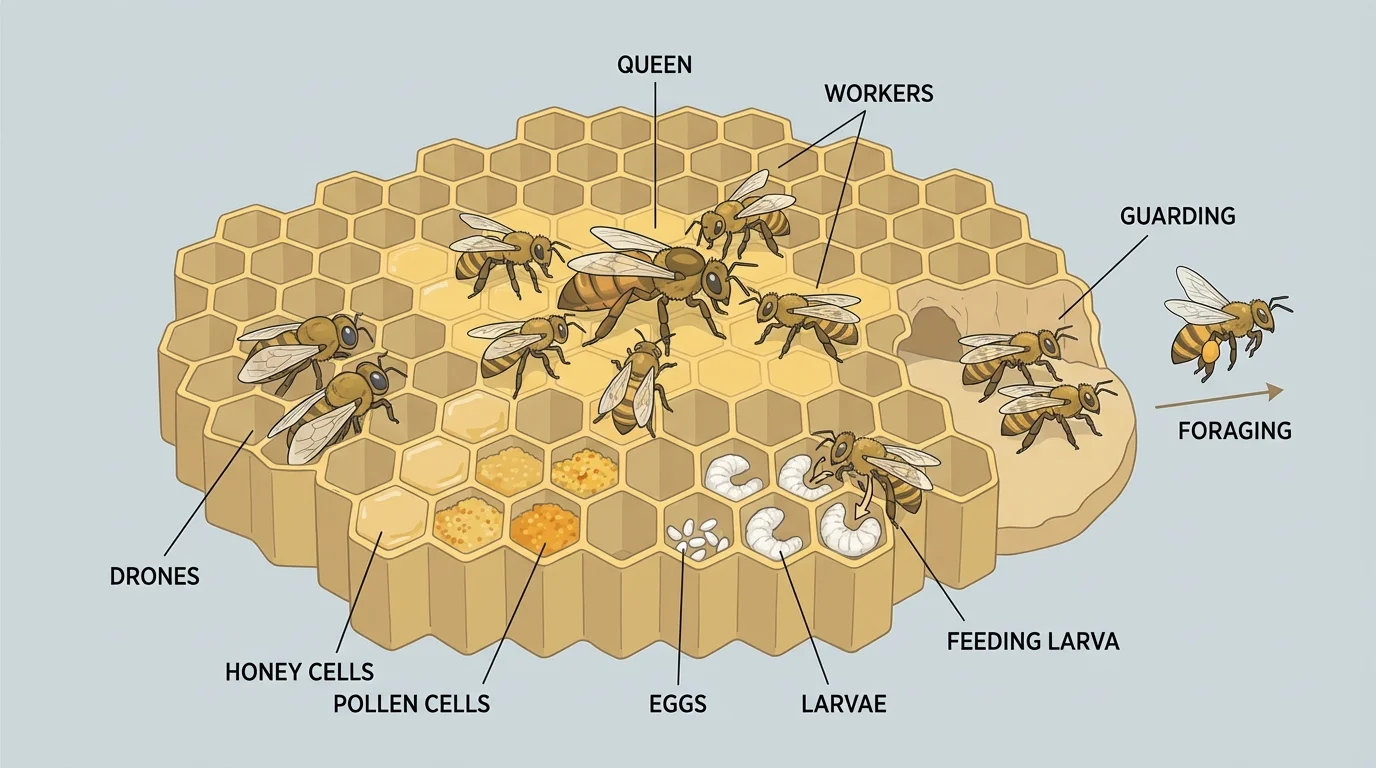
This division of labor can make the entire group highly efficient. A single worker bee may never reproduce, but by helping the colony function, it helps relatives survive. The colony behaves almost like a superorganism, with different members performing functions similar to organs in a body.
Other species have less rigid systems but still show organized social roles. Primates often form dominance hierarchies that reduce constant fighting by establishing social order. Wolves may have coordinated roles during travel or hunting. In bird flocks, some individuals may take turns occupying riskier edge positions. Social systems vary widely, but all involve some pattern that affects how individuals interact.
Division of labor and efficiency
When individuals specialize, a group can perform multiple survival tasks at once. One member may guard, another may forage, and another may care for offspring. Specialization can increase efficiency, especially in stable social groups where members interact repeatedly.
The organization seen in bees remains one of the clearest examples of how evolution can shape a social system. Later, when considering ecosystem effects, [Figure 3] also helps explain why losing a colony can disrupt pollination across an entire habitat.
Group living is not automatically better. It brings serious costs. More individuals in one place often means more competition for food, mates, shelter, or nesting sites. In drought conditions, a large herd may quickly exhaust nearby resources.
Disease and parasites also spread more easily in dense groups. A pathogen can move rapidly through a colony, flock, or troop. This is one reason some animals groom one another, avoid sick group members, or space themselves in particular ways. Social species often evolve behaviors that lower these risks, but the danger never disappears.
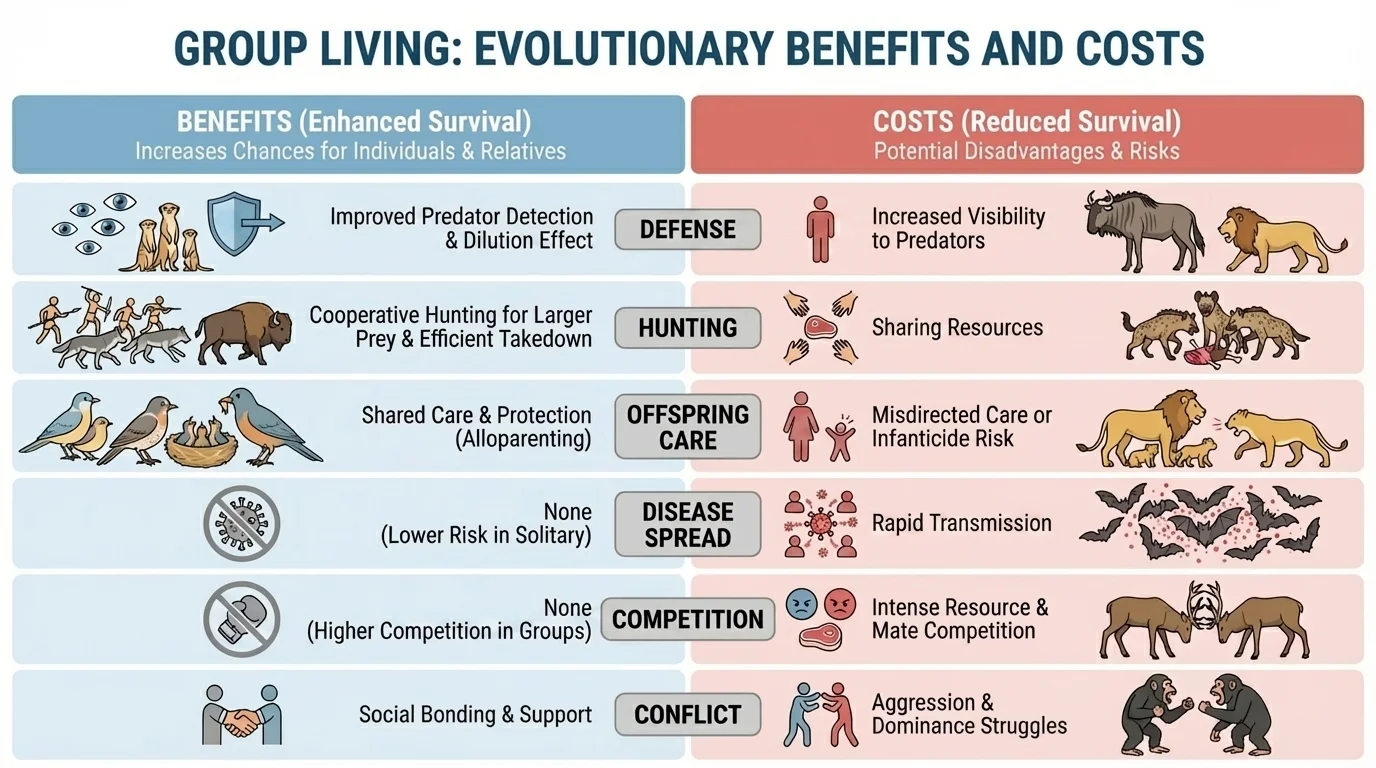
Conflict inside groups is another major cost. Individuals may compete over rank, food access, or reproductive opportunities. Some animals cheat by taking benefits without contributing equally. Evolutionary stability depends on mechanisms that limit cheating, such as punishment, partner choice, repeated interaction, or close relatedness.
These trade-offs explain why many species are only social under certain conditions. Some spiders, for example, are solitary most of the time but may aggregate when prey is abundant. Some birds form flocks during migration or winter but defend territories alone during breeding season. Social behavior can be flexible because the balance of costs and benefits changes with season, habitat, and population density.
| Potential benefit | How it helps survival | Potential cost | Why it matters |
|---|---|---|---|
| Predator detection | Many individuals can notice danger earlier | Visibility | Large groups may attract predators |
| Cooperative hunting | Groups can capture larger or faster prey | Food sharing | Each individual may receive less food |
| Care of young | More adults can protect and feed offspring | Conflict | Competition over reproduction can increase |
| Heat conservation | Grouping reduces energy loss in cold | Disease spread | Close contact increases transmission |
Table 1. Benefits and costs that influence whether group behavior is favored in a population.
The comparison in [Figure 4] helps show why no single social system works everywhere. Evolution favors the strategy that best fits the local environment, not the most cooperative-looking strategy in a general sense.
In grasslands, zebras and wildebeest gain safety in numbers and improve predator detection. In oceans, sardines form schools that confuse predators through synchronized movement. In forests, primates use social bonds, grooming, and vocal communication to maintain group stability. In deserts, meerkats and social insects survive harsh conditions through cooperation and burrow-based protection.
Pollinator systems offer another important example. Bees live socially in ways that improve colony survival, and while foraging they transfer pollen among flowering plants. This means a social adaptation in one species can affect reproduction in another species, shaping food webs and ecosystem productivity.
Humans are also a social species, though our culture makes the picture more complex than in most animals. Cooperation in food sharing, defense, teaching, and child care has likely contributed to human survival over evolutionary time. Culture, language, and technology expand these effects, but the biological foundation still involves the survival benefits of group membership.
Population-level patterns emerge from individual interactions. When the behavior of individuals changes survival and reproduction, the whole population can evolve over generations.
Across all these examples, the central pattern is consistent: group behavior evolves when interacting with others improves the chances that genes are passed on, either through personal reproduction or through the success of relatives.
Scientists use observations, field experiments, genetic studies, and mathematical models to test ideas about social behavior. They compare individuals that live alone with those in groups, measure offspring survival, track predator attacks, and analyze relatedness within family groups. This evidence-based approach helps biologists distinguish between behaviors that merely occur together and behaviors that actually improve fitness.
Conservation biology depends on these ideas. If a species relies on group defense, cooperative breeding, or migration flocks, breaking populations into tiny isolated fragments can lower survival. Protecting habitat corridors may matter not only for movement but also for maintaining the social structure a species needs.
Animal management also uses knowledge of social behavior. Zoos, wildlife reserves, and livestock systems must consider whether animals need companions, territories, or specific group sizes to remain healthy. Stress, aggression, and reproductive failure often increase when social species are housed in unnatural groupings.
Real-world application: conserving social species
A small population of African wild dogs declines after habitat fragmentation separates packs.
Step 1: Identify the social need.
Wild dogs depend on pack hunting and cooperative care of pups.
Step 2: Identify the ecological problem.
If packs become too small or isolated, hunting success falls and pup survival drops.
Step 3: Apply the lesson concept.
Conservation plans should protect enough connected habitat for stable pack structure, not just enough land for individual dogs.
This shows that understanding group behavior can directly improve conservation decisions.
Research on disease spread in animal groups has also become increasingly important. Social contact networks influence how parasites and viruses move through populations. Studying these patterns helps ecologists predict outbreaks and understand why some group structures are more resilient than others.
Biologists ask careful questions about social behavior: Who benefits? Under what conditions? Is the behavior directed toward relatives? Does it increase food intake, reduce predation, or improve offspring survival? These questions turn dramatic animal scenes into testable science.
For example, if researchers observe alarm calls in ground squirrels, they do not stop at describing the call. They measure who calls most often, whether callers are surrounded by relatives, how often predators are detected, and whether nearby young survive more often. If the data support the prediction that callers are helping kin, then kin selection becomes a stronger explanation.
Likewise, if a fish school becomes tighter when predators are nearby, scientists can test whether this reduces the chance of capture. They may compare survival rates of grouped and isolated fish. This is how evolutionary explanations are built: through evidence linking behavior to survival and reproduction.
"Nothing in biology makes sense except in the light of evolution."
— Theodosius Dobzhansky
Group behavior is one of the clearest examples of that principle. What may look at first like simple togetherness is often the result of long-term natural selection acting on individuals, relatives, and the ecological challenges they face.
