Every cell in your body, from a neuron in your brain to a muscle cell in your heart, contains essentially the same set of DNA. That sounds almost impossible at first. If the genetic information is the same, why does one cell help you think while another contracts to move your body? The answer reveals one of the most powerful ideas in biology: DNA stores the instructions, but cells do not all use those instructions in the same way.
DNA, short for deoxyribonucleic acid, is the molecule that carries hereditary information in living things. It contains instructions for building, operating, and maintaining an organism. These instructions influence traits such as eye color, blood type, height potential, and many aspects of body structure and function. In species that reproduce sexually, offspring inherit DNA from both parents, which is why they resemble their parents but are not identical to either one.
DNA is often described as a blueprint, but that comparison is only partly accurate. A blueprint is static, while DNA is part of a dynamic system. The information in DNA must be read, copied, regulated, and sometimes repaired. Cells constantly interact with this information. In other words, DNA does not simply sit in the nucleus like a library book on a shelf. It is actively used.
DNA is the molecule that stores genetic information. A chromosome is a long, organized DNA molecule packaged with proteins. A gene is a specific segment of DNA that contains information used to make a functional product, often a protein or a functional RNA.
The sequence of units in DNA matters. DNA is built from smaller subunits called nucleotides, and the order of these nucleotides acts like a code. Even a small change in DNA sequence can sometimes affect how a gene works, which can influence a trait. That is one reason inherited variation exists within populations.
Inside eukaryotic cells, DNA is not left loose. It is packaged into chromosomes, highly organized structures that make the enormous DNA molecules easier to manage, copy, and separate during cell division. As [Figure 1] shows, there is a hierarchy of organization: the nucleus contains chromosomes, each chromosome contains one very long DNA molecule, and specific segments of that DNA are genes.
Each chromosome consists of a single, extremely long DNA molecule associated with proteins called histones. These proteins help coil and compact the DNA so that it fits inside the nucleus. If the DNA from a single human cell were stretched out, it would be far longer than the cell itself. Packaging is not just about saving space; it also helps regulate which parts of the DNA are accessible for use.
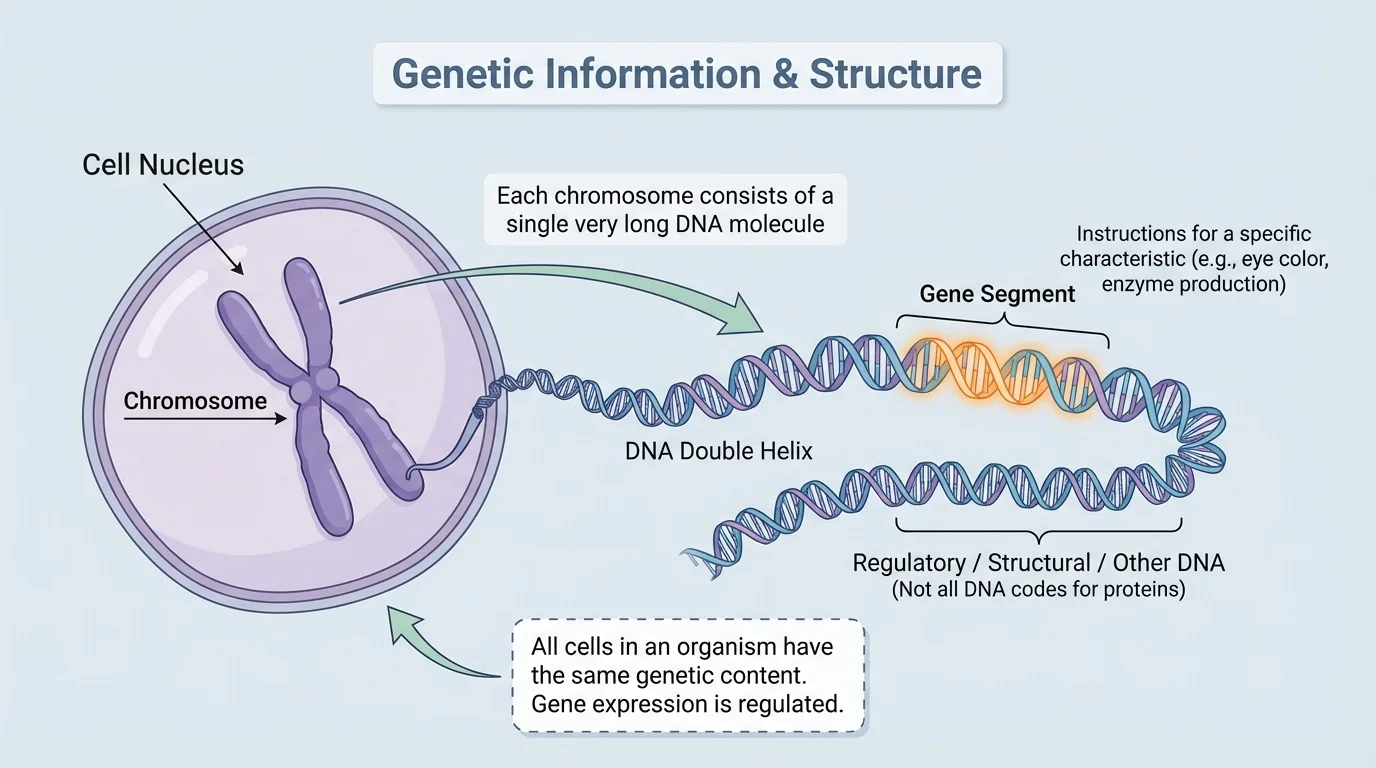
Humans usually have 46 chromosomes in most body cells, arranged in 23 pairs. One chromosome in each pair comes from the mother and one from the father. Other species have different numbers. For example, dogs have 78 chromosomes, while fruit flies have 8. The number of chromosomes does not measure how complex an organism is. It simply reflects how that species organizes its genome.
Chromosomes become especially visible when cells prepare to divide. During most of a cell's life, the DNA is in a less condensed form called chromatin. When a cell gets ready for mitosis or meiosis, the DNA condenses further, making chromosomes easier to separate accurately. That accuracy matters because each new cell must receive the correct genetic information.
A gene is a specific stretch of DNA located at a particular place on a chromosome. Genes are not floating independently; they are parts of chromosomes. One chromosome contains many genes, and each gene has a particular DNA sequence. That sequence can be used to produce a functional product, often a protein.
Genes contribute to traits, but the relationship is not always simple. Some traits are strongly influenced by one gene, while others are affected by many genes and by the environment. For example, a single gene can strongly influence whether a person has a particular form of inherited disease, but height depends on many genes interacting with factors such as nutrition and health.
Different versions of the same gene are called alleles. Alleles can lead to differences in traits. A classic example is blood type, where different alleles help determine whether a person has type A, type B, type AB, or type O blood. The existence of different alleles is one major source of variation within a species.
Genes are instructions, not finished traits. A gene does not directly equal a visible characteristic. Instead, a gene usually affects the production of a molecule, often a protein, and that molecule helps shape the trait. For example, a gene involved in pigment production can affect flower color or skin color because the protein it helps produce influences the amount or type of pigment made.
This is why saying "there is a gene for" a trait can be misleading. A more accurate idea is that genes contribute to the development of traits through biological processes.
Many genes work by providing instructions for making proteins. This flow of information, introduced in [Figure 2], helps explain how DNA affects cell structure and function. Proteins are essential molecules that act as enzymes, build cell structures, transport substances, send signals, and carry out many other jobs.
The first major step is transcription. In transcription, a cell uses one strand of DNA as a template to build a complementary RNA molecule. For protein-coding genes, this RNA is messenger RNA, or mRNA. The mRNA carries a copy of the gene's instructions out of the nucleus to the ribosome.
The second major step is translation. During translation, the ribosome reads the sequence of the mRNA and links amino acids together in the correct order to build a protein. The order of amino acids determines how the protein folds, and the protein's shape is closely connected to its function.
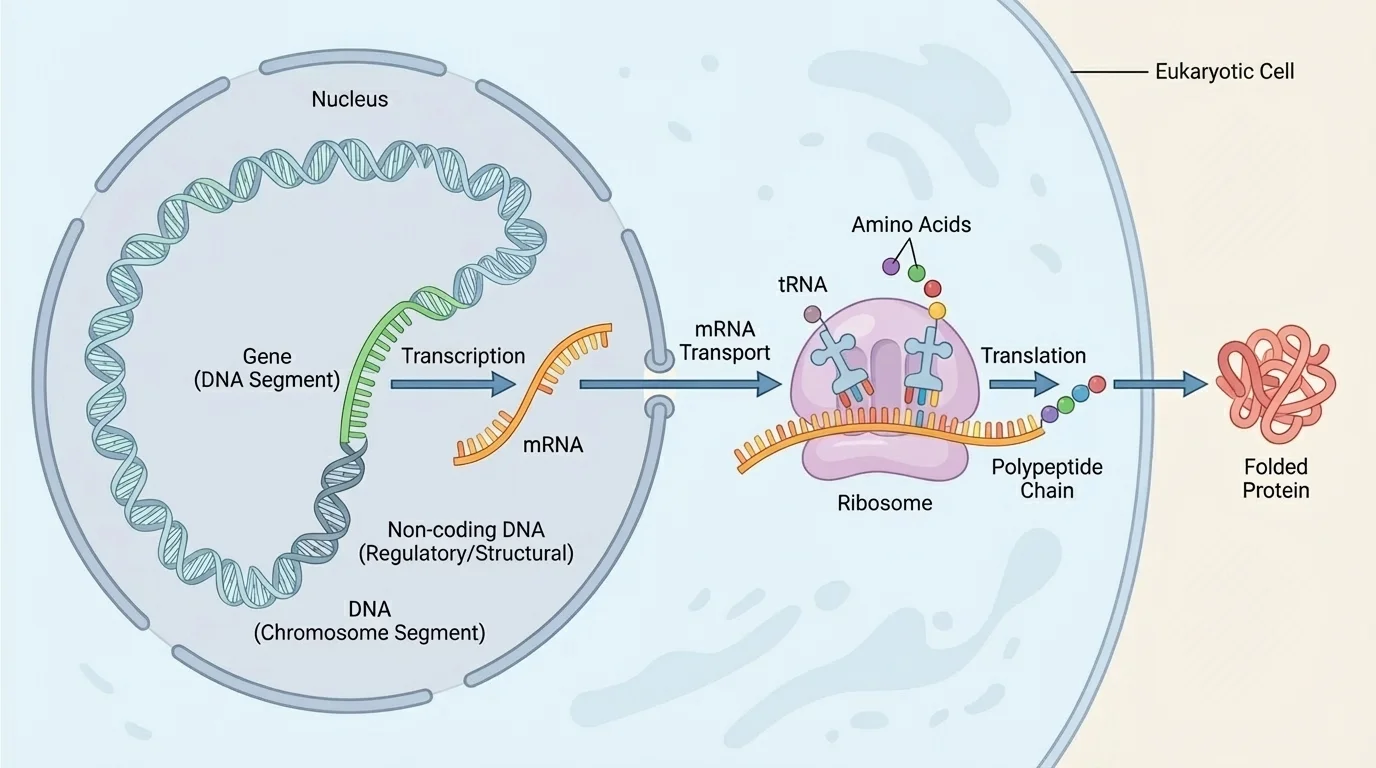
For example, the gene for hemoglobin contains instructions for making part of the protein in red blood cells that helps transport oxygen. A change in the DNA sequence of that gene can change the resulting protein. In sickle-cell disease, a mutation affects hemoglobin structure, which can change the shape of red blood cells and interfere with their function.
Not every gene produces a protein, however. Some genes produce functional RNA molecules that help with processes such as protein synthesis or gene regulation. This is an important reminder that "gene" does not always mean "protein recipe."
Real-world case: Lactase persistence
Many human populations vary in whether adults continue producing the enzyme lactase, which breaks down lactose in milk.
Step 1: Identify the gene-related process.
The relevant DNA includes regulatory sequences that influence whether the lactase gene stays active after childhood.
Step 2: Connect gene expression to a trait.
If the gene remains expressed, the person continues making the lactase enzyme and can usually digest milk more easily as an adult.
Step 3: See the broader principle.
This trait shows that inherited differences can involve not only the structure of a protein but also how strongly or how long a gene is expressed.
The lactase example also shows why heredity is more than memorizing gene names. What matters is how DNA information is used in living cells.
One of the most important ideas in modern biology is gene expression: the process by which information in a gene is used to produce a functional product. Cell specialization depends on gene expression, as [Figure 3] illustrates. A neuron, a muscle cell, and a skin cell usually contain the same DNA, but they express different sets of genes.
When a gene is "turned on," the cell uses it to make RNA or protein. When it is "turned off," the cell does not use it, or uses it at a much lower level. This regulation allows cells with identical genetic content to develop very different structures and roles. Muscle cells express genes for proteins involved in contraction. Pancreatic cells express genes needed to make insulin. Neurons express genes involved in signaling.
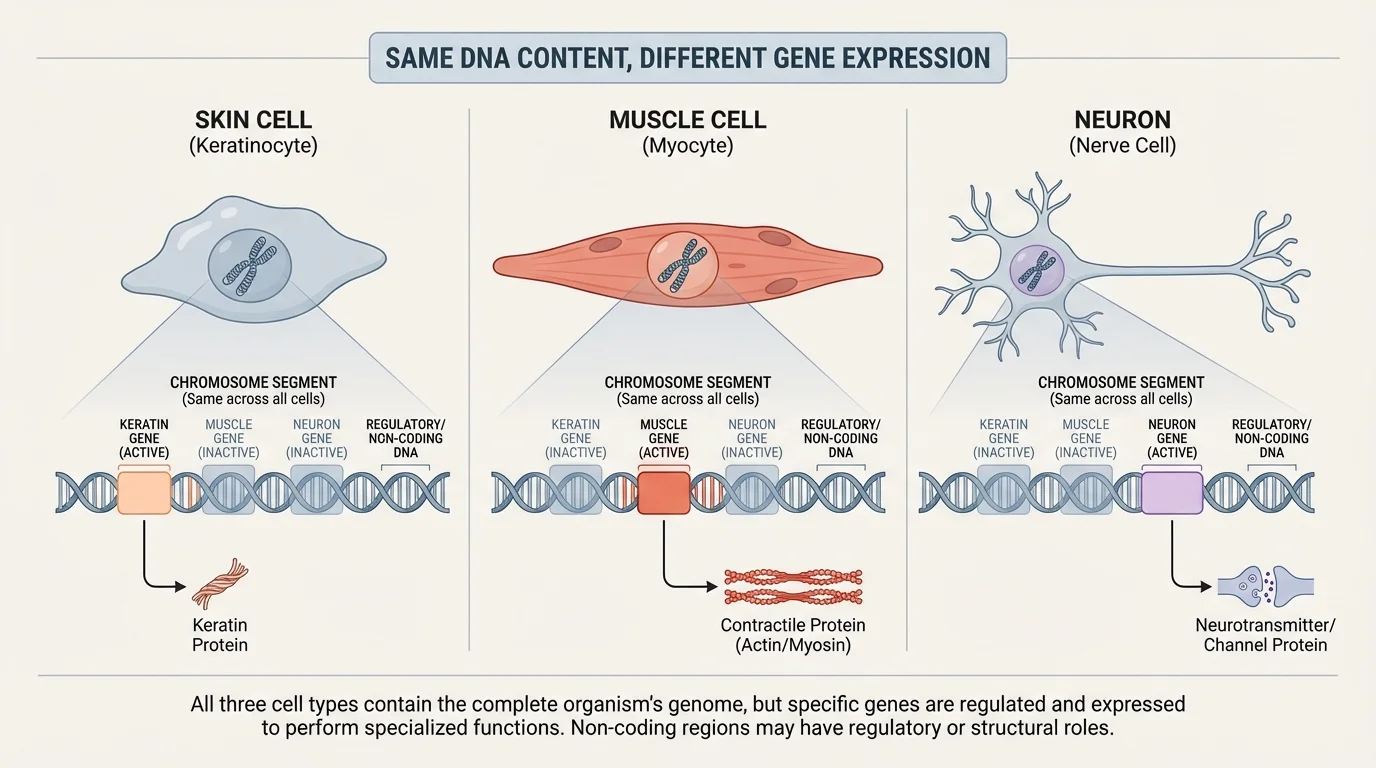
Gene regulation is controlled by many factors. Some regulatory proteins bind to DNA near genes and increase or decrease transcription. Chemical changes to DNA or associated proteins can also affect accessibility. Signals from the environment, such as hormones, temperature, nutrition, or stress, may influence which genes are expressed and when.
This is why identical twins, who begin with nearly the same DNA sequence, can still develop differences over time. Their environments, experiences, and patterns of gene expression are not perfectly identical. The same basic genetic information can be used in somewhat different ways.
Some cells in the human body deliberately ignore most of the genetic instructions they carry. A mature red blood cell even loses its nucleus, which means it no longer contains nuclear DNA, yet it continues functioning for a time using proteins made earlier in its development.
Development from a single fertilized egg into a complex organism depends on precisely timed gene regulation. Early in development, cells begin to follow different pathways because different genes are activated in different places and at different times.
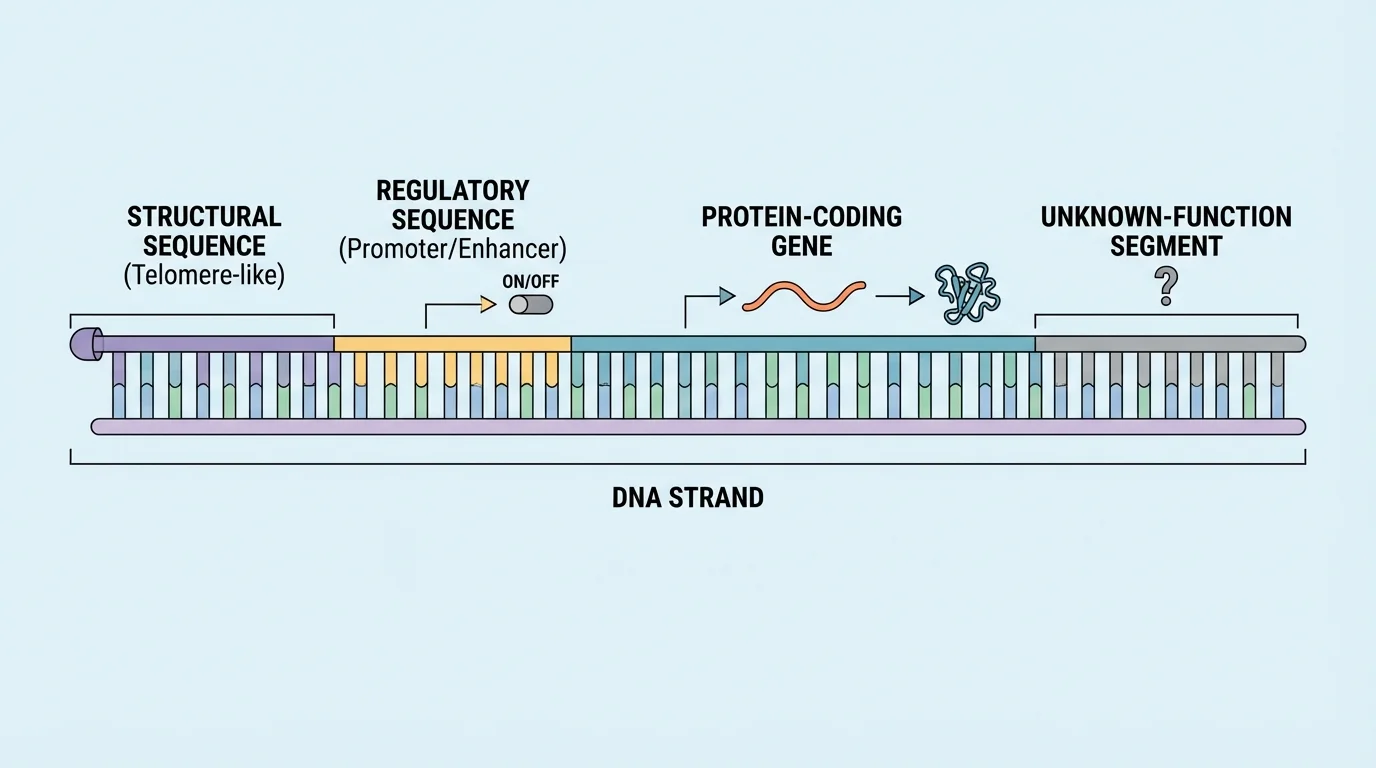
Many students first learn genetics as if DNA were mainly a collection of protein instructions. In reality, a large part of the genome does not directly code for proteins, and [Figure 4] helps show how different kinds of DNA can exist on the same chromosome. Some noncoding DNA has crucial regulatory or structural roles, and some still has no clearly known function.
Regulatory DNA includes sequences that help control whether a gene is expressed, where it is expressed, and how strongly. Promoters are regions where transcription begins. Enhancers can increase transcription even when located some distance from the gene they regulate. Without these control elements, cells would struggle to use genes properly.
Other noncoding DNA has structural functions. For example, telomeres are repeated DNA sequences at the ends of chromosomes that help protect them. Centromeres are regions important for chromosome movement during cell division. These parts may not code for proteins, but they are still essential.
Some genes also contain introns, stretches of DNA that are transcribed into RNA but removed before translation. The remaining expressed portions, called exons, are joined together. This process means that the initial RNA copy is often edited before it is used to make a protein.
There are also repeated sequences and other regions whose functions are still being studied. The old phrase "junk DNA" is now considered too simplistic. Some sequences once thought useless are now known to affect regulation, chromosome structure, or genome evolution. Others still have no confirmed function, but "unknown" does not automatically mean "unimportant."
| DNA region type | Main role | Example |
|---|---|---|
| Protein-coding sequence | Contains instructions used to build a protein | Part of the hemoglobin gene |
| Regulatory sequence | Controls when, where, or how much a gene is expressed | Promoter, enhancer |
| Structural sequence | Helps maintain chromosome stability or movement | Telomere, centromere |
| Transcribed but noncoding sequence | Copied into RNA but not translated into protein | Introns, some functional RNAs |
| Unknown-function sequence | No confirmed role yet | Some repetitive or poorly understood regions |
Table 1. Major categories of DNA regions and their typical roles.
As we saw earlier in [Figure 2], gene information must pass through several steps before a protein is made. Noncoding regions often control those steps, which means they can be just as biologically important as coding regions.
Traits arise from the interaction of genes, gene regulation, and environment. Inherited DNA differences can change a protein's structure, alter when a gene is expressed, or sometimes have little noticeable effect at all. This helps explain why members of the same species share many features yet also differ from one another.
Mutations are changes in DNA sequence. Some mutations are harmful, some are helpful, and many are neutral. A mutation in a coding region might change an amino acid in a protein. A mutation in regulatory DNA might change how much of a protein is made. Because both coding and noncoding DNA can matter, both can influence traits and evolution.
The inheritance of traits is often more complex than simple dominant and recessive patterns. Many traits are polygenic, meaning they involve multiple genes. In addition, environmental factors can influence the final outcome. Skin color, athletic performance, and risk for certain diseases all reflect complex interactions rather than a single genetic cause.
Cells arise from preexisting cells by division, and DNA must be copied before division. Accurate DNA replication is essential because daughter cells usually receive the same genetic information as the original cell.
Meiosis and fertilization create new combinations of alleles in sexually reproducing organisms. That reshuffling increases genetic variation, which is one reason siblings can look different from each other even though they share the same parents.
Understanding chromosomes, genes, and gene expression has major practical uses. In medicine, genetic testing can help identify inherited conditions or estimate disease risk. Doctors can sometimes examine whether a mutation changes a protein or affects regulation of a gene. Cancer research also depends heavily on gene expression, because cancer cells often turn the wrong genes on or off.
Forensics uses DNA comparisons to help identify individuals. Agriculture uses knowledge of genes and inheritance to breed crops with desirable traits such as drought tolerance or disease resistance. In biotechnology, scientists can insert genes into bacteria so the bacteria produce useful proteins such as human insulin.
Real-world case: Gene expression in cancer
Cancer is not only a disease of mutated DNA sequence; it is also a disease of misregulated gene expression.
Step 1: A mutation or regulatory change affects a gene that controls cell division.
Step 2: The cell may produce too much of a growth-promoting protein, too little of a growth-suppressing protein, or both.
Step 3: The altered pattern of gene expression allows uncontrolled cell division.
This is one reason cancer treatment increasingly includes analysis of which genes are active in a tumor, not just which DNA changes are present.
The comparison among specialized cells in [Figure 3] also helps explain regenerative medicine. If scientists can understand how cells switch gene programs, they may be able to guide cells toward repairing damaged tissues.
One common misconception is that every gene produces a protein. Many genes do, but some produce functional RNA, and many important DNA sequences are regulatory or structural rather than protein-coding.
Another misconception is that all DNA in a cell is always active. In reality, only some genes are expressed in a given cell at a given time. This selective use of DNA is what allows specialization.
A third misconception is that noncoding DNA is useless. As shown earlier in [Figure 4], noncoding regions can control gene activity, maintain chromosome integrity, or perform functions scientists are still uncovering.
Finally, it is misleading to think that one gene always equals one trait. Biological traits often result from networks of genes interacting with one another and with the environment.
"What is inherited is not simply a trait but information that cells use to build and regulate traits."
That idea captures the core of heredity at the molecular level: DNA stores information, chromosomes organize it, genes specify important products, and cells regulate which instructions they use.
