Why can two siblings have the same parents, grow up in the same house, and still differ in eye shape, height, metabolism, or disease risk? The answer lies in one of biology's most powerful ideas: life copies information with astonishing accuracy, yet it also reshuffles and occasionally changes that information. Those two processes—careful inheritance and variation—work together to make every generation both connected to and different from the one before it.
Organisms inherit traits through DNA, the molecule that stores genetic information. Much of your body plan, many of your physiological processes, and some of your susceptibility to certain conditions are influenced by genes passed down from your parents. But inheritance is not like copying and pasting an identical file. During sexual reproduction, each parent contributes a unique set of chromosomes in sperm or egg cells, and those chromosomes have already been sorted and recombined during meiosis.
This means offspring receive a unique combination of genetic information. Even before considering environmental influences such as nutrition, sunlight, exercise, or exposure to toxins, the genetic starting point is already unique. Genetic variation is therefore a built-in feature of sexual reproduction, not an accidental side effect.
Body cells in humans usually contain 46 chromosomes arranged in 23 pairs, while gametes contain half that number, or 23. One chromosome of each pair comes from the mother and the other from the father.
Variation matters because populations with more genetic differences are more likely to include individuals that can survive disease, climate shifts, or changes in food supply. In other words, genetic variation is not only about why families look different from one another; it is also a key reason species can persist over time.
Before looking at how variation arises, it helps to review the structure of hereditary information. A chromosome is a long, coiled DNA molecule wrapped around proteins. Each chromosome contains many genes, which are segments of DNA that provide instructions for making functional products, often proteins.
Different versions of the same gene are called alleles. For example, a gene involved in pigment production may exist in different allelic forms that contribute to variation in eye color. You inherit two alleles for many genes, one from each parent, though those alleles may be identical or different.
Chromosome refers to an organized package of DNA and proteins that carries many genes. Gene means a segment of DNA that contains instructions for a trait or cell function. Allele is a different version of the same gene.
Because homologous chromosome pairs carry the same kinds of genes in the same locations, they can interact during meiosis in ways that generate new combinations. That interaction is one of the major sources of variation in sexually reproducing organisms.
Meiosis is the specialized type of cell division that produces gametes. Unlike mitosis, which makes genetically similar body cells, meiosis reduces the chromosome number by half and creates four genetically different cells. In humans, a diploid cell with 46 chromosomes produces haploid gametes with 23 chromosomes.
[Figure 1] Meiosis occurs in two major stages, often called meiosis I and meiosis II. In meiosis I, homologous chromosomes pair up and are separated into different cells. In meiosis II, sister chromatids separate. The result is four cells that do not all carry the same combinations of chromosomes.
One reason these cells differ is independent assortment. During meiosis I, homologous chromosome pairs line up in orientations that are effectively random. This means the maternal and paternal chromosomes are distributed into gametes in many possible combinations. If an organism has only 3 pairs of chromosomes, the number of possible chromosome combinations from independent assortment alone is \(2^3 = 8\). In humans, with 23 pairs, the number is \(2^{23}\), which equals more than 8 million possible combinations before crossing over is even considered.
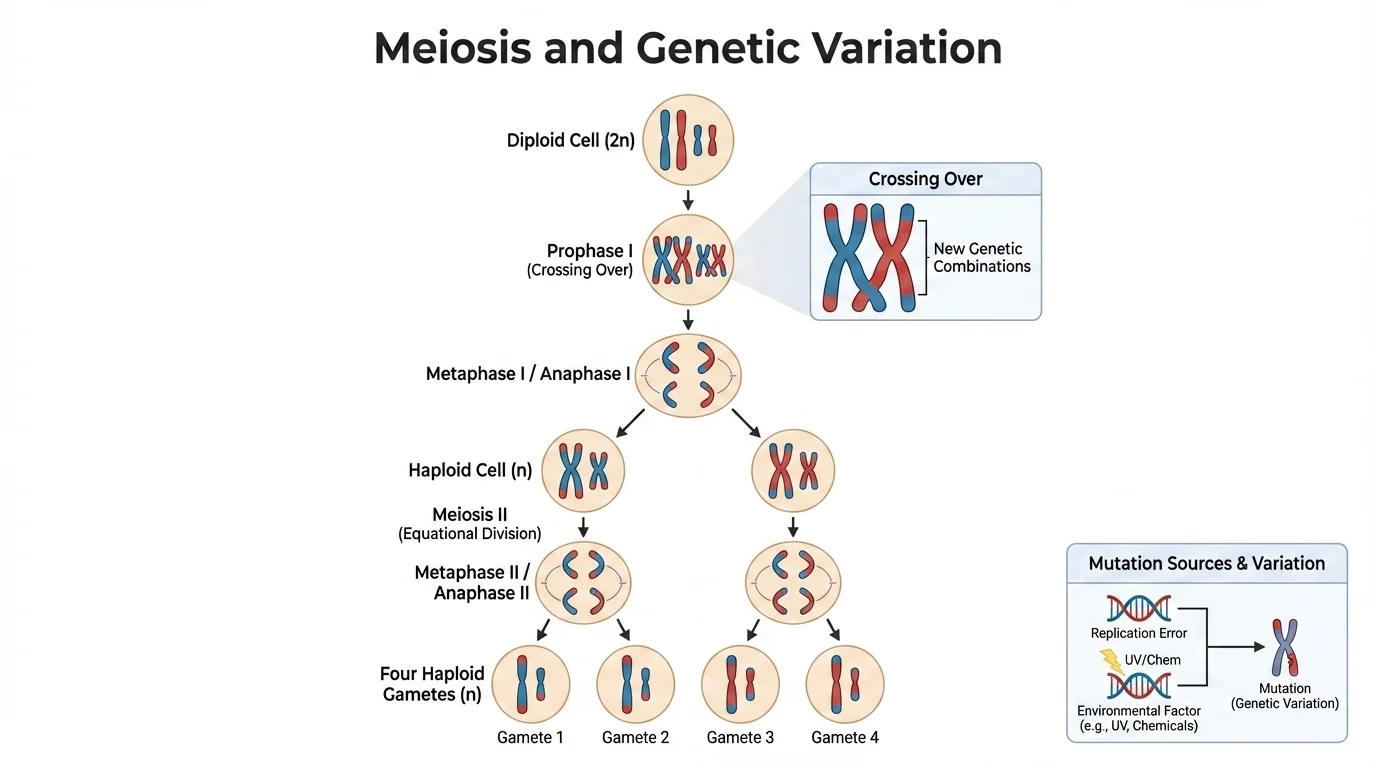
That number becomes even more impressive when fertilization is added. One genetically unique sperm combines with one genetically unique egg, multiplying the number of potential offspring genotypes. This is one reason no two siblings, except identical twins, are genetically identical.
Independent assortment means that each homologous pair of chromosomes separates independently of the other pairs during meiosis. Because the alignment of each pair is random, gametes receive different mixes of maternal and paternal chromosomes.
Independent assortment mixes whole chromosomes. Another process mixes pieces of chromosomes, creating even finer-scale variation.
[Figure 2] During early meiosis I, homologous chromosomes pair closely together. At this stage, sections of DNA can be exchanged between matching chromosomes. This process is called crossing over, and the physical point of exchange is called a chiasma.
Crossing over happens between homologous chromosomes, not between random chromosomes. Because the chromosomes carry the same genes in the same order, the exchanged segments usually match corresponding regions. After crossing over, the resulting chromosomes contain new combinations of alleles that were not previously linked together on the same chromosome.
Suppose one chromosome carries alleles for dark hair and lactose tolerance, while its homolog carries alleles for light hair and lactose intolerance. If crossing over occurs between those gene locations, a gamete could receive a chromosome with dark hair and lactose intolerance, or light hair and lactose tolerance. This is a new genetic combination produced by recombination.
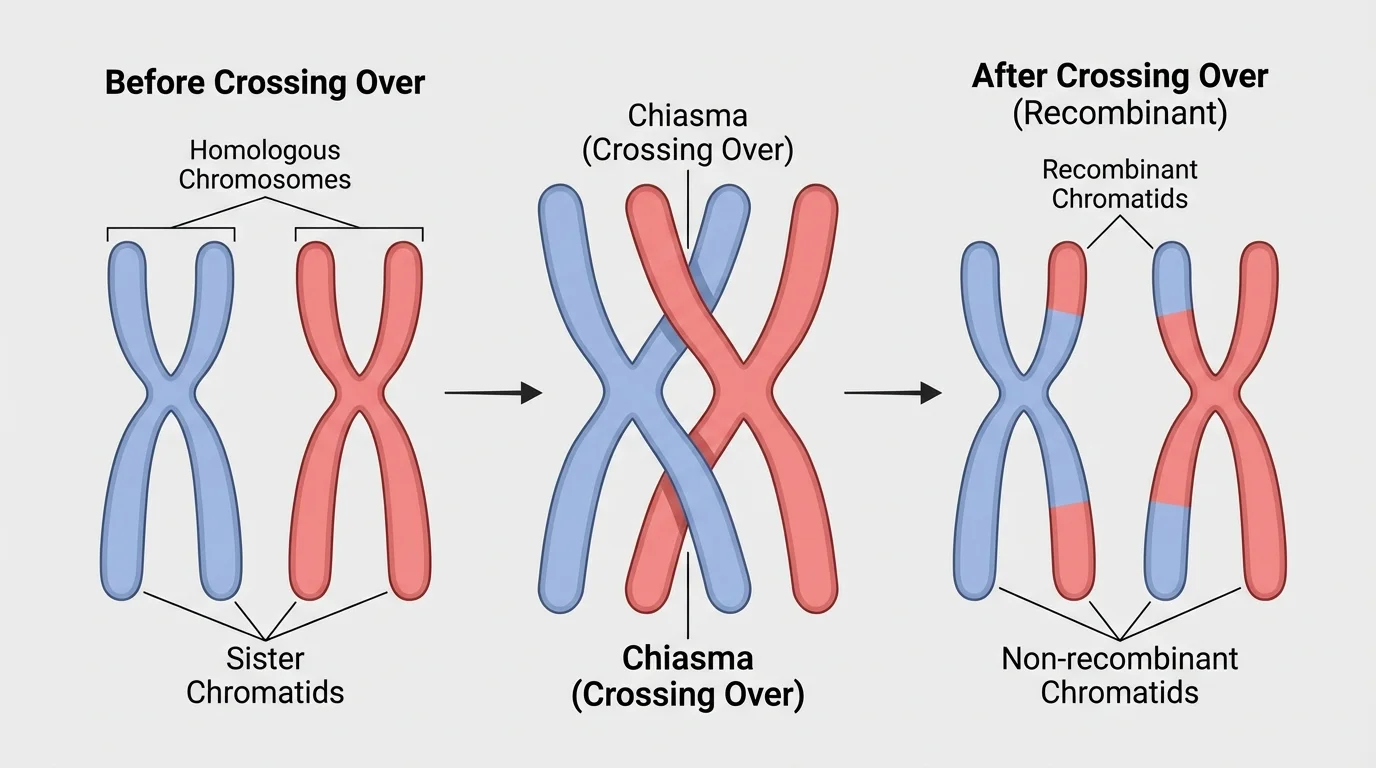
Crossing over is important because it increases variation within a population. It also means that genes located on the same chromosome are not always inherited together. The farther apart two genes are, the more likely crossing over will occur between them.
In many species, crossing over is so common that it helps scientists map the relative positions of genes on chromosomes. The frequency of recombination can reveal how far apart two genes are likely to be.
When you combine independent assortment with crossing over, meiosis becomes a powerful generator of diversity. It does not create new genes from nothing, but it reshuffles existing alleles into fresh combinations.
Reshuffling existing alleles is only part of the story. New genetic variation also arises through mutations, which are changes in DNA sequence. DNA replication is highly regulated and remarkably accurate, but no biological system is perfect. Occasionally, an incorrect nucleotide is inserted, deleted, or left unrepaired.
Cells have proofreading and repair systems that catch many mistakes. Enzymes check newly copied DNA, remove mismatched bases, and repair damaged regions. Most replication errors are corrected before they become permanent. However, some escape repair, and if the cell survives and continues dividing, the altered DNA sequence may persist as a mutation.
Mutation as a source of novelty means that while meiosis reshuffles alleles that already exist in a population, mutation can create brand-new alleles. This is a major reason populations can continue to generate variation over long periods of time.
Not all mutations affect traits in obvious ways. Some occur in noncoding DNA, some do not change the amino acid sequence of a protein, and some have effects that appear only in certain environments. Others strongly alter how a protein works and can have dramatic biological consequences.
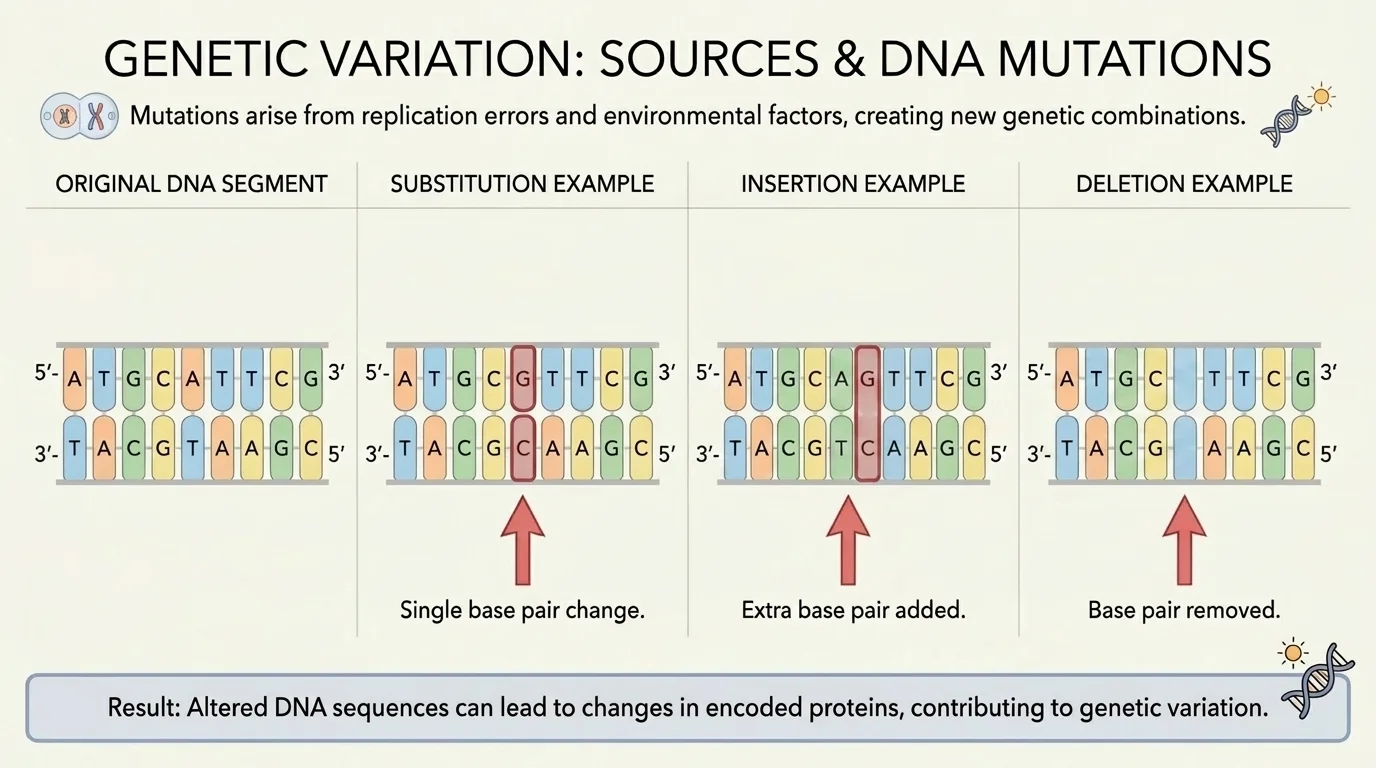
[Figure 3] Several common gene-level mutation types can change DNA information. A substitution mutation replaces one nucleotide with another. An insertion adds one or more nucleotides. A deletion removes one or more nucleotides.
Insertions and deletions can be especially significant if they occur in a coding region and are not in multiples of 3, because they may cause a frameshift mutation. Since genetic code is read in three-base codons, shifting the reading frame can alter every codon after the mutation site.
For example, if the original coding sequence is read in groups such as ABC-DEF-GHI and one base is deleted near the beginning, the grouping of all later codons changes. The resulting protein may be completely different or stop early, often making it nonfunctional.
Mutations can also affect whole chromosomes. Sometimes a segment is duplicated, deleted, inverted, or moved to another chromosome. Errors in chromosome separation during meiosis can produce gametes with extra or missing chromosomes. In humans, one example is trisomy 21, in which there are three copies of chromosome 21 instead of two.
The effects of mutations vary widely. Some are harmful, reducing survival or normal function. Some are neutral, having little or no effect on phenotype. A few are beneficial, increasing survival or reproductive success in a specific environment. Whether a mutation is beneficial often depends on context. A trait that helps in one environment may be disadvantageous in another.
| Mutation type | What changes | Possible effect |
|---|---|---|
| Substitution | One base is replaced | May change one amino acid, no amino acid, or create a stop signal |
| Insertion | Base(s) added | May cause frameshift and major protein change |
| Deletion | Base(s) removed | May remove amino acid(s) or cause frameshift |
| Duplication | DNA segment copied twice | Extra gene copies may alter gene dosage |
| Nondisjunction | Chromosomes fail to separate properly | Gametes may have extra or missing chromosomes |
Table 1. Common mutation types and some of their biological effects.
A well-known example of a small mutation with a large effect is sickle-cell disease, which results from a change in a gene coding for part of hemoglobin. The altered protein can distort red blood cells under low-oxygen conditions. Yet the same allele can provide partial protection against malaria when a person has only one copy, showing how the effect of a mutation depends on genetic and environmental context.
Mutations do not arise only from replication mistakes. External factors in the environment can damage DNA and increase mutation rates. A factor that causes mutations is called a mutagen.
Examples include ultraviolet radiation from sunlight, ionizing radiation such as X-rays and gamma rays, and certain chemicals found in tobacco smoke, pollution, or industrial waste. Ultraviolet light can cause abnormal bonds between nearby DNA bases, while ionizing radiation can break DNA strands. Some chemicals attach to DNA bases and interfere with accurate replication.
Real-world example: skin cancer and ultraviolet radiation
Repeated exposure to intense sunlight can damage DNA in skin cells.
Step 1: Ultraviolet radiation alters DNA bases.
Step 2: If repair systems fail, permanent mutations remain in the cell.
Step 3: If mutations affect genes that control cell division, the cell may divide uncontrollably.
This is one reason sunscreen and protective clothing reduce cancer risk: they lower exposure to a DNA-damaging mutagen.
Importantly, not every environmental change causes heritable genetic change. Lifting weights can enlarge muscle cells, but it does not rewrite the DNA sequence in gametes. By contrast, a mutagen that changes DNA in cells that give rise to sperm or eggs can affect future generations.
[Figure 4] Only mutations in cells that form gametes can be passed to offspring. A mutation in a skin cell, liver cell, or nerve cell may affect the individual in whom it occurs, but it usually is not inherited. These are often called somatic mutations.
Mutations in egg cells, sperm cells, or the precursor cells that produce them are called germline mutations. If such a mutation is present in a gamete and that gamete contributes to fertilization, the resulting zygote will carry the mutation in every cell of the body.
For an inherited mutation to persist in a population, it must also be viable. That means the mutation must allow the organism to survive long enough to reproduce. Many severe mutations never become common because they reduce survival or fertility too strongly. Others remain rare, and some can spread if they are neutral or advantageous.
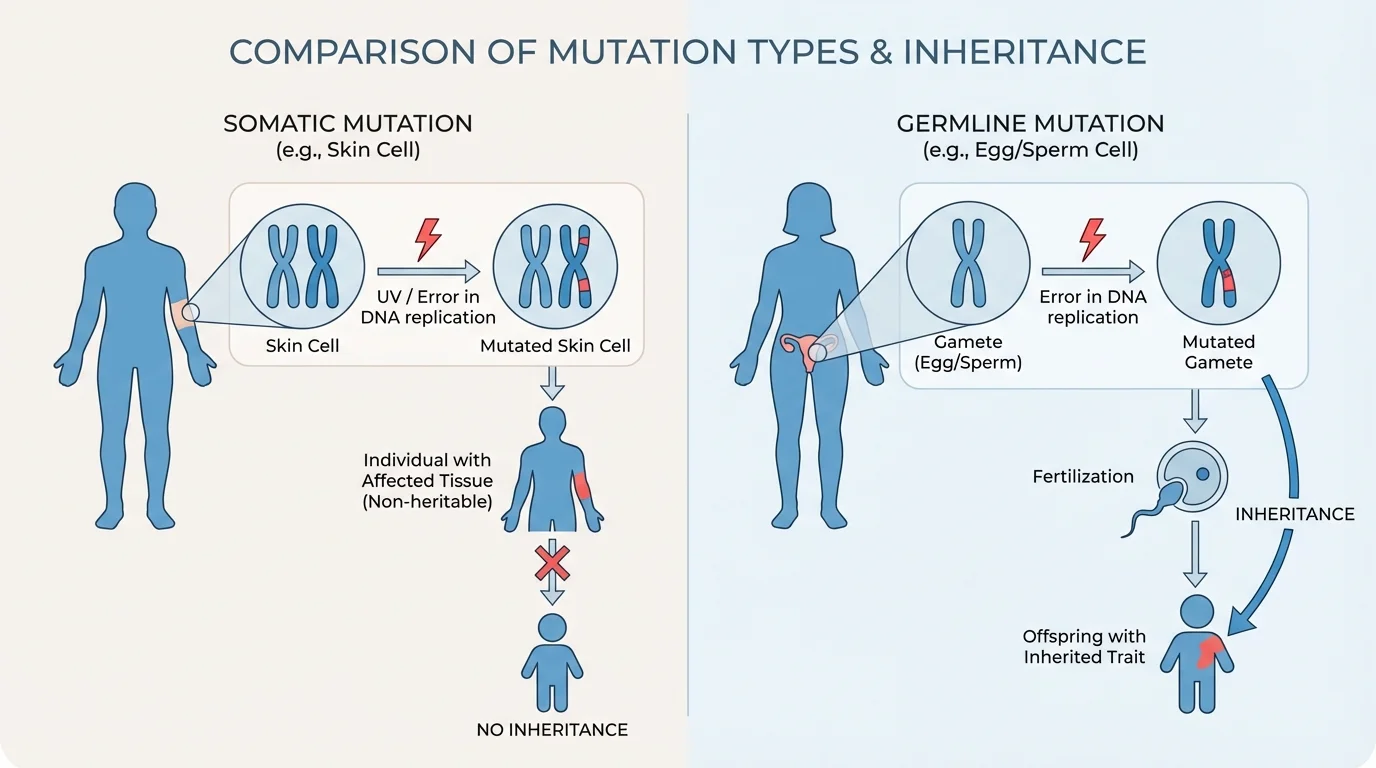
This distinction explains why some disorders run in families while other mutations appear only in one person's tissues. It also explains why cancer mutations in a tumor usually are not inherited by that person's children, unless a separate mutation also exists in the germline.
Somatic mutation means a DNA change in a body cell that usually affects only the individual. Germline mutation means a DNA change in a gamete or gamete-forming cell that can be passed to offspring.
As seen earlier in [Figure 2], meiosis naturally reshuffles chromosomes, but inheritance across generations depends on what ends up inside gametes. That is why the location of a mutation in the body matters just as much as the mutation itself.
These ideas are central to medicine. Genetic counselors examine family histories to estimate whether an inherited mutation may be present. Researchers study mutation rates and recombination patterns to understand disease risk, trace ancestry, and identify genes involved in disorders.
They also matter in agriculture. Plant breeders often cross individuals with desirable traits, such as drought tolerance and high yield, hoping meiosis and crossing over will produce useful combinations in offspring. Mutations, whether naturally occurring or carefully induced under controlled conditions, can also create new plant varieties.
Case study: antibiotic resistance
Bacteria usually reproduce asexually, so this example highlights mutation more than meiosis, but it shows why variation matters.
Step 1: A random mutation gives one bacterium some resistance to an antibiotic.
Step 2: The antibiotic kills many non-resistant bacteria.
Step 3: The resistant bacterium survives and reproduces.
Over time, the population changes because a mutation that was once rare becomes common in that environment.
Conservation biology also depends on genetic variation. Populations with very little variation are often more vulnerable to disease outbreaks or environmental change. A population with more variation has a better chance that some individuals possess alleles suited to new conditions.
The importance of reshuffling is visible again in [Figure 1], because the production of different gametes helps explain why sexual reproduction can maintain diversity within populations. Mutation adds new possibilities, and selection can then act on that variation.
Genetic variation is the raw material for evolution. Natural selection cannot favor a trait unless some difference already exists among individuals. Meiosis creates new combinations of existing alleles, while mutation introduces new alleles. Together, they supply the diversity on which evolution operates.
Not every mutation will spread, and not every recombined chromosome will matter. But across many individuals and many generations, these processes shape populations. They influence everything from disease susceptibility to crop improvement to the survival of species facing climate change.
"Variation is the foundation on which selection acts."
— A central principle of modern biology
At the molecular level, heredity is precise enough to preserve life's continuity. At the same time, crossing over, chromosome assortment, and mutation ensure that life is not genetically frozen. That balance between stability and change is one of the reasons biology is both orderly and endlessly diverse.
