A population can look healthy, active, and diverse, yet evolution by natural selection may still be impossible within it. That sounds strange at first. After all, if organisms are living, competing, and reproducing, why would evolution ever stall? The answer is that natural selection is not just about struggle or survival. It depends on two kinds of variation being present at the same time: differences in inherited genetic information and differences in the traits that actually affect how organisms perform in their environment.
When biologists say populations evolve, they do not mean that every change counts as evolution. A population changes by natural selection only if some individuals have inherited differences that lead to trait differences, and those trait differences cause some individuals to survive or reproduce more successfully than others. If either part is missing, natural selection has nothing to work on.
Natural selection is the process in which individuals with inherited traits that improve survival or reproduction in a particular environment tend to leave more offspring, causing those traits to become more common over generations.
Genetic variation means differences in DNA among individuals in a population.
Trait variation means differences in observable characteristics, such as size, color, behavior, or physiology.
This idea sits at the center of biological evolution. It explains why populations can adapt to cold, heat, disease, predators, drought, or new food sources. It also explains why some bacteria become resistant to antibiotics and why crop pests can become harder to control over time. In every case, the same logic applies: inherited differences must exist, and those differences must show up in ways that matter.
Natural selection is often described too simply as "survival of the fittest," but that phrase can hide the real mechanism. The key question is not just who survives. The key question is why some individuals leave more descendants than others. The answer must involve variation. If every organism in a population were genetically identical and expressed exactly the same traits, then no one would have an inherited advantage over anyone else.
That means evolution by natural selection is not automatic. A changing environment does not force adaptation into existence. Instead, the environment acts like a filter. It favors some existing heritable trait differences over others. If those differences are absent, the filter has nothing to sort.
Genes are segments of DNA that influence traits. Different versions of a gene are called alleles. Traits are shaped by genes, environmental conditions, and interactions between the two.
For that reason, biologists often describe natural selection as requiring heritable variation. Heritable means that the differences can be passed from parents to offspring. A temporary change that is not inherited may affect one organism, but it does not drive long-term evolutionary change in a population.
A population must contain differences in genetic variation for natural selection to occur. [Figure 1] illustrates this idea with individuals carrying different inherited versions of a trait. These differences often involve different alleles of the same gene, but they can also involve larger DNA changes. Without variation in DNA, offspring would inherit essentially the same biological instructions, and natural selection would have no raw material.
Genetic variation arises in several ways. One source is mutation, which is a change in DNA sequence. Mutations can occur when DNA is copied or when environmental factors such as radiation or certain chemicals alter genetic material. Most mutations are neutral or harmful, but some create new alleles that may be useful in certain environments. Another source is sexual reproduction, which shuffles alleles through meiosis and fertilization. This process creates new combinations even when no new mutation appears, helping explain the variation shown in [Figure 1].
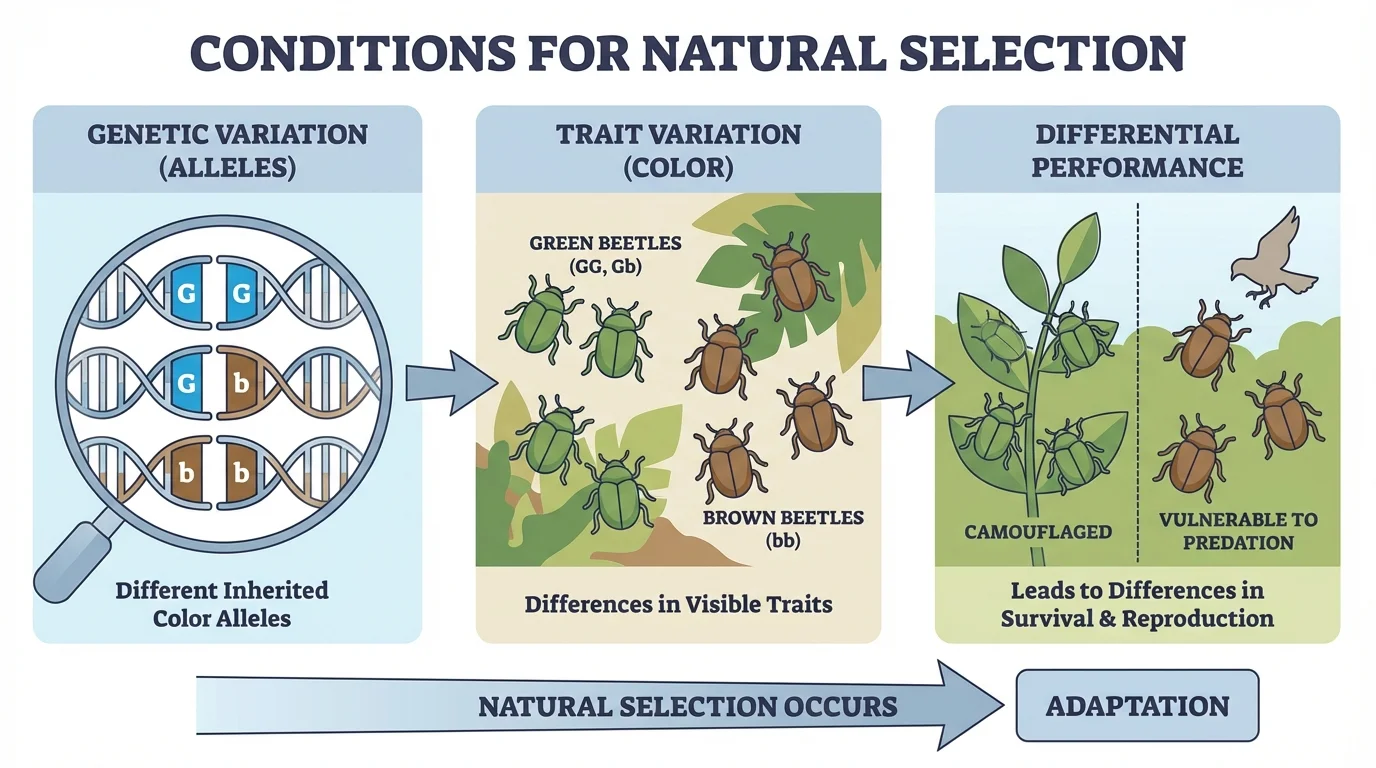
Notice an important detail: genetic variation does not guarantee visible differences in every case. Some DNA differences may have no effect on a trait that matters for performance. Others may affect traits only under certain environmental conditions. Still, without underlying genetic differences, there is no inherited basis for natural selection to favor one line of descendants over another.
Consider a population of insects with different color alleles. If some inherit an allele for darker coloration and others inherit an allele for lighter coloration, the population now has heritable genetic variation. That does not yet mean selection is happening, but it makes selection possible. If birds hunt more easily against one background than another, those inherited color differences may begin to matter.
By contrast, if all insects carry the same allele for color and look the same, predators cannot favor one inherited color type over another. Birds may still eat some insects and miss others, but that would not produce evolutionary change in color because no heritable difference exists.
| Source of variation | What changes | Why it matters |
|---|---|---|
| Mutation | DNA sequence changes | Creates new alleles |
| Recombination | Alleles are reshuffled during meiosis | Produces new genetic combinations |
| Fertilization | Different gametes combine | Increases diversity among offspring |
| Gene flow | Alleles enter from another population | Adds variation to a population |
Table 1. Major biological sources of genetic variation in populations.
Genetic differences must also lead to differences in how traits are expressed. This is where the idea of phenotype becomes important. A phenotype is the set of observable characteristics of an organism, such as body size, blood chemistry, fur thickness, camouflage pattern, flowering time, or hunting behavior. Natural selection acts on phenotypes because the environment interacts with actual traits, not directly with hidden DNA sequences.
Trait variation can appear because genes differ, because the environment differs, or because genes and environment interact. For natural selection to produce evolutionary change, the trait differences that affect performance must be linked, at least partly, to inherited genetic differences. For example, two plants may differ in height because one has better soil and more water. If that difference is purely environmental and not inherited, natural selection on height will be limited.
Why gene expression matters
Genes do not act like simple on-off labels for most traits. Many traits result from networks of genes interacting with each other and with environmental conditions. A genetic difference may change the amount of a protein made, when it is made, or where it is made in the body. Those changes can alter structure, behavior, development, or physiology, which then influences how well an organism functions.
This is why the statement "genetic variation is enough for natural selection" is incomplete. If a DNA difference does not affect a trait that changes performance, the environment cannot favor it through natural selection. Likewise, if trait differences exist but are not heritable, selection may affect which individuals succeed in one generation without causing lasting evolution.
A classic example involves fur thickness in mammals living across cold regions. Suppose some individuals inherit alleles that lead to denser winter fur. If denser fur helps conserve body heat, those individuals may survive harsh winters better and produce more offspring. Here both conditions are present: genetic variation exists, and the variation is expressed as a trait difference that affects performance.
As with the beetles in [Figure 1], the crucial point is that inherited differences must appear in a form the environment can "test." Color, speed, resistance to toxins, drought tolerance, and mating signals are all examples of traits that can change performance.
[Figure 2] Natural selection is best understood as a chain of events. First, individuals in a population differ genetically. Second, those differences contribute to trait variation. Third, the trait variation causes differences in survival or reproductive success in a particular environment. Fourth, because successful individuals leave more offspring, the alleles linked to those advantageous traits become more common in the next generation.
This process does not happen because organisms try to change. It does not happen because a species decides what it needs. It happens because populations already contain variation, and environmental conditions affect which variants leave more descendants.
Suppose a rabbit population lives in a region where winters become colder over many years. Some rabbits have inherited alleles associated with thicker fur, while others have thinner fur. Thicker fur improves heat retention, so those rabbits are less likely to die from exposure and may spend less energy staying warm. As a result, they are more likely to survive to breed. After many generations, alleles linked to thicker fur become more frequent in the population, as [Figure 2] summarizes.
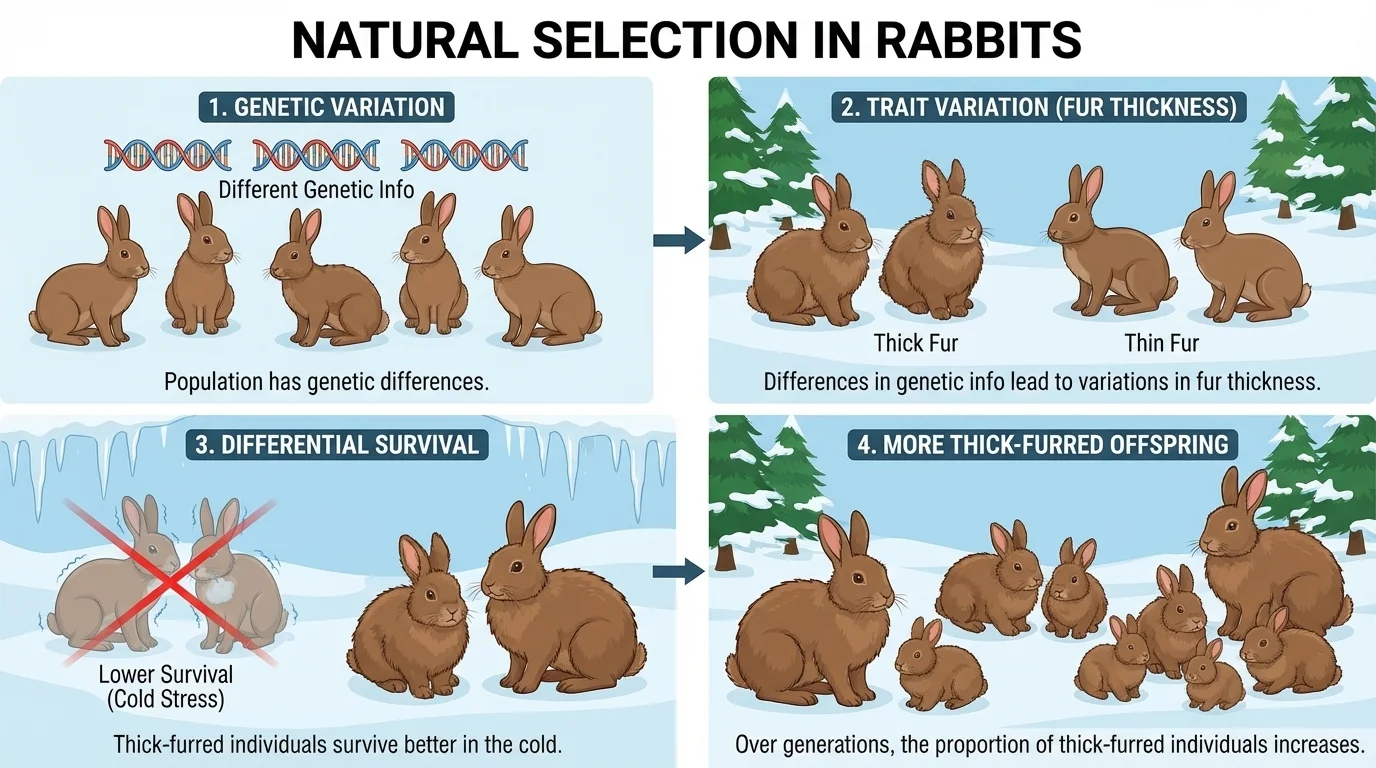
What changes over time is not the need for warmth but the allele frequency in the population. Allele frequency means how common a particular allele is relative to other alleles of the same gene. If the thick-fur allele starts at frequency \(0.30\) and, after many generations of selection, rises to \(0.70\), evolution has occurred because the population's genetic makeup has changed.
This also shows why individuals do not evolve through natural selection during their own lifetimes. A rabbit may grow a thicker coat seasonally, but evolution refers to a change in the inherited characteristics of the population across generations.
Case logic: when selection can and cannot occur
Step 1: Start with inherited variation.
If all individuals have the same allele for a trait, there is no heritable difference for selection to act on.
Step 2: Ask whether the variation changes the phenotype.
If different alleles do not change any trait related to performance, natural selection will not favor one over another.
Step 3: Ask whether the trait affects survival or reproduction.
If a trait difference changes who survives, attracts mates, or produces offspring, selection can occur.
Step 4: Check inheritance across generations.
If the successful trait is heritable, it can become more common in the population over time.
Selection can be strong, weak, constant, or fluctuating. It can favor one extreme, both extremes, or intermediate forms depending on the environment. But in every version, the same requirements hold: genetic differences and expressed trait differences that affect performance.
Performance in biology is broader than simple strength or speed. It includes any trait difference that changes an organism's ability to survive and reproduce. For a plant, better performance might mean deeper roots, more efficient water use, or flowering at the right time. For a bird, it might mean beak shape that matches food type. For bacteria, it may mean the ability to survive exposure to an antibiotic.
The word fitness refers to reproductive success relative to others in the population. A fit organism is not necessarily the fastest, largest, or most aggressive. It is the one whose inherited traits allow it to leave more surviving offspring in that environment. A trait that increases fitness in one context may reduce fitness in another.
For example, a brightly colored feather pattern may attract mates and increase reproduction, but it may also make an animal easier for predators to spot. Whether the pattern is favored depends on the balance of these effects in the real environment. Natural selection is always context-dependent.
Some traits that seem beneficial come with trade-offs. Sickle-cell alleles in humans can cause serious disease in people with two copies, but in regions with malaria, one copy can provide protection against the parasite, helping explain why the allele persists in some populations.
This context dependence is one reason populations often retain diversity. There may not be a single "best" form under all conditions. Seasonal changes, predators, competition, disease, and mate choice all influence which traits increase fitness.
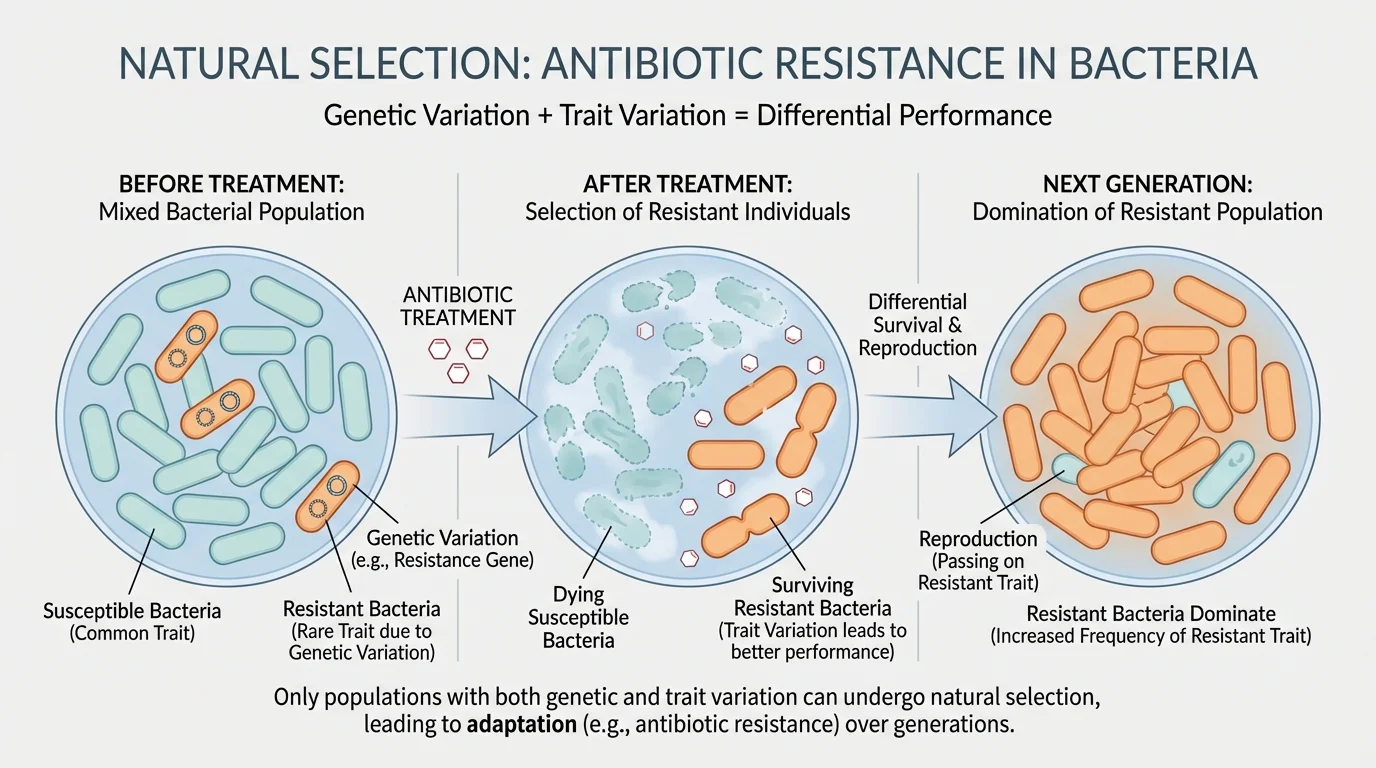
[Figure 3] One of the clearest modern examples comes from bacteria. In a bacterial population, random mutations may create a few cells with resistance to a particular antibiotic. Before treatment, those resistant bacteria may be rare. When the antibiotic is used, susceptible bacteria die in large numbers, but resistant bacteria survive and continue reproducing. The population then becomes dominated by resistant descendants.
This is not because the antibiotic causes bacteria to "try harder" or because all bacteria decide to adapt. The resistant variants already exist due to genetic variation. The antibiotic creates the selection pressure that makes the trait difference matter. Resistance is a powerful example because bacterial generations are short, so the population can change quickly, as shown in [Figure 3].
Peppered moths provide another well-known case. In parts of industrial Britain during the nineteenth century, soot darkened tree bark. Light-colored moths became easier for birds to see, while darker moths were better camouflaged. Because color was heritable and affected survival, the frequency of darker moths increased. Later, as pollution decreased and bark became lighter again, selection patterns shifted.
Darwin's finches in the Galápagos Islands also reveal the same principle. Finch populations contain heritable differences in beak size and shape. During droughts, birds with beaks suited to cracking harder seeds may survive better. In wetter years, other beak forms may do well. The environment changes which trait differences affect feeding success and reproduction.
Pesticide resistance in insects follows the same pattern we saw with bacteria in [Figure 3]. A pesticide does not create resistance because insects need it. Instead, resistant individuals already present in the population survive exposure and pass on the relevant alleles. Over time, the pesticide becomes less effective because the population has evolved.
Real-world application: agriculture and medicine
Farmers and doctors use evolutionary thinking to slow resistance. In agriculture, rotating control methods can reduce the advantage of one resistant genotype. In medicine, using antibiotics only when needed helps reduce selection favoring resistant bacteria. These strategies work because they change the selection pressure acting on existing variation.
These examples all point to the same conclusion: natural selection is not a mysterious force. It is the predictable result of heritable variation interacting with environmental conditions.
A major misconception is that all variation leads to natural selection. It does not. Some differences are neutral, meaning they do not affect survival or reproduction in a given environment. Other differences are caused entirely by the environment and are not inherited. For natural selection to produce evolutionary change, the trait differences must matter for performance and must be linked to inherited genetic differences.
Another misconception is that organisms evolve because they need to. Need does not create suitable mutations on demand. Mutations arise without regard to what would be useful. Selection then sorts among the variants that already exist.
Students also often confuse acclimation with adaptation. Acclimation is a short-term, non-heritable adjustment made by an individual, such as increased breathing rate at high altitude. Adaptation, in the evolutionary sense, refers to an inherited trait shaped over generations by natural selection.
"It is not the strongest of the species that survives, nor the most intelligent, but the one most responsive to change."
— Often attributed to Charles Darwin, though the wording is likely a later paraphrase
Even that famous idea needs care. Being responsive to change helps only when populations contain suitable heritable variation. Without it, even dramatic environmental change may lead to decline or extinction rather than adaptation.
Another limit is time. If environments change too quickly, selection may not spread beneficial alleles fast enough. Small populations may also lose variation through chance alone, reducing the raw material for future adaptation.
Natural selection is not just a topic about wild animals on remote islands. It shapes issues students may hear about in news reports, hospitals, and environmental policy. Antibiotic resistance, cancer treatment resistance, viral evolution, crop breeding, and conservation biology all involve the same core principle.
In conservation, preserving genetic diversity is essential because populations with more variation are often better able to respond to new diseases or climate shifts. In agriculture, plant breeders search for useful genetic variants such as drought tolerance, salt tolerance, or disease resistance. In medicine, understanding selection helps researchers predict how pathogens may change under treatment.
Even cancer can be viewed through this lens. A tumor contains genetically different cells. Treatments may kill many cells but leave some resistant ones behind. Those surviving cells then multiply. The logic closely parallels bacterial resistance: variation exists, trait differences affect survival, and the surviving lineages become more common.
Natural selection cannot act effectively when there is no meaningful heritable variation, when trait differences do not affect performance, or when successful traits are not passed on. It is also limited when chance events dominate, such as in very small populations where random genetic drift can overpower selection.
We can reduce the whole idea to a simple test. Ask three questions: Are individuals genetically different? Do those differences produce trait variation? Do those trait differences cause some individuals to leave more offspring than others? If the answer is yes to all three, natural selection can occur. If not, it cannot drive adaptation in that trait.
That framework helps unify a huge range of biological examples. Whether the organism is a bacterium, oak tree, insect, fish, or human population, the same rules apply. Evolution by natural selection begins not with effort or intention, but with inherited variation expressed as real-world trait differences that matter.
