A single pair of organisms can, in theory, produce an astonishing number of descendants. If every bacterium, insect, fish, or plant offspring survived and reproduced, Earth would be overwhelmed by life in a very short time. Yet that does not happen. Most offspring never reproduce, populations do not grow without limit, and the traits found in species change over time. That pattern leads to one of biology's most powerful ideas: evolution is not random chaos and it is not a conscious plan. It is the consequence of four interacting factors acting generation after generation.
Those four factors are simple to state but profound in their effects. First, organisms have the potential to increase in number. Second, individuals in a species vary genetically because of mutation and sexual reproduction. Third, organisms compete for limited resources in their environment. Fourth, as a result of that competition, individuals with inherited traits that help them survive and reproduce leave more offspring, so those traits become more common. Together, these processes explain how populations change over time and how life becomes both diverse and well matched to different environments.
Evolution is the change in the inherited characteristics of a population over generations.
Natural selection is the process in which individuals with heritable traits better suited to their environment tend to survive and reproduce more successfully.
Adaptation is an inherited trait that increases an organism's chances of surviving and reproducing in a particular environment.
To understand evolution clearly, it helps to focus on populations, not isolated individuals. A single organism may live or die, but evolution happens when the genetic makeup of a population shifts across generations. That shift can be slow or rapid, obvious or subtle, but it always depends on the same underlying logic.
Evolution begins with a mismatch between what organisms could produce and what the environment can actually support. Every species faces limits: food, water, light, shelter, space, mates, and protection from predators or disease. At the same time, no two individuals are genetically identical except identical twins or organisms produced asexually from the same source. That means some individuals are, by chance, better equipped than others for the conditions around them, as [Figure 1] helps illustrate.
When the environment favors certain inherited traits, the organisms carrying those traits are more likely to survive and reproduce. Over many generations, their traits spread through the population. This is the core of evolution by natural selection. It is not that organisms "try" to evolve. Instead, the environment filters variation that already exists.
Genes are segments of DNA that influence traits, and alleles are different versions of the same gene. Offspring inherit alleles from their parents, which is why some traits can be passed from one generation to the next.
This idea also explains both the unity and the diversity of life. The unity comes from common ancestry: all living things share basic features such as DNA, cells, and similar biochemical processes. The diversity comes from populations adapting to different environments over long periods of time.
Every species has the capacity for rapid population growth. In a stable environment with unlimited resources, many organisms could reproduce at rates far beyond what we actually observe. This potential for growth means that species produce far more offspring than can possibly survive to adulthood and reproduce.
A flowering plant may release hundreds of seeds. A fish may lay thousands of eggs. Many insects produce enormous numbers of offspring in a short time. Even mammals, which usually produce fewer young, can increase their numbers quickly under favorable conditions. If each generation fully survived, population size could rise extremely fast. In a simple model, if a population of rabbits doubled each generation, then after a few generations the number would follow a pattern like \(2, 4, 8, 16, 32\), showing how quickly growth can accelerate.
But real environments are not unlimited. Seeds land where they cannot grow. Young animals are eaten. Drought reduces water supply. Disease spreads. Winter arrives. As a result, only a fraction of offspring survive long enough to reproduce. This overproduction is essential to evolution because it creates the conditions for selection: not every individual can succeed.
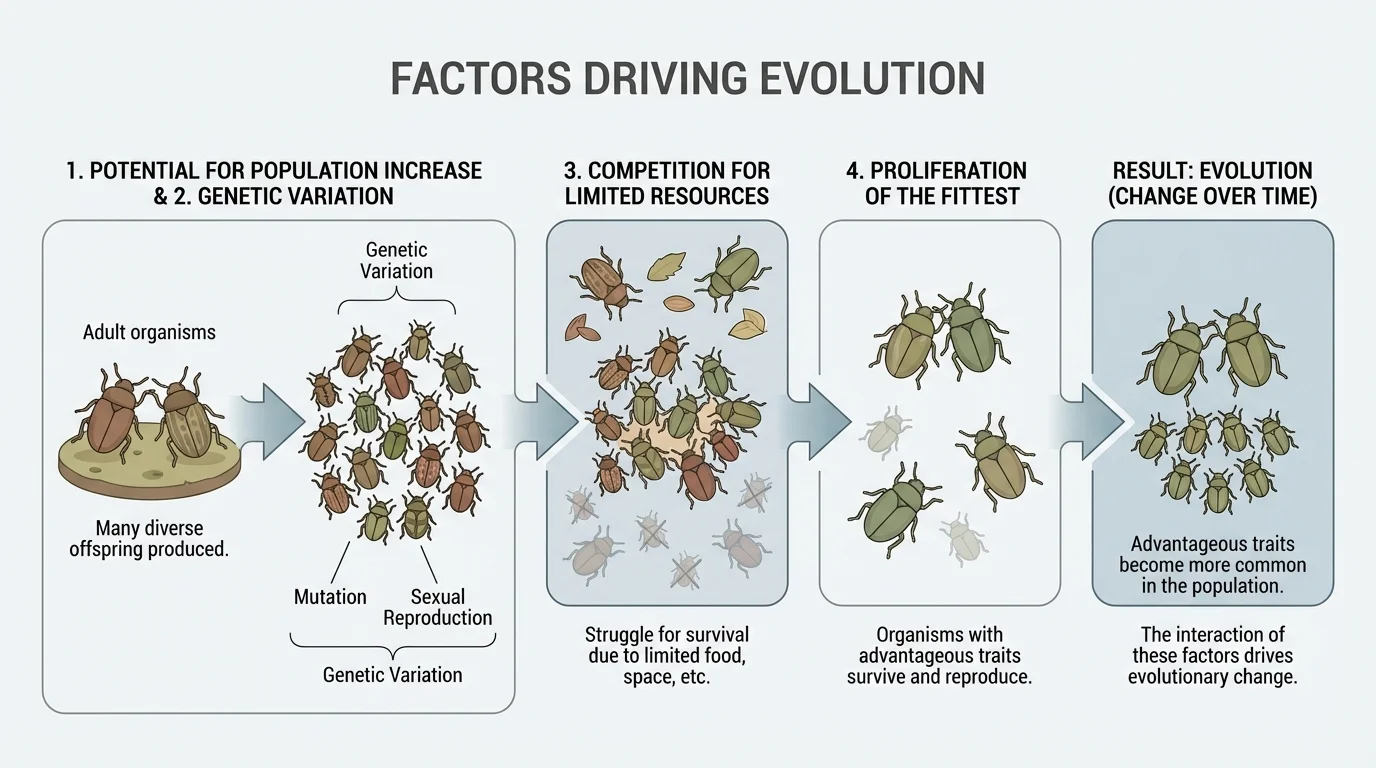
This factor does not by itself cause evolution. If all offspring were genetically identical, then survival would not change which inherited traits become more common. Overproduction matters because it creates pressure, but pressure only produces evolutionary change when there is heritable variation in the population.
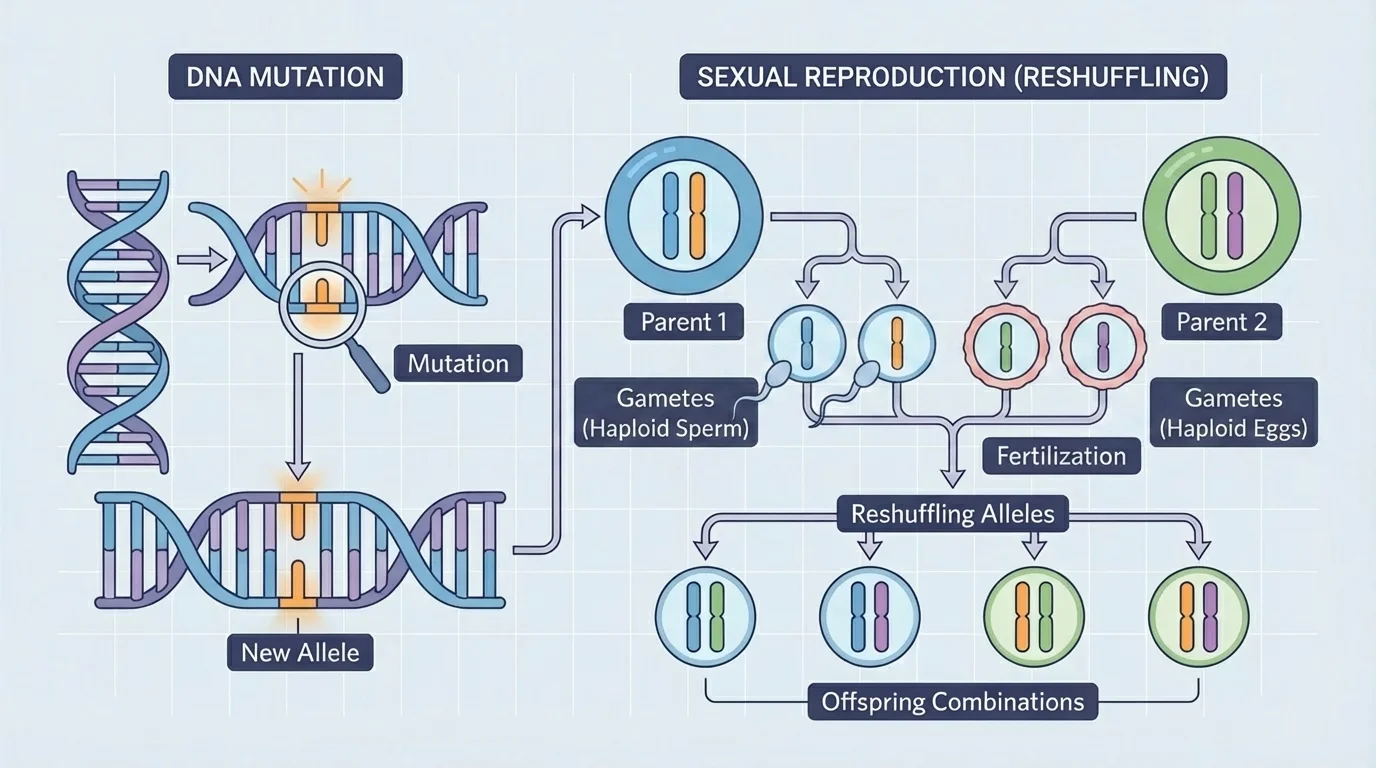
The second factor is genetic variation. As [Figure 2] shows, members of the same species differ from one another in many inherited ways, and that variation comes largely from mutation and sexual reproduction. Without variation, evolution by natural selection could not occur because there would be no inherited differences for the environment to act on.
A mutation is a change in DNA. Some mutations have no effect, some are harmful, and some are beneficial in a particular environment. Mutations can create new alleles, introducing traits that did not exist previously in a population. For example, a mutation in bacteria may change a protein targeted by an antibiotic, making the bacterium less affected by the drug.
Sexual reproduction also generates variation by reshuffling alleles. During meiosis and fertilization, offspring receive different combinations of genes from their parents. Brothers and sisters may resemble one another, but they are not genetically identical because each inherits a unique combination of alleles. This constant recombination means every generation contains a fresh set of genetic combinations.
Not all variation is genetic. A person may develop larger muscles through exercise, or a plant may grow shorter in poor soil. These differences can affect appearance, but if they are not caused by inherited genetic differences, they are not passed on in the same way and do not directly drive evolution by natural selection. For natural selection to matter evolutionarily, the trait must be heritable.
Variation may involve visible traits such as fur color, beak shape, and body size, but it can also involve internal traits such as enzyme efficiency, immune response, or tolerance to temperature extremes. In many cases, the most important evolutionary differences are invisible without molecular tools. A small DNA change can alter how an organism responds to disease, toxins, or climate.
Some mutations that are helpful in one environment can be harmful in another. A trait is not universally "good" or "bad"; its value depends on the conditions in which the organism lives.
The idea of variation also helps explain why members of a population never all respond the same way to a challenge. When a drought occurs, some plants may have root systems slightly better at reaching water. When temperatures drop, some animals may have inherited features that improve insulation or metabolism. Those differences are the raw material of evolution.
The third factor is the struggle for existence caused by limited resources. Because more offspring are produced than can survive, organisms must compete. This competition may be direct, such as two wolves fighting over territory, or indirect, such as many plants drawing water from the same dry soil.
Resources can include food, water, light, minerals, nesting sites, shelter, and mates. Limits may also come from predators, parasites, pathogens, and physical conditions such as heat, cold, storms, or salinity. An environment does not merely "contain" organisms; it actively shapes which traits matter. In a forest, camouflage may be crucial. In a desert, water conservation may matter most. In an ocean with changing temperature and acidity, physiology may determine survival.
This competition does not mean nature is always dramatic combat. Sometimes the struggle is quiet and constant. A seedling that receives slightly more sunlight may grow taller and produce more seeds. A bird whose beak is better suited to cracking hard seeds during a drought may continue feeding while others starve. A bacterium that can survive a dose of antibiotics suddenly has far less competition because susceptible bacteria die off.
Competition can occur within a species and between species. Members of the same species often compete strongly because they need similar resources. However, interactions with other species also matter. Predators select for speed, camouflage, toxins, or warning coloration. Parasites and pathogens select for immune defenses. Pollinators can influence flower shape. Evolution often unfolds through networks of ecological relationships rather than a single isolated pressure.
The environment acts as a filter
Natural selection does not create useful traits because organisms need them. Instead, the environment filters the variation already present. Traits that happen to improve survival or reproduction under current conditions become more common because the organisms carrying them leave more descendants.
Environmental pressures can also change over time. A trait that once offered an advantage may become less useful if climate changes, a new predator arrives, or human activity alters the habitat. This is why evolution is dynamic rather than fixed.
The fourth factor is the outcome of the first three: some individuals survive and reproduce more successfully than others because their inherited traits fit the environment better. As [Figure 3] illustrates, this is natural selection acting across generations. The key idea is not just survival, but survival linked to reproduction. An organism that lives a long time but leaves no offspring does not pass on its alleles.
Biologists often describe this idea using the term fitness. In evolution, fitness does not mean strength, athletic ability, or perfection. It means reproductive success in a specific environment. A small bird that produces many surviving offspring may have higher fitness than a larger, stronger bird that produces fewer. Fitness is always relative to conditions.
Suppose a population of beetles lives on dark soil. If some beetles are lighter and easier for birds to spot, they may be eaten more often. Darker beetles survive at a higher rate and reproduce more. In the next generation, a larger proportion of the population may be dark. After many generations, dark coloration becomes common. The population evolves because allele frequencies change over time.
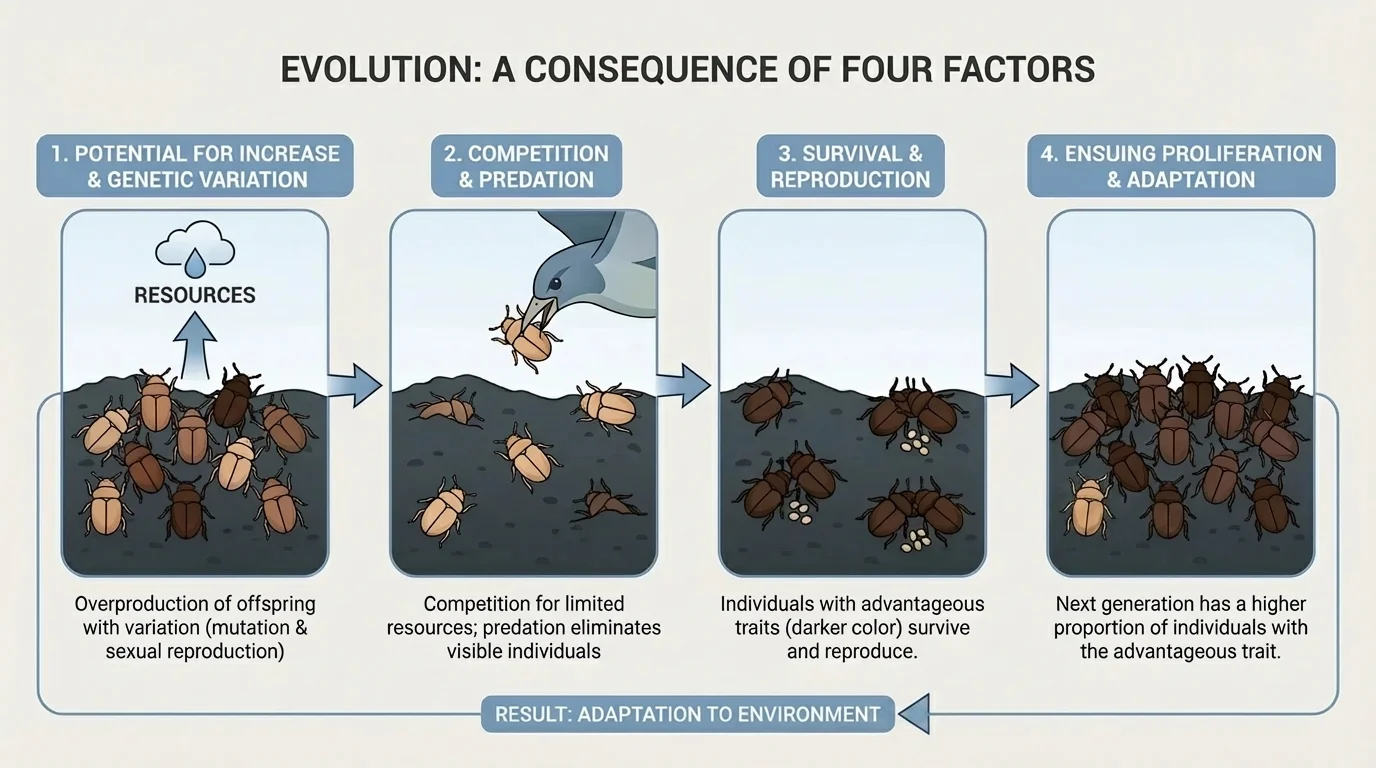
An adaptation is not simply any trait an organism has. It is a heritable trait that increases fitness in a given environment. Thick fur can be an adaptation in cold climates. Waxy leaves can be an adaptation in dry environments. Drug resistance can be an adaptation in bacteria exposed to antibiotics. As with the beetles shown in [Figure 3], an adaptive trait spreads because organisms carrying it leave more descendants.
Natural selection does not guarantee perfection. It works with existing variation, historical constraints, and trade-offs. A trait may improve one aspect of survival while creating costs in another. Large antlers may help attract mates but require energy to grow and can make escape harder. Evolution produces organisms that are workable and competitive in real conditions, not ideally engineered in every way.
The power of evolutionary theory comes from seeing these factors as one connected process. Species produce more offspring than can survive. Offspring differ genetically. Limited resources and environmental pressures mean not all individuals succeed equally. Those with advantageous inherited traits leave more offspring, so the population gradually changes. Each factor depends on the others.
If there were no overproduction, there would be little struggle. If there were no genetic variation, selection could not shift trait frequencies. If there were no competition or environmental limits, survival differences might not matter. If survival and reproduction were completely unrelated to inherited traits, evolution by natural selection would not occur. Evolution emerges from the interaction of all four.
Case study: drought and seed-eating birds
A bird population contains variation in beak depth. In ordinary years, birds with different beak sizes survive reasonably well. During a severe drought, however, soft seeds become scarce and mostly hard seeds remain.
Step 1: Overproduction and variation already exist.
The population produces more young than can all survive, and individuals differ in inherited beak shape.
Step 2: Resource limits intensify competition.
Because food is scarce, birds compete more strongly for the remaining seeds.
Step 3: Some traits increase success.
Birds with deeper, stronger beaks crack hard seeds more efficiently and survive at a higher rate.
Step 4: The next generation changes.
Those survivors reproduce, and alleles associated with deeper beaks become more common in the population.
This is evolution by natural selection. The environment did not give birds stronger beaks because they needed them; it favored birds that already had inherited variation in that direction.
A critical point follows from this chain: individuals do not evolve during their lifetimes. Populations evolve because the proportion of traits changes from one generation to the next. An individual bird does not grow a new inherited beak type because of drought. Instead, birds with certain inherited beaks survive and reproduce more successfully.
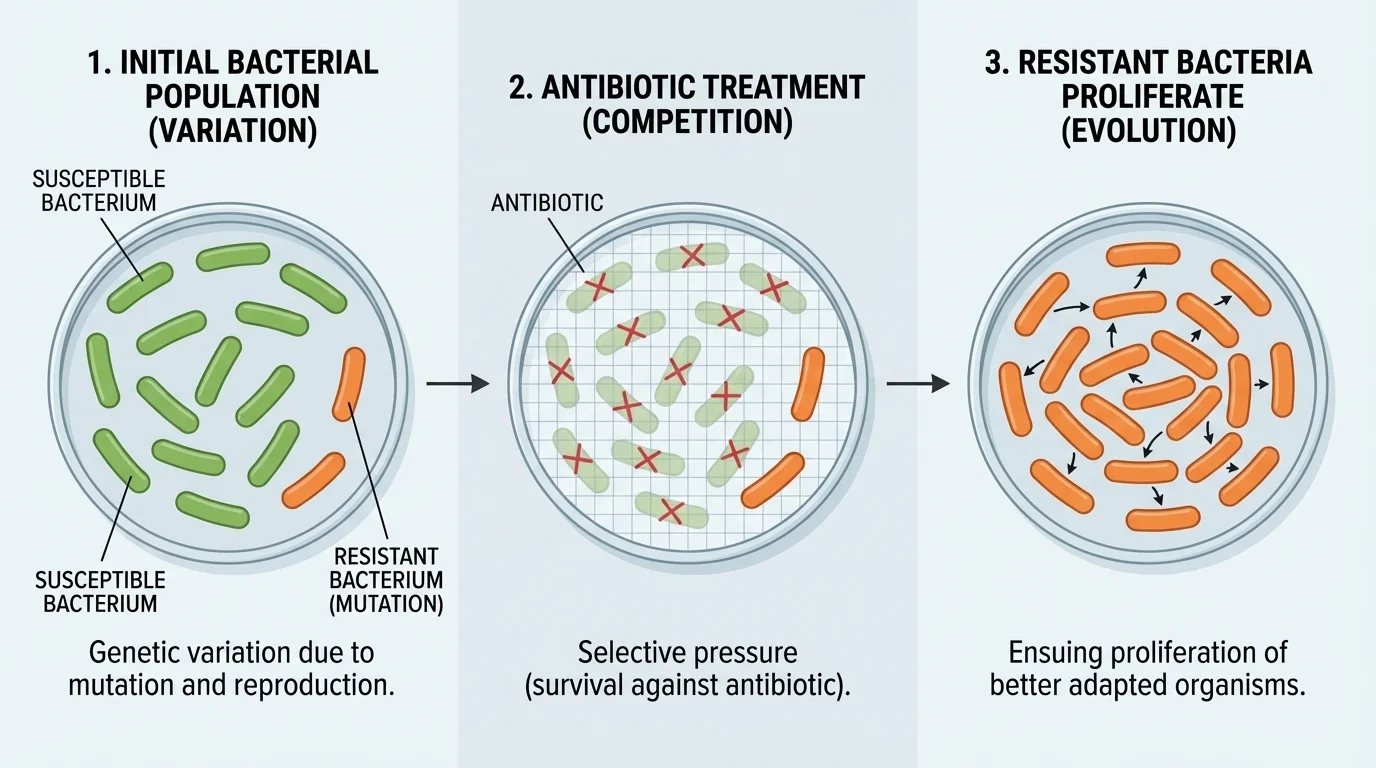
One of the clearest modern examples of evolution is antibiotic resistance. Bacterial populations often contain genetic variation, including rare mutations that reduce the effect of a drug. When antibiotics are used, susceptible bacteria die while resistant bacteria survive and reproduce. The pattern follows the same logic as the beetle example shown in [Figure 3]: the environment removes some variants and leaves others to multiply.
This is why incomplete or unnecessary antibiotic use is a serious public health problem. It increases the selective pressure favoring resistant strains. Hospitals, farms, and communities all feel the consequences when resistant bacteria become common. Evolution is not just a historical idea about fossils; it shapes medicine right now.
The peppered moth case is another classic example. In parts of industrial England during the nineteenth century, soot darkened tree bark. Lighter moths became easier for predators to spot, while darker moths were better camouflaged. As conditions changed, darker forms became more common. Later, when pollution decreased and bark became lighter again, the balance shifted. This case shows that selection depends on environment, not on a trait being inherently superior in all situations.
Darwin's finches on the Galápagos Islands provide a famous example of how ecological conditions affect inherited traits. Different islands and food sources favored different beak shapes. During droughts, changes in seed availability altered which beak traits had the highest fitness. Researchers have directly measured these shifts over relatively short timescales, showing evolution in action in wild populations.
Humans also drive evolution in many species. Insects evolve resistance to pesticides. Weeds evolve resistance to herbicides. Fish populations can change when intensive harvesting removes the largest individuals before they reproduce. These examples matter because they affect agriculture, conservation, and food security. Evolutionary principles help scientists design better policies and treatments.
| Example | Selective pressure | Trait favored | Result |
|---|---|---|---|
| Antibiotic-resistant bacteria | Antibiotic exposure | Resistance-conferring mutations | Resistant strains become more common |
| Peppered moths | Predation on different backgrounds | Camouflage coloration | Moth color frequencies shift |
| Galápagos finches | Food availability during drought | Beak size and shape suited to available seeds | Population beak traits change |
| Pesticide-resistant insects | Pesticide use | Resistance traits | Control becomes less effective |
Table 1. Examples showing how environmental pressures favor certain inherited traits and change populations over time.
One common misconception is that evolution means organisms get "better" in an absolute sense. In biology, "better" means better suited to a specific environment. A trait that increases fitness in one setting may reduce it in another. Webbed feet are useful in water but not necessarily on dry grasslands. Thick fur helps in cold climates but can be costly in heat.
Another misconception is that organisms evolve because they need to. Need alone does not create genetic change. Mutations occur without regard to what an organism wants or requires. Selection then acts on existing heritable variation. A giraffe does not lengthen its neck by trying to reach leaves and then pass that acquired change to offspring. Instead, if neck length is heritable and longer-necked individuals leave more offspring, neck length can increase in the population over generations.
"It is not the strongest of the species that survives, nor the most intelligent, but the one most responsive to change."
— Commonly attributed to Charles Darwin
It is also incorrect to say that every trait is an adaptation. Some traits may be byproducts of other features, neutral differences, or remnants of evolutionary history. Natural selection is a major mechanism of evolution, but not every characteristic exists because it was directly favored.
Finally, evolution is supported by multiple lines of evidence, including fossils, comparative anatomy, embryology, biogeography, and molecular biology. The same genetic code used by bacteria, plants, fungi, and animals is powerful evidence of shared ancestry. DNA comparisons allow scientists to reconstruct relationships among species with remarkable precision.
Over shorter timescales, evolution may appear as small shifts in trait frequencies within a population. Over long timescales, accumulated changes can contribute to the formation of new species, a process called speciation. If populations become isolated and experience different selection pressures, mutations, and genetic changes, they may eventually become unable to interbreed successfully.
This process helps explain Earth's extraordinary biodiversity. Tropical forests, coral reefs, deserts, tundra, and freshwater ecosystems all contain species shaped by different environmental conditions and evolutionary histories. At the same time, the shared chemistry and cellular organization of living things reveal their common ancestry. Evolution explains why life is both varied and connected.
Understanding evolution also has practical value. It helps researchers track emerging viruses, develop vaccines, manage endangered species, improve crops, and predict how populations may respond to climate change. When scientists study the evolution of pathogens, they can anticipate how quickly a strain may spread or resist treatment. When conservation biologists protect genetic diversity, they help populations retain the variation needed to adapt.
The central lesson is elegant: evolution is not caused by a single force acting alone. It is the outcome of reproduction, inheritance, variation, environmental limits, and differential reproductive success all working together. From bacteria in a hospital to birds on an island to plants in a desert, the same four factors shape the living world.
