If geologists want to know what Earth was like more than 4 billion years ago, the obvious place to look might seem to be Earth itself, but it is often the wrong place to start. Our planet is so geologically active that it has erased much of its own earliest history, while quieter objects in space have preserved evidence from a time when Earth was just beginning. Rocks from the Moon and fragments of asteroids can act like surviving pages from a book whose original copy on Earth was mostly burned, torn, and rewritten.
Earth is a dynamic planet. Its surface is constantly reshaped by plate tectonics, volcanism, weathering, erosion, and the movement of water and ice. Over immense spans of time, these processes destroy, bury, melt, or transform old rocks. Earth's crust is not a permanent shell; it is recycled, as [Figure 1] shows, through collisions between plates, subduction into the mantle, and the building and wearing down of mountains.
One of the most important processes is subduction, in which one tectonic plate sinks beneath another and carries crustal material back into Earth's interior. Once rocks are deep enough, high pressure and high temperature can alter them or melt them completely. Even if rocks are not destroyed this way, they may be changed by metamorphism, which reorganizes minerals and can erase earlier evidence of how the rock first formed.
At the surface, wind, rivers, glaciers, and chemical reactions break down exposed rocks. Sediments may later form new rocks, but those new rocks tell a later story, not always the original one. This is why truly ancient rocks from Earth's first few hundred million years are extremely rare. A few very old mineral grains called zircons survive from that time, but they are isolated clues rather than a complete rock record.
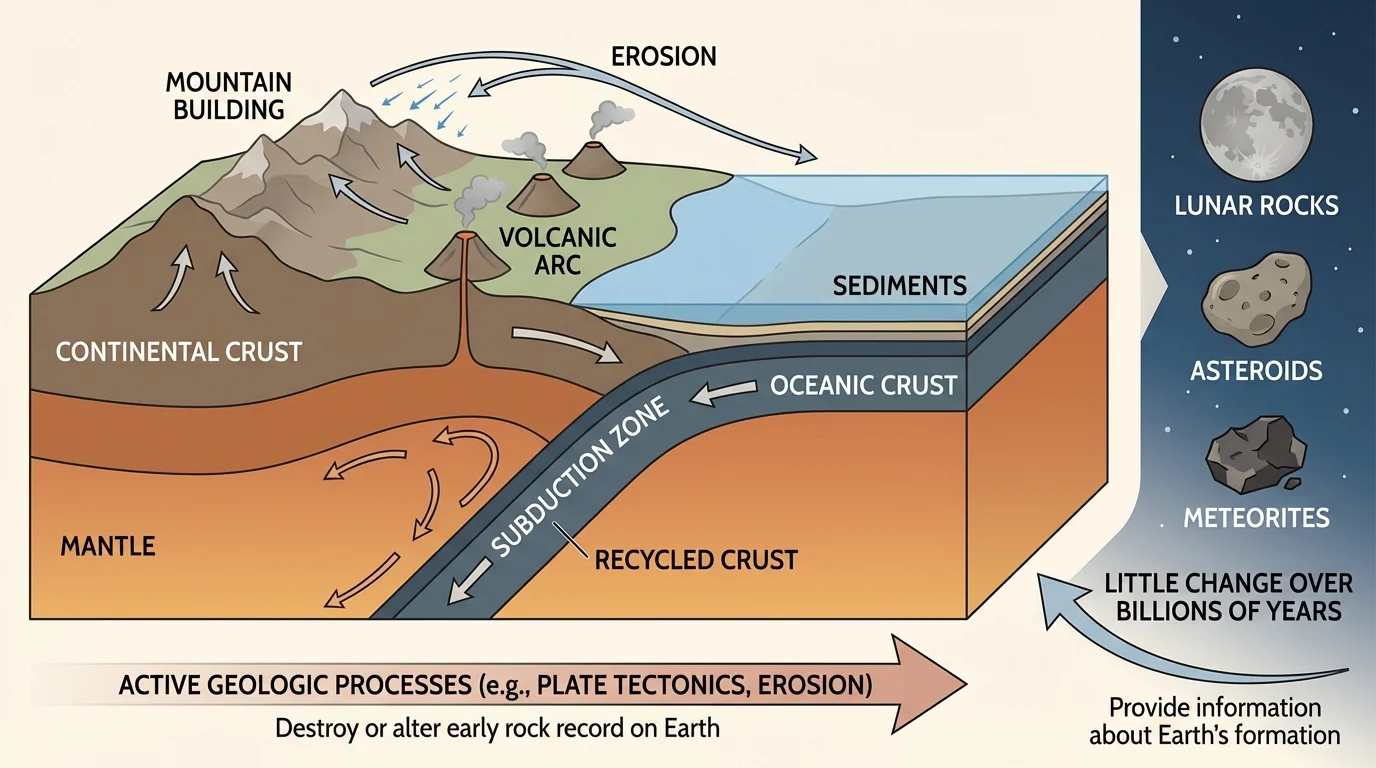
The oldest known minerals on Earth are about 4.4 billion years old, but Earth itself formed about 4.54 billion years ago. That gap matters. It means direct evidence from the very beginning is sparse. To fill in the missing history, scientists compare the tiny amount of ancient Earth material with objects elsewhere in the solar system that have remained far less changed.
Deep time refers to the immense span of geologic history, especially the billions of years over which Earth and the solar system formed and changed.
Geologic recycling is the destruction, transformation, and re-use of crustal material by processes such as subduction, melting, erosion, and sedimentation.
Thinking about deep time is difficult because human history covers only a tiny fraction of Earth's existence. If Earth's history were compressed into a single year, the earliest crust would form in the first days of January, while humans would appear only in the last minutes of December 31. Most of the earliest chapters are missing not because they never existed, but because Earth continually rewrites its surface.
To understand why lunar rocks and meteorites matter, we first need a picture of how Earth formed. The solar system began as a rotating cloud of gas and dust called the solar nebula. Gravity caused material to clump into small solid bodies, then into larger ones called planetesimals. Repeated collisions and mergers built protoplanets, including the young Earth.
The sequence of growth from dust to a layered planet is shown in [Figure 2]. This process is called accretion. During accretion, collisions released enormous amounts of energy. Radioactive decay and compression also heated the growing planet. Early Earth was likely hot enough for much of it to melt, at least partially.
When a planet becomes molten, materials separate by density. Heavy elements such as iron and nickel move inward, while lighter silicate materials remain above them. This process is known as differentiation. Because of differentiation, Earth developed a metal-rich core, a rocky mantle, and eventually a crust.
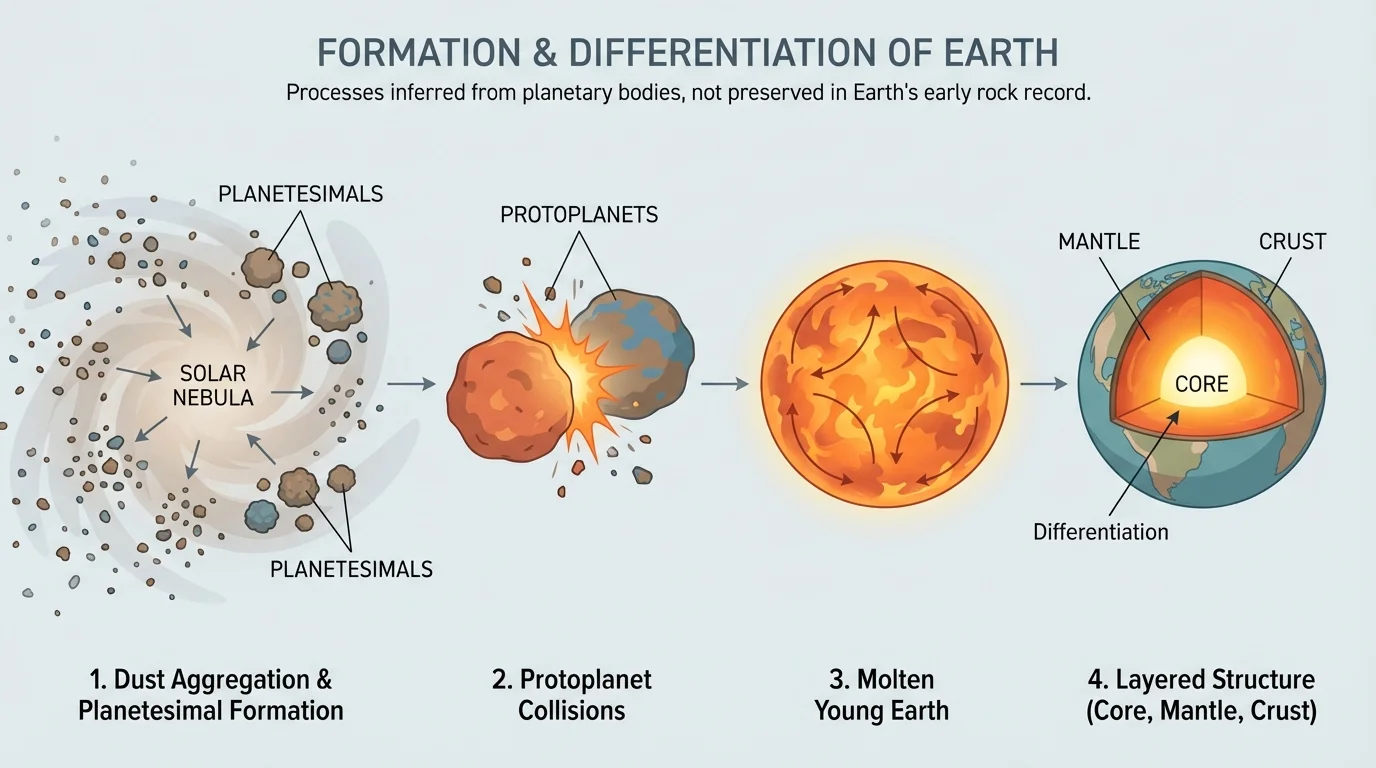
Differentiation was one of the most important events in Earth's early history because it established the planet's internal structure and helped control its magnetic field, volcanic behavior, and long-term geologic activity. Scientists cannot directly observe this event on early Earth, but meteorites and planetary materials provide powerful evidence that such separation happened widely during solar system formation.
Many scientists also think a giant collision between the young Earth and a Mars-sized body helped form the Moon. That event would have been catastrophic, remelting much of Earth's outer layers and further erasing early rocks. Ironically, the violence that helped shape our planet also makes its earliest history harder to read.
Some meteorites are older than any unaltered rock found on Earth. Their ages cluster near 4.56 billion years, making them among the oldest solid materials known in the solar system.
Because these ancient materials formed around the same time as Earth, they let scientists investigate conditions in the early inner solar system even when Earth's own rocks are missing or altered.
Not all bodies in the solar system are equally active. Earth has plate tectonics, abundant liquid water at the surface, and an atmosphere that drives weathering and erosion. By contrast, many asteroids are small, cold, and geologically simple. The Moon has no global plate tectonics and almost no atmosphere. That difference is crucial: surfaces and rocks on these bodies can remain comparatively unchanged for billions of years.
This does not mean they are perfectly preserved. The Moon is heavily cratered by impacts, and asteroids can break apart in collisions. But many of their materials have avoided the intense recycling that dominates Earth. As a result, they retain records of early solar system chemistry, ancient impact events, and the timing of planetary formation.
Scientists often describe some meteorites as time capsules. That phrase is not just dramatic language. Certain meteorites still contain tiny round structures called chondrules, primitive minerals, and isotope patterns that formed near the birth of the solar system. These features preserve information about the conditions under which the first solids condensed and assembled.
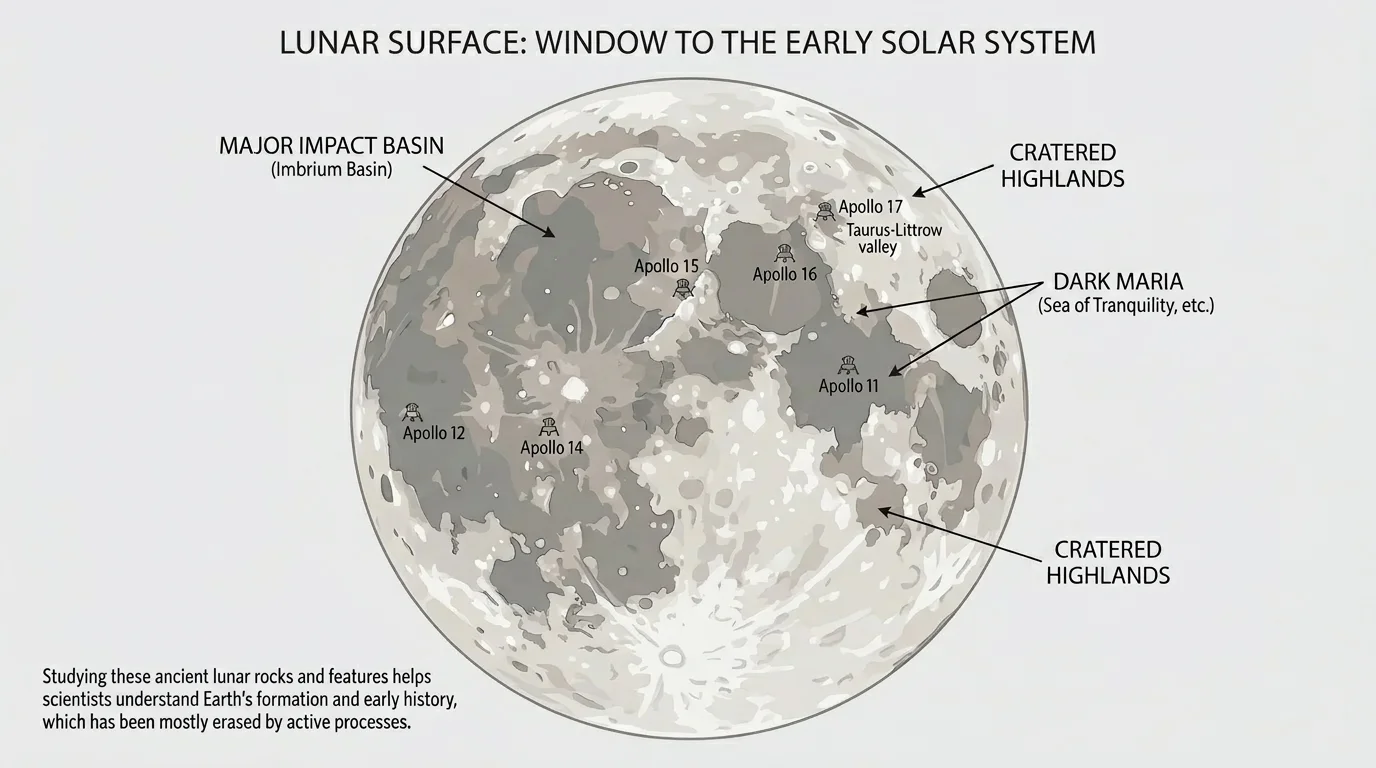
The Moon is especially valuable because its surface preserves ancient terrains, as [Figure 3] illustrates. Since the Moon lacks flowing water, strong winds, and active plate tectonics, many lunar surfaces remain much older than typical surfaces on Earth. Samples returned by the Apollo missions revolutionized scientists' understanding of the Moon and, indirectly, of Earth.
Lunar rocks come from different settings. The bright highlands are ancient, heavily cratered regions made largely of light-colored rocks rich in feldspar. The dark maria are younger basaltic plains formed when lava flooded large impact basins. Comparing these terrains helps scientists reconstruct the Moon's geologic timeline.
The contrast between highlands and maria is clearly preserved on the lunar surface. The oldest lunar highland rocks date to more than 4 billion years ago. Because these rocks formed shortly after the Moon itself, they provide a window into conditions in the early inner solar system, including the period when Earth was still cooling and differentiating.
Lunar samples support the idea that the Moon and Earth are linked by a giant impact origin. For example, oxygen isotope ratios in lunar and Earth rocks are strikingly similar, suggesting they formed from closely related material. At the same time, the Moon is depleted in some volatile elements, which fits the idea of formation in a high-energy event.
Lunar craters also record the history of impacts in the inner solar system. Because Earth and the Moon occupy the same neighborhood in space, the impact history preserved on the Moon helps scientists estimate how often Earth was bombarded early in its history. This matters because frequent giant impacts could have influenced Earth's crust, atmosphere, and the conditions under which oceans and, eventually, life emerged.
Why crater counts matter
On a surface that is not being erased by erosion or tectonics, more craters usually mean greater age. Scientists compare crater densities on lunar surfaces with ages measured from returned samples. That relationship becomes a tool for estimating the ages of other planetary surfaces, including parts of Mars and Mercury.
The Moon therefore serves two roles at once: it is a preserved archive of early solar system events, and it is also a reference surface that helps scientists interpret other worlds.
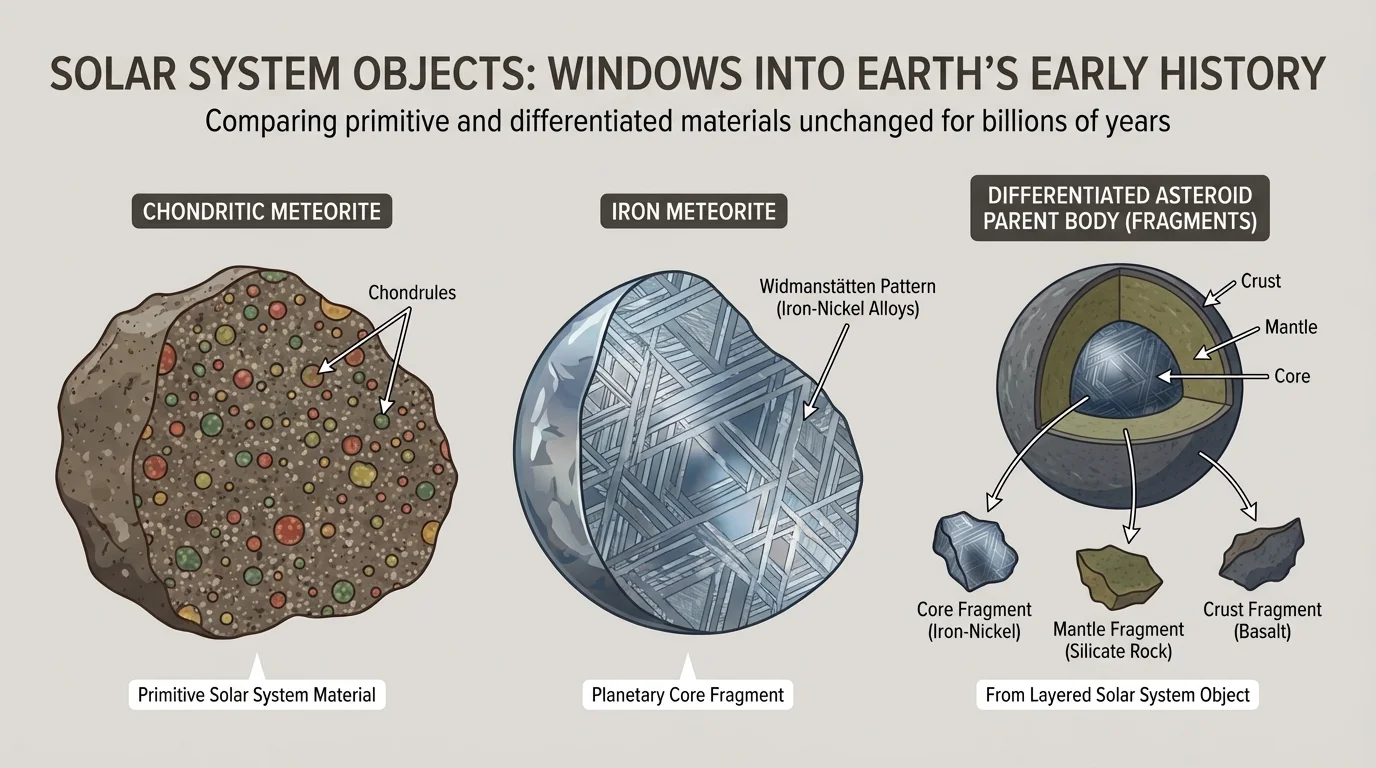
Meteorites are pieces of rock or metal from space that survive passage through Earth's atmosphere and land on the ground. Many come from asteroids, and some originate from the Moon or Mars. As [Figure 4] shows, meteorites are not all alike; their internal structures reveal different histories of heating, melting, and chemical change.
One major group is the chondrite, a stony meteorite that contains chondrules and is considered primitive because it formed early and often avoided large-scale melting. Chondrites are especially important because their bulk composition is similar to the starting materials from which the inner planets formed.
Other meteorites are iron-rich or stony-iron mixtures. These often come from parent bodies that melted and differentiated, much like early planets. An iron meteorite may represent material that once belonged to the core of a shattered asteroid. By studying such specimens, scientists learn how small bodies heated up, separated internally, and then broke apart.
Meteorites also contain isotopic evidence that reveals when solids formed in the solar system. Some calcium-aluminum-rich inclusions, among the oldest known materials, date to about 4.567 billion years ago. These inclusions help define the beginning of solar system history and provide a time anchor for later events, including Earth's accretion.
Chemical analyses of meteorites help answer questions such as: Which elements were common in the early solar system? How much water-bearing material existed? Which bodies melted, and which remained primitive? For instance, carbonaceous chondrites contain water-bearing minerals and carbon-rich compounds, making them important for studying how Earth may have received some of its water and organic building blocks.
| Object or material | Main value for studying early Earth | Typical preserved evidence |
|---|---|---|
| Lunar highland rocks | Record of ancient crust and impact history | Old ages, cratered terrain, isotope similarities to Earth |
| Basaltic lunar maria | Record of later volcanic activity on the Moon | Lava flows, younger impact surfaces |
| Primitive chondrites | Clues to original solar system building materials | Chondrules, primitive minerals, volatile compounds |
| Iron meteorites | Evidence of differentiation in small bodies | Metal-rich material from asteroid cores |
| Ancient zircons on Earth | Rare direct clues from early Earth | Old isotope ages, evidence for early crust and water |
Table 1. Comparison of major materials used to reconstruct Earth's earliest history.
When scientists compare these records, they can separate what was unique to Earth from what was common across the early solar system. That comparison is one of the strongest tools in planetary science.
To turn rocks into historical evidence, scientists need reliable dating methods. One of the most powerful is radiometric dating. This technique uses the fact that some isotopes are unstable and decay into other isotopes at predictable rates.
The time required for half of a sample of a radioactive isotope to decay is its half-life. If a mineral crystal forms with a known parent isotope and later accumulates daughter products as the parent decays, scientists can measure the ratio between them to estimate the mineral's age.
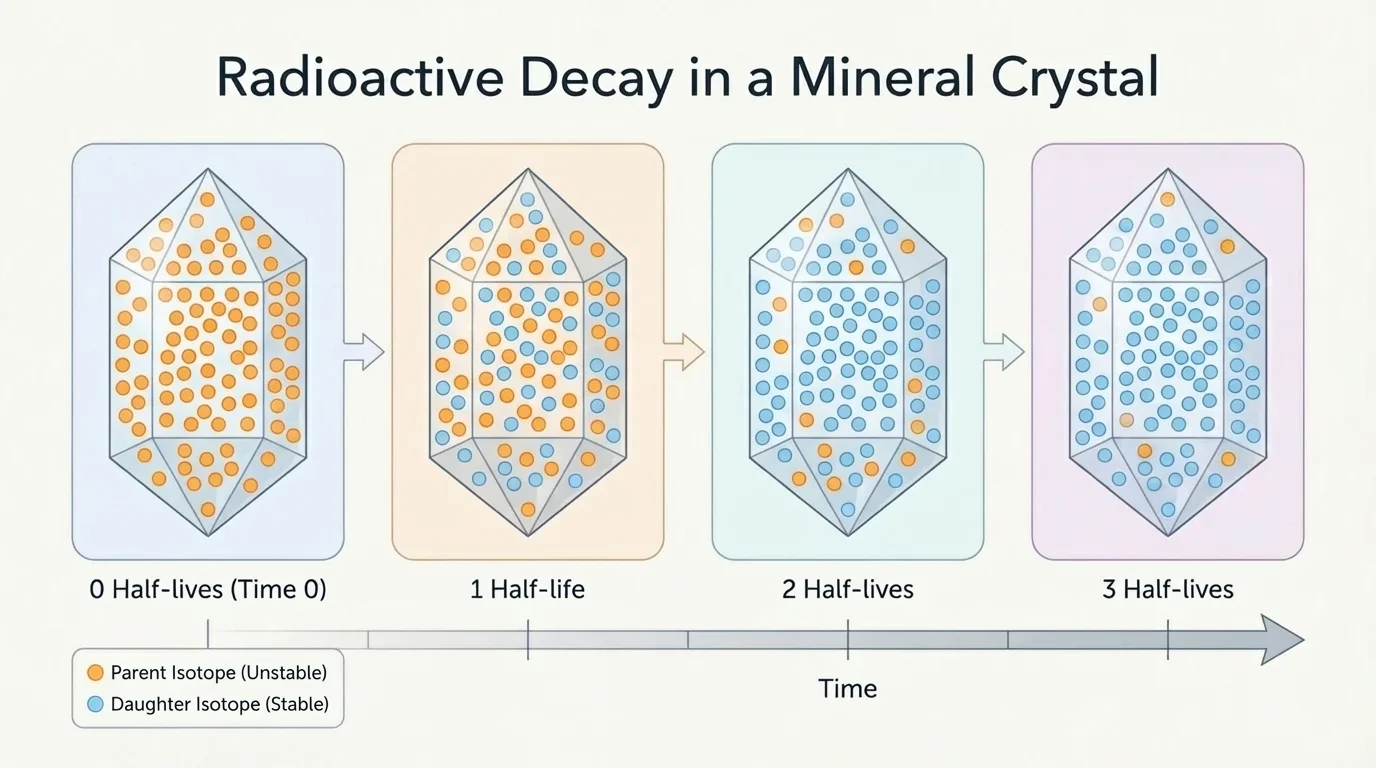
A simplified relationship for radioactive decay is:
\[N = N_0\left(\frac{1}{2}\right)^{t/T}\]
In this equation, \(N_0\) is the original amount of parent isotope, \(N\) is the amount remaining, \(t\) is elapsed time, and \(T\) is the half-life.
Radiometric dating example
Suppose a mineral originally contained only a radioactive parent isotope. Scientists now find that \(\dfrac{1}{4}\) of the parent isotope remains. If the isotope's half-life is \(700\) million years, how old is the mineral?
Step 1: Interpret the fraction remaining.
If \(\dfrac{1}{2}\) remains, one half-life has passed. If \(\dfrac{1}{4}\) remains, two half-lives have passed because \(\dfrac{1}{2} \times \dfrac{1}{2} = \dfrac{1}{4}\).
Step 2: Multiply the number of half-lives by the half-life length.
The age is \(2 \times 700\) million years.
Step 3: State the result.
\[t = 1.4 \textrm{ billion years}\]
The mineral is about 1.4 billion years old.
Real radiometric dating is more sophisticated than this simplified example. Scientists must account for contamination, original conditions, and whether the mineral remained a closed system. They often compare multiple isotopic systems, such as uranium-lead or potassium-argon, to test whether ages are consistent.
Beyond age dating, scientists study mineral composition, isotope ratios, and trace elements. For example, ratios of oxygen isotopes can reveal whether rocks from different bodies formed from related source material. Chemical signatures can indicate whether a sample formed in the presence of water, under high heat, or in a reducing or oxidizing environment.
Elements are defined by the number of protons in their atoms, while isotopes are atoms of the same element with different numbers of neutrons. Isotopes behave similarly in many chemical reactions, but unstable isotopes decay over time, which makes them useful as geologic clocks.
As seen earlier in [Figure 4], the structure of a meteorite and its chemical makeup must be interpreted together. A rock's age alone is not enough; scientists also need to know what kind of body it came from and what changes it experienced after formation.
Evidence from space materials has changed ideas about Earth's earliest environment. For a long time, scientists assumed the young Earth was simply a molten, hostile world. It certainly was violent, but ancient zircons and comparisons with meteorites suggest the story may be more complex. Some evidence indicates that liquid water may have existed on Earth surprisingly early, perhaps within the first few hundred million years.
Carbonaceous meteorites are especially important in this discussion because they contain water-bearing minerals and carbon-rich compounds. If similar bodies struck the young Earth, they may have contributed part of Earth's water inventory and some of the raw materials involved in prebiotic chemistry. Scientists still debate how much came from meteorites versus other sources such as volcanic outgassing or comets, but extraterrestrial materials are clearly part of the story.
The lunar crater record also suggests that the inner solar system experienced intense bombardment early on. Large impacts could vaporize surface water, melt crust, and temporarily alter the atmosphere. Yet impacts may also have delivered new material. Early Earth was shaped by both destruction and delivery at the same time.
This dual role is one of the most fascinating ideas in planetary science: the same processes that made early Earth dangerous may have also helped supply ingredients needed for long-term planetary development.
Studying meteorites and lunar samples is not just about the distant past. It drives modern science and technology. Laboratories use ultra-precise mass spectrometers to measure isotope ratios at incredibly small scales. Clean-room techniques, sample handling protocols, and remote robotic missions all developed partly because scientists need uncontaminated material from other worlds.
Recent missions have extended this work. Spacecraft such as Hayabusa2 and OSIRIS-REx collected samples from asteroids and returned them to Earth. These missions allow scientists to study pristine material without the complications that occur when meteorites pass through Earth's atmosphere or weather on the ground.
The logic is similar to forensic science: the less disturbed the evidence is, the more reliable the conclusions. In that sense, asteroid sample return missions are like sending investigators directly to the crime scene of solar system formation.
Real-world application: why asteroid sample return matters
Consider two pieces of space rock. One lands in Antarctica after heating in Earth's atmosphere and then sits exposed in ice and air. Another is sealed in a spacecraft container immediately after collection from an asteroid.
Step 1: Compare contamination risk.
The meteorite on Earth may gain terrestrial water, oxygen, or biological contamination. The returned asteroid sample is far less altered.
Step 2: Compare scientific confidence.
Because the asteroid sample is better preserved, scientists can more confidently identify original minerals, organic compounds, and isotope ratios.
Step 3: Connect to early Earth.
If those compounds resemble materials thought to have reached the young Earth, scientists gain stronger evidence about what building blocks were available during Earth's formation.
These missions also matter for planetary defense. Understanding asteroid composition helps scientists predict how potentially hazardous asteroids might behave if deflection were ever necessary. The same objects that preserve the past also matter for protecting the future.
Even the best-preserved meteorite or lunar sample does not provide a perfect snapshot of early Earth. The Moon is not Earth, and asteroids are not tiny copies of planets. Each object has its own history. Scientists must therefore avoid simple one-to-one assumptions.
Instead, strong conclusions come from combining evidence. Researchers compare meteorite chemistry with Earth's mantle composition, match lunar ages with impact histories, test models of planetary formation, and check whether independent dating methods agree. When several lines of evidence point in the same direction, confidence increases.
This is a powerful example of how science works. We often cannot travel directly to the beginning of Earth's history, but we can reconstruct it from preserved clues. In that way, the Moon, asteroids, and meteorites are not just objects in space. They are records of a time that Earth itself has mostly erased.
"The present is the key to the past,"
— a core principle of geology, expanded today by comparing Earth with other worlds
Modern planetary science extends that principle beyond our planet. By studying what Earth has changed and what other bodies have preserved, scientists can piece together the earliest chapters of Earth's story with increasing precision.
