Have you ever kicked a ball and watched it zoom away, or pulled a wagon and felt it start to roll? That is an example of science in everyday life. Objects do not just move in random ways. A push or a pull can make something start moving, stop moving, go faster, go slower, or change where it is going.
Motion means that something is moving from one place to another. A toy car rolling across the floor is in motion. A leaf blowing in the wind is in motion. If a book is sitting still on a table, it is not in motion.
We can describe motion by talking about speed and direction. Speed tells how fast or slow something moves. Direction tells where it is going, such as forward, backward, left, right, up, or down.
Motion is movement from one place to another.
Speed tells how fast or slow something moves.
Direction tells which way something moves.
When we watch something move, we can ask simple questions: Did it start moving? Did it stop? Did it speed up? Did it turn? The answers often have to do with a push or a pull.
A force is a push or a pull, as [Figure 1] shows with familiar objects. When you push a door, the door swings open. When you pull a drawer, the drawer slides toward you. Forces are all around us every day.
A push moves something away from you or in a new direction. A pull brings something closer to you or drags it along. You can push a stroller, pull a sled, push a block tower, or pull a kite string.
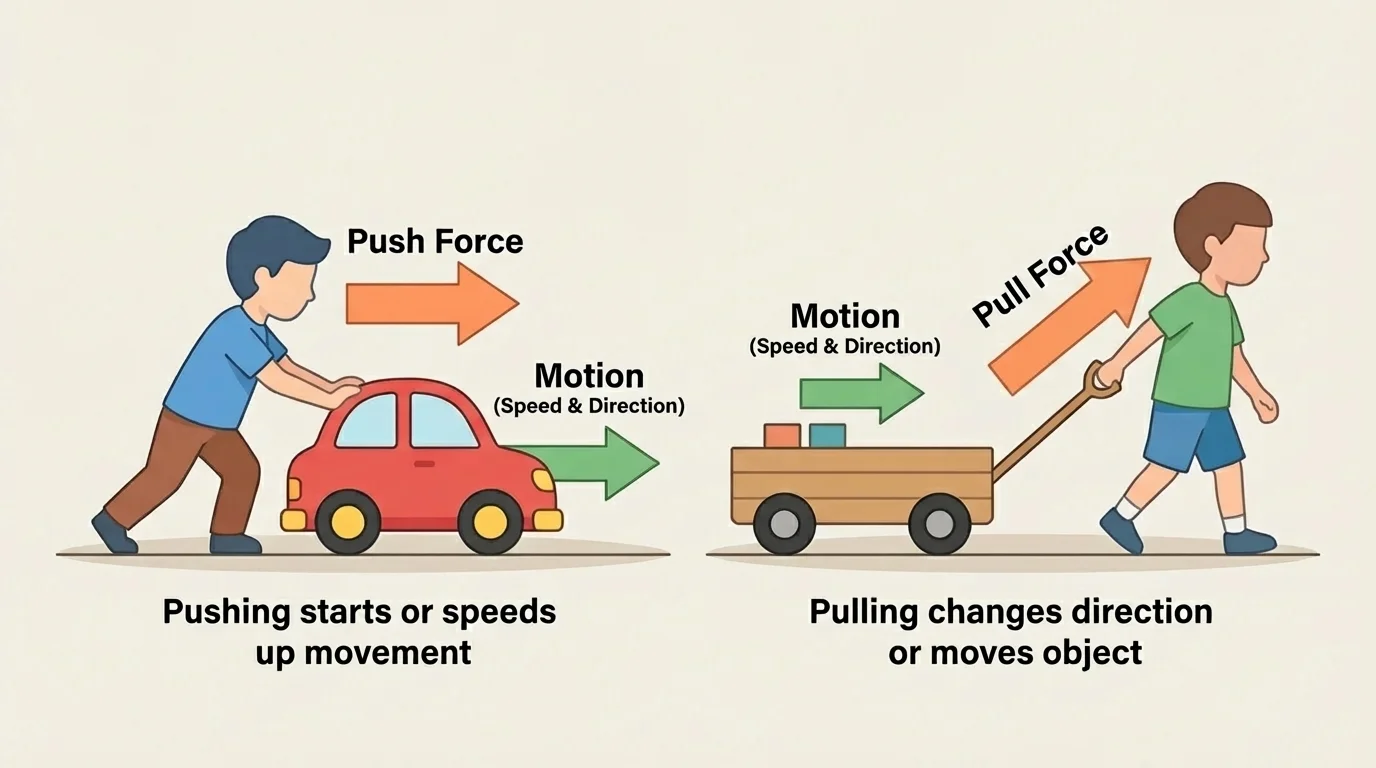
Sometimes an object needs a force to begin moving. A soccer ball sitting on the grass stays still until someone kicks it. The kick is a push. That force starts the ball's motion.
Forces change motion
If an object is still, a force can start it moving. If it is already moving, a force can change how fast it moves or which way it goes. Forces are the reason motion changes.
You may also feel forces on your own body. When you jump, your legs push on the ground. When you climb a rope, your hands pull. Your muscles help you make pushes and pulls.
When something is moving, a push or a pull can change its speed. If you give a toy car a gentle push, it moves slowly. If you give it a stronger push, it usually moves faster. The force changes the speed of the car.
A moving swing can speed up when someone pushes it again. A bicycle can go faster when a rider pushes the pedals. In each case, the object is already moving, and another force makes its speed change.
Forces can also slow things down. If you catch a rolling ball with your hands, your hands push on the ball and make it slow down. If you lightly press the brake on a scooter or bicycle, the wheels slow down.
Real-world example: playground swing
Step 1: The swing is moving a little.
Step 2: A person pushes the swing.
Step 3: The swing moves faster and higher.
The push changes the swing's speed.
When we say something gets faster, we mean its speed increases. When we say something gets slower, we mean its speed decreases. Young scientists can notice both changes just by watching carefully.
A force can also change direction, as [Figure 2] illustrates with a rolling ball that gets tapped. A ball rolling straight can turn if someone hits it from the side. A toy car can turn when you steer it. A kite changes direction when wind pushes on it.
Think about bouncing a ball off a wall. The wall pushes on the ball. Before the bounce, the ball goes toward the wall. After the bounce, it goes away from the wall. The force from the wall changes the ball's direction.
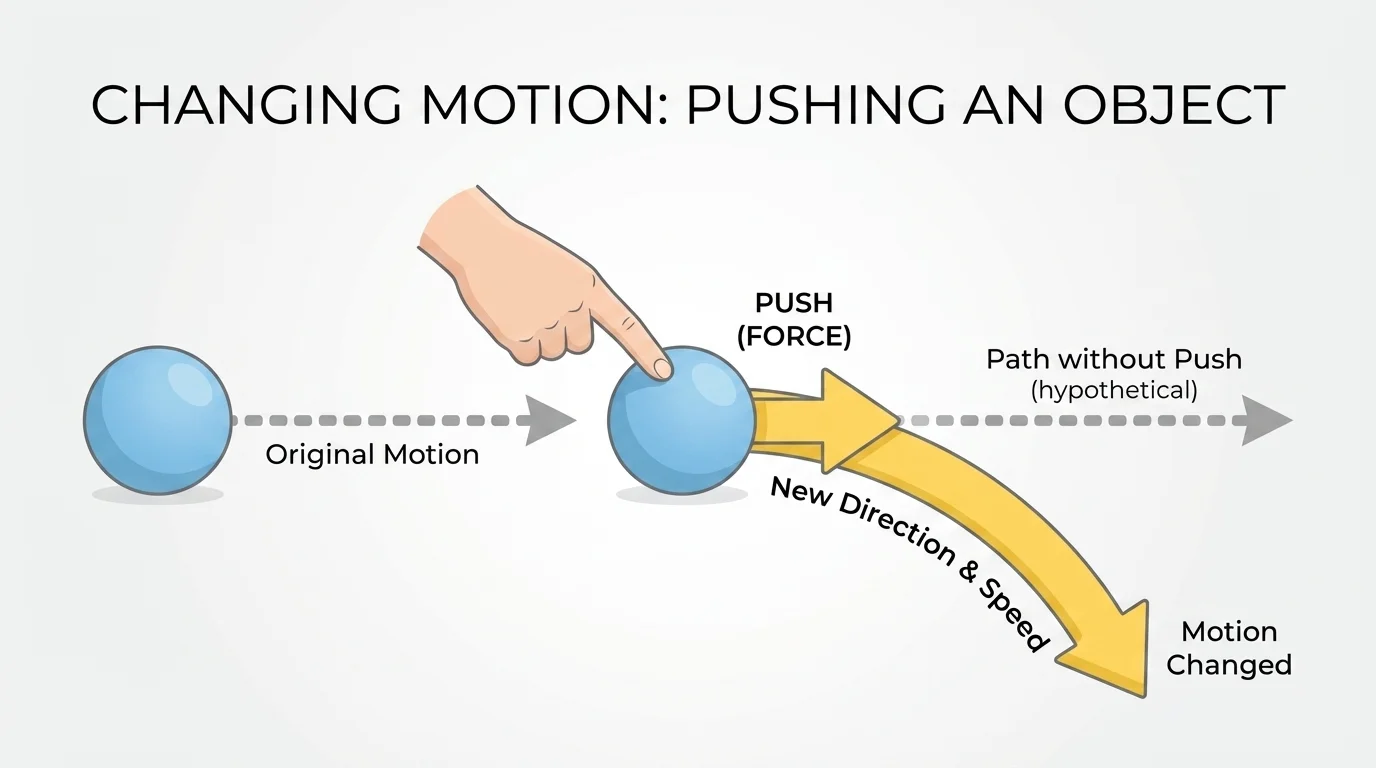
In games, children use direction changes all the time. A basketball player pushes the ball to the floor, and the floor pushes it back up. A baseball bat pushes a ball and sends it off in a new direction. A person pulling a wagon handle can make the wagon turn left or right.
Later, when you notice a ball bounce or a scooter turn, remember what [Figure 2] shows: a force does not only make things move faster or slower. It can also make a moving object change its path.
Some forces start motion, and some forces stop it. A toy train begins to move when its motor pushes the wheels. A box begins to slide when someone pushes it. A wagon starts rolling when someone pulls it, and [Figure 3] shows how surfaces can also affect when motion stops.
Stopping happens because a force pushes or pulls in a way that slows motion down. When you catch a ball, your hands apply a force that stops it. When you put your foot down while riding a scooter, the scooter slows and stops.
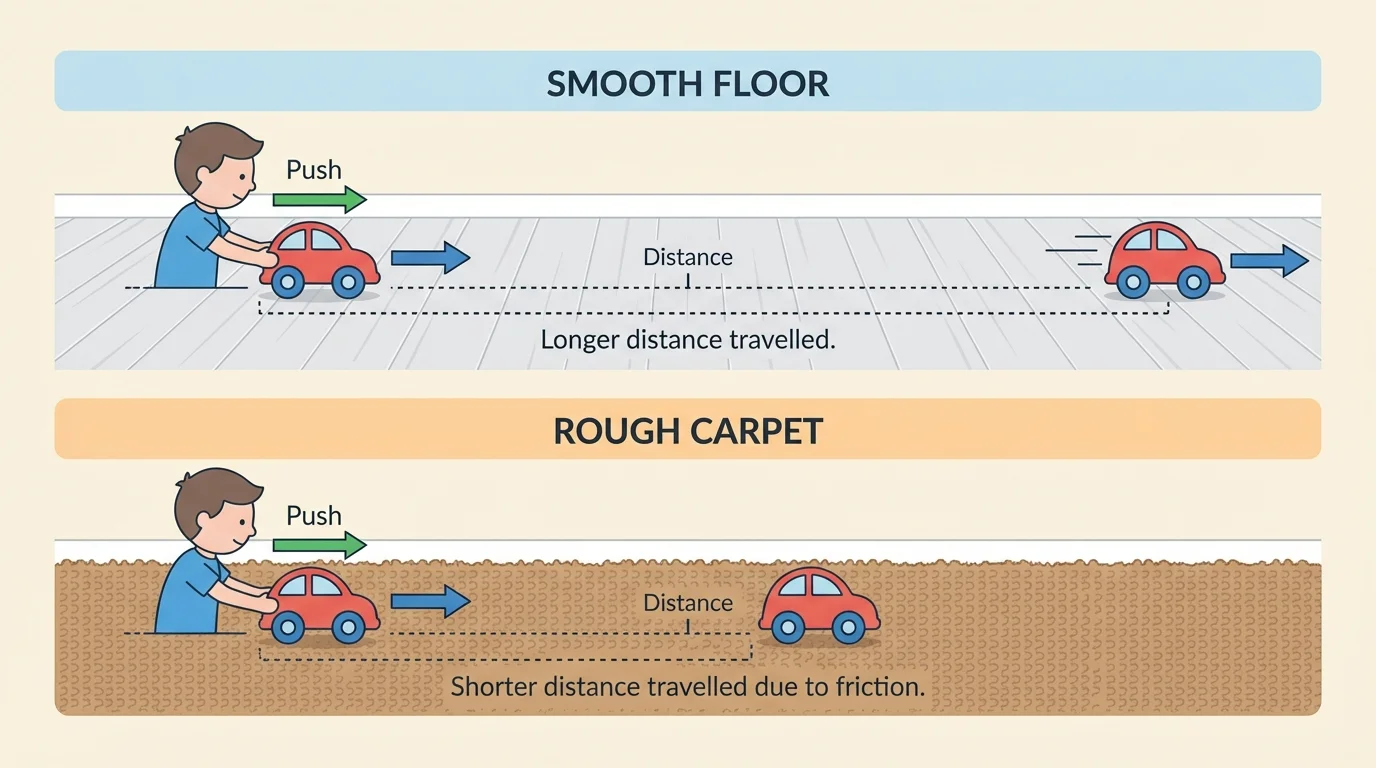
Another important force is friction. Friction happens when two surfaces rub against each other. Friction often slows objects down. A toy car rolls farther on a smooth floor than on a rough carpet because the carpet creates more friction.
Ice feels slippery because there is very little friction compared with rough ground. That is why people can slide on ice much more easily than on carpet.
Shoes help us walk because friction between our shoes and the ground helps stop our feet from slipping. Brakes on bikes and cars also use friction to help stop wheels from turning.
When you compare the smooth floor and the rough carpet in [Figure 3], you can see that surfaces matter. The same push may not move an object the same distance on different surfaces.
Not all forces are the same size. A small push and a big push can cause different changes. If you nudge a block softly, it might move a little. If you push it harder, it may move farther or faster. A stronger force often makes a bigger change in motion.
The same idea works with pulls. A gentle pull on a wagon may make it start slowly. A stronger pull may make it roll faster. This is why adults can often move heavy objects more easily than small children can: they can usually apply a larger force.
| Action | What the force does |
|---|---|
| Push a ball | Can start it moving |
| Push a moving swing | Can make it go faster |
| Catch a ball | Can slow it down or stop it |
| Hit a ball to the side | Can change its direction |
| Pull a wagon handle | Can start it moving or turn it |
Table 1. Examples of pushes and pulls and how they change motion.
Heavy objects often need bigger pushes or pulls than light objects. A small toy is easier to move than a full laundry basket. This does not mean the heavy object cannot move. It means it may need more force.
Forces are important in everyday life. People use them to open doors, move chairs, kick balls, stir soup, zip coats, and pull carts. Animals use forces too. A dog pulls on a leash. A bird pushes air with its wings. Wind pushes tree branches and sails on boats.
Engineers and builders think about forces when they make playgrounds, bicycles, and cars. A slide must be smooth enough for fun motion, but safe enough for stopping. Seat belts help keep people safe by applying forces that slow their bodies during sudden stops.
Real-world example: opening a door
Step 1: Your hand pushes or pulls the door.
Step 2: The door starts moving on its hinges.
Step 3: If you stop pushing, the door may slow down and stop.
A simple force changes whether the door is still or moving.
Sports are full of examples. A bat pushes a ball. A foot kicks a soccer ball. A goalie catches the ball to stop it. In each case, forces change motion by starting, stopping, speeding up, slowing down, or changing direction.
Scientists study these changes carefully, but you can already be a careful observer of motion just by watching the world. Every time an object's motion changes, a force is involved.
