Have you ever kicked a ball and watched it zoom away? Or bumped a toy car and seen it roll in a new direction? These exciting changes happen because when objects touch, they push on one another. That push can change how something moves.
Motion is a change in position. An object can be still, or it can move fast, slow, straight, or turn. When something touches it, the motion can change. That is a big science idea: when objects touch, they affect each other.
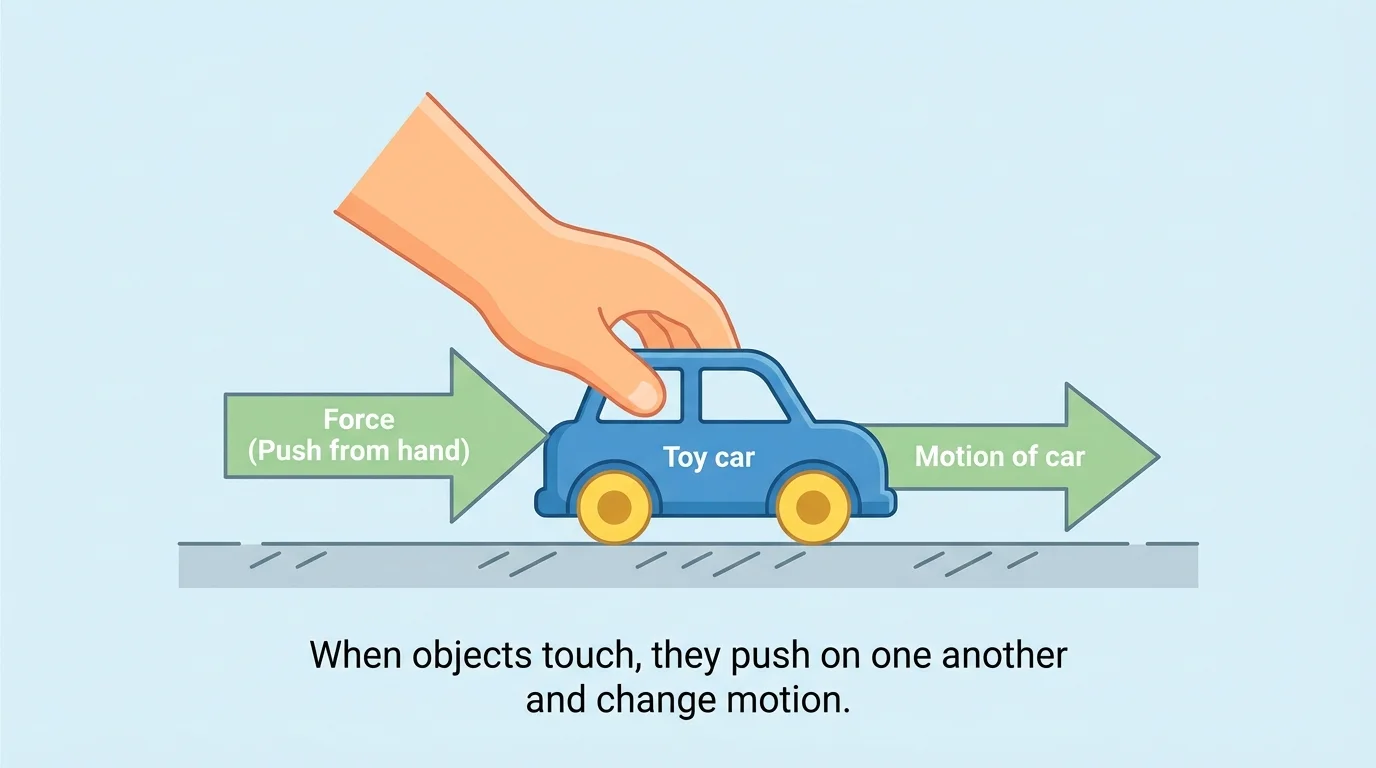
[Figure 1] When one object touches another, it can exert a force. A force is a push or a pull. In this lesson, we are mostly looking at pushes from touching. A hand can push a door. A foot can push a ball. One toy car can push another and make it move.
If a block is sitting still and you push it, it can begin to move. If a swing is moving and you touch it gently, you can change how it moves. Touching matters because the objects act on each other at the same time.
Motion means a change in position. Collision means two objects bump into each other. When objects touch, whether in a gentle contact or a bump, they can change each other's motion.
You may not always see the push clearly, but you can see what it does. A book slides. A ball bounces. A wagon starts rolling. These are signs that touching objects have pushed on one another.
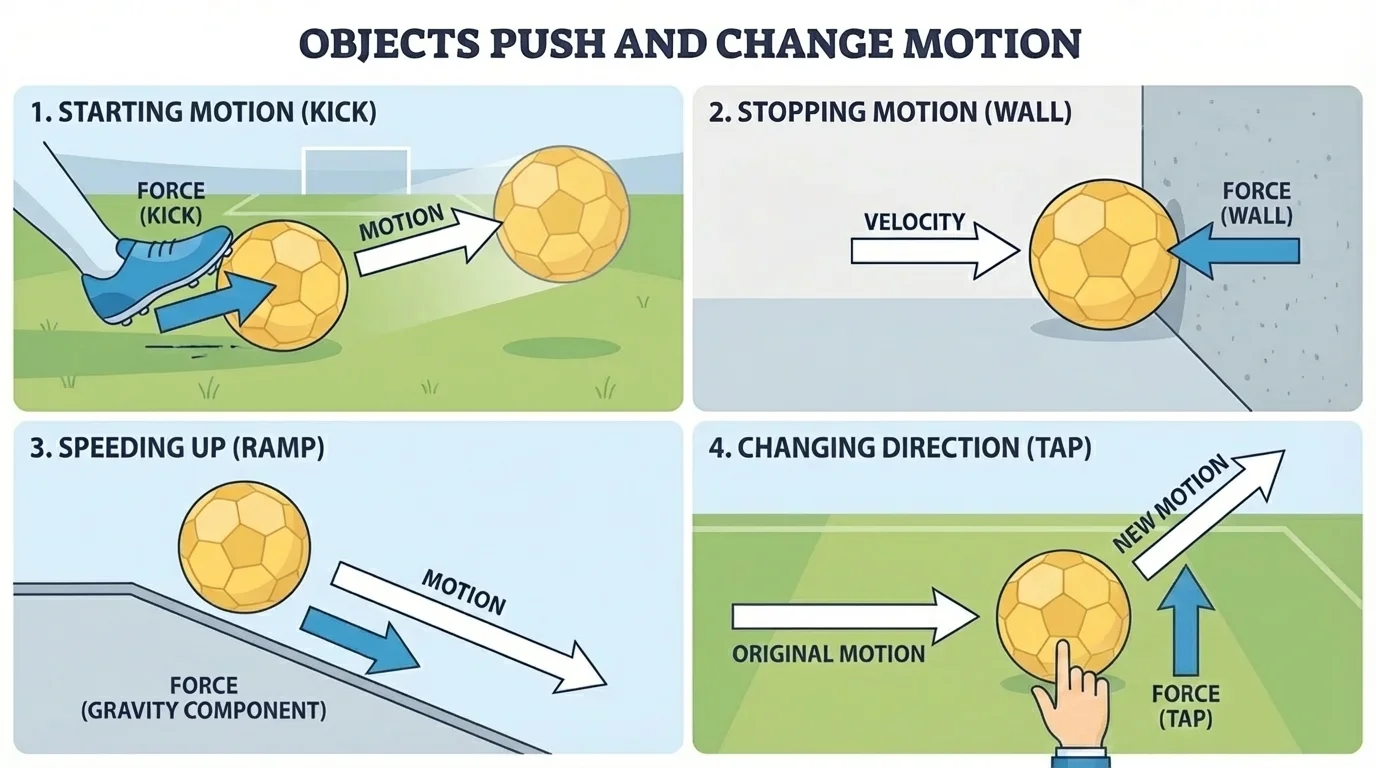
Motion can change in several ways, as [Figure 2] illustrates. An object can start moving. It can stop moving. It can speed up. It can slow down. It can also change direction.
Think about a soccer ball. When it rests on the grass, it is still. A kick makes it start moving. Another kick can make it go faster. A hand or foot can make it turn. A fence or wall can make it stop or bounce back.
A rolling toy car can hit a pillow and slow down. A marble can roll and then stop when it bumps a block. A balloon can float along and then change direction when it touches your hand.
How a push changes motion
A push changes motion by changing what the object is doing right now. If it is still, a push can start it. If it is moving, a push can make it go faster, slower, stop, or turn. The change depends on how the object is touched and how strong the push is.
Sometimes the change is small. A gentle tap on a block may move it only a little. Sometimes the change is big. A strong kick can send a ball far across a field. The idea is the same: touch leads to a push, and the push can change motion.
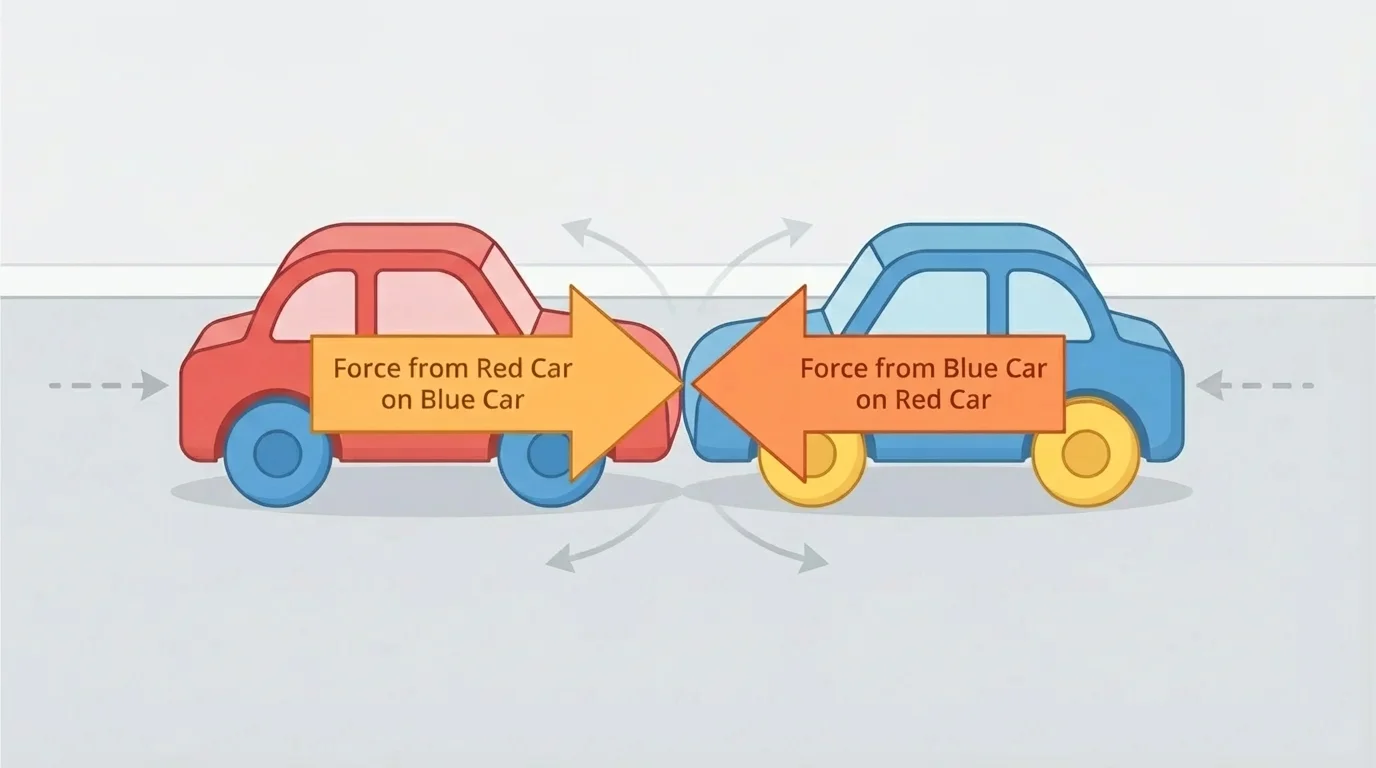
[Figure 3] A collision happens when objects bump into each other. In a collision, both objects push on one another. This is true whether the bump is soft, like a ball hitting a curtain, or hard, like two toy cars crashing together.
Suppose one toy car rolls into another toy car. The moving car pushes the still car. The still car may begin to move. But the still car also pushes back on the moving car. That can make the first car slow down, stop, or roll away in a different direction.
When a ball hits the floor, the ball pushes on the floor. The floor pushes on the ball too, and the ball can bounce upward. The floor does not zoom away because it is attached to the ground and is much harder to move, but the push is still there.
A basketball bounces because the floor pushes it back up after the ball pushes down on the floor. That quick two-way push happens in a tiny moment.
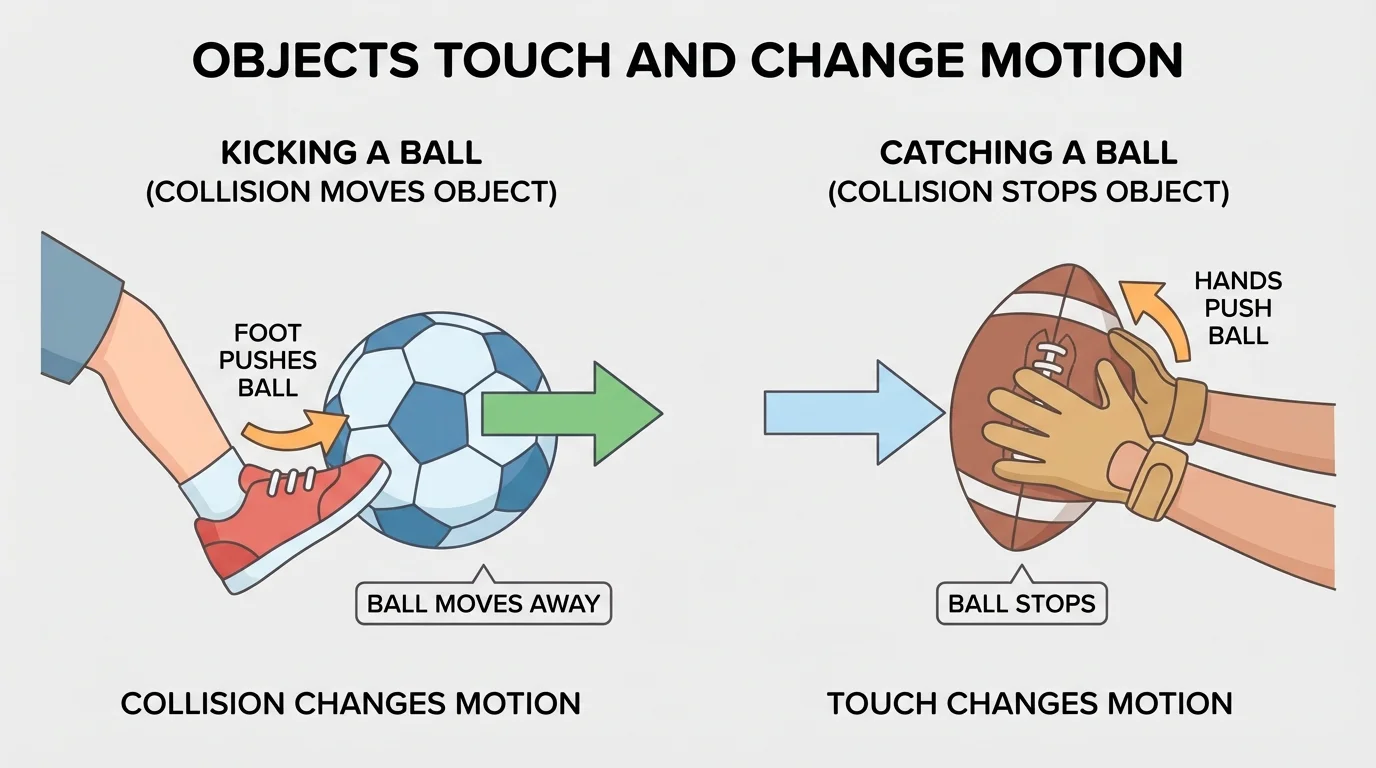
If you catch a ball, your hands push on the ball and the ball pushes on your hands. You can feel that push. Catching works because your hands change the ball's motion from moving to stopped.
Not all pushes are the same. A stronger push often causes a bigger change in motion. A gentle nudge may move a toy only a short distance. A stronger shove may make it roll much farther.
Some objects are also easier to move than others. A small empty box is easier to push than a heavy full box. A light ball is easier to kick than a large heavy rock. So, how much motion changes can depend on both the push and the object.
That is why a tiny push can move a feather, but the same tiny push may not move a big chair. Scientists observe both the push and the object to understand what will happen.
Real-world example: pushing different objects
Step 1: Push a toy car gently.
The car rolls a little because the push changes its motion.
Step 2: Push the same toy car harder.
The car rolls farther or faster because the push is stronger.
Step 3: Compare with a heavier toy truck.
The truck may need a stronger push to change its motion the same way.
This helps us notice that strength of push and kind of object both matter.
We can say this idea simply: stronger pushes often make bigger motion changes. Even without using hard math, we can compare small changes and large changes by watching carefully.
[Figure 4] You see contact pushes every day in sports and play. When you open a door, your hand pushes it. When you sit on a chair, your body pushes on the chair and the chair pushes back to hold you up. When you ride a scooter, your foot pushes on the ground and your motion changes.
On the playground, a push can start a swing moving. A stop with your feet on the ground can slow the swing down. In a game, a bat pushes a ball, and the ball flies away. Later, a glove pushes on the ball and stops it.
Cars also change motion when they touch things. That is one reason seat belts are important. If a car stops suddenly, the seat belt pushes on the rider and helps the rider stop more safely. Helmets also help in some sports because they help protect the body during collisions.
Nature gives examples too. Wind can push leaves, but when a leaf lands on the ground, the ground stops it. Raindrops hit windows. Waves hit rocks. A bird can land on a branch and make the branch bend a little because they push on each other.
Remember the toy cars in [Figure 3]. The same idea happens in bigger real-life collisions too: both objects affect each other. And the ball scenes in [Figure 2] connect to games where starting, stopping, and turning are easy to see.
Scientists learn by watching what changes. You can watch a ball before it is kicked, while it is moving, and after it hits a wall. First it is still. Then the kick changes its motion. Then the wall changes it again.
You can also compare two tries. Roll one toy car softly into a block. Then roll it faster into the same block. Watch what happens to the block each time. Careful looking helps you notice how touching changes motion.
Objects can be still or moving. Motion is a change in position. This lesson adds a new idea: touching objects can cause that change.
As seen earlier in [Figure 1], even a simple hand and toy car show an important science rule. When objects touch, they push on one another. That push can begin motion, end motion, or change it in other ways.
