Have you ever gone outside in the morning and felt warm sunshine, then later heard rain tap on the window? Weather can change quickly, and that makes it exciting to watch. Weather tells us what the world outside is like right now in a certain place.
Weather is the mix of sunlight, wind, snow or rain, clouds, and how hot or cold the air feels in one place at one time. The weather in the morning can be different from the weather in the afternoon. The weather where you live can also be different from the weather far away.
Weather is what the air and sky are like at a certain place and time. Temperature tells how hot or cold the air is. Precipitation is water that falls from clouds, such as rain or snow.
If it is sunny and warm at school today, that is the weather there today. If it is snowy and cold in the mountains at the same time, that is the weather in that place. Weather is about where and when.
We can learn about weather by looking at its parts. In [Figure 1], the outdoor scene shows several kinds of weather we can notice, such as bright sunlight, moving air, rain, and snow. These clues help us describe the day.
Sunlight can make a day bright and warm. Wind is moving air. We cannot usually see air, but we can see leaves blow, flags flap, or hair move. Rain falls as drops of water. Snow falls as icy flakes when the air is cold enough.
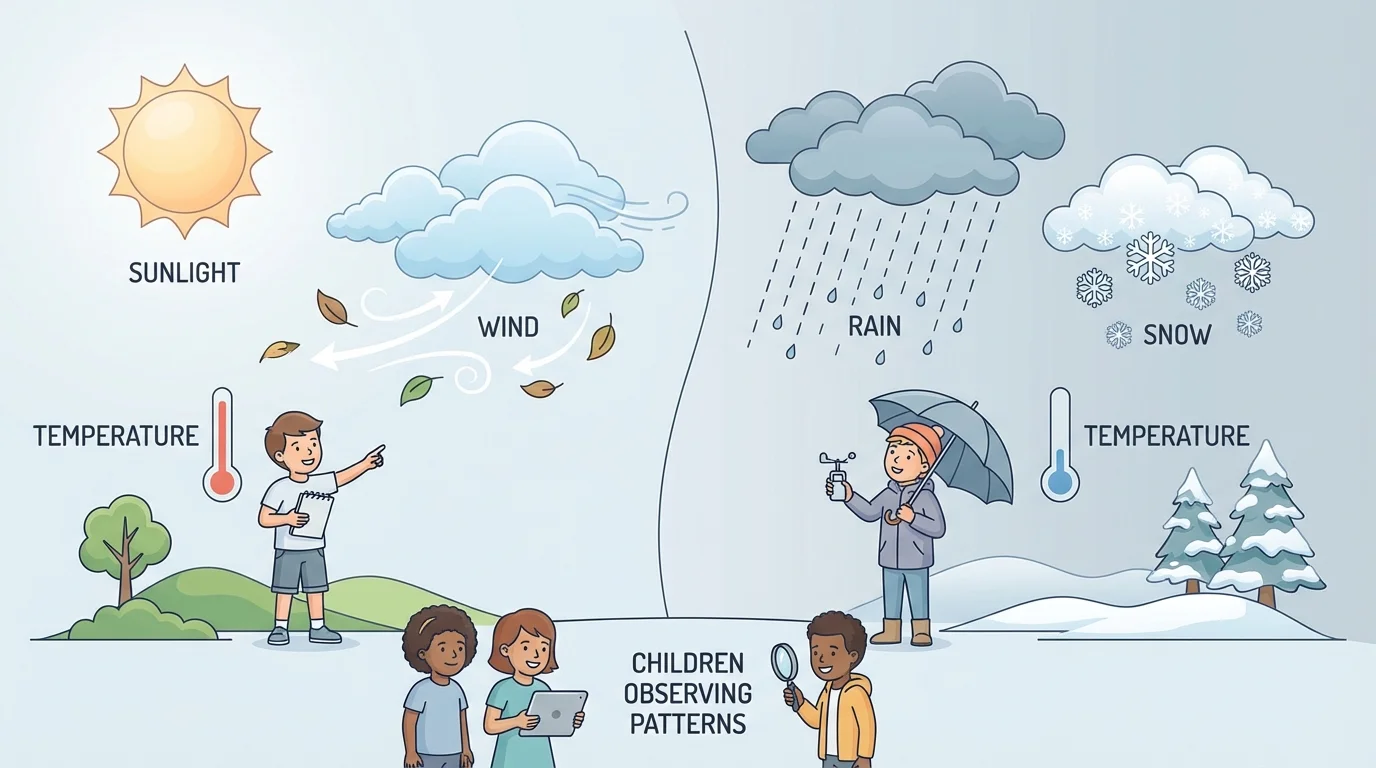
Temperature tells us if the air feels hot, warm, cool, or cold. A hot summer afternoon and a cold winter morning have different temperatures. Clouds matter too. Some days have a clear blue sky, and some days are cloudy and gray.
Sometimes weather has only one strong feature, like a very windy day. Other times it is a mix, such as cool, cloudy, and rainy. As we saw in [Figure 1], different weather conditions can happen in different places and at different times.
Snow and rain are both made from water. Snow forms when water in clouds freezes into tiny ice crystals.
People often describe weather with words like sunny, cloudy, rainy, snowy, windy, warm, or cold. Using clear words helps everyone understand what the day is like.
Looking is helpful, but people also measure weather so they can describe it carefully. Weather tools help us learn something different about the day.
In [Figure 2], a thermometer measures temperature. A rain gauge collects rain so we can see how much fell. A windsock or anemometer can help show how the wind is moving. People can also use a chart or calendar to write down what the weather is each day.
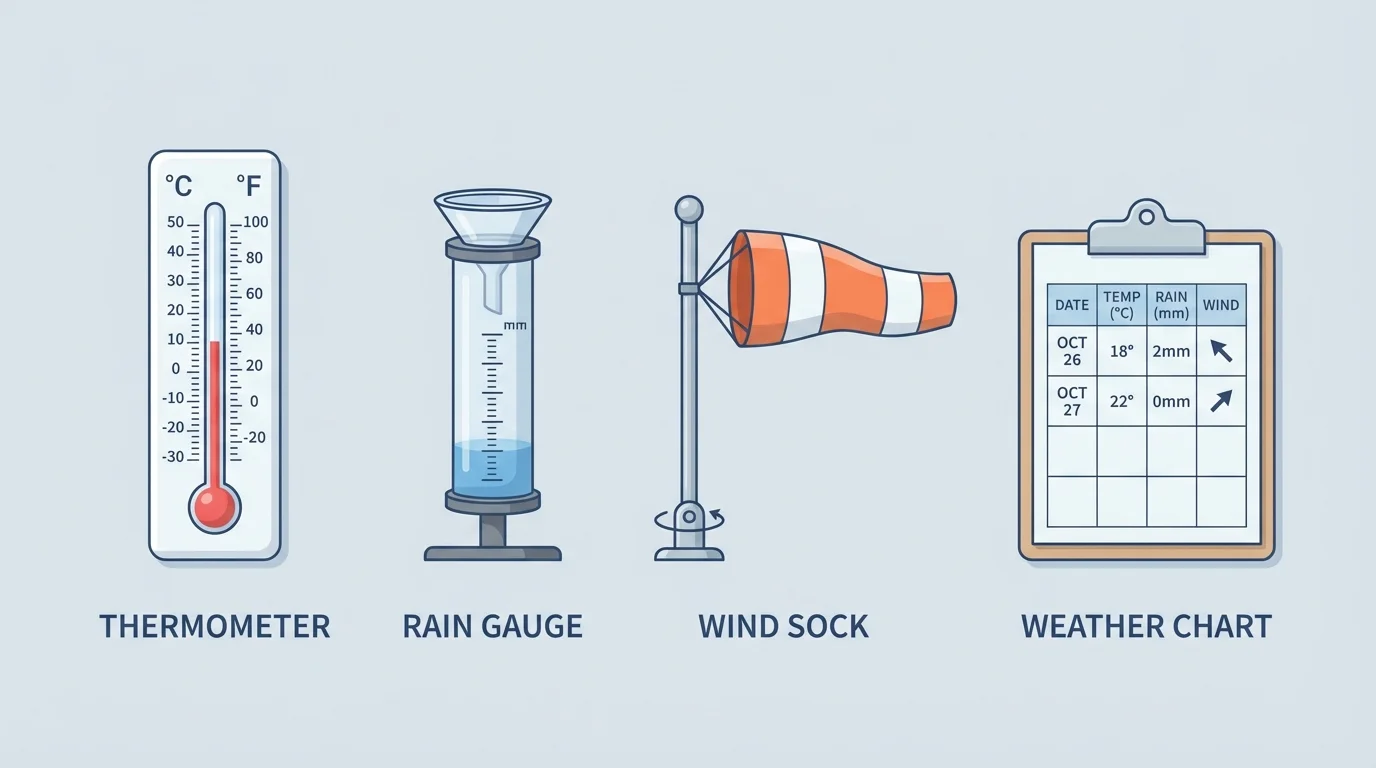
Measuring weather helps people talk about it in a careful way. Instead of saying only "It feels cold," someone can say the temperature is low. Instead of saying "It rained a lot," a rain gauge can help show how much rain fell.
Real-world example: Measuring a rainy day
Step 1: A class puts a rain gauge outside before school.
Step 2: Rain falls during the day.
Step 3: The class checks the gauge later and records what they find on a weather chart.
Now the class has a weather record they can compare with other days.
Weather helpers use tools at airports, farms, and weather stations. Pilots, gardeners, and families all care about knowing if it will be windy, rainy, hot, or cold.
Weather does not stay the same all the time. A day may begin foggy, turn sunny at noon, and become cool by evening. One week might have several rainy days, and the next week might be dry and bright.
Sometimes children mix up weather and seasons. Weather is what is happening now. Seasons are parts of the year that often bring certain kinds of weather. Summer is often warm, and winter is often cold, but one summer day can still be rainy, and one winter day can still be sunny.
Weather changes over time
Weather can change from hour to hour and from day to day. When we watch the sky, feel the air, and record what happens, we learn that weather is always moving and changing.
A storm can bring dark clouds, stronger wind, and rain. After the storm passes, the sky may clear again. These changes are part of Earth's systems, in which air, water, land, and sunlight all work together.
When people write weather down every day, they can find patterns over time. In [Figure 3], a weekly weather chart shows how a record helps us compare one day with another.
A class might make a weather calendar with picture symbols. They can draw a sun for sunny days, clouds for cloudy days, raindrops for rainy days, or snowflakes for snowy days. After many days, they can look back and ask, "Did we have more sunny days or rainy days?"
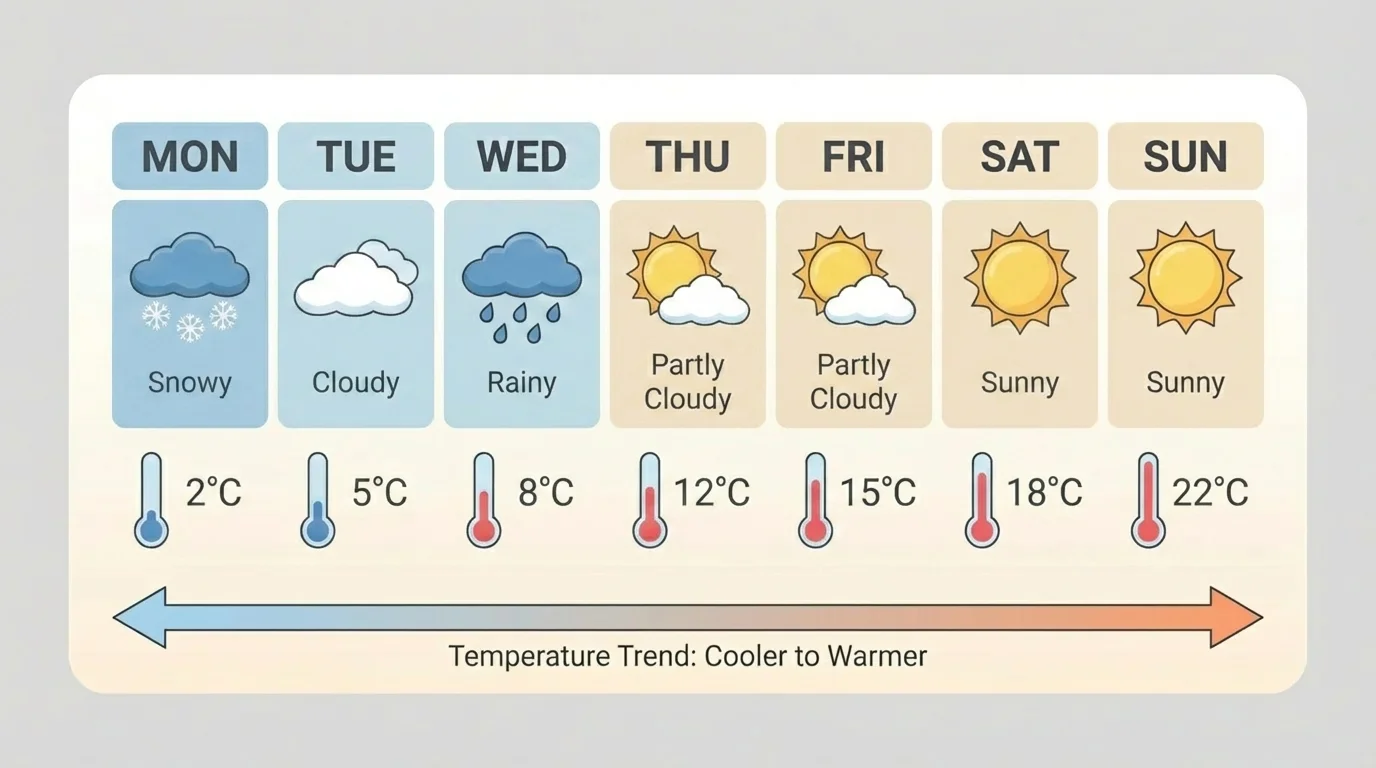
This kind of pattern helps us notice what happens again and again. Maybe afternoons are warmer than mornings. Maybe one month has more rain than another month. Records help us remember instead of just guessing.
As shown earlier in [Figure 2], tools help us measure weather, and charts help us save that information. Then, as [Figure 3] shows, we can look for patterns across many days.
| Weather word | What it tells us | Example |
|---|---|---|
| Sunny | There is lots of sunlight | A bright playground at recess |
| Windy | The air is moving | Leaves blow across the ground |
| Rainy | Water falls from clouds | Puddles form outside |
| Snowy | Ice crystals fall from clouds | Snow covers the grass |
| Cold | The temperature is low | People wear coats and hats |
Table 1. Common weather words, what they describe, and simple everyday examples.
Weather matters because it helps people decide what to do. If the day is rainy, people may wear boots and carry umbrellas. If the day is hot and sunny, they may wear light clothes and drink more water. If it is snowy, roads and sidewalks may need extra care.
Plants and animals are affected by weather too. Rain helps many plants grow. Strong wind can bend trees. Birds may look for shelter during storms. Farmers watch weather so they know when to plant and when crops need water.
Real-world example: Getting ready for the day
Step 1: A child checks outside and sees dark clouds and moving tree branches.
Step 2: The child learns it is cloudy and windy.
Step 3: The child brings a jacket before leaving home.
Watching weather helps people make smart choices.
People also use weather information to stay safe. If there is thunder, lightning, ice, or a big storm, adults can help children go to a safe place. Learning about weather is not only interesting; it is useful every day.
