A toy car can sit still for a long time, but one small hand can change everything. A gentle tap may make it roll a little. A bigger tap may make it zoom across the floor. A pull on a wagon can get it moving too. Motion is all around us, and we can learn about it by watching what pushes and pulls do.
A push is when you press on something. A pull is when you bring something toward you. When we push or pull an object, we can change its motion. Motion means how something moves.
A push or pull can start motion, stop motion, make something go faster, make something go slower, or make it go a new way, as [Figure 1] shows. If a ball is still, a push can make it roll. If a wagon is still, a pull can make it move. If a rolling toy is already moving, another push can change what it does.
We can see this every day. We push a door to open it. We pull a drawer. We kick a ball to send it across the grass. We stop a toy by holding it with our hand.
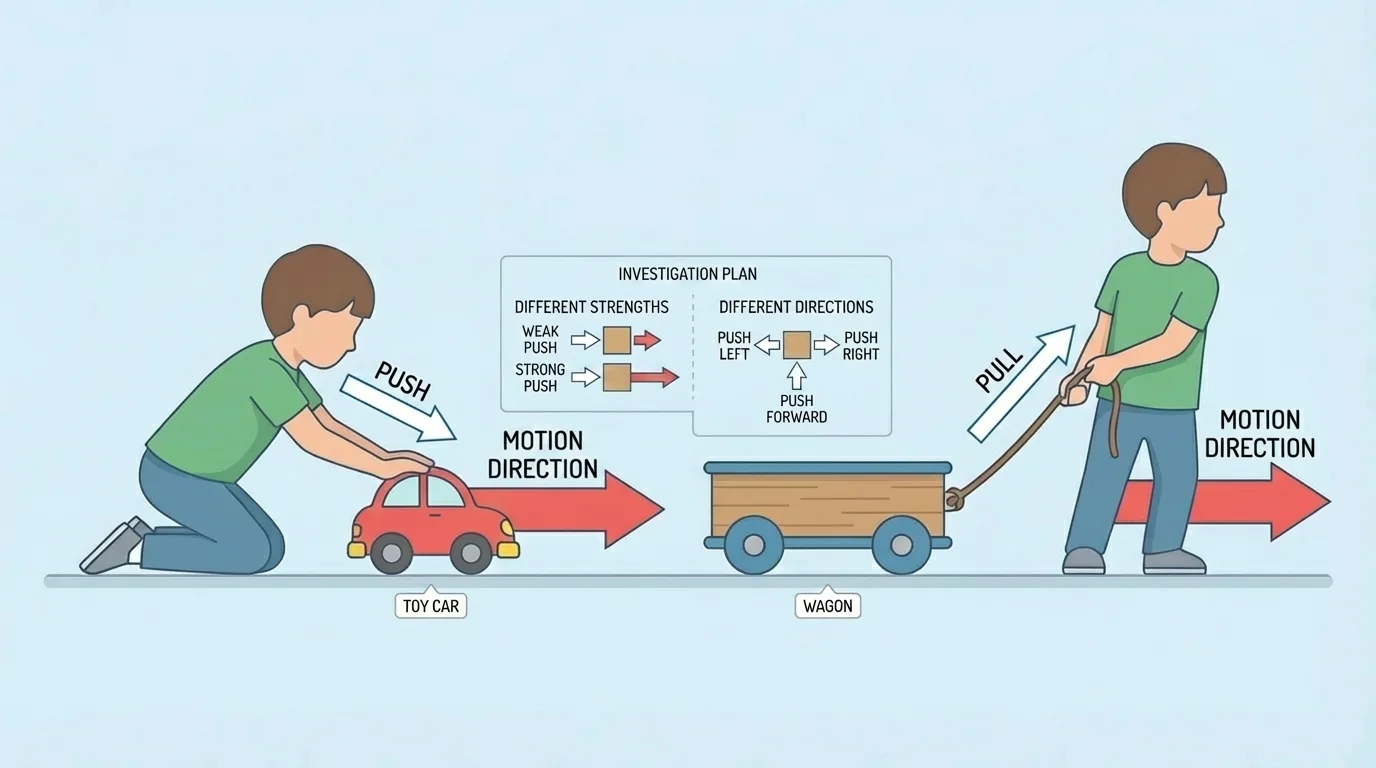
Push means to press something away. Pull means to bring something closer. Motion means movement.
Scientists learn by watching carefully. They compare what happens when one part changes. That helps them understand cause and effect.
Sometimes we compare the strength of a push or pull. Strength means how big or small the push or pull is. A small push is gentle. A big push is strong. When the same toy car gets different strengths of pushes, it may move different distances, as [Figure 2] illustrates.
If you gently push a toy car, it may roll a short way. If you push the same toy car harder on the same floor, it may roll farther. We changed one thing: the strength of the push. We kept other things the same: the same toy car and the same floor.
This kind of comparison helps us be fair. If we change too many things, we do not know which change caused the new result.
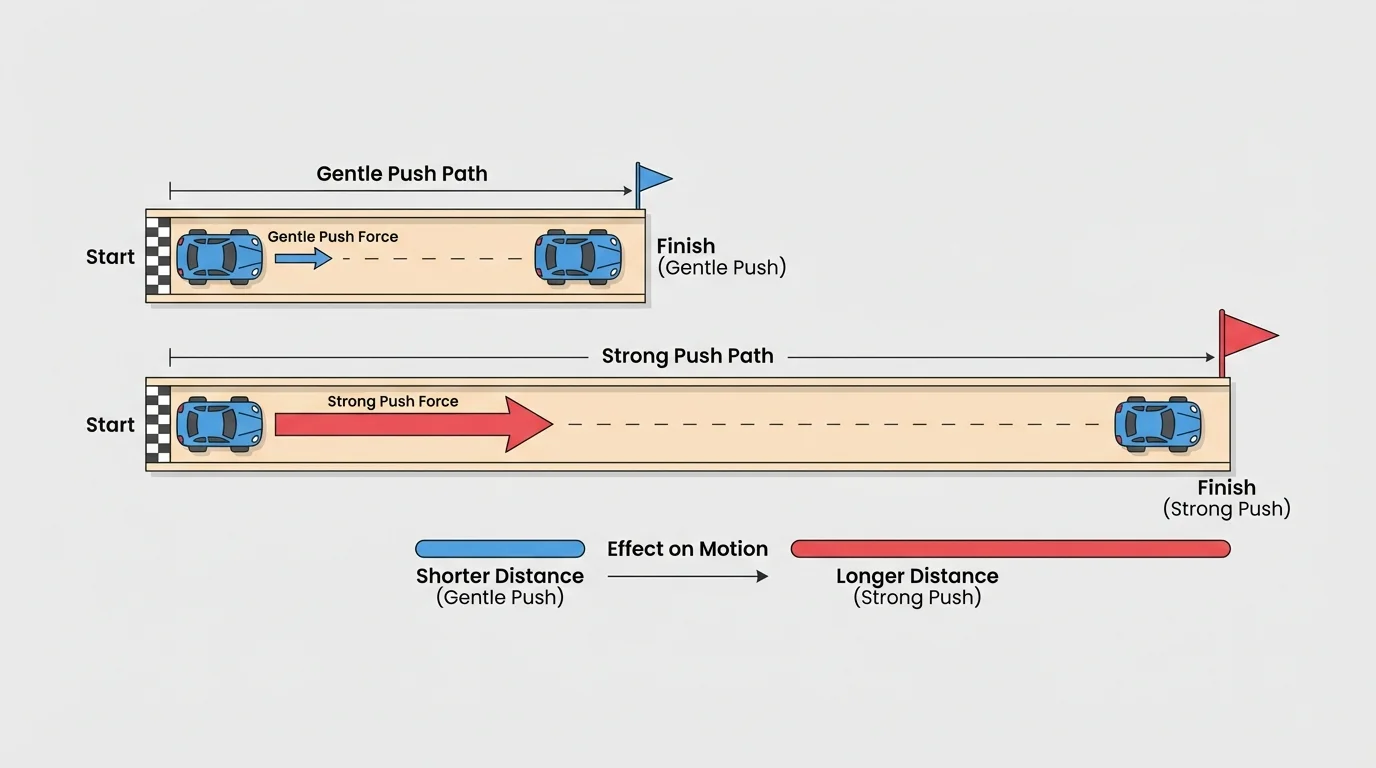
Keeping a fair test means changing only one thing at a time. To compare push strength, we keep the object the same and the place the same, but use a weaker push and a stronger push.
We can talk about what we observe with simple words such as shorter, farther, slower, and faster. Those observation words help us describe motion clearly.
A push or pull also has a direction. Direction means which way something goes. If you push a ball to the left, it goes left. If you push the same ball to the right, it goes right, as [Figure 3] shows.
Direction is different from strength. A strong push and a weak push tell us how much force we use. Direction tells us which way the object moves. In one investigation, it is best to compare only one idea at a time.
For example, if a child slides a block forward, the block moves forward. If the child slides the same block backward, the block moves backward. The object is the same, but the direction changed.
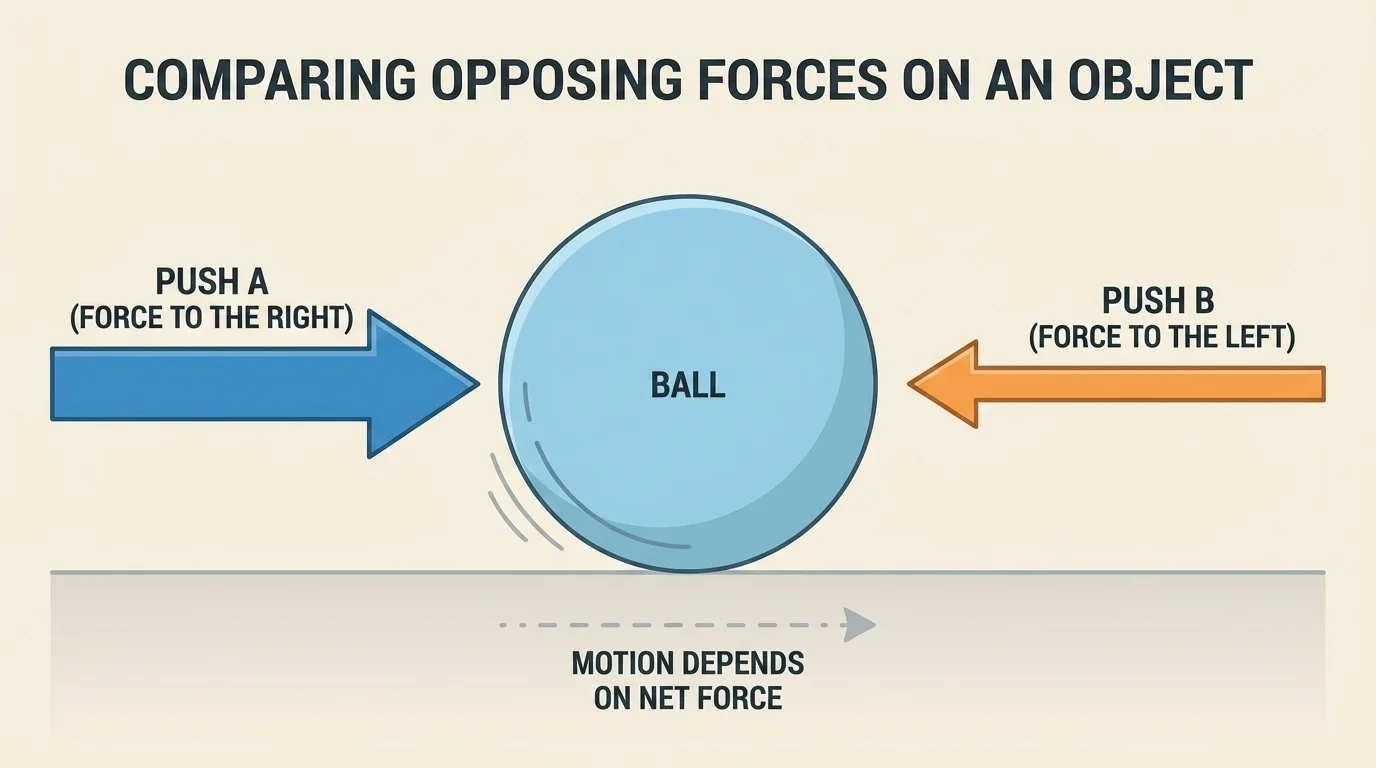
A soccer ball, a toy car, and a wagon can all change motion because of pushes and pulls, even though they do not move in exactly the same way.
When we look back at the toy car in [Figure 2], we remember that changing strength can change how far it goes. When we look at the ball example in [Figure 3], we notice that changing direction changes where it goes.
An investigation is a careful way to find out something. To plan one, we first ask a question. A good question might be, "What happens when I give a toy car a gentle push and then a strong push?" Another good question might be, "What happens when I push a ball left and then right?"
Next, we choose what to change and what to keep the same. For a fair test, we change only one thing. We might change the strength of the push. Then we keep the object the same, the floor the same, and the starting place the same, as [Figure 4] illustrates.
We also decide what to observe. We can watch whether the object starts moving, how far it goes, whether it stops, or which way it moves. These are our observations.
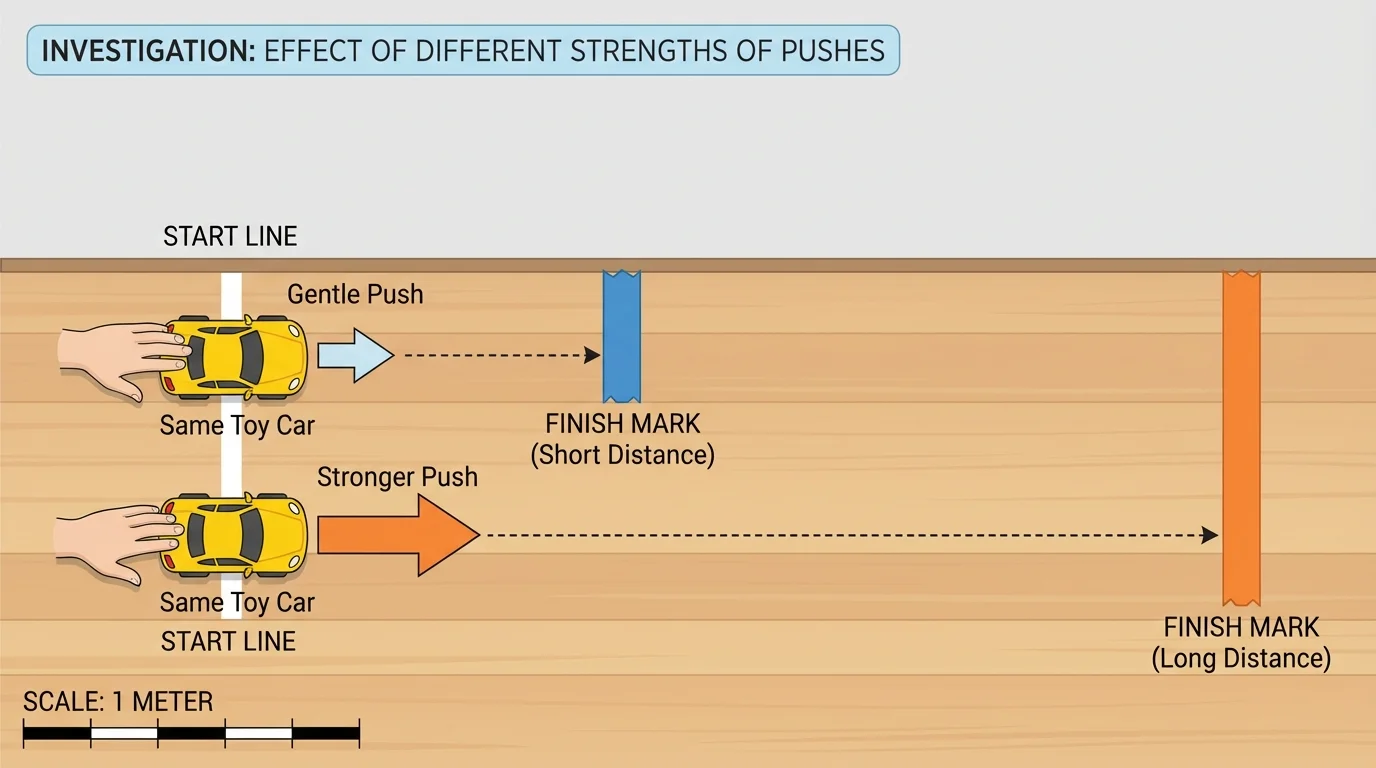
Example investigation: comparing push strength
Question: What happens when the same toy car gets a gentle push and a stronger push?
Step 1: Put one toy car at the same start line each time.
Step 2: Give it one gentle push.
Step 3: Watch how far it goes.
Step 4: Put the same toy car back at the same start line.
Step 5: Give it one stronger push.
Step 6: Compare what happened.
If the stronger push makes the car go farther, the investigation shows that stronger pushes can change motion more than weaker pushes.
We can also plan an investigation about direction instead. In that case, we use the same object and push it in one direction and then another direction. We do not compare strength and direction at the same time.
When we conduct an investigation, we do the plan carefully. We watch closely. We may repeat the test so we can be more sure of what we saw.
Suppose we test a toy car three times with a gentle push and three times with a stronger push. If the stronger push usually makes the car travel farther, we can say the stronger push has a bigger effect on the car's motion. If we test direction, we may see that a left push sends the object left each time, and a right push sends it right.
Observations can be spoken, drawn, or shown with simple marks. A child might draw a short path for a gentle push and a long path for a strong push. Another child might draw arrows to show different directions. The setup in [Figure 4] helps us remember to start in the same place each time.
| What we compare | What stays the same | What we observe |
|---|---|---|
| Gentle push and strong push | Same toy car, same floor, same start place | How far the car moves |
| Push left and push right | Same ball, same floor, same start place | Which way the ball moves |
Table 1. Examples of simple investigations comparing either strength or direction of pushes and pulls.
You already know that objects can be still or moving. A push or pull is one reason that motion can change.
Good investigators use their eyes and clear words. They say what happened, not what they only guessed. That makes science strong.
Pushes and pulls matter in real life. On the playground, a stronger push can make a swing start moving more quickly. At home, a gentle pull may slide a light chair, but a heavier chair may need a stronger pull. In a game, the direction of a kick changes where the ball goes.
Drivers, builders, athletes, and toy designers all care about motion. They want objects to start, stop, speed up, slow down, or move the right way. Our simple investigations help us understand these big ideas.
When we remember the examples from [Figure 1] and [Figure 3], we see that pushes and pulls are not just science words. They are part of daily life. Every time something moves because of our hands, we can ask what strength or direction changed its motion.
