Some days the sky is bright and sunny. Other days puddles splash under our shoes, or the wind pushes leaves across the ground. Weather is always giving us clues about what is happening outside, and good observers learn to notice those clues again and again.
Weather is what the air and sky are like outside at a certain time. We can notice if it is sunny, cloudy, rainy, windy, warm, or cool. Weather can change during the day, and it can also change from one day to the next.
Weather is what is happening outside in the air and sky, such as sun, clouds, rain, wind, and how warm or cool it feels.
Observation means using your senses to notice something carefully.
Pattern means something that happens again and again in a way we can notice.
[Figure 1] We learn about weather by making careful observations. We can look at the sky, listen for rain, watch trees move in the wind, and feel whether the day seems warmer or cooler. These observations help us describe what our local weather is like.
A local weather observation can be very simple on a class chart with picture clues. We might say, "Today is sunny," or "Today is cloudy and cool." We do not need big numbers to begin learning about weather. We can use clear words that tell what we notice.
Some important weather observations are the sky, the air, and what the wind or rain is doing. A bright sun means sunny weather. Many gray clouds mean cloudy weather. Falling drops mean rainy weather. Moving leaves or swaying branches can tell us it is windy. We can also compare days by saying one day feels warmer and another feels cooler.
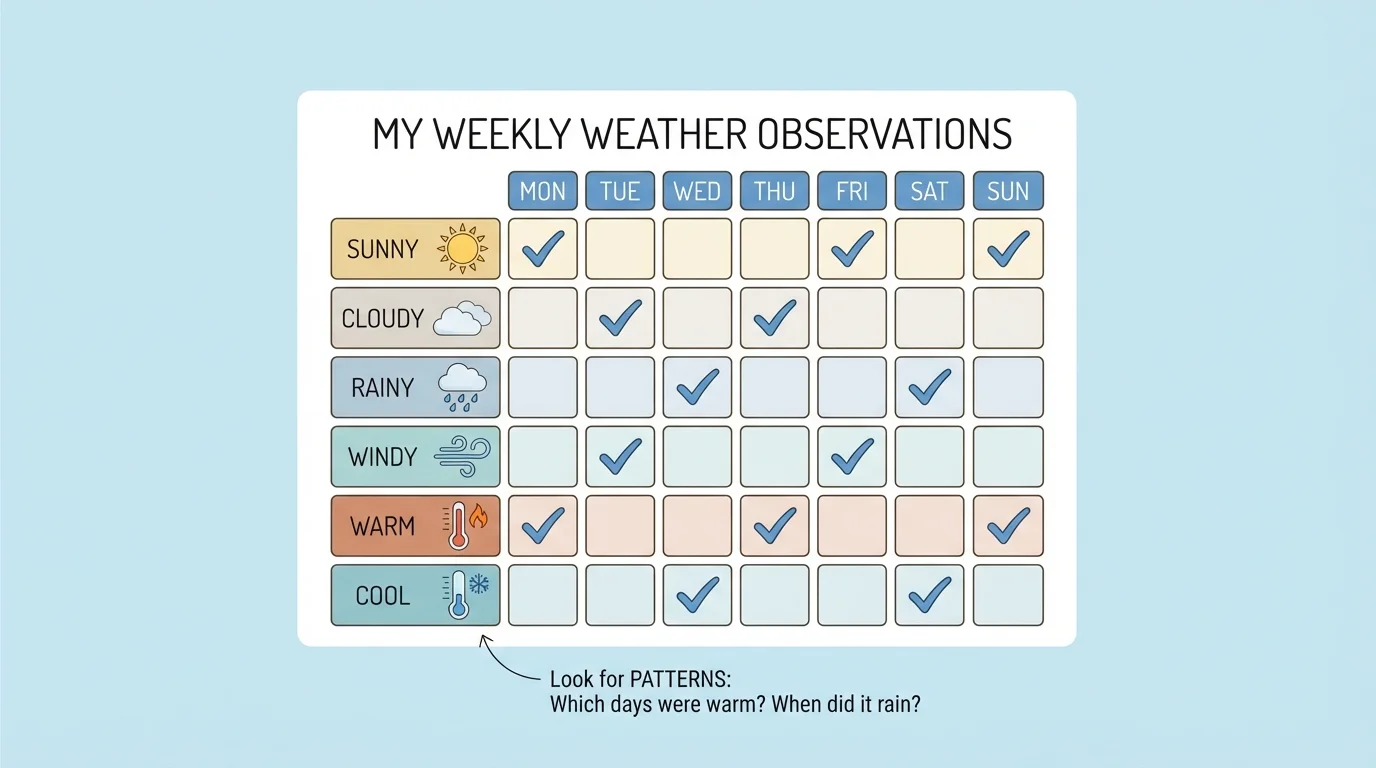
Observations can be shared in many ways. A student may draw a sun, place a rain sticker on a chart, or tell a friend, "It is windy today." When many observations are saved in one place, it becomes easier to look back and notice what happened over time.
Clouds can help tell a weather story. A clear sky often looks very different from a rainy sky, so just looking up can give useful weather clues.
[Figure 2] People sometimes use simple tools to help with weather observations. A windsock can show which way the wind blows. A rain gauge can collect rainwater, but young learners can still describe rain with simple words like "rainy" or "more rain" without needing detailed measurement. What matters most is careful noticing.
When we observe weather on many days, we can start to see a pattern in weather from several days in a row. A pattern is not just one day. It is something that happens again and again. For example, if many afternoons are sunny, that is a pattern. If rainy days happen often in one part of the year, that is also a pattern.
We can compare today with yesterday and with other days before that. Maybe Monday was rainy, Tuesday was sunny, and Wednesday was sunny again. Then we can say, "We had more sunny days than rainy days this week," using simple counting with whole numbers like \(2\) sunny days and \(1\) rainy day.
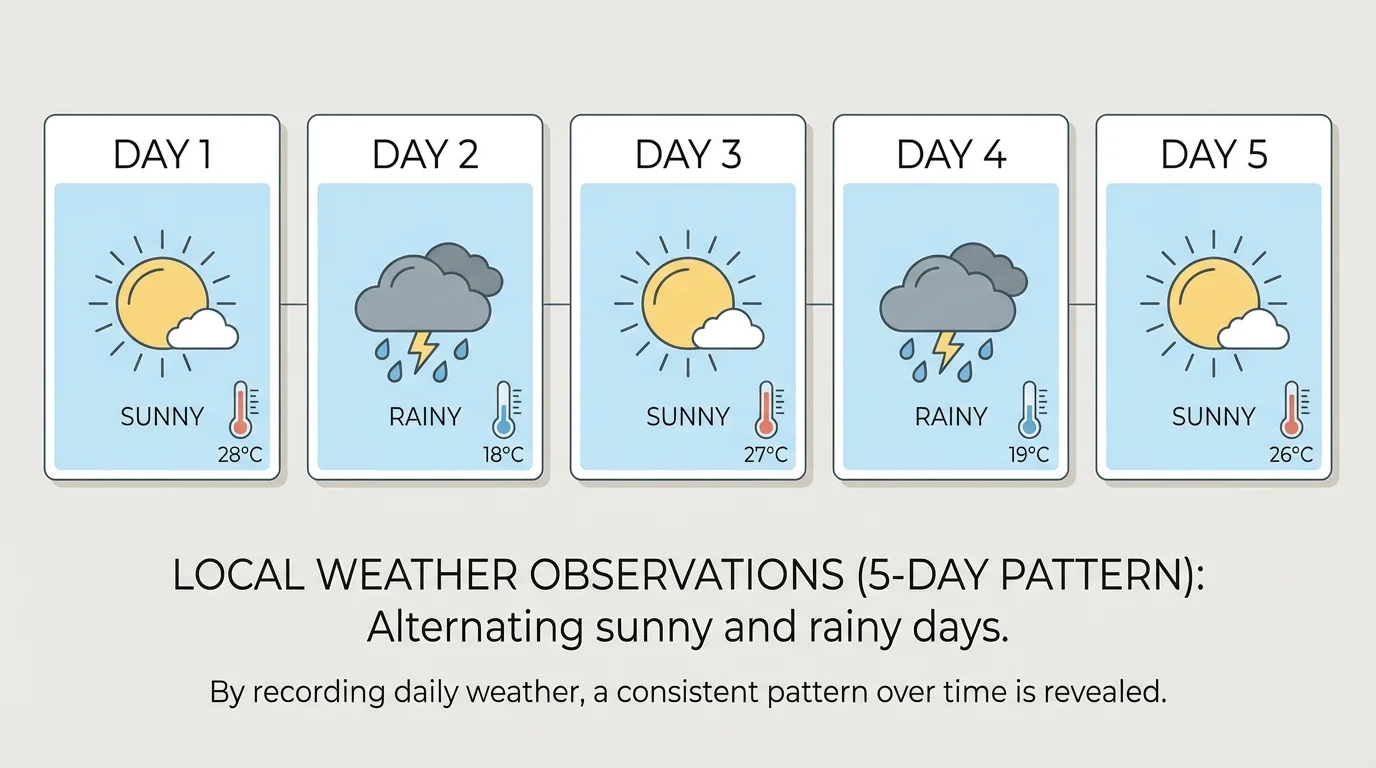
Patterns help us make sense of weather. They do not mean the weather is always the same. Instead, they help us notice what happens often. A place may have many warm days, many cool mornings, or many windy afternoons. Watching weather over time helps us learn what is common in our own area.
How weather patterns help us
When people notice the same kind of weather happening again and again, they can make good choices. A class may know to wear jackets on many cool mornings or bring boots when rainy days happen often. Patterns come from many observations, not just one.
Looking back at a weather chart also helps us talk with others. We can say, "I noticed three sunny days," written as \(3\) sunny days, or "Today is cooler than yesterday." These are useful ways to share observations without using complicated measurements.
Scientists share what they observe, and children can do that too. A weather observation can be shared by speaking, drawing, pointing to a picture, or adding to a class chart. The goal is to help other people understand what was noticed outside.
When we share weather information, we use clear words. We might say, "The sky was cloudy this morning," or "The wind moved the leaves." We can also tell how weather changed: "It was rainy before lunch, but sunny later." Sharing makes everyone in the class part of the weather story.
Real-world example: a class weather report
Step 1: The class looks outside in the morning.
They notice gray clouds and moving tree branches.
Step 2: The class uses weather words.
They say the day is cloudy and windy.
Step 3: The class adds the observation to a chart.
Later, they can compare this day with other days and look for a pattern.
Sharing observations helps everyone learn from the same information.
[Figure 3] As students get used to sharing observations, they become better at noticing details. One student may see dark clouds, another may hear rain on the roof, and another may notice that the air feels cooler. Putting these observations together gives a fuller picture of the weather.
Weather affects people, plants, and animals every day in different outdoor conditions. On a cool day, people may wear a coat. On a rainy day, they may use boots or an umbrella. On a warm sunny day, plants may need water, and animals may look for shade.
Local weather also affects what we do. A playground may be busy on a sunny day and empty during heavy rain. Birds may hide when the weather is stormy and return when it is calm. These changes help us see that weather matters to all living things.
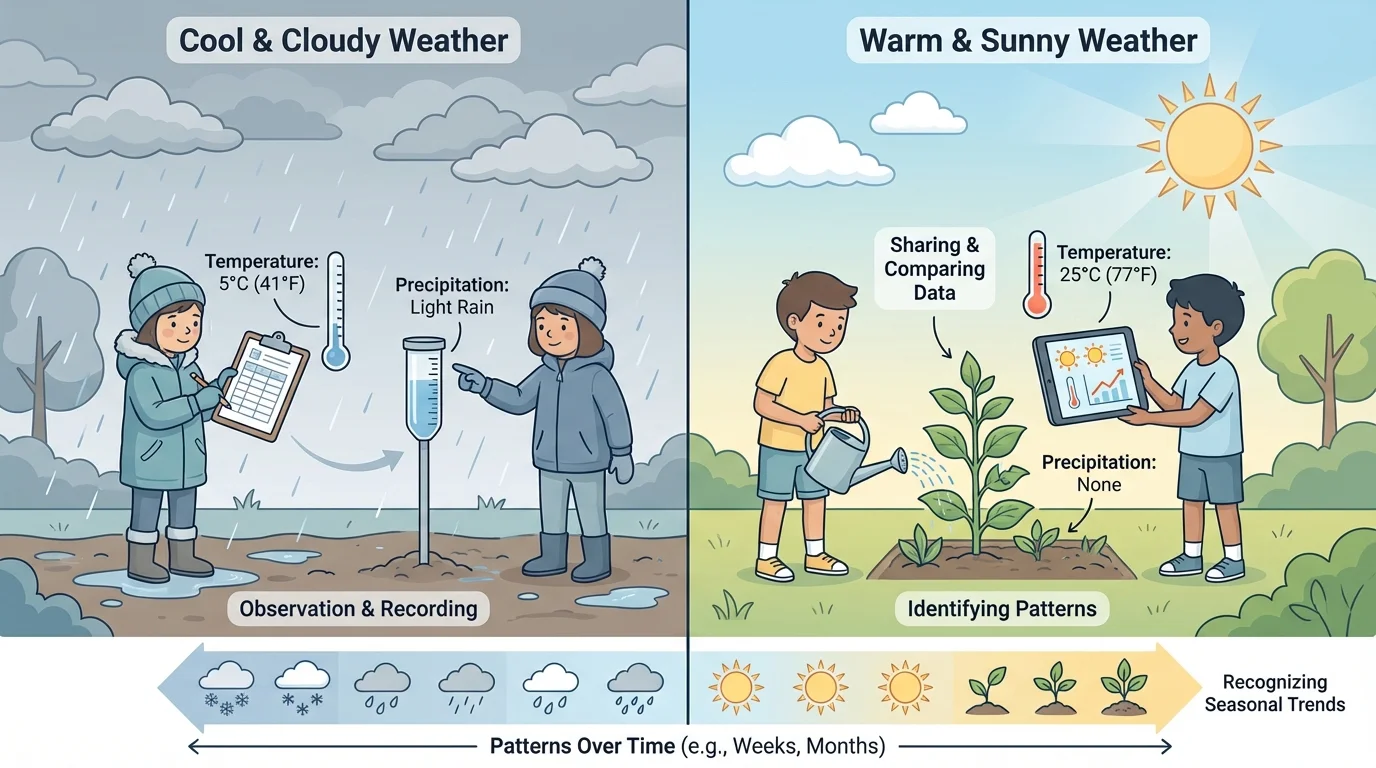
Humans also affect the environment around them. When people throw trash on the ground, water can become dirty after rain washes the trash away. When people care for plants, make clean spaces, and protect habitats, they help living things. Weather and living things are connected, and our actions matter too.
Living things need air, water, and safe places to live. Weather can change how easy or hard it is for plants and animals to get what they need.
Later, when we think again about repeated weather, we can connect it to life outdoors. For example, many sunny days in a row may dry the soil, while many rainy days help fill puddles and water plants. The clothing choices and plant care seen in the earlier illustration connect directly to these weather patterns.
Over a longer time, local weather often follows broader patterns called seasons. In some places, one part of the year has many warm days. Another part of the year may have many cooler days. Children do not need to know every detail to notice that weather in one month may be different from weather in another month.
Seasonal patterns help explain why the weather chart from earlier can change over time. The repeated sunny and rainy symbols in [Figure 2] show short-term patterns across a few days, and over many more days those patterns can connect to a season. This helps us understand that weather can be observed for both short and long times.
By observing, recording, and sharing what we notice, we learn that weather is not random to our eyes. We can describe it with simple words, compare days, count whole numbers of weather days, and notice what happens again and again in our own community.
