Have you ever pushed a toy car just a little and then pushed it a lot? The same car can move in two very different ways. A little push makes a small change. A big push makes a big change. That is an important science idea: stronger pushes and pulls can change motion more.
All around us, things move. A ball rolls. A swing goes back and forth. A stroller moves when someone pushes it. A door opens when someone pulls it. When something starts moving, stops moving, goes faster, or goes slower, a push or pull is often the reason.
We can feel this with our own bodies too. If you gently push a box, it may move slowly. If you push harder, it may move faster. If you pull a wagon softly, it moves a little. If you pull it strongly, it moves more quickly.
Force is a push or a pull.
Motion is movement.
Energy is what helps things happen, including causing objects to move.
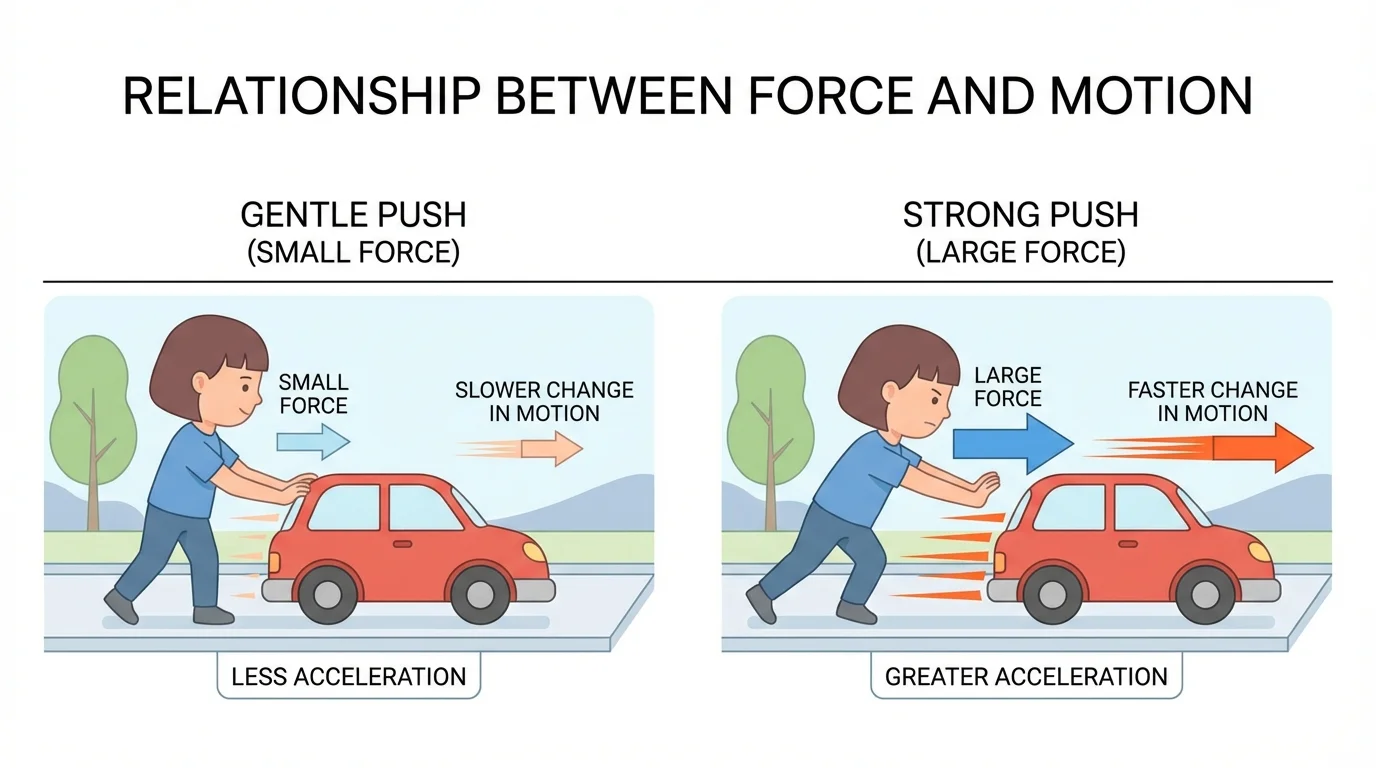
These words help us talk like scientists. We do not need big complicated ideas yet. We only need to notice that forces change motion, and bigger forces make bigger changes, as [Figure 1] will show.
A force can start something moving, stop it, or change how fast it moves. A toy car changes its motion more when the push is bigger. The stronger push makes the car go faster.
If something is already moving, a force can change that motion too. A hand can stop a rolling ball. A foot can kick the ball and make it go faster. A pull on a sled can make it start moving.
Sometimes a force makes something slow down. When you catch a ball, your hands pull it to a stop. When you press the brakes on a bike, the bike slows down. So forces do not only make things go faster. Forces can also make things go slower or stop.
How force changes motion
If the push or pull is small, the change in motion is small. If the push or pull is bigger, the change in motion is bigger. That is why a soft kick and a hard kick do not do the same thing to a ball.
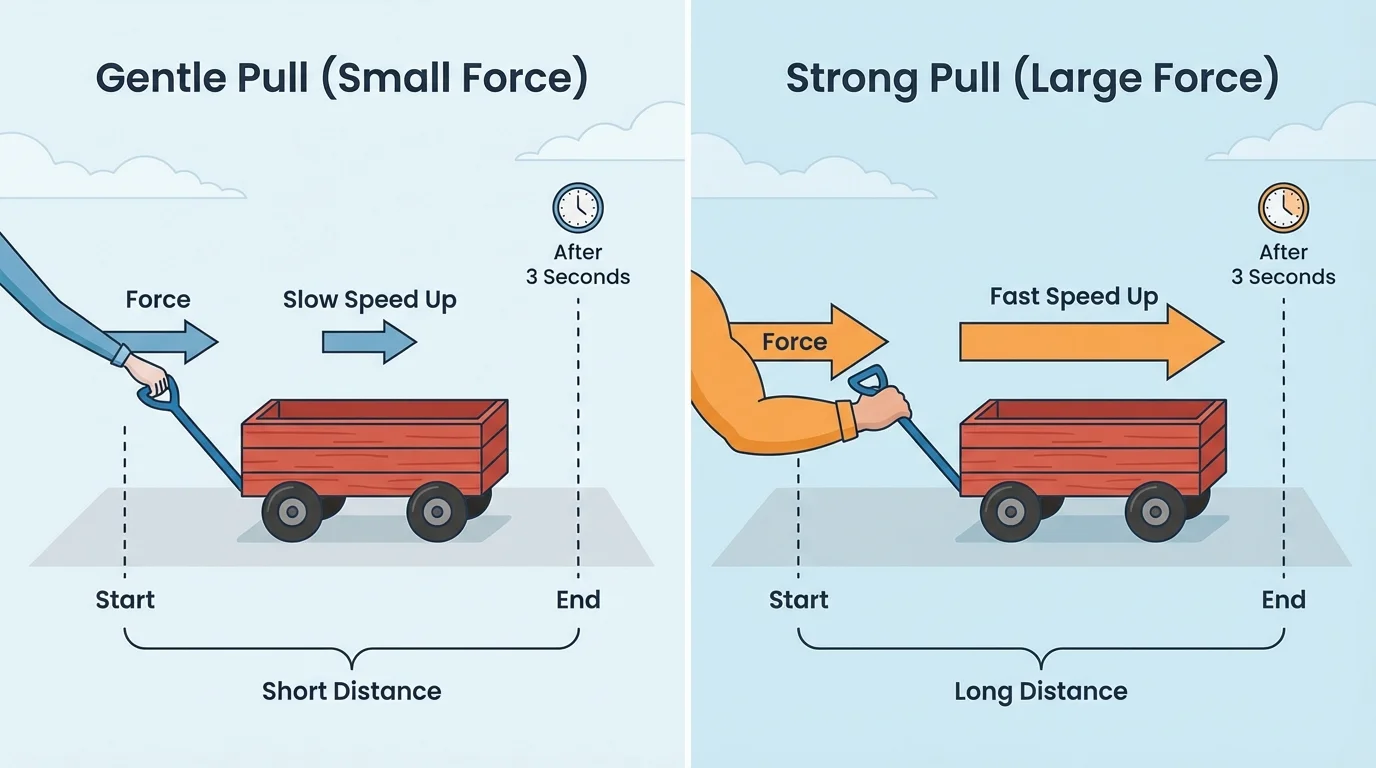
This idea helps explain many things children see every day. A light tap on a block may only slide it a tiny bit. A stronger shove can make it slide much farther, as [Figure 2] also shows with a wagon.
A stronger push or pull makes a bigger change in how something moves. When the pull is stronger, the wagon speeds up more quickly. When the pull is gentle, the wagon speeds up only a little.
Think about a swing. A small push makes the swing move a little. A bigger push makes the swing move higher and faster. The bigger push gives a bigger change to the swing's motion.
Think about slowing down too. If a rolling toy is stopped with a gentle hand, it slows gently. If it meets a stronger stopping force, it slows faster. Bigger forces can make bigger slow-downs.
The object matters too. Some things are easy to move, and some are harder to move. But for the same object, a bigger push or pull usually makes a bigger change. That is the pattern scientists want us to notice.
A rocket lifting off uses a very strong push from hot gases. That strong force helps the rocket speed up and leave the ground.
Even though rockets are huge and toy cars are small, the same science idea works in both places: stronger forces change motion more.
When something moves, it has energy called kinetic energy. A moving ball can knock over a block. A moving scooter can carry a rider forward. Movement is one way we notice energy.
A bigger push or pull can give an object more motion. When an object moves faster, it has more energy of motion. We do not need a hard formula to see this. We can just observe it. A ball rolling fast can do more than a ball rolling slowly.
Real-world example: two toy cars
Suppose one toy car gets a soft push and another gets a strong push.
Step 1: Give the first car a gentle push.
The car starts moving, but only a little.
Step 2: Give the second car a stronger push.
The car moves faster and farther.
Step 3: Compare them.
The stronger force causes the bigger change in motion.
This tells us that the stronger push gives the moving car more kinetic energy.
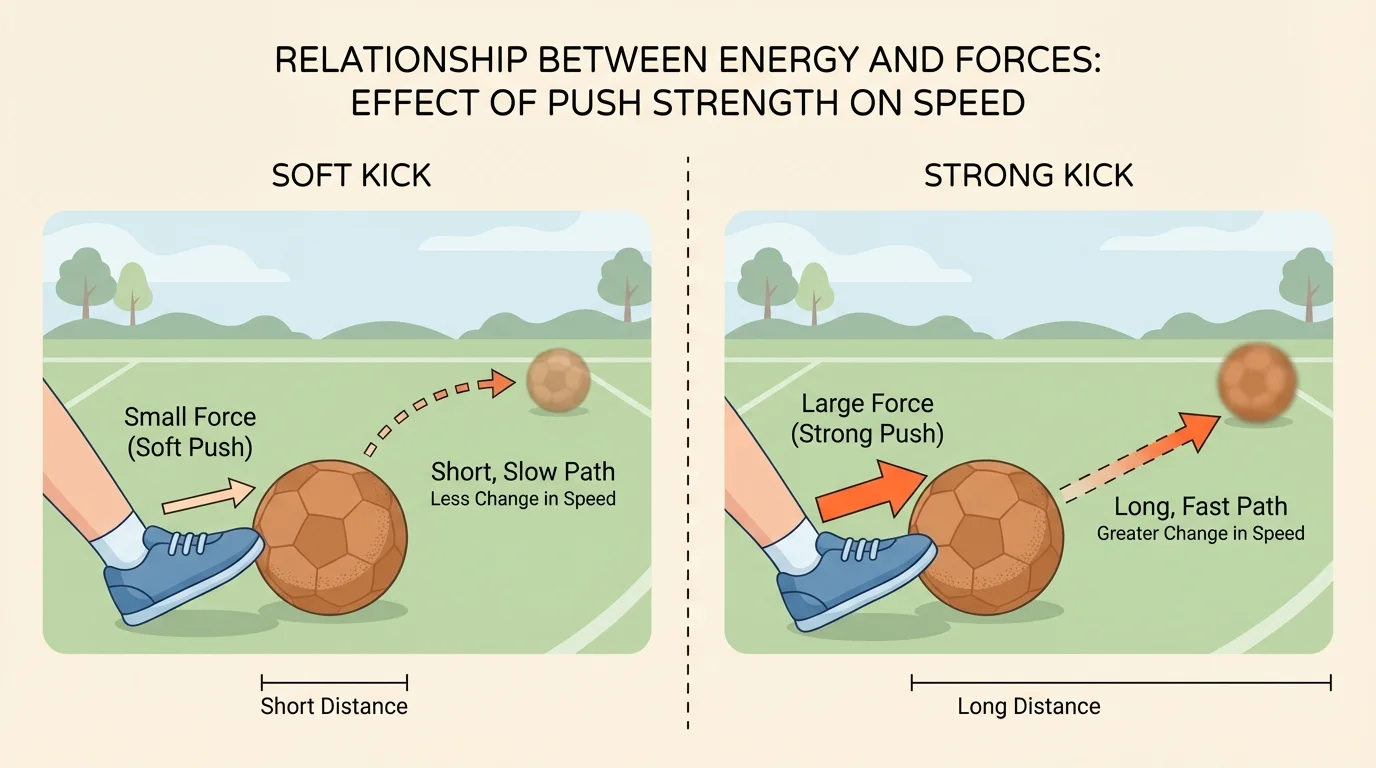
Energy and forces are connected. A force can transfer energy to an object and change its motion. That is why pushes and pulls matter so much in science, and [Figure 3] gives another clear example.
Children see this idea during play. A soft kick makes the ball move slowly or not very far. A hard kick makes the ball move faster and often farther.
When an adult pushes a shopping cart a little, it starts moving slowly. When the adult pushes harder, the cart speeds up more quickly. When someone pulls open a heavy door with more force, the door moves more quickly than with a tiny pull.
On a playground, a stronger push on a merry-go-round makes it speed up more. At home, a stronger pull on a drawer can open it faster. On the road, cars speed up when the engine provides force to the wheels, and cars slow down when brakes provide a stopping force.
We can also connect back to the toy car in [Figure 1]. The same pattern appears again and again: gentle force, gentle change; stronger force, bigger change.
You already know that objects can be still or moving. This lesson adds one more idea: pushes and pulls are what change that stillness or movement.
This science idea helps us explain so many everyday events because moving things are everywhere.
Strong forces are useful, but they must be used safely. A hard push can make a swing go high, but people need space and care. A strong kick can send a ball far, so we should watch where it goes.
Scientists and engineers think about forces all the time. They design seat belts, brakes, playgrounds, and helmets to help strong forces slow things safely. So learning about pushes, pulls, energy, and motion is not just for school. It helps keep people safe.
When you watch the wagon example from [Figure 2], you can see why care matters. A stronger pull changes motion more quickly, so people need to be ready for that bigger change.
