Have you ever picked up a rock, splashed in water, or hugged a soft blanket? Your body helps you do science. Your eyes, hands, ears, and nose help you learn about the world. When we look closely at things around us, we can notice what they are like and how they are different.
We can learn about an object by observing its property. A property is something we can notice about it. We might see its color, feel its shape, hear its sound, or notice whether it is hard or soft. We use our senses carefully and safely. We do not taste classroom objects, and we only smell things when an adult says it is safe.
Objects are things we can touch or see, like a spoon, ball, rock, or book.
Materials are what objects are made of, like wood, metal, plastic, fabric, or water.
Some objects are made from one material, and some are made from more than one. A cup may be plastic. A shoe may have fabric, rubber, and laces. When we explore materials, we learn how they look, feel, and act.
Our eyes help us notice color, size, and shape. A leaf may be green. A ball may be round. A box may have corners. Looking carefully helps us describe what we see.
Our hands help us feel texture and temperature. Something may feel bumpy, smooth, soft, hard, wet, or dry. A fuzzy toy feels different from a shiny spoon. Touch gives us lots of clues.
Our ears can help too. When we tap objects gently and safely, some sounds are loud and some are quiet. A metal pot may make a ringing sound. A pillow makes almost no sound. Smell can also help us notice some materials, like soap or an orange, when an adult says it is safe.
Your skin is your largest sense organ. It helps you feel many different textures and temperatures all day long.
Scientists observe carefully. That means they pay attention and notice details. Young children can be scientists when they use their senses to explore the world around them.
[Figure 1] A solid keeps its own shape, and a liquid flows and takes the shape of its container. A block stays block-shaped on the table. A ball stays round. A book stays flat and does not pour.
Water is different. If you pour water into a cup, it fits the cup. If you pour it into a bowl, it fits the bowl. Juice, milk, and soup are liquids too. Liquids can move and flow.
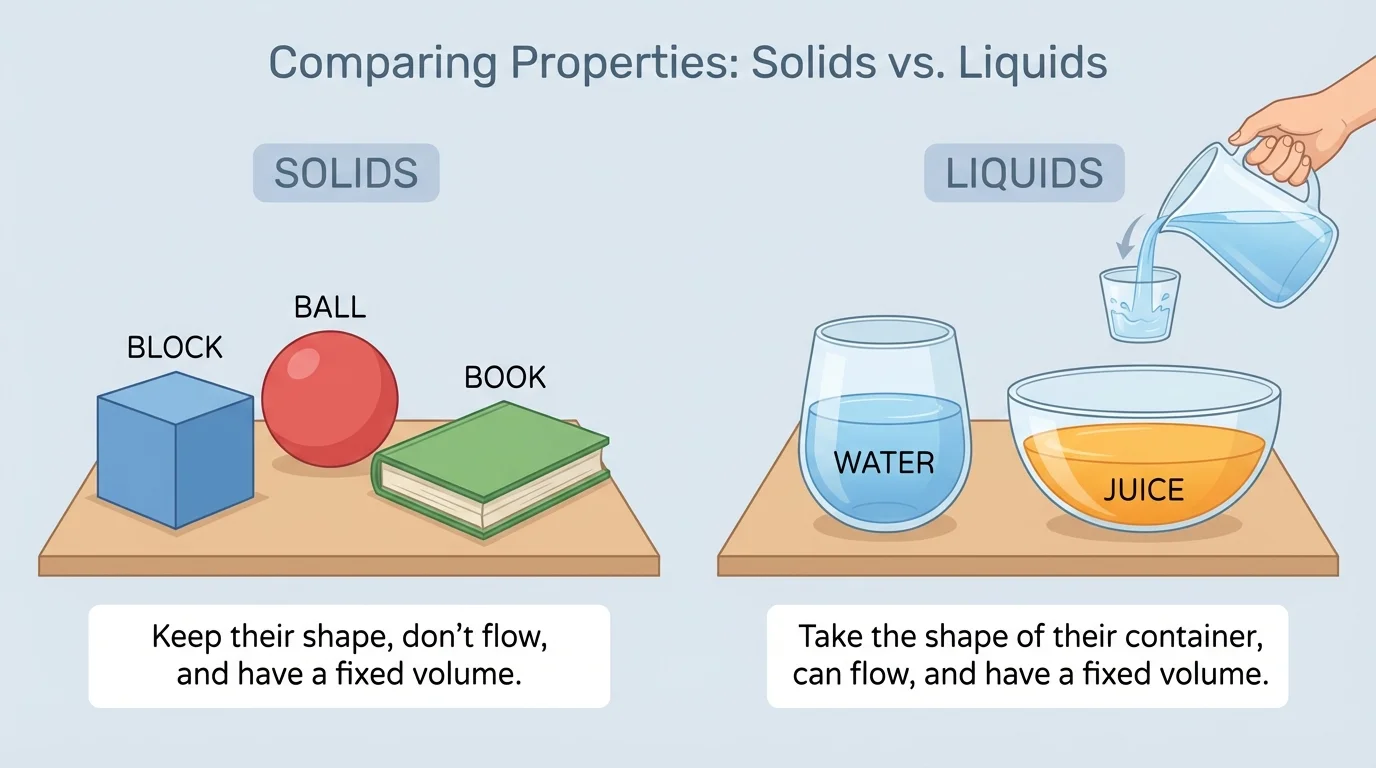
Some materials can be tricky to notice at first. Sand can be poured, but it is made of many tiny solid pieces. A spoon is solid. Honey is a liquid that moves slowly. Looking carefully helps us understand what kind of material we are exploring.
How solids and liquids behave
Solids usually stay in one piece and keep their shape when you move them. Liquids do not keep one shape by themselves. They spread, drip, or pour and need a container to hold them.
When we clean up spilled water, we see that liquids can spread across a table or floor. When we stack blocks, we see that solids can stay put. This is one way properties help us understand the world.
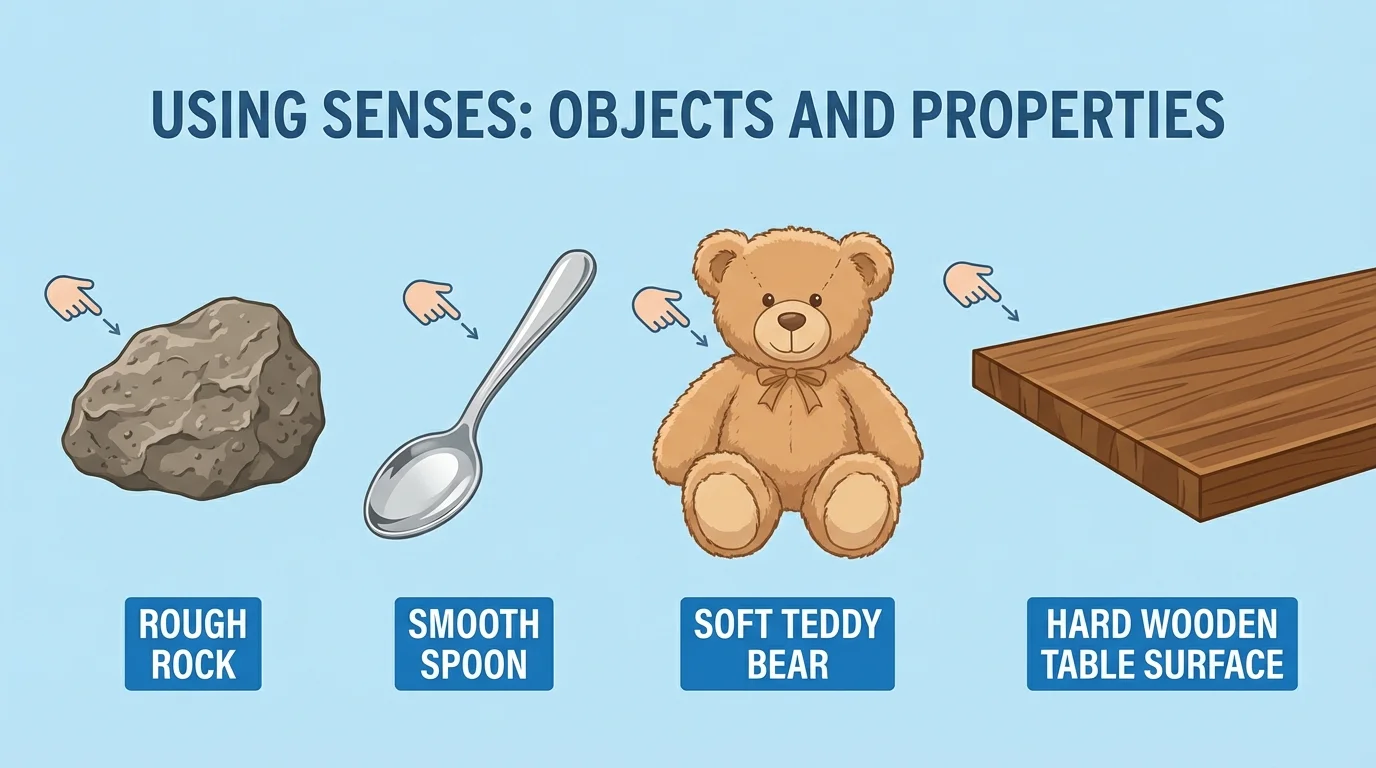
We can use special science words to describe materials, as [Figure 2] illustrates with textures and surfaces. A rock may feel rough. A spoon may feel smooth. A teddy bear may feel soft. A table may feel hard.
We can also notice if something is shiny or dull. Foil often looks shiny because it reflects light. A piece of paper may look dull. Some things are bendy, like a rubber band, while others are stiff, like a wooden ruler.
Some materials soak up water, and some do not. A sponge can absorb water. A rain boot does not let water pass through easily. This is why boots help keep feet dry on rainy days.
We may also compare weight in simple ways. One object may feel heavier and another may feel lighter. A big pillow may feel light, while a small rock may feel heavy. We do not need numbers to notice that some objects are easier or harder to lift.
Later, when we think again about texture and feel, the rough rock and smooth spoon in [Figure 2] remind us that our hands can help us tell materials apart even when objects are similar in size.
| Object | Material | Property Words |
|---|---|---|
| Rock | Rock | Hard, rough, heavy |
| Spoon | Metal | Smooth, hard, shiny |
| Blanket | Fabric | Soft, warm |
| Water | Liquid water | Wet, flows, clear |
| Sponge | Soft material | Soft, squishy, absorbent |
Table 1. Examples of everyday objects, what they are made from, and words that describe their properties.
Wood, metal, plastic, fabric, glass, and water are all common materials. They do not behave the same way. Wood can be strong. Metal can be hard and shiny. Fabric can be soft and flexible. Glass can be smooth and clear.
A toy car made of plastic feels different from a scarf made of fabric. A drinking glass is solid even though you can see through it. Water may look clear too, but it is a liquid and pours. Seeing one property is helpful, but noticing many properties gives us a better idea of what a material is like.
Real-world example: A cup and water
Step 1: Look at the cup. It is solid. It keeps its shape.
Step 2: Look at the water. It is a liquid. It flows into the cup.
Step 3: Notice why they work together. The solid cup holds the liquid water.
The properties of each material help them do a job.
We can compare objects by asking simple questions. Does it pour? Does it feel soft? Is it smooth? Is it clear? Does it soak up water? These questions help us sort and describe the things we find.
[Figure 3] Properties help us choose the best material for a job. A raincoat should help keep water out. A window should be clear so we can see through it. A sponge should soak up spills. A cooking pot should be strong and hold hot food safely.
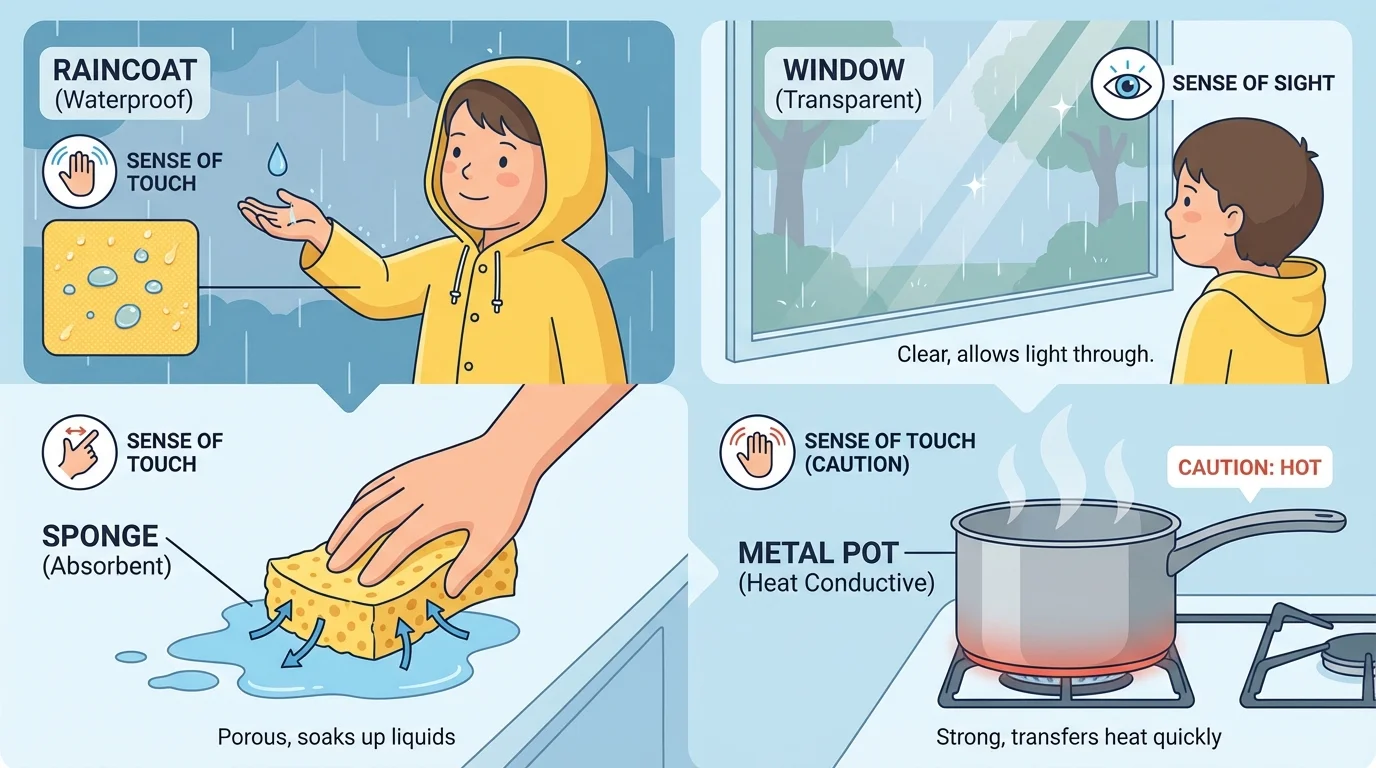
At home and at school, people use properties all the time. We sit on chairs that are firm and strong. We wear soft clothes. We drink from cups that can hold liquids. We wipe hands with towels that absorb water.
When we think back to solids and liquids, the objects in [Figure 1] help us remember why a bottle can carry juice but a toy block cannot hold it. The material and its properties make a big difference.
Good observers use words to tell what they notice. Saying "The spoon is smooth and hard" gives more science information than saying only "I like it."
Using our senses helps us ask questions and notice patterns. That is part of science. We learn not just the names of objects, but also what they are like and what they can do.
